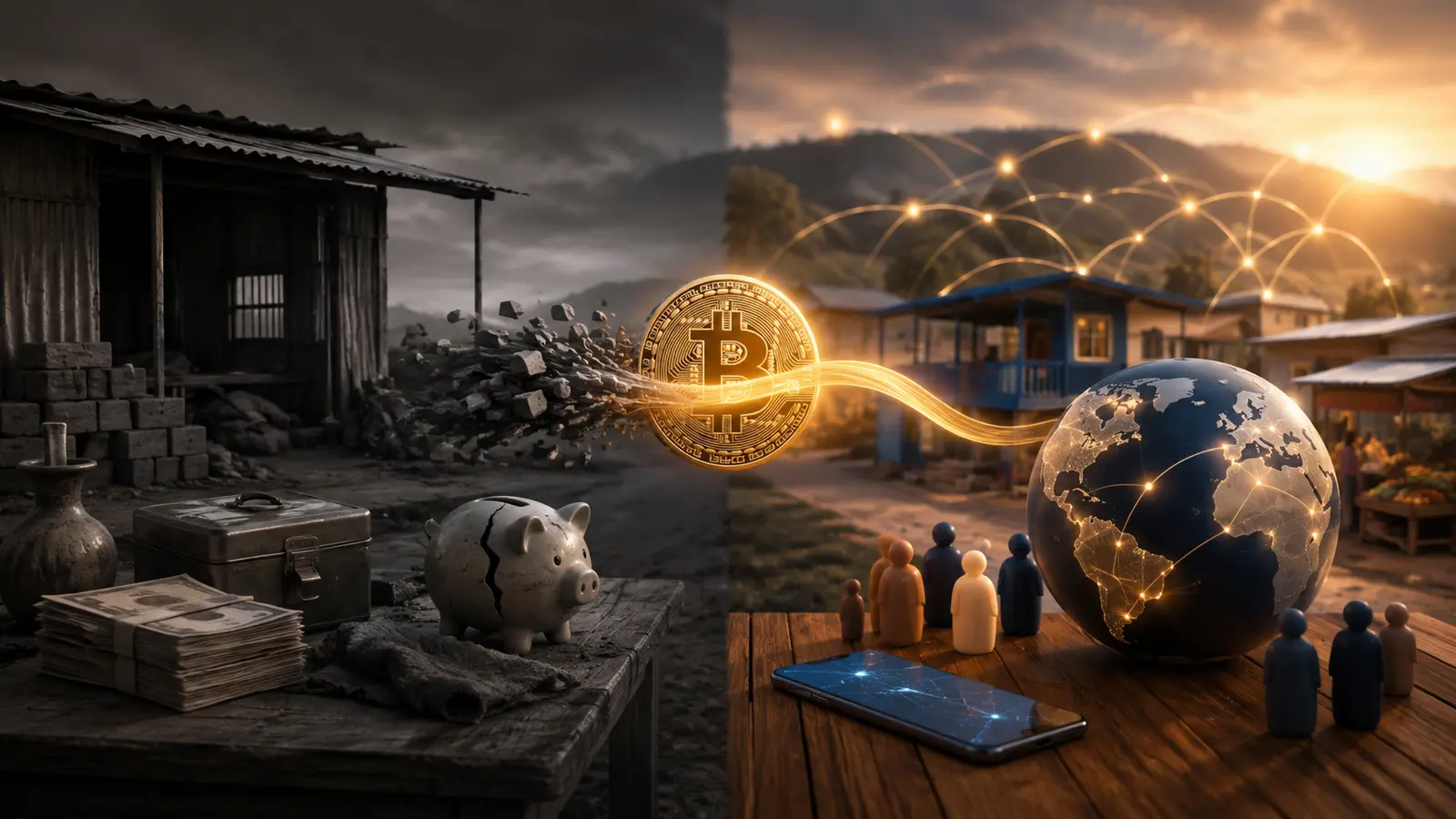
Bitcoin can offer an additional route for saving or transferring value where existing services are expensive or unreliable. Whether that route helps depends on local conditions: access to cash, conversion costs, connectivity, regulation, and tolerance for price changes. Broad regional narratives miss those details, and crypto use should not automatically be described as Bitcoin use.
The Hidden Privilege of Stable Money
Having a stable currency is one of those privileges you don't even notice until you lose it. If you live in a place where money mostly holds its value, you probably don't spend much time stressing about it. Your paycheck clears, you pay rent, your groceries cost about the same as they did last month, and the money sitting in your checking account will still act like money next week.
But for billions of people around the world, that kind of financial predictability isn't the norm. It's an absolute luxury.
In countries dealing with hyperinflation or constant currency crises, money stops feeling like a safe way to store value. Instead, it feels like an ice cube melting in your hand. A paycheck isn’t just your income; it’s a ticking clock. Families have to rush out and immediately convert their cash into groceries, fuel, building materials, foreign currency—anything that won't lose value as fast as the paper bills in their wallets. Leaving your savings in the local currency isn't just irrational; it’s financially dangerous. The longer you hold onto it, the less it buys.
Living like this completely messes with your psychology. You can't plan your life in years; you have to plan in pay cycles. Whether it's a mother worrying about next month's school fees, a shopkeeper trying to price their inventory, or a driver saving up for car repairs, they're all fighting the same invisible pressure: you have to do something with your money before your money does something to you.
Even when banking is an option, it doesn’t always fix things. Traditional banks often demand mountains of paperwork, minimum balances, proof of formal employment, or physical proximity to a branch. Those hoops might sound perfectly normal in a wealthy country, but they completely shut out large chunks of the global population. Rural workers, street vendors, refugees, young people, and anyone working outside the formal economy are often left totally unbanked.
This is exactly where Bitcoin steps in with a completely different set of rules. It doesn’t run a credit check on you. It doesn’t care if you have a local branch, and it doesn't close on weekends. As long as you have a phone and an internet connection, you can hold it, send it, and receive it. Now, that doesn’t mean it’s perfectly simple or entirely risk-free. But it is fundamentally different from the restrictive systems so many people have been trapped in.
If you already have a great bank account, Bitcoin might just look like an interesting alternative. But if you're locked out of the system, it looks like an open door.
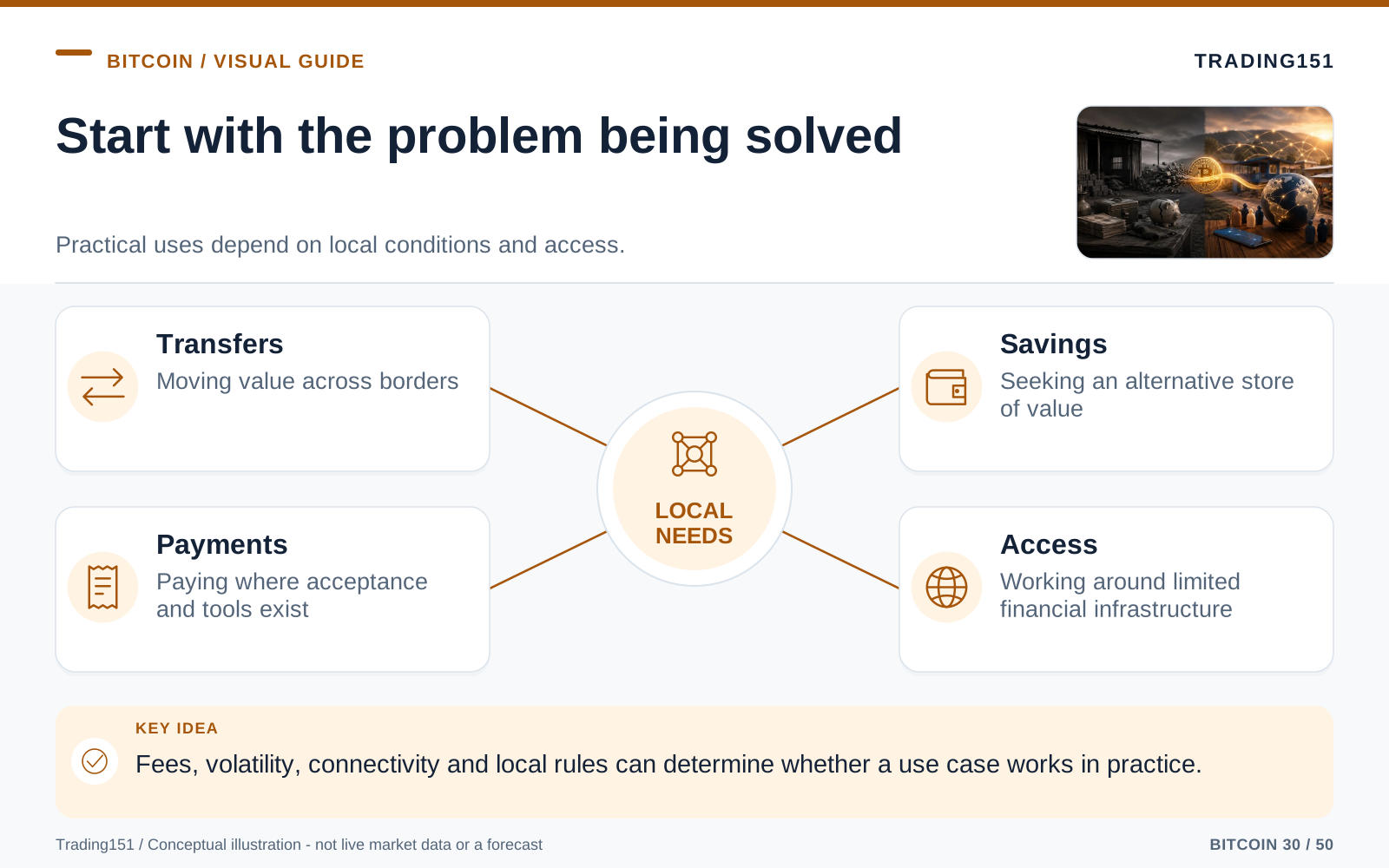
Read this diagram as text
- Transfers
- Moving value across borders
- Savings
- Seeking an alternative store of value
- Payments
- Paying where acceptance and tools exist
- Access
- Working around limited financial infrastructure
What Adoption Looks Like on the Ground
A lot of people talk about Bitcoin adoption in developing nations as if it’s this unified, ideological movement. The reality is way messier, hyper-local, and practical. People aren’t jumping on the bandwagon because they read the original white paper or want to smash the state. They just want to know if their money will arrive, if they can spend it, if they can save it, and if anyone can arbitrarily block their account. Adoption doesn't look like a whole country suddenly ditching its currency for crypto. It looks like a freelancer accepting a partial payment in BTC, a family keeping an emergency digital stash, or a merchant using a payment processor that instantly flips crypto into local cash. People are adopting whatever pieces of the network solve their immediate problems today, rather than buying into a sweeping ideology. The result is this deeply improvised, messy landscape that tells us a lot more than just looking at a chart of wallet downloads.
In one town, Bitcoin might be the only way a migrant worker can send money home. In another, it’s a lifeline for a small online business trying to accept international payments. Somewhere else, it’s just a temporary stepping stone to get into dollar-backed stablecoins. For people living under strict capital controls, it acts like a pressure release valve. In places where the banks are corrupt, it functions as a private vault. And during protests, it frequently becomes a way to accept donations that the government can't shut down.
This variety is super important. We get so caught up in extreme narratives—"Bitcoin will fix everything!" or "It's a total scam!"—that we miss the nuance. The real-world experience is complicated. Bitcoin can be powerful, but also clunky and difficult. It might solve your cross-border payment issue but introduce a new problem with price volatility. It gives people real options, but it definitely doesn't guarantee a perfect outcome.
And that’s exactly why we need to pay attention to what's happening in the developing world. It takes Bitcoin out of the realm of abstract theory and puts it directly into the hands of real people trying to navigate hard choices with very limited options.
The Nightmare of Global Remittances
If you want to understand why Bitcoin appeals to people, just look at remittances. Sending money across borders is a nightmare, and the "last mile" of that transfer is what really matters. Even if the crypto part is cheap, the person receiving the funds still needs a phone, decent internet, a secure wallet, and a way to spend the money or turn it into cash. Bad exchange rates, greedy local agents, and strict banking laws can easily wipe out whatever money was saved by using crypto. Bitcoin fixes the slow, expensive international leg of the journey, but it can't magically build good local infrastructure. The best remittance setups are the ones where the tech fades into the background, and families just see exactly how much cash they're getting.
Every year, migrant workers send staggering amounts of money back home. We aren't talking about abstract numbers on an economics chart here. This is rent money. It’s school uniforms, life-saving medicine, groceries, and emergency funds for when a family member gets sick. For millions of households, these remittances are quite the only thing standing between stability and total ruin.
Despite how important they are, the traditional ways of sending this money are painfully slow, inconvenient, and shockingly expensive. A worker might pay a large fee just to send fifty bucks. On top of that, the exchange rate is usually rigged to hide even more fees. And it gets worse on the receiving end: family members often have to travel miles to a sketchy cash pickup spot, wait in line for hours, present ID they might not have, and then walk home with a wad of physical cash. If you live somewhere with high crime rates, just going to pick up your money can make you a target.
Think about a construction worker in Texas trying to send $200 back to his mom in El Salvador. A $15 or $20 fee might not sound like a huge deal to someone with a comfortable salary, but to the family getting that money, twenty bucks could be several days' worth of meals, a crucial pharmacy run, or bus fare for the entire week. That fee isn't just a number—it’s taking food straight off the table.
Bitcoin, especially when you use fast layers like the Lightning Network, offers a totally different reality. You can zap money from one phone to another almost instantly, for pennies. The mom in El Salvador doesn’t have to wait for a bank branch to open. The son in Texas doesn’t have to give a cut to Western Union. They can do it on a Sunday night, on a public holiday, or the second an emergency happens.
Obviously, there are still real-world hurdles. Can the mom spend the Bitcoin at her local market? Does she have to figure out how to swap it for local cash? Is the wallet app confusing? What happens if the price of Bitcoin drops overnight? These are large questions. But even with those headaches, you can see why people are drawn to it. A system that lets a worker keep their hard-earned money and give it to their family isn't some quirky tech experiment. It's a life-changing improvement.
Nigeria: The Power of Peer-to-Peer
If you want to see what grass-roots, ground-up Bitcoin adoption looks like, look at Nigeria. It’s got this young, tech-savvy, hustling population that is completely fed up with crazy inflation, strict capital controls, and banks that barely work. For a lot of Nigerians, Bitcoin isn't a political statement or a meme. It’s straight-up infrastructure.
When the Nigerian government started making it difficult to use formal crypto services through the banking system, people didn't just throw up their hands and quit. They just adapted. Millions moved over to peer-to-peer (P2P) trading, buying and selling crypto directly with each other via WhatsApp or Telegram. It’s one of the greatest lessons Nigeria has taught the world: when people need something, banning official channels doesn't stop the behavior. It just pushes it underground into informal networks.
We also saw Bitcoin step up in a huge way during the #EndSARS protests, when young Nigerians took to the streets to fight police brutality. The government didn't just push back physically; they pushed back financially, freezing the bank accounts of people trying to support the protests. That’s when Bitcoin donations flooded in. Because crypto operates outside the banking system, the government couldn’t stop people from funding food, water, and medical aid for the protesters.
What happened there was bigger than just one protest movement. It proved exactly why we need money that can't be censored, especially in places where the government weaponizes the banking system. When a payment network can’t just be switched off by a politician, it stops being just a neat piece of tech and becomes a tool for civic survival.
Beyond protests, crypto is also quietly helping Nigerian graphic designers, coders, writers, and small business owners tap into the global economy. If a young freelancer in Lagos lands a gig with a client in London or Dubai, they really don't want to wait a week for a wire transfer, lose 10% to middlemen, or fight with a local bank that treats receiving foreign money like a crime. Digital money just gives them a way out.
This isn't some fairy tale where tech swoops in to save the day. It’s just regular people finding whatever tools they can to bridge the large gaps in their everyday reality.
The El Salvador Experiment
While Nigeria is the perfect example of bottom-up adoption, El Salvador shows us exactly what happens when you try to force it from the top down. Back in 2021, they became the first country in the world to make Bitcoin legal tender. Almost overnight, the entire nation became a large, highly scrutinized test case.
Interestingly, the story started way before the national law, in a small surfing town called El Zonte. Someone made an anonymous donation of Bitcoin to the town on the condition that they use it locally, rather than just cashing it out. That project became known as "Bitcoin Beach." Locals started buying groceries, paying for haircuts, and funding community projects with tiny fractions of Bitcoin. In a town where most people didn't have bank accounts, it proved that if you make the tech simple enough, people will use it in their daily lives.
The national rollout, on the other hand, was way bigger and way more chaotic. The government rushed out a state-backed wallet app, aggressively pushed Bitcoin payments, and promised it would lower remittance fees, bring in foreign investment, and finally bank the unbanked. Die-hard crypto fans cheered it on as a visionary move to upgrade the country's financial infrastructure. Skeptics saw it as an reckless gamble with a highly volatile asset, pushed onto citizens before they even understood how to use it.
Both sides have a point. The rollout was plagued with buggy apps, widespread confusion, deep skepticism, and uneven usage. A huge chunk of the country just kept using cash and dollars, especially for groceries and everyday stuff. Passing a law might make Bitcoin official, but it definitely doesn't make people magically comfortable using it. Trust takes time, and you have to earn it transaction by transaction.
Even with all the stumbles, El Salvador fundamentally shifted the global conversation. It forced politicians, Wall Street, and everyday folks to realize that a country could use crypto for more than just speculative trading. They're using it for national branding, driving tourism, and experimenting with financial inclusion. Whether you think the whole thing is genius or a total disaster, it’s undeniably the most important real-world stress test Bitcoin has ever faced.
Argentina, Lebanon, and the Desperate Search for an Exit
In places where the local money feels like a bad joke, Bitcoin rarely exists in a vacuum. Instead, it becomes part of a broader survival strategy. People are desperately hunting for US dollars, real estate, foreign bank accounts, stablecoins—anything to shield themselves from the next inevitable currency crash. Bitcoin just becomes one of many life rafts.
Argentina is a severe, fascinating example. Thanks to decades of economic chaos, everyday Argentines have a Ph.D.-level understanding of how currency works. When inflation rises sharply and the government makes it illegal to buy foreign cash, normal people get savvy. They know the official exchange rate is a fiction compared to the black market rate. They know exactly why a physical dollar bill is infinitely safer than pesos sitting in a bank. They've learned the hard way that government promises about the economy are usually completely empty.
For a lot of Argentines, Bitcoin is a way to quietly step outside that broken system. You don't need a bank to buy it, you can hide it on your phone, you can move it across borders without asking permission, and you can sell it when you need to eat. Sure, it’s volatile as hell. The price can tank in an hour. But when your own government's money is guaranteed to lose value, you start weighing the risk of crypto against the concerning reality of being trapped in pesos.
Lebanon’s story is arguably even more heartbreaking. A few years ago, the banking sector completely melted down. People woke up to find they couldn't withdraw their own life savings. It wasn't just a loss of trust; it was a total betrayal. People who played by the rules and saved their money responsibly watched helplessly as their accounts were frozen, rationed out in tiny drips, or totally destroyed by hyperinflation.
In the middle of that nightmare, informal crypto markets exploded. People started relying on local traders, WhatsApp groups, underground mining rigs, and their own personal networks just to get their hands on digital assets so they could survive. They weren't trying to ride a trendy tech wave. They were just desperately clawing back some control after the banks robbed them.
This is the gritty, uncomfortable truth about why Bitcoin catches on. It thrives precisely where institutions fail. The more corrupt your banks are, the more holding your own digital money makes sense. The faster your currency collapses, the less you care about Bitcoin’s crazy price swings. When the government builds a wall around your finances, permissionless money becomes priceless.
The Borderless Paycheck
We talk a lot about inflation and remittances, but getting paid for your work is arguably just as large. The internet means you can sell your skills to anyone on earth, but our payment rails are still stuck in the 1990s. An illustrator in Manila, a programmer in Buenos Aires, or a translator in Beirut can find a client in New York in five minutes—but getting the cash in their hands can take weeks.
Using traditional banks for international wires is slow, agonizing, and expensive. Platforms like PayPal or Stripe straight-up refuse to operate in dozens of countries. When they do, they routinely freeze accounts over "suspicious activity," demand ridiculous paperwork that freelancers just don't have, or hit them with fees that completely eat their margins. For people just trying to hustle online, getting paid is often more stressful than doing the actual work.
Bitcoin totally flips the script. A client hits send, and the worker gets the money directly. No merchant account needed, no foreign bank hoops to jump through, and no payment processor randomly holding the funds for 180 days. They can keep it in Bitcoin, immediately swap it for local cash, or flip it into a stablecoin pegged to the dollar. It doesn't matter if they don't hold the Bitcoin forever—the point is that Bitcoin was the bridge that let them get paid.
Small business owners are doing the same math. A coffee shop that takes digital payments can cater to tourists who don't have local cash, bypass absurd credit card fees, and tap into a whole new demographic. In cities with big crypto scenes, putting up a "Bitcoin Accepted Here" sticker brings in foot traffic. Now, most of these shopkeepers aren't trying to become blockchain experts. They just want money that settles instantly and doesn't bleed them dry in hidden fees.
The Complicated Reality of Stablecoins
You honestly can't talk about Bitcoin in the developing world without bringing up stablecoins. The reality on the ground is that a lot of people who rely on crypto aren’t holding Bitcoin for their daily expenses. They usually gravitate towards digital dollars like USDT or USDC, because they're specifically designed to mirror the value of the US dollar.
And that makes perfect sense. If you’re holding next month’s rent, your grocery budget, or the cash to restock your store, Bitcoin’s insane volatility is concerning. A 20% price drop might be a fun buying opportunity for a wealthy investor in the US, but it’s catastrophic for a family living paycheck to paycheck. When you have zero margin for error, a digital dollar just feels vastly safer.
So, where does that leave Bitcoin? Well, it’s still the gateway drug that introduced the world to the concept of permissionless, digital money. It’s still the most famous, battle-tested network out there. And it’s still the go-to long-term savings account for people who trust its decentralized code over their own central banks. But people on the ground are completely pragmatic. They use whatever gets the job done. Sometimes they need Bitcoin. Sometimes they need a lightning-fast stablecoin. Sometimes they just need physical cash.
The real victory here isn't that everyone on earth is going to switch to one specific cryptocurrency forever. The victory is that people finally have choices they didn't have before.
The Very Real Risks We Keep Ignoring
You can make a powerful case for Bitcoin in the developing world without pretending it’s flawless. In fact, sugarcoating the risks is dangerous for the exact people who need this technology the most. Volatility is just the tip of the iceberg. People are constantly dealing with severe scams, extortionate local exchange rates, zero consumer protection laws, terrible internet connections, phone theft, and governments that ban crypto overnight. Being your own bank is great right up until you make a tiny backup mistake or get hacked. Any honest conversation about crypto adoption has to prioritize basic education, foolproof wallet interfaces, and actual customer support. "Financial sovereignty" sounds cool on Twitter, but it’s completely useless if regular people can't afford the learning curve.
Let’s start with the most obvious issue: the price. Bitcoin can shoot to the moon, but it can also violently crash. If you're a rich tech bro with a diversified portfolio, you can afford to hold through a bear market. But if you're a low-income family trying to buy groceries, you do not have that luxury. If Bitcoin is ever going to work for everyday survival, people desperately need to understand exactly when to hold it, when to cash out, and exactly how much risk they're taking.
Security is another complication. Having total control of your money is amazing, but it comes with concerning responsibility. If you lose your seed phrase, get your phone stolen, download a fake app, click a bad link, or trust the wrong "friend" to help you set up your wallet, your money is gone. Forever. Traditional banks might suck, but if someone steals your debit card, you can usually get your money back. Bitcoin has absolutely no undo button.
Then there are the scams. They are everywhere. Whenever you combine desperate people with confusing new technology, the predators show up in droves. They pitch guaranteed returns, fake cloud mining schemes, secret trading algorithms, or "miracle" investments. When you are desperately trying to outrun hyperinflation or climb out of poverty, you are vulnerable to anyone throwing you a lifeline. That’s why education isn’t just a nice-to-have. It is the only thing standing between financial empowerment and total ruin.
We also have to talk about infrastructure. Bitcoin relies on smartphones, reliable electricity, steady internet, and apps that make sense. In places where the power grid goes down every afternoon, or where mobile data costs a fortune, a purely digital currency isn't always practical. You can't buy bread with crypto if the bakery's WiFi is down.
Measure usefulness from the recipient's side
A remittance is not finished when a blockchain transaction confirms. It is finished, from the recipient's perspective, when the money can pay for the intended need. A useful comparison includes the exchange rate received, local withdrawal options, travel or waiting time, identification requirements, and the chance that the service is unavailable when needed. The cheapest network fee may not produce the best overall route.
Distinguish savings from payment preferences. Someone may use a dollar-linked stablecoin to reduce exposure to their local currency while avoiding bitcoin's price swings. Another person may hold bitcoin as a longer-term speculative asset. Both are crypto activity, but they solve different problems and carry different issuer, custody, and market risks.
Local examples should be described with care. A successful merchant community or freelancer payment route can demonstrate genuine utility without representing an entire country's behavior. Look for repeated use and the user's alternatives, not just the announcement that a service launched. Adoption supported by incentives may change when the incentives stop.
El Salvador's experience also needs dates rather than a permanent slogan. Its 2021 Bitcoin policy was followed by changes in 2025 that made private-sector acceptance voluntary and required taxes to be paid in U.S. dollars. That history illustrates why legal status, government promotion, and everyday use must be examined separately. None can safely stand in for the others.
Compare the whole remittance journey
A low on-chain fee does not necessarily mean a low-cost remittance. The sender may pay to acquire the asset, the recipient may pay to convert it, and both may face spreads or withdrawal charges. The exchange rate can move between those steps.
Compare the amount the recipient can actually spend, the time required, and the remedies available if something goes wrong. Local cash-out access may be more important than the speed of the transfer itself. A route that works well between two well-served cities may not be practical in a place where the recipient cannot reliably exchange or spend the funds. The relevant unit is the completed payment, not one inexpensive step inside it. 1, 2
Why the Global South Is the Only Story That Matters
For years, the mainstream debate around Bitcoin has been completely stuck. Critics look at the crazy prices, the ridiculous energy consumption, and the endless scams, and they write the whole thing off as a giant Ponzi scheme. Die-hard fans look at the same system and declare it the flawless future of global finance. Both sides usually base their arguments on the same perspective: a wealthy, stable, Western financial system.
But when you step outside that bubble and look at the developing world, the entire conversation changes.
In these places, Bitcoin isn't just an abstract theory being debated on a podcast. It isn't a get-rich-quick scheme, and it definitely isn't a perfect utopian solution to poverty. It is simply a tool. Like any tool, it can be used brilliantly, and it can cause serious damage.
But for millions of people, it’s a tool that does what it claims to do.
It gives them a way to hold on to the value of their labor when their own government is actively destroying it.
It gives them a way to send money home to their families without a corporation skimming 15% off the top.
It gives them a way to sell their skills to the rest of the world without asking a bank for permission to get paid.
It gives them a tiny sliver of leverage against systems that have done nothing but exploit them for decades.
These use cases aren't just a footnote in the Bitcoin story. They are the entire point of the technology. The ability to transact globally, without relying on a central authority, is completely revolutionary for people who have been historically abused or excluded by those exact authorities.
We have a very long way to go. The technology is still clunky. The user experience is often awful. The local infrastructure needs a large overhaul. And yes, a depressing number of people will still lose their shirts in scams or bad trades.
But despite all of that, something absolutely incredible has already happened. Bitcoin has fundamentally shifted what millions of people believe is possible. It’s proven that money can move freely without the traditional gatekeepers, that you can safely store value outside of a crumbling bank, and that anyone—no matter how poor or disconnected—can plug into a global economy.
In the West, using Bitcoin is a lifestyle choice. In much of the developing world, it’s a matter of survival, access, and basic human control. That doesn’t mean the system is flawless. But it does mean we need to start taking it seriously.
The price charts are going to keep bouncing around. The Twitter debates are never going to end. But miles away from all that noise—in busy street markets, cramped apartments, internet cafes, family WhatsApp groups, and small businesses—people are already using this technology for reasons that have absolutely nothing to do with the hype. They're using it because it hands them something the traditional world has always denied them: actual financial agency. And for a lot of people, that is infinitely more valuable than any viral headline.
Sources and further reading
Editorial revision: 7 October 2026. Numerical scenarios are hypothetical unless identified as historical. References support the added explanations and selected corrections; rules and product terms should be checked again before acting.