
A central bank digital currency would be a claim on a central bank in digital form. Bitcoin is a separate asset operating under a different issuance and validation system. That is a meaningful distinction, but it does not tell you every detail about privacy or spending controls. CBDC designs vary, and proposals should be judged by their actual rules rather than the most alarming or optimistic hypothetical version.
Money Is Becoming Software
Digital payments already rely heavily on software, including commercial-bank deposits and private payment services. A CBDC would change the form of the public-money claim available in a particular system; it would not mark the first appearance of digital money. Design decisions still matter: settlement, offline use, data access, eligibility, and legal remedies can differ substantially between proposals.
Some digital arrangements support automated payments or restrictions under specified rules. That does not mean all digital money carries spending conditions imposed by an issuer. Payment automation, access controls, and restrictions embedded in the monetary unit are separate features that should be examined individually.
Bitcoin and CBDCs address different design objectives. Bitcoin enables use of an asset without a single issuer controlling supply, while a CBDC is a central-bank liability denominated in an official currency. Either can involve intermediaries at the user-facing level. Whether a particular payment requires a commercial-bank account depends on the implementation.
Bitcoin asks: what if money didn't need a central authority at all?
CBDCs ask: what if the central authority issued money in a purely digital form?
Those might sound like technical, technical questions, but they lead to radically different worlds.
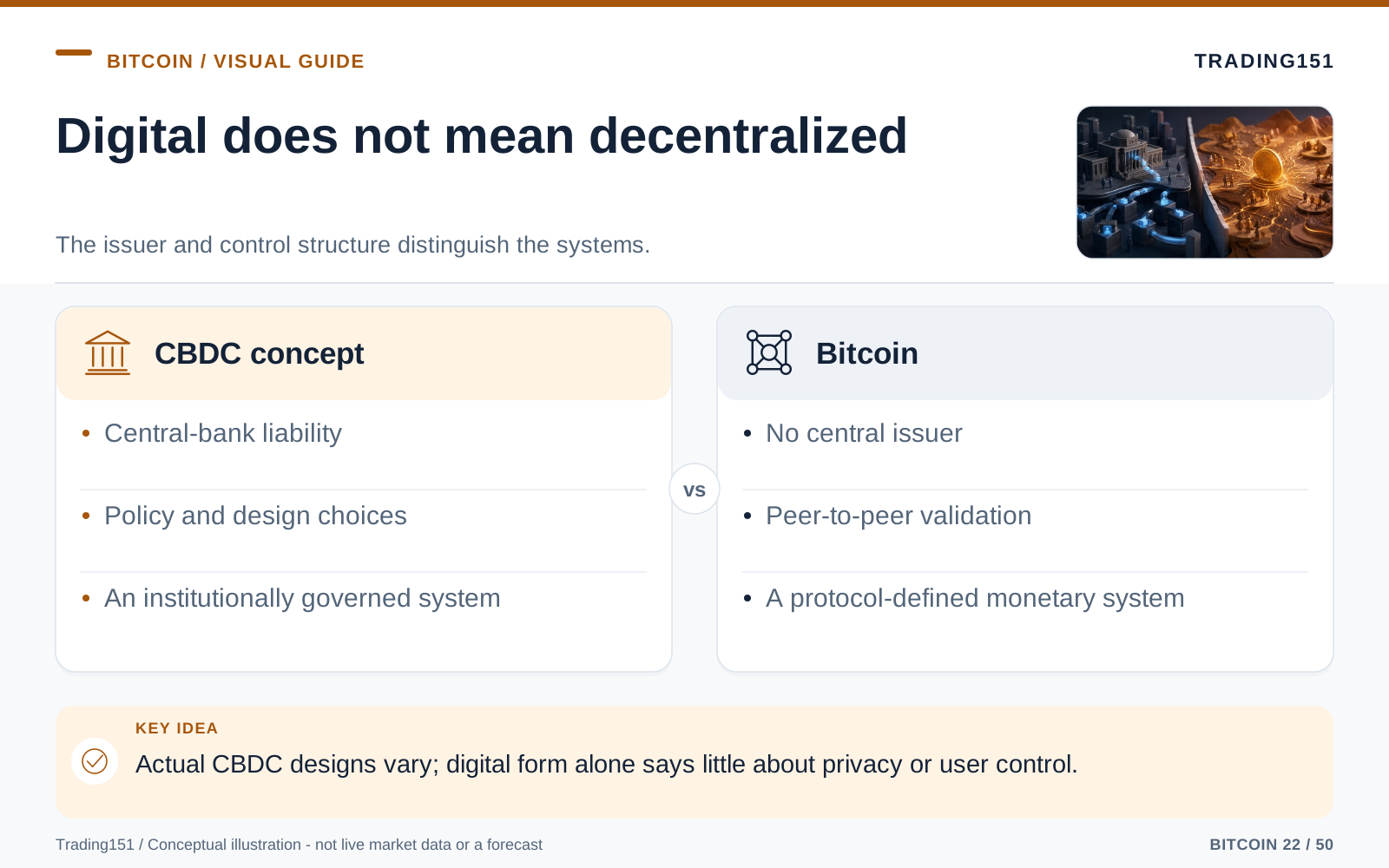
Read this diagram as text
- CBDC concept
- Central-bank liability; Policy and design choices; An institutionally governed system
- Bitcoin
- No central issuer; Peer-to-peer validation; A protocol-defined monetary system
Meet the Contenders
Before we dive into the comparison, let's break down what each of these is.
Bitcoin: The Open, Decentralized Network
Bitcoin was unleashed in 2009 by an anonymous creator (or group) going by the name Satoshi Nakamoto. The original pitch was simple: a peer-to-peer electronic cash system. It was designed to let people send value directly to one another without needing a bank, a credit card company, or a government to greenlight the transaction.
Bitcoin has no central issuer or company managing the network. Its issuance and transaction-validity rules are implemented in open-source software and enforced by participating nodes. That separates its monetary structure from a central-bank currency, but it does not eliminate reliance on wallet software, internet access, market infrastructure, or custody choices.
Nodes independently check transactions and blocks using the rules of the software they run. They do not vote one computer at a time on each transaction, and not every installation necessarily runs identical software. Users can hold their own keys, while others choose intermediaries whose legal and operational risks remain separate from the protocol.
The existing consensus rules limit total issuance to approximately 21 million bitcoin and reduce the block subsidy at scheduled heights. A single committee cannot change the rules accepted by all users merely by announcing a new limit. Changes or forks still involve software choices and social coordination, so the system should not be described as existing outside all human governance.
Supporters value self-custody and the ability to transfer an asset without depending on a particular bank. Those properties can be useful in some circumstances, but Bitcoin's volatile price, transaction costs, and access constraints can make it unsuitable for essential short-term savings. It is not guaranteed protection against a weak local currency.
CBDCs: Digital Money From the Central Bank
A CBDC, or central bank digital currency, is basically exactly what it sounds like: a digital version of a country’s official fiat money. A digital dollar, euro, pound, or yuan wouldn't be some new, renegade asset like Bitcoin. It would be the same national currency, issued and backed by the same central bank, just rebuilt from the ground up for a digital economy.
You might be thinking, "Don't we already use digital money every day?" We do. Debit cards, Venmo, Apple Pay, and online wire transfers all move digital balances instead of physical cash. So what makes a CBDC any different?
A retail CBDC would give the public access to a digital claim on the central bank, but it would not necessarily give every user a direct central-bank account. Many designs use banks or payment providers as intermediaries. Speed, cost, accessibility, and offline use depend on the chosen architecture and operating rules rather than following automatically from the CBDC label.
Potential benefits include broader access to public money in digital form and improvements in payment resilience or competition. Whether those benefits materialize depends on adoption, infrastructure, costs, and the alternatives already available. A CBDC proposal needs to explain what problem it solves better than existing payment services.
Centralized issuance raises legitimate questions about data access, legal controls, and institutional accountability. It does not establish that every CBDC is designed for unrestricted surveillance or conditional spending. Evaluate the published design, privacy safeguards, independent oversight, and legal remedies of the specific system rather than treating the most intrusive possible architecture as universal.
The Real Divide: Trust, Control, and Permission
The most profound difference between Bitcoin and CBDCs has nothing to do with transaction speeds or branding. It doesn't even matter whether or not they use a blockchain. The real dividing line comes down to one word: permission.
Bitcoin is built to be permissionless. If you have an internet connection and the right software, you can receive, send, and store Bitcoin entirely on your own. You don't need anyone to like you, approve your account, or deem your transaction profitable. The network doesn't care about your political views, your credit score, or what country you live in.
That doesn't mean Bitcoin exists in some magical lawless void. Exchanges, custodial services, and normal users still have to play by the rules of their local legal systems. But the core network itself doesn't have a gatekeeper. That's the crucial difference.
A CBDC operates within a jurisdiction's legal and institutional framework. Access and compliance arrangements differ by design, and some proposals include offline or lower-value privacy features. These arrangements can support consumer protections while also creating powers that need clear limits and oversight. Neither safety nor abuse follows automatically from the form of the currency.
Self-custody requires a dependable backup and recovery arrangement. Losing every usable key and recovery path can make funds permanently inaccessible. Bitcoin has no central service that can reverse a valid transfer or reset a lost key, although a recipient may voluntarily return funds. This responsibility should be assessed before using self-custody, particularly for money that cannot be replaced.
CBDC access and any power to freeze or restrict funds depend on the governing law and system design. The presence of an intermediary may support recovery or dispute processes, but those protections must be specified rather than assumed. Equally, it is inaccurate to say that every design permits the government to freeze any balance at will without legal constraints.
The comparison involves different allocations of responsibility and authority. Bitcoin self-custody can reduce dependence on a service provider while increasing key-management duties. A CBDC can provide a claim on a central bank through a defined legal framework, with privacy and access features that need to be examined on their own terms.
Programmable Money: Useful Tool or Dangerous Lever?
Programmable payments and programmable money are different ideas. A user can authorize an automated payment without the issuer limiting where the money may later be spent. The ECB's published digital-euro design distinguishes conditional payments from programmable money and states that the proposed digital euro would not be programmable money. Other proposals should be assessed individually rather than assigned the same capabilities or restrictions.
Conditional payment services can automate an agreed transaction, such as releasing payment after delivery. Public payments may also become easier to distribute through suitable infrastructure. These are possible service improvements, not proof that every CBDC requires the issuer to control recipients' subsequent spending or that payment fraud would disappear.
Expiring balances, product restrictions, or politically conditioned access are potential policy choices sometimes raised in this debate. They should be discussed as specific design risks or proposals, with evidence, rather than presented as established features of CBDCs generally. Ask who could impose a restriction, under what authority, with what notice, and through which appeal process.
The architecture and legal framework work together. Data minimization, offline functionality, institutional separation, and enforceable privacy rights can limit access to transaction information. Their effectiveness needs technical and legal scrutiny. A promise of privacy is not sufficient evidence, but neither is centralized issuance sufficient evidence that privacy is impossible.
Powers over financial data and account access deserve oversight because they can be misused. Whether misuse occurs, and what prevents it, depends on the institutions, law, and technical controls involved. Claims that every available power will inevitably be abused go beyond the evidence and obscure the practical safeguards readers should examine.
Bitcoin has no central administrator able to edit a user's balance or attach a new spending condition to an existing coin by decree. That does not make every route to using Bitcoin independent of institutions: custodians, exchanges, internet providers, and recipients may still impose restrictions or be subject to law. Protocol-level access and practical market access are distinct.
Some advocates view self-custodied Bitcoin as an alternative when confidence in financial institutions weakens. That is a proposed role, not a guarantee that it will solve a particular person's access or purchasing-power problem. Volatility, legal obligations, and the ability to transact safely remain relevant.
Privacy: The Quiet Issue That Becomes Loud Too Late
Most of us don't care about financial privacy until the exact moment it's stripped away. Buying a coffee, paying a babysitter, donating to a political campaign, picking up a prescription, or sending cash to a struggling family member—these are totally normal, everyday things. But put them all together, and they paint an intimate picture of your life.
Cash can allow ordinary payments without creating the same centralized digital record as an account-based transaction. It is not a guarantee of anonymity in every setting: receipts, cameras, reporting requirements, and the surrounding circumstances can still identify a transaction. The comparison should concern the actual records created and who can access them.
A design that collects extensive identifiable payment data could create substantial privacy and breach risks. The relevant questions are which data are collected, where they are held, who can obtain access, and how long they remain available. Data misuse or a breach is a risk to address, not an inevitable outcome that can be asserted for every system.
Privacy safeguards can include offline use, limits on personal data, cryptographic protections, and independent supervision. The proposed digital euro includes a differentiated privacy approach for online and offline payments. These are design commitments subject to implementation and law; evaluate their details rather than assuming either complete anonymity or unrestricted state visibility.
Bitcoin tackles privacy differently, and it’s important to clarify that it is not completely anonymous by default. The main blockchain is entirely public. If someone connects your real-world identity to your Bitcoin address, they can track your spending. Anyone pitching Bitcoin as a flawless invisibility cloak is selling you snake oil.
Bitcoin addresses do not inherently display a legal name, but public transactions can become linked to identities through counterparties, exchanges, address reuse, and analysis. A CBDC's identity and transaction-data arrangements depend on its design. The comparison is not simply an anonymous Bitcoin system versus a named CBDC ledger: both require a closer examination of what is visible and to whom.
The bottom line is simple: digital money leaves a trail. The real fight is over who gets to own that trail, how long they keep it, and whether you get any say in the matter.
Inflation, Scarcity, and the Value of Savings
Money isn’t just a way to buy things. It’s a battery that stores the energy of your labor. When you work hard and put some of your paycheck away, you are operating on trust—trusting that your money will still be worth something when you need it years down the line.
This is where Bitcoin and CBDCs aggressively part ways.
A CBDC remains denominated in the issuing jurisdiction's currency. Converting a balance from one form of that currency to another does not by itself remove exposure to inflation. Monetary and fiscal conditions still matter, but a policy expansion does not mechanically produce an equal or immediate loss of purchasing power. The effect depends on the broader economy and the return available on the particular holding.
Now, fiat isn't inherently evil. It gives central banks the agility to navigate crises. It lets governments cushion the blow of recessions, rescue failing banks, and theoretically keep the broader economy humming. A rigid, inflexible currency doesn't give you those shock absorbers.
When inflation exceeds the after-tax return on cash, the balance loses purchasing power. That risk is important, but the result is not identical across currencies, periods, or accounts. Cash also provides liquidity for near-term obligations. It is misleading to say that every saver must take speculative risk or face a guaranteed erosion of all savings.
Bitcoin's existing rules constrain new issuance, so no central issuer can expand it at discretion. Its price still depends on both demand and the willingness of existing holders to sell. Limited supply does not mean the price must rise whenever one measure of demand increases; market expectations, liquidity, and other flows can change at the same time.
Bitcoin's price can fluctuate substantially over short periods, including while local consumer prices are rising. A holder may prefer its monetary design for a long-term thesis, but that choice involves price and custody risks. It should not be framed as a risk-free escape from an inevitable loss on every conventional savings account.
The monetary comparison concerns an official-currency claim under a policy framework and a market-priced asset with constrained issuance. Each has different uses and risks. Whether either is appropriate depends on the purpose of the balance, the relevant jurisdiction, and the time over which purchasing power must be available.
Everyday Use: Convenience Still Matters
Despite all the high-level philosophical debates, most people just want something that works. They don't care about the history of money; they just want to buy their groceries, pay their rent, and send cash to their friends without a headache.
A well-designed CBDC could offer a familiar interface through existing payment providers, with features intended for everyday use. Merchant acceptance, fees, account recovery, and offline availability would still depend on the actual system. They cannot be assumed to be effortless or universal before the design and operating arrangements are established.
Public infrastructure can support common standards and broad access, but reliability and ease of use still have to be demonstrated. Legal backing does not by itself resolve every practical payment problem.
Bitcoin transfers can work across borders without a bank executing the protocol transaction, but recipients still need a suitable wallet, usable connectivity, and a way to meet their expenses. Fees, confirmation delays, exchange access, and local rules affect the practical result. Independence from one intermediary does not make every payment simple or inexpensive.
That’s exactly why developers built "second-layer" solutions like the Lightning Network. Lightning allows for instant, practically free Bitcoin payments that scale beautifully for everyday use.
But even with those upgrades, the user experience still has a long way to go. Getting your mom to safely set up a self-custody wallet, secure her private keys, and navigate Lightning channels is a big ask. For Bitcoin to compete at the checkout counter, it has to become as brain-dead simple as swiping a credit card.
The most likely outcome isn't a winner-take-all scenario. It's much more likely that people will use CBDCs or stablecoins for their daily coffee and rent, while relying on Bitcoin as a secure, decentralized savings account.
The Unbanked and the Underbanked
When politicians and tech bros debate finance, they usually assume everyone has a comfortable starting point: a stable bank account, a decent passport, and a credit card. But billions of people around the world don't have those luxuries.
For someone who is completely locked out of the traditional banking system, a CBDC could be a large lifeline. If all you need is a cheap smartphone to access a direct central bank account, that instantly hurdles the steep fees, minimum balances, and endless paperwork that commercial banks demand.
But there's a catch: a CBDC still inherits the flaws of the state that issues it. If you live under a corrupt regime, your CBDC account can be frozen just as easily as a bank account. If your country is suffering from hyperinflation, having a slick digital app doesn't stop your money from losing its value. A CBDC might give you access to the system, but it doesn't protect you from the people running it.
Bitcoin offers a completely different brand of access. Anyone, anywhere on the planet, can download a free app and immediately start receiving funds. You don't need a government ID, you don't need a credit check, and you don't need a banker's permission. For dissidents, refugees, or people living under crushing financial surveillance, that kind of borderless access isn't just a cool feature—it's a matter of survival.
Does that make Bitcoin a flawless cure-all? Not at all. You still need internet access, some basic tech literacy, and a way to convert it back into local currency when the grocery store doesn't accept crypto. But it does provide a powerful alternative for those left behind by traditional finance.
The Real Risks on Both Sides
If we’re going to have an honest conversation about this, we have to look the ugly risks square in the eye.
A CBDC could improve aspects of payments while introducing new operational and privacy risks. Those risks depend on its architecture: a system that stores extensive identifiable records centrally differs from one that minimizes data and supports private offline payments. The assessment should examine actual access powers, retention rules, cybersecurity controls, and legal remedies.
Restrictions on spending or access would raise serious questions about due process and public accountability. They should not be presented as inevitable features of every CBDC. The proposed digital euro, for example, distinguishes conditional payment services from programmable money and states that it would not be programmable money. Its final implementation remains a separate matter.
Bitcoin has substantial risks of its own. Prices can fall sharply, and lost signing information may be impossible to recover. Self-custody changes who controls access but does not remove software, physical-security, or legal risks. Governments can regulate intermediaries and users even though no single authority administers the protocol.
None of these concerns should be brushed under the rug. Grown-up conversations about the future of money require admitting that both systems have serious blind spots.
Supporters value Bitcoin as an alternative monetary network with a different allocation of control. The strength of that argument depends on the use case. A person weighing the alternatives still needs to consider volatility, custody, access, and the legal setting rather than treating independence as sufficient evidence of suitability.
Can CBDCs and Bitcoin Coexist?
CBDCs and Bitcoin could coexist because their claims and operating arrangements differ. Someone might use official-currency payments for bills and hold Bitcoin for a separate investment thesis. Neither use requires the other to disappear. Whether that combination proves useful depends on the available services, their costs, and the user's circumstances.
Adoption of a CBDC is not assured. It would depend on legislation, useful payment features, trust, privacy, accessibility, and the alternatives already available. A central bank can build infrastructure without establishing that households or businesses will choose to use it.
Bitcoin may appeal to people who value its issuance rules, self-custody options, or ability to transfer value without a central administrator. Those preferences do not establish a future adoption rate. Users must still decide whether its risks and practical limitations are acceptable for the intended purpose.
Restrictions in an official payment system could increase interest in alternatives, including Bitcoin. The effect is uncertain: the same environment could restrict exchanges, connectivity, or legal access. A plausible incentive is not a reliable forecast of demand or price.
There is no single established outcome for the future of money. Bank deposits, cash, payment services, possible CBDCs, and crypto assets may continue to serve different purposes. Comparing concrete functions is more useful than predicting that everyone will adopt the same combination.
What Ordinary People Should Watch
It’s really easy for the whole CBDC debate to feel like abstract, technical white-noise. Policy papers, pilot programs, and stuffy central bank speeches don't exactly sound like they affect your daily routine. But the fine print matters immensely.
If your country starts pushing a CBDC, you need to start asking hard questions. Will it let you make offline payments just like cash? Exactly what data is being sucked up, who gets to look at it, and how long do they keep it? Can your account be frozen without a fair trial? Can the government dictate what you are and aren't allowed to buy based on your social or political footprint?
Ask whether physical cash would remain available and supported. Cash can provide privacy and a useful alternative during some digital outages, though access to it and the ability to make change also matter. The ECB describes the proposed digital euro as a complement to cash, not a replacement. Other proposals should be assessed on their own terms.
On the flip side, if you're curious about Bitcoin, do your homework before diving in headfirst. Being your own bank is an incredible superpower, but it demands serious responsibility. Buying crypto on a centralized exchange is easy, but it’s not the same as holding your own keys. Bitcoin shields you from certain institutional risks, but it exposes you to entirely new ones. How you approach it should depend on your tech skills, your patience, and your personal financial reality.
The future of money is way too important to be left to central bankers, Silicon Valley engineers, politicians, or crypto promoters. It affects everyone who earns a paycheck, buys groceries, runs a business, or tries to save for their family's future.
Read the proposed design, not a generic scenario
A system can support conditional payments without making the money itself expire or restricting which lawful goods its holder may buy. For example, a payment could be released when a delivery condition is met while the recipient receives ordinary, freely usable money. Treating every programmable payment feature as programmable restrictions on the currency blurs an important distinction.
Privacy also has several layers. Ask what an intermediary can see, what the central bank can see, whether offline payments are supported, and which identity checks or reporting obligations apply. A claim of privacy should specify whose access is limited and under what conditions. A claim of universal surveillance needs the same precision.
The digital euro illustrates why project-specific reading matters. The ECB describes it as a proposed complement to cash, not a replacement, and says it would not be programmable money. Its plans and timetable remain subject to the relevant decisions and legislation. Those stated design commitments should be distinguished from both a launched service and a guarantee about every possible future policy.
For Bitcoin, ask equally concrete questions about public transaction records, wallet providers, and conversion services. Neither comparison benefits from giving one side its idealized design and the other side its worst conceivable implementation. The relevant choice concerns the rights, dependencies, and practical safeguards in the system a person would actually use.
Compare three ordinary payment situations
The differences between monetary systems become clearer when the task is specific. Start with a small purchase during a connectivity outage. Cash may still work if the merchant has change and accepts it. An offline digital-payment feature may help, but its limits, device requirements, and later synchronization rules need to be understood. A payment system's normal speed tells us little about its usefulness when the network is unavailable.
Now consider a mistaken payment. A bank or payment provider may have a process for attempting recovery, but recovery is not automatic in every case. A self-custodied Bitcoin transfer generally cannot be cancelled by calling a central operator; returning funds depends on the recipient or other circumstances. For a proposed CBDC, the relevant procedures would depend on its design and legal framework. A comparison that labels one system 'reversible' and another 'irreversible' can conceal important differences between a technical capability, a legal power, and a customer's practical remedy.
The third situation is a person who loses access to a device. Recovery through a provider can be convenient but may require identity checks and expose the user to delays or account-takeover attempts. Independent recovery from wallet backups avoids some of those dependencies while making the quality of the backup crucial. Neither arrangement is automatically better for every user. A person with limited technical support may value assisted recovery differently from a business with a dedicated security team.
These examples suggest a more useful evaluation than comparing slogans. Write down who holds the information needed to authorize a payment, who can help after an error, what records are created, and what happens during an outage. Then distinguish promised features from features that have actually been implemented and tested. A pilot can reveal useful behavior without proving that the system will perform identically at national scale.
There is also a distributional question. A service that works well for someone with a recent smartphone, stable internet, and accepted identity documents may be difficult for someone without those resources. Accessibility needs to be examined in practical terms: assisted channels, device replacement, language, disability access, fees, and the ability to obtain help. Calling a system inclusive does not establish that each of those barriers has been addressed.
Public accountability belongs in the comparison too. Technical design can constrain certain actions, while law and institutions constrain others. Useful safeguards specify who can authorize an intervention, what evidence is required, what the affected person is told, and how a decision can be challenged. A broad assurance that a system protects freedom is less informative than an enforceable procedure that a user can understand and use. Those questions remain relevant whether the infrastructure is operated by a central bank, a commercial provider, or a network of independent participants. 1, 2
The Difference Is Who Holds the Switch
People love to frame the showdown between CBDCs and Bitcoin as a pure tech race. Which one is faster? Which one scales better? Which one has a sleeker app? Those things matter, but they completely miss the point.
The important questions concern access, privacy, accountability, and resilience: who can change the rules, who can see the records, and what happens when a payment fails or is disputed?
A CBDC's potential benefits and risks must be judged from its specific technical and legal design. A label does not tell readers whether data collection is proportionate, offline payments are practical, or users have meaningful recourse. Those details deserve scrutiny before broad claims about convenience or control.
Bitcoin's issuance and validation rules offer a different form of predictability from an official-currency claim. Self-custody can reduce dependence on a custodian, but it also transfers security and recovery responsibilities to the holder. The choice involves trade-offs rather than an escape from all institutional and personal risk.
The next time you tap your phone at a cash register, it might just feel like another forgettable, two-second interaction. But the digital rails moving that money matter deeply. They dictate who gets to watch you, who can stop you, who can dilute your savings, and who ultimately holds all the cards.
The strongest comparison starts with a real task: paying a merchant, keeping emergency money accessible, or transferring value to someone abroad. Examine the total cost, the failure cases, the information exposed, and the available recourse. That makes the debate useful to the person who has to live with the decision.
Sources and further reading
- ECB: Digital Euro Frequently Asked Questions
- Bitcoin.org: Protect your privacy
- Bank of England: Money Creation in the Modern Economy
Editorial revision: 7 October 2026. Numerical scenarios are hypothetical unless identified as historical. References support the added explanations and selected corrections; rules and product terms should be checked again before acting.