
The "Magnificent 7" is a market nickname commonly used for Apple, Microsoft, Alphabet, Amazon, Nvidia, Meta Platforms, and Tesla. It is not a formal asset class or a guarantee that the companies will lead returns together. Their businesses, financing needs, and valuations differ. An investor needs to assess the price and role of each exposure rather than treating membership in a popular group as an investment thesis.
1. Apple (AAPL): The Ecosystem You Notice Only When You Try to Leave
The vibe: The reliable, polished brand that never really sweats, yet constantly finds brilliant little ways to keep you paying. The secret sauce here is the ecosystem. Watch how many devices they have in the wild, how fiercely loyal their customers are, and how much cash they rake in from subscriptions. Selling a lot of phones is great, but the real magic is getting people to pay a monthly toll for years. Just keep an eye on the regulators—government crackdowns on the App Store aren't just headline fodder; they're a real threat to the business model.
The business: Apple is simple to grasp but surprisingly hard to fully explain. On paper, they sell iPhones, Macs, watches, and AirPods. In real life, they sell convenience. People stick with Apple because all their stuff just works together seamlessly, and leaving feels like a large chore. Your texts are blue. Your photos are trapped in iCloud. Your watch talks to your phone, which talks to your AirPods. Once your whole family is on the same subscription plan, you're locked in.
It’s not as flashy as rolling out a new AI supercomputer, but man, is it a powerful business model. Apple doesn't need every customer to buy a new phone every twelve months. They just need hundreds of millions of people to stay inside their walled garden and spend a few bucks more each year.
The investment case: Apple isn't the hyper-growth rocket ship it was back when the iPhone was still taking over the globe. The smartphone market has grown up, people are holding onto their old phones longer, and let's face it—it’s getting harder to make each new iPhone feel like a must-have upgrade. China is also a nagging headache, both as a huge market and a place with surprisingly tough local competitors.
Then there's the AI elephant in the room. While Microsoft and Google were shouting about AI from the rooftops, Apple took a much quieter route. That doesn't mean they're doomed, it just means investors are waiting to see if Apple's version of AI will convince people to buy new hardware or subscribe to more services.
The good news? Apple doesn't have to invent a whole new industry overnight to survive. They have a ferociously loyal customer base, a high-margin services business, and a mountain of cash. The risk is simply the price. Sometimes investors pay up for Apple as if explosive growth is a sure thing. If you buy a wonderful company at the wrong price, you can still end up with a mediocre investment.
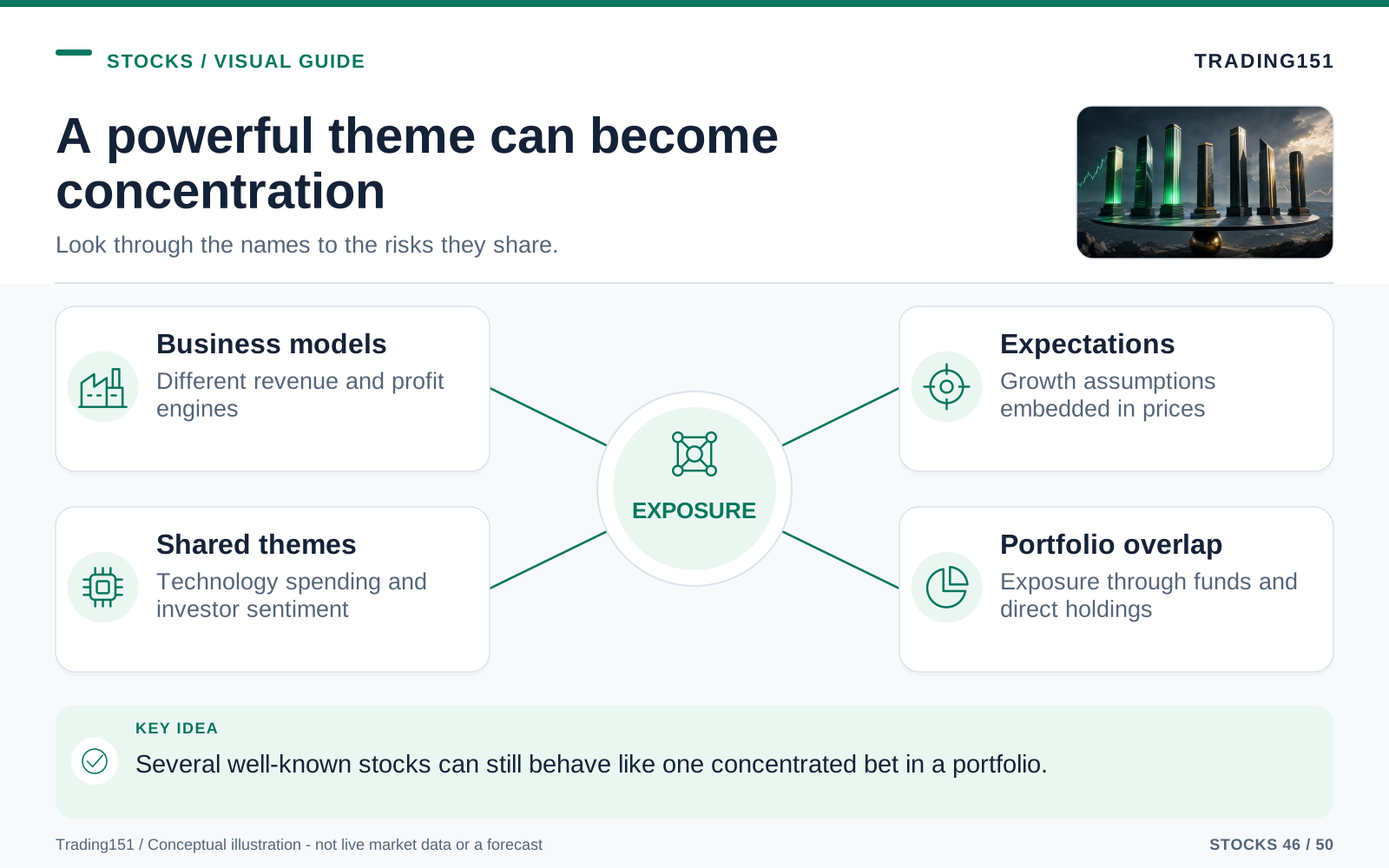
Read this diagram as text
- Business models
- Different revenue and profit engines
- Expectations
- Growth assumptions embedded in prices
- Shared themes
- Technology spending and investor sentiment
- Portfolio overlap
- Exposure through funds and direct holdings
2. Microsoft (MSFT): The Quiet Toll Road of Corporate Life
The vibe: The once-stodgy office software giant that somehow managed to become the most crucial AI company on the planet. If you're watching Microsoft, look at their cloud growth right alongside how much they're spending to build data centers. AI is driving huge demand, but it also costs an absolute fortune in chips and electricity. Revenue growth only matters if they can turn a solid profit on all that heavy lifting while keeping their pricing power intact.
The business: Microsoft is basically the operating system of modern work. Word, Excel, Teams, Outlook, Windows, LinkedIn, GitHub, Azure cloud servers, security tools—it just doesn't stop. For most companies, Microsoft isn't a choice; it's basic infrastructure.
That’s an beautiful place to be as a business. A normal consumer might get bored and switch smartphone brands. A Fortune 500 company doesn't just casually rip out its entire email system, cloud architecture, and security software. Microsoft weaves itself deeply into the daily operations of businesses, schools, and governments worldwide.
The investment case: Microsoft’s take on AI is substantially practical. They aren’t just selling sci-fi dreams; they’re baking AI directly into the tools millions of people already use every day. Bolting their "Copilot" AI onto Office, GitHub, and Azure gives them a straight shot at turning the AI hype into actual, recurring revenue.
Their early tie-up with OpenAI was a masterstroke that put them way ahead in the corporate AI race. Plus, Azure gets a huge boost every time another company decides to build or run AI models in the cloud. When a business wants to experiment with artificial intelligence, Microsoft is almost always the first call.
The catch? The stock is priced for perfection. Investors aren't just wondering if Microsoft is a good business—they know it is. They want to know if all those billions poured into data centers will eventually spit out even more billions in profit. If corporate America decides to take its time adopting AI, or if running these models stays expensive, the stock could take a hit.
Microsoft might just be the most well-rounded company of the seven. It has growth, stability, and enterprise trust. The issue is rarely the quality of the business; it's the premium you have to pay to own it.
3. Alphabet (GOOGL): The Search Giant Trying to Reinvent Its Own Front Door
The vibe: The brilliant librarian who holds the answers to everything, but suddenly has to convince people to still walk through the library's front door instead of just asking a robot.
The business: We all know Alphabet as Google, and Google remains one of the most ridiculously profitable habits in human history. We search, we watch YouTube, we check our Gmail, we use Google Maps, and we click on ads. Advertisers happily throw money at Google because it captures people right when they're ready to act. You're actively searching for a plumber, a flight, or a new pair of shoes.
That intent is pure gold. Social media might make you want something you didn't know existed, but Google captures you when your wallet is practically already open. That’s why search advertising has been such an unstoppable cash machine for so long.
The investment case: Alphabet is in a weird spot. AI is arguably the biggest threat to their core search business, yet Alphabet also has the talent, the cash, and the data to be a large winner in the AI era. The big fear is that if AI chatbots just give people the answers directly, nobody will click on those lucrative lists of blue links anymore.
But don't count them out. Alphabet owns Gemini, they run some of the best AI research labs on earth, and they know how to operate computing systems at a staggering scale. Plus, they own YouTube, which is an absolute juggernaut on its own. YouTube isn't just cat videos anymore—it's TV, music, podcasts, sports, and shopping all rolled into one addictive package.
The other complication here is the government. Antitrust regulators are breathing down Google's neck over their dominance in search and digital ads. These legal battles can drag on for years, and whatever remedies the courts come up with could sting.
Because of all this, Alphabet's stock often trades with a bit more skepticism than Microsoft or Nvidia. Ironically, that exact skepticism is why some investors love it. You have to ask yourself: is AI going to kill traditional Google Search, or is it just the newest feature Google will figure out how to monetize?
4. Amazon (AMZN): The Storefront Everyone Sees and the Cloud Business Many People Forget
The vibe: The relentless machine that drops toothpaste on your porch, runs half the internet behind the scenes, streams football, sells ads, and still operates with a chip on its shoulder like a hungry startup.
The business: To most of us, Amazon is just the "buy everything" store. And sure, the retail side is an absolute beast. But under the hood, Amazon is a dozen large businesses stacked together in a trench coat. You’ve got the online store, Prime subscriptions, the sprawling logistics network, third-party seller fees, a large advertising arm, and—most importantly—Amazon Web Services (AWS).
AWS is the invisible plumbing of the internet. It provides the cloud servers that run thousands of other companies, and for a long time, it was the golden profit engine that funded Amazon’s wild expansion everywhere else.
The investment case: Amazon went on an absolute spending tear during the pandemic, building warehouses as fast as humanly possible. When the online shopping craze eventually cooled down, they were left with a large hangover. Keeping all those extra employees and warehouses running is expensive when sales aren't rising rapidly anymore. So, management pivoted. They cut costs, trimmed the fat, and got serious about efficiency.
And you know what? It worked. A leaner Amazon is a much more profitable Amazon, even if the retail side isn't growing at breakneck speed. Then there's the advertising business, which is a quiet money creation. When someone searches for "coffee maker" on Amazon, brands pay top dollar to be the first thing they see.
The big risk to watch is the cloud wars. Microsoft and Google are fighting tooth and nail for cloud dominance, especially as AI changes what companies need from their servers. Amazon has to prove that AWS isn't just the king of the old cloud, but the king of the new AI cloud, too.
Buying Amazon is basically betting that they can keep running this substantially complex empire while turning it into a disciplined, cash-generating machine.
5. Nvidia (NVDA): The Company Selling the Shovels in the AI Gold Rush
The vibe: The guy standing at the tollbooth to the future, holding out his hand while every tech giant on earth lines up with a blank check. Watch their developer ecosystem and how cyclical the chip market is, rather than just assuming last quarter's insane growth is permanent. The risks include big tech companies eventually making their own custom chips, geopolitical export bans, or the reality that right now, everyone might just be panic-buying computing power.
The business: A few years ago, Nvidia was mostly famous for making the graphics cards that made PC games look amazing. That history is still there, but it’s barely the headline anymore. It turns out that the architecture inside those gaming chips is absolutely perfect for crunching the large amounts of math required to build AI models.
When the AI frenzy kicked off, Nvidia was standing there with the exact hardware everyone desperately needed, plus years of software development that kept programmers hooked. The result was a substantial explosion in revenue that Wall Street had rarely seen from a company already worth hundreds of billions.
The investment case: Nvidia is the ultimate "pick and shovel" play of the AI boom. Microsoft, Google, Meta, Tesla—they all need large piles of Nvidia's chips to build their AI dreams. Nvidia isn't just riding the wave; they are supplying the ocean.
Their secret weapon isn't just hardware, though. It's a software platform called CUDA that AI developers have relied on for years. You can't just easily swap out an Nvidia chip for a cheaper rival because the whole programming ecosystem is built around Nvidia. Cloud providers and researchers are totally locked in.
But man, the expectations on this stock are terrifyingly high. If AI spending takes a breather, if cloud companies start successfully building their own silicon, or if profit margins simply come back to earth, the stock could get hammered—even if the company itself is doing great. Chip businesses go through boom and bust cycles, something investors have a bad habit of forgetting when times are good.
Nvidia might define the next decade of tech, but you need an iron stomach to hold it. When a stock is priced for endless sunshine, even a cloudy day can cause a painful drop.
6. Meta Platforms (META): The Advertising Machine That Refused to Die
The vibe: The social media empire that everyone constantly complains about, yet instinctively opens again five minutes later.
The business: Meta owns Facebook, Instagram, WhatsApp, Messenger, and Threads. No matter how you feel about them, they control an unimaginable chunk of global human attention every day. They take all that scrolling, tapping, and viewing and feed it into a fiercely effective advertising algorithm. Lately, they've been using AI to make that algorithm even sharper—better targeting, slicker content recommendations, and more ways to prove to advertisers that their money was well spent.
Meta has been through the wringer over the last few years. Apple’s privacy changes wrecked their ad targeting for a while. TikTok threatened to steal Instagram’s cool factor completely. And investors were horrified by how much money Mark Zuckerberg was burning to build the "metaverse." But then came the pivot: large cost cuts, better execution, an AI reboot, and suddenly, the ad machine was roaring again.
The investment case: Meta’s comeback is honestly one of the wildest stories on Wall Street. They proved that their apps still matter, advertisers still desperately need them, and AI can keep users glued to their screens. Instagram Reels stepped up to fight TikTok, and WhatsApp is sitting there as a large, barely-tapped goldmine.
They even started paying a dividend, which was their way of telling Wall Street, "We aren't just a crazy growth experiment anymore; we're a grown-up cash cow."
The risks haven't disappeared, though. Regulators are always circling over privacy and youth safety. Younger users can be notoriously fickle. And Meta is still pouring billions into AI infrastructure while funding those long-term virtual reality bets. It’s not the cleanest company from a PR perspective, but purely as a business? It remains an absolute juggernaut.
7. Tesla (TSLA): The Stock That Refuses to Be Valued Like a Car Company
The vibe: The brilliant, utterly unpredictable wildcard that looks like a visionary genius one month and a total chaotic mess the next.
The business: Let's give credit where it's due: Tesla dragged the entire auto industry into the electric age. Before Tesla, electric cars were seen as slow, quirky little golf carts. Tesla made them fast and desirable. They forced the old-school automakers to wake up, built a charging network that works, and turned software into the most important part of buying a car.
But Tesla is easily the most polarizing stock of the bunch because no one can agree on what it is. Is it a car company? An energy grid player? An AI and robotics firm? A future fleet of driverless taxis? Who you ask completely changes the answer.
The investment case: If you judge Tesla purely as a company that stamps out metal and sells cars, the math is hard to justify. The EV market is cutthroat right now, especially with Chinese manufacturers flooding the zone. Tesla has had to slash prices to keep sales up, which eats directly into their profit margins. They simply don't have the playing field to themselves anymore.
But Tesla bulls don't care about today's car margins. They are looking years down the road. They believe Tesla will figure out full self-driving, launch an unstoppable robotaxi network, sell large energy storage batteries, and roll out millions of humanoid robots. In their eyes, Tesla is a tech platform that just happens to sell cars for now.
This makes investing in Tesla less about reading financial statements and more about picking a side in an intense debate about the future. If they pull off the autonomy and robotics play, the upside is astronomical. If they don't, or if it takes a decade longer than promised, it’s a long way down.
Buying Tesla requires accepting a level of volatility and narrative-driven price swings that you just don't get with Apple or Microsoft. That doesn't make it a bad stock. It just makes it a very different beast.
The Big Question: Are the Magnificent 7 in a Bubble?
It’s the question on everyone's mind, but the honest answer is a bit unsatisfying: parts of the market can be highly expensive without the whole thing being a total hallucination.
People constantly compare today to the Dot-Com bubble of 1999. In some ways, it's a fair comparison—back then, everyone knew the internet would change the world, and they were right. The mistake was paying insane prices for companies that had zero profits, shaky business models, and barely any real revenue.
The Magnificent 7 aren't like that. These aren't sketchy startups with clever domain names; they are quite some of the most profitable, cash-flush enterprises in human history. They own the critical infrastructure of the modern world. Their dominance is real.
But just because a business is real doesn't mean the stock is a guaranteed winner. Price always matters. If investors price a stock assuming AI will be adopted perfectly, profit margins will grow forever, and regulators will look the other way, then even a spectacular company will eventually disappoint its shareholders.
The real danger is how top-heavy the market has become. When you buy a broad index fund, it feels safe and diversified. But because these seven companies are so large, they drive a huge chunk of the fund's performance. When they soar, they make the whole market look healthy. When they stumble together, they will drag your portfolio down—even if hundreds of other normal companies are doing just fine.
That doesn't mean index funds are broken. It just means you need to go in with your eyes open. Buying the S&P 500 today isn't a bet on 500 equal pieces of the economy; it’s a large tech portfolio with a side order of everything else.
The AI Boom: Real Opportunity, Real Pressure
If you look closely, AI is the beating heart of the Magnificent 7 right now. Nvidia is making the chips. Microsoft is selling the software. Alphabet is rebuilding search around it. Amazon is defending its cloud turf. Meta is optimizing its ads. Apple wants smarter iPhones, and Tesla wants cars that drive themselves.
The shift is completely real. This isn't just a tiny niche. Companies are spending actual billions, developers are building wild new tools, and regular people are using AI in ways that felt like sci-fi a few years ago.
But Wall Street has a habit of getting way ahead of reality. Building this AI infrastructure is shockingly expensive. You need chips, data centers, cooling systems, power grids, and land. Eventually, the companies writing these large checks are going to have to prove to their investors that it was worth it. Patience is great, but Wall Street's patience is not unlimited.
The million-dollar question isn't whether AI is impressive. It clearly is. The real question is who gets to keep the money. Throughout history, the biggest winners of new technologies aren't always the ones with the flashiest prototypes; they're the ones who already own the distribution, the customer relationships, and the pricing power. That’s exactly why the Magnificent 7 matter so much.
How a Normal Investor Can Approach These Stocks
Don’t let FOMO write your investment plan. The absolute worst time to buy a stock is when your neighbor, your barber, and the guy on TV are all guaranteeing it will go up. Nvidia, Meta, and Tesla can have bright futures and still suffer severe drops. If a stock has already skyrocketed, you might be showing up late to the party. Take a minute to check what you already own. If you want to buy a few shares of a tech giant, make sure it won't suddenly become 20% of your total net worth once you factor in your retirement accounts.
Remember that owning the index already gives you exposure. You really don't have to play the stock-picking game to win. A standard, low-cost S&P 500 or total-market index fund is already packed with the Magnificent 7. Sure, buying the index won't make you feel like a genius stock picker at a dinner party, but it completely protects you from placing a large bet on the one company that ends up stumbling.
If you buy individual names, size them honestly. It’s perfectly fine to buy Microsoft because you love the business, or Amazon because you see their cloud potential. The danger is when a "fun" stock idea quietly takes over half your portfolio. A smart rule of thumb? Keep broad, boring index funds as the heavy core of your portfolio, and treat individual stock picks as smaller, manageable side bets.
Don’t confuse a great product with a great stock. You can be obsessed with your iPhone and still overpay for Apple stock. You can scroll Instagram for three hours a day and still buy Meta at a risky valuation. You can love driving your Tesla and still acknowledge that the stock is completely detached from car math. Great products and great investments are two entirely different things.
Watch cash flow, not just headlines. Flashy AI demos, bold CEO tweets, and new product launches can make a stock bounce around for a few days. But over the next decade? It’s all about cold, hard cash. The companies that figure out how to turn this AI hype into large piles of free cash flow will justify their stock prices. The ones that only figure out how to burn money will get crushed.
Be careful with the phrase “too big to fail.” These tech giants feel completely invincible today. But they aren't immune to greedy management, aggressive regulators, or some kid in a garage inventing the next big thing. Corporate history is a graveyard of "untouchable" monopolies that lost their edge.
Which of the Seven Looks Best?
There isn't a magical right answer here, mostly because these seven companies aren't moving in lockstep anymore.
Microsoft makes sense if you want steady, corporate AI growth. Nvidia is the high-octane play if you want direct exposure to AI hardware and have a strong stomach. Alphabet looks tempting for value hunters who think the "Google is dead" narrative is substantially overblown. Amazon is great if you want to bet on cloud dominance and relentless logistical efficiency. Meta is there for folks who believe the AI ad machine is unstoppable. Apple is the ultimate safe-haven play for ecosystem loyalty. And Tesla? Tesla is for dreamers who are perfectly fine ignoring today's car margins to bet on a sci-fi future.
Instead of asking "Which one is best?", try asking yourself, "Which set of headaches am I most comfortable dealing with?" With Apple, you're risking sluggish growth. With Microsoft, it's a steep valuation. Alphabet faces regulators and search disruption. Amazon has fierce cloud rivals. Nvidia is battling absurd expectations and cyclical demand. Meta is spending like crazy while dodging politicians. Tesla relies entirely on promises that haven't materialized yet.
Once you look at it that way, the choice becomes a lot more rational. You stop acting like a cheerleader and start acting like a business owner.
Buying seven famous companies is still a valuation decision
Start by checking what the portfolio already owns. Broad U.S. index funds and technology-oriented funds may include substantial positions in several of these companies. Adding a separate basket can increase an existing concentration rather than create a new source of diversification. Look through the funds to the underlying holdings before deciding how much additional exposure is intended.
Separate business quality from the return implied by the purchase price. A company can continue to grow and still disappoint shareholders when expectations were too high. The question is not merely whether a product or platform is important, but how much growth, margin resilience, and future cash generation the current valuation already assumes.
Capital spending deserves particular attention where the thesis depends on artificial intelligence infrastructure. Distinguish the companies selling equipment from those buying it, and examine how expenditure is expected to turn into revenue or cost savings. Customer concentration, depreciation, financing, and competition can affect the outcome differently across the group.
Use current filings rather than a static ranking of the seven. A disciplined comparison includes scenarios in which growth slows or expected returns on investment take longer to appear. The nickname may help organize a conversation about market concentration. It should not replace seven separate business assessments or the broader question of how much of the portfolio should depend on closely related expectations.
Look through the fund names
An investor may own the same large technology companies through a broad U.S. index fund, a growth fund, a technology fund, and individual shares. Each purchase can feel like a separate idea while increasing exposure to the same businesses.
Calculate the combined holdings where practical and consider the shared economic drivers, including capital spending, advertising, consumer demand, and regulation. The exact concentration changes with market values and fund rebalancing, so it should not be inferred from an old weight quoted in an article. Diversification is a property of the combined exposures, not the number of fund labels on the account screen. 1, 2, 3
Seven Companies, Seven Separate Decisions
The Magnificent 7 are still undeniably magnificent, but the honeymoon phase where they all magically surged together is over. They aren't just a unified block of tech stocks floating on low interest rates and AI buzz anymore. They are seven distinct empires, fighting seven very different wars.
They aren't going to trade as a pack forever. Their business models, government scrutiny, and spending habits are just too completely different. The catchy nickname will probably stick around in financial media for years, but as an investor, you have to rip off the label and look at the actual companies underneath.
Before you hit the buy button on any of these, check under the hood of your broad index funds. A portfolio can easily become dangerously top-heavy without you even noticing, and buying five different tech tickers might just equal one giant, risky bet on Silicon Valley.
These are some of the greatest businesses ever built, and they absolutely deserve your attention—but they don't deserve an automatic buy. Figure out what the current price tag implies, leave a little mental room for things to go wrong, and keep your position sizes sane. Dominant companies can stay on top for a very long time, but no stock is exempt from gravity.
This article is for general educational purposes only and isn't meant to be personalized financial advice. Always keep your own goals, risk tolerance, and time horizon in mind. When in doubt, it never hurts to chat with a qualified financial professional before making any big investment moves.
Sources and further reading
- SEC: Beginners Guide to Financial Statements
- Investor.gov: Asset Allocation
- SEC: Frequently Asked Questions About Form 13F
Editorial revision: 7 October 2026. Numerical scenarios are hypothetical unless identified as historical. References support the added explanations and selected corrections; rules and product terms should be checked again before acting.