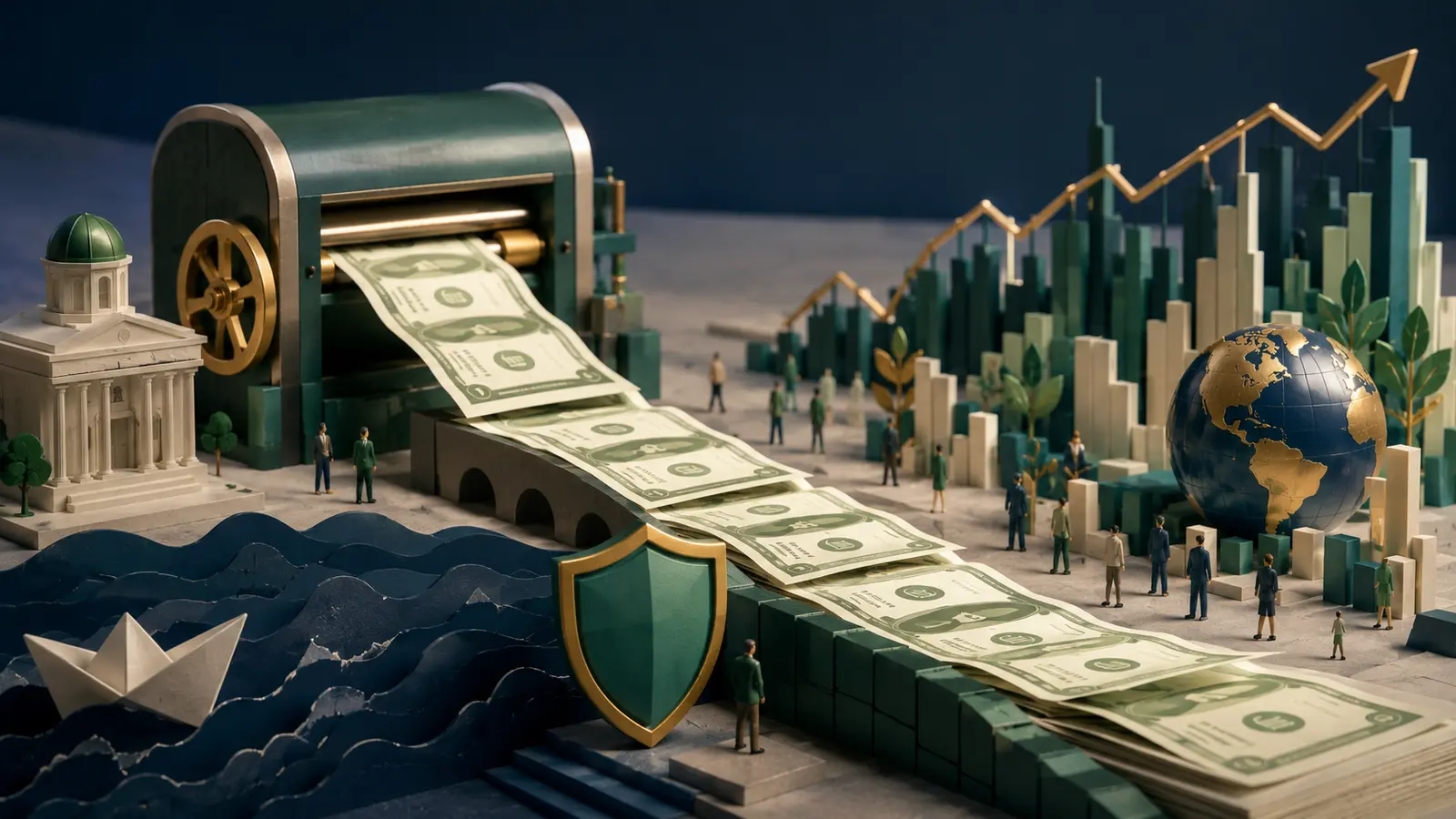
Quantitative easing is a central-bank asset-purchase policy used to influence financial conditions, often when ordinary policy-rate cuts offer limited room. It changes the central bank's balance sheet and the composition of assets held elsewhere in the economy. Calling it a money printer captures only part of the process. The effect on stocks depends on expectations, interest rates, economic conditions, and the reasons the policy is being used.
What Quantitative Easing Means
Normally, central banks steer the economy by tweaking short-term interest rates. If inflation is running hot, they hike rates to make borrowing sting a little, which cools things down. If the economy is sluggish, they cut rates so borrowing is cheap, hoping to coax people and businesses into spending, investing, and hiring. Behind the scenes, banks use central-bank reserves to settle accounts and meet regulations; this isn’t cash landing straight in your personal checking account. While QE can indirectly boost the broader money supply if banks decide to lend more, they don’t just blindly loan out every reserve dollar they get. Whether that money reaches the real economy depends heavily on whether people want loans, how confident they feel, and the overall health of the banking system.
This whole system works fine until the central bank hits a brick wall. During a large crisis, interest rates might drop all the way to zero, but banks are still scared to lend, businesses are slashing budgets, and everyday folks are too anxious to borrow or spend. The central bank has yanked its favorite lever as far as it'll go, and nothing is happening.
That’s where QE steps in.
With Quantitative Easing, the central bank creates new digital money and uses it to buy financial assets—usually government bonds and mortgage-backed securities. There are no armored trucks delivering pallets of cash to banks. It’s all keystrokes. The central bank buys bonds from financial institutions and simply credits their digital accounts with newly created reserves.
Think of it as a large swap. The central bank takes long-term assets (like bonds) off the market and hands over cash-like reserves in return. Suddenly, the financial system is flush with cash, but there are far fewer safe, reliable bonds left to buy.
The point isn’t just to make banks feel secure. The real goal is to force that money out into the wild. Because safe bonds are suddenly scarce and paying terrible yields, investors have to go hunting elsewhere to make a return. Borrowing costs plunge, meaning companies can refinance old debts, issue new bonds, and invest on the cheap. Mortgages get cheaper, making homes more affordable for some. And as asset prices climb, the people holding those assets feel wealthier and are more likely to spend.
At least, that’s how it works on a whiteboard. When it hits the real world, the effects are undeniable, but they're also messy and sometimes create uncomfortable side effects.
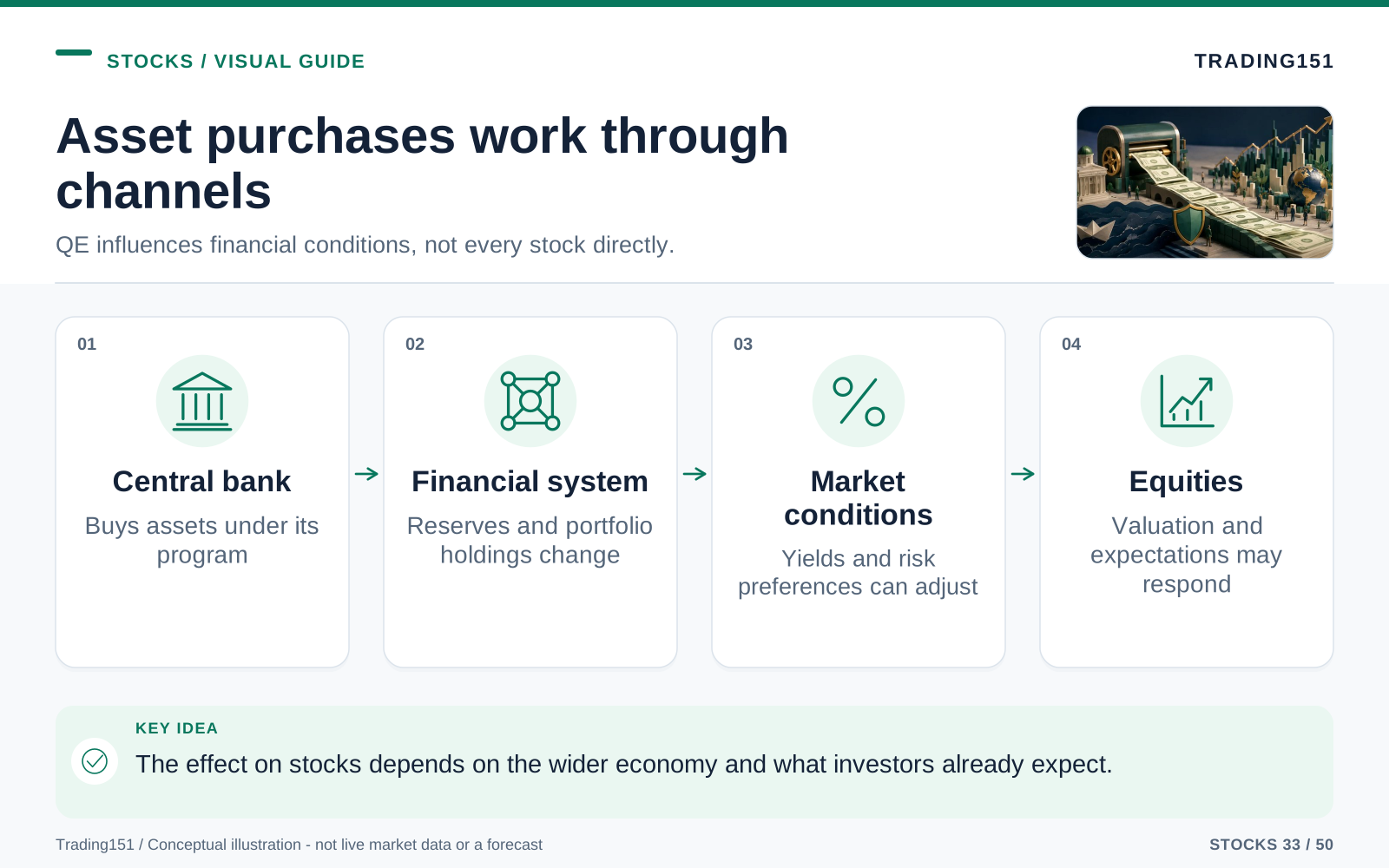
Read this diagram as text
- Central bank
- Buys assets under its program
- Financial system
- Reserves and portfolio holdings change
- Market conditions
- Yields and risk preferences can adjust
- Equities
- Valuation and expectations may respond
Why Bond Buying Can Lift the Stock Market
At first glance, the whole thing sounds totally disconnected. The Fed buys some bonds, and suddenly tech stocks rally? Why?
It comes down to comparison shopping. Investors are constantly weighing their options: cash vs. Bonds, bonds vs. Stocks, playing it safe vs. Taking a gamble, having money now vs. Waiting a decade. QE scrambles the math on all of these choices.
By stepping in and buying mountains of bonds, the central bank drives up the demand for them. High demand pushes bond prices up. And because bond prices and yields are on a seesaw, higher prices mean lower yields.
That yield drop is the first domino. Once safe money pays next to nothing, investors are forced to ask themselves a very practical question: Where else can I put my money to get a return?
1. The “There Is No Alternative” Effect
This brings us to a huge driver of market behavior during QE: the TINA effect. It stands for There Is No Alternative.
When your savings account, CDs, and government bonds are kicking back fractions of a percent, playing it safe feels like a losing game. A pension fund can’t pay its future retirees with a 0.5% return. An insurance company can’t hit its targets. Retirees realize they can’t live off the interest from traditional fixed-income portfolios. Even regular folks start noticing that their cash is just sitting there losing purchasing power, especially if inflation starts creeping higher than their savings rate.
So, the money has to move. Some of it flows into corporate debt. Some finds its way into real estate. And a large chunk of it pours right into the stock market.
This doesn't mean conservative investors suddenly turn into reckless gamblers overnight. It just nudges everyone a little further out on the risk branch. The person who used to buy government bonds buys investment-grade corporate bonds instead. The corporate bond buyer shifts into dividend-paying stocks. And the person who was already in stocks starts eyeing riskier, high-growth companies. The net result is a large wave of demand for riskier assets.
Ultimately, stocks shoot up not necessarily because every company is suddenly knocking it out of the park, but simply because the safer alternatives have become practically useless.
2. Lower Discount Rates Make Future Profits Look Bigger
There’s also a wonkier, mathematical reason QE pushes stock prices up. A stock's price is heavily based on the profits investors expect that company to make in the future. But a dollar earned ten years from now isn't worth a dollar today. Investors "discount" those future earnings to figure out their present value, and interest rates are the core of that math. This discount effect heavily impacts companies whose biggest payouts are still years away. When rates fall, those distant future dollars suddenly look a lot more valuable today. This dynamic often stretches the valuation gap between flashy growth stocks and boring, established cash cows. Of course, if rates go back up, this exact same math works in reverse—crushing the stock price even if the company's actual business hasn't changed at all.
Basically, low rates make future profits far more appealing in today's terms.
This perfectly explains why periods of heavy QE and low rates are an absolute gold rush for tech stocks and other long-duration assets. A steady, boring utility company making money today will get a nice little bump from QE. But a hyped-up software company that swears it’ll dominate the world in ten years? That stock will go to the moon, because those far-off profits suddenly look attractive when the discount rate drops.
It also explains why the hangover is so severe. When rates eventually rise, the market violently reprices these growth stocks. The company might still be great, but investors simply aren't willing to pay a premium for profits that are still years away.
3. Cheap Debt Fuels Corporate Buybacks
QE aggressively pushes down borrowing costs across the board. Since investors are starving for yield and government bonds aren't paying anything, corporate debt suddenly looks tempting to them. Big companies realize they can borrow money at low rates—often even when they're already sitting on a mountain of cash. They can use that cheap debt to fund stock buybacks, though whether that's a smart move really depends on what price they pay for the shares and the health of their balance sheet. Borrowing money to buy back cheap stock can reward shareholders; borrowing to the hilt to buy back stock at the top of the market just leaves the company weighed down with debt when things eventually go south. QE makes the money cheap; it doesn't make the executives any smarter at spending it.
So, what do companies do with all this practically free money?
Some do exactly what the textbooks say: they build factories, hire people, upgrade their software, and invest in research. That’s the productive, healthy version of the story. But a lot of them just use the cheap debt to buy back their own stock.
When a company buys back its shares, it shrinks the total number of shares out in the wild. Since the company’s total profits are now divided among fewer shares, the earnings per share metric goes up—even if the actual business hasn't grown a single inch. This artificially boosts the stock price, keeps Wall Street happy, and usually helps executives hit their bonus targets.
Now, buybacks aren't inherently evil. They can be a perfectly logical way to hand extra cash back to the people who own the company. But in a world where money is basically free, buybacks can turn into a bad habit. Instead of using low rates to bulletproof the business for the long haul, companies just engineer their financial metrics to look better on paper.
That’s a huge reason critics complain that QE pumps up the stock market without fixing the real economy underneath it.
4. Liquidity Changes Investor Psychology
Markets aren't just giant calculators; they run on emotion, memory, and habit.
When a central bank fires up a large QE program, it sends a loud and clear message to Wall Street: we are not going to stand aside and let the financial system break. Investors read that as a giant safety net. They start to believe that if the market ever really tanks, the central bank will just swoop in and save the day again.
You'll often hear this called the “Fed put.” In options trading, a "put" is a contract that protects you from losses. Nobody thinks the Federal Reserve is promising that stocks will never go down. It doesn't. But if traders believe the Fed will rush in with the money hose at the first sign of panic, they become way more willing to buy the dip, take wild risks, and pay ridiculous prices for stocks.
You can't overstate how much this shift in psychology changes the game. A market that believes help is waiting in the wings acts very differently from a market that knows it's entirely on its own.
5. Rising Asset Prices Create a Wealth Effect
QE also leans heavily on what economists call the wealth effect. When your stock portfolio is up 20% and your house is suddenly worth more, you feel rich. You might finally redo the kitchen, book that vacation, buy a new car, or just generally stress less about your future.
All that extra spending trickles down to businesses, boosting their revenues and profits, which in turn pushes their stock prices even higher. It creates a temporary, self-fulfilling loop: QE pushes yields down, money floods into assets, asset prices soar, consumers feel flush, they spend money, corporate earnings look great, and investors get even more confident.
The catch? This loop only really benefits people who already own things. If you don't own stocks or a house, watching asset prices rise sharply doesn't feel like an economic recovery. It just feels like the world is getting way too expensive to live in.
QE After 2008: The Experiment Becomes the Playbook
The 2008 financial crisis changed the game completely. Before then, QE wasn't totally unheard of, but in the US and Europe, it was viewed as a break-glass-in-case-of-emergency measure, not a standard part of the central-bank toolkit.
But when housing crashed and the banks froze up, the Fed slashed rates to essentially zero and started buying up assets by the truckload. We called that first wave QE1. Then came QE2, QE3, and various other spin-offs of the same playbook.
People were terrified of it at first. Critics screamed that it would destroy the value of the dollar or trigger runaway inflation. Supporters argued that if the Fed didn’t step in, the entire global banking system would vaporize and the recession would get infinitely worse.
What happened was a lot weirder. The cost of everyday goods didn't instantly skyrocket, which baffled a lot of the critics. But asset prices? They went on an absolute tear. Stocks clawed their way out of the 2009 basement and kept running for over a decade. Sure, they had help from recovering corporate profits, tech breakthroughs, and globalization, but the constant, comforting presence of central-bank money was always there.
Now, QE wasn't the only reason the market went on a historic bull run. It never is. Companies still had to sell products, hire talent, and beat the competition. But QE radically changed the environment they were operating in. It lowered the hurdle for taking risks. It made far-off profits look tantalizing. It trained investors to ignore short-term hiccups and throw money at long-term growth.
Put another way, QE didn’t write every chapter of the bull market story, but it absolutely provided the background music.
QE in 2020: The Emergency Response Goes Supersized
If 2008 normalized QE, 2020 put it on steroids.
When the COVID-19 pandemic hit, markets panicked in a way we hadn't seen in years. Businesses boarded up, flights were grounded, unemployment spiked, and investors scrambled to hoard cash. Even the most boring, reliable corners of the bond market started to crack under the pressure. The fear wasn't just that stocks would drop; the fear was that the actual plumbing of the financial system was breaking down.
The Federal Reserve reacted with extraordinary force. They slashed rates, fired up large asset purchases again, backstopped credit markets, and basically made it crystal clear that they would pump in as much cash as it took to keep things afloat.
The market's reaction gave a lot of people whiplash. Stocks completely cratered in early 2020, and then snapped back with breathtaking speed. To the average person on the street, it felt almost obscene. Restaurants were dying. Families were struggling. Hospitals were a warzone. And yet, major stock indexes were climbing, and speculative assets were minting new millionaires.
That disconnect made a lot of people justifiably angry. But from the cold, calculated view of the market, the logic tracked. Interest rates were near zero. The central bank was flooding the system with liquidity. Stimulus checks were landing in bank accounts. And digital companies were making a killing as everyone suddenly relied on remote work, online shopping, cloud software, and streaming to survive. Investors were desperate for growth, and they were willing to pay whatever it took to get it.
The result was an explosive rally, heavily tilted toward tech and hyper-growth stocks. Some of it was rooted in real changes to the economy. Some of it was fueled by practically free money. And a lot of it was just pure speculation. QE created the perfect greenhouse for all three to thrive at the same time.
The Darker Side of Easy Money
QE is a lifesaver during a panic, but it’s not a harmless magic trick. It has real, lingering side effects—and the longer you leave the money creation running, the more damaging those side effects become.
1. Asset Inflation Can Hide in Plain Sight
For years after the financial crisis, one common argument against QE looked completely wrong on the surface. Critics warned that creating all this money would cause inflation, yet the price of groceries and services stayed pretty normal for a long time.
But inflation was absolutely happening; it was just hiding in the financial markets.
Stocks got drastically more expensive. Real estate soared. Private startups raised cash at wild valuations. Vintage cars, venture capital, crypto—if you could trade it, waves of cheap money were pushing its price into the stratosphere.
Policymakers often overlook this kind of inflation because it doesn’t hit you at the grocery store checkout line. But it still alters people's lives. If house prices double while salaries barely inch forward, a young family trying to buy their first home feels that pressure plain as day.
2. Inequality Can Get Worse
Simply put, QE tends to take care of the people who already own things first. If you have a fat stock portfolio, a house, or a business, you benefit directly when asset prices rise. People living paycheck to paycheck don't get that same boost.
Central banks aren’t sitting in a room trying to make the rich richer and screw over everyone else. When they step in during a crisis, they're usually trying to stop a catastrophic collapse that would devastate working-class people too. The problem is that their only real tool is the financial system, and the financial system doesn't distribute benefits evenly.
If your retirement account balloons, QE feels like a rescue. If your rent jumps and your hourly wage stays flat, it feels like the system is working for someone else.
3. Bad Businesses Can Survive for Too Long
Free-flowing, cheap cash has a way of keeping terrible companies on life support. When borrowing is easy and investors are desperately hunting for returns, businesses that might otherwise go under can just keep refinancing their debt again and again.
Wall Street calls these zombie companies. They make just enough money—or borrow just enough money—to keep the lights on and pay the interest, but they don't thrive. They just shamble along, tying up workers, capital, and market share that could be put to way better use somewhere else.
It sounds harsh, but a healthy economy relies on companies failing. When a bad business goes under, its resources get recycled into newer, better ideas. When cheap money pauses that natural cycle of death and rebirth indefinitely, the whole economy gets less dynamic.
4. Investors Can Forget What Risk Feels Like
One of the strangest effects of a long QE era is that it trains investors to expect a rescue.
When every major dip is met with easier policy, people start treating risk like a temporary inconvenience rather than a real threat. They blindly buy stocks with zero profits. They chase fads just because the line on the chart is pointing up. They assume there will always be plenty of cash sloshing around when it’s time to sell.
And that works beautifully—right up until the moment it doesn't.
When the central bank takes away the punchbowl, the same trades that looked genius can implode in days. Assets priced for a perfect future get massacred by the slightest bit of bad news. Zombie companies suddenly realize they can't afford to borrow anymore. And a whole generation of investors who only knew the easy-money years gets a severe reminder that markets can still inflict real pain.
What Happens When QE Turns Into QT?
There’s a flip side to the money creation, and it’s called Quantitative Tightening, or QT. This happens when the central bank decides to actively sell off its assets, or simply lets its existing bonds mature without buying new ones to replace them. Exactly how painful this gets depends on a whole bunch of factors—like how much debt the Treasury is issuing, what’s happening in money markets, and how fast the bank shrinks its balance sheet. You can't just look at a spreadsheet of QT runoffs and perfectly predict a stock market crash; you have to look at the broader vibe of the financial system.
Essentially, under QT, the central bank is putting its wallet away. Instead of pumping cash into the system, it's allowing liquidity to drain out.
This usually happens at the same time they are jacking up interest rates, typically to fight off inflation. When you combine those two things, the market's entire incentive structure flips overnight.
Suddenly, holding cash isn’t a guaranteed loss. Government bonds start offering yields that are worth looking at. Your boring old savings account pays out real interest. Investors don’t have to take wild gambles just to make a buck. That whole TINA argument? It weakens or completely evaporates.
This is an absolutely severe environment for assets that thrived on free money. High-flying growth stocks, speculative tech, crypto, and companies burning through cash usually take a large beating. Their hypothetical future profits get discounted at higher rates, their loans get expensive, and investors suddenly become picky.
It’s a painful reminder that liquidity dictates valuation. You can own a phenomenal business, but if you paid an astronomical, QE-fueled price for it, it’s still a terrible investment. When the era of free money ends, the market stops cheering and starts asking very hard questions.
Does QE Always Make Stocks Go Up?
No. And this is probably one of the most important points to understand.
QE is a large force, but it’s not a magic button that automatically makes the stock market rise. If the economy is cratering, banks are terrified to lend, corporate earnings are in freefall, or everyone is panicking, QE acts like a shock absorber. It might stop the bleeding, but it won't instantly launch a new bull market.
It also never operates in a vacuum. Government spending, inflation, employment numbers, corporate profits, global supply chains, energy prices, and geopolitical tensions all have a large say in where stocks go. QE is just one loud voice in a very noisy room.
The best way to think about QE is this: it warms up the environment for risk-taking. It pushes yields down, injects cash into the system, supports confidence, and nudges investors toward the stock market. But it doesn't eliminate risk, and it certainly doesn't mean every stock deserves a higher price.
Asset purchases create reserves, not a guaranteed stock-market gain
When a central bank buys an eligible security, the transaction is settled through the banking system and creates central-bank reserves. If the seller is a non-bank investor, a commercial-bank deposit may also be created as part of the transaction. This is not the same as handing an equal amount of freely spendable cash directly to every household.
The intended channels can include lower longer-term yields, easier financing conditions, and changes in investors' portfolio choices. Their strength varies with the circumstances. Banks do not mechanically lend out reserves to households, and a larger reserve balance does not by itself establish how much credit the private sector will demand or receive.
For stocks, lower discount rates can support valuations, but weak earnings or financial stress can work in the opposite direction. An announcement may also confirm that policymakers see a serious problem. The market response therefore cannot be inferred from the balance-sheet increase alone, and an anticipated purchase program may already be reflected in prices.
Distinguish policy announcements, actual purchases, reinvestment, and balance-sheet runoff. They describe different actions and can affect markets at different times. A useful analysis connects the policy to financing costs and business cash flows rather than assuming a fixed amount of central-bank buying produces a predictable rise in an equity index. Monetary policy changes conditions; it does not remove investment risk.
Follow the balance-sheet change
Quantitative easing is easier to understand when the transaction is traced. The central bank acquires an asset and creates the corresponding central-bank liability; the effect on commercial-bank deposits depends in part on who sold the asset and how the payment moves through the banking system. That accounting is different from imagining banks receiving a pile of cash that must then be lent to households.
The economic effects depend on interest rates, portfolios, expectations, credit conditions, and other influences. A balance-sheet expansion does not mechanically translate into the same percentage increase in lending, consumer spending, or asset prices. Keep the accounting mechanism separate from claims about its eventual impact. 1
Liquidity Changes Prices, Not Economic Laws
So what does this mean for you? First off, don't drive yourself crazy trying to decode every sentence a Federal Reserve official mutters into a microphone. Financial media loves to turn that stuff into a daily soap opera, but 99% of it won't matter to your long-term life.
That said, it absolutely pays to know which way the wind is blowing.
When central banks are easing, cash is usually everywhere, yields are in the basement, and risky assets have the wind at their backs. When they are tightening, cash dries up, safe yields look tempting, and high valuations get punished. The same company can be valued substantially differently depending on which environment we're in.
This doesn't mean you should try to time the market based on Fed headlines—that’s a great way to lose money. Most people are way better off sticking to the basics: diversify your portfolio, don’t borrow more than you can handle, keep an emergency fund, rebalance when things get out of whack, and never forget that the price you pay for an asset matters.
QE is great at bringing down yields and unfreezing markets, but it can’t fake a healthy economy forever. It can't magically invent profitable business models, responsible borrowers, or productive investments. And because asset prices bounce back so much faster than the real economy heals, it almost always looks like Wall Street gets the bailout while Main Street gets the bill.
When the machine goes into reverse, you can't just play the movie backward. Quantitative tightening, rate hikes, inflation, and government borrowing all crash into each other in unpredictable ways. The market is also forward-looking; it will start pricing in the pain long before the central bank finishes shrinking its balance sheet.
In the end, QE is just the weather—it’s not the whole journey. Avoid buying assets that only make sense in a fantasy world of permanently falling interest rates. Keep your debt in check, and invest in companies that are tough enough to make real cash, no matter what the central bank is doing with its money creation. The Fed can change the tides, but it doesn't make every boat seaworthy.
Sources and further reading
Editorial revision: 7 October 2026. Numerical scenarios are hypothetical unless identified as historical. References support the added explanations and selected corrections; rules and product terms should be checked again before acting.