
Choosing between active and passive investing is partly a question of ambition, but mostly a question of process. Are you prepared to research individual investments, measure the results honestly, and keep doing the work through disappointing years? Or would you rather choose a suitable mix of funds and spend less time managing it? Neither approach removes risk. They ask different things of you.
Part 1: Active Investing — Trying to Beat the Market
Active investing is exactly what it sounds like: hands-on, heavily involved, and aiming high. You aren't just looking to ride the wave of the stock market. You want to beat it.
When we talk about "the market," we’re usually talking about a benchmark like the S&P 500 or a total market index. The math for an active investor is simple in theory: if the S&P 500 goes up 10% this year, you want to make 12% or 15%. If the market takes a nosedive and drops 10%, your goal is to fall maybe 5%, stay flat, or ideally—find a way to make a profit while everyone else is bleeding cash.
People generally tackle this in one of two ways. You can do it yourself—picking your own stocks, jumping between industries, and figuring out when to pull your cash out to sit on the sidelines. Or, you can hire a pro to do it for you through an actively managed mutual fund. Either way, the underlying belief is the same: with enough research and brainpower, you can outsmart the basic strategy of just owning everything.
When it works beautifully, active investing is a deeply thoughtful, research-driven process. It involves digging into how companies make money, tearing through balance sheets, sizing up competitors, and figuring out if the rest of the world has completely mispriced a business.
When it goes wrong, though? It’s basically gambling disguised as a strategy. It devolves into chasing whatever stock is trending online, panic-selling at the worst possible moment, buying on hot tips from a neighbor, and tricking yourself into thinking a lucky streak is actual genius.
How Active Investors Look for Opportunities
The core belief of every active investor is that the market isn't perfectly efficient. Put simply, they think prices are sometimes just flat-out wrong. To win, you need an edge. That might mean you have a deeper understanding of a specific industry, a willingness to wait longer than Wall Street traders, or a knack for spotting hidden value. Though: just scrolling through financial news doesn't give you an edge, because millions of other people are reading the same headlines. You have to understand why an opportunity exists and why other smart people haven't already pounced on it.
Often, it looks like this: A great company misses its quarterly earnings estimate, the stock drops, and you swoop in to buy it on a discount. Or you find a small, boring company doing incredible things that the flashy tech investors are completely ignoring. Active investors live for those moments—the gaps where a stock's price doesn't match its true value.
There’s no single way to do this. Some folks are strict value investors, always hunting for the bargain-bin stocks that are trading for less than they're worth. Others are growth investors, betting on disruptive companies they think will take over the world. You’ve got traders who buy and sell based on quick catalysts like a product launch or an interest-rate hike, and you’ve got patient stock-pickers who buy ten companies and sit on their hands for a decade.
A day trader glued to six monitors, a Wall Street hedge fund manager, and a retiree picking a few favorite blue-chip stocks are all, technically, active investors. The common thread is simply the belief that their choices can move the needle on their wealth.
Why Active Investing Appeals to People
- It offers the possibility of exceptional returns. this is the big draw. Finding a great company before everyone else does and riding it to a large profit is an incredible feeling. You're never going to get that specific thrill—or that lottery-ticket payoff—from a standard index fund.
- It gives you total flexibility. If you hate a particular industry, you don't have to put your money there. If you think tech is dangerously overpriced, you can sell it. If you're nervous about the economy, you can hold cash. Passive funds don't give you that choice; they just blindly follow their index.
- It feels personal and engaging. A lot of people love learning how businesses work. They enjoy observing consumer habits, reading through company reports, and predicting future trends. For them, investing isn't a chore; it's a fascinating intellectual puzzle.
- It gives you a sense of control. Even if that control is largely an illusion, making your own choices feels good. You aren't just sitting in the passenger seat accepting whatever the market hands you—you've got your hands on the steering wheel.
The Problems Active Investors Have to Face
- Beating the market consistently is hard. Having one great year or picking a couple of winning stocks doesn't make you a genius. The true test is doing it consistently over a decade or more, even after paying fees, dealing with taxes, and surviving severe bear markets. It’s a much steeper hill to climb than beginners think.
- Costs will quietly eat your profits. Active mutual funds charge higher fees to pay for all that research and management. And if you’re trading frequently yourself, you’re racking up tax bills and transaction fees. A percent here or there might not seem like a big deal today, but over twenty years, it can devour a shocking amount of your wealth.
- It demands serious time and attention. Picking your own stocks means you can't just set it and forget it. You have to keep up. CEOs get fired, industries get disrupted, and a business that looked unstoppable three years ago can suddenly hit a wall. You have to stay awake at the wheel.
- It practically invites emotional mistakes. More decisions mean more opportunities to mess up. You might panic and sell a great stock at the bottom, stubbornly hold onto a loser because you don't want to admit defeat, or FOMO-buy a trendy stock right before it crashes.
The hard truth is that active investing is only partially about finding brilliant ideas. Mostly, it’s about having the psychological grit to stick to those ideas when the market is testing your sanity. There’s also the hidden issue of capacity. A strategy that works perfectly when you’re managing $50,000 might completely fall apart when a fund manager is handling $5 billion. Big money is hard to move quietly. So, if you're buying into a hot active fund, always ask yourself if they've gotten too big to keep doing what made them famous in the first place.
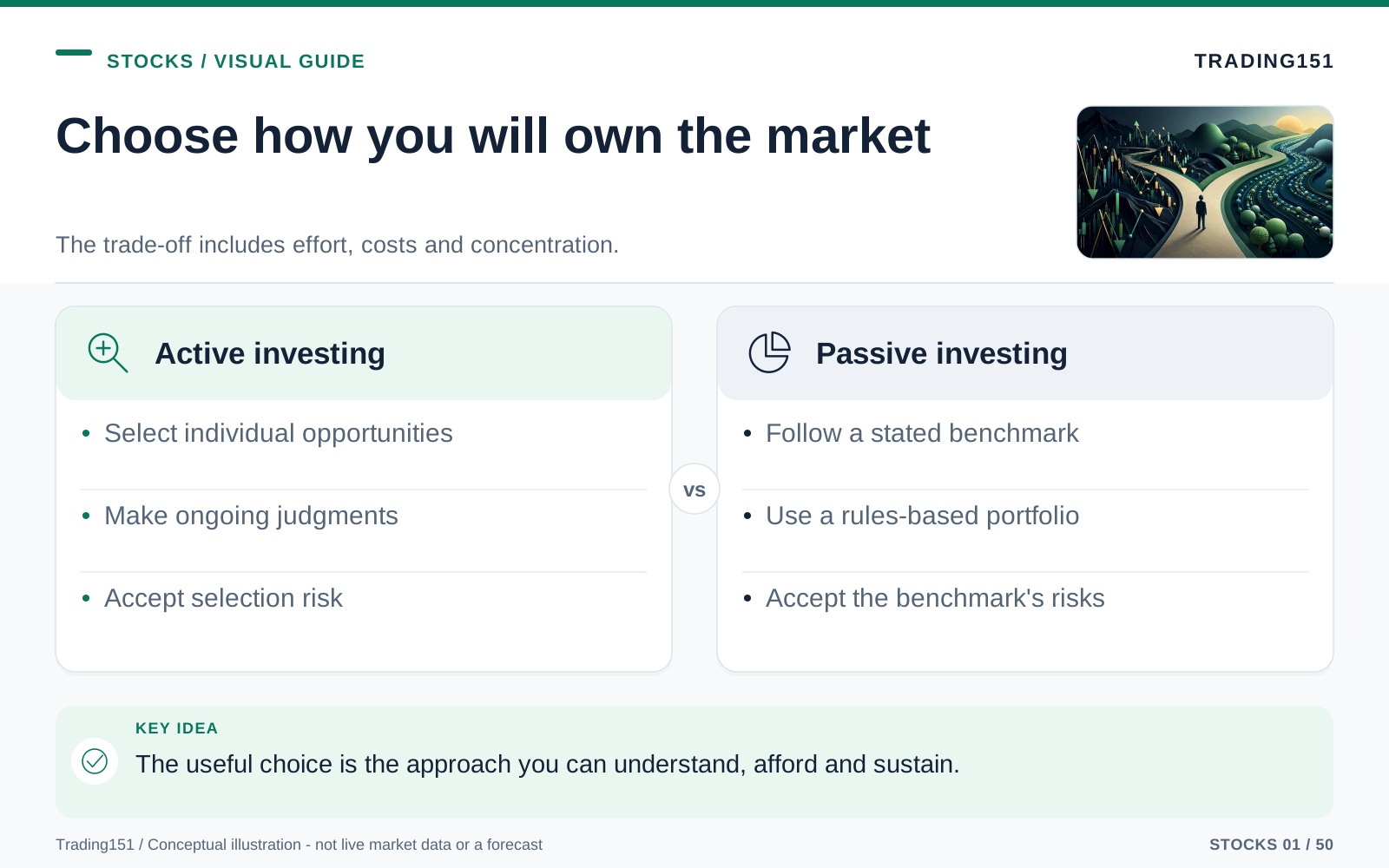
Read this diagram as text
- Active investing
- Select individual opportunities; Make ongoing judgments; Accept selection risk
- Passive investing
- Follow a stated benchmark; Use a rules-based portfolio; Accept the benchmark's risks
Part 2: Passive Investing — Owning the Market Instead of Fighting It
Passive investing flips the script entirely. Instead of stressing over the question, “How can I beat the market?” it asks a much more peaceful one: “What if just owning the market is plenty?”
In practice, this means buying index funds or ETFs (Exchange-Traded Funds). The goal isn’t to outsmart anyone; it’s just to mirror a specific index. If you buy an S&P 500 fund, you instantly own a tiny sliver of the 500 largest U.S. companies. If you buy a total world fund, you're suddenly a partial owner of thousands of businesses across the globe.
The beauty of it lies in its simplicity. You don't have to guess if AI is the future or if banks will have a good quarter. You don’t need to hunt for the next Amazon. You just buy a large basket of everything, keep funneling money into it, and let the natural upward trajectory of global business do the heavy lifting over the next few decades.
People love to call passive investing "boring," and they aren't wrong. But when it comes to your life savings, boring is a superpower. A slightly dull plan that you can comfortably stick with for 30 years is always going to beat a complex, genius-level strategy that stresses you out so much you abandon it after three months.
How Passive Investing Works in Practice
Most passive investors keep things minimalist, relying on just two or three broad, low-cost funds. You might have one for U.S. stocks, one for international stocks, and maybe a bond fund to smooth out the bumps. The exact recipe depends on your age, your risk tolerance, and when you need the cash. Just remember that "passive" doesn't necessarily mean "equally balanced." Most index funds are market-cap weighted, meaning the biggest companies take up the most space in the fund. If a tech giant's stock price rises sharply, it becomes a larger chunk of your portfolio. That lets your winners keep winning without you lifting a finger, but it can also mean you're heavily concentrated in a few large companies. It’s worth knowing what’s under the hood of your index fund.
Once you set up this portfolio, your job is basically maintenance. You automate your contributions, let your dividends reinvest, rebalance maybe once a year, and deeply resist the urge to log in and tinker just because the stock market had a scary week on the news.
Of course, this doesn't mean you can just tune out of your financial life completely. You still need an emergency fund, you still have to navigate taxes, and you still have to manage your debts. It just means you don't have to treat the stock market like an exhausting second job.
Why Passive Investing Has Become So Popular
- The fees are low. Index funds are basically run by algorithms, so they don't need to pay seven-figure salaries to a team of Wall Street analysts. Because the overhead is so tiny, they pass those savings on to you. Over a lifetime of investing, keeping those extra fractions of a percent will save you a fortune.
- Instant, effortless diversification. You’re never betting your retirement on one CEO making the right call. You own thousands of companies. Sure, some of them will go bankrupt. But others will grow beyond anyone's wildest expectations, and those large winners will pull the rest of the portfolio upward.
- It takes away the pressure to be a genius. You don't have to predict when the next recession will hit or guess which tech trend will dominate the 2030s. You just accept that nobody owns a crystal ball, and you use a strategy that works fine without one.
- It fits into a busy life. Real life is messy and exhausting. You’ve got a job, family, hobbies, and a million other responsibilities. Passive investing respects your time and lets you focus your energy on your actual life instead of CNBC.
The Trade-Offs of Passive Investing
- You will never beat the market. By definition, an index fund is just trying to tie the market, minus its tiny fee. You are officially surrendering the dream of substantially outperforming the pack. If you're a highly competitive person, this can feel like a letdown.
- You have to ride out the crashes. If the market drops 30%, your portfolio is going to drop 30%. There's no manager there to move your money to cash or try to soften the blow. Passive investing doesn't shield you from the storm; it just expects you to sit in the rain until it passes.
- You'll end up owning stuff you hate. When you buy the whole market, you buy the good, the bad, and the ugly. You’ll own pieces of companies you think are horribly mismanaged, terribly overvalued, or morally questionable. You aren't curating a list of your favorite brands; you're just buying the whole haystack.
- It can breed a false sense of security. Just because the strategy is simple doesn't mean you can't screw it up. You can still pick an asset mix that's way too aggressive, panic and hit "sell" during a recession, or get distracted and stop putting money in altogether.
Passive investing doesn't eliminate risk. It just eliminates a lot of exhausting, unnecessary decision-making. And that's a crucial difference.
Part 3: Fees, Time, and the Quiet Math Behind the Debate
We talk about active and passive investing like it's some grand philosophical debate, but a lot of it just comes down to cold, hard math. Every dollar you hand over in fees is a dollar that stops working for you. It loses its ability to compound and grow over time.
Imagine two friends who each start with $10,000 and invest $500 a month for 30 years. Let's say, just for the sake of the example, that they both get the same returns before fees. One uses a dirt-cheap index fund, and the other uses a pricier actively managed fund. A 1% difference in fees sounds completely harmless on paper, right? But the math over three decades is absolutely severe.
That 1% or 1.5% fee doesn't just trim a little fat off this year's profits. It shrinks your core balance, meaning you have less money generating growth next year, and even less the year after that. It’s compounding in reverse, silently eating away at your nest egg.
This is why active fund managers have such a severe job. They don't just have to be good at picking stocks. They have to be so good that they can cover their hefty fees and still have enough extra profit left over to beat the index. Often, they have to hit home runs just to tie the score.
Then there's the hidden cost of your time. A passive investor can set up their accounts on a Sunday afternoon and barely think about them for the rest of the year. An active investor is spending their weekends poring over earnings reports, listening to CEO interviews, and stressing over whether their strategy is still solid. If you love doing that, it's a great hobby. If you don't, it’s a miserable second job.
The final cost is pure mental energy. Your investments aren’t just abstract numbers—they dictate your mood, your confidence, and how well you sleep at night. You can build the most mathematically perfect portfolio on a spreadsheet, but if it makes you so anxious that you sell everything in a panic during a market dip, it’s a failed strategy.
Part 4: Performance — Why Consistency Is So Difficult
Active investing is built on legends. We all know the stories of rogue investors who bet against the crowd and made billions, or the guy next door who bought Amazon in 1999 and is now retired on a boat. Those stories are entirely real, and they’re exactly what makes stock picking so seductive.
The catch is that success stories are loud, while failures are very quiet. People love to brag at dinner parties about the tech stock that went up 500%. They conveniently forget to mention the three other stocks they rode into the ground, the years their portfolio got crushed by the S&P 500, or the flashy mutual fund they bought that quietly shut down after losing money.
When you look at the data over 10 or 20 years, it paints a sobering picture. The vast majority of professional active managers fail to beat the basic market indexes after you factor in their fees. That doesn't mean beating the market is impossible. It just means you are playing against the smartest people in the world, the margin for error is razor-thin, and the superstar manager who crushed it last year is statistically unlikely to do it again this year.
Plus, the statistics are heavily skewed by survivorship bias. When an actively managed fund performs terribly, the investment firm usually just quietly closes it or merges it into another fund. The losers are erased from history. So, when you look at a list of funds available today, you're only seeing the ones that happened to survive, making the whole industry look far more successful than it is.
If the Wall Street guys—with their ivy-league analysts, Bloomberg terminals, and direct lines to CEOs—struggle to beat the market, imagine how hard it is for the average person trading on their lunch break. You can absolutely still make money picking stocks, but you have to be direct with yourself about the odds you're up against.
Part 5: The Psychology of Money
Investing would be a breeze if we were all just emotionless robots. We’d set up our perfectly calculated spreadsheets, execute our plans, and never once feel panic, greed, or the urge to show off. But we're human, and humans are a mess of feelings.
Active investing taps right into our ego. We all want to be right. There is an undeniable thrill in spotting a trend before your friends do, putting your money on the line, and watching that stock soar. It feels amazing to think you saw something the rest of the world completely missed.
But that same ego is your biggest liability. If a stock you love starts falling, your pride might stop you from cutting your losses because you refuse to admit you were wrong. If you get lucky and win big, you might suddenly think you're a genius and start taking reckless risks. And when your coworker brags about making a quick fortune on some trendy crypto coin, you’re going to feel foolish for sitting patiently with your diversified index funds.
Passive investing brings its own mental baggage. Doing absolutely nothing sounds easy on a sunny day when the market is up. It is agonizingly hard when the news is concerning, your portfolio is down 25%, and every expert on TV is reporting on the end of the economy. In those moments, doing nothing feels completely irresponsible, even though doing nothing is the exact strategy you signed up for.
Ultimately, the best investing strategy isn't the one that makes you sound like a genius at a dinner party. It’s the one you can stomach sticking to when the market goes through the floor.
Part 6: Which Type of Investor Are You?
Choosing your path isn't just a math problem about maximizing returns. It’s a lifestyle choice. The right strategy needs to seamlessly fit your personality, your free time, your financial goals, and your stress tolerance.
You’ll probably thrive as a passive investor if:
- You just want a straightforward plan that doesn't demand weekend homework.
- Your eyes are on the long game—like retirement, true financial independence, or leaving something behind for your kids.
- You physically cringe at the idea of paying unnecessary fees to financial managers.
- You know yourself well enough to admit that market crashes freak you out, and you want to remove the temptation to panic-sell.
- You'd rather spend your precious free time hanging with your family, advancing your career, traveling, or just taking a nap.
You might love active investing if:
- You find business strategy, economics, and market trends deeply fascinating.
- You understand the crucial difference between "a great company" and "a great stock price."
- You have thick skin and can take a financial hit without spiraling emotionally.
- You have some "play money" that you can afford to gamble with, without jeopardizing your ability to pay rent or retire.
- You are disciplined enough to keep an honest scorecard of your wins and your embarrassing losses.
That last point is huge. Human memory is funny—we remember the time we tripled our money on a tech stock, but completely block out the three times we lost 20% on a bad tip. If you’re going to be active, keep a real spreadsheet. Put your returns side-by-side with a basic S&P 500 index fund. You aren't doing this to beat yourself up; you just need to know if all those hours of research are paying off.
Part 7: The Core-and-Satellite Approach
The good news is that you don't have to pledge allegiance to just one camp. Plenty of people use a hybrid strategy called the core-and-satellite approach. But there’s a catch: you have to set strict rules for your "satellite" money before you buy a single stock. Decide exactly what percentage of your portfolio it will be, how you'll measure its success, and what you'll do if you keep losing money. Without hard rules, it’s far too easy for a lucky streak to make you overly confident, or for a losing streak to make you double down to chase your losses. The "core" part of your portfolio only protects you if you keep it intact when your emotions are running high.
The core is the portion intended to carry the main investment plan. Some investors illustrate this approach with 80% to 90% in diversified, low-cost funds and a smaller satellite allocation, but that split is not a universal recommendation. The appropriate core depends on the goal, time horizon, cash needs, and capacity for loss. Diversification can reduce concentration risk; it cannot guarantee a comfortable retirement.
The satellite portion is your fun money. Depending on how much risk you can stomach, this might be 5% to 15% of your cash. This is where you get to scratch the itch. You can pick individual tech stocks, bet heavily on green energy, or buy that company you think is about to explode. If you're right, you get a nice little boost to your returns and a great story to tell. If you’re wrong, your retirement is still totally safe.
A core-and-satellite approach can separate long-term investing from a limited interest in selecting individual holdings. The satellite still needs a budget and a clear purpose. Without a limit on its size, repeated additions to speculative positions can undermine the diversification that the core was meant to provide. The arrangement is useful only when the combined portfolio remains suitable.
Part 8: Common Mistakes to Avoid
No matter which route you take, there are a few classic pitfalls that can absolutely wreck your progress if you aren't careful.
- Don’t invest cash you’re going to need next month. The stock market has a funny way of falling exactly when you need liquidity. If you need the money for a house down payment, tuition, or emergency bills in the next few years, keep it in a boring savings account.
- Don’t assume yesterday’s winner is tomorrow’s winner. Just because a stock or a specific sector has been on a tear recently doesn't mean it's going to the moon. Often, by the time everyone is talking about how great an investment is, the easy money has already been made, and the stock is dangerously overpriced.
- Don’t build a portfolio that keeps you awake at night. If a 30% drop in your account balance would make you panic and sell everything, you are taking on too much risk. It is infinitely better to hold a conservative portfolio you can stick with than an aggressive one you'll abandon at the worst possible moment.
- Don’t turn a blind eye to fees and taxes. They aren't glamorous, but they are the silent killers of wealth. Over a lifetime, paying attention to tax efficiency and fund costs can mean the difference between retiring at 60 and retiring at 70.
- Don’t let your portfolio become your personality. your investments are just tools to buy you freedom and security. Don't spend so much time obsessing over the market that you forget to live your life.
A fair comparison needs the same starting line
Suppose two investors each start with $20,000. One chooses an index fund; the other selects individual shares. After a year, the stock picker has $22,000 and the fund investor has $21,600. That looks like a clear win for active investing, but the comparison is not finished. Did the stock picker add money halfway through the year? Hold more cash? Take a much larger position in one sector? Pay for research or incur taxes that the fund investor avoided?
These questions separate a useful comparison from a flattering one. Contributions are not investment returns, and a concentrated portfolio should not be judged as though it took the same risks as a diversified fund. Choose an appropriate benchmark in advance, include trading and account costs, and compare the same dates. Record the hours spent researching as well. Time does not appear on a brokerage statement, but it is part of the commitment.
A small active allocation can serve as a learning exercise without becoming a referendum on your whole financial plan. Set its size before the next exciting opportunity appears, and decide what would justify keeping it. Perhaps the research is genuinely enjoyable. Perhaps the results, after costs and over a meaningful period, support the effort. What does not help is moving the goalposts whenever the benchmark does better. The purpose of measuring performance is to learn which process suits you, not to keep proving that your first choice was right.
What happens when a successful strategy becomes uncomfortable?
An active portfolio can become harder to manage precisely because it has done well. Imagine that one holding doubles while everything else stays roughly unchanged. The investor may still think of the account as a collection of ten equally important ideas, but the money now tells a different story. Keeping the winner means accepting more concentration; trimming it means accepting the possibility of missing further gains. Neither choice can be made sensible by looking only at the original purchase price.
A passive approach has decisions of its own. An investor who chose a broad equity fund five years before a major expense may need to reduce risk as the date approaches. That adjustment is about the purpose of the money, not a forecast that the market is about to fall. Calling the portfolio passive does not make its time horizon permanent.
Write down the circumstances that would justify changing the approach. A change in income, a nearer withdrawal date, or a loss of time for research is different from frustration after a weak quarter. That distinction helps prevent a damaging cycle: abandon active management after underperformance, embrace passive management after an index rally, then reverse the decision when stock picking looks attractive again. The strategy should fit a sustainable routine, not whichever result was easiest to admire last month. 1, 2
Choose a Process You Can Defend and Maintain
People will be arguing about active vs. Passive investing forever, and that’s perfectly fine. We need both. Active investors are the ones doing the heavy lifting to make sure stocks are priced accurately, keeping the markets competitive. Passive investors get to happily piggyback on that efficient market, reaping the rewards without breaking a sweat.
But for the vast majority of us juggling real-world responsibilities, a low-cost passive strategy is just the most logical place to start. It’s cheap, diversified, and demands almost zero mental bandwidth. It won't give you thrilling stories for the group chat. It just gives you a highly reliable engine for building generational wealth without the daily heart palpitations.
Passive investing is the ultimate default setting. You don't have to be right all the time; you just have to stay the course. Active investing is there for you if you have a unique edge, the time to exploit it, and the stomach to look foolish for a few years while you wait for your thesis to play out.
Whichever route you choose, judge your results fairly. If you're picking stocks, compare your real-world returns (after fees and taxes!) to an index fund that matches what you're doing. And if you're entirely passive, make sure you're still keeping an eye on your fund's hidden costs and whether it aligns with your long-term goals.
At the end of it all, the secret to investing is simply choosing the game you can keep playing. For most, that means relying on a large, passive core to do the heavy lifting, while carving out a small, safe space to actively scratch the itch. Just make sure you're allocating your money based on your actual tolerance for risk, not just because you want your financial life to feel a little more exciting.
Sources and further reading
Editorial revision: 7 October 2026. Numerical scenarios are hypothetical unless identified as historical. References support the added explanations and selected corrections; rules and product terms should be checked again before acting.