
ESG investing can mean managing financial risks, excluding certain activities, expressing personal values, or trying to influence companies. Those are different objectives, and they can lead to different portfolios. The first decision is what you are trying to achieve. A fund name or a high score cannot answer that question for you.
What ESG Means
ESG stands for Environmental, Social, and Governance. Think of it as a lens investors use to spot things that traditional financial statements tend to hide. —revenue, profit, debt, and cash flow are still important. ESG just adds an extra layer of context: how is this company making its money, and what kind of baggage comes with that?
A standard investor asks, "Is this company growing?" An ESG-minded investor asks that same question, but adds, "Is this company growing in a way that won't blow up in its face five years from now?"
These three pillars overlap a lot, but each one targets a specific part of how a business operates.
E is for Environmental: How the Company Treats the Planet
The "E" is usually the easiest part to wrap your head around. It’s all about a company’s relationship with the natural world—the energy it burns, the waste it dumps, and the resources it hogs. But a good environmental check doesn't just look at current emissions; it looks at the game plan. A utility company might be polluting heavily right now, but if they have a fully funded plan to transition to renewables, they might be a better bet than a software company that looks "clean" on the surface but relies on a large, energy-sucking global supply chain. The timeframe, the budget, and whether their data is trustworthy all play a huge role in the final grade.
- Climate impact: Are they actively measuring and cutting their greenhouse gases? Are they preparing for a low-carbon world, or just crossing their fingers and hoping regulators don't notice?
- Energy use: Are they switching to cleaner energy and making their factories, offices, and supply chains more efficient?
- Waste and pollution: How do they handle toxic materials, wastewater, and packaging? Do they try to prevent messes, or do they only clean them up when somebody catches them on camera?
- Resource use: If they rely on heavy water usage, mining, or timber, are they managing those resources so they don't run out?
- Product lifecycle: What happens when their product dies? Can it be fixed, reused, or recycled, or is it destined to sit in a landfill forever?
Imagine you're comparing two companies in the same industry. One is quietly streamlining its packaging, cutting waste, reducing emissions, and prepping for strict new environmental laws. The other is treating environmental damage like it's someone else's problem. Even if they both look substantially profitable today, that second company is carrying hidden risks that just haven't hit the balance sheet yet.
S is for Social: How the Company Treats People
The social pillar is all about humans. And we aren't talking about vague, feel-good PR campaigns. We're talking about the gritty daily reality of how a business treats its workers, customers, suppliers, and neighbors. A company can have a polished brand and still be propped up by exhausted employees, exploitative supplier contracts, unsafe factories, or products that actively harm the people buying them.
- Employee treatment: Are people paid a fair wage? Do they have decent benefits, safe working conditions, and actual room to move up?
- Workplace culture: Do they crack down on harassment, discrimination, and burnout, or do they sweep it under the rug until a whistleblower goes to the press?
- Diversity and opportunity: Is leadership open to people from all walks of life, or is the boardroom just the same small, exclusive club talking about inclusion without practicing it?
- Supply chain ethics: Does the company know who is assembling their products? Cheap production gets expensive when it turns out you're relying on forced labor or dangerous sweatshops.
- Customer responsibility: Are their products safe? Are they designed with the customer's wellbeing in mind, and marketed honestly?
- Community impact: Does the company add value to the towns where it operates, or does it just suck up resources and leave a mess behind?
Social metrics can feel a little harder to pin down than carbon tons, but there’s nothing soft or sentimental about them. Companies with toxic cultures hemorrhage top talent. Businesses that mistreat customers get sued, boycotted, and dragged on social media. And squeezing suppliers to the breaking point usually means your supply chain snaps the second a crisis hits.
G is for Governance: How the Company Is Run
Governance is easily the least glamorous part of ESG, but it’s the one most likely to save you from large financial headaches. It’s all about leadership, accountability, incentives, and the behind-the-scenes rules that shape corporate decisions. Things like board independence, executive bonuses, shady insider deals, and audit quality dictate how every other risk in the business is managed. A company can brag about its ambitious environmental targets, but if its governance is a mess, investors have zero reason to believe those targets will ever be funded or achieved.
A business can publish beautiful sustainability goals, sponsor local community events, and post endlessly about its corporate mission. But if the board is spineless, the CEO gets large bonuses regardless of performance, the accounting is totally murky, and insiders do whatever they want, those warm-and-fuzzy promises don't mean a thing.
- Board independence: Does the board hold the CEO accountable, or do they just rubber-stamp whatever management wants?
- Executive pay: Are the bosses rewarded for building long-term value, or just for artificially pumping up the stock price for a quick payout?
- Shareholder rights: Do regular investors have a voice, or is all the voting power locked up by a few insiders?
- Transparency: Are their financial reports clear and honest, or are they drowning in corporate double-speak that makes it impossible to know what's going on?
- Business ethics: Does the company have a rap sheet full of fraud, bribery, tax evasion, or regulatory fines?
- Risk oversight: Do the leaders see big threats coming—like cyberattacks or new climate laws—or are they always playing catch-up after a disaster hits?
Good governance doesn't guarantee a company will be perfect, but bad governance is a glaring red flag. When executives are insulated from the consequences of their actions, systemic problems tend to fester in the dark until they finally explode into very expensive public scandals.
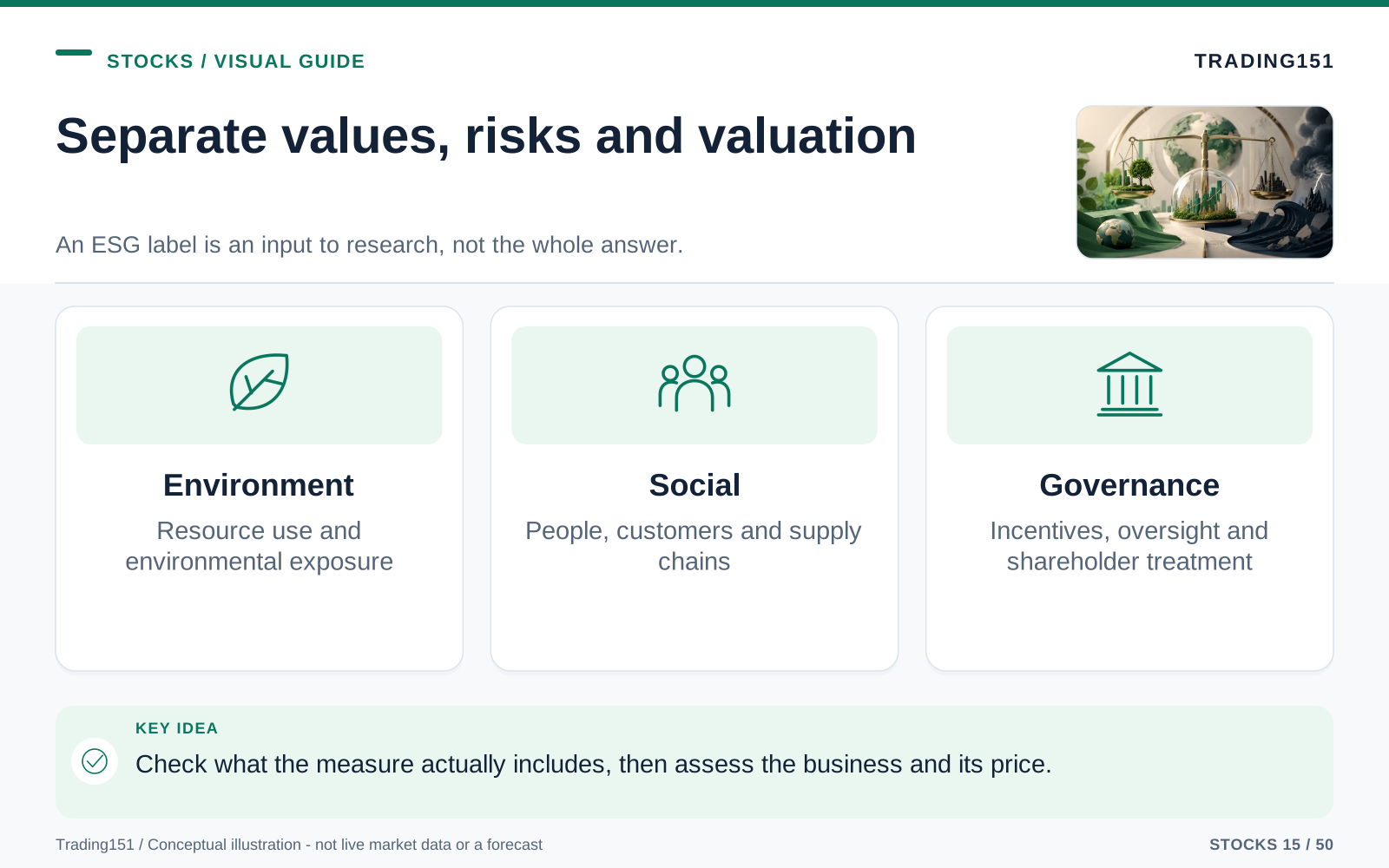
Read this diagram as text
- Environment
- Resource use and environmental exposure
- Social
- People, customers and supply chains
- Governance
- Incentives, oversight and shareholder treatment
Why ESG Became So Hard to Ignore
ESG didn't just pop up out of thin air. It gained traction because regular investors, employees, customers, and regulators started paying way more attention to the ripple effects of corporate actions. The outdated idea that companies could blindly chase quarterly profits and dump every resulting problem onto society is just really hard to defend these days.
Part of this is a generational shift. Younger investors are much more likely to ask what their money is funding. They aren’t satisfied with a broker just saying, “Hey, this fund went up 10% last year.” They want to know what’s inside. Are they bankrolling fossil fuels? Weapons? Private prisons? Companies known for busting unions? For a growing number of people, those aren't just fringe concerns anymore.
Transparency is another huge factor. It is practically impossible for companies to hide their dirty laundry now. A toxic workplace, a factory collapse, an oil spill, or a racist ad campaign can jump from a local incident to a global trending topic in minutes. Employees tweet. Customers organize boycotts. Regulators launch probes. And Wall Street notices.
But the biggest reason ESG took off is that it finally framed ethics as financial risk. Climate change isn't just a moral debate; it physically threatens supply chains, spikes insurance premiums, disrupts agriculture, and brings heavy regulations. Treating your workers terribly isn't just cruel; it leads to strikes, high turnover, lawsuits, and tanked productivity. Shady governance isn't just ugly; it leads to large fraud and overnight stock collapses.
Put simply, ESG isn't about whether a company is "nice." It’s about whether that company is prepared to survive in the real world.
Can ESG Investing Still Make Money?
This is the question people always hesitate to ask, even though it is completely completely fair. Investing isn't charity. You're allowed to care about your returns. If you're trying to build a nest egg for retirement, buy a house, or secure your family's future, performance absolutely matters.
For decades, the standard argument against ethical investing was straightforward: if you limit your options, you handicap your returns. The assumption was that having a conscience meant settling for a weaker portfolio.
But reality has proven to be a lot more complicated.
Some ESG funds knock it out of the park. Some perform terribly. Some are basically identical to regular index funds, just with three or four bad actors stripped out. Others are heavily concentrated in trendy sectors that might skyrocket one year and crash the next. There is no magic "ESG button" that automatically turns a portfolio into a winner.
That being said, leaning into ESG doesn’t mean you have to brace for lower returns. In a lot of cases, it's just a smarter way to spot incoming risks and hidden opportunities. A company that wastes energy, cuts corners on safety, treats its staff like garbage, and lies to its shareholders might post great numbers for a few quarters, but it's fundamentally fragile. Companies that handle those issues well are generally built to last.
Think about the large corporate trainwrecks that have wiped out billions in shareholder value: catastrophic oil spills, accounting frauds, exploding products, bribery rings, large data breaches, or unhinged CEOs. Almost all of these disasters had a glaring ESG component. They weren't random lightning strikes; they were the result of toxic cultures and ignored risks that had been bubbling under the surface for years.
Still, let's stay grounded. ESG isn't a guarantee of virtue, safety, or market-beating returns. It’s a lens. It's a very helpful lens, but it's still just one part of doing your homework. Things like management fees, diversification, valuation, and your personal time horizon still matter just as much as they always have.
The Many Faces of ESG Investing
One of the biggest reasons ESG feels so confusing is that people use the same term to describe totally different strategies. Two people can proudly claim they are "sustainable investors" while holding completely different portfolios.
Exclusionary Investing
This is the oldest trick in the book. You decide what you fundamentally refuse to support, and you boot it out of your portfolio. Common targets include tobacco, coal mining, weapons manufacturing, gambling, private prisons, or companies tied to severe human rights abuses.
People love this because it’s black and white. If you hate an industry, you don't own it. The downside? Just avoiding the "bad guys" doesn't necessarily mean you're actively supporting the "good guys." It just narrows your pool.
Best-in-Class Investing
This approach compares companies directly to their peers. Instead of tossing out a whole sector, a fund will pick the companies that have the strongest ESG habits within that specific industry.
This is very practical, but it catches a lot of people off guard. A "best-in-class" ESG fund might still hold shares in an oil giant, a mining conglomerate, or a large global bank—simply because that specific company scored better than its direct competitors. If you're pragmatic, this makes sense. If you're deeply ideological, it feels like a large cop-out.
Thematic Investing
Thematic funds zero in on very specific solutions, like clean energy, water infrastructure, battery tech, sustainable farming, or women in leadership. These are popular because you know exactly what you're buying into.
The catch here is concentration. A fund that only buys clean energy stocks is way less diversified than a total stock market index. You might see large gains when green tech is trending, but you'll feel every bump when the market shifts away from it.
Impact Investing
Impact investing is for people who want hard proof. The goal is to generate measurable, positive changes right alongside financial returns. You usually see this in private markets, community loans, or green bonds. If a company just sounds friendly, that's not enough; the investor wants to see the data proving they fixed a problem.
For the average person buying stocks on a brokerage app, true impact is tough to pull off. Buying shares of Apple from another guy on the stock market doesn't directly give Apple money to build a solar farm. Still, impact-heavy funds are great for funneling capital toward businesses that have crystal-clear environmental or social goals.
Shareholder Engagement
Some investors refuse to walk away from problematic companies. Instead, they buy enough shares to get a seat at the table and make a racket. They vote on corporate proposals, pressure the board, demand transparency, and rally for better climate or labor policies.
This strategy embraces a messy reality: sometimes the best way to fix a broken company isn't to boycott it, but to buy it and force it to change from the inside.
The Problem with Greenwashing
Whenever large amounts of money swarm around a new trend, the marketing teams aren't far behind. That’s exactly why greenwashing has become such a headache. When a company claims to be eco-friendly, you need to look for actual, measurable baselines. Are they hitting interim targets? Are outsiders auditing their progress? Is their budget funding these grand promises? Vague corporate speak about being "planet positive" or "on a sustainability journey" is cheap. A real, credible plan tells you exactly what is changing, what it will cost, when it will happen, and—just as importantly—what bad habits they aren't fixing yet.
Greenwashing happens when a business or a mutual fund dresses itself up to look way more ethical or sustainable than it is. Sometimes it’s notably obvious: a company slaps a picture of a leaf on a plastic bottle, throws around words like "earth-conscious," and hopes you don't look closely. Other times it's sneaky: a mutual fund subtly adds "ESG" to its name but is still packed with the same questionable stocks you'd find in a standard fund.
The really frustrating part? Greenwashing works because we're all busy. Most of us don't have the time to comb through a 200-page prospectus or cross-reference corporate sustainability audits. A nice green logo and a reassuring label do a lot of heavy lifting.
That’s why you have to make a habit of looking under the hood. Never stop at the title of the fund. Look at their top ten holdings. Read how they screen their stocks. Are they excluding things? Are they focusing on a theme? Are they aggressively voting at shareholder meetings? A fund called "Future Sustainable Leaders" might be a brilliant, forward-thinking portfolio... Or it might just be the S&P 500 wearing a hemp t-shirt.
Why ESG Ratings Can Be Confusing
If you've ever looked up an ESG score, you've probably walked away scratching your head. They aren't like credit scores or simple math. Different rating agencies use substantially different formulas, care about different data points, and prioritize different issues. A company might get a gold star from one agency and a failing grade from another. Crucially, a lot of these ratings measure financial materiality—meaning how much ESG risks threaten the company's profits—rather than how much the company threatens the planet. A business can get a great ESG score simply because it expertly shields itself from climate risks, even if its main product is terrible for the environment. You have to know what the rating is measuring before you treat it like a moral grade.
Part of the chaos is just how broad ESG really is. Company A might have practically zero carbon emissions but treat its warehouse workers terribly. Company B might have incredible corporate governance but sell a highly controversial product. Company C used to be a disaster but is turning things around faster than anyone else in its sector. How on earth do you boil all of that down into a single letter grade? The short answer is: you can't, at least not perfectly.
There is also that large underlying question: is the rating telling you how good the company is for the world, or how much the changing world threatens the company? Those are two very different things.
This doesn't mean you should ignore ESG scores entirely. They are a fantastic place to start your research. But don't treat them like gospel. A rating is just a map drawn by someone else—before you follow it, make sure you know where they're trying to take you.
How to Start ESG Investing Without Overcomplicating It
You don't need a finance degree to start investing with a bit more intention. The goal here isn't to build a flawlessly ethical portfolio that solves world peace. The goal is just to make better choices and stop blindly throwing money at companies that actively fight against the things you care about.
1. Decide What You Care About Most
Start with yourself. ESG covers a large amount of ground, and no single fund is going to perfectly mirror your personal worldview. For one investor, fighting climate change is the only thing that matters. For someone else, it might be fair wages, gender equality, animal rights, fighting corruption, or blacklisting the defense industry.
Write down your absolute dealbreakers. Then, figure out where you're willing to bend. Doing this upfront makes the whole process so much easier. If you don't know what you're looking for, every fund will feel either entirely too strict or frustratingly loose.
2. Look at What You Already Own
If you have a 401(k), a standard brokerage account, or a basic index fund, you likely already own tiny pieces of thousands of different companies. Don't panic, but it is definitely worth peeking inside.
Look up the top holdings in your current funds. You might be shocked to find your "safe" index fund is loaded with companies you despise. Or, you might realize your portfolio is a lot cleaner than you thought. Either way, you can't fix it if you don't know what's in there.
3. Choose Between Broad ESG Funds and Focused Themes
For most regular people, broad ESG mutual funds or ETFs are the most painless way to start. They keep your money spread out across the whole market, but they tweak the weightings to favor better-behaved companies or screen out the worst offenders. They aren't flawless, but they are a large step up from a blind market fund.
If you're really passionate about a specific cause—like clean water tech or solar energy—thematic funds are great additions. Just keep in mind that niche funds can be a rollercoaster. They’re fun and impactful, but they probably shouldn't hold your entire life savings.
4. Read the Fund Methodology
I know, reading a fund's methodology sounds like a great cure for insomnia, but it will save you so much frustration. It simply tells you how the managers pick their stocks. Do they blacklist certain sectors? Do they just buy the highest ESG scorers? Do they use their voting power to bully bad boards? Do they publish reports proving their impact?
You don't need to understand every financial algorithm they use. You just want to make sure their definition of "responsible" matches yours.
5. Check the Fees
Values are great, but compound interest is real. A fund with large management fees is going to drag down your long-term wealth, no matter how ethical it is. A lot of ESG funds are cheap, while others charge a premium because they require heavy research or active management.
Before you click buy, compare the expense ratio to a non-ESG equivalent. Paying a tiny bit more for a fund that truly aligns with your soul? Totally reasonable. Getting gouged on fees just because a fund slapped the word "Green" in its title? Pass.
6. Stay Diversified
It is common for people to take a good intention and turn it into a recklessly narrow bet. You might absolutely love the idea of wind power, but dumping your entire retirement account into three wind turbine companies is a terrible financial plan. ESG investing doesn't give you a pass on basic investing rules: stay diversified, think long-term, and don't chase fads.
A smart, balanced ESG portfolio can mix broad index funds, a few thematic bets, some bonds, and cash, tailored to your risk tolerance. Your values should guide your financial plan, not hijack it.
7. Revisit Your Portfolio Over Time
The business world shifts. Funds change their rules. Your own values might evolve, too. A mutual fund that looked perfectly fine three years ago might start drifting away from its original goals, or a company you previously hated might clean up its act and deserve a second look. You don't need to check your ESG scores every morning, but a quick annual review goes a long way.
Common Mistakes to Avoid
The biggest rookie mistake is assuming that just because a fund has "ESG" in the name, it is fundamentally ethical. The label is just a marketing tool. Always look at what they hold.
The second mistake is demanding perfection. Publicly traded companies are large, messy, global operations. They deal with complex supply chains, conflicting global laws, and thousands of employees. If you refuse to invest in any company that isn't utterly flawless, you're going to end up hiding your cash under a mattress.
The third mistake is tossing out standard investment logic. A fund can have the most noble mission on earth, but if it's substantially overpriced, heavily concentrated in one sector, or totally wrong for your retirement timeline, it's a bad investment. A good conscience doesn't offset bad math.
Finally, stop treating ESG like a personality test. Two people can share the same worldview and tackle it completely differently. One person might sell every oil stock they own. Another might intentionally buy oil stocks to vote on board members and force a green transition. One might avoid controversy; the other might dive into it. Be honest with yourself about what strategy fits your style, and stick to it.
So, Is ESG Investing Worth It?
If you want your portfolio to be more than just a blind pursuit of short-term cash, then yes, ESG is absolutely worth your time. It forces you to ask much better questions about the businesses you're backing. It can help you dodge large corporate disasters, reward companies that care about their footprint, and make sure your money isn't quietly funding things you hate.
But let’s not romanticize it. It is not a shortcut to moral purity. Buying an ESG ETF isn't going to reverse climate change by itself. It’s not going to force every greedy CEO to suddenly care about their community. And it certainly doesn't guarantee you'll beat the market. Anyone who tries to sell you ESG as a flawless, risk-free utopia is hoping you don't look too closely.
The healthiest way to look at ESG is simply as a tool. Like any tool, it can be used brilliantly or it can be totally abused. If you're lazy with it, you'll just fall for marketing tricks. But if you use it carefully, it becomes an powerful way to invest with your eyes wide open.
Give the fund a test it can actually pass or fail
Suppose your priority is avoiding a particular business activity. A fund that selects the highest-rated companies within every sector may still own businesses involved in that activity. It may be following its methodology correctly while failing your objective. Read the exclusion thresholds and exceptions rather than assuming that a broad sustainability label means no exposure.
Now suppose the goal is corporate change. Ask what mechanism is intended to produce it. Voting, engagement, financing new projects, and simply holding existing listed shares work differently. A fund's portfolio characteristics do not by themselves establish a measurable real-world effect. Reports should connect claimed outcomes with actions and acknowledge where attribution is uncertain.
Financial evaluation remains necessary. Compare costs, concentration, tracking differences, and valuation with a suitable alternative. A portfolio can align more closely with your preferences while taking a larger sector bet than you expected. That trade-off may be acceptable, but it should be visible rather than presented as a cost-free improvement.
Write two separate review questions: did the investment meet the stated values-related objective, and did its financial behavior remain appropriate for the plan? Keeping those tests separate avoids celebrating one result as proof of the other. It also makes changing funds easier when a methodology no longer matches what you intended to support or avoid.
Choose which compromise you are prepared to make
Two ESG funds can reach different portfolios because they define the objective differently. One may exclude certain businesses; another may hold them while seeking changes through engagement. Neither label tells you which trade-off has been chosen.
Read the methodology closely enough to explain the exclusions, data sources, treatment of disputed information, and review process. Then compare the resulting holdings with the financial exposure you intended to buy. A sustainability preference can be meaningful without being treated as proof of lower risk or higher returns.
It also helps to decide which priority comes first when objectives conflict. An investor seeking a strict exclusion may reject a holding that a transition-focused strategy considers useful. That disagreement is not resolved by a single score. A clear objective makes the compromise visible and prevents a fund's marketing language from quietly making the choice on the investor's behalf. 1, 2
Define the Values Before Choosing the Label
Most of us are never going to sit on the board of a Fortune 500 company, and we aren't writing national climate legislation. We don't get to directly dictate how the biggest corporate giants operate. But we do control where our money flows, and those choices leave a mark.
When millions of investors start demanding cleaner supply chains, fairer labor practices, honest leadership, and smart long-term planning, companies sit up and take notice. The large Wall Street asset managers take notice, too. The stock market isn't inherently moral, but it is highly responsive. It follows the money, and if enough investors demand better behavior, the market will adapt to supply it.
At its best, ESG forces Wall Street to factor in the very real risks of climate impact, burned-out workers, and shady backroom deals—things their old financial models used to completely ignore. It only falls apart when we let a lazy letter grade replace actual critical thinking, or when marketing departments trick us into thinking a basic stock filter is saving the world.
Take the time to read the methodology. Check the exclusions. Look at the top holdings. Be realistic about the trade-offs. A strict moral filter might mean you're heavily weighted in tech; a pragmatic "best-in-class" fund might mean you still own a little oil; a high-impact fund might cost you more in fees.
Your money is always sending a signal. Make sure it's saying what you want it to say. Keep your eyes open, protect your financial future, and let your convictions guide the way.
Sources and further reading
Editorial revision: 7 October 2026. Numerical scenarios are hypothetical unless identified as historical. References support the added explanations and selected corrections; rules and product terms should be checked again before acting.