
Institutional investors manage money for organizations, clients, or beneficiaries, often on a scale that affects trading and corporate ownership. They do not all pursue the same objective. A pension fund, an insurer, an index manager, and a hedge fund can hold the same stock for very different reasons. Following their activity requires understanding the mandate and the limits of the information being disclosed.
Who Are the “Whales”?
The phrase “institutional investor” sounds pretty clinical, like some faceless algorithmic machine humming away in a Wall Street basement. Really, it just means an organization that pools a lot of money together to invest on behalf of other people—whether that's clients, policyholders, or university donors.
The operative word here is huge. While you or I might buy fifty shares of a tech stock or drop a few thousand bucks into an index fund, an institution might drop five hundred million into a single trade. That large gap in scale changes the entire game. It dictates the tools they use, the risks they're allowed to take, and even the literal mechanics of how they click "buy" or "sell."
Here is a quick breakdown of the major players you’re sharing the market with, even if you never see them directly.
1. Mutual Funds and ETFs: The Crowd-Sourcers
Mutual funds and exchange-traded funds (ETFs) are probably the ones you know best. Millions of us use them in our 401(k)s without giving the underlying machinery a second thought. Financial juggernauts like Vanguard, BlackRock, State Street, and Fidelity rake in cash from everyday folks, advisors, and retirement plans, and then use that mountain of money to buy vast collections of stocks and bonds.
When you buy into an S&P 500 ETF, you aren’t individually calling up the stock exchange to buy fractional shares of 500 different companies. The fund handles the heavy lifting. They pool your fifty bucks with millions of other people's fifty bucks and follow a set strategy—some just mindlessly track an index, while others have a room full of analysts actively trying to beat the market.
This is where the magic of scale kicks in. Your monthly contribution is a drop in the bucket, but combined with millions of others, it creates a financial tidal wave. That’s exactly why these fund families end up being the largest single shareholders in the companies whose products you use every day.
2. Pension Funds: The Long-Term Planners
Pension funds exist to solve a very practical problem: people eventually retire, and they expect the checks they were promised. Firefighters, teachers, factory workers, and government employees rely on these systems to invest money today so it’s there for them thirty years down the road. Because of this, pension funds are obsessed with liabilities rather than just trying to beat a stock index. For instance, if interest rates shift, it changes the math on their future payouts, which might force them to sell stocks and buy bonds. When they dump large chunks of equity, it often has nothing to do with hating the stock—it's just a mathematical adjustment to keep the fund solvent.
Because their responsibilities stretch decades into the future, pension managers think very differently from day traders. Their job isn’t to win the afternoon news cycle. Their goal is to hit required return targets without taking wild gambles that could blow up retirees' safety nets. That mindset naturally pushes them toward deep diversification: a mix of stocks, bonds, private equity, and tangible assets like real estate.
That doesn't mean they're entirely passive. When a large pension fund starts making noise about climate risks, a CEO's ridiculous compensation package, or demanding better corporate governance, boardrooms usually listen.
3. Insurance Companies: The Risk Managers
Every time you pay a premium for your car, home, or health insurance, that cash doesn't just sit in a checking account. Insurers take those premiums and invest them, aiming to grow the money so it’s ready and waiting when someone files a claim.
Because they are constantly on the hook for sudden, large payouts—like a natural disaster or a major lawsuit—they can't afford to act like reckless gamblers. Insurers heavily favor boring, steady investments: high-grade bonds, reliable dividend stocks, and income-generating assets. You rarely hear about them causing wild market swings, but they quietly manage mind-boggling amounts of capital anchored to real-world promises.
4. Hedge Funds: The Aggressive Strategists
When movies and TV shows depict Wall Street drama, they are usually talking about hedge funds. Catering mostly to the ultra-wealthy, family offices, and other large institutions, hedge funds play by a different set of rules. They have the freedom to short stocks, heavily use leverage, trade obscure currencies, and run complex mathematical models that are nearly impossible to explain over coffee. Oh, and good luck tracking their moves. While public filings might show their stock holdings, they rarely reveal the full picture—like what they are shorting or hedging. What looks like a large bet on one company might just be a defensive hedge for a completely different trade.
The personalities of these funds are all over the map. Some spend months painstakingly researching a single company before buying in. Others are ultra-aggressive and use supercomputers to exploit price gaps that exist for less than a second. But they all share one thing: intense pressure to deliver exceptional returns that stand out from the crowd, which naturally pushes them toward unusual tactics.
Hedge funds get blamed for a lot of market volatility—sometimes fairly, sometimes not. Sure, shorting a struggling company into oblivion seems ruthless. But sniffing out corporate fraud or forcing a lazy CEO to step down? That's pretty useful. Like most powerful players in the market, they’re far more complicated than their reputation suggests.
5. Endowments: The Patient Capital of Universities and Charities
Universities, museums, and major charities rely on endowments to keep the lights on—not just for this semester, but for the next hundred years. A well-managed endowment funds scholarships, research grants, and those new campus buildings.
Because endowments are basically investing for eternity, they can buy things that regular people can't. If you need your cash next month to pay rent, you can't buy a forest. Endowments can. They pour money into illiquid assets like venture capital, timberland, and private equity, happily enduring years of tied-up capital in exchange for massively higher long-term payouts.
6. Sovereign Wealth Funds: Nations as Investors
Take the concept of an institutional investor and make it the size of a country—that's a sovereign wealth fund. Usually funded by oil revenues, trade surpluses, or large national savings, governments use these funds to ensure long-term economic stability for their citizens.
These funds are almost incomprehensibly huge. They buy up chunks of international real estate, global infrastructure, and huge stakes in public companies all over the world. And because they're an arm of a government, their investments often carry geopolitical weight. When a sovereign wealth fund buys into a foreign tech company, people don't just ask if it's a good financial deal; they wonder what the broader political strategy might be.
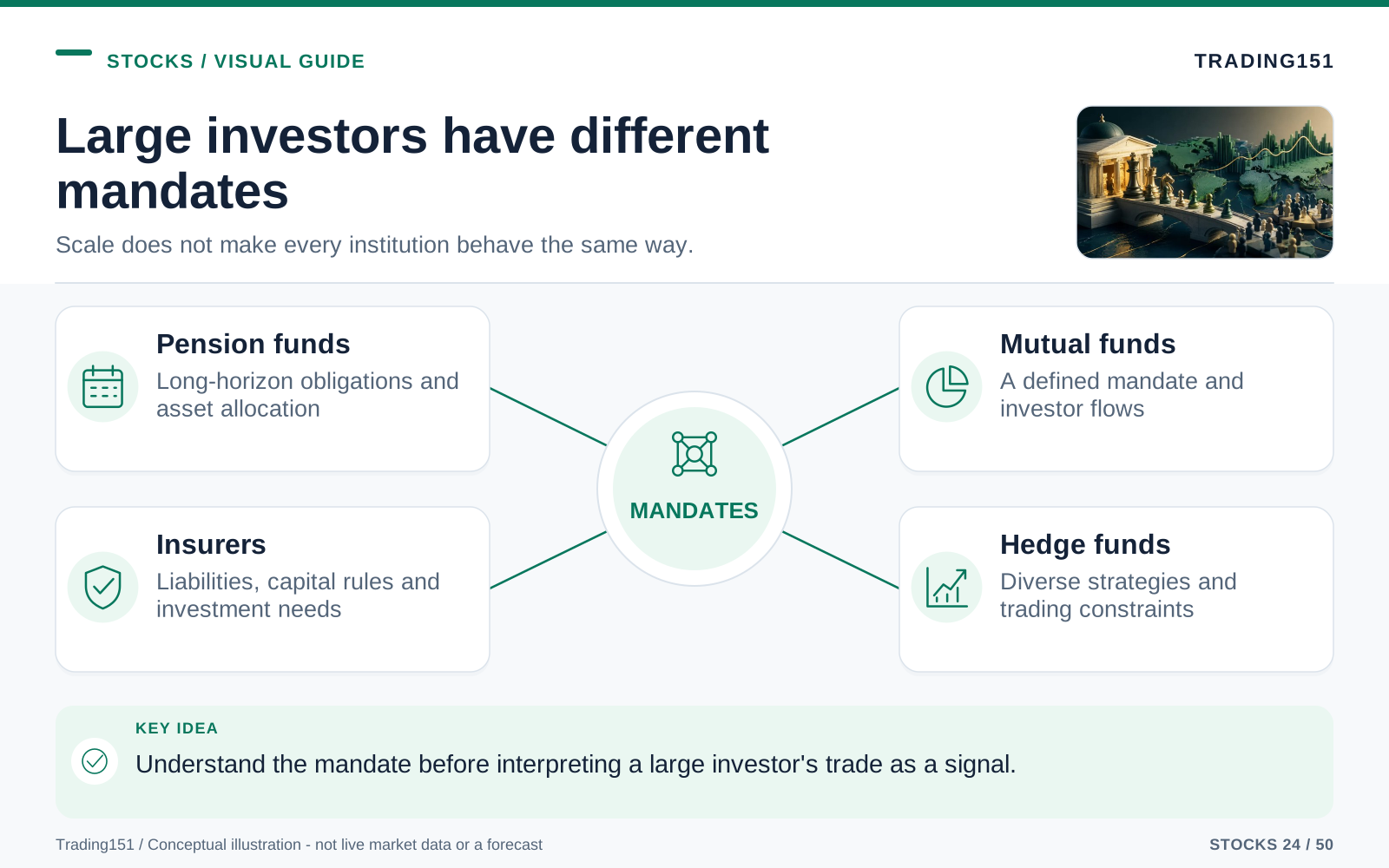
Read this diagram as text
- Pension funds
- Long-horizon obligations and asset allocation
- Mutual funds
- A defined mandate and investor flows
- Insurers
- Liabilities, capital rules and investment needs
- Hedge funds
- Diverse strategies and trading constraints
How Institutions Move the Market
Buying and selling as an institution is a fundamentally different sport than trading as an individual. Things like index rebalancing, the end of a financial quarter, or benchmark updates trigger predictable, large waves of buying and selling. A stock’s price might swing substantially simply because a passive fund had to adjust its holdings, even if the actual company hasn't changed at all. In the short term, this money flow dictates the market, even if it has nothing to do with long-term value.
If you pull out your phone right now and buy twenty shares of Microsoft, your trade executes instantly. Your tiny order is a pebble dropped into the ocean. The market doesn't even blink.
Now imagine a mutual fund needs to buy ten million shares. If they just smash the "buy" button all at once, the sudden explosion in demand will send the stock price soaring before their order even finishes filling. By moving too aggressively, they make the stock more expensive for themselves. The same goes for selling—dump too much at once, and they crash the price while they're still trying to get out.
To avoid this, institutions have to be careful. They slice huge orders into tiny fragments and slowly feed them into the market over days or even weeks. They also use "dark pools"—private exchanges where big players can swap large blocks of shares without tipping off the broader public. It sounds shady, but it’s mostly just a practical way to move giant sums of money without causing a public panic.
But no matter how sneaky they try to be, you can't completely hide an elephant in a phone booth. Sustained institutional buying will prop a stock up for weeks, while heavy selling will crush a sector—even if the news cycle is overwhelmingly positive. When the major players universally decide that interest rates are stuck high, or that artificial intelligence is the future, capital shifts on a tectonic scale.
Those shifts become market trends. You see it in booming sectors, crashing industries, and sudden changes in what investors are willing to pay for growth or safety.
Why Their Advantages Are So Big
We love the romantic idea that the stock market is an even playing field where everyone sees the same information and the smartest person wins. The reality? Institutions have advantages that the average guy at home on a laptop simply cannot replicate.
Information and Research
A serious retail investor might read annual reports, listen to earnings calls, and hang out on financial subreddits. A major institution, on the other hand, has an army of analysts who have studied one specific industry for a decade. They build unusually complex financial models, fly out to meet with suppliers, interview former employees, and cross-reference data from dozens of sources.
They also buy data most of us don't even know is for sale. We’re talking real-time credit card transaction feeds, global shipping logs, app usage statistics, and literal satellite images of retail parking lots. It's not magic; it's just a high-budget effort to see the future a few days before everyone else does.
Naturally, they still mess up. They get overconfident, they all pile into the same dumb trade, and they completely miss risks that seem blindingly obvious in hindsight. But they are playing with a much bigger deck of cards.
Technology and Speed
For high-frequency trading firms, the game is all about speed. They spend fortunes on supercomputers and lay fiber-optic cables just to shave a fraction of a millisecond off their connection times. They aren't reading balance sheets and thinking about the next ten years; they are using algorithms to scrape pennies off microscopic price inefficiencies before humans even realize they exist.
Trying to beat these machines at their own game is financial suicide. By the time your brain processes a price jump and your finger clicks the mouse, their computers have already bought, sold, and moved on. The good news? If you're investing for the long haul, milliseconds are just meaningless noise.
Access and Influence
Wall Street giants get VIP access. They have private sit-downs with CEOs, attend exclusive conferences, and get briefed by top-tier analysts. Yes, regulations strictly forbid companies from handing out insider information, but getting a read on a CEO’s body language, tone, and overall confidence over repeated conversations is a large edge.
Their size also buys them actual power. If you own ten shares of a company, your complaints go into the void. If a major fund owns 10% of a company, they can fire the CEO, shake up the board, and force large strategic changes. In the market, big money equals a loud voice.
The Good Side: Liquidity, Discipline, and Shared Access
It’s very easy to resent the big funds, especially when the game feels rigged. But the truth is, the market would be an absolute nightmare without them.
Their biggest gift to the rest of us is liquidity. Because institutions are constantly trading, you can instantly sell your shares whenever you want. You don't have to wait days to find a buyer. That seamless, invisible plumbing exists because institutional money keeps the gears turning.
They also force the market to be somewhat rational. Because they employ thousands of brilliant people to constantly test assumptions and hunt for mispriced stocks, they help ensure prices generally reflect reality. They put real, large money behind their opinions.
Let's not forget corporate discipline. When arrogant management teams start treating public companies like their own personal piggy banks, institutional investors are the ones with enough muscle to step in and stop it. They don't always do it perfectly, and they have their own conflicts of interest, but having concentrated ownership acts as a necessary guardrail against corporate greed.
Finally, institutions are the reason regular people can invest so easily today. Thanks to low-cost index funds, someone with a modest paycheck can instantly own a tiny piece of hundreds of companies. Fifty years ago, that kind of instant diversification was completely impossible for the working class.
The Bad Side: Crowded Trades, Fragility, and Distance from Real Life
Of course, the sheer size of these institutions comes with serious, undeniable risks.
Because a lot of them use the same data and risk models, they often end up piling into the same trades. Everything looks great on the way up, but the moment the wind changes, they all rush for the exit at the same time. This triggers a vicious cycle: selling drops the price, which triggers internal risk limits, which forces even more selling. It’s a recipe for market crashes that move way faster than the actual business fundamentals would suggest.
Add automated algorithms into the mix, and you get true fragility. In moments of panic, computers can start rapid-fire selling based on chaotic data, causing "flash crashes." One minute the market is perfectly fine, and the next, a glitch in the financial infrastructure violently wipes out billions in value.
Then there is the human cost, which is hard to ignore. Wall Street operates completely detached from Main Street. A hedge fund might look at a struggling retailer and see a brilliant short-selling opportunity. An activist investor might demand aggressive cost-cutting to boost quarterly margins. But to the people working at that company, those "efficiencies" mean large layoffs and shattered livelihoods. The cold math of finance rarely accounts for the human wreckage it leaves behind.
The GameStop saga of 2021 was the ultimate boiling point for this tension. When a large online mob of retail traders teamed up to squeeze the hedge funds betting against the stock, it felt cathartic. To millions of people, it was a righteous rebellion against a rigged system. To Wall Street, it was a senseless, speculative joke divorced from reality. Both sides were kind of right, but it proved one thing for sure: if ordinary folks band together, they can briefly force the giants to their knees.
Retail Investors Are Not Powerless
Knowing what you’re up against, it’s entirely understandable to feel outgunned. The big boys have more money, faster internet, deeper data, and VIP access. Going toe-to-toe with them on daily trades is a fool's errand. A fund manager might be forced to sell a perfectly good stock simply because clients are pulling their money out or a strict mandate kicked in. But as an individual, as long as you aren't playing with money you need tomorrow, you are never forced to sell. You can just wait them out.
You have a distinct set of superpowers. They’re just different from theirs.
You Can Think Longer
Professional money managers live in a state of constant paranoia. They are judged every quarter by clients who will happily fire them if they underperform. That pressure breeds extreme short-term thinking; a bad year can ruin a career, even if the long-term investment idea was brilliant.
You don’t have a boss demanding to know why your portfolio dipped this quarter. You can buy into a great company or a broad index and just go live your life for the next ten years, ignoring the temporary noise. Time is the ultimate equalizer, and it doesn't cost a dime.
You Can Stay Simple
When you manage fifty billion dollars, you can't just buy a few small, deeply undervalued companies. You have to buy large, complex positions just to move the needle, which inevitably leads to overly complicated portfolios.
You are allowed to be aggressively boring. Dollar-cost averaging into cheap, broad index funds month after month will mathematically outperform a huge percentage of Wall Street's sharpest minds. Boring isn't a weakness when boring works.
You Can Be Nimble
A large whale can't sneak into a tiny small-cap stock without accidentally jacking up the price and alerting the SEC. As a small retail investor, you can easily dart in and out of tiny, under-the-radar positions. Small-cap investing isn't easy by any means, but your lack of size is your greatest asset when hunting in those waters.
You Can Avoid Their Worst Habits
Wall Street is plagued by FOMO and bad incentives. Fund managers routinely buy into completely unhinged bubbles simply because they can't afford to look stupid while their competitors are making money, or they sell great assets because terrified clients are withdrawing cash.
You have the freedom to opt out of the madness. You can refuse to use dangerous leverage, keep your costs practically at zero, and completely ignore the hysterical news headlines designed to make you panic-sell.
How to Read Institutional Activity Without Obsessing Over It
You can peek at what the big funds are doing. By law, large U.S. money managers have to file "13F" reports every quarter that list their stock holdings. Sure, this data is heavily delayed by the time you see it—meaning the fund might have already sold the stock you're looking at—but it’s still a fantastic way to spot broad trends and see where the smart money is migrating.
Watching fund flows is another great hack. If you see tens of billions of dollars suddenly draining from tech ETFs and pouring into bonds or money market funds, that tells you a lot about the market's current appetite for risk. Keeping an eye on insider buying, short interest, and giant options trades adds great context too.
The trap, however, is treating these clues like a cheat code. Just because a legendary billionaire bought a stock doesn't mean it belongs in your portfolio. Institutions might be hedging against a different bet, they might be early, or they might just be flat-out wrong. Use their moves as a data point, not a direct command.
A large holding does not reveal the whole investment decision
A reported purchase may reflect an index change, client inflows, a hedge, or a long-term investment judgment. The public filing alone may not distinguish among them. Copying the holding without knowing the reason can leave an individual investor with an exposure that serves no comparable purpose in their own portfolio.
U.S. Form 13F reports are a common source of confusion. They disclose certain reportable positions at quarter-end and are generally filed up to 45 days later. They do not provide a real-time, complete view of the manager's portfolio, and short positions are not reported in the same way as the listed long holdings. The position could have changed before a reader sees the filing.
Scale also creates constraints. A large fund may need days to adjust an exposure without moving the market excessively, while a small investor can often trade an ordinary position more easily. Institutions may negotiate fees or access unavailable to individuals, but they can also face mandate limits, liability matching, and redemption demands that individuals do not share.
Use institutional activity as context for further research, not as borrowed conviction. Ask whether the underlying business and valuation make sense for your own horizon and risks. A respected manager's name cannot answer those questions for you, especially when the published record shows only part of the position and none of the full decision process.
A disclosed position may already be old information
Public filings are useful because they provide structured information, but they describe a reporting date and arrive under a reporting schedule. An institution may have changed its position before the reader sees the disclosure. The filing may also omit exposures that sit outside its scope.
Use the information to generate research questions rather than to copy a trade blindly. What might the institution's mandate require? Is the holding large relative to its portfolio, or merely large in dollar terms? Does the filing show ownership, management for clients, or something else? The answers can change the meaning of a headline. A prominent buyer's name does not establish a suitable entry price or holding period for another investor. 1, 2, 3
Large Capital Has Power—and Constraints
The stock market isn’t some epic fairytale struggle between plucky retail traders and evil institutional empires. It's a complex ecosystem. Some participants are large, some are fast, some are patient, and some are totally reckless. Often, the same institution will play all of those roles at different times.
Remember that "institutional money" isn't a single, coordinated hive mind. On any given Tuesday, an index fund might be blindly buying a stock, a hedge fund might be aggressively shorting it, and a pension fund might be selling it just to rebalance their bonds. The ticker tape just shows you the transaction, not the large web of mandates behind it.
Pay attention to what the whales are doing, but don't blindly follow them into the deep end. Copying a billionaire’s trade without copying their billions, their safety nets, or their exit strategy is a fantastic way to inherit a completely different set of risks.
The real takeaway? Respect the large scale of these players, but don't let them intimidate you. They provide the liquidity that makes the whole machine work. As an everyday investor, your biggest advantage is simply avoiding forced trades, keeping things profoundly simple, and letting your timeline do the heavy lifting that no Wall Street research budget could ever buy.
Sources and further reading
Editorial revision: 7 October 2026. Numerical scenarios are hypothetical unless identified as historical. References support the added explanations and selected corrections; rules and product terms should be checked again before acting.