
Retail investing apps make it easier to open an account, transfer money, and buy investments. Those conveniences can support a sensible plan, but they can also make frequent trading feel effortless. The important comparison is not which interface looks simplest. It is what the account permits, how the provider is paid, which protections apply, and whether the design helps you invest for the purpose you intended.
How Investing Became an App
This whole shift started with a basic frustration: traditional brokerages were clunky, expensive, and out of touch. Before the fintech boom, buying stocks often meant routing through a broker and paying commissions that would eat a small investor alive. Even when early online trading came around, the platforms felt like they were built exclusively for Wall Street insiders. The screens were packed with intimidating numbers, the research was dense, and normal people with a few hundred bucks to invest were treated as an afterthought.
Then, smartphones completely rewired our expectations. We got used to ordering takeout, catching a ride, and splitting bills through gorgeously simple apps. Finance couldn’t stay hidden behind ugly interfaces and confusing fee structures forever. A new wave of startups realized this. They didn't sell investing as some grand, intimidating venture—they pitched it as instant, highly visual, and entirely seamless.
The earthquake was zero-commission trading. When apps like Robinhood made free trades the new normal, the entire industry had to pivot. Legacy brokers who were used to charging per-trade fees suddenly found themselves competing with slick platforms where buying standard US stocks and ETFs cost absolutely nothing upfront. Before long, heavyweights like Charles Schwab, Fidelity, and ETRADE were forced to follow suit.
Next came fractional shares, which entirely changed the emotional math of the market. When a company's stock trades for hundreds of dollars a share, it feels impossible to own—even if it's a brand you use every day. Fractional trading meant you could buy a tiny slice of that company for five bucks. Suddenly, you didn't need to save up for a full share to get off the sidelines. You could just start with whatever you had in your checking account.
The pandemic poured gasoline on all of this. Millions of people were stuck at home—bored, anxious, and glued to their screens. Throw in stimulus checks, fewer ways to spend money, and substantially active social media communities, and you had a perfect storm. Trading apps morphed into a bizarre mix of entertainment, financial experiment, and social identity. The GameStop saga of early 2021 proved that everyday retail traders were now a legitimate cultural force, cementing the term "retail investor" into our daily vocabulary.
For many, this felt incredible. Everyday people were finally moving markets and openly discussing money in ways that used to be strictly reserved for financial professionals. But it also exposed the severe reality of crowd psychology, viral hype, and reckless risk-taking. The gates had been thrown open, but a lot of the people rushing through had no idea what was on the other side.
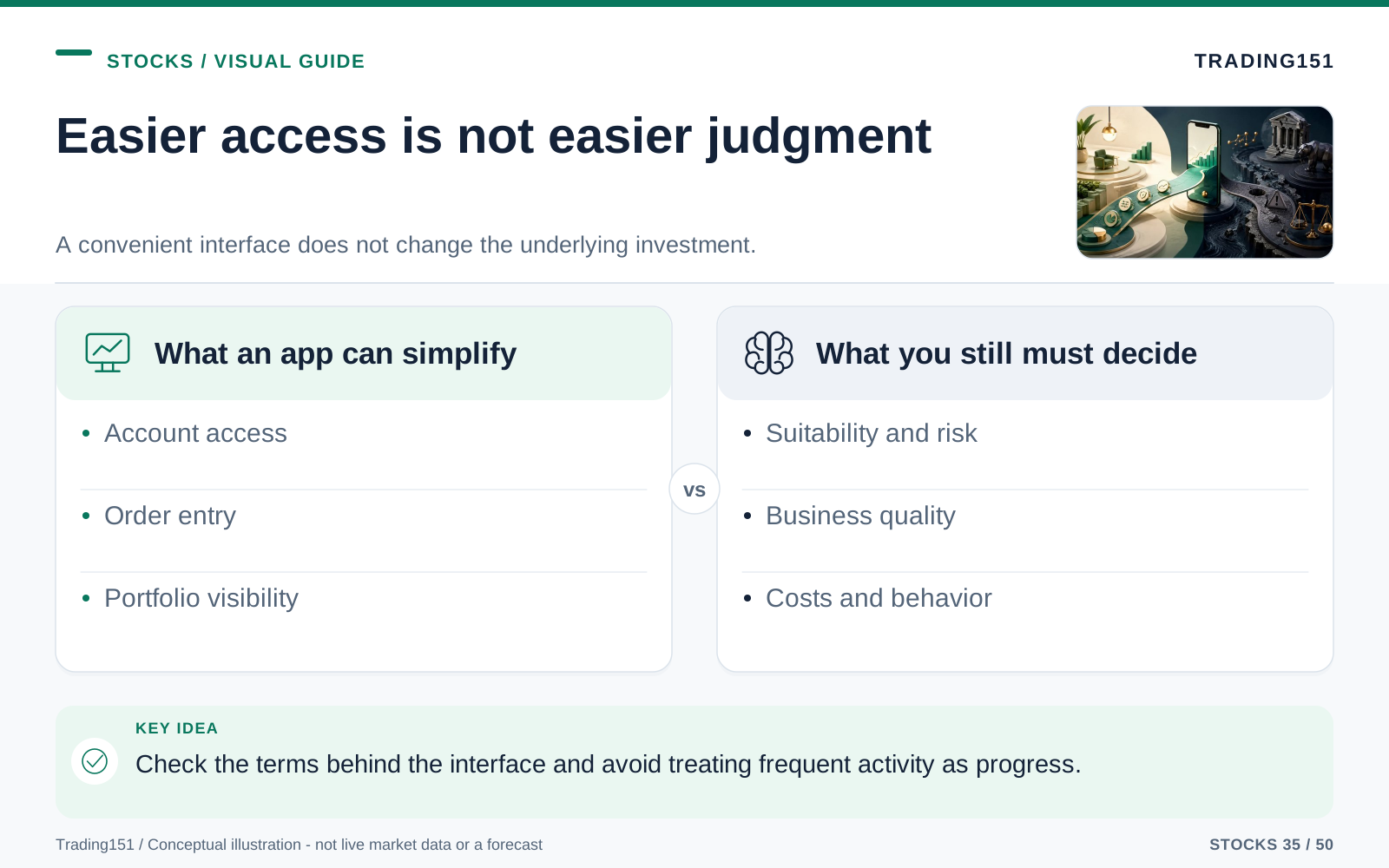
Read this diagram as text
- What an app can simplify
- Account access; Order entry; Portfolio visibility
- What you still must decide
- Suitability and risk; Business quality; Costs and behavior
What Retail Investing Apps Changed
Access is the obvious answer, but the real change was in our behavior. Apps didn’t just make investing easier; they fundamentally changed how it feels.
For starters, they completely lowered the barrier to entry. Someone who thought they needed five thousand dollars to start investing can now begin with the price of a cup of coffee. That’s huge. It lets people learn the ropes without betting the farm, making the market feel far less exclusive.
They also made our money hyper-visible. Your portfolio used to live in a paper statement that showed up once a month. Now, it lives right next to your text messages and Instagram feed. You can watch your net worth fluctuate by the second. While that can be motivating, it can also breed obsession. The more you stare at the screen, the more every tiny market dip feels like a personal attack.
Furthermore, they turned investing into a deeply consumer-centric experience. The most popular apps are bright, friendly, and lightning-fast. They swap out financial jargon for plain English, slick charts, and easily digestible educational content. This is great for getting beginners over the hurdle of opening an account. The downside? When an app feels this smooth, the gravity of what you’re doing can vanish. Hitting "buy" on a volatile asset starts to feel no different than adding a sweater to your digital shopping cart.
Finally, investing became a team sport. People now share screenshots of their gains, debate trades in group chats, follow financial influencers, and tie their personal identities to their market opinions. Learning from a community can be brilliant, but mixing money with public performance is a dangerous cocktail. It often pushes people into taking wild risks just for the bragging rights.
What Makes a Good Investing App?
Picking a platform is about way more than just finding the prettiest interface. You’re handing over your hard-earned money, your social security number, and potentially your entire retirement. A solid app makes smart investing simple, without making reckless gambling feel normal. You need to know what happens when things break down. When the market tanks and you need help, an elegant stock chart won't save you—but strong customer service, clear transfer rules, and a history of staying online during volatile days absolutely will. (Pro tip: always check if an app lets you transfer your assets to another broker "in-kind," otherwise you might be forced to sell everything and take a large tax hit just to switch platforms).
When you're shopping around, here is what matters:
- The real cost: Zero-commission stock trades are standard now, but these companies aren't running charities. Keep an eye out for sneaky fees on options trading, crypto spreads, transferring your money out, or borrowing on margin.
- A clean interface: The app should be easy to navigate without hiding the details that matter. Simple is great. Dangerously oversimplified—where you're encouraged to buy things you don't understand—is a huge red flag.
- Ironclad security: Biometric logins, two-factor authentication, and instant alerts shouldn’t be "nice-to-haves." They are non-negotiable baselines.
- Reliable execution: The market moves fast, especially when things get chaotic. An app that crashes the moment a stock goes viral is an app that will cost you money.
- Useful education: A good platform explains things like diversification, taxes, and compound interest in plain English. It should teach you how to be patient, not poke you to trade more often.
- Human customer support: When thousands of dollars are missing or frozen, an automated chatbot isn't going to cut it. Fast, clear human support is vital.
- The right account types: If you're just dabbling, a basic taxable account is fine. But if you’re serious about the future, you’ll want a platform that offers IRAs, automated investing, and access to low-cost mutual funds.
The best app rarely has the flashiest marketing. It’s simply the one that aligns with your financial goals and gives you the fewest opportunities to self-destruct.
The Major Personalities of Investing Apps
Brokerages aren't one-size-fits-all. Some are built for adrenaline, others for data nerds, and some for quiet wealth building. Figuring out which vibe you need will save you a complication later.
Robinhood: The Frictionless Trendsetter
Robinhood changed the world because it made buying stocks feel as easy as sending a text. When older brokerages still looked like Windows 95, Robinhood was sleek, inviting, and completely unintimidating.
- The feel: Lightning-fast, mobile-first, and easy on the eyes.
- Best for: Absolute beginners who want a dead-simple way to buy stocks and ETFs without drowning in data.
- The caution: That beautiful design can trick you into thinking real financial risk is harmless. The company has taken plenty of heat for gamifying trading, halting buys during the GameStop run, and routing orders in ways that benefit them. Convenience is great, but don't let it replace your brain.
Webull: The Chart Lover’s Playground
If Robinhood is a sleek sports car, Webull is an airplane cockpit. It’s packed with technical indicators, deep charts, analyst ratings, and real-time market news.
- The feel: Data-dense, highly customizable, and intensely technical.
- Best for: Active traders and intermediate investors who enjoy doing their own deep-dive analysis.
- The caution: Just because you have fifty charts on your screen doesn't mean you're making better choices. For a beginner, all that flashing data just creates the illusion of expertise. Often, a boring index fund will completely outperform a customized technical strategy.
Public: The Social Investing Space
Public looked at the stock market and decided it needed to feel more like Twitter. It mixes investing with a social feed, letting you see what creators, friends, and analysts are buying and talking about.
- The feel: Conversational, community-driven, and far less solitary than a traditional brokerage.
- Best for: People who learn best by watching others, or who want to demystify finance by talking about it openly.
- The caution: Just because a trade is popular doesn't mean it's smart. A financial influencer might be totally wrong, or they might just have a large risk tolerance that would ruin your personal bank account. Don't confuse "likes" with "due diligence."
Fidelity and Charles Schwab: The Long-Term Heavyweights
The old guard had to adapt, and they did a pretty good job. Their mobile apps might not win design awards, but beneath the hood, they offer robust research, retirement planning, and a large track record of trust.
- The feel: Established, comprehensive, and a bit traditional.
- Best for: Long-term planners, retirement savers, and anyone who wants to manage their IRA, checking account, and stock portfolio all in one reliable place.
- The caution: The mobile experience can feel a little clunky compared to the new fintech startups. But for many serious investors, that lack of flashiness is exactly why they stay.
The Hidden Business Model: Free Is Not Always Free
One of the wildest things about modern finance is that the price tag is usually hidden. If an app lets you trade for zero dollars, they are still making a large profit off you behind the scenes. Free trades don't mean free infrastructure. Brokerages make their money by collecting interest on your uninvested cash, lending out your shares to short sellers, charging you for margin loans, or getting paid by market makers to route your trades to them (a practice known as Payment for Order Flow).
Payment for order flow is highly debated. Proponents say it's the magical mechanism that allows you to trade for free. Critics argue it creates a large conflict of interest, ensuring you never quite get the absolute best price on your trade.
You don't need a degree in market mechanics to survive, but you do need to understand incentives. If your broker's entire business model relies on you trading constantly, borrowing money, and churning your account, they are not your partner in building slow, generational wealth. Free access is a brilliant thing, but it should never turn off your internal bullshit detector.
The Dark Side of the Swipe
When investing becomes this easy, it becomes easy to screw up.
In the past, the friction of calling a broker gave you time to think. Modern apps have completely nuked that pause button. You can see a stock surging on TikTok, feel a rush of adrenaline, buy in at the absolute peak, and deeply regret it twenty minutes later.
The problem isn't that regular people aren't smart enough to invest. It’s that human biology is terribly unsuited for a casino of flashing red and green numbers living in our pockets.
The illusion of action is a large trap. We are wired to feel like doing something is always better than doing nothing. But when it comes to investing, doing nothing is usually the winning move. Real wealth building is boring. You buy, you hold, you wait decades. Apps, however, hate boredom. They send you push notifications, highlight "top movers," and beg you to check in. Activity feels productive, but in the market, it usually just bleeds your returns.
FOMO (Fear Of Missing Out) is severe. When your coworker brags about their crypto gains or a stock goes parabolic online, panic sets in. You feel like you're the only one not getting rich. Buying something just because you’re terrified of being left behind is a recipe for disaster. Usually, you're just volunteering to hand your money to the guy who bought in early and is cashing out.
Overconfidence sneaks up on you. A new investor downloads an app during a large bull market, makes a quick thousand bucks, and suddenly thinks they’re the next Warren Buffett. Markets have a very cruel way of letting you think luck is a skill—right up until the crash wipes you out.
Options and margin can turn a bad afternoon into a lifelong debt. Options trading isn't inherently evil, but it’s highly complex and you can easily lose your entire investment. Margin is just a fancy word for trading with borrowed money. When you borrow money to trade, your losses are amplified. If you are new to this, treat these features like radioactive waste, not a fun weekend experiment.
Tax surprises ruin lives. Apps make trading feel like a video game, but the IRS definitely doesn't view it that way. Rapidly buying and selling triggers taxable events. Short-term gains are taxed aggressively. If you aren't paying attention, you can end up with a tax bill that wipes out your profits entirely.
Trading and Investing Are Not the Same Thing
It sounds like semantics, but understanding this difference will save your financial life. You need to intentionally build friction into your speculative gambling, while making your long-term saving totally frictionless. Set up your app to auto-buy index funds on payday, and actively disable your options and margin access. If you really want to play the market, keep a tiny, separate account just for scratching that itch, so your real wealth stays safe from your boredom.
Trading is trying to predict the future over days or weeks. It relies on charts, momentum, rumors, and incredible stress. A rare few people make a living doing this. The vast majority just lose their shirts.
Investing is buying a piece of a productive business or an index fund because you believe in its long-term growth. It’s patient. An investor doesn't care what the market does on a random Tuesday in October. They care about owning diversified assets and letting time do the heavy lifting.
Your app will let you do either. It doesn't care if you're quietly saving for retirement or aggressively day-trading penny stocks. The only thing separating those two realities is your own self-control.
A Responsible Playbook for Everyday Investors
You don’t have to swear off modern apps to protect yourself. You just need a few basic rules that are stronger than your impulses.
Rule 1: Start With the Boring Foundation
Before you even look at a single trending stock, get your house in order. Pay down your high-interest credit cards and build a cash emergency fund. The stock market is highly unpredictable; it is not the place to park next month's rent money hoping for a quick double.
Once you’re ready, start with broad index funds or ETFs. No, you aren't going to impress anyone at a party by talking about your S&P 500 fund. But diversification works precisely because you don't have to be a genius stock-picker to get wealthy.
Rule 2: Use Money You Can Leave Alone
The market crashes. Sometimes it takes years to recover. If you invest money that you're going to need for a house down payment in six months, a sudden drop will force you to sell at a large loss. A good rule of thumb is to only invest cash you won't need to touch for at least five years. Time heals most market wounds.
Rule 3: Automate Good Behavior
The single best feature of modern investing apps is automation. Set a fixed amount to pull from your checking account every Friday and buy your chosen funds. This is called dollar-cost averaging, and it completely removes the stress of trying to time the market. You'll buy when things are expensive, you'll buy when things are cheap, and over time, it all smooths out.
Automation takes your emotions completely out of the driver's seat. That’s exactly what you want.
Rule 4: Turn Off the Noise
Push notifications are fantastic if someone is stealing your identity. They are horrible if they are just popping up to tell you a stock you own dropped 2%. Go into your settings and aggressively turn off price alerts, trending news, and social feeds.
You do not need to check your portfolio while you are standing in line at the grocery store. Checking your account less often isn’t ignorant; it’s a superpower.
Rule 5: Write Down Your Rules Before You Need Them
Everyone is a rational genius when the market is flat. But when your portfolio tanks by 30%, or your buddy makes 10x his money on a meme coin, logic goes out the window.
Write down your strategy today. Why are you investing? What do you buy on a monthly basis? What percentage of your money are you allowed to gamble on individual stocks? Writing it down gives you a physical anchor when the market tries to pull you into a frenzy.
Rule 6: Keep Speculation Small
It's totally fine to want to buy a specific company because you think they're building the future. Just keep it contained. Decide on a small percentage of your portfolio (say, 5%) that you use as "play money." Treat it as money you are entirely prepared to lose, and never let it infect your core retirement savings.
Rule 7: Protect the Account Like It Matters
This isn't a game of Candy Crush; this is your actual wealth. Use a unique, strong password. Turn on two-factor authentication (ideally through an authenticator app or hardware key, not just SMS). Lock down the email address associated with your account, because if a hacker gets your email, they get your brokerage. Be paranoid about screen-sharing requests or sketchy Wi-Fi networks. Protecting what you’ve built is just as important as building it in the first place.
Who Should Use Retail Investing Apps?
If you want to start with fifty bucks, learn at your own pace, and automate your financial future from your couch, these apps are a godsend. They are the absolute best way for beginners to break the ice and get skin in the game.
However, if you know you have an addictive personality, a history of gambling, highly unstable income, or severe anxiety around losing money, a slick app on your home screen might be a terrible idea. You might be much better off using a traditional, "boring" brokerage, utilizing a financial advisor, or just sticking to your company's 401(k) where the money is taken out of your hands automatically.
Stop asking, "Which app will make me the most money?" and start asking, "Which platform will protect me from my own worst instincts?"
The Future of Investing Apps
The next generation of financial apps is going to get hyper-personalized. We are going to see AI deeply integrated into our portfolios, analyzing our spending, auto-adjusting our risk, and merging our checking, savings, and investments into one unified brain.
If done right, this is amazing. Imagine an app that gently taps you on the shoulder to say, "Hey, you're paying too much in fees over here," or "You have too much cash losing to inflation."
But there’s a darker alternative: apps that use AI to become even more addictive, perfectly tailoring their nudges to keep you swiping, trading, and generating fees. As the platforms get smarter, you’re going to have to be hyper-vigilant about whether the app is working for your future, or working for its own quarterly earnings report.
Frictionless access can still carry substantial costs
A zero-commission trade is not necessarily costless. Depending on the service and market, spreads, currency conversion, fund expenses, financing, withdrawal charges, or other arrangements can affect the result. Compare the full cost of a realistic month of activity rather than the one charge featured most prominently in advertising.
Look at the account's legal structure. Find the provider's registered entity, the custodian where relevant, and the treatment of uninvested cash. Investor-compensation and deposit-protection schemes have defined eligibility and limits; they do not insure ordinary market losses. A protection available for one balance or product should not be assumed to cover everything visible in the app.
Fractional shares can help invest small amounts, but their transferability, voting arrangements, order handling, and corporate-action treatment depend on the service. Check what happens if you move to another broker. Ease of purchase should not hide practical restrictions on ownership or exit.
Finally, adjust the interface to the plan. Price alerts, trending lists, and prompts to trade can be useful for some tasks and distracting for others. A long-term investor may benefit more from a reliable contribution confirmation than from constant invitations to react. Judge the app by whether it makes the right activity easier, not by how often it persuades you to open it.
Test the path out of the app
An investing app is also a route for withdrawals, transfers, tax records, and account closure. Review those functions before choosing it for a long-term holding. An attractive purchase screen is not enough if moving assets elsewhere is expensive, slow, or unsupported.
Check which securities can be transferred, whether fractional positions must be sold, what records can be exported, and how support is reached during a problem. The answers may differ by product and jurisdiction. A convenient interface can conceal a custody or product structure that is different from what the user expected.
Also examine the incentives built into the design. Frequent notifications, rankings, and prominent speculative products can encourage activity unrelated to the original plan. The best app for a particular investor is not necessarily the one with the most features. It is the one that supports the intended behavior while making costs, ownership, and exit arrangements clear. 1, 2, 3, 4
Convenience Is Useful; Engagement Is Not the Goal
Retail investing apps have completely democratized finance. They took a system that was expensive, exclusive, and confusing, and handed it to anyone with a smartphone. That is a beautiful thing.
But remember that these platforms are just tools. Their best features are the boring ones: automated deposits, dividend reinvestments, tax documents, and secure logins. All the flashy stuff—the confetti, the trending lists, the options chains—deserves your utmost skepticism.
Pick a broker based on trust, low fees, and reliable execution. Don't pick one because it has a fun color scheme. Turn off the notifications, protect your login like it's the keys to a vault, and understand exactly what you are doing before you ever borrow money to trade.
The barriers to building wealth have never been lower, but neither have the barriers to blowing your savings. Let the app handle the boring mechanics of investing, put your phone down, and let your actual life be the exciting part.
Sources and further reading
- Investor.gov: Technology and Digital Finance
- SEC Investor Bulletin: Trading Basics and Order Types
- Investor.gov: Asset Allocation
- Investor.gov: Stocks
Editorial revision: 7 October 2026. Numerical scenarios are hypothetical unless identified as historical. References support the added explanations and selected corrections; rules and product terms should be checked again before acting.