
Researching a stock means testing whether the business, its finances, and the price make sense together. A promising product is only one part of that assessment. The investor also needs to understand how the company earns cash, what claims sit ahead of shareholders, and which expectations are already reflected in the valuation. Good research leaves room for the possibility that an attractive story is a poor investment.
Step 1: Understand the Business Before You Touch the Numbers
Before you even peek at P/E ratios, analyst upgrades, or zigzagging stock charts, ask the most fundamental question: What on earth does this company do? Try tracing a single dollar from a customer’s wallet into the company’s bank account. Who decides to buy? How often? What else could they have bought instead? And as sales go up, what costs go up with them? Sometimes, digging into a company's segments reveals that their most famous product barely makes a dime. If you can't easily explain their money-making engine, you're going to have a nightmare trying to keep tabs on your investment.
It sounds like a no-brainer, but you'd be shocked by how many people skip this step. They buy in because a stock is on a hot streak, the tech sounds like a sci-fi movie, or a 30-second TikTok made it sound like a sure thing. Then, when the stock tanks, they’re left clueless. Is it a temporary market hiccup or is the company falling apart? They don't know, because they never understood the business in the first place.
Here’s a quick sanity check: could you explain what the company does to a smart ten-year-old in two sentences?
Apple, for example, is a breeze: they sell iPhones, Macs, and digital subscriptions to people worldwide. Costco is just as simple: they run large warehouses where people pay a yearly fee for the privilege of buying groceries and TVs in bulk at rock-bottom prices. Visa acts like a toll booth for digital payments, taking a tiny slice of the transaction every time you swipe your card.
Sure, those aren't boardroom-level breakdowns, but they prove you get the gist. You know what's being sold, who is buying, and why the money is flowing.
On the flip side, if you find yourself relying on buzzwords like "AI-powered ecosystem," "next-gen synergy," or "disruptive blockchain infrastructure," hit the brakes. It doesn’t mean the company is a scam, but it definitely means you aren’t ready to put your money into it. Toss it in the “too hard” pile until it clicks.
Once you've got the basics down, dig a little deeper. Where exactly is that cash coming from? Are people buying a product once, paying a monthly subscription, or generating ad revenue? Are they locked into long-term contracts? A software company pulling in steady, predictable monthly fees is a totally different beast than a homebuilder living at the mercy of mortgage rates and consumer confidence.
Don't forget to look for weak spots in how they get paid. Does one flagship product bring in almost all the cash? Is there a single large customer keeping the lights on? Are they completely reliant on one country, a specific raw material, or a government permit? Concentration isn’t a guaranteed death sentence, but if the company is leaning heavily on one pillar, you better make sure you understand it inside and out.
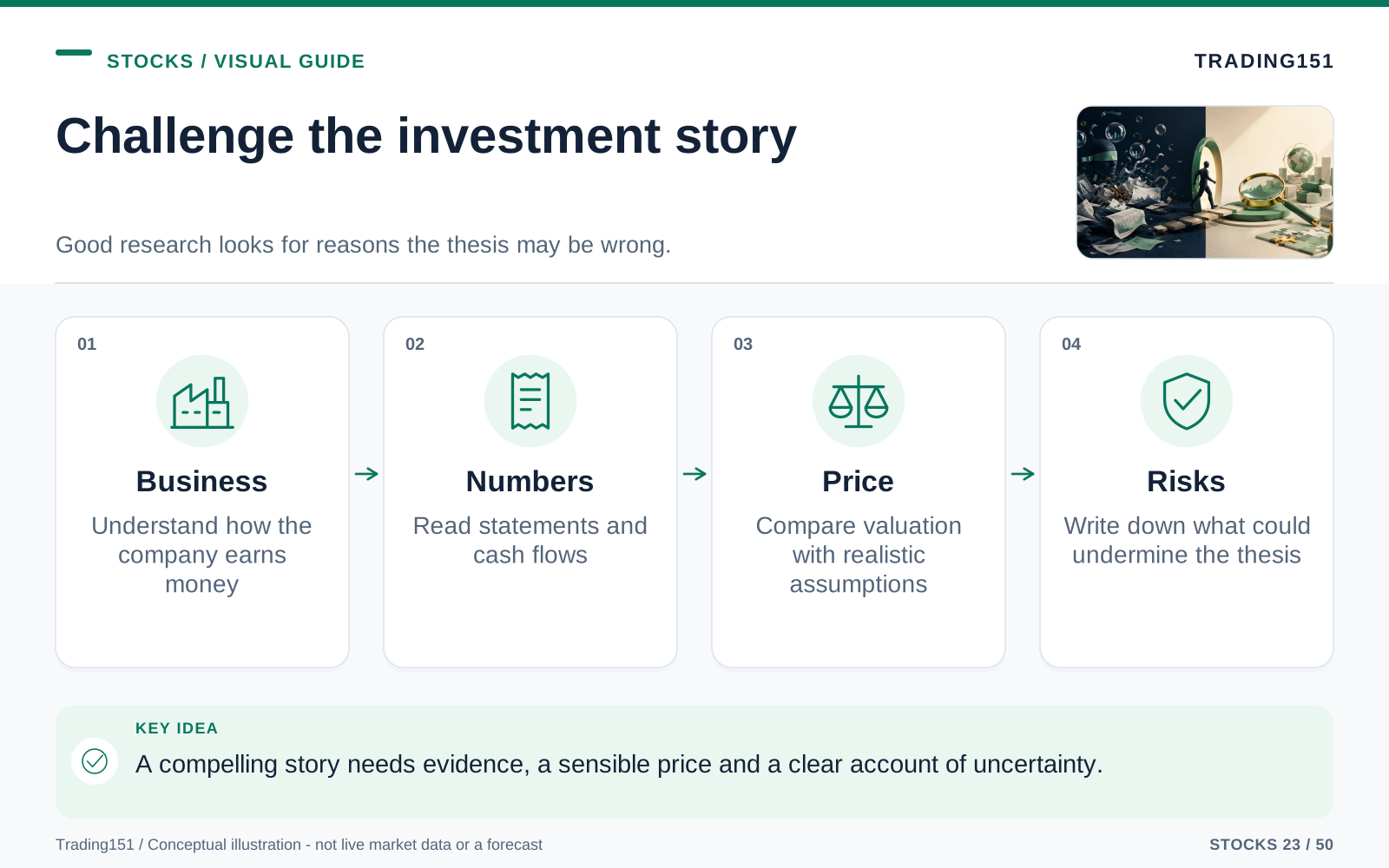
Read this diagram as text
- Business
- Understand how the company earns money
- Numbers
- Read statements and cash flows
- Price
- Compare valuation with realistic assumptions
- Risks
- Write down what could undermine the thesis
Step 2: Find the Company’s Moat
Success paints a target on a company's back. If a business is pulling in large profits, competitors are going to want a piece of that pie. That’s why you'll hear investors obsess over an "economic moat"—a built-in advantage that shields a company from copycats. You should be able to spot this moat in the real world and in the financial data. It might look like fiercely loyal customers, the ability to raise prices without losing sales, rock-bottom production costs, or government licenses. Keep in mind, high profit margins alone don't equal a moat; in fact, they’re usually what attracts the competition in the first place. You have to ask: what’s stopping a rich, aggressive rival from stealing their lunch?
Think of it like an actual medieval castle hoarding a pile of gold. If there are no walls or water around it, anyone can stroll in and take the loot. But if the castle is protected by deep water, iron gates, and archers, the gold stays put. In business, the gold is the profit, the attackers are rival companies, and the moat is whatever special sauce keeps customers coming back.
So, ask yourself bluntly: Why can’t a startup launch tomorrow, sell the same thing, and steal all the customers?
The best moats usually boil down to a few key advantages:
- Brand power: Some names carry serious weight. People don't buy an iPhone, a Ferrari, or a pair of Jordans just for the technical specs. They buy them because of the status, trust, and emotion tied to the brand.
- Switching costs: If breaking up with a company is expensive, risky, or just a complication, customers tend to stick around. Think about corporate software. Once a business builds its entire daily routine around a specific system, moving to a new one means retraining staff, risking lost data, and slowing down operations.
- Network effects: This happens when a product gets better simply because more people are using it. Think of social media platforms, payment networks, or online marketplaces. Buyers flock to where the sellers are, and sellers go where the buyers are.
- Scale advantages: Size matters. Large companies can negotiate cheaper materials, ship faster, and spread their costs over millions of sales. Walmart and Amazon didn't become retail giants by accident; their sheer size makes it painful for smaller guys to compete on price.
- Regulatory or intellectual property barriers: Sometimes, the law is the moat. Patents, exclusive licenses, and complex regulatory approvals can build a fortress around a business. You see this all the time with pharmaceutical drugs, defense contractors, and utility companies.
"They make awesome stuff" isn't a moat. Awesome stuff can be reverse-engineered. A real moat sounds more like, "Their customers are locked in because switching providers would shut down their operations for a week," or "They own the infrastructure and operate at a scale no one else can match."
Be extra cautious with hyped-up companies that don't have any real protection. Without a moat, their sky-high profits will eventually get chipped away by copycats. Sure, the stock might surge for a while, but the long-term reality is usually pretty grim.
Step 3: Read the Financial Statements Like a Business Checkup
Look, financial statements look concerning to beginners. They’re dense, boring, and full of accounting jargon. But you don't need a CPA to read them. Think of it like taking the company's blood pressure. You aren't trying to diagnose a rare disease; you just want to make sure the patient is breathing and healthy.
Public companies air their dirty laundry every three months, and they put out a large recap once a year. There are really only three documents you need to get comfortable with: the income statement, the balance sheet, and the cash flow statement.
1. The income statement: Are they making money? This shows what the company brought in (revenue) and what they kept after paying the bills (net income or profit).
Don't just glance at the latest year. Look at a three-to-five-year stretch to spot the trend. Are sales climbing steadily, or are they all over the place? Is the company taking home more profit as sales grow, or are they burning through cash faster than they can make it?
Pay close attention to margins—the percentage of each dollar they get to keep. Big margins usually mean the company has pricing power or a unique product. Razor-thin margins aren't always a dealbreaker, but they leave very little room for error if costs suddenly spike or sales take a hit.
2. The balance sheet: Can they survive a crisis? This is a snapshot of what the company owns (assets like cash, property, and inventory) and what it owes (liabilities like loans and unpaid bills).
Keep a close eye on debt. Debt isn't evil—it can fuel large growth if handled well. But too much of it strips a company of its flexibility. When the economy is booming, high debt makes growth look explosive. But when the market turns, that same debt can become a death sentence.
Ask some common-sense questions here: Do they have enough cash on hand to pay their upcoming bills? Is their long-term debt rising rapidly faster than their profits? If the economy tanked and sales dropped for a year, could they keep the lights on without panicking?
3. The cash flow statement: Is the cash real? The income statement can be legally massaged with clever accounting tricks, but cash flow is severe, honest math. It tells you if actual dollars are hitting the bank account.
Focus on operating cash flow (what the day-to-day business generates) and free cash flow (what’s left over after paying for building maintenance, new equipment, and other core investments). A company swimming in free cash flow has choices: they can pay off debt, buy out a competitor, reward shareholders with dividends, or buy back their own stock.
If a company constantly brags about record profits but never seems to generate positive free cash flow, be suspicious. Sometimes there's a valid reason, like heavy upfront investments in a fast-growing tech firm. But often, it's a large red flag that their accounting "profits" are mostly smoke and mirrors.
Step 4: Study Growth, but Do Not Worship It
Everyone loves growth. A company that consistently boosts its sales and earnings can make you very rich. But blind growth is dangerous; you need to care about the quality of that growth. Break it down: are they selling more products, raising prices, buying up competitors, or just benefiting from lucky currency exchange rates? Growing naturally using your own cash is vastly different from getting bigger by taking on debt to buy other companies or issuing a lot of new stock.
The best growth happens naturally because customers are obsessed with the product and the company can scale up efficiently. The worst kind of growth happens when a company slashes prices, burns cash on aggressive marketing, or overpays for shiny acquisitions just to make their revenue chart go up. That might fool Wall Street for a few quarters, but it doesn't create real value for you.
When a company posts large growth numbers, ask how they did it. Did they hike prices? Break into a new country? Organic growth is always cleaner than growth bought via endless mergers. Being able to raise prices is a much stronger flex than relying on heavy discounts to move inventory.
You also have to gauge how much runway is left. A tiny startup in a large global market might have a decade of explosive growth ahead. A heavy-hitter that already owns 80% of its market might barely grow at all, even if it prints cash every day. Neither is inherently bad—you just need to know exactly which game you're playing before you buy in.
Step 5: Decide Whether the Price Makes Sense
Here is one of the toughest pills for new investors to swallow: a world-class company can be a terrible investment if you pay too much for it. It feels totally backward. If the company is flawless, shouldn't the stock be a slam dunk?
Sadly, no. Price dictates your return.
Imagine your dream house in the perfect neighborhood. It's a great house. But if its actual market value is $500,000 and you pay $1.5 million for it, it was a horrible financial decision. The quality of the house doesn't save you from the reality that you drastically overpaid. Stocks act exactly the same way. The business and its stock are linked, but they aren't the same thing. A company can have a phenomenal year, but if the market's expectations were already ridiculously high, the stock will plummet anyway.
The classic starting line for valuation is the price-to-earnings ratio (P/E ratio). It simply tells you how much you're paying for one dollar of the company's profit. A P/E of 20 means you're shelling out $20 for every $1 the company earns over a year.
A P/E number isn't inherently "good" or "bad." A sleepy utility company trading at a P/E of 35 is likely substantially overpriced. But a hyper-profitable tech company growing 40% a year might be an absolute steal at a P/E of 25. You have to look at the context.
The best way to check a price tag is to compare it in three directions:
- Against its own past: Is the stock way above its historical average? If it usually sits at a P/E of 15 and suddenly it's trading at 40, expectations are running dangerously hot.
- Against the competition: How is the market pricing similar businesses with similar growth, debt, and risks?
- Against its future: Does today's stock price require the company to be perfect for the next ten years, or is the market totally ignoring a business that is quietly getting better?
Just remember that one size doesn't fit all. You analyze a bank using price-to-book value, but you judge a real estate trust (REIT) on its funds from operations. A cloud software company might be graded purely on recurring revenue and retention rates. Don't stress about memorizing a hundred different formulas; just figure out which metrics matter for the specific industry you're looking at.
And beware of the "value trap." A stock with a dirt-cheap price tag looks like a bargain, but sometimes it’s cheap because the underlying business is dying. If profits are about to fall off a cliff, a low P/E is just a mirage. Always ask yourself why Wall Street is letting this stock go for so cheap. Sometimes the crowd is wrong, but sometimes they see a large iceberg that you missed.
Step 6: Look Closely at Management
Buying a stock means buying more than just a brand name, some patents, and a few factories. You are actively handing your money over to a group of executives and trusting them not to mess it up.
Leadership dictates the future. A brilliant executive team will reinvest smartly, avoid stupid acquisitions, and shoot straight with their investors. A toxic or incompetent team can run a flawless business straight into the ground by drowning it in debt, diluting the stock, or chasing short-term bonuses.
Take a hard look at the CEO and the CFO. How long have they been steering the ship? Did they build this company from the ground up, or are they hired guns from another industry? Founder-led companies can be incredible because founders tend to think in decades, not just about next quarter's earnings—though being a founder doesn't automatically make you a genius capital allocator.
Check their skin in the game. Do the leaders own a large chunk of stock themselves? When an executive's personal net worth is tied to the stock price, their goals suddenly look exactly like yours. But if they're cashing large bonus checks while owning almost zero shares—or constantly selling off their stock without explanation—run.
Skim through their shareholder letters and listen to a few earnings calls. Tone tells you a lot. Do they speak in plain English, or are they hiding behind corporate word salad? Do they own up to their mistakes, or do they blame the economy, the weather, and the supply chain for every miss?
The best, most disciplined CEOs rarely make the evening news. They often sound boring. They talk about cash flow, customer satisfaction, cost control, and long-term strategy. In investing, boring is usually substantially profitable.
Step 7: Understand the Risks Before the Market Teaches Them to You
There is no such thing as a risk-free stock. But the most dangerous risks are the ones you didn't even bother looking for.
The human brain is a funny thing. The second you decide you like a stock, your brain will actively hunt for information that proves you right. You’ll cling to optimistic articles, bullish YouTube videos, and glowing forecasts, while brushing off any criticism as "hater" nonsense. Before you know it, you aren't an investor analyzing a company; you're a fanboy defending it.
To fight this, you have to play devil's advocate. Imagine it’s five years from now, your investment has crashed by 50%, and you lost a chunk of your savings. What went wrong?
- Did a hungry competitor launch a cheaper, better alternative?
- Did a large shift in technology make their main product obsolete?
- Did the government pass a law that destroyed their profit margins?
- Did inflation crush them because they couldn't raise prices?
- Did the CEO blow billions on a disastrous merger?
- Did interest rates spike and make their heavy debt load unmanageable?
- Did they lose that one large client who brought in 30% of their revenue?
Go out of your way to find the "bear case." Read the harshest critiques you can find. Look at their biggest rivals and ask honestly if the competitor's product is better. Check the risk factors buried in the company's annual report, but remember that lawyers write those to cover all bases—you need to figure out which threats have teeth.
The point of this isn't to terrify yourself out of buying stocks. It’s to know exactly what you’re stepping into. If you stare down the absolute worst-case scenarios and still believe the potential upside is worth it, your confidence will be unshakeable when the market gets rocky.
Step 8: Build a Simple Investment Thesis
Never click "buy" without writing down your investment thesis first. Seriously, this one habit will save you more money than any financial model. Putting it on paper forces you to turn a fuzzy "gut feeling" into a logical argument. Map out a base scenario, a best-case scenario, and an absolute disaster scenario. What numbers would prove you right, and what valuation makes sense? Doing this keeps you grounded and stops you from betting the farm on a single, fragile assumption.
It doesn't need to be a ten-page essay. In fact, a few bullet points is usually better. Jot down today's date, the current stock price, the core reasons you're placing the trade, and—most importantly—what specific events would force you to sell.
A solid thesis looks something like this:
- "I'm buying Company X at $50 a share because they dominate a fast-growing industry, their customers almost never leave, they print free cash flow, and their debt is super manageable."
- "I think they can easily grow their profits over the next five years because they are aggressively expanding into Europe and improving their profit margins."
- "The biggest threats are their somewhat high valuation, the threat of Big Tech swooping into their space, and their reliance on three major clients."
- "I will sell if their revenue growth suddenly stalls, customers start leaving, they take on large debt, or the CEO starts buying up unrelated businesses."
This piece of paper becomes your lifeline. When the stock market freaks out and your stock drops 20%, you can pull this out and ask: Did the actual business break, or is the market just having a bad day? If the facts changed, take the loss and walk away. But if the business is still cranking out cash and everything in your thesis holds true, it keeps you from panic-selling at the bottom.
Plus, writing it out acts as a BS detector. If you struggle to write down why you want to buy a stock without using hype words, you don’t have a thesis—you just have FOMO.
Step 9: Know What You Are Comparing It Against
Staring at a single company in a vacuum is a recipe for disaster. A stock can look incredible until you line it up next to its rivals. Before you invest, size it up against a few competitors and the broader industry.
Look at how they stack up in growth, profit margins, debt, and market share. Sometimes the stock you fell in love with is the best of the bunch. But other times, you'll realize a lesser-known competitor is growing twice as fast, holds zero debt, and trades at a much cheaper price.
Checking the competition also breaks the spell of a good corporate story. A CEO might blame a terrible quarter on a "tough macroeconomic environment," but if their top three rivals just posted record profits, you know the CEO is making excuses. If everyone in the industry is losing money, you know the sector itself is fundamentally broken right now.
Investing is a game of opportunity cost. Every thousand dollars you put into Stock A is money you can't put into Stock B, an index fund, a down payment on a house, or a business of your own. Your stock doesn't just need to be a "good" idea; it needs to be better than every other option on the table.
Step 10: Decide How the Stock Fits Your Portfolio
Even the most thoroughly researched stock isn’t a sure thing. How much money you put into it matters just as much as what you buy. A great stock pick can still wreck your finances if you bet way too heavily on it and get hit by bad luck.
Look at the big picture. How does this new stock fit with the rest of your portfolio? Are you accidentally buying your fifth software company? Do half your stocks rely on low interest rates, cheap oil, or a booming housing market to survive? A lot of people think they are diversified because they own a bunch of different tickers, only to realize later that all their stocks move in the same direction.
New investors completely underestimate concentration risk. Owning ten different AI startups is not diversification. Owning three major banks does not mean you own the whole economy. Diversifying won't make you immune to losses, but it will keep you from going broke when one specific sector falls sharply.
Decide beforehand what percentage of your portfolio this stock will take up. If you're just starting out, keep your individual bets small while you learn the ropes. Your confidence should come from doing the hard work and checking the facts—not from the adrenaline rush of YOLOing your savings into a single ticker.
Common Mistakes to Avoid
Successful investing is as much about dodging landmines as it is about picking winners. Here are a few traps that wipe out beginners time and time again:
- Buying just because the stock dropped: A stock that fell 60% isn't automatically a bargain. It might be undervalued, or it might be a dying business heading for zero.
- Buying just because the stock went up: Chasing a green chart might work for a few days, but a rising line is not a substitute for understanding the business.
- Ignoring share dilution: If a company is constantly creating and handing out new shares of stock, your slice of the pie is getting smaller and smaller, even if the company is growing.
- Falling in love with the product, not the business: You can absolutely love your Peloton or your favorite vegan burger, but that doesn't mean the company behind it is a smart financial bet.
- Staring at one metric: No single number holds all the answers. A large dividend yield, a super low P/E, or crazy revenue growth can all be large traps if you don't look at the bigger picture.
- Moving the goalposts: If you bought a stock for a specific reason, and that reason turns out to be wrong, take the loss. Making up new excuses to hold onto a losing stock isn't investing—it's delusion.
A Practical Research Checklist
To keep yourself grounded, run through a quick checklist before buying any stock. It doesn't need to be a 40-page spreadsheet, but running through these questions will stop you from making impulsive, emotional buys.
- Can I easily explain how this company makes its money?
- Do I know exactly what drives their sales?
- Do they have a real, defendable advantage over the competition?
- Are revenue, profit, and cash flow all trending up?
- Could they survive a severe recession with their current balance sheet?
- Do I trust the management team, and do their financial interests align with mine?
- Am I paying a fair price for the growth and quality I'm getting?
- Have I aggressively looked for the downside and the risks?
- How do they look compared to their biggest rivals?
- Did I write down exactly why I'm buying it and what would make me sell it?
If you can't confidently answer these, it doesn't mean you can never buy the stock. It just means you have more homework to do. There is absolutely no penalty for sitting on your hands. The stock market will be open again tomorrow.
Build a small case against your own thesis
Write the investment thesis in a few sentences before collecting more material. State what must happen for the purchase to work, what evidence supports that expectation, and what could make it wrong. A thesis that says only "the industry will grow" is too broad: industry growth can coexist with weak margins, heavy dilution, or disappointing shareholder returns.
Now look for the strongest objection. A competitor's filings may expose a cost disadvantage. A customer's report may show spending slowing. The cash-flow statement may reveal that reported profit is tied up in receivables or inventory. These checks are useful precisely because they are less flattering than the company's own presentation.
Use a range of outcomes instead of one highly precise valuation. Consider slower growth, weaker margins, or more shares outstanding, then ask whether the current price leaves room for those possibilities. A model can calculate a number to the cent while relying on assumptions that are uncertain by a wide margin. Precision in the output should not conceal uncertainty in the inputs.
Keep a short source record with dates, filing periods, and the distinction between management guidance and reported results. At the next review, compare developments with the original expectations rather than rewriting the story around the share price. The research has done its job when it helps you make and revisit a decision, including the decision not to buy.
Write the strongest objection to your idea
A research note is more useful when it includes the case against the investment. Identify the most credible reason the business could disappoint and what evidence would reveal that problem. Avoid substituting a vague statement such as 'markets may be volatile.'
The objection should connect to the company's economics: customer losses, weak cash conversion, refinancing, dilution, or a valuation that leaves little room for error. This does not make the decision pessimistic. It makes the monitoring process specific enough to notice a meaningful change before every disappointment is explained away. 1
Research Should Make the Thesis Easier to Break
Researching stocks isn't about perfectly predicting the future. Nobody has a crystal ball. It’s simply about stacking the deck in your favor and making smarter decisions before your hard-earned money is on the line.
A great piece of research fits on a single page. It lays out how they make money, what makes them special, the financial health, a fair price range, the biggest threats, and exactly what would ruin the trade. You only need to add more detail if it changes one of those core answers.
Make sure you never blur the line between hard facts, educated guesses, and personal opinions. Last year's revenue is a fact. Next year's profit margin is an estimate. Trusting the CEO to pull off a big pivot is just an opinion. Mixing those up makes your thesis feel bulletproof when it’s highly fragile.
You can never completely eliminate risk, no matter how many hours you spend staring at spreadsheets. The real payoff of doing the work isn't a 100% win rate. It’s knowing exactly what you own, managing your position size based on the risks, and being the first to realize when it’s time to cash out and move on.
Sources and further reading
Editorial revision: 7 October 2026. Numerical scenarios are hypothetical unless identified as historical. References support the added explanations and selected corrections; rules and product terms should be checked again before acting.