
Dividend growth investing focuses on businesses that can increase distributions over time, but the dividend is only part of the return. The price paid, the company's reinvestment needs, and the durability of its cash flow still matter. A rising payment can be encouraging without making the shares attractive at any valuation or suitable for every income need.
What Dividend Growth Investing Really Means
At its core, a dividend is just a slice of a company’s profits that gets handed directly back to the owners—and when you buy a share of stock, you are an owner. If a business brings in more cash than it realistically needs to keep the lights on, expand, or pay down debt, management has to figure out what to do with the surplus. One of the cleanest options is to just wire it straight to the shareholders.
Buying dividend stocks sounds foolproof, but true dividend growth investors are picky. They don’t just want a company that happens to be paying a dividend right now. They are hunting for companies whose underlying economics are so strong that they can hike that payout year in and year out.
It’s a crucial difference in mindset. Let's say you're looking at a stock paying a seemingly boring 2.5% yield next to one dangling a large 9%. Naturally, the 9% catches your eye. But if that first company manages to grow its dividend by 10% every year for the next decade while the second company struggles and freezes its payout, the "boring" stock will absolutely crush the high-yielder over time.
You aren't just buying cash flow. You’re buying cash flow that has the horsepower to grow. If everything goes to plan, that income grows faster than the rate of inflation, meaning your actual purchasing power gets stronger as you age instead of slowly withering away.
This is why veterans of this strategy rarely sort stocks by who pays the most today. A smaller, reliable slice of the pie from an absolute juggernaut of a company is infinitely more valuable than a large slice from a business that's fighting for its life.
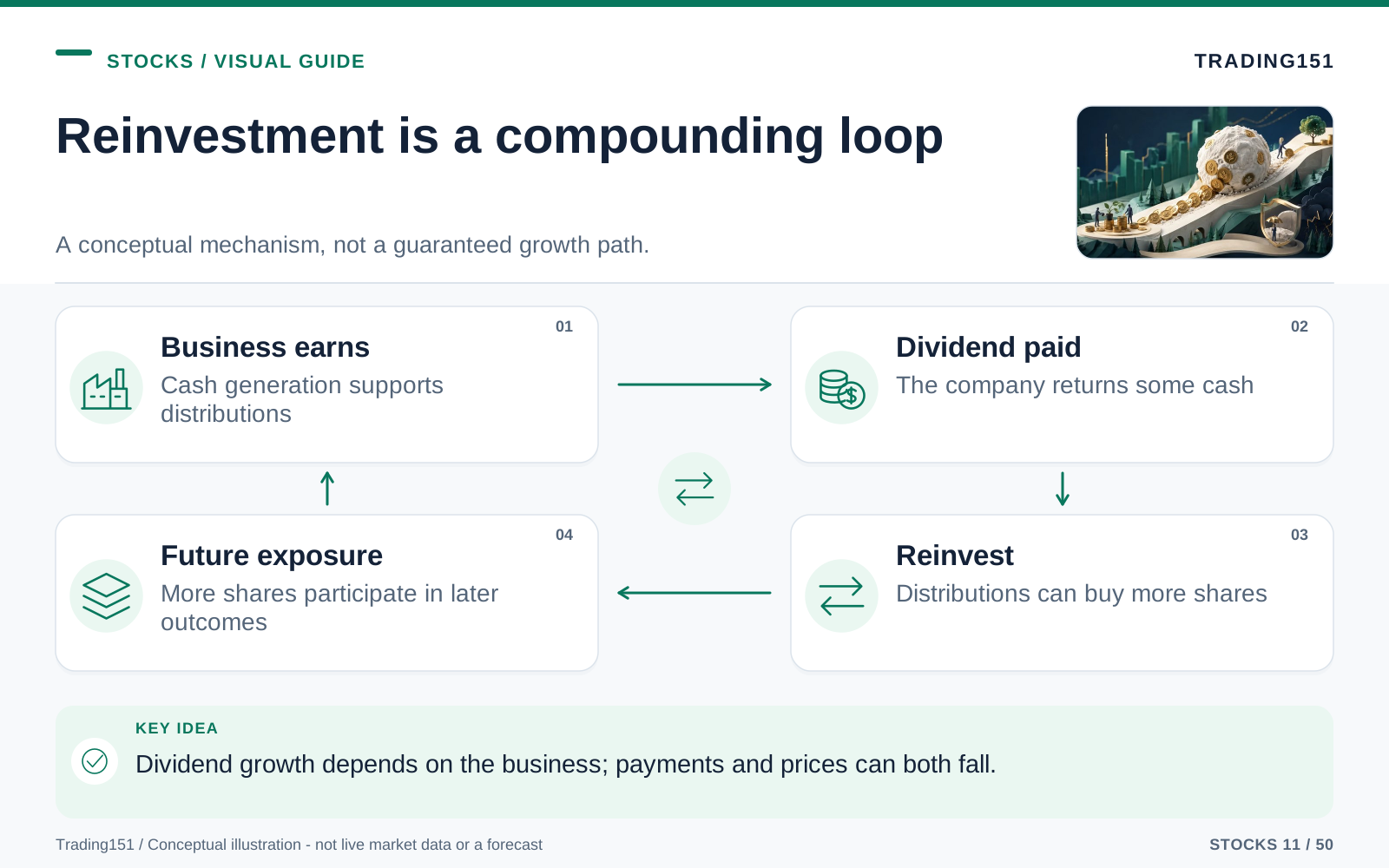
Read this diagram as text
- Business earns
- Cash generation supports distributions
- Dividend paid
- The company returns some cash
- Reinvest
- Distributions can buy more shares
- Future exposure
- More shares participate in later outcomes
The Problem With Chasing High Yield
High yields are seductive. They play right into our natural impatience. If you see one stock offering a 3% payout and another dangling 11%, it’s tempting to grab the 11% and walk away feeling like a genius. More money right now—what’s the catch? The catch is that you always have to look at what happens when things go wrong. A cyclical business might look generous when profits are peaking, but what happens when margins shrink, debt needs refinancing, or they have to upgrade their equipment? If you only look at the yield, you miss the actual business reality.
And that reality is often ugly.
A dividend yield is just a ratio: the annual payout divided by the stock price. Sometimes the yield is high because the company is printing money and wants to reward shareholders. But far more often, the yield has spiked because investors got spooked, sold off the stock, and drove the share price into the dirt. The dividend just hasn't been officially cut yet. That’s the exact moment unsuspecting investors swoop in thinking they've found a bargain.
In investing circles, this is known as a yield trap. The payout looks amazing on your screen, but the broader market is already screaming that the company is in trouble. Maybe their core product is obsolete. Maybe they are drowning in debt. Whatever the reason, the earnings no longer support the dividend.
When the inevitable dividend cut is finally announced, it’s a double whammy. First, your expected income vanishes overnight. Second, the stock price usually takes another large nosedive as income investors flee. You thought you were being smart, but you just bought a front-row seat to a slow-motion car crash.
Dividend growth investors neatly sidestep this landmine by changing the question. They don't ask, "Who is paying me the most right this second?" Instead, they ask, "Who is most likely to be paying me significantly more a decade from now?"
It completely shifts your perspective. You stop shopping for yields and start thinking like a business owner.
Why Dividend Growth Works So Well Over Time
This approach works so beautifully because it harnesses three distinct forces at the same time: business expansion, rising payouts, and the sheer math of compounding.
A top-tier dividend growth stock is usually tied to a business that naturally gets bigger and more efficient over time. They figure out how to sell more goods, raise their prices without losing customers, break into new countries, or systematically buy back their own shares. As the cash flow swells, management can comfortably bump up the dividend without starving the business of the capital it needs to survive.
For you, as the shareholder, this creates a rising stream of income. You aren't stuck on a fixed income like a bondholder; you get a raise every year. A 6% or 8% dividend hike might not sound life-changing in year one, but stretch that out over ten or fifteen years, and the math gets staggering.
Then compounding kicks in. If you take those dividends and immediately reinvest them, you are buying more shares. Next quarter, those new shares generate their own dividends, which buy even more shares. In the early days, it feels like watching grass grow. It’s painstakingly slow.
But give it time. Eventually, the sheer momentum takes over. When a snowball is small, it barely picks up any snow. But once it’s halfway down the mountain, every rotation gathers an immense amount of mass. The endgame of this strategy isn't about how much money you started with; it's about consistency and letting time do the heavy lifting.
Yield on Cost: The Moment the Strategy Starts to Click
One of the most rewarding concepts in this space is yield on cost. Now, to be fair, you shouldn't hold onto a dying business just because your personal yield looks great on paper—you always have to evaluate if your capital could be doing better elsewhere today. But as a way to track how your income is growing relative to your original investment, it’s a brilliant motivator.
Imagine you put $1,000 into a company that pays a 3% yield. Year one, you get a whopping $30. Nobody is throwing a parade for thirty bucks. But let's say this company is a powerhouse, and they raise that dividend by 8% every year.
Fast forward a decade or so, and your annual payout is nowhere near $30. Thanks to those relentless yearly hikes, that exact same $1,000 original investment might now be spitting out $60, $90, or even $120 a year in pure cash—and that’s before we even talk about the extra shares you've been buying through reinvestment.
If you're getting $120 a year off an initial $1,000 purchase, your yield on cost has grown to 12%. Someone buying the stock fresh today might still only get a 3% yield because the stock price went up right alongside the dividend. But you? You're sitting on a double-digit cash return simply because you got in early and didn't touch it.
That is the silent beauty of this strategy. You don't have to day-trade or stress out trying to time the market perfectly. You just buy a great business and let the passage of time transform it into an income machine.
The Psychological Advantage Most People Underestimate
It’s very easy to be a rational, level-headed investor in theory. In practice, the stock market will test your sanity.
Everyone believes they have a high risk tolerance when the charts are glowing green. It’s easy to be patient when you're making money. But the second the market tanks 15% and the financial news starts reporting on a recession, people miraculously discover they aren't quite as "long-term" as they thought.
This is where dividend growth investing really shines. It gives you something tangible to focus on other than the concerning, flashing red numbers on your screen. The market might be having a meltdown, but if your companies are still selling products, generating cash, and announcing their annual dividend hikes, you have a psychological anchor.
Look, watching your portfolio's value drop is never fun. It stings. But the emotional toll is drastically lighter when the cash dividends keep hitting your account on schedule. Instead of panicking, you start to view market crashes as a clearance sale. Your reinvested dividends are suddenly buying more shares at a steep discount, locking in even higher future income.
Do not underestimate how important this mindset shift is. An investment strategy only works if you can stick to it. The most mathematically perfect portfolio on earth is completely useless if you panic-sell at the exact wrong moment.
Because you can see the progress—tracking your rising income, cheering on dividend hikes, and watching your share count tick upward—you stay engaged. These constant, positive feedback loops keep you tethered to the long-term plan when the rest of the market is losing its mind over whatever the Federal Reserve said yesterday.
What Makes a Strong Dividend Growth Stock?
Not every stock that pays a dividend deserves a spot in your portfolio. A true dividend growth candidate needs way more than just a history of paying out cash. It needs the underlying financial muscle to guarantee that cash keeps flowing no matter what the economy does.
1. A Sustainable Payout Ratio
The payout ratio is exactly what it sounds like: the percentage of a company’s profits that get paid out as dividends. If a business earns $5 a share and pays out $2, its payout ratio is a very comfortable 40%.
Why does this matter? A lower or moderate ratio means the company has plenty of breathing room. They can keep spending money on research and development, weather a nasty recession, pay down their debt, and still afford to cut you a check. If a company is paying out 95% of its earnings, there is zero margin for error.
To be fair, acceptable payout ratios vary substantially by industry. Utilities and real estate investment trusts (REITs) are structured to pay out the vast majority of their earnings, while tech or industrial companies usually keep their ratios much lower. But the golden rule remains the same: the dividend has to be backed by actual, sustainable profits, not accounting magic or pure stubbornness.
If management is handing over every spare cent they earn just to keep the yield high, it’s a house of cards. The second profits take a hit, the dividend is getting chopped.
2. Consistent Free Cash Flow
Earnings are great, but you can't pay a dividend with an accounting adjustment. You pay it with cold, hard cash. That’s why free cash flow is your best friend. It’s whatever money is left over after a company pays its bills and reinvests in its own operations. Since business spending can be lumpy from year to year, it’s always smart to look at how much cash a company generates over a multi-year cycle, not just during one freakishly good quarter. If they have to borrow money or sell off assets just to cover their dividend, run the other way.
A business flush with free cash flow is in control of its own destiny. They can bump up the dividend, buy out a competitor, fortify their balance sheet, or buy back stock. A company that struggles to generate cash is constantly operating on defense.
If you're buying for dividend growth, free cash flow is the beating heart of the operation. If the heart is strong, you can sleep well at night knowing the dividend is safe.
3. A Durable Competitive Advantage
Warren Buffett loves to talk about a company’s economic moat. Just like a medieval castle, a business needs a moat to protect its profits from invading competitors. This could be an incredible brand reputation, large cost advantages, patents, heavy government regulation, or simply a product that is way too painful for customers to switch away from.
Think about the products you buy without even looking at the price tag, or the software systems that large corporations are completely dependent on. Those entrenched positions allow companies to raise prices with impunity.
A wide moat doesn't mean a company is immortal, but it drastically improves the odds that they can keep their cash flow steady through recessions, industry shifts, and inflation.
4. A Sensible Balance Sheet
Let's be clear: debt isn’t evil. Most large corporations use debt strategically to grow. The problem only starts when the debt load becomes suffocating compared to the cash the business generates.
A company drowning in debt has zero flexibility. Huge chunks of cash go straight to interest payments. If interest rates spike and they need to refinance, it can cripple their margins. If the economy takes a sudden downturn, management is going to be forced into a severe corner: do we save the balance sheet, or do we save the dividend?
You never, ever want to own a company where management is forced to make that choice. A clean balance sheet gives a business the luxury of surviving bad times without having to punish its shareholders.
5. A Culture of Shareholder Returns
For some corporate boards, the dividend is just an annoying chore. For others, it’s a source of immense pride and a core part of their corporate identity.
You want to be invested with management teams that deeply respect the dividend. While a thirty-year streak of dividend hikes doesn't make a stock bulletproof, it tells you a lot about their discipline. They know exactly why you bought their stock, and they know perfectly well that cutting the dividend would obliterate their reputation with investors.
Culture dictates behavior. A company that has spent decades reliably raising its payout doesn't treat the dividend as an afterthought. They specifically structure their entire corporate budget around making sure that streak stays alive.
Dividend Aristocrats and Dividend Kings
If you spend enough time looking into dividend stocks, you will inevitably bump into two famous groups: Dividend Aristocrats and Dividend Kings.
- Dividend Aristocrats are companies in the S&P 500 that have raised their dividends for at least 25 years in a row.
- Dividend Kings are the absolute royalty of the market—businesses that have hiked their payouts for 50 consecutive years or more.
These lists are incredible cheat codes for finding elite companies. Think about what a business has to survive to raise its payout every year for half a century. We are talking about hyper-inflation, bursting tech bubbles, the 2008 financial crisis, global pandemics, and large shifts in consumer behavior. Through all of that, they kept writing bigger checks.
You simply have to respect a track record like that.
But a word of warning: use these lists as a starting point, not an excuse to skip your homework. A glorious past doesn't guarantee a profitable future. Consumer habits change, moats dry up, and balance sheets can slowly rot. A 50-year streak proves they were resilient in the past; it’s your job to figure out if they are still resilient today.
The Power of Reinvesting Dividends
If you want to see this strategy truly take off, you have to reinvest your dividends. Turning on automatic reinvestment is by far the easiest and most hands-off way to do this. However, some advanced investors prefer to let their dividends pile up as cash so they can manually buy whatever stock in their portfolio is currently trading at the best price. Both methods will compound your wealth beautifully; one just puts your portfolio on autopilot, while the other requires a bit more effort and judgment.
Setting up a Dividend Reinvestment Plan (often just called a DRIP) means every time a company pays you, your brokerage immediately uses those pennies and dollars to buy fractional shares of that exact same stock. You never even see the cash hit your bank account.
Let’s say you own 100 shares of a stock. They pay out their quarterly dividend, and it’s just enough to buy two more shares. Great, now you own 102 shares. The next time they pay out, you are getting paid on 102 shares, not 100. That slightly larger payment buys even more fractional shares. Slowly but surely, your share count creeps up, and your income accelerates right alongside it.
The best part is how utterly effortless it is. You don't have to stress about whether the market is overvalued today or read a hundred earnings reports. You just sit back and let time, ownership, and basic math do all the heavy lifting for you.
It also gives you a large psychological edge during a bear market. When stock prices inevitably crash, your DRIP is suddenly buying way more shares with the same dividend payment. Provided the underlying business is still healthy, market panics help you build your future income stream faster.
Individual Stocks or Dividend ETFs?
Some people absolutely love picking individual stocks. They get a thrill out of reading annual reports, scrutinizing payout ratios, dissecting debt loads, and curating their own custom portfolio. If you have the time, the patience, and the genuine desire to do the homework, it’s rewarding.
But —not everyone wants to spend their Sunday mornings reading corporate balance sheets. If that sounds like torture to you, dividend-focused Exchange Traded Funds (ETFs) are a godsend.
A good dividend ETF allows you to buy a basket of dozens, or even hundreds, of high-quality dividend payers with a single click. It instantly wipes out company-specific risk. If one random company in the fund makes a terrible decision and slashes its dividend, your overall income barely feels a blip.
ETFs also protect you from yourself. They remove the temptation to constantly buy, sell, and tinker with your holdings. The trade-off, of course, is a lack of control. You might end up owning a few companies you aren't thrilled about, and an ETF’s dividend growth won't be quite as explosive as a hand-picked portfolio of superstars.
But if you are just starting out, or if you just want to keep your life simple, a low-cost dividend growth ETF is an absolutely brilliant way to get into the game without turning investing into a second job.
Common Mistakes Dividend Investors Make
The core concept of dividend growth is pretty straightforward, but human beings are remarkably good at finding ways to sabotage themselves.
Chasing Yield Instead of Quality
We’ve covered this, but it bears repeating because everyone falls for it eventually. A large yield should always make you deeply suspicious. Why is it so high? Can they afford it? Are their sales in freefall? A 10% yield is utterly useless if the company goes bankrupt.
Ignoring Valuation
You can buy the greatest company on earth, but if you pay a ridiculous price for it, it will be a terrible investment. Dividend investors sometimes fall so deeply in love with a company's brand or its dividend history that they buy in when the stock is absurdly overvalued. Valuation always matters.
Overconcentrating in One Sector
Because certain industries like telecom, utilities, and banks naturally pay higher dividends, beginners often accidentally build portfolios comprised entirely of just one or two sectors. That might look great for income, but it's substantially dangerous. If interest rates spike and crush the utilities sector, your entire portfolio goes down with the ship. Diversify.
Assuming a Dividend Streak Guarantees Safety
We love companies with long track records, but past performance is not a legal contract. If a business loses its competitive edge, the board will absolutely cut the dividend to save the company. Respect the streak, but verify the financials.
Forgetting About Taxes
Unless you are investing inside a tax-advantaged account like an IRA, the IRS is going to want a piece of your dividends—even if you automatically reinvest them. Tax drag is real, and it eats into your total returns over time. Be strategic about which accounts hold your dividend-paying assets.
The Risks You Still Need to Respect
People love to label dividend growth investing as "safe" and "conservative." And compared to trading crypto or options, it is. But "conservative" does not mean "risk-free."
Great companies stumble. Once-dominant industries become obsolete. Fierce inflation can wreck profit margins. And when interest rates rise, the boring, safe yields offered by savings accounts and government bonds can suddenly make dividend stocks look a lot less appealing to the broader market. And let's not forget human error—a reliable company can absolutely ruin itself if the CEO goes on a reckless acquisition spree.
There is also a very real psychological risk: the fear of missing out. A portfolio built on sturdy, mature dividend payers is going to drastically underperform during large tech bubbles or speculative bull markets. Watching your neighbor brag about doubling their money on a sketchy tech stock while you are up a modest 8% will seriously test your discipline.
The goal isn't to pretend these risks don't exist; it's to build a portfolio sturdy enough to handle them. Diversify across different industries. Keep a close eye on payout ratios. Demand strong free cash flow. And above all, never let yourself fall so deeply in love with a stock that you ignore the warning signs.
How to Start Without Overcomplicating It
If you're ready to get started, the best advice is to keep it remarkably simple. Don't overthink it.
First, be honest with yourself about whether you want to pick individual stocks or just buy a broad dividend ETF. If reading financial statements sounds exhausting, do yourself a favor and buy the ETF.
Second, prioritize consistency over perfect timing. Don't sit around in cash waiting for a market crash that might not come for three years. Set up a system where you invest a set amount of money every month, regardless of what the market is doing.
Third, turn on dividend reinvestment (DRIP) immediately. If you don't actively need the cash to pay your rent, put it right back to work. That’s how the snowball starts rolling.
Fourth, ignore the daily stock ticker. Measure your success by the metrics that matter: is your total annual dividend income going up? Are your companies still generating plenty of cash? Is their debt manageable?
Finally, give it time. Be patient. In the first few years, your dividend checks will feel notably small. You might only make enough to buy a cup of coffee. But those first few drops of income aren't the harvest—they are just proof that the system works. Keep watering the tree.
Who This Strategy Is Best Suited For
This strategy is a perfect match for anyone who values predictability, logic, and visible progress. If the idea of owning tiny pieces of highly profitable real-world businesses and slowly watching your share of their profits grow sounds appealing to you, this is your lane.
It’s a phenomenal strategy for young investors, simply because they have decades of time to let those reinvested dividends spiral into large wealth. But it's equally loved by retirees who want to step away from the stress of selling off their portfolio and just live off the cash flow their assets generate.
On the flip side, if you are looking for adrenaline, fast money, or the thrill of outsmarting the market on a daily basis, you will be bored to tears. This approach actively rewards patience and punishes impulsivity. It requires you to tune out the daily financial noise and focus on what your portfolio will look like twenty years from now.
Yield on cost does not measure today's opportunity
Suppose you bought a share for $20 and it now pays a $2 annual dividend. Your yield on original cost is 10%. If the share currently trades at $50, its current dividend yield is 4%. Both calculations are correct, but they answer different questions. The first describes your purchase history; the second relates today's payment to the capital currently tied up in the holding.
That distinction matters when comparing alternatives. Keeping a stock because its yield on cost looks high can distract from the question of whether its current risk and expected return still suit the portfolio. Selling is not automatically the answer, especially after costs and taxes, but the decision should use present circumstances rather than a flattering historical denominator.
Dividend growth also needs a funding explanation. Is the payment rising because cash generation is improving, because the payout ratio is increasing, or because the business is borrowing? A company cannot indefinitely distribute more by relying on financial flexibility that is gradually being used up.
Track per-share cash generation, capital needs, debt obligations, and the room left after distributions. Reinvestment can compound a sound holding, but automatically buying more of a deteriorating business compounds the exposure instead. A dividend plan works better when regular payments trigger regular review, not when the income arrives so smoothly that the business behind it disappears from view.
Measure income growth after new contributions
An income portfolio can appear to be producing remarkable growth simply because the investor keeps adding money. That is not a problem, but it should be measured honestly. Separate the increase attributable to new purchases from dividend increases on existing holdings and from reinvestment. Each is a different source of progress.
For example, an investor receiving $1,000 a year adds enough capital to buy another $200 of annual income. If total expected income becomes $1,230, the increase is not evidence that the original holdings raised their payouts by 23%. Most of it came from the new contribution. Keeping those components separate makes it easier to notice a dividend cut or weakening coverage that a growing account might otherwise hide.
Tax and concentration deserve a parallel review. An income target can tempt an investor toward whichever sector currently offers the highest yield, even when that increases dependence on one set of economic conditions. Consider the after-tax cash received and the value at risk, not only the number of payments arriving each month. A growing stream is useful when the underlying portfolio remains suitable; it is less reassuring when the income goal forces progressively riskier holdings into the account. 1, 2
A Growing Payment Needs a Growing Business
Dividend growth investing isn't some secret magic trick. It won't shield you from recessions, and it certainly won't save a bad business from going bankrupt. But if you execute it with patience and common sense, it offers a beautifully clear, stress-free path to building lasting wealth.
The premise is almost painfully simple: buy slices of highly profitable, well-run companies. Let them send you a portion of their profits. As the business naturally expands, watch your paychecks expand too. Reinvest that cash to buy even more slices. It lacks the wild drama of day-trading, but its sheer effectiveness comes exactly from that lack of drama.
This is a strategy for the patient, grounded in cold hard cash rather than hype. The best companies out there can easily fund their daily operations, launch new products, keep their debt in check, and still reward you with a bigger dividend every year without breaking a sweat.
Just be careful not to let the hunt for income blind you to basic investing common sense. It’s easy for dividend portfolios to become bloated with utilities or mature consumer brands, and even great companies can become dangerously overpriced when everyone is running to them for safety. Keep an eye on your weightings. If you have automatic reinvesting turned on, make sure it isn't quietly making one or two stocks an uncomfortably large chunk of your net worth.
Ultimately, the goal here isn't just to get a slightly bigger deposit next quarter. It’s to build a permanent, ever-growing income stream backed by world-class businesses. Focus on quality, buy at fair prices, and let the quiet, relentless power of compounding do what a flashy high-yield trap never could.
Sources and further reading
Editorial revision: 7 October 2026. Numerical scenarios are hypothetical unless identified as historical. References support the added explanations and selected corrections; rules and product terms should be checked again before acting.