
A covered call combines a stock holding with an obligation to sell those shares under specified terms. The option premium is payment for that obligation, not a dividend or a free extra return. The strategy can fit certain objectives, but it leaves most of the stock's downside in place while limiting some of the upside. The combined position is what needs evaluating.
What Is a Covered Call?
A covered call boils down to two simple parts:
- You own the stock. This is where the "covered" part comes in. Since one standard options contract represents 100 shares, you generally need to own at least 100 shares of a company to sell a single covered call.
- You sell a call option against those shares. This gives the buyer the right—but not the obligation—to buy your stock at a specific price before a specific date.
When you sell this option, you’re essentially making a handshake deal with the market. You're saying, "Hey, if the buyer wants to exercise this option, I promise to sell my 100 shares at this agreed-upon price. But for taking on that promise, I want to be paid right now."
That cash you get upfront is your option premium, and it's yours to keep no matter what. Whether the stock rises sharply, tanks, or does absolutely nothing, that money stays in your account. The trade-off is that the sky is no longer the limit. If the stock goes on a large run well past your agreed-upon price, you're still on the hook to sell it at that lower price.
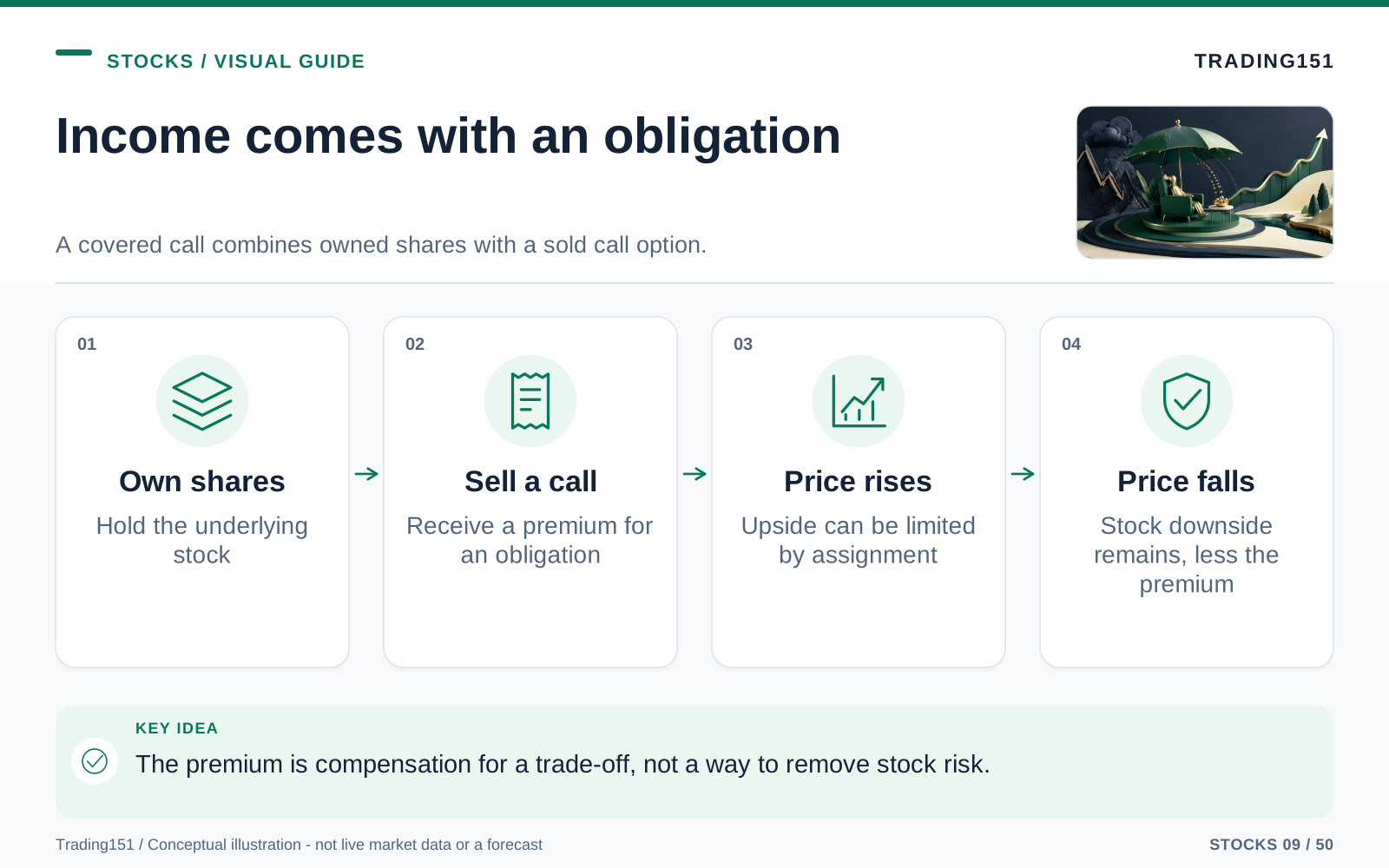
Read this diagram as text
- Own shares
- Hold the underlying stock
- Sell a call
- Receive a premium for an obligation
- Price rises
- Upside can be limited by assignment
- Price falls
- Stock downside remains, less the premium
The Four Pieces You Need to Understand
Options jargon can sound like a foreign language, but a covered call is pretty straightforward once you understand its four moving parts.
- Underlying stock: The actual shares sitting in your account. Remember, selling one contract usually ties up 100 shares.
- Strike price: The exact price you agree to sell your shares for if the buyer decides to exercise their option. Most people pick a strike price that's somewhat higher than what the stock is currently trading at.
- Expiration date: The deadline. This is when the contract officially ends. Shorter timeframes give you more flexibility, while longer ones usually pay a juicier premium but keep your shares locked up longer.
- Premium: Your payday. This is the cash you get for selling the option. It's quoted per share, meaning a $2.00 premium drops $200 into your account for a standard 100-share contract.
Those four details dictate the entire trade. They determine how much cash you pocket, how much future profit you might be giving up, how long you have to wait, and the exact price you might end up selling your shares for.
A Simple Covered Call Example
Let’s walk through a real-world scenario. Imagine you own 100 shares of a fictional company called Bluebird Tech. It’s currently trading at $100 a share, making your total position worth $10,000. (Quick tip: always think about your returns based on the total capital you have tied up in the stock, not just the flashy premium. A $2 premium sounds great, but its actual value depends heavily on the stock's price, how long your money is locked up, and how close it is to the strike price. Don't fall into the trap of annualizing short-term premiums to make the math look better than it is.)
So, you like Bluebird Tech and don't mind keeping it in your portfolio. However, you aren't expecting it to shoot to the moon anytime soon. If it happened to hit $110, you’d honestly be thrilled to take your profits and walk away.
Knowing this, you decide to write a covered call with these specific terms:
- Current stock price: $100
- Strike price: $110
- Expiration: 30 days from now
- Premium: $2.00 per share
Since one contract controls 100 shares, you instantly collect $200 in premium ($2.00 multiplied by 100).
Your trade is now live. You still own your Bluebird Tech stock, but you've promised to hand it over for $110 a share if the buyer exercises their option. From here, there are three main ways this can play out.
Outcome 1: The Stock Stays Below the Strike
Bluebird Tech bounces around for a month and finishes at $106 on expiration day. Since the stock price never crossed your $110 strike, the option is "out of the money."
What happens? The option simply expires worthless. You keep your 100 shares, and you keep the $200 premium. Moving forward, you can write another covered call, just hold the stock, or sell it outright.
For a lot of covered call traders, this is the absolute dream scenario: the stock drifts upward or trades flat, the contract expires, and they pocket the extra income without having to say goodbye to their shares.
Outcome 2: The Stock Rises Above the Strike
Now, let's say Bluebird Tech crushes it and closes the month at $120. Your $110 call is now "in the money." Naturally, the buyer is going to exercise the option because they get to buy your $120 stock for the discounted price of $110.
Once you're assigned, your 100 shares disappear from your account, and you receive $11,000 for the sale. Add in your original $200 premium, and your total takeaway is $11,200.
Making $1,200 on a $10,000 investment in a month is fantastic. But here’s the rub: if you hadn't sold that call, your shares would be worth $12,000. You gave up some serious upside.
That’s the core compromise of a covered call. You are getting paid today to cap your potential profits tomorrow.
Outcome 3: The Stock Falls
Remember, covered calls do not magically erase stock risk. What if Bluebird Tech has a terrible month and tanks to $88? That $200 premium you collected is a nice little cushion, but it doesn't stop the bleeding. Instead of being down $1,200 on your shares, you're down $1,000. Sure, you might be able to buy back the option for pennies since the stock dropped, but that small win pales in comparison to the large hit your actual shares just took. Before you blindly sell another call to make yourself feel better, take a hard look at the company. Are they still a good investment? Don't use option premiums to distract yourself from the fact that you might be holding onto a loser.
It’s a cushion, not a crash helmet. If the stock plunges, you're still taking the hit.
Why Investors Use Covered Calls
People love covered calls because they fix a very specific, very common problem. Many of us have great companies in our portfolios that we don't want to sell, but we also want our money to work harder and generate some cash. Covered calls bridge that gap.
They Generate Income
The biggest draw is obvious: cash right now. Selling a call drops premium directly into your account. If you hold a lot of shares in big, stable companies, this can easily become a reliable, repeatable income stream.
It’s especially nice when a stock is just dragging its feet, trading in a tight range. Instead of watching it do nothing, you can collect premiums and make the position feel productive.
They Can Lower Your Effective Cost Basis
Let's say you buy a stock at $100 and collect a $2 premium. Ignoring taxes and fees, your actual break-even point is now $98. If you keep doing this month after month, those premiums start adding up, drastically reducing the amount of your own money you have on the line.
Now, this won't save a terrible stock, but it does mean that the cash you collect chips away at your original purchase price.
They Force You to Choose an Exit Price
Selling a covered call forces you to confront a question we usually try to ignore: What's my actual exit price?
That kind of discipline is healthy. Instead of riding the emotional rollercoaster of the market, you draw a line in the sand ahead of time. If the stock hits that price, you've already made peace with selling. If it doesn't, you keep the cash and try again.
They Can Improve Returns in Flat or Mildly Bullish Markets
This strategy really thrives when a stock is just meandering sideways, crawling upward, or generally staying below your strike price. The premium gives your returns a nice little bump without forcing you to sell your shares.
On the flip side, it feels pretty awful when a stock suddenly goes parabolic. In those moments, the premium feels like pennies compared to the large gains you missed out on.
The Real Risks of Covered Calls
You'll often hear people call this a conservative strategy—and compared to a lot of crazy options plays out there, it is. But conservative does not mean risk-free. It is easy to get overconfident, especially after your first few trades go perfectly according to plan.
Your Upside Is Capped
Logically, you know this. Emotionally, it hurts. When you sell that call, you're putting a hard ceiling on your profits for the duration of the contract.
If the company suddenly announces a blowout earnings report, gets bought out, or launches a revolutionary product, you are going to miss the ride. You keep your premium and whatever gains you made up to your strike price, but every dollar above that belongs to the person who bought your call.
This is why you shouldn't write covered calls on explosive growth stocks. If you bought a stock because you think it’s going to double, capping your upside completely defeats the purpose of owning it.
The Premium Offers Only Limited Downside Protection
As we touched on earlier, the cash you collect reduces your loss—but only by the exact amount you collected. It does absolutely nothing to protect you from a true market meltdown.
A $2 premium on a $100 stock gives you a $2 safety net. If the stock crashes to $70, you're still holding a battered, bruised asset.
You Can Be Assigned Earlier Than Expected
A lot of newer options traders assume their shares can only be called away on expiration day. That’s usually how it goes, but early assignment is a very real thing. It happens most often when a call is deep in the money, has very little time value left, or—most importantly—when a big dividend is coming up. The person holding the option might exercise early just to snatch that dividend payment. It can also happen totally out of the blue because the buyer is in the driver's seat. Make sure you have the shares ready to go, and never assume you have until expiration to fix a trade gone wrong.
If you're writing calls on dividend-paying stocks, keep a close eye on the ex-dividend date. Your shares could get yanked away much sooner than you planned.
Taxes Can Be Messy
Between premiums, stock sales, holding periods, dividends, and assignments, covered calls can create a bit of a nightmare come tax season. How you’re taxed depends on where you live, what kind of account you're trading in, and the specific mechanics of your trade.
Obviously, this isn't tax advice. But if you're trading in a normal, taxable brokerage account, you really need to talk to a tax pro. A trade that looks substantially profitable on paper can look pretty mediocre once the IRS takes its cut.
What Makes a Good Covered Call Stock?
Spoiler alert: the best stocks for this strategy aren't usually the ones offering the highest premiums. Sky-high premiums are a red flag—they mean the market is terrified of large volatility, an impending disaster, or complete uncertainty.
Instead, you want to look for three specific qualities.
1. You Would Be Willing to Own It Anyway
This is the golden rule. Do not buy a garbage stock just because the options are paying out a lot of cash. If the bottom falls out, that premium isn't going to make up for the fact that you just bought a dying business at an inflated price.
Stick to companies you believe in—stocks you'd happily hold in your portfolio even if options didn't exist.
2. You Would Be Willing to Sell at the Strike Price
Before you place the trade, look at the strike price and be radically honest with yourself: If my shares get called away at this exact number, am I going to be happy, or am I going to be annoyed?
If the answer is "annoyed," pick a higher strike price or walk away from the trade. You shouldn't be setting emotional traps for yourself.
3. The Option Market Is Liquid
Liquidity is crucial. You want stocks with active, bustling options markets. Look for tight bid-ask spreads and plenty of open interest so you can get in and out without losing your shirt on poor pricing.
A wide spread is a silent killer. The premium might look amazing at first glance, but if you're forced to sell at the lowest bid and buy back at the highest ask, your profits will evaporate.
Choosing the Strike Price
Your strike price is the volume knob between generating income and letting your stock grow. Picking it isn't just a math problem; it's a portfolio management decision. A tighter strike pays you more but suffocates your upside. A wider strike pays less but gives the stock breathing room. Don't just click the highest number on the options chain—think about your tax situation, your fair value estimate, and whether you want to offload the stock.
If you pick a strike right near the current price, you'll get paid well, but you're highly likely to lose your shares. Go further out, and the payday shrinks, but the stock has room to run before you have to sell.
There is no magic number here. It completely depends on what you want out of the trade:
- If you just want cash: You'll probably lean toward a tighter strike and accept that your shares are probably going to get called away.
- If you really want to keep the stock: You'll push the strike further out of the money and settle for a smaller, safer premium.
- If you wanted to sell anyway: Just pick the exact price you were hoping to cash out at.
As you get more comfortable, you can start looking at an option's "delta" to gauge how likely you are to get assigned. A low delta generally means assignment is unlikely; a high delta means a bigger payday but a strong chance you'll lose your stock. You don't need a math degree to get started, but understanding delta is a great tool for your arsenal down the road.
Choosing the Expiration Date
The expiration date is your second major control dial. It determines exactly how long you’re locked into this obligation.
A lot of traders find their sweet spot around 30 to 45 days out. Why? Because the option's time value starts decaying at a nice, steady clip, but you still have enough flexibility to adapt. You aren't committing to a price for a whole year, and you aren't glued to your screen watching daily expirations.
Shorter timelines are great if you want to stay nimble, but they require you to pay close attention. Longer timelines will hand you a fatter check upfront, but they tie your hands if the market suddenly shifts.
The bottom line? Don't pick an expiration date just because the premium looks huge. More money almost always means more time, more risk, or both.
Covered Calls Around Earnings
Earnings season is a wild card. Leading up to an earnings report, option premiums get inflated because the market is bracing for a large price swing. It’s deeply tempting to sell calls during this time.
The problem is that earnings can completely rewrite the narrative overnight. A stellar report could blast the stock way past your strike, leaving you trapped while everyone else celebrates. A terrible report could crater the stock, and that "fat" premium you collected won't even come close to covering the damage.
Yes, seasoned traders absolutely play earnings to farm those high premiums—but they know exactly what they're risking. If you're new to this, sit it out. Either pick expirations that happen before the report, wait until the dust settles afterward, or choose a strike price so high that you truly wouldn't care if you got called away.
What Does It Mean to Roll a Covered Call?
Sometimes the market outsmarts you. Your stock rockets past your strike price, but you suddenly decide you really don't want to lose those shares. You have an escape hatch, and it’s called rolling.
Rolling basically means you buy back the call you originally sold, and immediately sell a brand-new call—usually with a later expiration date, a higher strike price, or both.
For example, if you sold a $110 call and the stock is suddenly at $115, you could buy back that $110 call to close the obligation, and then sell a $120 call that expires next month. The goal is to buy your stock some breathing room while collecting enough new premium to make the whole maneuver worthwhile.
But rolling isn't a get-out-of-jail-free card. Buying back a winning call is going to cost you, and sometimes you're just delaying the inevitable. Before you roll, do the math. Check your new break-even point, your net debit or credit, and ask yourself if you still want to be in this position.
Common Beginner Mistakes
Most people screw up covered calls because they get greedy and chase premiums without thinking about the fallout. Here’s what you need to avoid.
Selling Calls on Stocks You Never Wanted to Own
High premiums on bad stocks are a trap, not a bargain. If a company is a mess, drowning in hype, or impossible to value, the income from the option is simply not worth the risk of holding the underlying stock.
Picking a Strike You Would Hate to Sell At
Don’t sell a call at $105 if you're going to throw a tantrum selling for anything less than $120. That isn't the market's fault—it's poor planning.
Ignoring Dividends
If your stock pays a dividend, always check the ex-dividend date before you write a call. If your call is in the money and the dividend is juicy, the odds of getting assigned early shoot way up.
Forgetting That Assignment Is Not Failure
It’s totally normal for beginners to feel like they "lost" when their shares are called away. But if you picked a strike price you were happy with, assignment means the system worked perfectly. You collected your premium, and you sold your stock for a planned profit. Take the win.
Measuring Only the Premium
A $300 premium isn't automatically better than a $100 one. You have to weigh that cash against the stock price, the volatility, the timeframe, and how likely you are to lose your shares. Looking at the premium in a vacuum is how you end up taking the bait.
A Practical Checklist Before Selling a Covered Call
Before you hit the "submit" button on your trade, run through this mental checklist:
- Do I own at least 100 shares? If not, you might accidentally be selling a "naked" call, which is a whole different (and much riskier) ballgame.
- Am I okay holding this stock if it tanks? Remember, the premium won't save you from a major crash.
- Am I okay selling at the strike price? If you hesitate even a little, your strike is too low.
- Did I check for earnings or dividends? Big calendar events can completely change the risk of your trade.
- Is the options market healthy and liquid? Huge bid-ask spreads will eat your profits alive.
- Do I know how the IRS will treat this? In a taxable account, this is a huge deal.
- What's my game plan if the stock goes up, down, or nowhere? Make those decisions right now, while you're thinking clearly, not later when you're stressed.
Who Should Consider Covered Calls?
Covered calls are a fantastic fit for investors who already own solid, high-quality stocks, feel pretty neutral (or just mildly optimistic) about the market, and wouldn't mind taking profits at a specific price. They’re also a great tool for people who prioritize steady income and are totally fine giving up blockbuster, home-run gains to get it.
On the other hand, if you're hunting for large, explosive growth, trading crazy meme stocks you barely understand, or get deeply attached to your shares, this isn't for you. The strategy only works if you're completely honest with yourself about the trade-offs on day one.
The Psychology Behind the Strategy
The hardest part about trading covered calls isn't the math. It’s the sinking feeling in your gut when your stock blasts right past your strike price.
You can execute a substantially profitable trade and still feel like a total loser just because the stock kept going without you. That is a completely normal psychological quirk. Covered calls breed a very specific flavor of regret: you made money, just not as much money as you could have.
The only way to combat that feeling is to define what success looks like before you enter the trade. If your goal was to sell at $110, and you successfully sold at $110 while pocketing the premium, you won. Don't beat yourself up using hindsight that you didn't have when you set up the trade.
The best covered call traders aren't out there trying to squeeze every last penny out of every stock. They’re building a boring, reliable machine: buy good companies, collect fair premiums, stick to your exit plans, and never turn a trade into an emotional wrestling match with the market.
Calculate the total position, not just the premium
Suppose you buy 100 shares at $50 and sell one standard, unadjusted call with a $55 strike for $2 per share. The $200 premium reduces the net initial outlay to $4,800, ignoring fees and taxes. At expiry, a share price of $40 leaves the stock worth $4,000 and the call worthless: the combined loss is $800, not a profitable trade because a premium was received.
If the shares finish at $60 and the call is exercised, the shares are sold for $5,500. Adding the $200 premium and subtracting the $5,000 purchase cost gives a $700 profit before costs. That is also the maximum profit at expiry under these assumptions. The seller gave up the additional rise above $55 in exchange for the premium.
Closing or rolling the option changes the accounting. Buying back the call costs money; selling another one creates a new obligation. A net credit on a roll does not erase a loss on the old option or guarantee a favorable final result. Keep realized and unrealized results for both legs visible.
Before selling, ask whether you would be comfortable selling the shares at the strike and continuing to hold them after a large fall. Those are the two obligations that income-focused descriptions can obscure. Assignment, dividends, contract adjustments, and taxes can add complications, so the simplified payoff should be a starting point rather than the entire plan.
Assignment should not be a surprise
Before selling a covered call, decide whether selling the shares at the strike price would be acceptable. The premium can make the transaction feel like extra income, but the obligation is real. An investor who would regret losing the holding at that price may be using the wrong structure.
Also examine contract size, expiry, exercise style, and the possibility of early assignment where applicable. Dividends and account restrictions can matter. The sensible comparison is with simply holding the shares or selling them outright, not with an imaginary version of the trade that keeps both unlimited upside and the premium. 1, 2, 3
The Premium Is Payment for Surrendered Upside
At its heart, a covered call is a remarkably simple concept with a lot of strategic depth. You hold 100 shares, you sell someone the right to take them off your hands at a specific price, and you get paid for making that promise.
You are simply trading uncertain future gains for guaranteed cash today. That trade makes a lot of sense when you pick a strike price that aligns with your real exit goals, and when you want to own the stock in the first place. It is not, however, a magical free-money glitch slapped onto an otherwise boring portfolio.
Plan for assignment before you ever sell the contract. Look at your tax situation, dividend dates, earnings calendar, and what you plan to do with the cash if your shares get called away. You can always try to roll the option to buy time, but that doesn't erase the cold, hard economic reality of buying back a losing contract.
Use covered calls purposefully. Stick to liquid markets, manage your position sizes so you don't panic if you get assigned, and always remember: that premium is your compensation for giving up the future. Don't let it trick you into holding a stock you'd otherwise run away from.
Sources and further reading
- Options Industry Council: Covered Calls
- Options Industry Council: Options Basics
- IRS Publication 550: Investment Income and Expenses
Editorial revision: 7 October 2026. Numerical scenarios are hypothetical unless identified as historical. References support the added explanations and selected corrections; rules and product terms should be checked again before acting.