
Strong demand for AI computing can be good news for chipmakers without making every semiconductor stock a good investment. Investors still need to ask who earns the margin, how much spending is required to deliver the product, and how much growth the share price already assumes. The technology story matters. So do inventories, customer concentration, and the price paid for the business.
The New Gold Rush Is Built on Silicon
You’ve probably heard the old cliché: during a gold rush, the guys selling picks and shovels make the most reliable money. It’s a tired metaphor, but it fits the current AI boom perfectly.
The AI models are the gold. Every major tech giant is desperately trying to build smarter assistants, better search engines, automated coders, and next-gen recommendation algorithms. They’re racing to cram AI into healthcare, finance, advertising, and entertainment. It’s an aggressive, substantially expensive global arms race.
The chips? Those are the shovels.
Training a large AI model isn’t like running a standard piece of software. It requires a staggering amount of parallel computing. Instead of doing one highly complex task step-by-step, AI models process millions of tiny mathematical equations all at the same exact time. That fundamental difference is why graphics processing units, or GPUs, changed the world.
Years ago, GPUs were just for gamers. They were engineered to handle millions of pixels, calculating lighting, shadows, and textures simultaneously to make video games look realistic. As it turns out, that exact capability is the secret sauce for deep learning. A chip built to make a video game look cool ended up becoming the bedrock of modern artificial intelligence.
That weird twist of fate completely rewired the semiconductor market. Suddenly, the most valuable real estate in tech wasn't a viral app. It was the physical hardware churning underneath it, and the software platforms that let developers talk to that hardware.
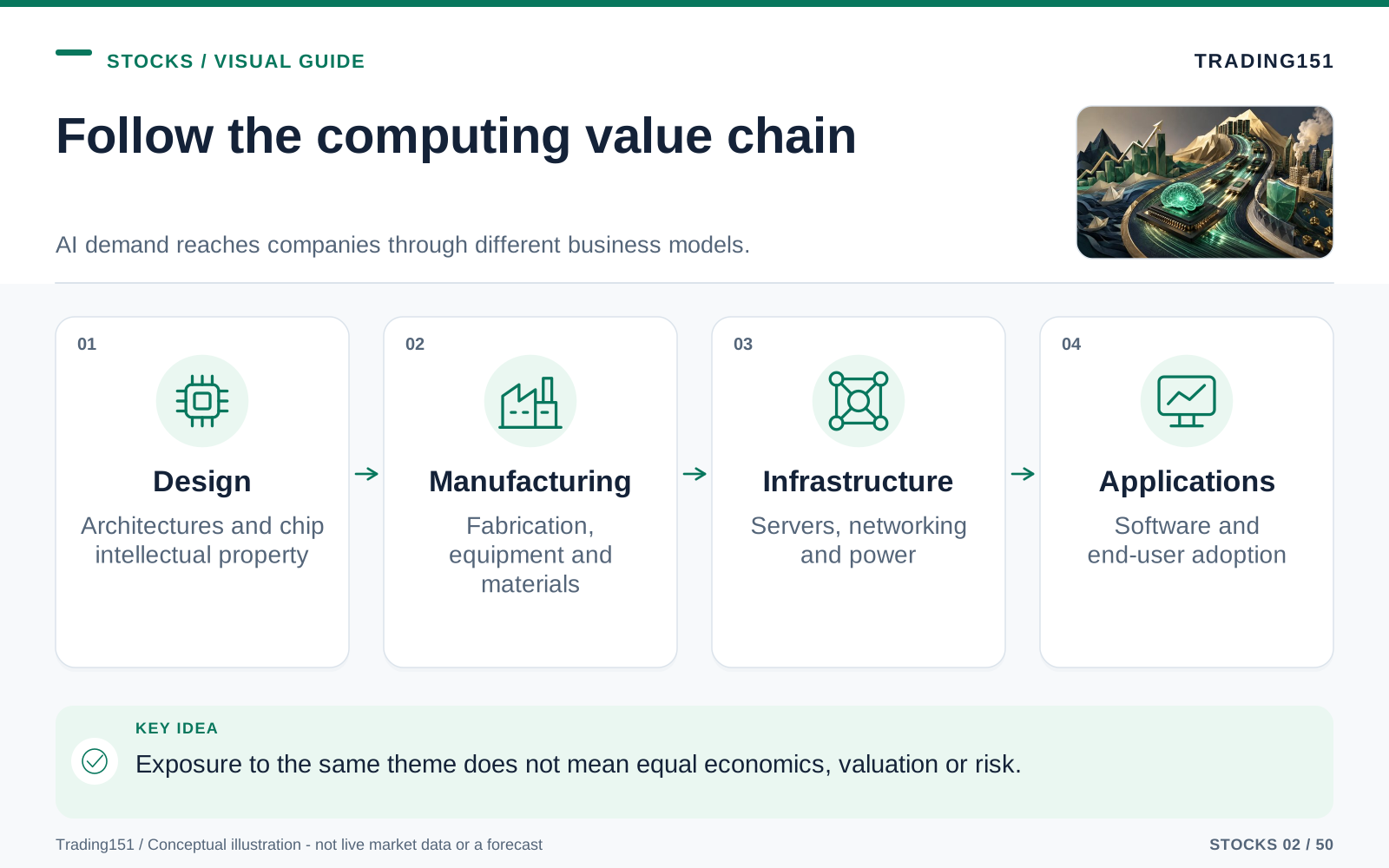
Read this diagram as text
- Design
- Architectures and chip intellectual property
- Manufacturing
- Fabrication, equipment and materials
- Infrastructure
- Servers, networking and power
- Applications
- Software and end-user adoption
Why Chips Matter More Than Ever
To really grasp the investment angle here, you have to separate the magic of AI from the plumbing. A chatbot might look like magic to a user, but the company running it is footing the bill for servers, processors, memory, networking gear, large electricity bills, and the cooling systems to keep everything from melting. As usage spikes, so do those bills. And the math changes depending on what the AI is doing. Training a new model requires large clusters of high-powered chips, while just running an existing model (inference) is all about keeping costs and energy use down. As the world shifts from building these models to using them, the companies cashing the biggest checks will likely change.
Right now, what we're watching is basically a global mega-construction project. We aren't just making new apps; we are laying down the digital equivalent of railroads, highways, and power grids. The data centers are the factories. The chips are the heavy machinery. The networking cables are the plumbing, and the power systems keep the lights on.
Because this is so physical, the supply chain is a tangled web. Nobody does it all. One company sketches out the chip design, a completely different company physically manufactures it, another one supplies the memory, someone else builds the multi-million-dollar machines to print the chips, and yet another company wires them all together. The AI boom isn’t a single stock you can buy. It’s an entire ecosystem.
That ecosystem is what makes semiconductor stocks so fun to follow—and so dangerous to own. If you only pay attention to the famous ticker symbols, you'll miss the real hidden gems. But if you don't understand the supply chain, you'll be blindsided when the market's mood suddenly sours.
The Big Names Everyone Talks About
You can’t have a conversation about AI without tripping over a few specific companies. They all sit at different choke points in the supply chain, and they all offer a unique lens on where the industry is heading.
Nvidia: The Company That Became the Face of the AI Trade
Nvidia is the undisputed poster child of the AI gold rush. But they didn’t just get lucky. They spent years quietly building out their GPUs and the software platform that runs them, long before generative AI was a mainstream obsession. That patience paid off. When the tech world suddenly panicked and realized they needed AI compute yesterday, Nvidia was the only one standing there with the hardware, the software, and the developer trust.
Their real moat isn't just the physical chip—it's the ecosystem. Whole teams of developers and researchers have built their entire workflows around Nvidia’s tech. In the software world, habits are hard to break. A competitor might come along with a cheaper alternative, but getting a tech company to rip out its entire software foundation to switch over? That’s a sharply tough sell.
That stickiness is why Nvidia’s numbers have looked so dramatic. They became the default choice, and the tidal wave of cash from cloud providers, governments, and AI labs propelled them into a financial stratosphere very few companies ever see.
But here’s the catch: even the greatest company in the world can be a tough stock to hold if expectations get entirely decoupled from reality. Nvidia’s biggest hurdle isn’t proving that AI is the future. Everyone already agrees on that. The hurdle is growing fast enough to keep up with a stock price that demands absolute perfection. When you’re priced for flawless execution, simply being "great" can be enough to trigger a sell-off.
AMD: The Challenger the Market Wants to See Succeed
Advanced Micro Devices (AMD) is playing a very different game. They aren't the face of AI, but they are the most credible underdog. And if there’s one thing AMD knows how to do, it’s fight heavyweights. They have a long track record of scraping their way into markets where they were completely written off, steadily improving their tech, and stealing market share.
AMD’s pitch is simple: big tech companies are terrified of being entirely reliant on one supplier. Nobody wants a single vendor controlling their destiny. Tech giants desperately want a second option to keep prices in check and supply chains flowing. If AMD can produce top-tier AI chips in large quantities, they have a line of very wealthy customers eager to take their calls.
The problem is that you can’t just build a fast chip and call it a day. You need the software support, the developer tools, the right power efficiency, and seamless integration into existing data centers. AMD doesn’t need to kill Nvidia to make a fortune, but they do have to prove that building an AI data center on their chips won't cause endless headaches for engineers.
TSMC: The Foundry at the Center of the World
It usually surprises people to learn that most of the famous "chip companies" don’t make any chips. They just draw the blueprints. The actual, physical manufacturing is outsourced to highly specialized foundries. And the undisputed king of those foundries is Taiwan Semiconductor Manufacturing Company, or TSMC.
TSMC is the quiet heartbeat of the global economy. They print the silicon for your smartphone, your laptop, the cloud, and yes, the most advanced AI servers. If chips are the bricks of the digital age, TSMC is the world's most important brickyard.
They dominate because building microscopic circuitry at an atomic level is mind-bogglingly hard. It requires enormous capital spending, decades of institutional knowledge, and zero margin for error. We are talking about precision so extreme that a stray speck of dust can ruin a batch of silicon. Very few companies on earth can even attempt it, let alone do it profitably at scale.
For an investor, TSMC feels like a broader way to play the semiconductor demand. You don’t have to guess whether a specific AI brand will win the chip war—you just bet that whoever wins will need TSMC to print their designs. The obvious elephant in the room, however, is geography. Being headquartered in Taiwan comes with intense, inescapable geopolitical risk.
ASML: The Company That Makes the Machines Behind the Machines
Then you have ASML. The average person on the street has never heard of this Dutch company, but without them, modern tech essentially grinds to a halt. ASML builds the lithography machines that foundries use to print the chips. These machines are some of the most complex, expensive, and near-magical pieces of engineering ever created.
Think of lithography as a substantially advanced printing press for silicon. ASML uses specialized light to etch patterns onto wafers at a scale that is practically impossible for the human brain to comprehend. If you want to make the fastest, most advanced AI chips in the world, you absolutely need ASML’s top-tier systems.
This puts them in an enviable spot. They don't have to worry about consumer trends, chatbot adoption rates, or cloud subscriptions. They just sell the pickaxes to the foundries. They are the ultimate "behind the curtain" company, holding a virtual monopoly on the equipment that makes the AI revolution physically possible.
The Less Obvious Winners in the AI Chip Ecosystem
It’s tempting to just buy a GPU stock and stop paying attention, but that’s a rookie mistake. Data centers are complex, interconnected systems, and a system is only as fast as its slowest chokepoint. The fastest AI processor in the world is utterly useless if it’s waiting on slow memory, bottlenecked by cheap networking cables, or melting down because the cooling system failed. The big money often rotates toward whichever component is currently holding the system back.
This is where the grittier, less glamorous parts of the supply chain step into the light. They might not get the magazine covers, but they are crucial to the buildout.
Memory is crucial because AI is ravenous for data. An ultra-fast processor needs data fed to it constantly. If the memory can't keep up, the expensive hardware just sits there idling. That’s sparked a large boom in High-Bandwidth Memory (HBM). The companies engineering these dense, fast memory stacks are reaping the rewards as data centers scramble to feed their AI accelerators.
Networking matters because AI works in a swarm. You don't just use one chip to train a model; you link thousands of them together. They have to talk to each other flawlessly, in microseconds. If the connection drops or lags, the whole training run suffers. That means the companies making networking switches, optical transceivers, and custom connecting silicon are seeing incredible demand.
Power and cooling are the unspoken bottlenecks. This is the part of the story everyone ignores until the lights flicker. AI chips suck down a concerning amount of electricity and spit out literal oven-levels of heat. Standard data center air conditioning simply can't handle it anymore. Now, facilities are moving to liquid cooling and demanding large upgrades to local energy infrastructure. The companies managing thermal dynamics and power flow are suddenly critical players.
The nuts and bolts of manufacturing matter. Every time a foundry upgrades its technology, it buys new chemicals, blank silicon wafers, inspection tools, and factory gear. When chipmakers expand capacity, a rising tide lifts dozens of highly specialized, under-the-radar supply companies.
Advanced packaging is the new battleground. For decades, the goal was simply making transistors smaller. Now, physics is making that harder. The solution? Packaging. Instead of one big chip, companies are stitching multiple smaller chips and memory stacks together in one highly advanced package. It’s no longer an afterthought; it’s one of the main ways companies squeeze more performance out of their hardware.
Why the Stocks Can Move So Violently
If you’ve watched semiconductor stocks for more than a week, you know they can be exhilarating on the way up and violently concerning on the way down. That volatility isn’t a glitch; it’s a feature of the business model. Chip companies have large fixed costs. Once a factory is built, every extra chip sold boosts profit rapidly. But the second orders slow down, those fixed costs remain, and margins get crushed.
First off, this industry requires burning billions of dollars up front. Factories take years to build. Research takes a decade. Investors are constantly trying to peer into a crystal ball, guessing if the billions spent today will translate into dominance tomorrow.
Second, this has always been a boom-and-bust industry. When a new tech cycle hits, companies panic-buy chips, causing large shortages. Suppliers expand capacity. Everyone cheers. But if demand normalizes or supply catches up too fast, the market is suddenly flooded. Prices tank. A business that looked utterly unstoppable can suddenly look dangerously exposed.
Third, Wall Street trades on expectations, not just reality. A chip company can announce record-breaking profits and still see its stock drop if analysts wanted a slightly bigger record. When a stock is priced for perfection, the tiniest bump in the road—a delayed shipment, a slight margin squeeze, a cautious CEO comment—sparks a sell-off.
Finally, the AI narrative has pulled in everyone from large institutions to day traders. When an entire sector becomes the market's favorite story, every tiny headline triggers algorithmic price swings. The underlying businesses are playing a decade-long game, but their stock prices are reacting minute by minute.
The Bubble Question
Whenever stocks go parabolic, it’s only natural to wonder if the market has lost its mind. And looking at some of the prices in the AI chip space, extreme caution is entirely justified. Some stocks have moved so fast it's dizzying.
But calling it a repeat of past tech bubbles requires a little nuance. The AI boom isn’t built on phantom companies with zero revenue and a cool pitch deck. Today's semiconductor leaders are generating large sales, huge profits, and real cash flow. Customers are spending billions because they need the computing power. This isn't just a gimmick.
That being said, a great business can still be a terrible investment if you pay too much for it. People tend to forget that two things can be true at the same time: AI can be a world-changing technological revolution, and certain AI stocks can still become sharply overvalued.
The real issue isn’t whether AI disappears. It almost certainly won’t. The issue is whether future growth can match the large expectations already baked into stock prices. If the market is assuming years of explosive, uninterrupted demand with zero competitive threats, even a modest slowdown is going to hurt.
That’s the maddening reality of investing in popular themes. You can be 100% right about the story, and still lose if your timing and valuation are wrong.
The Geopolitical Risk Nobody Can Ignore
We can't talk about chips without talking about politics. Semiconductors aren’t just a business story anymore; they are critical national security assets. Advanced chips are the key to defense systems, modern communications, and global economic power. Because the supply chain is specialized and scattered across the globe, it is efficient—and dangerously fragile.
The glaring hotspot is Taiwan. Because TSMC produces so much of the world's most advanced silicon, any disruption involving the island wouldn't just hurt a few tech companies—it would shake the entire global economy. The mere threat of instability influences how governments write policy and how CEOs plan their futures.
Then you have export controls. The US and its allies have aggressively restricted what kinds of high-end chips and factory tools can be sold to China. For tech companies, this cuts off revenue opportunities and complicates supply chains. Meanwhile, China is pouring endless resources into building its own domestic chip industry, which could completely reshape global competition over time.
To hedge these bets, governments in the US, Europe, and Japan are pushing hard to build chip factories on local soil. That’s creating a windfall for construction firms and equipment suppliers. But you can't just move a supply chain overnight. Building a cutting-edge fab takes years of severe engineering work, and it is massively expensive.
How Everyday Investors Can Approach the Trend
So, how does a normal person navigate this without losing their mind? The hardest part is separating your conviction in a long-term theme from the primal urge to chase every stock that spikes.
One approach is to avoid making it a single-stock bet. Finding the exact company that will dominate a tech cycle is notoriously difficult. Plenty of people knew the internet was the future but still bought the wrong dot-com stocks. A broad semiconductor ETF spreads your exposure across the designers, the equipment builders, and the foundries. This saves you from having your entire portfolio derailed if one CEO makes a bad call.
Another approach is to think in layers. The bottom layer is the hardware: GPUs, memory, and networking. The next layer up is the companies operating the large data centers. The top layer consists of the software companies turning AI into products people will pay for. The large gains we're seeing in hardware today won't be the only place to make money forever.
It also helps to respect valuation. A stock can be substantially popular for all the right reasons, but if it's priced too high for your comfort, walk away. Look at cash flow, profit margins, and how reliant they are on just one or two large customers. The goal isn't to pretend risk doesn't exist; the goal is knowing exactly what risks you are taking.
Position size matters more than most people admit. If a sudden 15% drop in a semiconductor stock makes you panic and sell, you probably own too much of it. This sector requires serious patience because the stocks will swing substantially even when the underlying business is doing fine.
Finally, it is worth asking who ultimately earns the money. Right now, companies are panic-buying AI chips because they are terrified of falling behind. But eventually, they have to turn those chips into higher revenue or lower costs. The market is rewarding the big spenders right now, but eventually, it's going to demand a real return on all this investment.
What Could Slow the AI Chip Boom?
The bull case is obvious: AI is starving for computing power, and advanced chips are hard to make. But ignoring the bear case is a great way to get burned.
One large risk is overbuilding. If the cloud giants and big enterprises order too much capacity too quickly, they'll eventually hit a wall where spending has to pause. We’ve seen this exact "indigestion" pattern play out in past cycles with internet servers and networking gear.
Another risk is efficiency. As AI models evolve, they are getting smarter and more optimized. Down the road, they might require significantly less raw computing power to get the job done. That doesn't destroy chip demand—cheaper compute means more people will use it—but it absolutely changes where the money flows.
Competition is creeping in, too. Nvidia may be wearing the crown, but its customers are highly motivated to find alternatives. Major cloud providers are already designing their own custom, in-house AI chips. If workloads start shifting away from branded GPUs and onto specialized internal silicon, the large profit pool could spread out in ways investors aren't prepared for.
There’s also the simple risk of disappointment. The technology is amazing, but corporations still need to turn that potential into actual value. If companies spend billions on AI infrastructure and realize the productivity gains just aren't there yet, the endless spending spree is going to dry up quickly.
The Long-Term Picture
Even with those risks looming, the long-term argument for semiconductors is basically bulletproof. The modern world simply cannot function without an ever-increasing supply of computation. Phones, cars, hospitals, the financial grid, defense systems—they all run on silicon. AI is just dumping lighter fluid onto an already roaring fire of global digitization.
Semiconductors aren't a niche tech sector anymore. They are the steel and concrete of the 21st century. The companies designing, printing, powering, and packaging these microscopic circuits are laying the literal groundwork for the future of human advancement.
That doesn't guarantee every company in the space will be a winner. Plenty of them will overpromise and underdeliver. Some will get crushed by competitors or swallowed by rising costs. And some stocks will just languish for years while they wait for their underlying business to catch up to their sky-high share prices.
But zoom out, and the picture is clear. The AI boom just forced the rest of the world to realize what tech insiders already knew: semiconductors sit at the absolute bedrock of almost every major technological trend. They aren't the whole story, but the story can't move forward without them.
Follow an order through to cash
Picture a fictional chip supplier whose sales rise from $10 billion to $13 billion. A 30% increase sounds impressive. Now suppose inventory grows even faster, customers take longer to pay, and the company commits heavily to future manufacturing capacity. Reported growth and cash available to shareholders may be telling different stories.
Follow the sequence rather than stopping at the revenue headline. An order is not necessarily a completed shipment. A shipment is not necessarily cash collected. Cash collected is not all available for distribution if the business needs substantial reinvestment. Revenue-recognition notes, working-capital movements, and capital commitments help explain the gaps. A company can have strong demand and still face a difficult cash-flow period.
Customer concentration adds another question. A supplier serving a handful of large buyers can benefit from their spending, but a postponed project or a shift toward internally designed chips may matter disproportionately. Ask what happens if the largest customer delays purchases for two quarters. The exercise does not require predicting that delay; it tests how much resilience the valuation assumes.
Compare businesses with similar roles. A chip designer, a foundry, an equipment maker, and a memory producer have different investment needs and competitive pressures. Treating them as one interchangeable AI trade hides those differences. A better research note explains where the company sits in the supply chain, why customers need it, and what would have to happen for today's expectations to prove too optimistic.
Watch the denominator as well as the growth
Per-share results can diverge from company-wide growth. A business that increases total profit while issuing many new shares may deliver much less growth to each existing shareholder. Stock-based compensation, acquisitions paid for with shares, and buybacks all deserve a place in the calculation. Compare diluted share counts across periods and ask whether the spending produced a lasting improvement in the business, rather than stopping at a larger revenue figure. 1, 2
A Powerful Trend Still Has a Price
It’s no surprise that the rise of AI has made semiconductors one of the most hyper-analyzed sectors in the stock market. The attention makes sense. The demand is real, the engineering is almost miraculous, and these companies are effectively deciding what the next digital era looks like.
But remember: a large, lasting technological shift doesn't mean stock charts will just go up in a smooth, straight line. Customers will get spooked and pause orders. Warehouses will suddenly fill up with inventory. Competitors will close the gap, and a crippling shortage can flip into an ugly oversupply faster than anyone expects.
If you're going to invest, do your homework. Know exactly where a company sits in the food chain, how easily their product can be swapped out, and who their biggest clients are. And most importantly, detach your excitement about the technology from the reality of the stock price. The market is very good at pricing in the good news long before the revenue arrives.
You don't need to be a hero and bet everything on finding the single permanent champion. By utilizing broad technology ETFs, keeping your position sizes reasonable, and exercising a little patience, you can absolutely ride this large structural trend without losing sleep. Computing power is going to run the future—but the price you pay to own it still matters.
Sources and further reading
- SEC: Beginners Guide to Financial Statements
- SEC/NASAA/FINRA: Artificial intelligence and investment fraud
Editorial revision: 7 October 2026. Numerical scenarios are hypothetical unless identified as historical. References support the added explanations and selected corrections; rules and product terms should be checked again before acting.