
Investment taxes depend on where you are taxable, the account used, the type of income, and when a transaction occurs. This article focuses on general U.S. federal rules for individual investors unless stated otherwise; state, local, and non-U.S. treatment can differ. Tax thresholds also change by year. Keep the year of the investment activity separate from the later year in which a return is normally filed.
The First Big Relief: A Stock Going Up Is Not Usually a Taxable Event
Let’s start with a rule that usually calms new investors right down: you generally don’t owe a dime in capital gains taxes just because your stocks went up in value.
Imagine you buy $1,000 worth of stock, and a year later, it’s sitting at $1,800. You’re up $800. It feels like you made money, but as far as the IRS is concerned, you haven't. Because you still own the shares and haven't sold anything, that gain is completely unrealized.
People often call these "paper profits." The money is right there on your screen, but you haven't locked it in yet. The stock could shoot up further, or it could tank tomorrow. You usually only get taxed when you hit the "sell" button and turn that paper profit into a realized gain.
Deferring a sale can defer recognition of an unrealized capital gain, but a taxable account is not free of annual tax events. Dividends, interest, and fund distributions may be taxable while the investment remains held. Some transactions and specialized investments have additional rules. Tax deferral is one consideration, not a reason to retain an unsuitable investment indefinitely.
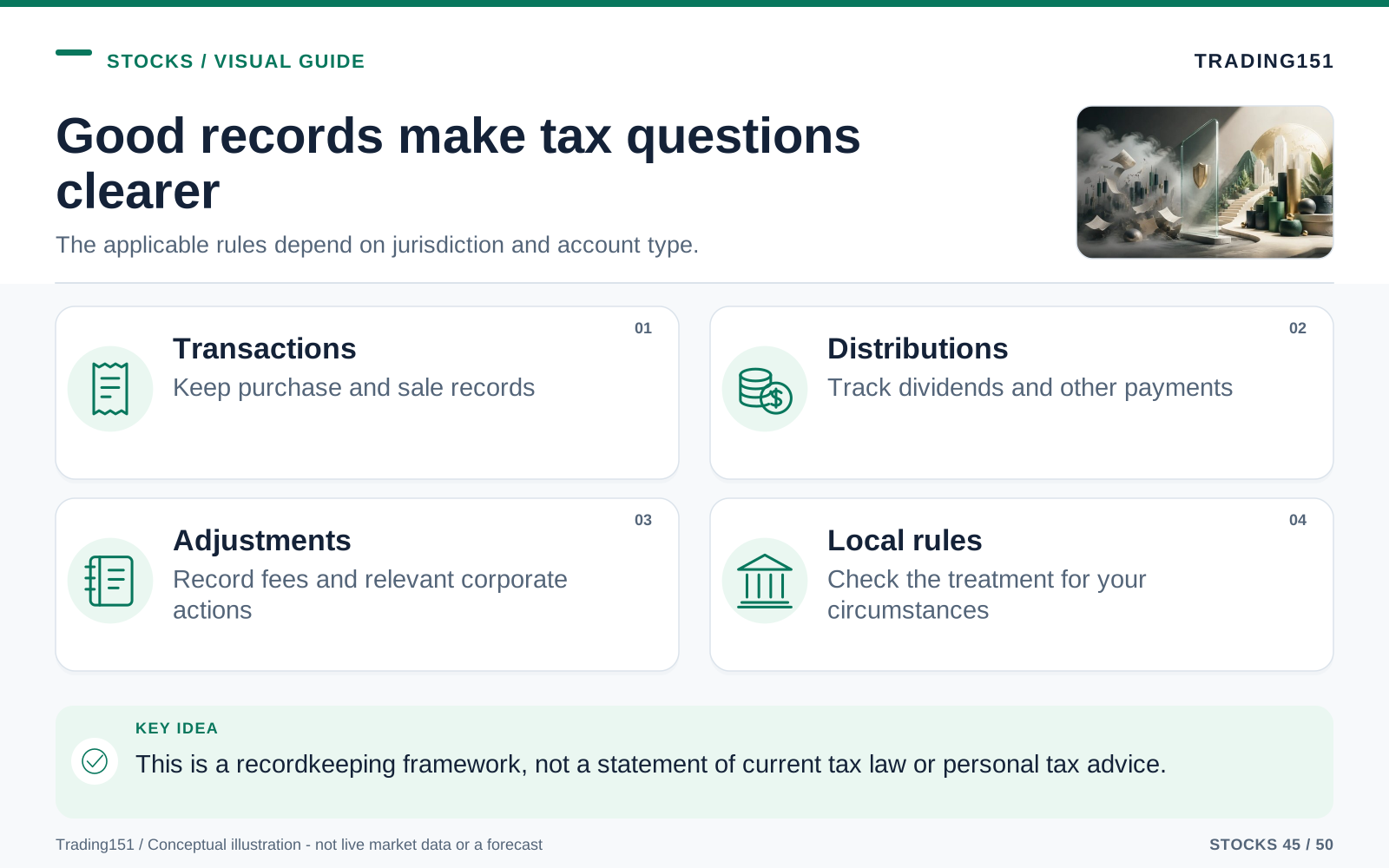
Read this diagram as text
- Transactions
- Keep purchase and sale records
- Distributions
- Track dividends and other payments
- Adjustments
- Record fees and relevant corporate actions
- Local rules
- Check the treatment for your circumstances
Cost Basis: The Number Your Tax Bill Starts With
Before you can figure out whether you owe money on a sale, you have to know your cost basis. If we strip away the financial jargon, your basis is usually just what you originally paid for the investment, plus maybe a few transaction fees. However, your basis can shift over time due to reinvested dividends, stock splits, corporate spin-offs, and wash sales. Reinvesting your dividends isn't just getting "free shares"—it's technically a new cash purchase, which creates an entirely new tax lot. If you ever move accounts between brokers, always double-check that your cost basis history transferred over correctly.
It sounds simple enough. If you buy a stock for $2,000 and sell it later for $2,700, your taxable gain isn't $2,700. Your gain is just the $700 difference between your sale price and your cost basis.
But that simple number gets tricky fast. If you buy shares of the same company at different times—say, a few at $40, some more at $55, and a handful at $70—you now have multiple tax lots. When you eventually sell just part of your position, deciding exactly which shares to sell will completely change the size of your taxable gain or loss.
Thankfully, major brokerages track this for you now and slap it on your year-end tax forms. Still, it pays to keep an eye on it, especially if you’ve transferred accounts, inherited older stocks, or participated in an employee stock purchase plan. A tiny tracking error can accidentally inflate your tax bill.
Capital Gains: What Happens When You Sell for a Profit
When you sell a stock or fund for more than your basis, that profit is called a capital gain. The tax rate you pay largely depends on how long you held onto the investment before cashing out. If you bought shares at different prices over time, you can usually tell your broker exactly which ones you want to sell to control your tax hit, but you have to do this when you place the trade. Once the trade settles, you usually can't change your mind, so check your default settings before you click sell.
Here is where the tax system explicitly rewards you for sitting on your hands.
Short-Term Capital Gains
If you hold an investment for one year or less before selling, you're looking at a short-term capital gain. The IRS treats this money just like the paycheck from your day job. It gets taxed at your ordinary income rate.
This is why rapid-fire day trading is often way more expensive than it looks on paper. If you flip a stock for a quick $2,000 profit, you aren't keeping $2,000. Once you factor in your federal (and maybe state) income tax bracket, a huge chunk of that win vanishes.
That doesn't mean every short-term trade is a mistake. Sometimes cashing out quickly is the smartest move. Just make sure you factor the tax hit into your strategy, because a brilliant trade can look pretty mediocre once the IRS takes its cut.
Long-Term Capital Gains
Hold that exact same investment for more than one year, and it magically becomes a long-term capital gain. These usually come with significantly lower, preferential federal tax rates.
For most net long-term capital gains, the federal rates are 0%, 15%, and 20%. For 2026, the 0% ceiling is $49,450 for single filers and $98,900 for married couples filing jointly; the 15% ceiling is $545,500 and $613,700 respectively. These are taxable-income thresholds, not salary limits, and the gain itself is included in taxable income. Portions of a gain can fall into different bands. Other filing statuses, special types of gains, state tax, and the net investment income tax require separate consideration.
The takeaway here is simple: if you have the flexibility, waiting for that one-year mark to cross can save you a lot of money. The difference in taxes between selling at eleven months versus thirteen months is large.
But don't be stubborn about it. If a company is fundamentally falling apart, or your portfolio is recklessly concentrated in one stock, it's almost always better to take the profit now and pay the higher tax than to watch the stock crash just because you were waiting on a calendar date.
Dividends: Income While You Still Own the Investment
A sale is a common way to realize a capital gain, but it is not the only possible taxable event. Dividends may be taxable without a sale, and funds can distribute capital gains to shareholders who have not sold their fund shares. Identify the event and the account type before deciding which rules apply.
Here is the part that catches people off guard: dividends in a standard brokerage account are taxable, even if you have them set to automatically reinvest. Your broker might make the process look completely invisible—sweeping the cash right into new shares before you even notice—but the IRS still views it as income that was paid out to you.
When tax season rolls around, dividends generally fall into one of two buckets.
Ordinary Dividends
Nonqualified ordinary dividends generally face ordinary income-tax rates. Qualified dividends are a subset of ordinary dividends that may receive preferential rates. REIT and fund distributions can have several tax components, so use their reported classification rather than assuming every payment has the same treatment. Interest on a bank money market deposit account is not the same as a dividend from a money market fund.
There's nothing wrong with ordinary dividends, but they aren't exactly tax-friendly. If you're building a portfolio focused heavily on income, it helps to know what kind of taxes those payouts are going to trigger.
Qualified Dividends
Qualified dividends generally receive the preferential rates that apply to most long-term capital gains. That treatment depends on the payment and the investor meeting the requirements; a familiar company name alone does not establish eligibility.
For ordinary common shares, the holding-period test generally requires more than 60 days during the 121-day period beginning 60 days before the ex-dividend date. The payer and payment must also qualify, and days when the risk of loss is reduced may not count. Certain preferred dividends have different holding-period requirements.
Long-term ownership can make the holding-period test easier to meet, but qualification should still be reconciled with the broker's Form 1099-DIV and the applicable rules. REIT distributions, foreign-company payments, and positions involving hedges can require a closer review.
Mutual Funds and ETFs Can Create Taxable Events Too
It isn't just individual stocks that trigger surprise tax bills. Mutual funds and exchange-traded funds (ETFs) do it too.
When a mutual fund manager decides to sell off some winning stocks inside the fund's portfolio, those profits get passed down to the shareholders as a capital gains distribution. You could end up owing taxes on those gains even if you didn't sell a single share of the fund yourself.
ETFs are generally structured in a way that makes them much more tax-efficient, avoiding a lot of these surprise distributions. But "more tax-efficient" doesn't mean "tax-free." Both ETFs and mutual funds will still pay taxable dividends and generate standard capital gains when you finally cash out.
This is why two funds with virtually identical returns can leave investors with completely different amounts of money in their pockets. Fees matter. Performance matters. But in a regular brokerage account, tax efficiency matters just as much.
Losses: The Part of the Tax Code That Softens the Blow
Nobody wins on every trade. Sometimes a company fails to deliver, an entire industry takes a hit, or you just buy at the exact wrong time. It stings, but in a taxable account, losing money gives you a useful consolation prize.
When you sell an investment for less than your cost basis, you lock in a capital loss. The beautiful thing about capital losses is that you can use them to cancel out your capital gains.
Let's say you hit a home run on one stock and sell it for a $6,000 profit, but you take a beating on another and sell it for a $2,500 loss. You don't pay taxes on the full six grand. The IRS lets you net them against each other, leaving you with a much more manageable $3,500 taxable gain.
After the required netting of capital gains and losses, an individual can generally deduct up to $3,000 of net capital loss against other income, or $1,500 if married filing separately. Unused losses generally carry forward, retaining their relevant character. The deduction is a limit on the net capital loss used against other income, not a limit on losses that can offset capital gains.
This is the engine behind tax-loss harvesting: intentionally selling your losers to lower your tax bill. When done right, it’s a brilliant way to salvage some value from a bad trade. But if you rush it, you might accidentally trip over the wash sale rule.
The Wash Sale Rule: The Trap Inside Tax-Loss Harvesting
The wash-sale rule can disallow a loss when substantially identical stock or securities are acquired within 30 days before or after the loss sale. That creates a 61-day window including the sale date. Review purchases across relevant accounts, including automatic reinvestments and certain spouse or IRA transactions. A broker's form may not identify every cross-account issue.
The basic rule is this: if you sell a security at a loss, and then buy a "substantially identical" security within 30 days—either before or after the sale—you forfeit the ability to claim that loss on your current taxes. Notice that the window looks backward as well as forward.
Selling a stock at a loss and buying it back four days later generally creates a wash sale to the extent of the replacement purchase. In a taxable account, the disallowed loss is generally added to the replacement shares' basis. A replacement purchase in an IRA can produce different, less favorable consequences, including a loss that is not recovered through an increased IRA basis.
The cleanest workaround is to simply wait out the 31 days, or temporarily swap the stock for a similar (but not identical) ETF that keeps your money in the market. Just remember to turn off automatic dividend reinvestments for that stock before you sell, or a fractional share purchase might ruin your whole plan.
Taxable Brokerage Accounts vs. Retirement Accounts
Where you hold your money often matters just as much as what you buy. Mixing and matching account types—a strategy called "asset location"—can seriously boost your after-tax returns. It usually makes sense to hide heavily taxed, income-producing assets inside retirement accounts, while leaving your long-term, low-turnover equity funds out in the open. The best setup really just depends on your withdrawal timeline and your current tax bracket.
Taxable Brokerage Accounts
A standard brokerage account offers ultimate freedom. There are no contribution limits, and you can pull your money out whenever you want without asking the government for permission. The catch? You pay for that flexibility with annual tax exposure.
In a taxable account, every realized gain, dividend, and fund distribution is fair game for the IRS in the year it happens. Your broker tracks it all, sends you a stack of forms, and those numbers plug straight into your federal return.
Traditional IRAs and Traditional 401(k)s
Traditional retirement accounts operate in a totally different world. You usually get an upfront tax break on the money you put in, and everything grows inside the account completely tax-deferred. You can trade, rebalance, and collect dividends all day long without triggering a single immediate tax event.
The tradeoff is that you're just kicking the can down the road. When you finally withdraw the money in retirement, the IRS taxes every dollar as ordinary income, and they have strict rules on exactly when and how you can take that money out.
Roth IRAs and Roth 401(k)s
Roth accounts flip the script. You fund them with after-tax money today, meaning there is no upfront tax break. But the payoff is huge: your growth, and your eventual qualified withdrawals, are entirely tax-free.
If you're a patient investor, a Roth is powerful. You can watch a stock compound for thirty years and never pay a dime in capital gains when you finally cash out. Dividends piling up inside the account don't create taxable income either.
This is why picking the right account is so crucial. A tax-heavy asset belongs in an IRA, while a tax-efficient index fund does perfectly fine in a regular brokerage. Get your account strategy right, and everything else gets easier.
High Earners: Remember the Net Investment Income Tax
If you're a high earner, the IRS has a little extra surprise waiting for you called the Net Investment Income Tax (NIIT).
It's essentially a 3.8% surtax slapped on top of your investment income once your overall income crosses a certain line. Currently, those thresholds are $200,000 for single filers, $250,000 for married couples filing jointly, and $125,000 for married people filing separately.
The IRS counts capital gains, dividends, rental income, and interest toward this tax. Your day job salary obviously isn't investment income, but a high salary can push your overall adjusted gross income over the threshold, pulling your stock market profits into the crosshairs.
This is just one more reason why looking at your "after-tax" return is so vital once your income starts climbing. A 15% long-term capital gains rate sounds great, but once you tack on the NIIT, the actual cost of a profitable trade gets noticeably heavier.
State Taxes Can Change the Picture
Everything we've talked about so far is just the federal side of things. Your state government usually wants a cut, too. Some states tax capital gains exactly the same as your regular salary. Others don't have an income tax at all. A few have bizarre, hyper-specific surcharges and deductions.
If you're comparing investment strategies, you can't ignore the local flavor. A trade that looks perfectly fine on a federal level might sting once your state hits you with a large tax bill. This is especially true if you moved across state lines this year, sold off a huge chunk of company stock, or run a business in multiple states.
What Your Brokerage Sends You at Tax Time
The silver lining to all this complexity is that you rarely have to track it with a pen and paper. Your brokerage handles the heavy lifting and mails you the results after the year ends.
Here are the main forms you’ll usually see:
- Form 1099-B: This is the big one. It logs all your sales, showing what you bought, what you sold it for, your cost basis, and whether your gains were short-term or long-term.
- Form 1099-DIV: This reports all your dividends, breaking them down into ordinary dividends, qualified dividends, and any capital gains distributions from mutual funds.
- Form 1099-INT: This covers taxable interest, which usually pops up if you hold cash in a sweep account, buy CDs, or invest in bonds.
- Consolidated 1099: To keep things easy, most brokerages just staple all these forms together into one giant document.
These packages usually drop into your inbox in mid-February, but beware: brokerages are notorious for sending "corrected" 1099s later in March if a mutual fund or REIT suddenly reclassifies its income. Filing on February 15th feels great until a revised tax form forces you to file an annoying amendment. Even though modern tax software imports these numbers effortlessly, always give your forms a quick visual check to make sure the numbers make sense.
Estimated Taxes: When a Big Gain May Need Attention Before April
When you work a W-2 job, your employer automatically holds back taxes from your paycheck to keep you out of trouble. The stock market doesn't do that. Unless you set up a special withholding rule, you are entirely responsible for paying the tax on your gains.
If you sell a huge position and lock in a large profit, waiting until next April to pay the IRS might be a costly mistake. The government expects to be paid as you earn, and if you severely underpay during the year, they'll happily tack on an underpayment penalty.
You don't need to stress over this for a few hundred dollars in casual trading. But if you liquidated a big chunk of your portfolio for a house down payment, finally cashed out those company stock options, or took heavy profits off the table during a bull run, it’s highly recommended to run the numbers mid-year and see if you need to make a quarterly estimated tax payment.
A Simple Example From Buy to Tax Return
Let's tie it all together with a quick scenario. Say you open a standard brokerage account and buy 100 shares of a stock at $50 apiece. Your initial cost basis is $5,000. Over the next two years, the company does well and pays you $200 in qualified dividends, which you automatically reinvest. A while later, you decide to sell your original 100 shares at $80 each, pocketing $8,000.
Here is how the tax math plays out:
- Those $200 in dividends? Even though you never saw the cash, you owed taxes on them in the year they were paid.
- You sold your original shares for $8,000 against a $5,000 basis. Since you held them for over a year, you now have a $3,000 long-term capital gain.
- Because you reinvested your dividends, you still own a few fractional shares. Those specific shares have their own unique cost basis and holding period, starting from the exact day the dividend was reinvested.
This is why reinvested dividends matter. They slowly build up your total investment, creating new mini-tax lots along the way. Your broker tracks it all, but understanding the mechanics helps explain why your final cost basis is usually a bit higher than your original cash deposit.
Common Mistakes That Make Stock Taxes Harder Than They Need to Be
Most people don't get tripped up by substantially exotic tax loopholes. They get burned by simple, everyday habits.
- Thinking reinvested dividends aren’t taxable: In a regular account, turning a dividend into more stock doesn't hide it from the IRS.
- Selling right before long-term treatment begins: Jumping the gun by just a few days can completely change your tax bracket on a large gain.
- Harvesting losses without checking for wash sales: An automated buy in a totally different account can ruin a brilliant tax-loss harvesting move.
- Ignoring state taxes: Your federal rate is only half the battle.
- Letting taxes override the investment decision: Skipping a much-needed portfolio rebalance just to dodge a tax bill is a great way to lose money.
- Assuming the brokerage is always perfect: Brokers are great, but transferred accounts and old shares get messy. Always double-check their math.
Do Not Let the Tax Tail Wag the Investment Dog
There is an old Wall Street cliché that you shouldn't let the tax tail wag the investment dog—and it sticks around because it is absolutely true.
Yes, taxes matter. They eat into your net returns, and smart planning helps you keep more of your own money. But minimizing taxes shouldn't be your only goal. The actual goal is to make smart, profitable investments.
Refusing to sell a fundamentally broken stock just because you don't want to pay taxes on your remaining gains isn't disciplined investing; it's just avoidance. Hanging onto a dangerously concentrated position in one single company because you dread the tax bill exposes you to way more financial risk than the IRS ever could. On the flip side, frantically trading in and out of stocks without realizing how much short-term tax you're racking up will quietly drain your wealth.
Find the middle ground. Understand the tax consequences before you hit the buy or sell button. Shelter your high-yield assets in retirement accounts when it makes sense. Harvest your losses carefully. Be patient when the market rewards patience. But never forget that owing taxes on a stock usually means you made a profitable trade—and making a profit is the whole point of investing in the first place.
A Practical Year-End Checklist for Investors
Before the year closes out, it helps to do a quick review of your taxable accounts. You don’t need an accounting degree to do this; you just need to know where to look.
- Review realized gains and losses. Pull up your year-to-date tax activity on your broker's website to see where you stand.
- Look for unrealized losses. If you have some dogs in your portfolio, consider harvesting the losses to offset your gains.
- Check holding periods. If you have a big winner that is weeks away from hitting the one-year mark, you might want to hold off on selling.
- Review scheduled reinvestments and other purchases before harvesting losses. Turning off an automatic purchase can help avoid an unintended replacement transaction, but it does not resolve purchases already made during the preceding 30 days or every cross-account issue.
- Estimate the impact of large sales. If you cashed out a huge position, see if it bumps you into the NIIT bracket or requires an estimated tax payment.
- Download and save your tax forms. Keep your 1099s and trade confirmations handy just in case something gets flagged later.
Separate the tax year, the filing year, and the type of income
For a taxable investment account, selling a stock generally creates a gain or loss measured against its adjusted basis. Dividends can create taxable income even when automatically reinvested. The reinvested amount ordinarily becomes the basis of newly purchased shares, so keeping the additional lot matters when those shares are later sold.
Long-term capital-gain thresholds apply to taxable income, not simply salary or gross sale proceeds. Gains can occupy more than one rate band as they are added to other taxable income. For tax year 2026, the 0% band for most long-term capital gains extends to taxable income of $49,450 for single filers and $98,900 for married couples filing jointly. The corresponding upper limits of the 15% band are $545,500 and $613,700. Other filing statuses, special gains, additional taxes, and deductions require separate consideration.
Loss deductions have conditions. Net capital losses can generally offset up to $3,000 of other income annually for an individual, or $1,500 when married filing separately, with qualifying unused losses carried forward. The wash-sale rule can defer or otherwise disallow a loss when substantially identical stock or securities are acquired within the relevant 30-day periods before or after a loss sale. Purchases in other accounts can matter too.
Reconcile the broker's forms with your records rather than assuming either is complete in every situation. Transfers, inherited or gifted shares, corporate actions, and cross-account activity can require additional information. Treat this overview as preparation for the calculation, not a personalized filing conclusion. A qualified tax professional is appropriate when the facts or jurisdiction make the answer uncertain.
Reconcile the records before estimating the bill
Broker forms are useful, but a taxpayer may need records from several accounts to identify transfers, replacement purchases, and basis adjustments. Match the reported proceeds and lots with the underlying transactions before applying a tax rate. A calculation based on incomplete basis can be wrong even when the rate is correct.
Keep the tax year explicit. A form received in one calendar year may report transactions from the previous year, while thresholds quoted in a current article may apply to a later year. The relevant rule is the one for the transaction and return being prepared, not simply the newest number available online. 1, 2, 3
Plan for the Tax, Then Make the Investment Decision
Taxes on stock investments aren’t something to ignore, but they definitely shouldn't scare you away from the market. The core rules are entirely manageable once you get the hang of them.
The trick is to think about taxes proactively, not reactively. Figure out your cost basis, holding period, and account type before you place a trade. Remember that holding a mutual fund can sometimes stick you with a tax bill even if you didn't sell anything.
Tax efficiency is a great tool, but it should always take a backseat to your actual investment strategy. Holding onto a dying company to avoid paying taxes on the little profit you have left is going to cost you way more than just paying the IRS and moving on. Always weigh the definite tax cost against the uncertain future of the stock itself.
Keep clean records, and don't be afraid to ask for help when things get complicated. Inherited shares, employee stock options, and foreign companies all come with their own messy rulebooks. Ultimately, a little bit of upfront planning is all it takes to keep the fine print from eating into your hard-earned returns.
Sources and further reading
- IRS Publication 550: Investment Income and Expenses
- IRS Revenue Procedure 2025-32: 2026 Inflation Adjustments
- IRS Topic 409: Capital Gains and Losses
Editorial revision: 7 October 2026. Numerical scenarios are hypothetical unless identified as historical. References support the added explanations and selected corrections; rules and product terms should be checked again before acting.