
Emerging markets contain very different economies, companies, and financial systems. A promising national growth story does not automatically translate into good shareholder returns, and the label does not make every market comparable. Currency movements, valuation, governance, and the composition of the investment all affect what a foreign investor actually receives.
What Exactly Is an Emerging Market?
Wall Street likes to keep things neat, so it usually lumps the world into three buckets: developed, emerging, and frontier markets. But the real world is messy. The big index providers regularly disagree on who goes where, and countries routinely graduate (or get demoted) as their economies evolve over time.
- Developed markets: These are the heavyweights. Think the US, UK, Canada, Germany, Japan, and Australia. They boast high incomes, large stock exchanges, strict financial watchdogs, and companies that have been operating globally for decades.
- Emerging markets: These countries have outgrown their "frontier" days but aren't quite as rich, deep, or stable as the developed crowd. We’re mostly talking about heavy hitters like India, Brazil, Mexico, Indonesia, Taiwan, China, and Saudi Arabia—though classifications can vary depending on who you ask.
- Frontier markets: Think of these as the wild west of investing. They’re smaller, harder to trade, and come with a much steeper political and financial risk. You'll generally find them in parts of Africa, Central Asia, and the less-developed pockets of Southeast Asia.
When you buy an emerging market stock, you’re basically betting on a company that’s operating in a nation still under construction. Maybe it’s an Indian bank, a Taiwanese chipmaker, a Mexican grocery chain, a Brazilian mining outfit, or a telecom company hooking up millions of people to their very first internet connection.
But remember: you aren’t just buying the business. You’re adopting the whole country. You’re taking on its currency, its political drama, its trade wars, its consumers, and its ability to grow rapidly without overheating and crashing.
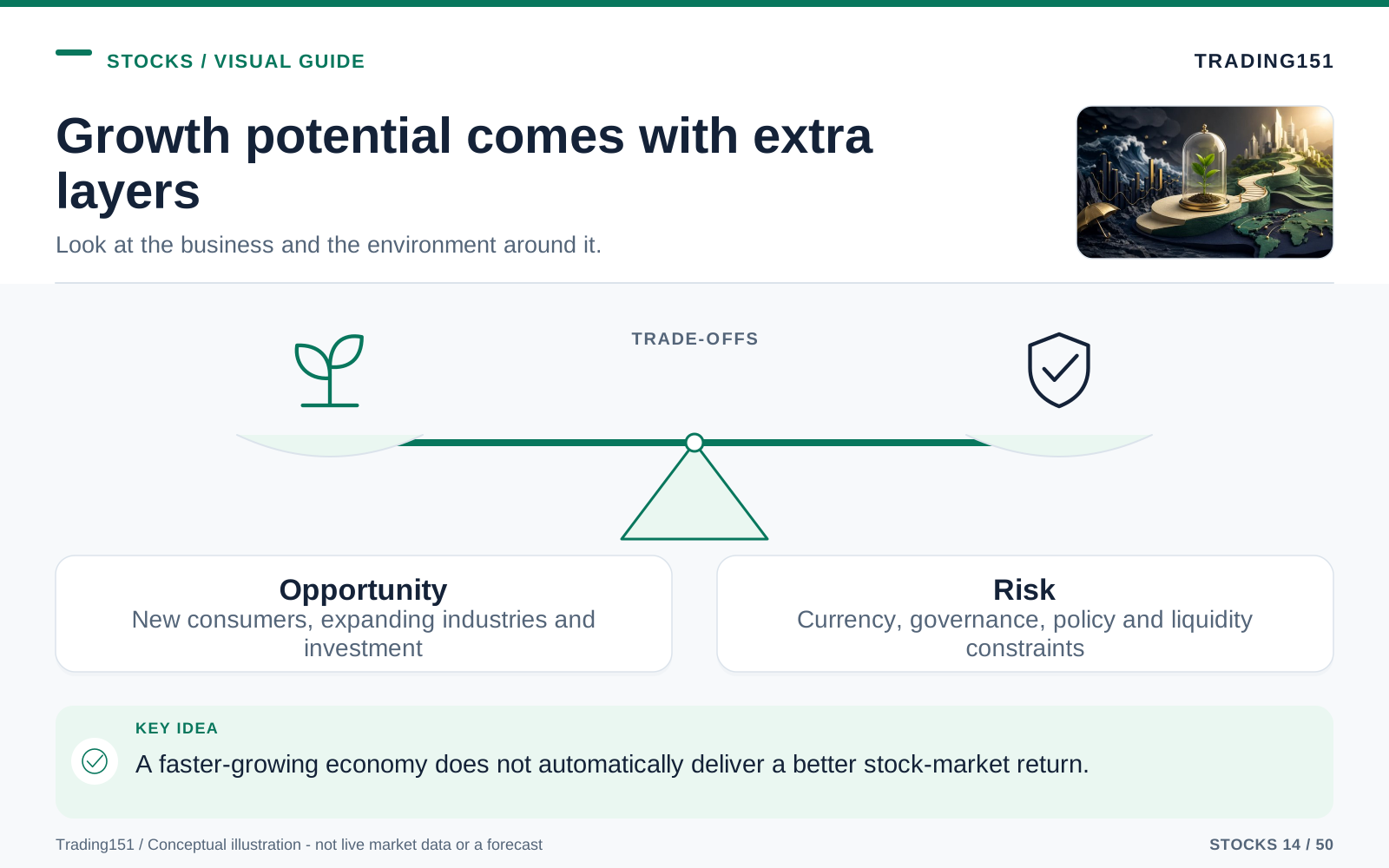
Read this diagram as text
- Opportunity
- New consumers, expanding industries and investment
- Risk
- Currency, governance, policy and liquidity constraints
Why Investors Look Beyond Developed Markets
It’s fair to wonder why anyone would bother with all this headache. Developed markets already have incredible companies, strong transparency, and more innovation than you can wrap your head around. For a lot of folks, a portfolio packed entirely with US and European stocks is perfectly fine.
Yet, emerging markets have an undeniable gravity. They are ground zero for large global shifts: exploding, youthful populations, rising incomes, intense industrial builds, and the birth of modern financial systems. These factors don't guarantee you'll get rich, but they do create the kind of raw growth opportunities that are getting hard to find in older, slower economies.
1. Younger Populations and Expanding Workforces
Let's face it, much of the developed world is getting old. Birth rates are falling, retirement homes are filling up, and economic growth relies more on getting technology to do things faster than on adding workers to the labor pool. Of course, just having a lot of young people isn't enough on its own. Governments still have to build schools, lay down roads, and create a business climate where companies can hire those workers and keep their profits.
But places like India, Indonesia, Mexico, and much of the Middle East look totally different. They are packed with young people hungry for work. When these generations get jobs, move to the city, and start spending money, the economic engine roars to life in a way mature markets just can't replicate.
A youth boom isn't a magic wand. You still need political stability and infrastructure to make it work. But when a country gets the recipe right, a young demographic becomes an unbelievable economic tailwind.
2. The Growth of the Middle Class
Sometimes the most lucrative investment stories aren't about AI or quantum computing; they're about everyday people buying normal stuff.
Imagine a family that used to spend every penny just to keep a roof over their heads and food on the table. Eventually, they save enough to buy a fridge, a moped, health insurance, or a smartphone data plan. For that family, it’s a life-changing personal milestone. For the stock market, it’s a large wave of fresh revenue pouring into local banks, retailers, hospitals, and telecom companies.
This is why Wall Street obsesses over domestic consumption in emerging markets. The first chapter of a country's growth is usually about building roads and exporting cheap goods. The second chapter is about millions of people finally getting a little disposable income—and spending it.
3. Catch-Up Growth
It’s just math: it is way easier to double the size of a tiny economy than a large one. A country that's currently laying down its very first modern highways, digital payment networks, and power grids has large room for what economists call "catch-up growth."
Now, not every country pulls this off. Some blow their cash on vanity projects, drown in debt, or get crippled by corruption. But when the money is spent right, the transformation is stunning. A new train line completely changes a city’s dynamic. Better ports mean a boom in exports. A functional banking system turns mattress money into business loans.
And public companies are right there to collect the toll. Banks fund the projects. Steel companies provide the materials. Tech platforms swoop in to connect everything. Retailers cash in on the new wealth.
4. Diversification Beyond One Economic Story
A lot of people think "diversification" just means owning a lot of different stocks. But real diversification means owning different kinds of risks and rewards.
If you only own stocks in your home country, your entire retirement is chained to your local interest rates, politicians, and economic moods. Emerging markets let you buy into entirely different storylines: the booming demand for raw materials in Latin America, a manufacturing renaissance in Mexico, the rapid adoption of digital banking in India, or large infrastructure projects in the Middle East.
Will emerging markets save you when a global financial crisis hits? Probably not. When true panic sets in, almost everything drops together. But over a decade or two, different parts of the world move to their own rhythms, helping to smooth out the ride for your overall portfolio.
The Risks Are Real, Not Fine Print
It’s easy to get swept up in the optimistic pitch. But the risks aren't just legal disclaimers—they are very real threats to your money.
Emerging market stocks aren't just normal stocks that happen to grow faster. They carry baked-in, structural dangers. A company could crush its earnings, expand its profit margins, and still lose you money because the local currency collapsed, the government changed the rules, or global investors simply got spooked.
1. Political and Regulatory Risk
Politics matters everywhere, but in emerging markets, it can upend your portfolio overnight.
A government might suddenly slap new taxes on a booming industry, freeze foreign assets, block exports, strong-arm banks into lending to political cronies, or completely crack down on their own tech companies. Sometimes you can see it coming from a mile away; other times, you wake up to a nasty surprise.
Because of this, you can’t just read balance sheets. You have to understand the rule of law, how buddy-buddy big business is with the state, and the overall political climate. A stock that looks ridiculously cheap on paper will stay that way for a decade if nobody trusts the local government.
2. Currency Risk
Currencies are the silent killers—or saviors—of international investing. A foreign company might be making money hand over fist in its local currency, but if that currency takes a nosedive against the US dollar (or euro, or pound), your actual return gets wiped out. You have to figure out where a company makes its money and whether it owes a lot of debt in a foreign currency.
Let’s say you buy shares in a Brazilian mining stock. The company does great, and the stock shoots up in Brazilian reals. But if the real drops sharply against your home currency? You just lost a huge chunk of that gain. In rough years, the currency swing can completely hijack whatever the stock itself is doing.
Of course, it cuts both ways. A strong local currency can supercharge your returns. That dual-edged sword is exactly what makes these markets so volatile.
Currency risk is an especially big deal in places wrestling with high inflation, sketchy politics, or large foreign debt. It's the main reason these stocks jump around so much more than the actual businesses do.
3. Corporate Governance and Transparency
In the US or Europe, investors rely on strict auditors, eagle-eyed regulators, and harsh penalties for cooking the books. You can’t assume those safety nets exist everywhere else. How minority shareholders are treated is a large deal here. Watch out for shady transactions between corporate insiders, powerful family dynasties, state meddling, and toothless boards of directors. You want to see respected auditors and a clear track record of treating outside investors fairly.
Yes, some emerging market companies are brilliantly run and completely transparent. But others are a tangled web of shell companies designed to funnel money to controlling shareholders while leaving you out in the cold.
This doesn't mean every foreign company is a scam. It just means the margin for error is razor-thin. When you’re thousands of miles away, reading translated documents, you have to be extra careful about who you trust.
4. Liquidity Risk
The large, blue-chip emerging market companies are usually easy to buy and sell, especially if they are bundled into global indexes. But step outside those heavy hitters, and it gets tricky.
In smaller markets, there aren't always enough buyers and sellers to go around. When times are good, you won’t notice. But when panic hits and everyone rushes for the exit, trading can completely freeze up. If you need to sell, you might have to accept a severe discount.
This is why everyday investors usually stick to broad funds rather than picking individual foreign stocks. A good fund manager worries about liquidity so you don’t have to.
5. Commodity and Debt Cycles
A huge chunk of the emerging world relies heavily on digging stuff out of the ground: oil, copper, lithium, soybeans, and gold. When commodity prices are high, these countries are flush with cash. Currencies strengthen, governments spend, and corporate profits soar. But when prices crash, the hangover is severe.
Then there’s the debt trap. Countries and companies love to borrow in US dollars when times are good. But if their local currency weakens or global interest rates spike, paying back those loans suddenly becomes painful.
You won't always see these cycles by just looking at a stock chart, but they explain why emerging markets are notorious for their spectacular booms and devastating busts.
A Quick Tour of the Emerging Market Landscape
People talk about "emerging markets" as if they're a single, unified thing. That’s substantially misleading. Treating Brazil, China, and Saudi Arabia as the same asset class makes about as much sense as treating Germany and Japan identically just because they're both "developed."
Asia: Scale, Technology, Manufacturing, and Consumers
Asia is the undisputed heavyweight champion of emerging market indexes. It’s home to the world’s most critical tech suppliers, manufacturing hubs, and largest consumer bases.
India is the darling of the moment, thanks to its large population, booming digital economy, and rapidly expanding middle class. The pitch is simple: a modernizing economy with a thriving private sector. The catch? Everyone knows it, which means Indian stocks are often priced for absolute perfection long before the growth happens.
China is the elephant in the room. It has incredible scale, world-class manufacturing, and large tech giants. But it also comes with heavy-handed government intervention, a sputtering property market, shrinking demographics, and intense geopolitical friction. You have to decide if China is a large opportunity, a risk you want to avoid, or just something you own a tiny piece of through a broad fund.
Taiwan punches way above its weight because it practically holds a monopoly on advanced semiconductors. If you care about AI, smartphones, or data centers, Taiwan is vital. But that dominance brings major concentration risk and obvious geopolitical anxieties.
Meanwhile, places like Indonesia, Thailand, Malaysia, and the Philippines offer a quieter, yet solid mix of domestic growth, tourism, and manufacturing. They might not dominate the news every week, but they are fantastic diversifiers for your portfolio.
Latin America: Resources, Nearshoring, Finance, and Volatility
Latin America dances to the beat of commodity prices, currency swings, and spicy politics. It’s highly cyclical, but it gives you direct exposure to things the rest of the world desperately needs.
Brazil is an agricultural and mining powerhouse with a large domestic consumer base. It dishes out some strong companies and juicy dividends, but it's substantially sensitive to inflation, interest rates, and who happens to be in political power.
Mexico is having a huge moment right now thanks to "nearshoring." With companies desperate to move their supply chains out of Asia and closer to the US, Mexico’s location is a goldmine. The potential is large, though investors still worry about infrastructure gaps, water shortages, and sudden policy shifts.
Down south, Chile and Peru are essentially mining plays. Since the world needs absurd amounts of copper to build electric vehicles and green energy grids, they are perfectly positioned. Just be ready for a bumpy ride whenever metal prices fluctuate.
The Middle East and Africa: Reform, Energy, Finance, and Frontier-Like Risk
The Middle East is grabbing a much bigger slice of emerging market portfolios lately. Saudi Arabia and the United Arab Emirates are throwing billions at diversifying their economies away from oil—investing heavily in tourism, tech, logistics, and finance. It’s an exciting shift, but these economies are still largely tethered to state-led development and the price of crude.
South Africa boasts one of the most sophisticated financial markets on the continent, with companies that operate globally. But the local headwinds are severe: rolling blackouts, staggering unemployment, and deep political uncertainty.
Looking at the rest of Africa, the demographic story is incredible—a large, young, rapidly growing population. But investing in it via public stock markets is tough. The best growth stories there are mostly private, highly illiquid, and totally out of reach for your average retail investor.
How to Invest Without Turning It Into a Second Job
Good news: you do not need to memorize the central bank policies of a dozen different countries to invest globally. In fact, the smartest thing you can do is admit what you don't know and pick a strategy that does the heavy lifting for you.
Option 1: Broad Emerging Market ETFs and Mutual Funds
For 99% of people, a broad index ETF or mutual fund is the smartest play. You buy one ticker, and suddenly you own a tiny slice of thousands of companies across dozens of countries. If one company goes bankrupt or one country has a political crisis, your portfolio barely flinches. Just remember to peek under the hood: index rules dictate how much weight each country gets based on liquidity and foreign-ownership limits, not just the size of the country's economy. And pay attention to where a company makes its money, not just where it’s legally headquartered.
Broad funds also solve the complication of access. Trying to buy shares directly on the Mumbai or São Paulo stock exchanges is a logistical nightmare for a normal person. A fund wraps it all up neatly in your standard brokerage account.
The downside? You're stuck with whatever the index gives you. If the fund is 30% China, congratulations, you're heavily invested in China. Always check the fund’s country breakdown, top holdings, and expense ratios before you hit the buy button.
Option 2: Emerging Markets Ex-China Funds
A lot of investors still want emerging market growth but are completely spooked by China's political and regulatory risks. Enter the "ex-China" fund.
This is a great option if you already own Chinese stocks elsewhere, or if you just want to heavily tilt your money toward India, Taiwan, and Latin America. The tradeoff is that by removing the biggest player in the room, you fundamentally change the risk profile of your portfolio. You're solving one concentration problem by creating another.
Option 3: Single-Country or Regional Funds
Have a strong gut feeling about a specific place? You can buy ETFs completely dedicated to India, Brazil, Mexico, or the broader Asia region.
It’s a great way to make a targeted bet, but it is deeply unforgiving. A single-country fund can get totally decimated by one bad election, one currency devaluation, or an unexpected banking crisis. If you play this game, keep the position small enough that a total meltdown won’t ruin your year.
Option 4: Individual Stocks and ADRs
If you want to hand-pick specific companies, you can look for American Depositary Receipts (ADRs). These are basically certificates issued by a US bank that represent shares of a foreign company, and they trade right on the New York Stock Exchange or Nasdaq.
ADRs are super convenient, but don't let the familiar ticker symbol fool you. You are still taking on all the local political, currency, and regulatory risks of that foreign country. It requires a lot of homework.
Option 5: Active Emerging Market Managers
This is one corner of the investing world where paying a human being to pick stocks makes sense. Because emerging markets are so murky, inefficient, and poorly governed in places, a boots-on-the-ground manager can theoretically dodge the landmines and find hidden gems.
The flip side? Active managers charge hefty fees, and plenty of them still fail to beat a basic index fund. If you go this route, look for a manager with a strong track record, obsessive risk control, and reasonable fees.
How Much Emerging Market Exposure Is Enough?
There’s no magic number here. It completely depends on when you need your money, how strong your stomach is, and whether you're prone to panic-selling when the market gets ugly.
For most savvy investors, emerging markets are the hot sauce in the portfolio, not the main course. You want enough exposure that it boosts your returns when things go well, but not so much that a rough decade derails your entire retirement plan.
Ask yourself these three questions before you buy:
- Can I hold this through a severe five-year slump? Emerging markets are famous for lagging behind the US market for years at a time. If that's going to make you rage-sell, your position is too big.
- Do I know what’s in this fund? Take five minutes to look at the top holdings. A lot of people are shocked to find out how heavily concentrated their "diversified" fund really is.
- Am I willing to rebalance? Rebalancing is your secret weapon. When emerging markets go on a tear, you sell a little to lock in gains. When they tank but the long-term thesis is still solid, you force yourself to buy more while they’re on sale instead of giving up on the asset class.
Figuring out exactly how much to buy is boring compared to finding the next big stock, but it will absolutely make or break your success. Emerging markets demand humility.
What to Check Before Buying an Emerging Market Fund
Before you dump your hard-earned cash into a fund, take five minutes to look under the hood. You don't need to be a Wall Street analyst, but you should at least know what you're buying.
- Country exposure: How much of your money is sitting in China, India, Taiwan, or Brazil?
- Sector exposure: Are you accidentally buying a portfolio stuffed entirely with state-run banks and fossil fuel companies, or is it tilted toward tech and consumers?
- Top holdings: Is the fund's performance entirely dependent on two or three mega-corporations?
- Expense ratio: Emerging market funds are almost always pricier than basic US index funds. Don't let high fees quietly bleed your returns over the next twenty years.
- Index methodology: What are the rules? Does it exclude certain countries? Is it based purely on the size of the companies, or does it focus on dividends or earnings?
- Liquidity and spreads: Can you easily buy and sell the ETF on a normal day, or is it thinly traded with large gaps between the buy and sell prices?
- Tax considerations: Be aware that foreign withholding taxes can take a bite out of your dividends, depending on what kind of account you use.
Checking these boxes won't make you bulletproof, but it will save you from the nasty shock of realizing you own something you completely misunderstood.
Common Mistakes Investors Make
Investing globally has a cruel way of punishing impatience, arrogance, and getting swept up in a good story while ignoring the actual price tag. Most people lose money here because of their own psychology, not bad math.
Chasing the Hottest Country
Every few years, the financial media falls in love with a new country. The narrative is flawless, the money floods in, and valuations go sharply higher. That is exactly the moment you need to pump the brakes.
A fantastic economy doesn't equal a fantastic stock if you’re paying an exorbitant price for it. The stock market doesn't just care if things are good; it cares if things are better than everyone already expected.
Confusing GDP Growth With Stock Returns
We said it earlier, but it bears repeating: a booming GDP does not automatically make you rich. Corporate profits can get diluted by the company issuing new shares, eaten by fierce competition, completely captured by greedy governments, or erased by a collapsing currency.
Economic growth is a great backdrop. But it’s not the whole story.
Ignoring Currency and Valuation
It is so easy to fall in love with a country's growth story that you completely forget to check the price-to-earnings ratio or the stability of their money. Both are crucial.
A market can look exciting, but if all that excitement is already baked into the stock price, you're late to the party. Conversely, some markets look inexpensive for a very good reason—like impending political doom.
Selling During the Inevitable Rough Patch
Emerging markets will absolutely test your sanity. Your portfolio might lag behind the S&P 500 for years. The news headlines will look concerning. Your friends will ask why you’re stubbornly holding onto those foreign stocks.
This is why sizing your position correctly from day one is everything. If you made it a modest, well-thought-out slice of your portfolio, the volatility is just part of the deal. Don't panic-sell at the bottom.
Golden Rules for the Long-Term Investor
Emerging markets absolutely deserve a spot in a serious portfolio, provided you treat them with a healthy dose of respect. You aren't trying to avoid risk completely—you're trying to take calculated risks that you understand, in a size you can sleep with at night.
- Keep the allocation sensible: You want just enough to move the needle when things go well, but not so much that a market crash ruins your life. A small position you can confidently hold onto is infinitely better than a large one you dump in a panic.
- Prefer broad exposure unless you have a clear edge: Betting on a single country is thrilling, but broad, diversified funds are much more forgiving. It’s boring, but it works.
- Expect long cycles: These markets tend to crush it for a decade, then go to sleep for a decade. Think in terms of generations, not the next quarterly earnings report.
- Rebalance instead of reacting: Pick your target percentage from day one. When the market goes crazy, let your rebalancing strategy dictate your trades—not the fear or greed you feel from reading the news.
- Watch fees and taxes: A high expense ratio is a silent killer. Don't let Wall Street quietly siphon off the extra returns you took so much risk to get.
- Don’t confuse a good story with a good investment: A booming young population is great, but the price you pay for the stock, the rights you have as a shareholder, and the stability of the local currency matter just as much.
Translate the local return into your spending currency
Suppose an investment rises 12% in its local currency while that currency falls 10% against your home currency. The combined return is approximately 1.12 multiplied by 0.90, minus one: 0.8%, before costs and taxes. Adding 12% and subtracting 10% gives a rough impression, but the multiplicative calculation is the correct way to combine the two changes.
A currency-hedged product changes that exposure rather than eliminating every currency-related risk. Hedging has costs and implementation limits, and the businesses themselves may earn revenue or carry debt in several currencies. The currency in which a fund trades is not, by itself, evidence that its underlying economic exposure is hedged.
Country labels can also conceal portfolio concentration. A broad emerging-market fund may have substantial weight in a few countries, sectors, or large companies. Check the current holdings and the index methodology. Different index providers can classify the same market differently, so two funds with similar names may not cover the same opportunity set.
Before investing, describe the exposure in ordinary terms: which businesses generate the earnings, which risks dominate, and how the return reaches an investor in your currency. That explanation is more useful than assuming that faster population or GDP growth must produce faster stock-market gains. Growth creates an opportunity; price, ownership rights, and execution determine how much of it shareholders capture.
Currency exposure can sit inside the business
The exchange on which a share trades does not reveal all of its currency risk. A company may report in one currency, earn revenue in several others, and borrow in another. The effect of a currency move therefore depends on the combination of sales, costs, debt, and hedges.
A fund's currency-hedged share class addresses a particular layer of exposure, not necessarily every currency effect within its companies. Read what the hedge is designed to do and what it costs. The investor's own spending currency adds another layer. A foreign investment that performs well locally can produce a different result when converted into the currency needed for a future expense. 1
Growth Is Attractive Only When Shareholders Can Capture It
Investing in emerging markets is a bet on messy, uneven human progress.
It’s a bet that more people will pull themselves out of poverty, buy their first appliances, and start businesses. It’s a bet that developing nations will build the roads, ports, and laws needed to thrive. But it is also an acceptance that progress is never a straight, clean line. It stumbles. It takes two steps forward and one step back. It gets interrupted by wild elections, nasty debt cycles, wars, inflation, and sheer panic.
You need the stomach for events you can't control or perfectly predict. Sanctions, currency devaluations, and geopolitical tantrums can completely drown out a company's actual business performance for years. That uncertainty isn’t a glitch in the system—it’s the exact reason the opportunity for high returns exists in the first place.
Stick to funds where you understand the country and sector weightings. Pay attention to fees, corporate governance, and how easy it is to cash out. If you buy a fund that excludes a large country, realize you are changing your risk profile, not just magically erasing risk.
Keep your position size modest enough that you won't panic during the ugly years, and hold on long enough to let the growth compound. The opportunity is very real, but it only rewards investors who know the difference between a catchy economic storyline and actual shareholder profit—and who realize that wild volatility isn't a mistake, it's just the price of admission.
Sources and further reading
Editorial revision: 7 October 2026. Numerical scenarios are hypothetical unless identified as historical. References support the added explanations and selected corrections; rules and product terms should be checked again before acting.