
Investing beyond your home market can broaden the businesses and economic conditions represented in a portfolio. It also introduces currency, legal, tax, and market-access questions. Geography is more complicated than the exchange on which a share trades. A company's customers, assets, costs, and financing may span several countries, even when its ticker looks familiar.
Why Investors Stay Too Close to Home
Finance folks call it home country bias, which sounds a bit clinical, but the urge to invest locally is human. We instinctively trust what we recognize. If a brand has been in our lives since childhood, we feel like we "get" it—even if we wouldn't know how to read its financial statements if our lives depended on it.
If you're in the US, it’s second nature to throw your money at Apple, Microsoft, Amazon, and Coca-Cola. A British investor naturally gravitates toward Shell or AstraZeneca, while someone in Japan feels perfectly safe with Toyota and Sony. These companies feel like the neighborhood streets we grew up on: comfortable, familiar, and seemingly safe.
The catch is that familiar doesn’t equal diversified. Think about it: your job, your house, your taxes, and your retirement system are already deeply anchored to your local economy. Tying up your entire investment portfolio in that exact same economy quietly piles on the risk. If your country hits a recession, faces a banking crisis, or suffers through a multi-year market slump, a huge chunk of your financial life gets hit all at once.
Investing globally helps untie that knot. It gives your wealth a few extra engines. When one part of the world is struggling, another might be booming. When your local currency takes a dip, a foreign one might be getting stronger. No single strategy works perfectly all the time, but spreading your money around gives you far more ways to stay afloat.
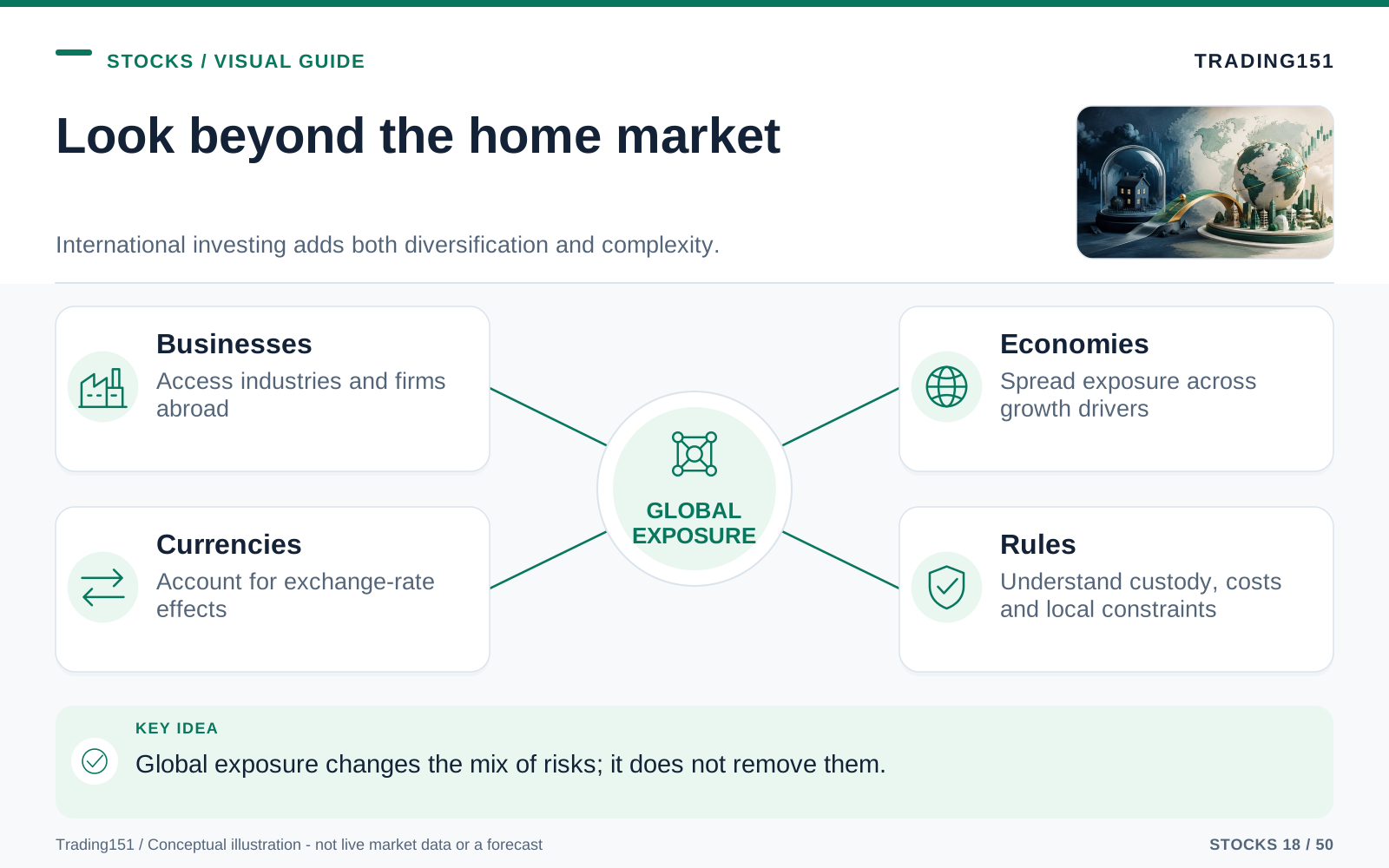
Read this diagram as text
- Businesses
- Access industries and firms abroad
- Economies
- Spread exposure across growth drivers
- Currencies
- Account for exchange-rate effects
- Rules
- Understand custody, costs and local constraints
Global Investing Is Not About Being More Sophisticated
There’s a lingering myth that investing internationally is only for Wall Street traders, the ultra-wealthy, or people who enjoy reading European Central Bank reports for fun on a Saturday. Maybe that was true decades ago. Today? Anyone can own slices of thousands of companies across dozens of countries with one click, usually through a single, dirt-cheap fund.
You don't do it to sound smart at dinner parties. You do it to avoid betting your entire future on one country running the world forever.
Markets go through phases. Sometimes the US market is the undisputed champion. Other times, Europe, Japan, or emerging markets take the lead. The torch gets passed because economies evolve, interest rates fluctuate, and demographic trends shift. A country can be home to fantastic, world-class companies, but if investors bid the stock prices up too high initially, the actual returns over the next decade can still be miserable.
By investing globally, you get a ticket to ride no matter where the growth happens. You aren't trying to outsmart the market or guess which country will win next year. You're simply admitting that nobody really knows, and you're building a portfolio that thrives regardless.
The Case for Investing Beyond Your Borders
Adding international stocks to your mix strengthens your portfolio in very real, practical ways. It isn't magic, and the perks won't show up right on schedule, but over the course of decades, they really matter.
1. You Get Broader Diversification
When most people hear "diversification," they think about mixing up industries—some tech, a few healthcare stocks, maybe a bank or two. That’s a solid start, but it’s incomplete. Adding geography to the mix changes everything. Individual country markets can be surprisingly lopsided. One country's market might be heavily dependent on mining and banks, while another is dominated by just a few large tech firms. A global index fund fixes this, but always check the fine print—some "global" funds still heavily favor one or two large countries.
Different regions bring different strengths to the table. The US market is famously tech-heavy. Europe is packed with large players in healthcare, luxury goods, and industrials. Japan is a powerhouse for robotics and precision manufacturing. Australia and Canada lean hard into natural resources. Meanwhile, emerging markets give you a front-row seat to rapidly growing middle classes and digital payment booms.
Buying into all of this doesn't erase market risk, but it does change the shape of it. Instead of tying your fate to a single national storyline, you own a piece of the entire global economy.
2. You Participate in Industries Your Home Market May Not Dominate
No single nation is the best at everything. In fact, some of the most critical companies on earth trade on exchanges you probably don't pay attention to.
Think about advanced microchips—Taiwan and South Korea completely dominate that space. European conglomerates hold the keys to the luxury goods empire. Many of the biggest players in mining, shipping, and industrial automation are scattered across Australia, the UK, and beyond.
If you draw a hard line at your national border, you are locking yourself out of entire sectors of the global economy. That becomes a serious blind spot when the next big wave of growth comes from an industry or region that wasn't previously on your radar.
3. You Reduce Dependence on One Currency
Holding money in different currencies can feel stressful, but it isn’t inherently a bad thing. If every asset you own is tied to your local currency, your actual purchasing power rises and falls with it. Holding international assets means you naturally own foreign currencies, which can act as a great shock absorber if your home currency ever loses steam.
Granted, this is a double-edged sword. Currency swings can help or hurt your returns in any given year. But holding assets in different currencies is useful, especially if you ever plan to travel extensively, buy property abroad, or just want to protect your wealth from local inflation.
4. You Gain Access to Emerging Market Growth
"Emerging markets" can sound a bit dramatic, but the concept is pretty straightforward. We’re talking about economies that are still building out their infrastructure, financial systems, and middle classes—places like India, Brazil, Mexico, and Vietnam.
The draw here is obvious. These countries have young populations, people moving to cities, and large room for technological leaps. A company catering to first-time smartphone buyers or new mobile banking users in these regions might have decades of explosive growth ahead of it.
But about the risks. These markets can be wild. Politics can be messy, currencies can plummet out of nowhere, and investor protections aren't always up to par. That’s exactly why it’s usually smarter to buy a broad index fund covering many emerging markets rather than trying to gamble on a single country or company.
The Risks You Need to Respect
International investing is useful, but it isn’t a free lunch. Moving money across borders introduces risks you just don't have to think about at home. Ignoring them is a surefire way to panic and make bad choices when the markets get choppy.
Currency Risk
When you buy a foreign stock, your return depends on two moving parts: how well the company's stock performs, and the exchange rate between their currency and yours. Over the long haul, a company's actual performance matters most, but currency swings can seriously mess with your short-term numbers.
Let's say you buy a Japanese stock and its price shoots up. Great! But if the Japanese yen loses a lot of value against your local currency during that same time, a chunk of your profits will vanish when you convert that money back home. Of course, the opposite is also true—a mediocre stock return can suddenly look fantastic if the foreign currency gets stronger.
Trying to predict currency movements is a notoriously miserable game. For most long-term investors, the trick isn't to obsess over the daily exchange rate, but just to accept that these swings are part of the journey.
Political and Geopolitical Risk
Companies don't exist in a vacuum. They are at the mercy of their local governments, tax authorities, and trade regulators. And in some parts of the world, the rules of the game can change overnight.
A government might suddenly hike taxes on foreign investors, ban a certain technology, or even nationalize private assets. Then there are elections, trade wars, sanctions, and actual wars. While these things can happen anywhere, the fallout is usually much harsher in countries with weaker legal systems.
This is why diversification is your best friend. A fund that holds two thousand companies across the globe isn't going to be derailed because one politician in one country made a terrible policy decision.
Regulatory and Accounting Differences
Not every stock market requires the same level of transparency. The rules around accounting, audits, and protecting everyday shareholders look very different depending on where you are in the world.
Even in highly regulated markets, companies can still cook the books or mislead investors. But in regions with looser rules, the risks are definitely amplified. Financial reports might be confusing, ownership webs can be murky, and minority investors might have zero say in how the company is run.
This doesn't mean you should avoid international stocks entirely. It just means that trying to hand-pick individual foreign companies is much riskier than most people realize. For the average investor, letting a broadly diversified fund handle it is much safer and saves a lot of headaches.
Tax Complexity
Venturing abroad can trigger annoying tax quirks that you never see with local stocks. Many countries take a cut of the dividends before the money even reaches your account—known as foreign withholding taxes. Some funds are better structured to handle this than others, and the type of brokerage account you use can also change how you are taxed.
It’s not a dealbreaker, but it is something to keep an eye on. Before you move a large chunk of your net worth into foreign assets, take a few minutes to understand how your specific tax residency and account types will impact what you get to keep.
Higher Costs and Liquidity Issues
While large global index funds are cheap these days, getting fancy with specialized foreign funds or buying direct overseas stocks can cost you. Currency conversion fees, higher trading commissions, and wider bid-ask spreads can slowly chip away at your returns.
There's also the issue of liquidity. Mega-corporations trade easily no matter where they are. But smaller companies in developing markets? They might be hard to sell when you want to, especially during a global panic when buyers simply disappear.
The Easiest Ways to Invest Globally
You absolutely don't need a secret offshore bank account or a stockbroker who works the graveyard shift to invest globally. The easiest tools are probably already sitting right there in your standard brokerage or retirement account.
1. Global Stock ETFs
For the vast majority of people, Exchange-Traded Funds (ETFs) are the absolute best way to go. A single ETF can hold thousands of companies, you can buy and sell it like a regular stock, and the annual fees are usually practically zero.
Here's how they generally break down:
- Total world ETFs are the ultimate "set it and forget it" option. They hold both your home market and foreign stocks, usually weighted by how big each country's market is.
- International developed market ETFs focus purely on wealthy, established economies outside your home country—places like Europe, Japan, and Australia.
- Emerging market ETFs target developing nations. You get higher growth potential, but you have to stomach a lot more volatility.
- Regional or country ETFs zero in on a specific place, like Latin America or India.
Usually, the wider the net, the better. Unless you have a crystal ball, broad and boring almost always beats trying to be overly clever.
2. International Mutual Funds
Mutual funds are another great route. Some simply track an index (just like an ETF), while others are run by human managers trying to hand-pick the best global stocks.
The pitch for an actively managed fund is that a smart manager might spot red flags and avoid bad companies, or find hidden gems that a blind index fund would just buy automatically. The downside? The fees. Active managers are expensive, and they have to beat the market by a significant margin just to break even for you after those fees are taken out.
If you go this route, check the price tag, look at their long-term track record, and make sure you aren't just buying the same stocks you already own in another fund.
3. Depositary Receipts
Depending on where you live, you might be able to buy foreign companies through depositary receipts—in the US, they call them ADRs (American Depositary Receipts). Essentially, a bank buys shares of a foreign company and then issues receipts for those shares that trade on your local stock exchange in your local currency. You skip the headaches of foreign exchanges, though they sometimes carry hidden administrative fees.
It makes life easy. You can buy shares in a large European pharmaceutical company or a Japanese automaker without having to convert currencies or wake up at 3 AM to trade on a foreign exchange.
But remember, they are still individual stocks. You still face all the risks of that specific company, plus currency and political risks. They might be convenient, but don't mistake convenience for a safety net.
4. Direct Foreign Shares
Some brokerages will let you hook directly into foreign exchanges like Tokyo, London, or Hong Kong.
If you are an advanced investor hunting for a specific small-cap company that isn't available anywhere else, this is how you do it. But for the rest of us, it’s usually more trouble than it’s worth. You have to deal with weird trading hours, foreign taxes, currency conversions, and hefty fees. It’s definitely not the place for beginners to start.
5. Target-Date and Multi-Asset Funds
Fun fact: you might already be a global investor without even knowing it. If your retirement money is in a target-date fund, a robo-advisor, or a balanced multi-asset portfolio, there's a very high chance they've already allocated a good chunk of your money to international stocks.
These are fantastic if you just want to live your life and let someone else do the driving. The trade-off is that you don't get to tweak the steering wheel—you have to trust the fund provider's judgment on exactly how much international exposure you need.
How Much International Exposure Is Enough?
Ask ten experts, and you'll get ten different numbers. The "perfect" amount depends on where you live, your currency, your tax situation, and how well you handle seeing your portfolio drop in value.
Some purists think you should just buy the world based on market size. If the US makes up 60% of the global market, put 60% in the US and 40% everywhere else. Others prefer a heavier "home bias" because they like investing in the economy where they pay bills and buy groceries. Ultimately, most solid portfolios land somewhere in the middle.
The exact percentage matters less than finding a number you can live with. A tiny 5% allocation won't move the needle enough to matter. But a large 70% international allocation might cause you to panic-sell the first time foreign markets hit a rough patch while your home market is soaring. The right allocation is the one you can stick with through the ugly years, not just the one that looks perfectly optimized on a spreadsheet.
Once you pick a number, write it down. Having a set rule stops you from making emotional, reactionary trades when one country goes on a large winning or losing streak. Without a target, it's just too tempting to mess with things.
Developed Markets vs. Emerging Markets
When looking abroad, it really helps to split the world into two main categories: developed and emerging.
Developed markets are the old guard. They have mature economies, strict financial regulations, and stable governments. They will still have good years and bad years, but the ride is generally pretty smooth.
Emerging markets are where the aggressive growth happens, but the road is bumpy. You get the benefit of booming middle classes and rapid industrialization, but you also have to stomach wild currency swings, political drama, and sharp market crashes.
A solid global portfolio usually uses both. Developed markets provide the stable foundation outside your home country, while emerging markets act as the volatile, high-growth kicker. Just mix them to match your own appetite for risk.
What to Look for in a Global Fund
Picking a global fund doesn't require a Ph.D. in finance, but you should look past the marketing. A boring, low-cost index fund will almost always serve you better than a flashy fund chasing the latest tech or green energy trend. Sometimes the locally available, basic fund is a much better deal once you factor in taxes and fees.
- Expense ratio: Keep it cheap. High fees act like a constant headwind on your money. This matters way more than people realize.
- Coverage: Look under the hood. A fund might call itself "global" but still dump 80% of its money into just three countries. Make sure it spreads the wealth.
- Developed vs. Emerging exposure: Double-check exactly what you are buying. Does this fund include emerging markets, or is it strictly wealthy nations?
- Currency policy: Some funds "hedge" against currency swings, while others just let the exchange rates float. Hedging can smooth out the ride, but it costs money to do, which eats into returns.
- Fund domicile and tax treatment: Where the fund is officially based can impact the taxes you owe. Find the one that works best for your specific country and tax brackets.
- Liquidity and spreads: Stick to large, heavily traded funds. They are much cheaper and easier to buy and sell.
- Overlap: Don't accidentally buy the same companies multiple times. If you buy a global tech fund and a US tech fund, you just bought the same heavy hitters twice.
Common Mistakes to Avoid
Global investing is pretty simple in theory, but human nature finds a way to complicate it. Try to steer clear of these classic blunders.
Chasing Last Year’s Winning Country
When a specific country's stock market goes on a large run, it makes headlines, and investors inevitably rush in. The problem? By the time everyone is talking about it, the easy money has already been made, and you're buying at the top. The global market is constantly rotating.
The country that looks like an unstoppable powerhouse today will eventually cool off, while the country everyone left for dead quietly starts its next bull run. Don't chase the hot dot.
Confusing Economic Growth with Stock Returns
It sounds crazy, but a booming, fast-growing economy doesn't always equal great stock returns. If investors get too excited and pay sky-high prices for the stocks in that country, the future returns will likely be terrible, regardless of how fast the economy is growing.
This is especially true in emerging markets. A country can be an exciting place to do business, but a terrible place to invest if the stock prices are already priced for perfection.
Owning Too Many Narrow Funds
It’s shockingly easy to build a portfolio that looks beautifully diverse, but is just a tangled mess of overlapping bets. If you own a European ETF, a Global Dividend ETF, and an International Large-Cap ETF, you probably just bought the same mega-companies three different ways.
Complexity isn't a superpower; it's mostly just clutter. Keep it broad, and only buy a niche fund if you have a very specific, strategic reason to do so.
Ignoring Taxes
Two similar funds can leave you with very different amounts of actual cash once the tax authorities takes his cut. Foreign dividend taxes, the type of account you use, and where the fund is legally based all play a part. Don't just look at the headline performance number—what you get to keep after taxes is the only thing that matters.
Giving Up Too Quickly
There will be years—sometimes an entire decade—where international stocks completely lag behind your home market. That doesn’t mean the strategy is broken. It just means the economic cycle isn't in your favor right now, or currency rates are working against you.
The worst thing you can do is hold international stocks for five years, get frustrated by their performance, and sell them right before the cycle flips. Decide if you believe in global diversification before the bad times hit, not during them.
A Simple Framework for Getting Started
If you are just starting to venture outside your home country, don't try to be a hero and find the next obscure foreign startup. Start with the basics.
- Step one: Decide if you want one large "all-in-one" global fund, or if you prefer to buy separate funds for your home country, developed nations, and emerging markets.
- Step two: Pick a percentage for your international exposure that you can stick with even when it's losing money.
- Step three: Buy broad, dirt-cheap index funds. Avoid the fancy stuff.
- Step four: Rebalance once a year so that a crazy winning streak in one region doesn't quietly take over your whole portfolio.
- Step five: If you're moving serious money, double-check the tax implications of the funds you chose.
This isn't a substantially exciting strategy. It won't make you the life of the party. But a truly bulletproof portfolio is usually boring on the surface and quietly powerful underneath.
The Bigger Picture
Investing globally isn't about collecting flags or pretending the entire world is one happy, synchronized economy. It’s simply recognizing that brilliance, innovation, and great businesses are scattered all over the globe. Some of the world’s most dominant companies over the next twenty years will be built right in your backyard. But many of them won't be.
Your portfolio doesn’t need a crystal ball. It just needs to be sturdy enough to handle a future that refuses to go exactly to plan. If you only invest at home, you are making a large, concentrated bet that your local economy, your currency, and your political system will continue to dominate forever. Spreading your money around the world is just a humble admission that the future is messy and unpredictable.
Yes, there will be deeply annoying years. Foreign markets will slump. Exchange rates will eat into your profits. Scary political headlines will make certain regions feel completely uninvestable. But eventually, there will come a time when your home market is overpriced and exhausted, and those foreign investments will be the exact thing keeping your portfolio afloat.
A globally diversified portfolio accepts that the next decade’s winners might look very different from the last decade’s. The hardest part of investing globally is staying the course when your home market happens to be on a hot streak. But that's exactly when diversification matters most.
A foreign listing is not the same as foreign exposure
Consider a home-market company that earns most of its revenue abroad and a foreign-listed company whose business is concentrated in one domestic market. Their economic exposures may be very different from what their listing locations suggest. Revenue geography is useful, but it is not the whole answer either: production, debt, taxation, and currency hedging also affect how the business responds to events.
For funds, read what "global" and "international" mean in the specific mandate. Some global products include your home market; some international products exclude a particular domestic market. Two funds may overlap heavily or leave an unintended gap. The names are not standardized enough to replace a look at the benchmark and holdings.
Account for practical costs before using a small foreign position to add sophistication. Currency conversion, custody charges, withholding tax, and unfamiliar dealing arrangements can make a tiny allocation cumbersome. A broader fund may offer simpler administration, but its structure and tax treatment still need checking for your jurisdiction and account.
The objective is not to own a little of everything regardless of cost. It is to reduce dependence on a narrow set of outcomes while keeping the plan manageable. Describe what the new exposure adds that the existing portfolio lacks. When that explanation is clear, the decision is easier to maintain during periods when another country's market looks more rewarding.
A foreign listing adds operational questions
Before buying an overseas security, check the trading currency, market hours, settlement arrangements, custody chain, and access to company disclosures. Depositary receipts and directly held local shares can involve different fees and rights. A familiar company name does not make those structures identical. The investment case should survive the practical cost of holding and eventually selling the instrument available in your account. 1
Diversification Does Not Stop at the Border
Choose your investments with your eyes open. Understand what’s inside the funds you buy—whether they cover emerging markets, how heavily they lean on certain currencies, and how they handle taxes. And if you’re going to make a bet on a single specific country, keep it small unless you really know what you’re doing.
Buying foreign stocks isn't some bold prediction that Europe or Asia is about to take over the world. It’s just the common-sense realization that great ideas, profitable businesses, and healthy returns aren’t trapped behind borders. Own a piece of everything, in an amount you can comfortably live with, and just let global capitalism do the rest.
Sources and further reading
Editorial revision: 7 October 2026. Numerical scenarios are hypothetical unless identified as historical. References support the added explanations and selected corrections; rules and product terms should be checked again before acting.