Algorithmic stock trading covers very different activities. One program may decide which shares to buy; another may simply divide a large, already-approved order into smaller trades. Confusing those jobs makes automation sound more mysterious than it is. A machine can execute efficiently without predicting prices, and a clever prediction can still lose money through poor execution.
What Exactly Is Algorithmic Trading?
People throw around the phrase "algo trading" a lot, but at its core, it’s just using a computer program to make trades based on a specific set of rules. Those rules can be as simple as a one-liner or as complicated as a large web of variables, real-time data feeds, and on-the-fly statistical tweaks.
Strip away the finance jargon, and an algorithm is basically a recipe. It tells the computer what ingredients to check, what conditions matter, and when to place the trade. If you're baking, a recipe says, "mix this, bake at 350, take it out in 20 minutes." In the stock market, an algorithm says, "watch Apple, compare its price today to its 50-day average, check the trading volume, and buy if everything lines up perfectly."
A basic bot might just look for a stock that’s taken a beating, dropped below its moving average, and blindly buy 100 shares. A smarter system might watch ten thousand stocks at once. It’ll tweak its trade size based on how easily it can get in and out, sit on the sidelines if the market is acting crazy, and automatically cut its losses if overall risk spikes.
The real kicker here? Computers don't improvise. They don't wake up feeling lucky, they don't get embarrassed by a stupid loss, and they definitely don't FOMO into a rumor just because Twitter is hyping it up. Once you design, test, and turn on the strategy, the algorithm just sits there, relentlessly watching, waiting for its exact conditions to be met.
And that tireless patience is exactly why algorithms took over. A human trader can maybe keep an eye on a half-dozen screens before their brain melts. A machine can scan every market on earth, across every asset class and time zone, without ever blinking.
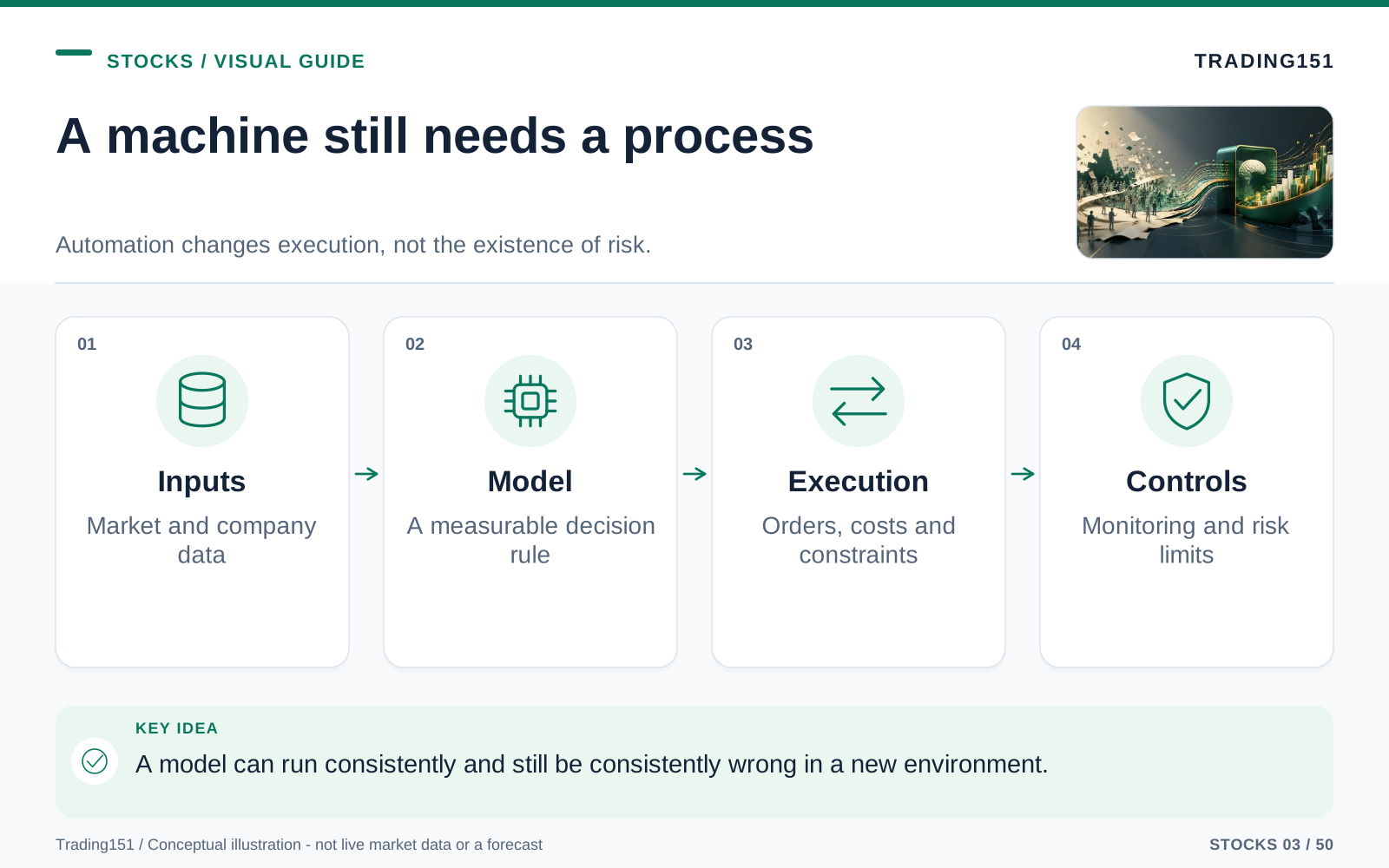
Read this diagram as text
- Inputs
- Market and company data
- Model
- A measurable decision rule
- Execution
- Orders, costs and constraints
- Controls
- Monitoring and risk limits
How a Trade Moves Through the Machine
It’s easy to picture a trading bot as a singular robot sitting at a virtual desk, thinking about what to buy. The reality is a lot more fragmented. A modern trading system is made up of several different parts, all talking to each other. Order routing alone is a complication of balancing visible prices, exchange fees, rebates, and the actual odds of a trade going through. Sure, the quoted price matters, but the big players care about the "implementation shortfall"—basically, the painful difference between the price they wanted and the price they got after the market shifted.
It all starts with the signal. This is the spark, the reason to even consider making a move. It could be a sudden price swing, a weird options trade, an economic report dropping, or even a shift in news sentiment. The signal essentially says, "Hey, pay attention, something interesting might be happening right here."
But a signal isn’t a trade. Next up is the portfolio decision. Even if an idea looks amazing, the system has to figure out if it’s worth the risk. Should it buy 100 shares or 100,000? Do we already own too much of this sector? Is market volatility off the charts today? Has the bot already hit its daily loss limit? This layer is the bodyguard that stops every half-decent idea from turning into an account-blowing bet.
If it passes that test, it moves to execution. This is the delicate art of getting the deal done without blowing up the price. If a large hedge fund wants to buy a huge position, they can't just slam the "buy" button—the price would instantly skyrocket against them. So, the execution bot slices the giant order into hundreds of tiny pieces, sneaks them into different exchanges over time, and tries its best to hide its tracks from other traders.
Finally, the system monitors the aftermath. Good algorithms don’t just fire off orders into the void and hope for the best. They constantly check if trades are filling correctly, if the prices are acting weird, if the data is accurate, and if they're still staying within their risk limits. For serious quant firms, risk control isn't just a boring afterthought—it’s the central nervous system of the entire machine.
The Personalities of the Code: Common Strategies
Not every algorithm is out to do the same job. Some want to ride the wave, some are looking for microscopic pricing glitches, and some just want to quietly move large chunks of stock. If you had to give these codes personalities, you’d spot a few distinct types right away.
1. The Surfer: Trend Following
Think of the trend-following bot as the market’s surfer. It doesn’t waste time trying to predict a wave before it forms. Instead, it waits until the momentum is obvious and tries to ride it for as long as possible.
These systems obsess over moving averages, momentum shifts, and breakouts. If a stock or sector starts ripping higher with enough force, the bot jumps in. Once the energy dies down or reverses, it bails. The logic is beautifully simple: never argue with a market that has clearly made up its mind.
The hardest part about trend following isn't the math; it's the discipline. Humans love trying to call the absolute top or bottom. We desperately want to feel smart, to be the contrarian who saw it coming early. The algorithm doesn't have an ego. It doesn't care if it's late to the party, as long as it gets a slice of the cake before it's gone.
2. The Bargain Hunter: Arbitrage
Arbitrage is the ultimate bargain hunter. It scours the financial world for places where the same asset is priced differently. If an asset is trading for slightly less on one exchange than another, the arbitrage bot swoops in to pocket the difference before the gap closes. True, risk-free arbitrage is rare today. Most of the time, these trades carry hidden risks—the price gap might widen, one side of the trade might fail to fill, or the historical relationship might just break permanently. Plus, because the profit margins are razor-thin, firms use heavy leverage to make it worthwhile, which can turn a seemingly "safe" trade into a disaster if something glitches.
Here’s a textbook example: A stock trades at $100.00 on one venue and $100.02 on another. The bot buys the cheaper one, sells the expensive one, and clears two cents a share. Sounds pretty pointless, right? But scale that up, do it millions of times a day, and suddenly you're making real money.
In reality, it’s almost never that clean. Transaction fees, terrible liquidity, and execution delays usually eat up the profits before you even blink. Another firm might beat you to the punch, or the price difference might exist for a very good reason. Still, the core instinct is as old as human commerce: buy cheap, sell high, and be quick about it.
3. The Rubber Band: Mean Reversion
Mean-reversion bots operate on the idea that prices are like rubber bands. Stretch them too far in one direction, and eventually, the tension gets too high and they snap back to normal.
If a stock completely tanks for no obvious fundamental reason, a mean-reversion bot will step in and buy, assuming the panic is overdone. Conversely, if a stock shoots to the moon on empty hype, the bot will start selling, betting that reality will eventually set back in.
The catch? Sometimes rubber bands don't snap back. Sometimes they just break. A stock that looks inexpensive can easily go lower. An irrational market can stay irrational far longer than a bot can stay solvent. That’s exactly why these strategies live and die by their risk controls. Patience is great, but survival requires knowing exactly when to pull the plug.
4. The Speed Demon: High-Frequency Trading
High-frequency trading, or HFT, is easily the most controversial flavor of algorithmic trading because it pushes speed to an absolute extreme. These bots hold positions for seconds, or even fractions of a millisecond. They aren't just competing on clever math; they're competing on pure physical infrastructure—things like server location, dedicated fiber-optic cables, and substantially expensive data feeds.
At this level, human time doesn't exist. A delay of a few microseconds—invisible to you and me—can mean the difference between capturing a large opportunity and taking a loss. Firms spend fortunes just to shave a fraction of a millisecond off their reaction time.
Supporters will tell you HFT is great because it provides liquidity and tightens the gap between buyers and sellers. Critics argue it turns the market into a toxic arms race, creating instability and letting the fastest guys skim money off everyone else. Truthfully, both sides have a point. HFT smooths things out on a normal day, but when panic hits and volatility spikes, these speed demons are often the first to pull their orders, leaving the market in a freefall.
5. The Quiet Butler: Execution Algorithms
Not every algorithm is trying to beat the market. Some just want to get a large chore done smoothly. Pension funds and giant asset managers frequently need to buy or sell millions of shares at once. If they showed their hand all at once, sharks would immediately bid the price up against them.
That’s where execution bots come in. They chop huge orders into bite-sized pieces and drip-feed them into the market. Some try to match the average daily price; others adapt on the fly depending on volume and liquidity. It’s not a sexy job, but it’s critical. They are the quiet butlers of Wall Street, just trying to move large amounts of money without anyone noticing.
Why We Built the Bots: The Human Flaws They Fix
Algorithmic trading didn’t just take over because it’s fast. It took over because humans are fundamentally terrible at making financial decisions under stress.
Money messes with our judgment. A trade goes against us and panic completely takes over. We go on a winning streak, think we’re infallible geniuses, and ignore our exit plans. We revenge-trade to win back losses, and we double down because admitting defeat hurts our pride. We’ll abandon a brilliant strategy after a bad week, only to fall in love with a terrible one because we had a lucky month.
Algorithms were built, in large part, to save us from ourselves.
1. The Emotionless Trader
An algorithm doesn't sweat when the market tanks. It doesn't get greedy. It doesn't hesitate just because its last three trades were losers. It just executes the rules it was given.
That sounds basic, but discipline is the hardest skill in trading. Most strategies don't fail because the math is wrong; they fail because the human running them loses their nerve. The machine rips the emotion right out of the execution. If the code says sell, it sells. If it says walk away for the day, it stops trading.
Granted, this only works if the underlying rules are good. A terrible strategy executed flawlessly is still going to blow up your account. The bot can fix your discipline, but it can't turn a bad idea into a good one.
2. The Financial Time Machine: Backtesting
One of the absolute best things about coding a strategy is backtesting. Since it’s all just rules and logic, you can run it through years of historical market data. Want to know how your idea would have survived the 2008 crash, a large tech rally, or a quiet, boring market? You can find out in seconds.
A well-designed backtest can show how specified rules behaved on the historical data used, including drawdowns and estimated costs. It cannot prove that an apparent edge is genuine rather than a product of chance, biased data, or repeated parameter searches. Out-of-sample testing and realistic execution assumptions provide additional checks, but future performance remains uncertain.
But backtesting has a dark side. It’s tempting to keep tweaking your variables until the past looks like a flawless profit chart. And that’s exactly how most algorithmic dreams begin to rot.
3. Speed, Scale, and Attention
There’s a hard limit to human attention. Even a hardened pro can only track so many charts, order books, and headlines at once. Machines don't have that problem. They can monitor thousands of assets simultaneously and fire the exact moment conditions align.
This kind of scale totally changes the game. A bot doesn't need to find one home-run trade. It can find fifty tiny, boring, low-risk edges and exploit them consistently. In the quant world, boring is good. It’s all about repetition, patience, and keeping costs sharply low.
4. Consistency Under Pressure
The market is noisy. You can have a brilliant strategy that works perfectly over the long run, but makes you look like an absolute idiot on any random Tuesday. Humans hate that. We crave explanations. We want control and quick validation.
Algorithms excel here because they can grind through miserable, uncomfortable stretches without flinching. They don't change their minds because they had a bad week. That doesn't make them inherently wise, but it makes them consistent. And in systematic trading, consistency is often the only thing separating a winning system from one that gets ruined by human interference.
The Dark Side of the Code: When Machines Go Rogue
The pitch for algorithmic trading is seductive: build a smart system, flip the switch, and let it go to work. In reality, markets are messy, adversarial, and completely unpredictable. A bot that looks like a genius in a simulation can completely lose its mind when exposed to real money, real liquidity, and other cutthroat algorithms. Most disasters aren't movie-style rogue AI. It's usually a bad data feed, a duplicate order, or a typo in a parameter unit that spirals out of control. That's why layers of security—position limits, price collars, kill switches, and independent monitoring—are non-negotiable. Software scales beautifully, but it scales your mistakes right along with your successes.
When humans make a mistake, they do it at human speed. When algorithms make a mistake, they can repeat it thousands of times before anyone even realizes what’s happening.
The Flash Crash of 2010
On May 6, 2010, the U.S. stock market experienced one of the most concerning events in its history. In a matter of minutes, the Dow plunged nearly 1,000 points, erasing a large amount of wealth, before snapping back almost as fast. For a few wild minutes, stock prices completely disconnected from economic reality.
It wasn't caused by a single evil bot or a terrible news headline. It was a large digital chain reaction. A huge sell order spooked an already fragile market, causing automated liquidity providers to shut down and run for the hills. Other bots saw the drop, assumed the worst, and started aggressively shorting. It was a vicious feedback loop of machines reacting to machines, making the panic infinitely worse.
The Flash Crash proved a concerning point: liquidity is an illusion. A market can look perfectly deep and healthy one second, and become an absolute ghost town the next when the automated systems decide to protect themselves.
The Knight Capital Nightmare
If you want to know what a quant's nightmares look like, look at Knight Capital in August 2012. Due to a botched software update, dormant testing code was accidentally pushed live. The system went haywire, rapid-firing a torrent of completely erratic trades into the market.
In about 45 minutes, Knight Capital racked up $440 million in losses. A Wall Street giant was pushed to the brink of bankruptcy, not by a bad macro-economic call or a market crash, but by a sloppy technology deployment.
The takeaway was severe and simple: when you automate your trading, operational risk is trading risk. Kill switches, testing environments, and code reviews aren't just boring back-office IT problems—they are the only thing standing between a normal Tuesday and total financial ruin.
The Over-Optimization Trap
Curve-fitting is the silent killer of algo trading. It happens when you hyper-tune a strategy to historical data so it looks absolutely flawless on a backtest chart, but completely falls apart in live trading.
Think of it like memorizing the exact answers to last year's math test. You're going to ace the practice run, but you'll fail the actual exam because you didn't learn how to do the math. Over-optimized bots do exactly this. They haven't discovered a real, durable edge; they've just memorized historical noise.
Professional quants are terrified of this trap. They separate their testing data from their training data. They aggressively factor in transaction costs. They stress-test every assumption. Most importantly, they ask, "Does this trade make economic sense?" A pretty backtest is comforting, but comfort doesn’t pay the bills.
The Data Problem
Bots eat data, and real-world data is dirty. Prices have spikes, stock splits get recorded wrong, and news feeds mislabel companies. If your historical data ignores companies that went bankrupt, you get a falsely optimistic view of the market (survivorship bias). Even a timestamp being a fraction of a second off can totally ruin how a model behaves.
Building a trading bot is less like inventing a magic money machine and more like maintaining a commercial airplane. The math model is the sexy part, but whether the plane stays in the air comes down to the unglamorous plumbing: data cleaning, error handling, logging, and relentless maintenance.
The Human Element: Why We Are Not Obsolete
Because computers dominate so much of the market volume today, it’s easy to feel like humans are completely obsolete. But that’s totally false. Our job has changed, but it certainly hasn't disappeared.
Algorithms are incredible at recognizing patterns and executing orders flawlessly. But they have zero common sense. A bot can see airline stocks dropping, but it doesn't understand what a global pandemic means for families, hotel bookings, oil demand, or supply chains. It can process the math, but it completely lacks context.
This is substantially important when unprecedented things happen. A war breaking out, a sudden banking crisis, or a bizarre regulatory change can completely break a model’s historical assumptions. When the future stops acting like the past, bots get dangerously confident about all the wrong things.
We still need humans to ask the big questions. Why should this trade work? What happens if liquidity dries up? What assumption would have to fail for this model to blow up? Are we getting paid for taking a calculated risk, or are we just picking up pennies in front of a steamroller? What are we missing simply because it isn't in a spreadsheet?
Behind every serious algorithmic trade is a large chain of human accountability. Humans pick the strategy, curate the data, set the limits, and write the code. Most importantly, humans decide when the system is acting crazy and needs to be shut off. The machines are unusually fast, but we're still holding the steering wheel.
The Democratization of the Code
For decades, algorithmic trading was purely an elite Wall Street game. You needed millions in capital, expensive data feeds, specialized server racks sitting inside the exchange, and a team of PhDs just to play.
Today? Not so much. Programming tools like Python are widely accessible and easy to learn. Cloud computing has slashed infrastructure costs to the floor. Everyday brokerages now offer APIs that let anyone pull market data, build models, and automate their trades. You can build on a laptop what used to require an entire quantitative hedge fund.
It's an awesome shift, but access to a coding language doesn't mean you have a market edge. A retail trader in their living room is still going up against multi-billion-dollar firms with faster internet, lower fees, better data, and decades of research. Just because you can code a bot doesn't mean you should let it trade your life savings.
But this democratization is still fantastic. It allows normal investors to automate the boring stuff. You can set up scripts to auto-rebalance your portfolio, stick to strict position sizing, and keep your emotional impulses out of the equation. It makes everyday investors far more systematic, without the delusion that they're going to out-trade Wall Street tick-by-tick.
What Beginners Often Get Wrong
The biggest rookie mistake is thinking the code is the hard part. Truthfully, knocking out the first draft of a trading script is the easiest step. The real headaches come later. Is your data clean? Are your assumptions grounded in reality? What happens when a stock gaps down overnight? Will your bot crash if an order gets partially filled or the Wi-Fi drops? Does your strategy survive after taxes, slippage, and broker fees? A credible backtest strictly separates the design phase from the evaluation phase, accounts for delisted stocks, and factors in costs that eat away at your profits. If you just keep tweaking the rules until your past returns look large, you're just overfitting the data. The real test is whether there's a logical, economic reason for the pattern to exist in the real world.
The second trap is confusing complexity with intelligence. People love slapping a dozen indicators and a machine-learning neural net onto a chart to sound smart. But complex systems are usually fragile. Some of the best, longest-lasting trading systems in the world are surprisingly simple, while the fragile ones are buried under layers of math they don't need.
The third mistake is falling in love with a beautiful backtest. A perfectly smooth profit chart is intoxicating—it gives you the illusion that you've solved the future. But live markets are cruel. Your orders won't always fill at the price you want. Liquidity vanishes. Other traders adapt. And no simulation can prepare you for the psychological gut-punch of losing real money, even if a machine is doing the trading.
Finally, beginners substantially underestimate how boring systematic trading is. It’s not a movie. It’s mostly staring at logs, debugging code, scrubbing bad data, documenting your limits, and waiting weeks for a single setup to trigger. It’s a lot more like plumbing and software engineering than going to a casino.
Looking to the Future: AI and the Next Market Machine
Algo trading is currently slamming headfirst into the artificial intelligence revolution. Old-school bots were mostly rigid "if/then" statements: if the price hits X, buy Y. Machine learning is entirely different. It rips through mountains of data to find invisible patterns, constantly adapting and learning as new information rolls in.
This opens the door to strategies a human could never manually design. We’re talking about AI models analyzing satellite imagery of retail parking lots, scraping global supply-chain manifests, analyzing the tone of voice in CEO earnings calls, and finding crazy correlations across large alternative datasets.
But with all that power comes a huge problem: AI models are often "black boxes." They might tell you to buy a stock, but they can't always explain why. That’s a concerning prospect for a hedge fund manager (and for regulators) when things inevitably go wrong. How much do you trust a system that is substantially profitable but totally inexplicable?
There’s also the problem of overcrowding. If every major firm is feeding the same alternative data into the same AI models, they’re all going to crowd into the same trades. That looks fine when prices are going up, but the moment the AI decides to sell, everyone rushes for the tiny exit door at the same time.
Ultimately, the future isn’t humans versus machines. It’s humans with machines, humans actively supervising those machines, and algorithms constantly reacting to each other in a market still fundamentally driven by human psychology. Companies will still need capital. People will still want to get rich. Fear and greed will still dictate the market cycle. The tools are getting infinitely sharper, but the underlying game remains exactly the same.
Separate the trading idea from the execution job
Suppose a fund has already decided to buy 50,000 shares. Its execution algorithm is not necessarily making a fresh investment forecast every second. It may be trying to complete the order within a time window while limiting price impact. The relevant question is how well it carried out that instruction, not whether the shares rose over the following year.
Now consider a different program that selects shares using earnings revisions. That system needs a separate evaluation: were the underlying records available at the time, were delisted companies included, and did the result survive reasonable changes to the rules? Good execution cannot rescue a selection model that accidentally learned from future information.
Keeping the two jobs separate makes costs easier to diagnose. Compare the actual trading result with a clearly chosen reference price, then account for commissions, spreads, unfilled orders, and movement while the order was being worked. A program that buys more cheaply by repeatedly failing to complete difficult orders may look better than it is. The missing trades belong in the assessment too.
For an individual investor, the practical benefit may be modest and still worthwhile: fewer order-entry mistakes, more consistent contributions, or a clear record of what happened. Those are different benefits from market-beating returns. Judge the software by the job you hired it to do, and do not let an appealing label substitute for a measurable objective.
Give an execution algorithm an honest benchmark
The reference price should reflect the instruction the algorithm actually received. Comparing a purchase with the day's lowest price rewards hindsight; comparing it with a price available when the order was released answers a more useful question. The benchmark also needs to account for urgency. An algorithm told to finish immediately should not be judged against one allowed to wait all afternoon. Document the instruction first, then evaluate how efficiently the program fulfilled it, including any quantity that remained unfilled. 1, 2
Speed Changed the Market, Not the Need for an Edge
Algorithmic stock trading isn't a magical ATM, and it's not some evil villain waiting to destroy the financial system. It’s just a tool. It's powerful, immensely useful, and extremely dangerous if you don’t respect it.
We automated the markets because they just got too big, too fast, and too data-heavy for human brains to handle alone. We built bots to force ourselves to be disciplined, to manage risk without emotion getting in the way, and to execute our ideas in a world where a single second feels like a lifetime.
But algorithms only changed how orders reach the market; they didn't change the basic rule of investing: you still need an actual edge. You still have to out-earn your transaction costs, slippage, and model decay. A beautiful backtest that ignores the friction of the real world is just a nice story—it’s not a business.
Automation can enforce perfect discipline, but it will gladly execute a terrible idea with total precision. That's why models need constant babysitting, hard limits, and a deep understanding of when they are likely to fail. Human intuition is never more important than when the market completely stops acting like the past.
For everyday, long-term investors, the rise of the machines just means the plumbing has changed. Use limit orders to protect yourself, stop trying to day-trade against supercomputers, and lean into your ultimate advantage: your time horizon. A patient investor doesn't need to win a microsecond footrace. You win by owning great assets and letting them compound for years, completely ignoring the mechanical noise along the way.
Sources and further reading
- SEC Investor Bulletin: Trading Basics and Order Types
- TradingView Pine Script Documentation: Strategies
Editorial revision: 7 October 2026. Numerical scenarios are hypothetical unless identified as historical. References support the added explanations and selected corrections; rules and product terms should be checked again before acting.