
In ordinary investing conversation, stocks and shares are often used interchangeably. More precisely, stock can refer broadly to equity ownership, while shares are the individual units held in a particular company or class. Usage varies by market and context. The legally important details are usually not the casual word chosen, but the rights, restrictions, and obligations attached to the specific security.
The Short Answer: Picture a Pizza
Think about a pizza fresh out of the oven.
The whole pizza is the stock. It’s the broad concept of the meal. If someone asks what’s for dinner, you just say, “Pizza.” You don’t usually feel the need to specify the exact geometry of what you're about to eat.
The slices, on the other hand, are the shares. They are the individual pieces of that whole. When you hand a piece to a friend, you aren't handing them "some abstract pizza concept"—you give them one slice, two slices, or half the pie.
The stock market works exactly the same way:
- Stock is the concept of owning a piece of a company.
- Shares are the individual slices that tell you exactly how much of it you own.
When a coworker mentions they "own Apple stock," they're just telling you they have a stake in the company. If they say they "own 20 shares of Apple," they're giving you the exact count of their slices. That’s really all there is to it. The rest is just about context.
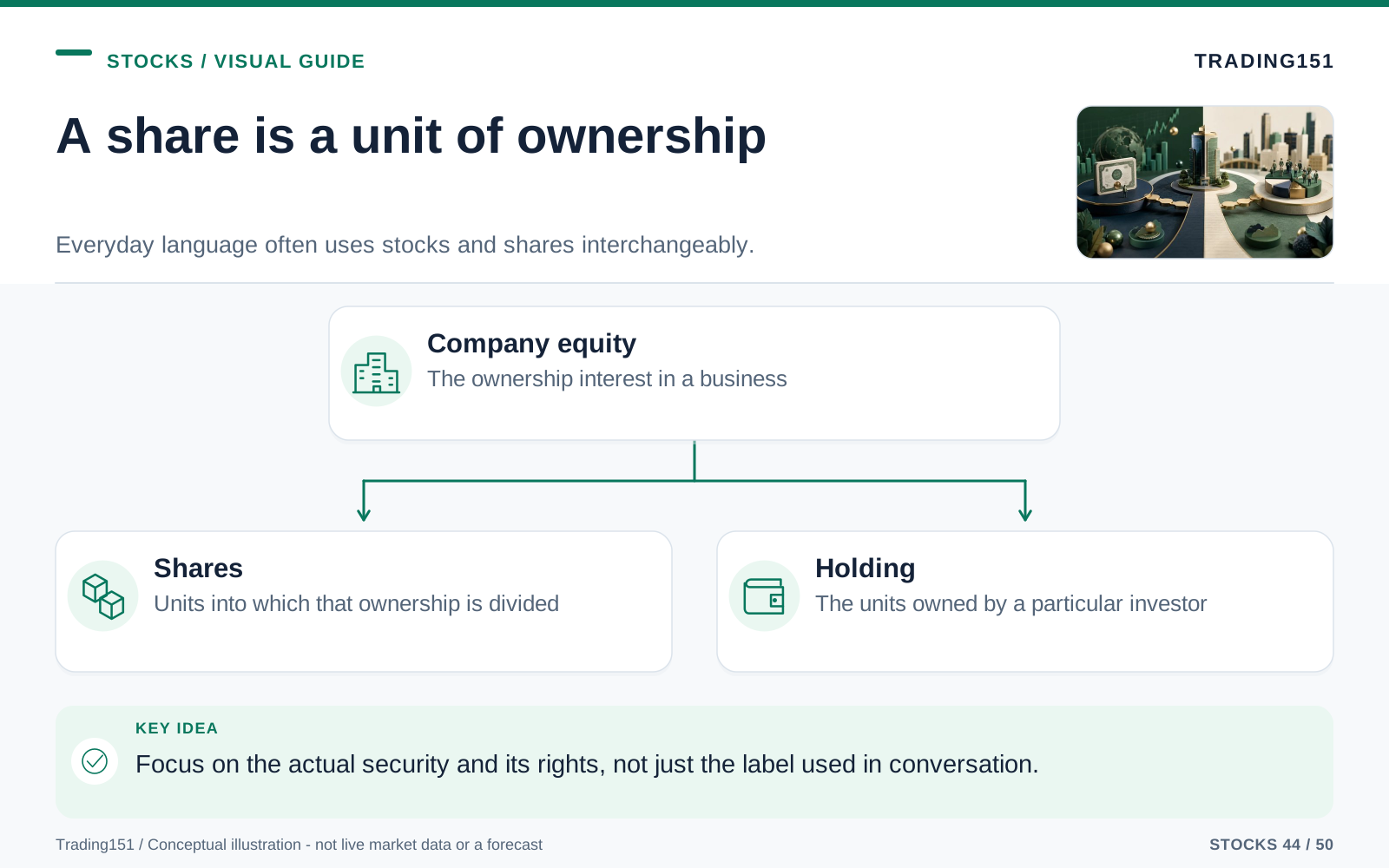
Read this diagram as text
- Company equity
- The ownership interest in a business
- Shares
- Units into which that ownership is divided
- Holding
- The units owned by a particular investor
What Exactly Is Stock?
In the financial world, stock is a security that represents a fraction of ownership in a business. When a company issues stock, they are essentially taking their business, slicing it up, and selling those pieces to the public. Buy a piece, and boom—you’re a shareholder.
Now, this doesn't mean you can stroll into the corporate headquarters and start demanding a better coffee machine in the breakroom. Owning stock gives you a financial stake, not operational control. But your money is now tied to the company's success. If they crush their earnings and grow, the value of your stock will likely go up. If they tank, your investment takes a hit.
This is why investors talk about stock as ownership. You aren't just betting on a ticker symbol blinking green on a screen. There's a real business behind it—complete with employees, products, debts, and long-term goals.
Stock as a Broad Term
You'll usually hear the word stock thrown around as a broad category. People say things like:
- “I mostly invest in stocks and real estate.”
- “The stock market took a beating yesterday.”
- “She holds stock in a few different tech companies.”
- “I'm looking for good dividend stocks.”
In all these cases, nobody cares about the exact number of units. The word just describes the type of investment. It's like saying you collect vintage guitars; you're naming the asset class, not listing off every Fender you own.
It also works for specific companies or sectors. "Tesla stock" just means ownership in Tesla. "Tech stocks" broadly covers companies in the technology sector.
Why Companies Issue Stock
To really grasp what stock is, you have to look at why a company would bother creating it in the first place.
Imagine you run a substantially successful local coffee cart. You want to expand and open five full-size cafes, but building out those shops costs a fortune. You need espresso machines, staff, marketing budgets, and emergency cash.
You could go to a bank for a loan, but then you're stuck paying back debt with interest. The alternative? Sell a chunk of your business to outside investors.
By issuing stock, a business gets the cash it needs to grow without taking on traditional debt. In exchange, the investors get a piece of the pie. They take on the risk of the business failing, but if it thrives, they get to ride the wave via a rising stock price or regular dividend payouts.
What Exactly Is a Share?
If stock is the abstract idea of ownership, a share is the cold, hard math. It’s a single, countable unit of that ownership. And importantly, the total number of shares isn't permanent. A company can create new shares to raise more cash, buy back their own shares to reduce the total count, or even split existing shares into smaller, cheaper pieces. All of this shifts the math, even if the underlying business hasn't fundamentally changed.
When you talk about quantities, you use the word share. You’d never say, "I just bought 50 stocks of Microsoft." You'd say, "I bought 50 shares of Microsoft stock."
Every share you hold represents a tiny percentage of the business. If a startup has 1,000 total shares and you hold 10, you own 1% of the company. If it’s a large corporation with 10 billion shares and you own 10, your stake is microscopic—but the logic is exactly the same.
Shares as a Specific Term
The word share is your go-to the moment you need to be specific. For example:
- “I picked up 25 shares of Amazon.”
- “They pay a dividend of $1.50 per share.”
- “My portfolio holds 100 shares of Coca-Cola.”
- “The price jumped $5 per share today.”
In every one of those sentences, the word points to a specific metric. This is crucial because almost all the math in investing is done on a per-share basis. Your dividends, your voting rights, and your profits are all calculated by looking at how many individual units you own.
Shares Can Apply Beyond Stocks
Here is a detail that often trips people up: shares aren’t exclusive to the stock market. A share is just a unit of ownership, and that concept exists all over the financial world.
Just look at a few examples:
- Mutual funds: When you put money into a mutual fund, you buy shares of that fund (which, in turn, buys various investments).
- ETFs: Exchange-traded funds are also bought and sold in shares, even though a single share might represent a bundle of 500 different companies.
- Private businesses: A local startup that isn't on the stock market still divides its ownership into shares for its founders and early backers.
- Co-ops: In some cities, you don't buy your apartment. You buy shares in a cooperative corporation that owns the building, which grants you the right to live in your unit.
It’s a helpful rule of thumb: all corporate stock is broken down into shares, but not all shares represent corporate stock.
How Stocks and Shares Work Together
Let’s look at how this plays out in the real world.
Say a tech startup called BlueCloud decides to go public. To raise capital, they offer stock. They decide to chop that ownership into 10 million individual shares, which are then listed on a stock exchange.
If you log into your brokerage app and buy 100 shares of BlueCloud, you’ve just acquired some of the company’s stock. "Stock" is the asset you decided to invest in; "100 shares" is the exact amount you bought.
If the price sits at $20 a share, your investment is worth $2,000. If it climbs to $30, those same 100 shares are now worth $3,000. If BlueCloud pays out a $0.50 dividend per share, you’ll find $50 deposited into your account. The stock gives you a seat at the table; the shares determine the size of your plate.
A Real-Life Investing Example
Let’s walk through a typical day for a new investor setting up a portfolio.
- The broad move: They decide they want to put their savings into the stock market instead of letting it lose value to inflation in a basic savings account. They've chosen the asset class (stocks).
- The company choice: After doing some reading, they decide to back Apple, Microsoft, and Google because they believe in the tech sector.
- The share purchase: They execute the trades, buying 10 shares of Apple, 5 shares of Microsoft, and 2 shares of Google.
- The final picture: If a friend asks what they did with their money, they'd likely just say, "I bought some tech stocks." But if they look at their brokerage dashboard, their actual wealth is tracked by the specific number of shares they hold in each company.
This is just how we talk. We discuss "stock" in conversation, but we buy "shares" when it’s time to click the buy button.
Stock Price vs. Company Value
Understanding the difference between these terms also clears up a large misconception: confusing the price of a single share with the value of the actual company. Comparing two companies purely by their share price is basically a waste of time.
Think about it. A company with 10 million shares priced at $100 has the same total value as a company with 100 million shares priced at $10. The first stock isn't inherently "better" or "more expensive" in a business sense; it just means the corporate pizza was cut into fewer, larger slices.
To figure out what a business is worth, you have to look at its market capitalization (or market cap). You find this by taking the current share price and multiplying it by the total number of shares that exist.
If Company A has a million shares at $100 each, its market cap is $100 million. If Company B has 100 million shares at $5 each, its market cap is $500 million. Company B has the "cheaper" stock, but it's a much larger, more valuable business. A share is just a single slice. You can't judge the size of the pizza until you know how many slices are in the box.
Common Shares and Preferred Shares
Not all shares are created equal. Companies can issue different types of ownership, and the two you’ll run into the most are common shares and preferred shares.
Common Shares
When you buy stock on an app like Robinhood or Fidelity, you are almost always buying common shares. They are the standard-issue piece of company ownership.
- Voting rights: You usually get a say in major company decisions, like voting for board members. Typically, one share equals one vote.
- Growth potential: If the company knocks it out of the park, common shares usually see the biggest price jumps.
- Dividends: Many pay dividends, but they aren't promised. A company’s board can slash or cancel dividend payouts at any time if money gets tight.
- Higher risk: If the worst happens and the company goes bankrupt, common shareholders are at the very back of the line to get any leftover money.
People love common shares because they offer the best chance to ride a company's upward momentum. But they can also be volatile, which means you need a strong stomach.
Preferred Shares
Preferred shares are a different beast. They act a bit like a mashup between a stock and a bond, and investors usually buy them for steady income rather than huge price swings.
- VIP payouts: If the company pays a dividend, preferred shareholders get their money before common shareholders see a dime.
- Fixed payments: These dividends are often set at a specific, predictable rate.
- Less influence: Preferred shares usually come with restricted voting rights, or sometimes none at all.
- Safer in a crisis: In a bankruptcy scenario, preferred shareholders get to claim assets before the common shareholders (though still behind the company's actual lenders).
They’re great for investors who prioritize income over aggressive growth, but they aren’t immune to risk. Their value still fluctuates based on interest rates and the overall health of the business.
Share Classes: Why One Company Can Have More Than One Kind of Share
Sometimes, a business will issue different tiers of common stock, usually labeled as Class A, Class B, or Class C. These classes can carry totally different voting power, dividend rules, or even share prices. Founders often keep a specific class of shares for themselves that grants extra votes, allowing them to control major corporate decisions even after they've sold economic ownership to the public.
For example, one share class might give regular investors one vote per share, while the class held by insiders gives them ten votes per share. It’s a strategy that lets a company's original leaders keep their hands on the steering wheel while still raising outside cash.
For the average investor, it just means you should pay attention. Before you buy, check the ticker symbol and the share class. Don't assume that owning a piece of paper with a company's logo on it gives you the same rights as everyone else holding the stock.
What About Fractional Shares?
In the old days, you had to buy whole shares. If a stock was trading at $1,000, you needed a grand in cash just to get your foot in the door. The company itself didn't issue half-shares; you either bought a full slice or you went home.
Thankfully, modern brokerages changed the game by offering fractional shares. Instead of buying a specific number of shares, you can just invest a flat dollar amount. Put $100 into a $1,000 stock, and your broker will credit your account with 0.1 shares. Behind the scenes, the broker manages the physical whole shares, while your account tracks your fractional economic claim.
While it might complicate how you transfer assets to another broker or cast a shareholder vote, the financial exposure is very real. You're still buying stock—your slice of the pie is just a bit smaller.
Does Using the Wrong Word Really Matter?
In casual conversation? Not at all. Say "I bought Apple stock" or "I own shares of Apple"—everyone knows exactly what you mean. Even hardcore Wall Street veterans mix the terms up when they're chatting over coffee.
But when you’re managing your money, precision starts to matter.
If a company announces a "new share issuance," that directly impacts you. It means they are creating more slices of the pizza, which dilutes the value of the slices you already own. If they announce a "dividend per share," you need to know exactly how many units you hold to calculate your payout. If they have multiple share classes, you need to know if the shares you own let you vote.
You definitely don't need to be the person correcting people's grammar at a dinner party. But understanding the exact terminology will make reading financial news and managing your brokerage account a whole lot easier.
Why the Difference Matters for Investors
1. It Helps You Understand What You Own
Knowing you own "stock" is a bit vague. Knowing exactly how many shares you hold, what class they are, and what rights they give you puts you firmly in the driver's seat of your portfolio.
2. It Makes Dividend Math Easier
Dividends are almost always calculated per share. If a business pays $2 a year per share, and you own 40 shares, you're making $80 before taxes. Once you realize the share is the core unit of measurement, the math is straightforward.
3. It Helps You Read Market News
Financial journalism loves jargon. But once you understand the core difference, headlines about "diluted shares," "stock surges," or "earnings per share" stop sounding like a foreign language and start acting as useful information.
4. It Prevents Confusion With Funds
You can own shares of an ETF or mutual fund, but that doesn't mean you own a single company's stock. Your fund shares might give you exposure to hundreds of different businesses. Knowing the difference keeps your diversification strategy in check.
5. It Helps You Ask Better Questions
Good investing is about asking the right questions. Instead of wondering, "Is this stock too expensive?", you'll start asking, "Is the total value of this company justified by its earnings?" It shifts your mindset from looking at a single price tag to evaluating the entire business.
A Simple Cheat Sheet
If you want to boil it all down, here is the quickest way to remember it:
- Stock is the broad concept of owning a piece of a business.
- A share is the physical (or digital) unit of that ownership.
- You generally talk about "stocks" when discussing asset classes.
- You buy a specific number of "shares" when executing a trade.
- Every piece of public corporate stock is divided into shares.
- But shares aren't limited to stocks—they exist in ETFs, mutual funds, and private co-ops.
- The share price is just the cost of one unit, not an indicator of how big or valuable the company is.
- Your share count dictates your voting power, your dividend payouts, and your total profit or loss.
Common Mistakes Beginners Make
Mistake 1: Thinking a Lower Share Price Means a Cheaper Company
A $15 stock isn't inherently a steal, and a $800 stock isn't automatically overpriced. You have to look at the total market cap, the debt, and the revenue. The price of a single share tells you almost nothing about the actual health of the company.
Mistake 2: Saying “Stocks” When You Mean “Shares”
It’s not the end of the world, but it causes unnecessary confusion. If you tell a broker you want to buy "five stocks," they might think you want to invest in five entirely different companies. "Five shares" makes your intentions crystal clear.
Mistake 3: Forgetting That Funds Also Have Shares
A lot of people hold fund shares in their retirement accounts and forget that those funds are baskets holding dozens of underlying stocks. Understanding what your fund shares represent is vital to knowing how much risk you're taking on.
Mistake 4: Ignoring Share Class Details
It’s surprisingly common to accidentally buy non-voting shares of a company just because the ticker symbol looked right. Always double-check what class of shares you're buying so you know exactly what rights you're getting.
The share class matters more than the everyday wording
Two securities issued by the same company can carry different voting rights, distribution priorities, or conversion terms. Common and preferred shares are not merely different labels for an identical investment. Even two classes of common shares may give their holders unequal influence over corporate decisions.
Read the security identifier and class when placing an order. Similar company names or tickers can refer to different listings, depositary receipts, or instruments that track the price without conferring the same ownership rights. Buying a derivative tied to a share is not automatically equivalent to owning that share through a custody account.
Fractional ownership through a broker introduces another practical layer. A fraction can provide economic exposure to part of a share, but voting, transferability, and corporate-action treatment depend on the provider and market. Check those arrangements before assuming the fraction can be moved or used in exactly the same way as a whole share.
Everyday terminology is useful as long as it does not obscure the contract. For a purchase, establish what security you will own, which entity issued it, how it is held, and what rights attach to it. Those answers matter far more than correcting someone who says they bought "stock" when they acquired a particular number of shares.
Read the rights attached to the share
A company's share classes can differ in voting power, economic rights, conversion terms, or trading access. A small price difference between classes does not automatically create a simple bargain. Identify the security you would own and the rights that accompany it. The company name alone is not a complete description of the investment. 1, 2
A Small Distinction That Clarifies a Lot
Ultimately, separating "stock" from "share" isn't about being a financial snob. It’s about giving yourself the clarity you need to navigate the market confidently.
Stock is the big picture; shares are the pixels. You invest in stock, but you purchase shares. You can talk endlessly about the state of the stock market, but your brokerage account balance is dictated entirely by the number of shares you hold.
Get comfortable with that, and the rest of the financial dictionary starts to fall into place. Market cap, dilution, earnings per share, dividend yields—they all revolve around this one basic distinction.
You won't get penalized for swapping the words in casual chats. A brokerage won't reject your order because you used the wrong noun. But the moment you start reading proxy statements or calculating your returns, you'll be glad you know exactly what a share represents.
Keep the basic rule in your back pocket: stock is the ownership, and shares are the units. From there, you can stop worrying about vocabulary and focus on the things that matter for your portfolio: understanding business health, evaluating growth, and paying a fair price for your piece of the pie.
Sources and further reading
Editorial revision: 7 October 2026. Numerical scenarios are hypothetical unless identified as historical. References support the added explanations and selected corrections; rules and product terms should be checked again before acting.