
Buying a first stock involves two separate decisions: whether the investment belongs in your plan, and whether the order will do what you intend. The second is easier to control, but beginners often rush it. A few checks on the account, instrument, price, and order type can prevent an avoidable mistake before the market has any say in the result.
Step 1: Make Sure Your Financial Foundation Is Ready
Before you even look at a stock ticker, you need to ask yourself: Am I ready to invest this money? Think about it this way. Imagine you buy a stock, it immediately drops 30%, and the very next day your car transmission explodes. If you'd be forced to sell that stock at a loss just to fix your car, you aren't ready to invest that specific chunk of cash. Investments need breathing room, and emergency savings are what give you that room.
I know that sounds a bit backward. If you have extra cash sitting around, why wouldn't you just invest it to make more? Because the stock market is a terrible short-term parking lot. Yes, it builds wealth over the years, but it can also take a large dive next Tuesday. If you’re going to need that money for rent, groceries, or a surprise medical bill anytime soon, the market is the last place it should be.
Getting your financial house in order usually boils down to two things:
- Deal with high-interest debt first: Credit card debt and payday loans will eat you alive. Trying to earn an 8% return in the stock market while paying 24% interest on a credit card is like trying to bail out a sinking boat with a slotted spoon. You don't have to pay off a low-interest mortgage or reasonable student loans before investing, but kill off the expensive debt first.
- Build an emergency fund: Stash away three to six months' worth of living expenses in a boring, safe savings account. This cash isn't there to make you rich. It’s a shock absorber. It keeps you from having to sell your investments during a market panic just to pay your bills.
Look, nobody expects you to be a financial saint before you start investing. Just don't use the stock market as a replacement for a basic safety net. The more stable your day-to-day finances are, the less likely you are to panic-sell when the market gets bumpy.
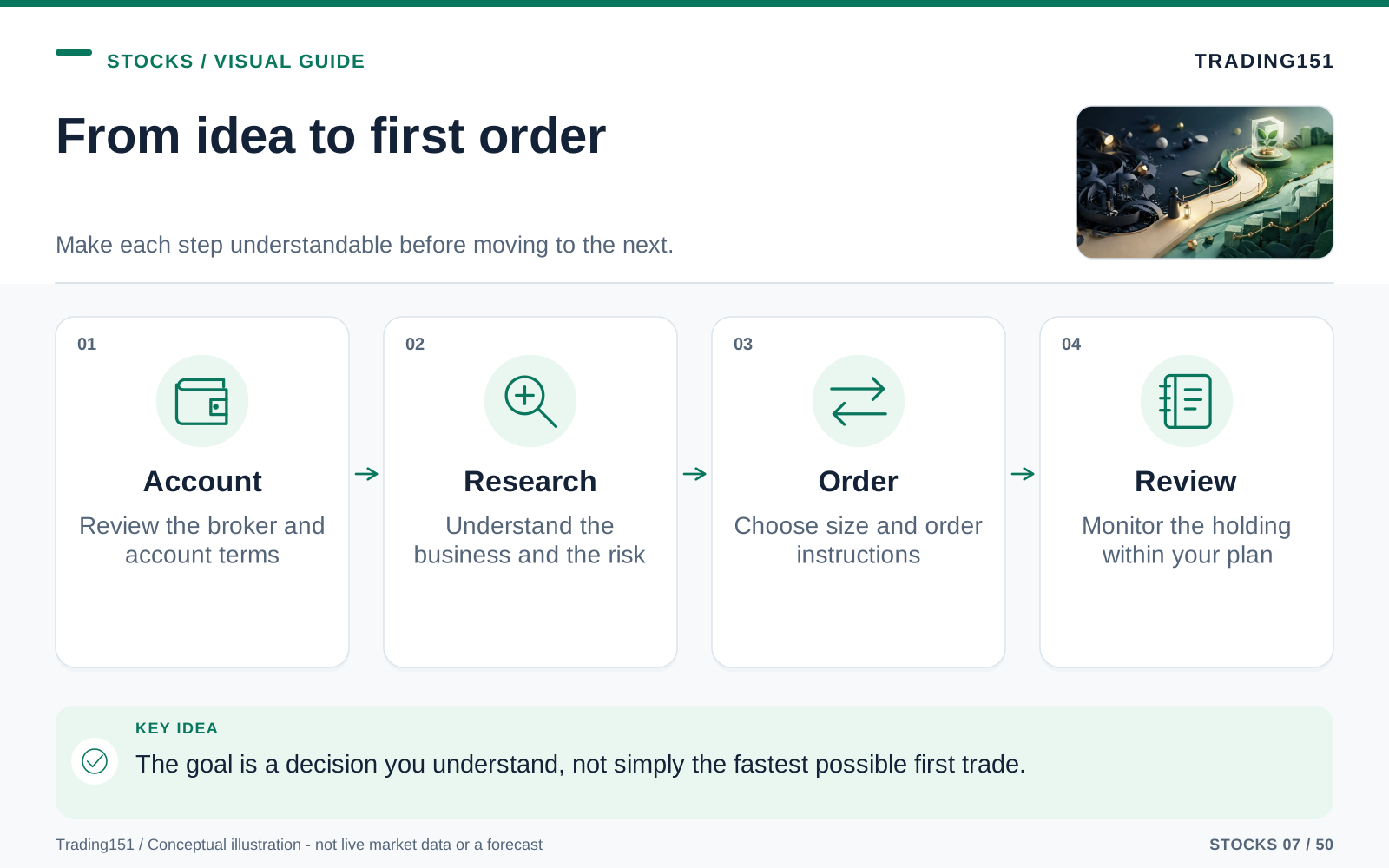
Read this diagram as text
- Account
- Review the broker and account terms
- Research
- Understand the business and the risk
- Order
- Choose size and order instructions
- Review
- Monitor the holding within your plan
Step 2: Understand What a Stock Really Is
Apps make it easy to view stocks as just blinking symbols on a screen. AAPL. MSFT. AMZN. You buy the letters, you stare at the squiggly green and red lines, and you hope they go up. But if that's how you look at it, you're missing the whole point.
A stock is an actual, literal piece of a real-world business.
When you buy a share, you are buying a tiny slice of that company. Sure, you can't strut into their headquarters and demand a corner office. Your slice might be a fraction of a fraction of a percent. But the concept remains true: you are now a part-owner, and your money is tied to the real-life future of that business.
If the company creates products people love, grows its profits, and thrives, your little slice becomes more valuable. If they make terrible decisions, alienate their customers, and drown in debt, your slice is going to lose value.
Imagine buying a 1% stake in a local coffee shop. If there's a line out the door every morning and they start opening new locations, your 1% is suddenly worth a lot more. But if the espresso starts tasting like dirt and the regulars stop showing up, your stake isn't worth much at all.
That’s the core of investing. You aren't gambling on magic numbers. You are buying pieces of businesses, and businesses either succeed, fail, or just awkwardly coast along.
Step 3: Decide Why You Are Investing
Before you drop money into the market, you really need to know what that money is for. Somebody investing for a retirement that's thirty years away should play a completely different game than somebody trying to save for a house down payment they'll need in three years.
Your "why" dictates everything: what kind of account you open, what you buy, and how much risk you can comfortably stomach.
If you're chasing long-term financial independence or retirement, you can afford to ride out the market's crazy mood swings. You have decades to recover from crashes. But if you need the money for a wedding, a car, or tuition in the near future? The stock market is way too unpredictable for that timeline.
A great rule of thumb is this: if you’re going to need the cash within the next three to five years, keep it out of the stock market. Stocks are for the long haul.
This is also the time to get direct with yourself about your personality. Some people can watch their portfolio drop 20% and sleep like a baby. Others get heart palpitations if they lose $15. Neither makes you a bad person, but knowing your limits will save you a lot of grief.
Step 4: Choose the Right Type of Account
You can't just walk into a store or go to a company's website to buy their stock. You need a middleman, which is a brokerage account. This is basically the platform that connects you to the market. But the type of account you open matters. It affects your taxes, when you can pull your money out, and how much you can put in. You shouldn't just pick whatever account looks prettiest on the app; pick the one that matches your goals.
Here are the usual paths you can take, depending on what you're trying to achieve:
Option A: A retirement account If this money is meant for your golden years, look into an IRA or a Roth IRA. These accounts are designed specifically for long-term investing and come with large tax perks. With a Roth IRA, for example, you put in money you've already paid taxes on, and then all your future growth and qualified withdrawals are totally tax-free. The catch? The IRS has strict rules on how much you can contribute and when you can take the earnings out without getting hit with a penalty.
Option B: A standard brokerage account If you want total freedom, a standard taxable brokerage account is your best bet. There are no contribution limits, and you can pull your money out whenever you feel like it. The downside is exactly what the name implies: taxes. You'll likely owe Uncle Sam a cut when you sell investments for a profit or collect dividends.
There is no "perfect" choice here. If it's for retirement, the tax breaks of an IRA are hard to beat. If you just want to learn the ropes and keep your options open, a regular brokerage account is straightforward.
What really matters is that you understand what you're opening. Don’t just blindly click "next" through the setup process.
Step 5: Pick a Brokerage You Can Trust and Use
Back in the day, buying stock meant calling up a guy in a suit, paying a hefty commission fee, and waiting for the trade to clear. Today, you can download an app, link your bank, and buy stocks from your couch while wearing sweatpants—usually for zero commission.
When you're picking where to open your account, ignore the slick marketing and look for a few practical things:
- No commission on standard stock and ETF trades: This is the industry standard now. Do not pay a platform fee just to buy a basic stock.
- Fractional shares: This is a game-changer. It means you can buy a slice of a share instead of the whole thing. If a stock costs $400 and you only have $50, you can just buy $50 worth.
- Clear layout: You want an app or website that makes sense to look at. If the interface is cluttered and confusing before you even buy anything, you're going to end up making a mistake.
- Good reputation and support: You want a company that takes security seriously, provides easy-to-read tax documents, and has real customer service when things inevitably glitch out.
The big players like Fidelity, Charles Schwab, and Vanguard are fantastic, reliable choices. App-heavy platforms like Robinhood or Webull are definitely easier to use on your phone, but just be careful. Some of these apps are designed to feel like video games. When your screen is constantly blasting you with push notifications, price alerts, and digital confetti, it tricks you into feeling like you need to be constantly trading. Usually, doing nothing is the smartest move you can make.
Once you pick a platform, the setup is pretty painless. They will ask for your personal info, including your Social Security number if you're in the US. It always feels a bit sketchy typing that into a website, but it's totally normal—legitimate financial institutions are legally required to verify your identity.
Step 6: Fund the Account Without Falling Into the Cash Trap
Once the account is live, you need to put some money in it. Usually, you just link your checking account and initiate a transfer. And hey, there is absolutely no shame in starting with $25 or $50. You aren't trying to fund your retirement on day one; you're just learning how the buttons work without risking next month's rent.
But here is a classic rookie mistake that catches so many people off guard: moving money into your brokerage account does not mean you've invested it.
If you transfer $100 from your bank, that money just sits in the brokerage account as cash. It’s on the platform, but it isn't doing anything yet. You still have to go in and explicitly buy a stock or a fund.
This is known as the "cash trap." People transfer money, pat themselves on the back for being an investor, and then check back six months later only to realize their cash has just been gathering dust. Always check your "buying power" or "cash balance," and then place the trade on a purchase.
Step 7: Decide What to Buy
Alright, here is the million-dollar question: what do you buy?
Truthfully, there is no magical "perfect" first stock. But there are smart ways to go about it, and really dumb ways. Most beginners will be looking at two main options: individual stocks, or funds like ETFs.
Choice 1: Buying an Individual Stock
Buying an individual stock means you are putting your money into one specific company. Think Apple, Microsoft, Coca-Cola, or whatever brand you know and love.
It’s easy to see why this is fun. If you pick a winner, the gains can be large. Plus, it just feels cool. Owning a microscopic sliver of a company whose products you use every day makes the whole investing thing feel very real.
But putting your money into a single company means you take on all of that company's baggage. Even large, legendary companies have terrible years. A competitor could crush them. The CEO could make a disastrous choice. Or the stock might just be unusually overpriced because everybody is currently hyped about it. A great company doesn't always equal a great stock.
If you really want to pick an individual stock, start with companies you understand. Ask yourself:
- How does this company make money? If you can’t explain their business model to a five-year-old, don't buy it.
- Do people need or love what it sells? Internet hype burns out fast; genuine consumer demand lasts.
- Is the company profitable or at least moving toward profitability? Promising to change the world is great, but eventually, they have to prove they can turn a profit.
- Would I still want to own this if the price dropped next month? If a temporary price drop would make you panic, you aren't investing—you're just gambling on a quick pop.
You'll hear the advice to "buy what you know" a lot. It’s a good starting point, but it’s not the whole story. Just because you love a company's coffee or their sneakers doesn't mean their stock is priced well. It's just step one of your research.
Choice 2: Buying an ETF or Index Fund
For the vast majority of beginners, an ETF is a much safer, vastly less stressful way to get your feet wet.
ETF stands for "exchange-traded fund." Think of it as a pre-packaged basket of investments that you can buy and sell just like a regular stock. Instead of betting your money on one single company, you buy a basket that might hold pieces of dozens, hundreds, or even thousands of different companies.
The classic example is an S&P 500 ETF. The S&P 500 is basically a list of the 500 largest publicly traded companies in the US. When you buy an ETF that tracks it, you are instantly spreading your money across 500 large businesses all at once.
If you look up tickers like VOO, SPY, or IVV, you'll see what I mean. They all do roughly the same thing: they give you a tiny piece of the broader U.S. economy in one simple click.
The beauty of an ETF is diversification. If one company in that basket completely tanks, it barely makes a dent because the other 499 are there to balance it out. Can ETFs still lose money? Absolutely—if the entire economy takes a hit, the ETF will too. But they completely eliminate the risk of your portfolio getting wiped out just because one CEO made a bad tweet.
Buying an ETF is the perfect first move. It lets you figure out how the platform works, helps you get used to watching your account balance fluctuate, and protects you from putting all your eggs in one basket before you really know what you're doing.
Step 8: Learn the Basic Order Types
Okay, you know what you want to buy. Now your app is going to ask how you want to buy it, and this is where beginners tend to freeze up. Don't worry, you really only need to know two terms right now. (If you're buying weird, obscure stocks or trading after hours, things get complicated, but for a standard daytime trade on a big stock, it’s simple).
- Market order: This is the "just get it done" button. It tells your broker to buy the stock right this second at whatever the best current price is. For large, popular stocks or ETFs, the price you pay will be almost exactly what you see on the screen.
- Limit order: This is the "control freak" button. It lets you set an absolute maximum price you are willing to pay. Say a stock is at $100, but you refuse to pay a penny over $98. You set a limit order for $98, and the app will only buy it if the price drops to that exact number. The catch? If it never drops to $98, your order just sits there, and you don't buy anything.
If you're just buying a few shares of a major ETF to hold for the next ten years, a simple market order during normal trading hours is totally fine. Limit orders are great when a stock's price is jumping around like crazy, but they aren't strictly necessary for your very first, small purchase.
Whichever you pick, take a deep breath before you hit confirm. Review the screen. Did you type the right ticker symbol? Did you accidentally try to buy 100 shares instead of $100 worth? A five-second double-check will save you a lot of embarrassment.
Step 9: Place the Trade
Looks good? Great. Hit confirm. Swipe up, click the button, whatever your app makes you do.
And... Boom. You just bought your first stock.
It’s probably going to feel surprisingly anti-climactic. You might get a little email receipt or some digital confetti, but that’s about it. Yet, underneath that quick screen tap, something major just happened. You crossed the line from thinking about investing to doing it. You own an asset now.
Whatever you do, don't judge your decision based on what happens five minutes later. The price will probably instantly change, and it means absolutely nothing. A terrible stock can bounce up right after you buy it, and a brilliant investment can dip ten seconds later. Short-term price wiggles are just noise. Focus on the big picture.
Step 10: Know What to Do After You Buy
Everyone thinks buying is the hard part. It’s not. Holding is the hard part. The trick is to establish a healthy routine before the novelty wears off. If you bought something to hold for years, you should probably only be checking up on it maybe a few times a year—not reloading your app ten times a day.
I know the urge to check the price every hour is going to be strong at first. It’s fun! When the line goes up, you feel like a financial genius. When it goes down, you feel like an idiot. Those emotional swings are completely normal, but they are also exactly what lead people to make terrible, impulsive decisions.
The market never moves in a straight line. Even the greatest companies in history have suffered through agonizingly bad weeks, months, and years. If you invested money you don't need tomorrow, and the reasons you bought it are still true, a sudden dip on a random Tuesday doesn't mean the sky is falling.
The ultimate rookie mistake is panic selling. People buy a stock, it drops 10%, they freak out, and they sell it just to make the anxiety stop. And then, inevitably, the market recovers a few months later, and they're sitting on the sidelines feeling burned and refusing to ever invest again.
You can avoid all this by setting rules for yourself before your emotions take over. One of the best strategies is simply deciding to invest a set amount of money on the same day every month, no matter what the market is doing. It’s called "dollar-cost averaging." You buy when prices are high, you buy when they're low, and over the years, it all averages out into steady growth without the stress of trying to time the market perfectly.
Also, do yourself a favor and just delete the app off your home screen. Long-term investors don't need minute-by-minute updates. Obsessing over the daily ticker just turns completely normal market behavior into a daily panic attack.
Step 11: Keep Learning, But Be Careful Who You Learn From
The funny thing is, the minute you buy your first stock, you'll suddenly start noticing financial advice everywhere. Your uncle will have a hot tip. TikTok will have a thousand hot tips. Some guy on YouTube with a whiteboard will scream about an incoming crash. Some of it is helpful. Most of it is total garbage.
Avoid offers that combine promised returns with pressure to act immediately. Taking time to understand an investment and its terms is more important than securing a particular quoted price. The opportunity and valuation may change overnight, but that possibility does not justify buying something you cannot yet evaluate.
Good financial advice usually sounds calm, practical, and heavily focused on patience. It talks about managing risk, avoiding crazy fees, and keeping your emotions in check. Bad advice usually tries to make you feel panicked, greedy, or like you're missing out on the party.
As you go, just focus on picking up the vocabulary naturally. Learn what a dividend is. Figure out what an expense ratio means. You don't have to memorize a textbook today. It all clicks a lot faster once you have skin in the game and can see how those words apply to your own account.
Common Beginner Mistakes to Avoid
Look, everyone messes up when they're learning, but you can skip a lot of the pain if you know where the potholes are.
- Investing money you need soon: The market loves to tank right when your water heater explodes. Keep your short-term cash in a boring bank account.
- Buying because of hype: If you're buying a stock purely because it's trending on social media, you are probably arriving at the party right before the cops show up.
- Putting everything into one stock: Even legendary companies can stumble. Diversifying your money across lots of different things is how you protect yourself.
- Checking your account constantly: Watching the ticker all day is just going to stress you out and make you want to tinker with things that should be left alone.
- Confusing trading with investing: "Trading" is frantically trying to guess short-term price jumps to make a quick buck. "Investing" is quietly owning good assets for years. Stick to investing.
- Ignoring taxes: If you’re using a standard brokerage account and you sell a stock for a profit, the IRS is going to want a piece of that. Don't let tax fear stop you from investing, but don't be surprised when tax season rolls around.
How Much Should You Start With?
You really don't need a large pile of cash to get started. Starting small is the smartest thing you can do. It lets you figure out the mechanics of the app, feel the sting of a red day, and build your confidence without risking your life savings.
If $25 is all you can spare right now, start with $25. If $100 feels better, do that. The dollar amount barely matters on day one. What matters is that you're building the habit and getting off the sidelines.
Consistency is where the magic happens. A one-time purchase is a great milestone, but habitually throwing a little bit of money into the market month after month is what builds wealth. Even fifty bucks a paycheck turns into something large if you give it enough years to compound.
Read the confirmation, not just the confetti
Before submitting an order, check the full security name, ticker, exchange, currency, quantity, and estimated cost. Similar tickers can refer to very different instruments. A platform may offer a share, a fractional interest, an option, or a derivative linked to the share price. Make sure the product is the one you intended to buy, particularly when leverage is available by default.
After execution, read the trade confirmation. Confirm the number of shares filled, the price, commissions, conversion charges, and any unfilled remainder. A displayed order is not necessarily a completed trade. A limit order can protect the price you accept, but it can remain unfilled; a market order prioritizes execution without fixing the eventual price.
Settlement is another date to notice. Most ordinary U.S. stock transactions have followed a T+1 settlement cycle since May 28, 2024, meaning the next business day rather than the next calendar day. Other markets and products may differ. Cash that appears available for trading may not yet be withdrawable, and account rules can restrict how unsettled proceeds are used.
Save the confirmation and write down the reason for the purchase. That gives you an administrative record and a decision record. The first helps resolve account questions; the second helps you evaluate the investment later without rewriting the original reason to match whatever the price happened to do.
Check the confirmation after the trade
Before closing the app, confirm the security, quantity, order status, execution price, and account used. An order marked pending is not a completed purchase, and a partial fill is not the full intended position. Keep the confirmation with your records. This modest habit helps catch duplicate orders, unexpected fees, or a purchase in the wrong account before the details become difficult to reconstruct. 1, 2, 3
The First Trade Is Only the First Step
Hitting that "buy" button for the first time doesn’t magically make you Warren Buffett. It's just you taking your very first step into owning a piece of the economy.
You're starting a real-world education. You're learning how businesses grow, how markets fluctuate, and most importantly, you're learning about yourself. You’ll find out how you handle risk, how easily you get spooked by the news, and whether you have the willpower to stick to a plan when your screen turns red.
No fake "paper trading" simulator can ever teach you what it feels like when it's your actual money on the line. A five-dollar dip hits totally differently when it comes out of your own pocket. And that feedback is valuable—as long as your first investment was small enough that a mistake is just a lesson, not an eviction notice.
Treat this first trade not as a test of your financial genius, but as the start of a lifelong habit. Jot down why you bought it, what would make you sell it, and what your long-term goal is. Then step back and let the market do its thing.
Succeeding as a beginner isn't about picking the perfect stock that rises sharply overnight. It’s about building a system. Keep your emergency cash safe, use the right accounts, buy things you understand, and give yourself grace when you inevitably make a mistake. Making that first trade is a huge deal, but the habits you build tomorrow are what will change your life.
Sources and further reading
- SEC Investor Bulletin: Trading Basics and Order Types
- FINRA Regulatory Notice 24-04: T+1 Settlement
- Investor.gov: Stocks
- CFTC: Forex Fraud
Editorial revision: 7 October 2026. Numerical scenarios are hypothetical unless identified as historical. References support the added explanations and selected corrections; rules and product terms should be checked again before acting.