
The stock market connects investors who want to buy and sell ownership interests in companies. Most everyday trading happens between investors, rather than sending fresh money to the company whose name appears on the screen. Understanding that distinction makes the rest of the machinery easier to follow: exchanges and other venues arrange trades, brokers handle orders, and clearing and settlement complete the transfer.
Part 1: What Exactly Is a Stock?
To really get what a stock is, put the giant corporations out of your mind for a minute. Forget Apple, Microsoft, Amazon, Tesla, and those blinking ticker symbols crawling across the bottom of the TV screen. Let’s bring it back to something simpler—like a neighborhood bakery.
Picture a friend, let's call her Sally, who runs a little shop called “Sally’s Sourdough.” She started out with a single oven, a small counter, and a stubborn belief that people would pay for good bread. Turns out, she was right. Now, there’s a line out the door every morning. Locals love it, restaurants want to buy her loaves wholesale, and she’s turning a solid profit. But she’s also completely exhausted and entirely out of space.
Sally has reached a crossroads. She can either keep things small and continue turning customers away, or she can expand. Expanding means opening three new spots, buying large commercial ovens, hiring a team, and maybe even getting her bread into grocery stores. The catch is that expansion costs money. One way to raise it is to sell investors shares in the company. Each share represents a small ownership stake in the bakery, so the investor becomes a part-owner rather than a lender.
Part 2: Why Companies Issue Shares
Whether companies are building new factories, developing cutting-edge software, funding medical research, or just trying to weather a tough economic storm, they need cash. Selling stock is an attractive way to get it because it changes the company's financial burden. Unlike a bank loan, they don't have to pay shareholders back with interest. Instead, the investors take on the risk. If the company blows up and becomes massively valuable, the investors get to ride that wave. But because the original founders are giving up a piece of their baby, selling shares is never truly "free money." It's always a trade: getting cash today by giving up a portion of tomorrow’s profits.
When a business needs cash, it basically has a few levers it can pull. It can borrow from a bank, issue corporate bonds, scrape by using its own profits, or sell pieces of itself by issuing shares.
Going the stock route has a large perk for the business: there's no looming deadline to pay the money back. The investors hand over their cash knowing full well they’re taking a gamble. They’re crossing their fingers that the business grows in value, but there are zero guarantees. If the whole thing goes under, the investors might lose every penny. If it takes off, they reap the rewards.
It’s a win-win setup, really. The company gets the rocket fuel it needs to expand without the chokehold of debt. Meanwhile, everyday people get the chance to build wealth from ideas they didn't even come up with. You don’t have to be the genius who invented the smartphone, designed a revolutionary payment network, or figured out how to ship packages worldwide in two days. You just have to buy a small slice of the companies doing the heavy lifting.
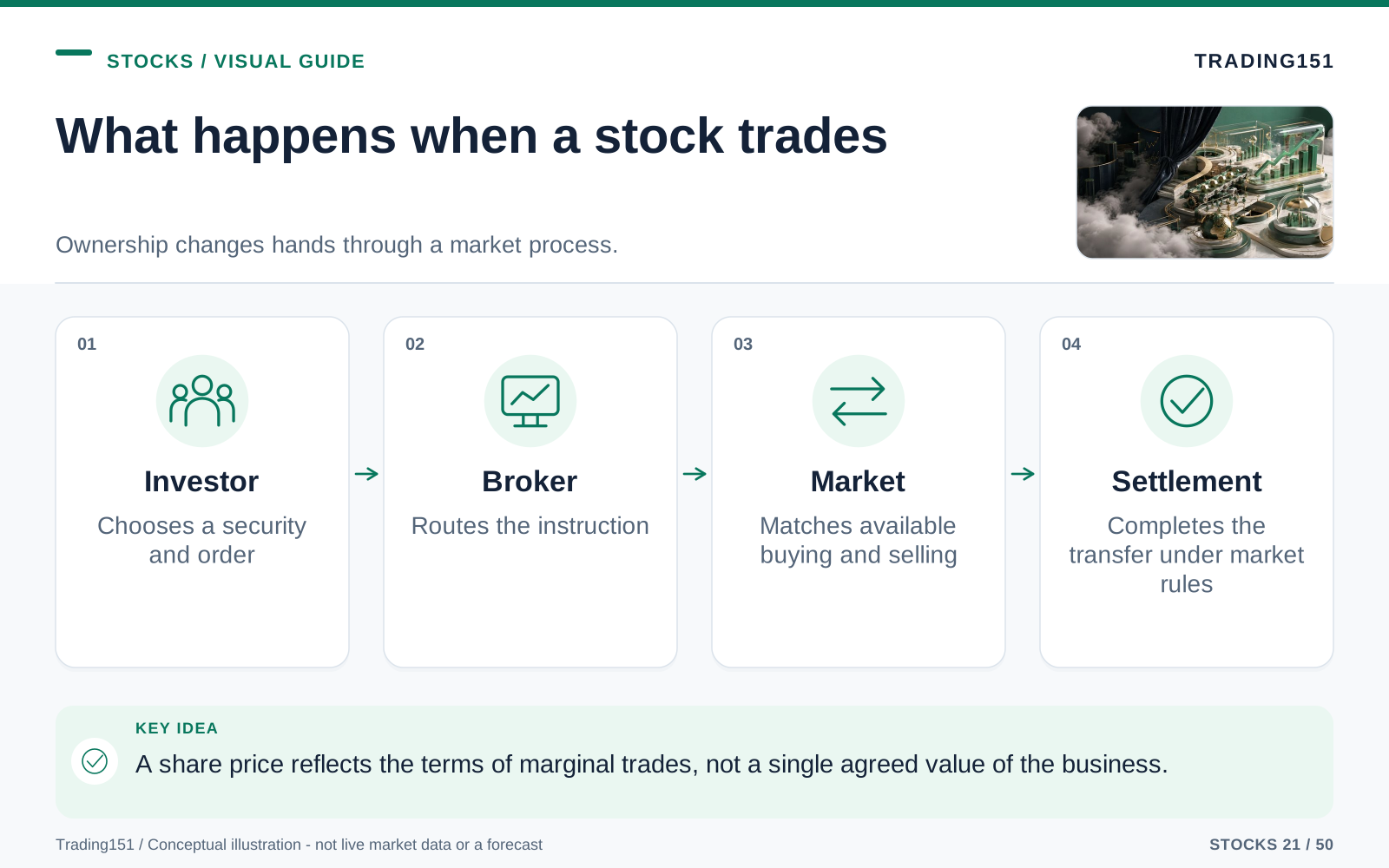
Read this diagram as text
- Investor
- Chooses a security and order
- Broker
- Routes the instruction
- Market
- Matches available buying and selling
- Settlement
- Completes the transfer under market rules
Part 3: The IPO — When a Private Company Goes Public
In the beginning, most businesses are private. They’re owned entirely by the founders, their families, maybe a few early employees, or deep-pocketed venture capitalists. You and I can’t just log onto an app and buy a piece of them.
That all changes if the company decides to "go public." You’ve probably heard the term Initial Public Offering, or IPO. An IPO is exactly what it sounds like: it’s the very first time a private business offers slices of its ownership to the general public. Once the IPO happens, those shares are listed on a stock exchange, and regular folks can start trading them through standard brokerage accounts.
Put simply, an IPO is the moment a company unlocks its front door, steps outside, and announces, "Alright, anyone who wants a piece of this business can now buy one."
Think about Amazon. Back in the day, it was just a scrappy online bookstore with substantially huge dreams. To become the absolute giant it is today—building warehouses globally, branching into everything from cloud computing to groceries—it needed a large influx of cash. When Amazon held its IPO in 1997, it gave regular investors the chance to buy in. Those who bought shares and held onto them through the dot-com crash, the recessions, and the growing pains saw rewards that honestly sound made up today.
But don't let the survival stories fool you—IPOs are not guaranteed golden tickets. Some newly minted public companies go on to change the world, while others crash and burn spectacularly. A company can have an hyped IPO and still be terribly managed, vastly overpriced, or years away from making an actual dime of profit. An IPO is just the starting line for public trading. What happens after the ribbon is cut depends entirely on the actual strength of the business.
Part 4: What the Stock Market Does
Once a company hits the public market, investors start buying and selling its shares among themselves. This is what the stock market is. Keep in mind, when you buy a share on a Tuesday afternoon, your money usually isn't going to the company itself. You’re buying it on the "secondary market" from another investor who decided to sell. The company already got its money when it first issued those shares. But this secondary trading is vital. Because investors know they can easily sell their shares whenever they want, they’re far more willing to invest in the first place.
The easiest way to visualize the stock market is to think of it as a large, high-speed matchmaking service. It pairs up people who want to buy with people who want to sell. If you decide you want ten shares of a specific tech company, someone out there has to be willing to part with ten shares. The market just connects the two of you and handles the paperwork.
Here in the US, the main arenas for this matchmaking are the New York Stock Exchange and the NASDAQ. The NYSE is the older, more traditional one—the one that probably pops into your head when you think of Wall Street financial professionals. The NASDAQ is entirely digital and has historically been the go-to home for tech giants, though both exchanges host all kinds of businesses today.
You don’t walk into an exchange to buy stock, of course. You go through a broker. Brokers are the middlemen. Companies like Fidelity, Charles Schwab, Vanguard, Interactive Brokers, or apps like Robinhood let you set up an account, transfer in some cash, and place your orders.
When you hit "buy" on your phone, your order doesn’t just vanish into a mysterious financial void hoping for a match. It instantly routes through complex systems built to track down a seller and lock in the trade. It happens so fast that we just take it for granted as instant.
But strip away the servers, the fiber-optic cables, and the flashing screens, and the market is doing exactly what markets have done for thousands of years: bringing buyers and sellers together to agree on a price.
Part 5: Why Stock Prices Move
Now, here is where things start to get a bit dramatic. A company's stock might be trading at $100 on Monday, drop to $93 on Wednesday, and suddenly shoot up to $108 a couple of weeks later. Nothing in the real world seems to have changed. The same people went to work, the products didn't change, and the logo is identical. So why is the price bouncing around? It helps to realize that raw data and human interpretation are two very different things. Two people can look at the same quarterly earnings report and have completely opposite reactions depending on how they view the company's future. The price you see on your screen is just the temporary compromise where all those substantially different opinions meet.
At the most basic level, it boils down to supply and demand.
There is a finite number of shares floating around at any given second. If everybody suddenly decides they want to buy a particular stock, but no one wants to sell it, the buyers have to sweeten the deal. They offer more money to coax the sellers into letting go of their shares, and the price climbs.
Conversely, if everyone is panicking and trying to dump their shares, but nobody is eager to buy, the sellers have to drop their asking price to attract takers. The price falls.
The math there is easy. The much messier question is why crowds of people suddenly get the urge to buy or sell all at once. The answer is a chaotic cocktail of actual data, future expectations, pure greed, sudden fear, news headlines, interest rate changes, and good old-fashioned human psychology.
Say a company announces a groundbreaking new product that everyone assumes will print money for the next decade. Investors scramble to get in on the action, and the stock price rises sharply. On the flip side, imagine a company admits its sales are falling and the CEO steps down with no replacement. People rush for the exits, dragging the stock price down with them.
Sometimes these price swings make perfect sense. A lot of times, they don't. We’re human, and humans have a habit of overreacting. We get overly hyped, we panic, we follow the herd, and we let scary news headlines dictate our financial choices.
This is why the market can look completely divorced from reality in the short run. A company might announce record profits, yet its stock drops—simply because Wall Street was betting those profits would be even higher. Or a company losing money might see its stock surge just because investors are convinced a turnaround is coming. The market is never just reacting to what happened today; it’s obsessively trying to predict what will happen tomorrow.
Part 6: Short-Term Noise vs. Long-Term Value
If you want to keep your sanity while investing, keep this legendary piece of advice in mind. It comes from Benjamin Graham, the guy who taught Warren Buffett. He said that in the short run, the market is a voting machine, but in the long run, it is a weighing machine.
It’s a brilliant analogy because it perfectly nails the stock market’s split personality.
Day to day, the market is just a popularity contest. Investors are "voting" with their wallets based on the current mood, flashy news, hype, or panic. A company can become substantially popular or completely hated for reasons that have absolutely zero to do with its actual, long-term health.
Zoom out a few years, though, and reality always catches up. A business that steadily grows its profits, treats its customers well, keeps its debts manageable, and makes smart moves will, over time, become a more valuable company. A business that bleeds cash, alienates its audience, and refuses to adapt will eventually hit a wall.
That doesn't mean a great company's stock will go up in a straight, beautiful line every year. It won’t. Even phenomenal businesses go through grueling slumps where their stock charts look terrible. But stretch your timeline out far enough, and stock prices inevitably track the actual success of the business. Profits matter. Debt matters. Good leadership matters. And, crucially, the price you pay matters—because even the best company in the world is a bad investment if you pay a ridiculous premium for it.
Part 7: How Investors Make Money
When you strip it all down, there are really only two ways you make money owning stocks: capital appreciation and dividends.
1. Capital Appreciation
This is the classic "buy low, sell high" scenario. You buy a share for $100. Five years go by, the business is thriving, and someone else is now willing to pay $250 for that exact same share. You sell it, and boom—you’ve made a $150 profit. That profit is your capital gain.
When people daydream about getting rich in the stock market, this is what they’re picturing: getting in early on the next big thing and cashing out years later. It’s a great way to build wealth, but it demands an iron stomach and a lot of patience. The ride from $100 to $250 is never a smooth, upward slope. That stock is probably going to crash to $80, rally to $140, sink back to $110, and drag out for years before hitting $250. The people who make money are the ones who understand the business well enough to not panic and sell when the chart dips into the red.
2. Dividends
Dividends are a completely different animal. Basically, a dividend is a cash payout—a literal slice of the company’s profits handed straight to you just for being an owner.
Let's look back at Sally’s bakery for a second. Imagine a few years have passed. The bakery is a large success, cash is rolling in, and she doesn't really need to build any more new locations. She might decide to take some of those extra profits and distribute them to her investors. Huge public corporations do this all the time. If a company announces a $2 dividend per share, and you hold 100 shares, $200 simply drops into your account.
The beauty of dividends is that you don't have to sell a single share to get paid. The cash just magically appears in your brokerage account. Some people use this money to pay their living expenses. Others take those payouts and automatically buy more shares of the company, which is an powerful way to quietly snowball your wealth over the years.
Not every stock pays a dividend, though. Scrappy, high-growth tech companies usually keep every dime they make to reinvest in their own aggressive expansion. Older, more established companies with predictable profits are usually the ones writing dividend checks. One isn't necessarily better than the other; it just depends on your goals and what phase of life the company is in.
Part 8: The Power of Compounding
If the stock market has a secret superpower, it’s compounding.
Compounding is what happens when the money your investments make starts making money of its own. In the beginning, it’s agonizingly boring. You put in a few bucks. It grows by a few dollars. Maybe you get a tiny dividend, which buys a fraction of another share. Your account balance wiggles up and down, and it feels like absolutely nothing is happening.
But let it brew for a decade or two, and compounding turns into something almost magical. The operative phrase there is "given enough time." Compounding doesn't care about your quick-flip strategy; it rewards immense patience. It’s a lot like planting an oak tree. For the first few years, you’re just staring at a twig in the dirt. But eventually, it thickens, branches out, and becomes large.
This is why every financial advisor on earth begs people to start investing in their twenties. Money that has 40 years to compound will utterly dwarf money that only has 10 years to grow, even if you invest way more cash later on. The market rewards intelligence, sure, but it rewards time significantly more.
It’s also why constantly jumping in and out of the market can be so destructive. Every time you panic-sell, chase a trendy new stock, or pull your money out waiting for the "perfect" time to jump back in, you interrupt the compounding process. You’re essentially digging up the seed to see if it’s growing.
Part 9: Bulls, Bears, and Market Mood Swings
Wall Street absolutely loves animal metaphors, and you’re going to hear two of them constantly: bulls and bears.
- A bull market is when stock prices are trending steadily upward and the general vibe is extremely optimistic. The metaphor comes from a bull attacking by thrusting its horns up into the air.
- A bear market is the opposite. It’s when prices are plummeting—usually defined as a drop of 20% or more from recent highs. This comes from a bear swiping its claws downward.
Bull markets are intoxicating. Your portfolio is up, your friends are making money, and everyone feels like a financial genius. People get bold—often a little too bold. They start acting like risk has been permanently deleted from the economy and that stocks only go up.
Bear markets, on the other hand, are miserable. Prices crater, the news cycle is full of doom, and you start second-guessing every financial decision you've ever made. It’s a harsh reality check. People who were aggressively buying during the good times suddenly realize that "taking on risk" feels deeply sickening when it’s their actual life savings dropping by 25%.
But here is the thing you have to internalize: both of these cycles are completely normal. The market never, ever moves in a straight upward line. It’s more like a guy hiking up a jagged mountain in a storm. He climbs, he slips, he walks sideways for a bit, he rests, and then he climbs some more.
The hard truth is that market crashes are not glitches in the system; they are the price of admission. If you're going to put your money in stocks, you have to accept that you will live through some ugly periods. You can't sidestep every downturn—no one can. Your goal isn't to perfectly dodge the drops, but to build a financial plan that you can stick to without losing your mind (or your shirt) when the bears take over.
Part 10: Risk Is Real, But It Can Be Managed
It would be nice to just call the stock market a magical wealth-building machine and leave it at that. But that would be a lie. Yes, stocks build wealth, but they can also evaporate it. Individual companies go bankrupt. Trendy industries cool off. A stock that everyone swears is a "sure thing" can nosedive and never bounce back. Plus, risk is heavily tied to the price you pay. An amazing company can be a terrible investment if you buy it when the price is massively inflated by hype. On the flip side, a boring, unsexy company might offer fantastic returns if you buy it when no one else cares about it. Diversifying your investments keeps you from getting wiped out if you’re wrong about a single company, but paying attention to value is what keeps you from buying a great stock at a terrible price.
The worst way to handle market risk is to just close your eyes and pretend it’s not there. The right way to handle it is to manage it.
Your first line of defense is diversification. That’s just a fancy way of saying "don't put all your eggs in one basket." If your entire net worth is tied up in a single tech stock, your financial future is entirely at the mercy of one CEO's decision-making. If you spread your money across dozens of companies in healthcare, tech, retail, and real estate, one bankruptcy isn't going to ruin your life.
Your second tool is your time horizon. If you are going to need your cash next year to buy a house or pay for a wedding, that money does not belong in the stock market. Period. The market could crash the exact week you need to make a withdrawal. Stocks are for money you can afford to leave alone for at least five to ten years, giving it plenty of time to recover from the inevitable dips.
Your third tool is position size. Even if you are absolutely convinced a company is going to change the world, you don't need to bet your entire mortgage on it. Smart investing isn't about being loudly, substantially right about one huge gamble. It’s about surviving long enough for your good decisions to compound.
Finally, you need humility. Nobody has a crystal ball. Not the hedge fund managers, not the screaming guys on financial TV, and definitely not your buddy who just downloaded a crypto trading app. The market is sharply efficient at humbling people who think they know everything.
Part 11: Index Funds — The Simple Path Most People Overlook
Hand-picking individual stocks is thrilling. It’s also difficult. To do it well, you really need to sit down and read boring financial statements, analyze the competition, judge the CEO's track record, and keep up with industry shifts. Even if you do all that perfectly, you can still just be wrong.
Most of us do not have the time or the energy to do that kind of homework. And luckily, you don't have to.
Enter the index fund. An index fund doesn’t try to find the one winning stock; it simply buys a giant basket of companies all at once.
The granddaddy of them all is the S&P 500, which tracks the 500 largest publicly traded companies in the US. When you drop money into an S&P 500 index fund, you aren’t placing a large bet on Apple or Walmart. You are buying a tiny sliver of 500 different large businesses simultaneously—spanning tech, healthcare, airlines, banks, and grocery stores.
This strategy is almost unfairly effective because it completely removes the guesswork. You don’t have to predict which tech gadget will dominate the 2030s, or which CEO is going to get caught in a scandal. If one company in the S&P 500 goes bankrupt, another one steps up to take its place. Your success is tied to the general growth of the American economy, not the fate of a single brand.
The late Jack Bogle, who founded Vanguard and basically invented index investing, summed it up perfectly: “Don’t look for the needle in the haystack. Just buy the haystack.”
That might be the single best piece of financial advice ever spoken. For the vast majority of us, the smartest path isn't hunting for the next big thing. It’s buying a cheap, broad index fund, adding a little bit of money from every paycheck, and letting time do the heavy lifting.
Part 12: Active Trading vs. Long-Term Investing
You’ll hear people use "trading" and "investing" interchangeably, but they are two substantially different games.
Trading is a short-term hustle. A trader buys a stock because of a chart pattern, a news rumor, or momentum, hoping to sell it for a quick profit a few days, hours, or even minutes later. It’s a legitimate profession, but it is sharply stressful. It requires intense discipline, advanced risk management, and the emotional detachment to cut your losses immediately when you're wrong.
Investing is playing the long game. An investor buys a piece of a business believing that, over the next five to ten years, the company will grow and become more valuable. Investors largely ignore what the stock is doing this afternoon; they care about what the business will look like a decade from now.
Neither approach is inherently "better." The disaster happens when everyday people think they are investing, but act like day traders or gamblers. They buy a stock just because it’s trending on social media. They panic and sell the second it drops. They confuse being lucky in a bull market with being a financial genius. They check their portfolio app twelve times a day and let a red screen ruin their weekend.
For almost everyone, patient, long-term investing is a much better fit. It doesn't require you to glue your eyes to a monitor or try to outsmart Wall Street algorithms. It just asks for something far less sexy but much more reliable: consistency.
Part 13: What a New Investor Should Focus On
If you're just starting out, please don't feel like you need to memorize a financial dictionary. You just need to internalize a few core rules:
- Know what you own. A stock isn't a magical ticker symbol; it’s a piece of a real-life business.
- Diversify. Never let one single company hold your entire financial future hostage.
- Think in years, not days. Most daily price swings are just meaningless noise. Ignore them.
- Keep costs low. Brokerage fees and high fund expenses will quietly eat your profits alive over a few decades.
- Avoid money you can’t afford to lose. If you need that cash for rent or an emergency fund, it belongs in a bank account, not in stocks.
- Be careful with hype. If your barber, your cousin, and a TikTok influencer are all telling you a certain stock is a "guaranteed lock," walk away.
- Automate good habits. Set up auto-deposits into your investment account so you don't even have to think about it. It removes the emotional urge to "time" the market.
The absolute best investing strategy isn't the one that sounds the most sophisticated at a dinner party. It’s the one you can stick to when the market is booming, when it's crashing, and during the long, boring stretches in between.
Part 14: The Biggest Mistakes Beginners Make
The most devastating investing mistakes aren't caused by stupidity. They are caused by raw emotion.
The classic trap is chasing performance. We’ve all seen it: a stock shoots to the moon, everyone is bragging about their gains online, and beginners blindly throw their money at it long after the real money has already been made. They aren't buying the stock because they researched the business; they're buying it because of FOMO (Fear Of Missing Out).
Then there’s the urge to panic-sell. The market takes a dive, the news anchors look grim, and people sell their shares just to stop the psychological pain of watching their account balance shrink. Yes, sometimes selling is the smart move, but selling purely out of panic is how you lock in a temporary loss and make it permanent.
Overconfidence is a quiet killer, too. A beginner gets lucky on a couple of trades, and suddenly they think they are the next Warren Buffett. They start taking wilder risks, ignoring the basics, until the market violently reminds them that a rising tide lifts all boats—even the leaky ones.
Finally, there’s the mistake of paralysis. So many people want to invest, but they’re waiting for the "perfect" time. They wait for the election to end, for interest rates to drop, or for the next inevitable crash so they can buy at the bottom. The catch is that the world is never totally calm. There is always a crisis looming. But historically, a decent plan executed today almost always beats a perfect plan executed a decade from now.
Part 15: The Stock Market and the Real Economy
Here is something that confuses people constantly: the stock market and the economy are connected, but they are absolutely not the same thing.
The "economy" is the real world. It’s your wages, local businesses, unemployment rates, factory outputs, and the cost of groceries. The stock market is just a gauge of what investors are willing to pay for ownership in large public companies. Yes, those companies operate within the economy, but they don't represent the whole picture.
That’s why you’ll sometimes see Wall Street hitting record highs while everyday people are struggling to pay rent. Investors are looking past the current misery, betting that corporate profits will bounce back before the average worker feels relief. And you see the reverse, too: the economy might look completely fine on paper, but the stock market starts falling because investors sense dark clouds on the horizon.
The stock market lives in the future. It is constantly trying to price in what’s going to happen six months from now, and since the future is unknowable, the market is often wrong, early, or substantially dramatic.
Part 16: Why the Market Has Built So Much Wealth
Despite all the chaos, the stock market remains one of the greatest wealth-building engines ever created for regular people. And the reason why isn’t some deep financial mystery. It’s because businesses exist to create value. They build products, innovate, hire smart people, and figure out how to turn a profit. As a shareholder, you get to attach a hose to that productivity and siphon off a little bit of the success.
When you buy broad index funds, you aren't gambling on lines on a chart. You are fundamentally betting on human progress. You’re putting your money on the belief that, over time, people will wake up, go to work, solve problems, and build better, more efficient things.
That’s a much more solid foundation for your money than trying to guess tomorrow’s news headlines. A smart investor isn’t sitting there saying, "I know exactly what the Federal Reserve will do next week." A smart investor is saying, "I believe that over the next twenty years, the economy will grow, and these businesses will figure out how to make money."
Will there be recessions? Absolutely. Market crashes, wars, political turmoil, and bursts of inflation are guaranteed. We shouldn't brush those off—they are concerning when you are living through them. But uncertainty is the default state of the world. It’s always been that way. In fact, that very uncertainty is the reason investors are rewarded. You get paid for your willingness to endure the bumps.
What changes hands when you buy a share?
Suppose a company sold shares to investors years ago. You now buy one of those shares from another investor through your broker. Your purchase price generally goes to the seller, not into the company's bank account. The company may still benefit indirectly from an active market, but this secondary-market trade is different from buying newly issued shares.
The displayed price also needs a little interpretation. A last-traded price records an earlier transaction. The best ask is an offer to sell a particular quantity now, while the best bid is an offer to buy. An order submitted after you look at the screen may meet different prices or quantities. This is one reason a market order can fill away from the number that first caught your attention.
Execution and settlement are separate events. A trade can be agreed immediately even though the final exchange of cash and securities follows the market's settlement timetable. Most covered U.S. securities transactions moved to T+1 settlement on May 28, 2024, meaning one business day after the trade. Holidays, product exceptions, and account funding rules still matter.
Owning a share does not mean every company decision becomes yours to make. Voting rights depend on the share class and applicable arrangements, and some investors hold through intermediaries. The practical rights to check are participation in distributions, voting where available, and the shareholder's place in a liquidation. Common shareholders generally stand behind creditors; a familiar ticker does not change that order.
The last trade is not an offer for any quantity
A displayed last price records a transaction that already occurred. It does not promise that another buyer or seller can trade any desired amount at that price. The current bid, ask, available depth, and order type determine what may happen next.
That distinction becomes important in a thinly traded share. A small transaction can set the visible price while a larger order would move through several levels. A limit order controls the acceptable price but may not fill; a market order prioritizes execution without guaranteeing the displayed quotation.
Review the confirmation rather than assuming that the chart price became the transaction price. Execution is a process involving available counterparties and instructions. Understanding that process makes an unexpected fill easier to investigate and reduces the temptation to treat every difference as either a platform error or deliberate misconduct. 1, 2, 3
What the Market Is Really Offering
When you clear away the fog, the stock market isn’t some impenetrable mystery. It’s just a marketplace for buying and selling business ownership. A stock is a piece of a company. The prices fluctuate because humans are constantly arguing about what the future holds. And you make money by holding onto good businesses as they grow, collecting dividends, and letting time work its compounding magic.
Everything makes more sense once you stop confusing a blinking ticker symbol with a real company. The stock price is just an auction bid at a specific second in time. The company behind it is a living, breathing organization full of people trying to make a profit. Good investing is about keeping those two realities connected in your mind, without mistaking one for the other.
You don’t need a crystal ball to win at this. Building a solid emergency fund, thinking in decades instead of days, buying diverse index funds, and consistently adding a little bit from every paycheck will do infinitely more for your wealth than trying to perfectly time the next market crash. It’s a substantially boring strategy, which is exactly why it doesn't make for good reality TV—but it works well.
The stock market is always going to be loud, emotionally exhausting, and occasionally completely absurd. But it also offers ordinary folks an practical way to own a piece of human progress. Take a little time to learn the ropes, deeply respect the risks involved, and build a boring, durable plan that you can stick to. Once you do that, it stops feeling like an intimidating Wall Street casino, and starts becoming exactly what it was meant to be: a tool to help you build a better future.
Sources and further reading
- Investor.gov: Stocks
- FINRA Regulatory Notice 24-04: T+1 Settlement
- SEC Investor Bulletin: Trading Basics and Order Types
Editorial revision: 7 October 2026. Numerical scenarios are hypothetical unless identified as historical. References support the added explanations and selected corrections; rules and product terms should be checked again before acting.