
A stock option is a contract whose value depends on an underlying share price and specified terms, including a strike and expiration. Buying an option creates a right; selling one can create an obligation. The distinction is more important than the apparent affordability of the premium. Direction, timing, volatility, and contract mechanics all affect the result, so a correct view of the stock can still produce a losing option trade.
What Exactly Is a Stock Option?
At its core, a stock option is a contract. It gives whoever buys it the right—but not the obligation—to buy or sell a specific stock at a predetermined price, on or before a certain date.
While that definition is technically spot-on, it’s a lot easier to grasp if we step away from Wall Street for a second.
Imagine you’re house hunting. You find the perfect place, and the owner wants $300,000 for it. You’d love to buy it, but you need a few months to sort out your mortgage. You’re also sweating the fact that a cash buyer might swoop in, or the neighborhood might suddenly become a hotspot, prompting the seller to hike the price.
So, you strike a deal. You hand the seller $5,000 in cash today. In return, they promise to let you buy the house for exactly $300,000 anytime in the next three months, no matter what happens.
Fast forward, and you now have a choice to make.
- The house becomes more valuable. Let's say a bidding war erupts nearby and similar homes suddenly start selling for $400,000. That contract you hold is now valuable. You can still buy the house for your locked-in $300,000, even though the market says it’s worth way more. That $5,000 upfront fee was money brilliantly spent.
- You decide not to buy the house. Maybe the home inspection uncovers a cracked foundation, or your loan falls through. Or maybe you just changed your mind. Because you only bought an option, you aren't legally forced to buy the house. You simply walk away. The seller keeps your $5,000, and that's the end of it.
That real estate scenario perfectly mirrors the moving parts of a stock option:
- The premium is the cash you pay upfront to own the contract. (The $5,000).
- The strike price is the locked-in, agreed-upon price. (The $300,000).
- The expiration date is your deadline. (The three-month window).
- The underlying asset is what the contract is about. (The house, though in the market, this is usually a stock or an ETF).
So, when you hear people talking about "trading options," they usually aren’t buying and selling actual shares of a company. They’re buying and selling these temporary contracts attached to the shares.
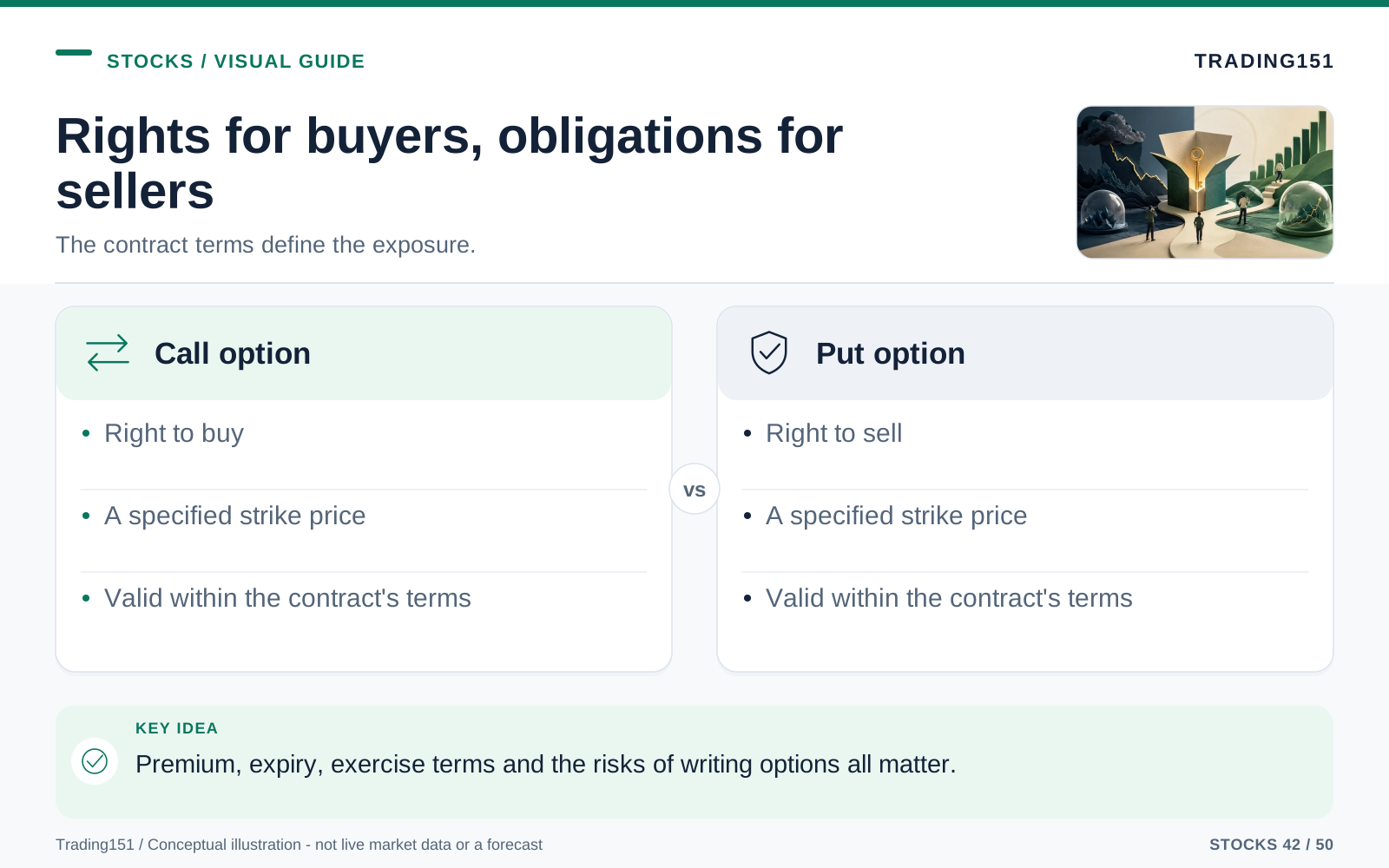
Read this diagram as text
- Call option
- Right to buy; A specified strike price; Valid within the contract's terms
- Put option
- Right to sell; A specified strike price; Valid within the contract's terms
Options Are Rights, Not Shares
This is a crucial distinction you need to nail down right away. If you buy a share of Apple, you own a tiny sliver of Apple. But if you buy an option on Apple, you don’t own a single share. You just own a piece of paper (well, a digital one) that gives you the right to buy or sell Apple shares under very specific conditions. Usually, one standard U.S. stock option represents 100 shares. And since you aren't a real shareholder, you don't get voting rights or quarterly dividends. (Though, expected dividends can shift how options are priced behind the scenes).
Why does this matter?
Because a stock can sit in your brokerage account gathering dust for decades. An option cannot. Every option has a ticking clock attached to it. If your trade doesn't pan out before the deadline, that contract can expire completely worthless. That built-in deadline is what makes options powerful, but also notoriously unforgiving.
Here’s another quirk to keep in mind: because one standard contract controls 100 shares, the prices can look deceptively cheap. If you see an option quoted at $2.00, it doesn’t mean it costs two bucks. It means $2 per share, so buying one contract will set you back $200. There are weird exceptions if a company undergoes a stock split or a merger, but 100 shares is the golden rule you'll see 99% of the time.
The Two Main Types: Calls and Puts
There are dozens of complex options strategies out there, and frankly, a lot of them sound like exotic martial arts moves. Iron condor. Butterfly spread. Straddle. Collar. Calendar spread. You don’t need to worry about any of those yet.
Just focus on the two foundational building blocks: calls and puts.
Call Options: The Right to Buy
A call option gives you the right to buy shares at a set strike price. People typically buy calls when they feel confident a stock is about to go up.
Let’s invent a company called TechTastic, currently trading at $100 a share. You have a hunch their new product launch next week is going to be large, and you think the stock price is going to surge over the next month.
You could just buy 100 shares. That would cost you $10,000. It's straightforward, but it ties up a lot of your cash.
Alternatively, you could buy a call option. Let's say you find a call that gives you the right to buy 100 shares at $105, and it costs $2.00 per share. Remember the 100-share rule? That means your total upfront cost (the premium) is $200.
Here is how that plays out:
- If TechTastic rises sharply to $130, your option is suddenly gold. The open market is demanding $130 a share, but your contract legally lets you buy them for just $105. That large gap is pure value.
- If TechTastic tanks to $90, your call will expire worthless. Think about it: why would you use your contract to buy shares at $105 when you could just buy them on the open market for $90? You let the option expire, you lose your $200 premium, and you move on. But importantly, you aren't dragged down by holding $10,000 worth of plummeting stock.
That asymmetrical risk is exactly why people love buying calls. Your absolute worst-case scenario is losing your premium, but your potential upside is huge if the stock takes off.
The catch? The stock doesn't just need to go up; it needs to go up enough, and it needs to do it quickly. A tiny bump in the stock price might not even cover the cost of the premium you paid.
Put Options: The Right to Sell
A put option gives you the right to sell shares at a set strike price. Traders generally buy puts for two reasons: they want to make money off a stock they think is going to crash, or they want to protect shares they already own.
The insurance analogy works beautifully here.
When you buy car insurance, you aren't crossing your fingers hoping to wrap your car around a telephone pole. You pay your monthly premium just in case the worst happens. If you go years without a scratch, your premium money is gone, but the peace of mind was worth it.
Let's say you own 100 shares of a fictional company, Mango Inc. It’s trading at $50 a share. You love the company long-term, but there’s an earnings report coming out next week and you're terrified the stock might take a short-term nosedive.
To sleep better at night, you buy a put option with a $45 strike price for a $1.00 premium. That costs you $100 total.
- If Mango drops off a cliff to $25, your put option acts as a safety net. It gives you the right to sell your shares for $45, completely bypassing the catastrophic market price of $25.
- If Mango stays around $50 or climbs higher, your put option simply expires. You’re out the $100 premium, but your actual investment is safe and growing. The insurance did its job.
Of course, you don’t have to own the underlying stock to buy a put. If you just hate the company and think the stock is destined to fall, you can buy a put to try and profit purely off the downward drop.
Strike Price, Premium, and Expiration: The Three Details That Matter Most
Looking at an options chain for the first time is heavily overwhelming. It looks like the cockpit of a commercial airliner—endless columns of numbers, dates, bid/ask spreads, Greeks, and percentages. Do yourself a favor and ignore most of it at first. Focus entirely on the three vital questions every option must answer.
1. What Is the Strike Price?
This is your line in the sand. It’s the exact price where the option can be executed.
For a call, it’s the price you’re allowed to buy the stock. For a put, it’s the price you’re allowed to sell it.
If you hold a $100 call, you get to buy at $100. If you hold a $100 put, you get to sell at $100. Simple as that.
2. What Is the Premium?
The premium is the price tag on the contract itself. It’s the cash the buyer hands over, and the cash the seller pockets.
If you're buying, this is your entry fee. If the option expires useless, this is exactly what you lose. And here’s a common rookie trap: if your trade is successful, your profits have to cover this premium before you make a dime.
It's rarely enough just to guess the right direction; you have to overcome your entry cost first.
3. When Does It Expire?
This is the deadline, the day the contract turns into a pumpkin.
This ticking clock is the absolute biggest difference between trading options and buying standard stocks. A stock investor can be early to a trend, wait it out, and still make a fortune. An options trader can be 100% correct about a company's trajectory, but if the stock makes its move a day after the expiration date, the trader still loses everything.
It’s a harsh reality that makes options difficult to master.
In the Money, At the Money, and Out of the Money
Traders love throwing around three specific phrases to describe where a stock's price is compared to an option's strike price. They sound fancy, but the logic is straightforward.
- In the money means the option already holds real, immediate value.
- At the money means the stock price is hovering right on top of your strike price.
- Out of the money means the option is currently useless if you had to exercise it today.
Let's break that down. For a call option, being "in the money" means the stock is trading above your strike price. If the market is trading at $120 and you have a call letting you buy at $100, you have the right to buy at a large discount. That contract has real, tangible value.
For a put option, it’s the reverse. Being "in the money" means the stock has fallen below your strike price. If the stock is bleeding out at $80 but you hold a put letting you sell at $100, you’re in a great spot.
"Out of the money" options are cheap because they require the stock to make a significant move before they do anything useful. They lure beginners in with the promise of large percentage gains, but in reality, they expire completely worthless all the time.
Intrinsic Value and Time Value
If you crack open an option’s price tag, you’ll find it’s made of two distinct parts: intrinsic value and time value.
Intrinsic value is the hard, mathematical worth the option would have if you were forced to exercise it this very second. If you own a $100 call and the stock is trading at $115, your option has $15 of intrinsic value. You have a legal piece of paper letting you buy something for $100 when the rest of the world has to pay $115.
Time value is the premium people are willing to pay simply because the future is unknown. A stock trading at $98 today might gap up to $105 next week. A quiet stock might go absolutely crazy after an earnings call. The more time left on the clock, and the more uncertainty in the air, the higher the time value.
But here is the catch: as the expiration date creeps closer, that time value slowly evaporates. This is why holding an option can feel like pure agony. Even if the stock isn't dropping, the sheer passage of time is slowly bleeding your contract's value dry.
A Simple Break-Even Example
Let’s bring TechTastic back into the mix. The stock is at $100. You buy a call with a $105 strike price and pay a $2.00 premium (which costs you $200 total). Now, waiting until expiration isn't the only way to play this. Often, an option’s value will spike before the deadline just because the stock starts trending the right way, or because market anxiety (implied volatility) shoots up. You can always sell early to lock in profits. But knowing your break-even point is still vital.
If you hold this to the bitter end, the stock doesn't just need to pass $105. It needs to hit $107 just for you to break even. Why? Because you paid $2 for the privilege of buying at $105. Those first two dollars of profit simply refill the hole you dug to buy the contract.
So, the basic math is:
Call break-even = strike price + premium paid
Puts work the same way, just in reverse. If you buy a $45 put for $1.00, the stock has to sink to $44 by expiration just for you to get your money back.
Put break-even = strike price - premium paid
While breaking even at expiration isn't the only goal (since you can sell early), doing this quick math is a fantastic reality check. It forces you to realize exactly how big of a mountain your stock needs to climb.
Why Do People Trade Options?
Options are substantially versatile. A conservative retiree and a reckless day-trader might both use options, but their goals couldn't be further apart. It’s like a vehicle—you can use it to drive safely to the grocery store, or you can use it to drag race.
1. Leverage
This is the shiny object that draws crowds. Leverage lets you control a large amount of stock with a relatively tiny amount of cash.
If a stock costs $200, buying 100 shares will set you back $20,000. But buying a call option on those same 100 shares might only cost $500.
If the stock takes off, that $500 option can double or triple in value much faster than the actual shares ever would. It's how tiny brokerage accounts sometimes post those insane screenshots of large wins.
But leverage is a double-edged sword. The same mechanics that turn $500 into $2,000 can mercilessly grind your $500 down to absolutely nothing. If you buy regular shares, the company basically has to go bankrupt for you to lose everything. With options, the company can be perfectly healthy, but if the stock doesn't move exactly how you predicted in your specific timeframe, your investment goes to zero.
2. Hedging
Hedging is a fancy word for buying financial insurance to cover your backside.
Let's say a patient, long-term investor has a lot of money in a stock. They don't want to sell it, but the market is looking shaky. Buying a put option places a hard floor under their portfolio. Just like home insurance, you have to pay a premium for it, but it aggressively cushions the blow if the market suddenly crashes.
Big institutional funds do this constantly, and smart retail investors use it to sleep soundly during volatile months.
3. Income
You can use options to generate regular cash, usually by stepping into the role of the seller. Remember, every time you buy an option, someone else on the other side of the screen is selling it to you and pocketing your premium.
A classic, beginner-friendly setup (though certainly not risk-free) is the "covered call." Imagine you own 100 shares of a slow-moving stock. You don't think it’s going anywhere fast, so you sell a call option against your own shares. Another trader pays you a cash premium for the right to buy your stock at a specific price.
If the stock stays quiet, the buyer's option expires useless, and you just keep their cash. If the stock unexpectedly rockets upward, you’ll be forced to sell your shares at the agreed-upon strike price.
It’s a great way to generate income, but the trade-off is that you might miss out on a large windfall if the stock suddenly shoots to the moon.
Buying Options vs. Selling Options
Being a buyer and being a seller in the options market feel like two completely different universes.
When you buy an option, you pay the premium. The beautiful part is that your worst-case scenario is capped. If you pay $200 for a call, the absolute most you can lose is $200. It doesn't make it a safe bet, but it does mean your risk has a hard ceiling.
When you sell an option, you get paid upfront, but you are taking on a legally binding obligation. If the person who bought the contract decides to exercise it, you have to deliver on the terms, no matter how much it hurts your wallet.
Some selling strategies are fairly tame, like the covered calls we just talked about. But others are like picking up pennies in front of a steamroller. Selling a "naked call" (meaning you don't own the shares to back it up) exposes you to theoretically infinite losses, because a stock’s price has no ceiling. It can just keep climbing, and you'll be on the hook for the difference.
New traders often hear a statistic like "most options expire worthless" and assume selling them must be an infinite money glitch. It’s not. You can collect small premiums for months, only to have one violent market swing wipe out your entire account. It feels like easy money—right up until it isn't.
The Greeks, Without the Headache
An option’s price tag is influenced by much more than just the stock price. Enter "the Greeks." These are mathematical measurements that forecast how an option’s price might react to a changing environment. Don't panic—they are just estimates and sensitivities, not guarantees. They shift dynamically as the stock price moves, time ticks away, and volatility fluctuates.
You don't need a PhD in math to grasp them. You just need to know what kind of warning each one is giving you:
- Delta is your directional compass. It estimates how much the option’s price will change if the stock moves by $1. A call with a 0.50 delta should roughly gain 50 cents if the stock goes up a buck.
- Theta is the slow leak in your tire. It measures time decay, showing exactly how much value your option loses with each passing day, even if the stock stands perfectly still. If you are buying options, Theta is your worst enemy.
- Vega measures the drama. It tracks sensitivity to volatility. When traders panic and expect large swings, options get way more expensive. When the market calms down, options bleed value—even if the stock price hasn't budged.
- Gamma is the accelerator pedal. It measures how fast your Delta is changing. Gamma is the reason short-term options can feel so erratic; one tiny stock movement can drastically alter how sensitive your option is.
If that’s still too abstract, try this: Delta is the direction, Theta is the ticking clock, Vega is the market's anxiety level, and Gamma is the momentum.
Implied Volatility: Why Options Get Expensive Before Big Events
It’s a rite of passage for new traders: you buy a call option right before a highly anticipated earnings report. The company crushes earnings, the stock goes exactly the way you predicted, and yet... Your option somehow loses money.
How on earth is that possible?
The culprit is almost always "implied volatility." Leading up to a large event—like an earnings call, an FDA approval, or a major economic report—everyone knows the stock is going to make a huge move. Because of that anticipated drama, options become heavily inflated. You’re essentially paying a premium for the hype.
The second the news drops, all that mystery vanishes. The hype is gone, and the option's price aggressively deflates. This is known in the trading world as a "volatility crush."
This doesn't mean you can never trade around big news. But it does mean it's rarely as easy as saying, "I think they'll beat earnings, so I'm buying calls." The good news might already be fully baked into the inflated price of the option.
Common Beginner Mistakes
Most beginners don't blow up their accounts because they're stupid; they blow up because options sharply punish tiny misunderstandings. If you mess up buying a normal stock, you usually have time to wait it out and recover. Options don't offer that luxury.
Mistake 1: Buying Options That Expire Too Soon
It’s tempting to buy an option that expires on Friday because it only costs a few bucks. But they are cheap for a reason: you are giving yourself virtually zero margin for error.
Short-term options can yield large gains, but they decay at a concerning speed. For someone just learning the ropes, they deliver mostly stress, not profits.
Mistake 2: Ignoring the Break-Even Price
Say you buy a $100 call for $5 because you're certain the stock will hit $103. The stock hits $103. You were right! But because your break-even was $105 (strike + premium), your trade is still a loser.
Don't just focus on the direction you want the stock to move; know exactly how far it needs to move.
Mistake 3: Confusing a Cheap Option With a Good Option
An option priced at $0.20 looks like a steal. The dollar risk is microscopic. But bargain-bin options are usually miles away from the current stock price, or they expire in a few hours. Buying them is like buying a lottery ticket.
Cheap doesn’t mean undervalued; it usually just means highly unlikely.
Mistake 4: Trading Too Big
Because options use leverage, position sizing can mess with your head. Spending $300 on options can give you the financial exposure of thousands of dollars of real stock. It’s easy to accidentally take on way more risk than you intended.
A good rule of thumb: before clicking buy, ask yourself if you’d be emotionally and financially okay if that money instantly vanished. If you hesitate, your trade is too big.
Mistake 5: Revenge Trading
Options tap directly into your adrenaline. A big win makes you feel like a financial genius. A stupid loss makes you desperate to win your money back immediately. This is the birth of "revenge trading."
Listen: the market doesn't know you lost, and it doesn't care about your bruised ego. After a harsh loss, the smartest thing you can do is step away from the keyboard, take a walk, and let your nervous system reset.
How to Approach Options More Safely
You can't strip the risk out of options. The risk is the whole point. But you can definitely make the inevitable learning curve less painful and expensive.
Start With Paper Trading
Almost every major broker offers a simulated "paper trading" account. Use it. And don't just use it for a weekend. Trade with fake money long enough to experience different market moods.
It won't replicate the sweaty palms of risking real cash, but it will hardwire the mechanics into your brain. You’ll learn how spreads work, how painful time decay is, and how violently prices can swing.
Use Defined-Risk Trades
When you are starting out, always know your worst-case scenario. Buying a standard call or put is a "defined risk" trade—the most you can lose is whatever you paid for it. Certain spreads can also define risk, though they add a little complexity.
Avoid exotic strategies where you can't quickly and easily calculate your maximum potential loss. If you don't know exactly how much blood you could lose, you shouldn't be in the trade.
Give Yourself More Time Than You Think You Need
New traders almost always buy the closest expiration date to save a few bucks. Veterans happily pay up for more time.
Giving your trade an extra month to play out means you aren't sweating a ticking clock every day. The time decay is slower, and you have breathing room if the stock takes a detour.
Keep the Position Small
Never, ever fund an options account with your rent money, emergency fund, or retirement stash. If you are going to dabble, carve out a tiny, designated fraction of your portfolio just for learning.
Your goal in year one isn't to buy a yacht; your goal is simply to survive long enough to figure out what you're doing.
Write Down the Trade Before You Enter
I know this sounds like homework, but it works. Before you open a trade, physically write down why you are buying it, what you expect to happen, where you plan to take profits, and exactly where you will cut your losses if you are wrong.
Options move fast. Having a written plan acts as an anchor when the market starts flashing red and your emotions try to take the wheel.
A Few Words About Liquidity
Not all options are created equal when it comes to trading volume. Some popular stocks have thousands of buyers and sellers trading options every second. Other obscure stocks are absolute ghost towns. You need to look at both the "open interest" and the real-time bid-ask spread. A contract can look super active but still cost you an arm and a leg to jump in or out of. Always use limit orders, don't just blindly accept the market price, and remember that closing out a complex trade might involve jumping over several hurdles. Poor liquidity can instantly erase whatever edge you thought you had.
Why does liquidity matter? Because it dictates whether you can get in and out of a trade at a fair price. The "bid" is what buyers are willing to pay; the "ask" is what sellers are demanding. If the bid is $1.00 and the ask is $1.05, you have a tight, healthy spread. But if the bid is $1.00 and the ask is $1.80, you are going to get fleeced trying to enter or exit that trade.
Don't fall so in love with a stock chart that you ignore a terrible options chain. A brilliant idea can turn into a nasty loss if the contract is too illiquid to trade efficiently.
So, Are Options Good or Bad?
Options are totally neutral. They are just a financial tool. A sharp chef's knife can prepare a Michelin-star meal, or it can send you to the emergency room. The knife isn't inherently evil; it all comes down to the hands holding it.
Options can be brilliant for protecting a portfolio, generating steady income, or making calculated speculative bets. But they can also breed toxic overconfidence, large gambling habits, and short-term obsession. The dividing line is almost always preparation and strict risk management.
Ironically, the most dangerous moment for a beginner isn't their first big loss. It’s their first large win. Hitting a home run early makes options feel effortless, which leads to sloppier, larger, and far more reckless bets. Stay humble, and respect the mechanics of the market even when you’re on a winning streak.
Being right about direction is only one part of an option trade
Consider a hypothetical call with a $50 strike purchased for a $3 premium per share. At expiration, ignoring costs, the buyer breaks even at $53. A stock price of $52 means the call has $2 of intrinsic value, but the buyer has still lost $1 per share relative to the premium paid. The stock rose above the strike without making the trade profitable.
Before expiration, an option's price also reflects remaining time and market expectations about volatility, among other inputs. The expiration break-even calculation therefore does not fully describe what the contract may be worth if closed earlier. Avoid treating a simple payoff diagram as a forecast of every price along the way.
Contract size needs checking. Standard U.S. equity options commonly represent 100 shares, but corporate actions can create adjusted contracts with different deliverables. Exercise style, settlement, broker deadlines, and the possibility of early assignment also matter. An in-the-money position near expiration can create a stock position or cash obligation that the account was not prepared to carry.
Start with the full loss and obligation under the chosen strategy, not only the premium collected or paid. An uncovered option sale can have risks very different from a purchased option or a covered call. Read the applicable options disclosure and account rules. A small entry cost is not evidence of a small or simple commitment.
A correct direction can still produce an option loss
An option's result depends on more than whether the underlying share moves in the expected direction. The size and timing of the move, the premium paid, time remaining, and changes in implied volatility can all matter. A call buyer can be directionally right and still lose money if the gain is too small or arrives too late.
Before entering, describe the payoff at several prices and dates, including a disappointing outcome. Check the contract multiplier and the total premium at risk. The exercise should use the actual contract being considered rather than a general belief that an option offers inexpensive exposure to a promising idea. 1, 2, 3
Understand the Contract Before You Trade the Story
Ultimately, stock options are just contracts. A call gives you the right to buy; a put gives you the right to sell. The strike price is your agreed-upon target, the premium is your entry fee, and the expiration date is your absolute deadline.
Once you internalize those basic moving parts, the options chain stops looking like a chaotic casino matrix. It starts looking like exactly what it is: a marketplace where people buy and sell time, risk, and probability.
Options demand precision. Simply guessing "the stock will go up" isn't enough. The contract demands to know: How high? By what exact date? And is it worth the inflated premium? Even a dead-accurate prediction can lose money if the move is too weak, happens a day late, or was already priced into the hype.
Start small. Stick to defined-risk trades, trade highly liquid stocks, and always have a written exit plan. Make sure you understand the severe realities of assignment and exercise before you ever think about selling an option, and don't blindly trust the "probability of profit" percentages your broker flashes on the screen without doing your own homework.
Options aren't an inherently reckless gamble, nor are they a guaranteed path to sudden wealth. They are highly specific agreements with rigid deadlines. When used strategically to solve a specific portfolio problem, they are practical. But if you try to use them as a get-rich-quick cheat code, they have a funny way of making the hidden costs of leverage painfully obvious, very quickly.
Sources and further reading
Editorial revision: 7 October 2026. Numerical scenarios are hypothetical unless identified as historical. References support the added explanations and selected corrections; rules and product terms should be checked again before acting.