
"ETF" describes a way an investment product is structured and traded; "index fund" describes an investment approach. An index fund can be an ETF or a mutual fund, and an ETF can be actively managed. Separating those ideas makes the choice clearer: decide what you want to own, then compare the available structures, costs, and account features.
Why Picking Individual Stocks Is Harder Than It Looks
When most people picture investing, they imagine a movie-style scenario: you find the next Apple, Amazon, or Nvidia before anyone else catches on, buy the stock, and kick back while your bank account explodes. It sounds ridiculously easy, mostly because we only ever talk about the large success stories after the fact.
In hindsight, everything looks obvious. Of course smartphones were going to take over. Of course that tech startup was going to change the world. But living through it in real time? Totally different story. For every household-name company that makes it big, dozens of others fizzle out, drown in debt, get crushed by a competitor, or just never figure out how to make a profit.
Even the truly great companies can be a nightmare to hold onto. Stock prices plunge all the time for reasons that have absolutely nothing to do with how well the business is running. A weird earnings report, a rumor, a supply chain hiccup, or just general panic on Wall Street can tank a stock's price in minutes.
Then there’s the psychological toll. When all your money is riding on one or two companies, every news headline feels like a personal attack. If your stock drops 20%, you panic and wonder if you missed a red flag. If it shoots up 20%, you agonize over whether to sell before it drops again. The more concentrated your bets, the more exhausting the emotional rollercoaster.
This is why financial planners constantly preach about diversification. It’s really just the "don’t put all your eggs in one basket" rule applied to your money. Instead of tying your financial future to a single CEO's decision-making, you spread your cash across dozens of industries and countries. If one company stumbles, the others can carry the weight.
The catch? Normal people don’t have the time, capital, or sanity to research and manage a portfolio of 500 individual stocks. You’d have to figure out exactly what to buy, obsessively rebalance your accounts, and make sure you aren't accidentally buying 50 companies that will all crash at the same time.
Index funds and ETFs take that complication and bundle it into one click.
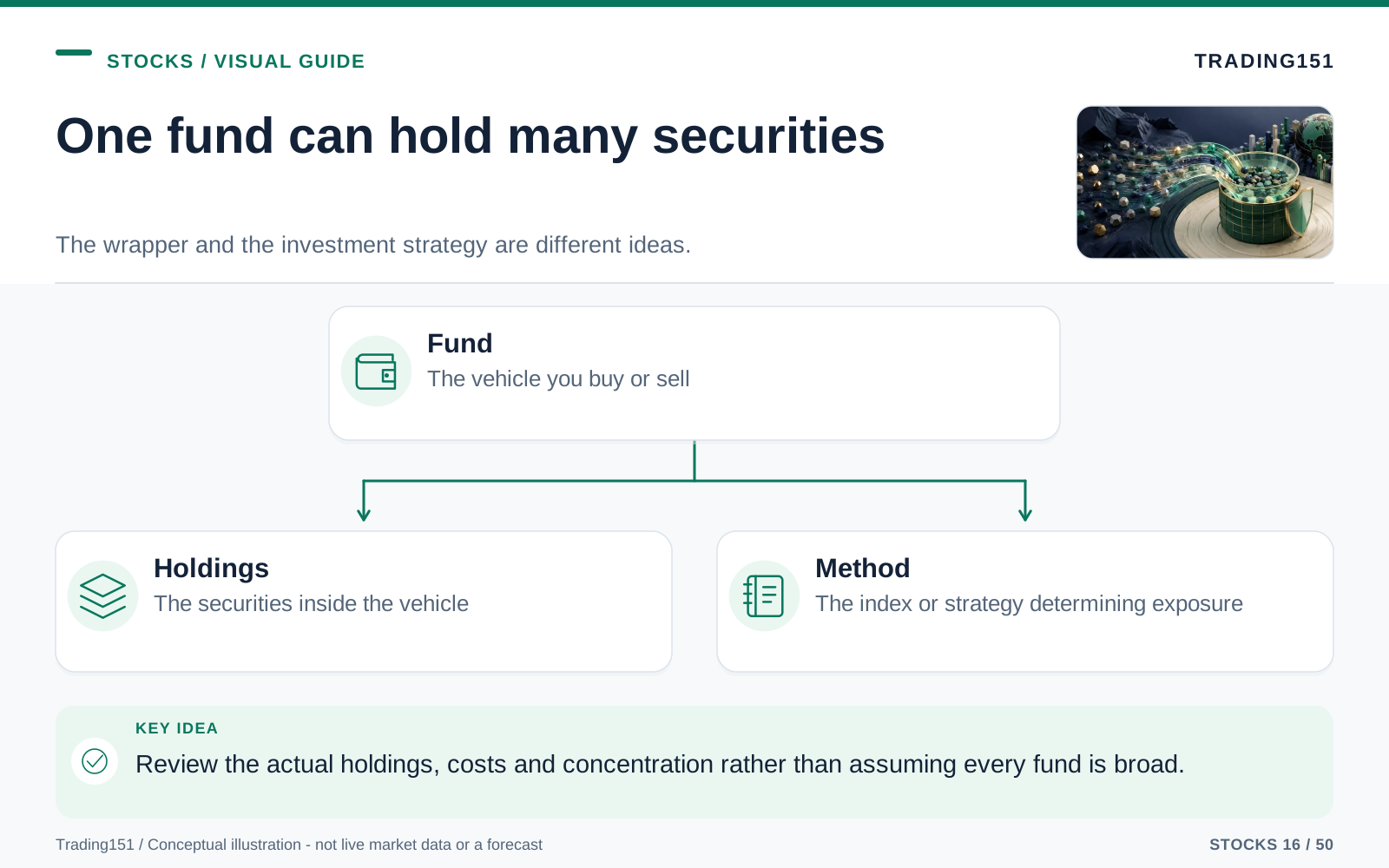
Read this diagram as text
- Fund
- The vehicle you buy or sell
- Holdings
- The securities inside the vehicle
- Method
- The index or strategy determining exposure
What an Index Is
At its core, an index isn’t something you can invest in. It’s just a measuring stick. Committees set up specific rules to track a certain part of the market, deciding which companies get included based on things like their size, profitability, or industry. Because companies are constantly being added or kicked off these lists, the funds tracking them have to buy and sell stocks to keep up.
Think of it like the Billboard Top 100. The chart itself doesn’t write or record the music, and you can’t go to the store and "buy" the chart. It just reflects which songs are currently dominating based on a strict set of rules. When a song fades from the radio, it drops off the list, and a new hit takes its place. The chart just gives you a snapshot of what’s happening in music right now.
A stock market index does the same thing for businesses. It tracks a specific group of companies following a strict rulebook. Some indexes only track large U.S. corporations. Others focus exclusively on small startups, international markets, or specific sectors like healthcare, real estate, or green energy.
The most famous one is the S&P 500, which tracks 500 of the largest publicly traded companies in America. When you hear a news anchor say, "The market was up today," they’re usually just talking about the S&P 500—even though the actual global economy is vastly bigger than those 500 companies.
Another popular measuring stick is a total stock market index. Rather than just skimming the biggest corporations off the top, it tries to capture the entire market, including the mid-sized and tiny companies.
The takeaway here is simple: an index is just a list with rules. You can’t buy the list directly, but you can buy a fund that promises to copy it exactly.
Index Funds: The Boring Idea That Changed Investing
An index fund is essentially a mutual fund built to mirror an index perfectly. If a specific index tracks 500 companies, the fund will go out and buy shares in those exact 500 companies, in the same proportions. When the index updates its list, the fund updates its holdings.
So, when you buy a share of an S&P 500 index fund, you aren’t betting on a single horse. You’re buying a microscopic slice of every company on that list. With one purchase, you instantly own pieces of tech giants, banks, hospitals, and airlines.
That’s the beauty of index funds. They completely remove the need to predict the future. You don’t have to guess which company is going to crush it next year; you just get to ride the overall upward trend of the broader market over time.
Why index funds work so well for many investors
- They neutralize risk. If one single company goes bankrupt, it barely makes a dent in your portfolio. You aren’t losing sleep over a CEO's scandal or a single bad product launch.
- They're low-maintenance. The underlying index dictates the rules. You never have to log in and agonize over whether to sell a struggling stock.
- They are inexpensive. Because the fund operates on autopilot instead of paying a team of Wall Street analysts to guess stock movements, the fees are usually shockingly low compared to actively managed funds.
- They cure decision fatigue. You can stop chasing stock tips, ignoring apocalyptic market predictions, and second-guessing your strategy. You just set a plan and get on with your life.
Wall Street used to openly laugh at index funds. When Vanguard founder Jack Bogle launched the first one for everyday investors back in the 1970s, finance pros thought it was a joke. Why on earth would anyone settle for "average" market returns? Wasn't the entire goal of investing to beat the market?
Bogle’s comeback was brilliant: beating the market sounds awesome in theory, but once you factor in high management fees, taxes, and inevitable human error, almost no one does it consistently. Instead of paying a guy in a suit to try (and fail) to outsmart the market, index investors simply accept the market's natural growth and keep all their money by paying practically nothing in fees.
It’s not a flashy concept. It won’t make you the most interesting person at a dinner party. But when it comes to securing your financial future, "boring" is the ultimate flex.
ETFs: Similar Basket, Different Wrapper
An ETF (which stands for exchange-traded fund) is just another way to buy a basket of investments. Like index mutual funds, a huge number of ETFs exist purely to track an index. You can easily find an ETF for the S&P 500, the total international market, corporate bonds, or even hyper-specific niches like cybersecurity. But unlike traditional funds, ETFs are traded actively on the stock market all day long. Behind the scenes, large institutional players constantly create and redeem shares to ensure the ETF's price stays closely aligned with the actual value of the stocks it holds. (Though, fair warning: when the market is totally panicking, ETF prices can temporarily detach from their true value).
For the average long-term investor, an ETF and an index fund are going to feel like the same thing. Both give you incredible diversification, both are usually inexpensive, and both are perfect foundations for a hands-off portfolio.
The main difference comes down to how you buy them.
A traditional index mutual fund only trades once a day, right after the stock market closes. If you hit "buy" at 10:00 a.m., you won’t know the precise price you paid until the closing bell rings and the fund tallies up its total value.
An ETF, on the other hand, trades exactly like a regular stock. You can buy and sell shares all day long while the market is open, watching the price fluctuate by the second. Plus, if your brokerage allows fractional shares, you can buy exactly $50 worth of an ETF rather than having to save up for a full share.
Think of it like this: an index fund is like handing a grocery list to a delivery service—they go grab everything and charge you whatever the total is at the end of the day. An ETF is like walking into the store yourself, seeing the price tag on the shelf, and buying it right then and there.
Does that matter? It depends. If you’re investing money you don’t plan to touch for 30 years, the ability to buy in at exactly 11:37 a.m. isn’t going to make or break your retirement. If anything, it might just tempt you to try and time the market. But because ETFs are super flexible, easy to access, and cheap, they've completely exploded in popularity.
ETF vs. Index Fund: Which One Fits You Better?
Honestly? You can't really go wrong with either. Finding the "best" one is less about the math and more about figuring out your personal habits, how much money you’re starting with, and what will keep you investing consistently.
Minimum investment
- Index funds: A lot of traditional mutual funds demand a chunk of cash upfront to get started. You might need $500, $3,000, or more just to open the door, though some modern brokerages have finally dropped these minimums.
- ETFs: ETFs are beginner-friendly. Because you can often buy fractional shares, you can start building wealth with 10 or 20 bucks.
- Best fit: ETFs usually win out for beginners or anyone looking to start investing with pocket change.
Automatic investing
- Index funds: Mutual funds were built for automation. You can easily tell your account, "Take $150 out of my bank account every other Friday and buy this fund," and then completely forget about it.
- ETFs: Automated ETF investing has gotten way better recently, but it really depends on what app or brokerage you use. Some make it seamless; others still force you to manually hit "buy" every time.
- Best fit: Index funds are the undisputed champions of the "set it and forget it" lifestyle.
Trading flexibility
- Index funds: Since they only trade once a day, you can't day-trade them. This built-in friction is great for stopping you from making impulsive panic-sells mid-morning.
- ETFs: You can buy and sell them constantly while the market is open. You get total control, but that also leaves the door wide open for you to tinker with your investments when you should just be leaving them alone.
- Best fit: ETFs offer ultimate control. Index funds offer peace of mind.
Taxes
- Index funds: If you hold them in a standard, taxable brokerage account, you might get hit with a surprise tax bill if the fund manager sells off stocks inside the fund and triggers a capital gain.
- ETFs: Because of a quirky loophole in how they're structured behind the scenes, ETFs are wonderfully tax-efficient. They rarely trigger unexpected tax bills, though you'll obviously still owe taxes when you eventually sell your shares for a profit down the road.
- Best fit: ETFs have a major edge if you're investing outside of a retirement account. If the money is safely tucked inside an IRA or 401(k), the tax difference doesn't really matter.
Behavior
- Index funds: Because they're boring and slow to trade, they force you to act like a long-term investor. There's zero reason to refresh your screen all day.
- ETFs: The slick, instant nature of ETFs can trick you into treating your life savings like a video game. If trading is too easy, overtrading becomes a real risk.
- Best fit: Go with whatever format saves you from your own worst habits. A technically perfect fund is useless if it tempts you to sell every time the market dips.
The Fee That Quietly Eats Returns
Whenever you look at a fund, the most critical number to find is the expense ratio. This is the annual cut the fund takes from your money just to keep the lights on. It's not the only cost—things like bid-ask spreads, trading taxes, and the fund holding too much cash can also drag you down—but for long-term investors sticking to major broad-market funds, the expense ratio is usually the heaviest anchor.
At a glance, the difference between a 0.03% fee and a 1.00% fee looks like a rounding error. It is absolutely not. That fee gets scraped out of your account every year, regardless of whether the market goes up or crashes. Over a few decades, a 1% fee will sharply devour a large chunk of your overall wealth.
Imagine two friends invest the same amount of money and earn the same returns over 30 years. The one stuck in a high-fee fund spends decades running into a headwind, continuously bleeding cash to their fund manager. The one in a low-fee fund gets to keep almost all of their compounding growth. It's not magic, it's just math.
This is why financial nerds are so obsessed with index funds and ETFs. A lot of broad-market funds cost almost nothing to own. Sure, a low fee doesn't guarantee you'll make money, but a high fee guarantees you're starting a 100-meter dash ten yards behind the starting line.
What About Risk?
Because index funds and ETFs are simple, people sometimes assume they're "safe." They aren't. If you own a fund that tracks the stock market, and the stock market decides to dive off a cliff, your portfolio is going with it. Recessions, inflation spikes, interest rate hikes, or just random bursts of global panic will absolutely cause your balance to drop.
The difference is the type of risk you're taking. Because you're beautifully diversified, you've completely eliminated the risk of a single rogue CEO bankrupting your retirement. But you are still fully exposed to market risk—the simple reality that sometimes, stocks as a whole just go down.
This is why your timeline is so crucial. If you need a pile of cash for a house down payment in six months, it has no business being in the stock market. Short-term money needs to be boring and stable. Long-term money, on the other hand, can afford to ride out the wild swings because it has decades to bounce back and grow.
This is also why most people eventually blend stock funds with bond funds or just hold cash. Stocks are your growth engine. Bonds and cash are your shock absorbers. Finding the right mix just depends on your age, your goals, and whether a 20% market drop would make you lose sleep at night.
Common Types of Funds You Will See
Once you get the underlying concept, all that financial alphabet soup becomes way less intimidating. Almost every broad fund you'll encounter falls into a few easy-to-understand buckets. (Just keep in mind that "broad" doesn't always mean "global." A total U.S. fund only holds American companies, even if those companies do business overseas. Always double-check what a fund covers so you don't accidentally ignore half the globe).
- S&P 500 funds: These hold the 500 biggest companies in the U.S. They're substantially popular because they're cheap, easy to understand, and basically track the heartbeat of the American economy.
- Total U.S. stock market funds: These cast a much wider net. Along with the large corporations, they sweep up all the mid-sized and small American businesses, too.
- Total international stock funds: These buy companies based exclusively outside of the United States, giving you a safety net in case the American market stalls out.
- Total world stock funds: The ultimate one-and-done option. They mash U.S. and international stocks together into one large, globally diversified portfolio.
- Bond index funds: Instead of stocks, these track the bond market. They're typically used to generate steady income and act as a buffer when stocks get chaotic.
- Sector ETFs: These narrow in on one specific flavor of the market, like tech startups, green energy, or healthcare. They can be a fun add-on, but they completely defeat the purpose of broad diversification.
If you're just starting out, stick to the broad-market funds. They do the heavy lifting for you, and you never have to play the impossible game of guessing which industry will be hot next year.
A Simple Portfolio Does Not Mean an Unserious Portfolio
There is this weird, unspoken peer pressure in the investing world to make your strategy sound complicated. If your entire portfolio consists of just two or three boring funds, it feels almost too basic. You start wondering if the "smart" investors know a secret you don't.
They don't.
A cleanly built portfolio using a few dirt-cheap index funds will almost always crush a chaotic mess of trending stocks, overlapping niche ETFs, and random tips you found on the internet. Complexity usually just gives people an illusion of control; it rarely puts more money in their pocket.
For example, a perfectly brilliant, bulletproof portfolio could just be three things: a total U.S. stock fund, a total international fund, and a bond fund. That's it. Someone else might prefer the ultimate lazy route and buy a single target-date fund that automatically adjusts its risk as they get closer to retirement. Another person might just dump everything into a total world ETF and call it a day.
There is no single "perfect" way to do this, and you don't win bonus points for having a complicated spreadsheet. The only goal is to build a system you understand, so you can leave it the hell alone and let it grow.
The Warren Buffett Bet
If you ever doubt the power of keeping things simple, just look at Warren Buffett.
Back in 2007, Buffett made a substantially public, million-dollar bet. He claimed that over the next ten years, a painfully boring S&P 500 index fund would easily beat a hand-picked collection of elite hedge funds. Keep in mind, hedge funds are the ultimate status symbol—run by Wall Street geniuses who use complex, exclusive strategies normal people aren't allowed to touch.
When the bet ended in 2017, the results weren't even close. The basic, set-it-and-forget-it S&P 500 index fund destroyed the hedge funds.
The takeaway here isn't that Wall Street managers are stupid. The lesson is that high fees, over-complication, and constant tinkering are large drags on your wealth. You can have the smartest minds in the world running a fund, and they'll still struggle to clear the hurdle of their own expensive management fees.
People love this story because it perfectly illustrates a truth that takes most of us years to accept: in investing, trying harder usually hurts you. The real money is made by doing fewer things, more consistently, for a much longer time.
How to Get Started Without Turning It Into a Research Project
It's easy to use "research" as a form of procrastination. There will always be another finance podcast to listen to, another YouTube video comparing two nearly identical ETFs, and another article to read. Eventually, you just have to place the trade. The basics will get you 95% of the way there.
Step 1: Decide what the money is for
Don't buy anything until you know what job this money is supposed to do. Is it for a house down payment in three years? A college fund? Your retirement in three decades? Your timeline dictates everything.
If you need the cash in the next few years, keep it safe—think high-yield savings accounts, money market funds, or plain old cash. If the money is locked away for your future 60-year-old self, you can afford to embrace the stock market's turbulence to get that long-term growth.
Step 2: Choose the type of account
A brokerage account is just the bucket that holds your investments. Retirement accounts—like a 401(k) or an IRA—are special buckets that give you large tax breaks, though they come with strict rules about when you can take the money out.
If your boss offers a 401(k) match, start there. An employer match is free money. It isn't sexy, but you will never find an investment that beats an instant 100% return.
Step 3: Look for broad, low-cost funds
You don't need to hunt for a "cool" or exciting fund. Actually, if an investment sounds exciting, you should probably run. Look for funds that cast a large net over the market, charge practically nothing, and come from a well-known, trustworthy provider.
For most Americans, the default starting line is a fund tracking the S&P 500, the total U.S. market, or the total international market. Don't stress too much about specific ticker symbols—just focus on buying a big, cheap slice of the global economy.
Step 4: Invest on a schedule
Investing works best when you completely remove your own brain from the process. Set up your account to automatically buy a set amount every time you get paid. This is called dollar-cost averaging. When the market is booming, your cash buys fewer shares. When the market crashes, your cash goes on a bargain-hunting spree and buys more shares.
Statistically, dumping a lump sum of money in all at once might edge out schedule-based investing, but we don't live in a spreadsheet. Setting it on autopilot ensures you do it, which is the only thing that matters.
Step 5: Leave it alone more than you want to
This is the part everyone thinks is easy until they experience their first market crash. Clicking "buy" is simple. Sitting on your hands while the news screams that the economy is collapsing is severe.
The market is going to drop. Sometimes it will drop for concerning reasons. Your portfolio balance will bounce around substantially. Don't let it shock you; expect it. The goal of a good investment plan isn't to prevent you from ever feeling nervous. The goal is to build a system so sturdy that you don't have to act on those nerves every time the market gets loud.
Mistakes Beginners Can Avoid
- Buying a fund totally blind. Don't just buy a cool-sounding ticker symbol. Take 30 seconds to look under the hood and see if you're buying stocks, bonds, a tiny niche sector, or the whole market.
- Hoarding funds that all do the same thing. Owning eight different S&P 500 funds doesn't make you extra diversified. It just means you own the same 500 companies eight different ways.
- Chasing last year's hot stock. If a fund just had an unbelievable, record-breaking year, you probably already missed the boat. The hype is already baked into the price.
- Shrugging off fees. A 1% fee sounds totally harmless until you realize it can eat up hundreds of thousands of dollars over a lifetime of investing. Keep it cheap.
- Staring at your portfolio. If you're investing for 20 years from now, checking your balance on a random Tuesday in November is completely pointless. The day-to-day market is just noise.
- Investing your grocery money. If there is any chance you'll need this cash to pay rent next year, keep it out of the market. You never want to be forced to sell your investments during a crash just to keep the lights on.
So, Should You Choose an ETF or an Index Fund?
If you're still agonizing over this, let me give you the ultimate cheat code: just pick whichever one makes it easiest for you to automate your life.
If your brokerage app lets you automatically buy mutual funds every time your paycheck hits, go with a low-cost index fund. If you're starting with just 20 bucks a week and your app lets you buy fractional shares of ETFs, go with an ETF.
Don't paralyze yourself trying to find the "perfect" answer. A dirt-cheap S&P 500 ETF and a dirt-cheap S&P 500 index fund are essentially identical under the hood. The packaging is different, but the recipe for wealth is exactly the same: keep your fees low, diversify like crazy, invest every time you get paid, and don't panic when the market throws a tantrum.
Choose the exposure before choosing the wrapper
Suppose two funds track the same broad stock index. One is an ETF traded through the day; the other is a mutual fund transacted under its daily pricing rules. Their underlying exposure may be similar, yet your experience can differ because of dealing arrangements, automatic purchases, minimums, and account-level charges. The wrapper should serve the investment plan rather than determine it by accident.
Compare the full cost of the way you intend to invest. A slightly lower expense ratio may be outweighed by repeated dealing commissions, currency conversion, or bid-ask spreads on small purchases. Conversely, a convenient automatic investment arrangement may encourage consistency. Use an example with your intended contribution size and frequency rather than comparing annual percentages alone.
Then inspect the index itself. Broad-sounding names can hide exclusions, concentration limits, weighting rules, or a narrow universe. A fund can track its index accurately and still give you an exposure you did not intend. Read the methodology and current holdings together; one explains the rules, the other shows their present result.
Keep the final decision simple enough to maintain. Owning several near-identical funds may add administration without adding much diversification. A suitable fund is one whose exposure, costs, and operating rules you understand. Ease of use is valuable, but it should make a sound plan easier to follow rather than make an unsuitable investment easier to buy.
The share class can change the practical result
Two funds tracking the same index can still create different experiences. Compare the ongoing charge, trading spread, tax treatment, distribution policy, and the account in which each can be held. A lower headline fee may not dominate every other cost, especially for small, frequent purchases.
The distinction between accumulating and distributing share classes is another source of confusion. One reinvests income within the fund; the other pays it out under its policy. Neither creates extra economic value merely by choosing a different route for the cash. The tax result also depends on the investor's jurisdiction and account, so internal reinvestment should not be assumed to mean tax deferral.
A useful selection note explains why the fund fits the job. Perhaps it provides the intended exposure at a manageable cost, is available in the right account, and has a structure the investor understands. That is a stronger basis than choosing whichever ticker has recently appeared most often in an online discussion. Once selected, review meaningful changes to its methodology or terms rather than repeatedly switching between near-identical products over tiny performance differences. 1, 2
Simple Funds Still Require Clear Choices
Wall Street doesn't have to be a VIP club reserved for guys in fleece vests throwing around acronyms. When you strip away the nonsense, investing is just buying pieces of profitable businesses and giving them a few decades to grow. Index funds and ETFs just make that accessible to regular people who have better things to do than read corporate balance sheets all weekend.
Are they exciting? No. They aren't going to give you a wild stock-picking story to share over drinks. But they offer something infinitely more valuable: a reliable, stress-free blueprint for building wealth without needing a crystal ball.
A minimalist, two-or-three fund setup isn't a set of training wheels you eventually take off. For most people, it is the absolute best permanent strategy. By sticking to broad funds, driving costs down to the floor, and automating your deposits, you're taking care of the few things you can control, and letting the market handle the rest.
Just make sure you know what you're buying. Two funds with similar names can behave totally differently behind the scenes. Look past the marketing, check out what the fund holds, and make sure it aligns with your strategy.
Pick the vehicle that helps you stay out of your own way. Whether that's the trading flexibility of an ETF or the automated bliss of an index mutual fund, the "best" investment is the one you can comfortably buy, confidently hold, and happily ignore when the world gets noisy.
Sources and further reading
Editorial revision: 7 October 2026. Numerical scenarios are hypothetical unless identified as historical. References support the added explanations and selected corrections; rules and product terms should be checked again before acting.