
Market capitalization is the share price multiplied by the number of shares outstanding. It gives a market value for the company's equity, not a complete price for the operating business and not the cash the company holds. The distinction becomes useful when comparing companies with different share counts, debt levels, and ownership structures. A cheap-looking share can belong to a very expensive business.
What Market Capitalization Really Means
At its core, market capitalization is just the total dollar value of all a company's outstanding shares. Simply put, it’s what the stock market collectively decides the company is worth right at this moment. Whenever possible, it’s best to look at the "diluted" share count. Unlike basic shares, the diluted count includes things like stock options and convertible bonds that could eventually become regular shares. For companies that hand out a lot of stock-based compensation to employees, those extra shares can seriously water down the value for existing owners.
The math couldn't be easier:
Current Share Price × Number of Outstanding Shares = Market Capitalization
That’s really all there is to it. You don't need a complex financial model, a Wall Street background, or a large spreadsheet. You just take the price of one share and multiply it by all the shares out there in the wild.
Let’s look at a quick example with two fictional companies:
- Company A trades at $20 a share and has 1 billion shares outstanding.
- Company B trades at $200 a share and has 20 million shares outstanding.
At first glance, Company B feels substantially expensive because a single share costs ten times as much. But let's do the math.
- Company A has a market cap of $20 billion.
- Company B has a market cap of $4 billion.
Turns out, the stock with the "cheap" share price belongs to a much larger company. That $200 stock isn't inherently expensive, and the $20 stock isn't a steal. If you don't know the market cap, you're missing the biggest piece of the puzzle.
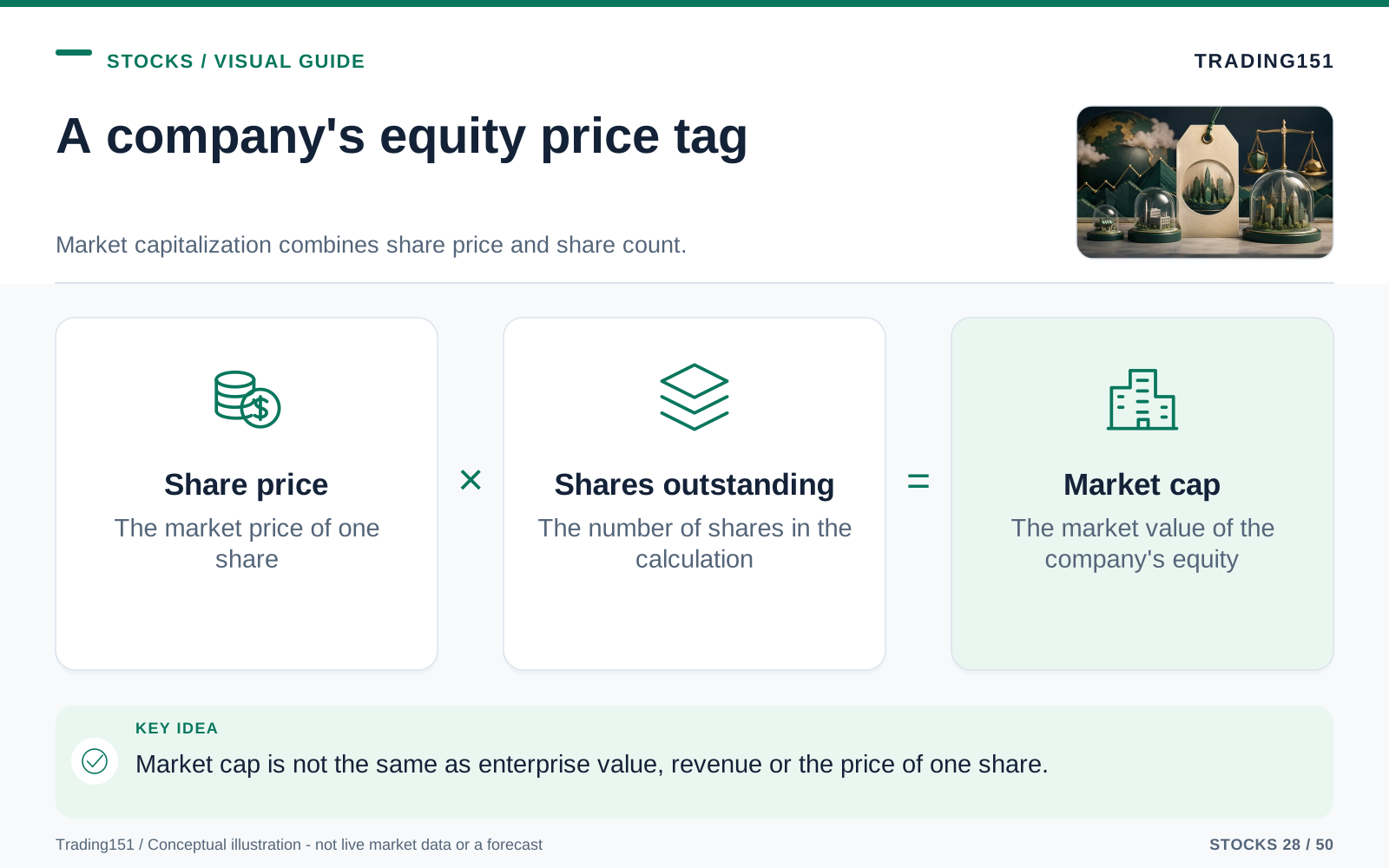
Read this diagram as text
- Share price
- The market price of one share
- Shares outstanding
- The number of shares in the calculation
- Market cap
- The market value of the company's equity
The Pizza Slice Problem
Let's go back to that pizza analogy because it really is the easiest way to picture this.
Imagine you have a pizza cut into 10 slices, and each slice is $3. The whole pie costs $30. Now imagine another pizza cut into just 4 slices, with each slice costing $6. That second pizza has a higher price per slice, but the entire pizza is cheaper at just $24.
Stocks operate the same way. One business might carve its ownership into billions of tiny shares, while another might issue far fewer. The share price is just the price of one slice. Market cap tells you what the whole pizza costs.
This is why hunting for penny stocks or low-priced shares can get you into trouble. A $5 stock isn't a guaranteed bargain. It might just be a microscopic slice of a company that flooded the market with shares, or it might be cheap because the business is failing. On the flip side, a stock with a hefty price tag might belong to a company that's smaller, healthier, and fairer in value than you'd think.
Market cap won't tell you if a stock is a slam-dunk investment on its own, but it will save you from making a classic rookie mistake: confusing a cheap share price with a cheap valuation.
Market Cap Is Not the Same as Intrinsic Value
We need to clear something up right away. Market cap is not some flawless, permanent measure of a company’s true, intrinsic worth. It is simply the market’s current mood and opinion, translated into dollars.
Sometimes that opinion is rational and well-thought-out. Other times, it's driven by panic, impatience, hype, or pure doom-and-gloom. Stock prices swing substantially because humans are reacting to earnings reports, changing interest rates, juicy rumors, CEO drama, and basic fear or greed.
So, market cap perfectly answers one very specific question: What price is the market putting on this company today?
What it doesn’t answer is everything else. It won't tell you how much debt is hiding on the balance sheet, if profits are growing, or if the management team knows what they're doing. And it definitely doesn't promise that the company deserves its current price tag.
Even so, it’s the best place to start because it grounds you in reality. Before you can figure out if a company is overvalued, risky, or poised for a breakout, you have to know what weight class it's fighting in.
The Main Market Cap Categories
Investors love to group companies by size. While these buckets aren't an exact science—and the cutoffs can vary depending on who you ask—they are useful. Think of them like weight classes in boxing. A scrappy startup and a large global conglomerate might trade on the same stock exchange, but they play by completely different rules. Just keep in mind that these categories shift over time as the economy grows, and different index funds might define them slightly differently.
1. Mega-Cap Companies
These are the undeniable titans of the stock market. We're talking globally recognized brands with endless resources, large customer bases, and a dominant grip on their industries.
Because they are already so enormous, their hyper-growth days are usually behind them. A small tech firm can easily double in size by tapping into a new market, but a mega-cap needs to generate billions of dollars in new revenue just to move the needle.
What this means for you: Mega-caps are generally seen as the stabilizing anchors of a portfolio. They boast large cash reserves and diversified income streams. While they aren't immune to a stumble, they are far less likely to vanish overnight compared to a young, unproven startup.
2. Large-Cap Companies
Large-caps are the established, battle-tested businesses that make up the core of the economy. You probably have their products in your house right now, and they've likely survived their fair share of recessions.
While they might not offer the explosive, overnight gains of a hot new tech stock, they offer something arguably better: durability and steady growth. Many of them pay out regular dividends, while others reinvest heavily to keep expanding.
What this means for you: These stocks are the foundation for most long-term investors. They will absolutely take a hit during a market crash, but they usually have the financial muscle to weather the storm. If you want solid growth without losing sleep, large-caps are your bread and butter.
3. Mid-Cap Companies
Mid-caps live in a really fascinating middle ground. They’ve outgrown the risky startup phase and proven their business model works, but they haven't quite reached total market dominance. Now, their goal is to scale up.
This is an exciting space for investors. These companies often have plenty of runway left to expand into new countries, roll out fresh products, or buy up smaller competitors.
What this means for you: Mid-caps are the ultimate balancing act. They usually grow faster than the lumbering giants, but they are sturdier than the little guys. The catch? They can still be quite vulnerable to economic downturns or fierce competition from larger rivals.
4. Small-Cap Companies
Small-caps are the younger, leaner, and more hyper-focused businesses. Some are innovating in brand-new industries, while others dominate a very specific local niche. A handful of these companies will eventually grow into the large household names of tomorrow.
The appeal here is the large potential upside. Because they are starting from a smaller base, they don't need to conquer the entire globe to give investors incredible returns—they just need to win in their specific lane.
What this means for you: Buckle up, because small-caps are volatile. When things go right, the stock can soar. But when sales miss the mark, cash gets tight, or the economy dips, the drop can be severe. Wall Street analysts tend to ignore them, which leaves room for savvy investors to find hidden gems—but also leaves room for nasty surprises.
5. Micro-Cap and Nano-Cap Companies
These are the smallest players in the public markets, and this is where things get highly speculative. You'll find early-stage companies desperately trying to prove their worth, alongside fading businesses that have shrunk to a fraction of their former size. Many of these stocks trade with very low volume, meaning it can be tough to cash out without crashing the stock price.
What this means for you: Tread carefully. It's tempting to buy a stock for a few pennies hoping it goes to a dollar, but the risks are immense. These companies often lack transparency, rely on a single product, or constantly need to issue new shares just to keep the lights on. It’s also an area plagued by hype and pump-and-dump schemes.
Why Market Cap Matters in Real Life
Market cap is way more than just financial trivia. It fundamentally changes how you look at the stock market. It grounds you, helping you figure out exactly what kind of beast you're dealing with before you get swept up in flashy headlines, chaotic charts, or social media hype.
It Helps You Compare Companies Fairly
Let's say two rival companies are battling it out. Stock A trades at $40, and Stock B trades at $400. If you ignore market cap, Stock B looks ten times more expensive. But if Stock A has issued millions more shares, it might be the much larger, more dominant business.
Market cap levels the playing field. Once you know the actual size of the companies, you can ask the questions that really matter: Who makes more money? Who has more debt? Who is growing faster relative to their actual size?
It Gives You a Quick Read on Risk
Being a large company doesn’t mean you’re invincible, but size drastically changes the kind of risks you face.
A mega-cap might struggle with sluggish growth or government antitrust lawsuits. A small-cap, on the other hand, might struggle just to survive, facing cash crunches and substantially unpredictable price swings. A mid-cap is fighting to cross that treacherous gap between being a promising upstart and a permanent industry fixture.
Knowing a company’s size tells you where to look for trouble. If it's a small-cap, you better check their cash flow to make sure they won't go bankrupt next year. If it's a large-cap, you’ll want to look at profit margins, dividend history, and whether Wall Street has set expectations impossibly high.
It Helps Build a Portfolio You Can Live With
Financial advisors love to talk about "risk tolerance" as if it's a simple checkbox on a form. In reality, risk tolerance is purely emotional. It’s that knot in your stomach when your account drops 20% and the news is predicting financial doom. It’s whether you can sleep soundly or if you end up panic-selling at the absolute worst time.
Market cap helps you build a portfolio that matches who you really are, not just who you aspire to be. If big market swings stress you out, loading up on small-cap tech stocks is a terrible idea. If you’re young, patient, and completely unbothered by volatility, sprinkling in some smaller companies makes total sense. The goal isn't to build the most exciting portfolio—it’s to build one you won't abandon when the market gets ugly.
Stock Splits: Why the Price Changes but the Company Doesn't
Understanding market cap is also the ultimate cure for stock split confusion.
When a company splits its stock, it simply multiplies the number of shares while cutting the price of each share by the same ratio. If a company announces a 2-for-1 split, and the stock is trading at $100, you’ll suddenly have two shares worth $50 each.
Human nature makes us feel like we just got a fantastic discount. But fundamentally, absolutely nothing changed. You hold more shares, but each one represents a smaller piece of the company. Your total investment is worth the same amount the second the split happens.
Think about the pizza again: taking a knife and cutting a pizza into eight slices instead of four doesn’t magically conjure up more cheese and crust. It just gives you smaller pieces to hold.
Companies usually do this to make their stock feel more affordable to everyday investors or to boost trading activity. But a split doesn’t make the business itself one penny more valuable. Keeping your eye on the market cap keeps you grounded, proving that the actual value of the company hasn't moved, even if the sticker price got a dramatic makeover.
Market-Cap-Weighted Indexes: Why the Heavyweights Rule the Market
Here’s another reason market cap is crucial: most of the popular stock market indexes (and the funds that track them) are market-cap weighted. That’s a fancy way of saying the biggest companies get the most influence. This system naturally lets the winners keep growing their footprint without forcing fund managers to constantly buy and sell to keep things equal. However, it also means a handful of mega-corporations can end up dominating the entire market.
When you buy a standard broad-market index fund, your cash doesn’t get sprinkled evenly across all 500 companies. The lion's share of your money flows directly into the largest companies at the top. A single tech giant having a good day can completely drag the index upward, even if dozens of smaller companies at the bottom are falling.
This isn’t inherently a bad thing. It’s simple, it keeps fees low, and it accurately reflects how wealth is distributed in the market. But you need to be aware of it. A lot of people buy an index fund thinking they are perfectly diversified across hundreds of businesses, completely unaware that a huge chunk of their retirement is riding on just five or six large tech companies.
That doesn't mean you should ditch index funds. You just need to know what’s under the hood. If you realize your portfolio is heavily skewed toward U.S. mega-caps, you might decide to manually add in some mid-caps, small-caps, or international funds to truly balance things out.
How Market Cap Changes Over Time
Market cap is never static; it breathes with the market. Every time a stock’s price ticks up or down, the market cap moves with it. If investors are feeling optimistic and buy heavily, the company’s valuation swells. If bad news hits and people panic-sell, billions of dollars in market cap can vanish in an afternoon.
These shifts can take years to play out, or they can happen at lightning speed. A blockbuster earnings report, a PR disaster, shifting interest rates, a disruptive new rival, or looming regulations can all instantly rewrite how the world values a business.
But the share price isn't the only moving part—the number of shares matters, too. Companies frequently issue brand-new shares to raise cash for expanding, buying out competitors, or paying off debt. While this injects money into the business, it also dilutes your slice of the pie, making your existing shares a little less valuable if the cash isn't put to good use.
Conversely, companies often buy back their own stock. When a business buys its own shares and retires them, the total number of shares shrinks. If the company is thriving and buys the stock at a fair price, this is fantastic for you—it means your remaining shares now represent a larger chunk of the company's profits. But beware: if management overpays for those shares or burns through cash they should have saved, buybacks can destroy value.
Ultimately, a company's market cap isn't a permanent tattoo. It’s a real-time, constantly shifting reflection of price, share count, future expectations, and raw human emotion.
Market Cap vs. Enterprise Value
As great as market cap is, it doesn’t give you the absolute total price tag of a business. To understand why, picture two companies with the same $10 billion market cap. Company A is sitting on a mountain of cash and has zero debt. Company B is drowning in loans and has barely any cash in the bank. Are they worth the same amount? Not a chance. That’s where enterprise value (EV) steps in to give you a truer picture of what the entire operation is worth, which is especially vital if you're trying to compare companies with totally different financial habits.
Enterprise value takes the market cap, tacks on the company's debt, and subtracts its cash. Think of it as the theoretical cost of buying the entire business outright, paying off all its loans, and pocketing whatever cash is in the register.
The basic math looks like this:
Enterprise Value = Market Cap + Debt - Cash
While market cap tells you the value of the equity, enterprise value looks at the whole financial structure. It’s an incredible tool for spotting hidden risks.
For example, a company might look fairly priced based on its market cap, but if it has a crushing debt load, its enterprise value will reveal just how risky it is. On the flip side, a company with a large pile of cash might be far cheaper and more resilient than its share price suggests.
You definitely don’t need to throw out market cap just because enterprise value exists. Think of market cap as looking at the front of a house to gauge its size, and enterprise value as the home inspection that tells you if the foundation is rotting.
What Market Cap Won't Tell You
Because market cap is such a handy shortcut, it’s easy to over-rely on it. But it has serious blind spots.
For starters, it doesn’t tell you if a company is making money. We regularly see highly valued companies bleed cash for years simply because investors are dreaming of large future profits. Sometimes those dreams come true, but often, they don't.
It also tells you absolutely nothing about the company's financial health. A large corporation can still be suffocating under debt, fighting severe lawsuits, or struggling with shrinking cash flow.
Most importantly, market cap doesn't tell you if a stock is fundamentally cheap or expensive. To figure that out, you have to dig into valuation ratios, profit margins, cash flow, and how it stacks up against the competition.
Finally, size doesn’t guarantee an economic moat. A company might be gigantic today simply because it dominated the last decade, completely unaware that a smaller, faster competitor is currently building the technology that will make them obsolete.
In short: use market cap to start your research, never to end it.
Common Mistakes Investors Make With Market Cap
Mistake 1: Thinking a Low Share Price Equals a "Cheap" Stock
We’ve covered this, but it’s the ultimate rookie trap. A stock trading at $3 can be drastically overpriced if the underlying business is terrible and they've issued a billion shares. Conversely, a $300 stock can be a phenomenal bargain if the company is printing money, carrying zero debt, and growing aggressively.
Mistake 2: Assuming the Giants Are Invincible
Big companies fall from grace all the time. They can grow stagnant, take on reckless debt, miss large cultural shifts, or blow billions on terrible acquisitions. Size definitely brings stability, but it breeds complacency, too. A large cruise ship is hard to sink, but it’s also remarkably hard to turn around when an iceberg is dead ahead.
Mistake 3: Treating Small-Caps Like Scratch-Off Tickets
Small companies can deliver life-changing returns, but they aren't magic beans. Throwing money at a tiny company just because "it could be the next Apple" is gambling, plain and simple. Unless you truly understand their business model, their industry, and their cash burn rate, you're just throwing darts. The harsh reality is that most small companies stay small, or go bankrupt entirely.
Mistake 4: Ignoring Index Fund Concentration
Buying a broad index fund is usually a brilliant, low-stress move, but remember that the money isn't spread evenly. In a cap-weighted index, a few titans pull most of the weight. That’s amazing when big tech is booming, but it will drag your portfolio down fast if those specific heavyweights stumble.
Using Market Cap to Balance Your Portfolio
One of the best ways to apply market cap to your own life is to build your portfolio in layers.
The deep foundation of your investments should probably be anchored by broad funds or large, heavily established companies. This money isn't there to give you an adrenaline rush. It’s there to provide unshakable staying power.
The next layer up might be your mid-cap holdings. This is where you sacrifice a little bit of safety for a higher growth ceiling, catching proven companies while they still have room to run.
Finally, your top layer can be your small-cap, adventurous investments. This injects some real energy and growth potential into your portfolio, but it should be a small enough chunk that you won't panic and sell everything when the market gets rocky.
A lot of professionals call this the "core-and-satellite" method. The sturdy large-caps are the core, keeping you on track. The smaller, riskier positions orbit around it, adding upside and personal conviction.
Your exact mix is deeply personal. It depends on your age, income, future goals, and how well you handle stress. A 25-year-old investing for retirement can handle a vastly different setup than a 60-year-old about to live off their savings. Market cap won't give you the formula, but it gives you the vocabulary you need to build your portfolio with actual intention.
A Quick Checklist Before You Buy
Next time you're thinking about placing the trade on a stock, use market cap to frame your research. Ask yourself these questions to avoid getting hypnotized by the share price:
- How big is this company's market cap? Get a sense of its actual weight class before you do anything else.
- How does its size compare to its rivals? This tells you instantly if they are the bully in the schoolyard or the scrappy underdog.
- Is the growth keeping up with the valuation? A large market cap means Wall Street has baked large expectations into the price. Can they deliver?
- What's the debt situation? Time to peek at the enterprise value. Are they floating on cash, or drowning in loans?
- Does this fit my portfolio? Even a great company is a bad buy if you already own 15 stocks just like it.
- Can I stomach the ride? If it’s a micro-cap, be honest with yourself about your ability to handle 30% price swings without losing your mind.
These questions aren't a foolproof shield against losses—nothing in the stock market is. But they force you to slow down. They shift your brain from "Wow, this stock is cheap!" to "Okay, what business am I buying into?"
A low share price does not mean a small company
Suppose Company A has 100 million shares priced at $10. Its equity market value is $1 billion. Company B has 10 million shares priced at $50, giving it a $500 million equity value. The second company's individual share costs more, but the total quoted equity is worth less. Share price alone cannot tell you which company is larger or better value.
A stock split illustrates the same point. A two-for-one split approximately doubles the share count and halves the price per share, all else equal. It does not create an equivalent increase in the company's economic value. The investor owns more units representing the same proportional interest, subject to the specific treatment of fractional shares.
Debt and cash lead to another comparison. Enterprise value is commonly calculated from equity market value plus relevant debt and other claims, less cash and similar adjustments. Definitions can differ, so use consistent inputs. Two companies with the same market capitalization can have very different financing obligations and operating-business valuations.
Check which share count a data service uses, especially where options, convertible securities, multiple share classes, or recent issuance are important. Dilution can change the claim represented by each existing share even when the headline market capitalization grows. Market cap is a useful starting measurement. It becomes misleading when it is treated as a substitute for understanding the balance sheet, profitability, or price paid for future cash flows.
A stock split does not create enterprise value
A split changes the number of shares and the price per share proportionately, before other market movements. It does not, by itself, change the value of the whole equity or the business's operating assets. Comparing companies by the nominal share price can therefore be misleading. Use the appropriate capitalization and financial measures rather than treating a low-priced share as automatically inexpensive. 1, 2
Know the Size Before Judging the Price
The next time you open your brokerage app, refuse to let the share price do all the talking. A $5 stock isn't a gift, and a $1,000 stock isn't necessarily a rip-off. The share price is just one slice of the pizza.
Market capitalization shows you the whole pie. It instantly reveals whether you're staring at an unstoppable global titan, a steady legacy brand, a hungry challenger, or a highly unpredictable micro-cap.
Use market cap to orient yourself. It acts as your compass, telling you what kind of business you're dealing with and how liquid the shares might be. But remember, it never gives you a free pass on doing your homework regarding the company's financial health or actual value.
Always weigh the market cap against the company's real-world sales, cash flow, debt, and future opportunities. Keep an eye on that diluted share count to make sure executives aren't handing out so much stock that your ownership gets watered down.
Calculating market cap takes three seconds on a calculator, which is exactly why it should be your very first step—long before you draw any conclusions from a stock chart. Size up the whole company first, then dig into the enterprise value and the quality of the business itself. Let market cap open your analysis; just make sure you never let it finish it.
Sources and further reading
Editorial revision: 7 October 2026. Numerical scenarios are hypothetical unless identified as historical. References support the added explanations and selected corrections; rules and product terms should be checked again before acting.