
Spot Bitcoin exchange-traded products and Bitcoin futures funds seek exposure to the same broad market through different structures. A spot product generally holds bitcoin through a custody arrangement, while a futures fund holds derivatives and other assets consistent with its mandate. In the United States, many spot products commonly called ETFs are commodity trusts rather than funds registered under the Investment Company Act of 1940. The prospectus, not the nickname, establishes the structure.
Let’s Back Up: What Exactly Is an ETF?
An ETF (exchange-traded fund) is basically just a basket of investments that trades on a stock exchange exactly like a regular stock. You can buy and sell shares all day long through your normal brokerage account. That sheer convenience is exactly why ETFs have exploded in popularity—they give you the diversity of a mutual fund with the ease of trading a single stock.
Think of it like a container. Inside that container could be a mix of hundreds of different stocks, some bonds, physical gold, or—in this case—Bitcoin. The people running the fund manage whatever is inside the container, and you simply buy shares of the container itself.
When you buy an S&P 500 ETF, you aren't personally buying tiny slivers of 500 different companies. The fund takes care of all that heavy lifting; you just hold the ETF shares. The same logic applies to Bitcoin ETFs. The fund deals with all the annoying crypto mechanics so you can just use a familiar investment tool.
That convenience is the whole selling point. Instead of opening a brand-new account on a crypto exchange and diving into the weeds of digital self-custody, you just buy the ETF where your IRA already lives. For millions of people, that convenience is what finally turned Bitcoin from an abstract idea into an actual, actionable investment.
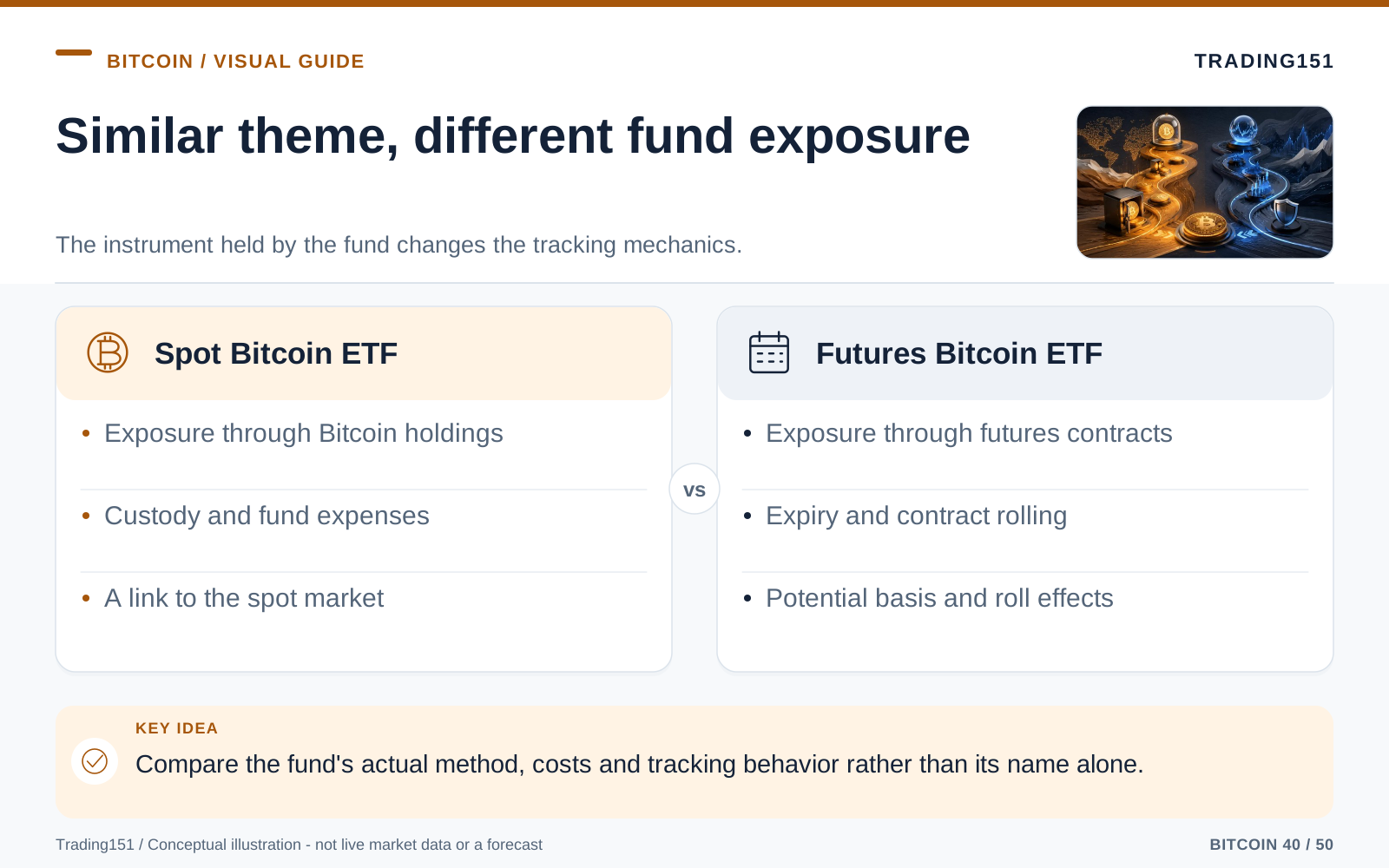
Read this diagram as text
- Spot Bitcoin ETF
- Exposure through Bitcoin holdings; Custody and fund expenses; A link to the spot market
- Futures Bitcoin ETF
- Exposure through futures contracts; Expiry and contract rolling; Potential basis and roll effects
Why Everyone Made Such a Big Deal About Bitcoin ETFs
Historically, Bitcoin has catered to two entirely different crowds. On one side, you have the hardcore, crypto-native believers who love direct ownership, holding their own keys, and moving money around without asking a bank for permission. On the other side, you have everyday investors who think Bitcoin might be a good long-term play but want absolutely nothing to do with the hassle of storing it themselves.
Bitcoin ETFs were designed almost entirely for that second group. To be clear, they don’t magically turn Bitcoin into a safe, boring asset. It’s still wild, volatile, and prone to large price swings. What the ETFs do is strip away all the logistical friction.
That’s a huge deal for regular folks, but it’s an even bigger deal for financial advisors, large institutions, and retirement funds that are legally restricted to buying regulated products. A Bitcoin ETF slots perfectly into the traditional financial system. It shows up cleanly on statements and can be bought without anyone having to touch a crypto exchange.
But putting Bitcoin in a fancy financial wrapper doesn’t eliminate the underlying risk. An ETF might feel much cozier than a cold storage crypto wallet, but its value is still tethered to one of the most volatile assets on earth. The structure makes it easier to buy, not easier to predict.
What Is a Spot Bitcoin ETF?
In the financial world, the word “spot” simply means the current market price of an asset. If someone asks for the spot price of Bitcoin, they just want to know what it’s trading for right this second. The ETF structure just adds a bunch of professional middlemen behind the scenes. Authorized participants create or redeem shares, market makers ensure you can trade it, and a custodian vaults the actual coins. All this plumbing exists to keep the ETF’s share price glued to the value of the Bitcoin it holds. To you, it just looks like a single trade on your phone, but underneath, there's a whole machine keeping it aligned.
A spot Bitcoin ETF buys and holds actual Bitcoin. When new money flows into the ETF, the people running the fund create new shares and go buy more Bitcoin to back them up. That Bitcoin gets locked away by a custodian—usually a large institution specializing in digital security.
Simply put, a spot ETF acts as a direct bridge between your normal brokerage account and real Bitcoin sitting in a digital vault. You buy the shares, the ETF holds the coins. The share price is designed to closely track the value of that locked-up Bitcoin (minus the fund's management fees, of course).
You’ve probably seen these launched by heavy hitters like BlackRock or Fidelity. But the brand name matters a lot less than the actual structure: these funds are backed by real, hard Bitcoin, not financial contracts.
The Main Benefits of a Spot Bitcoin ETF
- It mirrors Bitcoin closely: Since the fund owns Bitcoin, its share price moves in lockstep with the real thing. It’s not flawless down to the microsecond, but the logic is simple: if Bitcoin goes up, your ETF should go up. If it crashes, you crash with it.
- It’s easy to understand: The fund buys Bitcoin. You buy shares of the fund. That’s it. You don’t need a finance degree to grasp what’s going on, unlike some of the wild futures strategies out there.
- No self-custody nightmares: You are completely off the hook for managing wallets, guarding private keys, or having a panic attack about sending funds to the wrong address. The big institutions handle all the security.
- It lives in your normal brokerage account: This was the big game-changer. You can buy a spot ETF right alongside your Apple stock or Vanguard funds.
- The fees make sense: Spot ETFs just charge a standard expense ratio. Sure, you’ll deal with normal trading spreads, but overall, the pricing is transparent and straightforward.
The Trade-Offs of a Spot Bitcoin ETF
- You don’t own any Bitcoin: The ETF owns the Bitcoin; you just own a piece of paper (well, a digital record) saying you own the ETF. You can’t take "your" Bitcoin out of the fund and spend it.
- You’re relying on a lot of middlemen: You’re trusting the fund sponsor, the custodian, and the broader stock market infrastructure. If you love Bitcoin for its "trustless" independence, this defeats the whole purpose.
- Trading is limited to market hours: Bitcoin never sleeps—it trades 24/7/365. ETFs, however, only trade when the stock market is open. If Bitcoin tanks on a Saturday night, you’re stuck holding the bag until the opening bell on Monday morning.
- It doesn’t magically erase volatility: Convenience is great, but don't get a false sense of security. A spot ETF will still drop like a rock if the underlying crypto market has a bad week.
The bottom line on spot ETFs: A spot Bitcoin ETF is hands-down the cleanest, most direct way to get Bitcoin exposure without dealing with crypto exchanges. It’s the closest you can get to owning the real thing through a traditional broker.
What Is a Bitcoin Futures ETF?
Unlike a spot ETF, a Bitcoin futures ETF doesn’t hold any Bitcoin. Instead, it holds Bitcoin futures contracts.
A futures contract is basically a legally binding agreement to buy or sell something at a specific price on a specific date in the future. Futures markets have been around forever. Farmers, airlines, and oil companies use them all the time to lock in prices and protect themselves from wild market swings.
Let’s say a local coffee shop owner is terrified that coffee bean prices are going to skyrocket by next quarter. A bean supplier, meanwhile, is worried prices might crash. They agree today on a set price for beans to be delivered in three months. Boom—both sides get a little peace of mind. That’s the core concept of a futures contract.
A Bitcoin futures ETF plays this exact same game, just swapping out coffee beans for Bitcoin. The fund buys regulated contracts betting on where Bitcoin’s price is headed, and uses those contracts to mimic the coin's price movements.
For a while, this was the only game in town. Regulators were totally fine approving futures ETFs because the futures market is highly regulated and heavily monitored. Approving a fund that held actual, unregulated Bitcoin took them a lot longer to stomach.
The Main Benefits of a Bitcoin Futures ETF
- It plays by the old rules: These contracts trade on heavily regulated, traditional futures exchanges. Regulators and big institutions love that safety net.
- Easy access: Just like a spot ETF, you can buy it with a few clicks in your standard brokerage account.
- No crypto custody required: Because the fund never touches actual Bitcoin, nobody has to worry about digital vaults or hackers stealing the underlying coins.
- Great for active traders: If you’re a professional trader looking to hedge a portfolio or make short-term bets, futures products give you some unique strategic tools.
The Big Problem: Roll Costs
Here’s where futures ETFs get sneaky. The biggest drawback isn’t obvious on day one: futures contracts eventually expire. If a fund holds a contract that’s about to expire, they have to sell it and buy a new one for the next month. If the market is completely flat, that constant swapping of contracts can quietly bleed the fund’s value dry. Sometimes the math works in your favor, but often it doesn't. Your returns end up depending just as much on the weird mechanics of the futures market as they do on the actual price of Bitcoin. This is why a futures ETF can totally disappoint you even if Bitcoin itself is having a great year.
ETFs are meant to last forever. Futures contracts aren’t. So, when the fund's contracts are nearing expiration, they have to swap them out for newer ones that expire later. Wall Street calls this rolling.
Rolling can get expensive. If contracts for next month cost more than the ones expiring today (a market condition known as contango), the fund is basically forced to sell low and buy high, over and over again. This constant friction slowly eats away at your investment.
This is known as a "roll cost." You won't see it listed on the fund's official fee sheet, which is why it catches so many people off guard. You might think you're only paying a tiny expense ratio, but the rolling process is quietly dragging down your returns in the background.
Occasionally, the opposite happens (called backwardation), where future contracts are cheaper. In that scenario, rolling boosts the fund's value. But you definitely shouldn't count on that happening all the time. The main takeaway? A futures ETF can perform noticeably worse than Bitcoin itself, even if everyone on Twitter is celebrating a large crypto rally.
The Trade-Offs of a Bitcoin Futures ETF
- It can seriously lag behind actual Bitcoin: Over time, a futures ETF might drift pretty far from Bitcoin's real price, especially if you hold onto it for months or years.
- Hidden costs: Between the standard management fees and the invisible drag of rolling contracts, you might be paying more than you realize.
- It’s overly complicated: You aren’t buying Bitcoin. You aren't even buying a fund that holds Bitcoin. You’re buying a fund that manages financial contracts guessing at Bitcoin's future price. It's a layer cake of complexity.
- It’s terrible for long-term holding: If you plan to buy and hold for five years, stay away. The longer you hold a futures ETF, the more those rolling costs will chew up your profits.
The bottom line on futures ETFs: They offer a way to bet on Bitcoin, but they are a very clunky tool for everyday investors. They make sense for institutional traders with specific strategies, but they’re rarely the right choice if you just want to add some crypto to your retirement account and forget about it.
Spot vs. Futures: The Core Difference
If you take away just one thing, let it be this: a spot Bitcoin ETF revolves around the actual coin, while a futures ETF revolves around contracts about the coin.
That sounds like a technicality, but it completely changes the game. A spot ETF is the closest you can get to owning real Bitcoin through a traditional stockbroker. A futures ETF is a Wall Street derivative product that attempts to mimic Bitcoin.
It’s not that one is universally good and the other is universally evil. You just have to ask yourself: “What am I buying, and what is this going to look like if I hold onto it for three years?”
Head-to-Head: How They Compare
1. Price Tracking
Winner: Spot ETF. A spot ETF is miles better at tracking Bitcoin simply because it holds it. Sure, there might be tiny discrepancies here and there, but it’s designed to stick to the actual price like glue.
A futures ETF can point you in the right general direction, but over time, all that contract rolling and market weirdness will likely cause its performance to drift away from the true spot price.
2. Cost Clarity
Winner: Spot ETF. Spot ETFs are beautifully simple to evaluate. What you see on the expense ratio is generally what you get.
Futures ETFs hit you with a stated fee, plus the invisible bleed of rolling contracts. That doesn't make them a scam, but it does mean you have to do a lot more math to figure out what you're paying.
3. Simplicity
Winner: Spot ETF. The pitch is simple: the fund holds Bitcoin, you hold the fund. Futures ETFs require you to understand derivatives, contango, backwardation, and roll yields. No thanks.
4. Long-Term Holding
Winner: Spot ETF. If you’re a "set it and forget it" investor planning to hold for years, a spot ETF is the obvious choice. You avoid the constant grind of rolling futures contracts.
Futures ETFs are best viewed as short-term trading instruments. They aren’t meant to sit in a retirement account collecting dust for a decade.
5. Direct Bitcoin Ownership
Winner: Neither. Let’s be very clear about this: buying an ETF does not mean you own Bitcoin. You cannot put it in a cold wallet, you cannot spend it, and you do not hold the private keys.
With a spot ETF, a large corporation owns the Bitcoin, and you own their stock. If your actual goal is to participate in the decentralized crypto network, an ETF of any kind is completely useless to you.
Why Did Regulators Approve Futures ETFs First?
For a long time, the crypto world was reporting on this: if a futures ETF is so complicated, why on earth did regulators give it the green light years before the dead-simple spot ETF?
It entirely came down to comfort zones. Futures contracts trade on heavily regulated, old-school exchanges that the SEC already monitors and understands. The actual Bitcoin spot market, however, is scattered across a bunch of global crypto exchanges that historically played pretty fast and loose with the rules.
Regulators were terrified that the underlying Bitcoin market was too easily manipulated. Crypto advocates fired back, pointing out how ridiculous that logic was: if futures contracts are based on Bitcoin's price, and you approve futures, why not just approve the Bitcoin itself?
After years of fierce debate, lawsuits, and large Wall Street firms finally pushing for it, the SEC relented. When spot ETFs finally hit the market in early 2024, it completely changed how the traditional finance world interacts with crypto.
But let’s get one thing straight: regulators didn't suddenly declare Bitcoin a safe, wonderful investment. They just admitted that the ETF structure itself followed the legal rules. Judging the actual risk is still entirely on you.
When a Spot Bitcoin ETF Makes Sense
If you want some exposure to Bitcoin but refuse to deal with crypto exchanges or hardware wallets, a spot ETF is probably exactly what you’re looking for. It’s perfect for folks who want convenience, easy tax reporting, and a straightforward link to Bitcoin’s price.
It’s especially great for the long haul. If you're holding out hope that Bitcoin is going to the moon over the next decade, the spot ETF lets you ride that wave without the headache of futures contracts eating your returns.
Just remember: it’s not magic. Even inside a boring, traditional brokerage account, Bitcoin is still Bitcoin. A small slice of your portfolio can still feel stressful when the crypto market decides to take a 20% nosedive.
When a Bitcoin Futures ETF Makes Sense
Futures ETFs are for a much smaller crowd. Pro traders love them for short-term bets. Huge institutions use them for complex hedging strategies. Some people might use them just because their specific brokerage blocks access to spot products.
But for everyday investors? Now that spot ETFs exist, futures ETFs are hard to justify. If you just want to track Bitcoin's price, the futures structure adds a lot of complexity and very little benefit.
They aren’t useless, they’re just highly specialized tools. Don't use a bulldozer to plant a tulip.
The Very Real Risks Both ETFs Share
It’s easy to get so bogged down in the "Spot vs. Futures" debate that you forget the biggest risk factor they both share: Bitcoin itself. Sure, an ETF means you don't have to worry about hackers stealing your private keys, but it doesn't insulate you from the market. You're still relying on middlemen, paying management fees, and dealing with stock market hours that completely ignore Bitcoin's 24/7 reality. And again, you can't use the underlying network. You’re just betting on a price chart.
Bitcoin is famous for rocketing upwards, but it is equally famous for absolutely severe crashes. There is no safety net preventing it from crashing again. An ETF does not pad your fall—if Bitcoin plummets, your ETF shares will plummet right alongside it.
You also have to worry about macro factors. New government regulations, security breaches at major crypto exchanges, climbing interest rates, and general panic in the global economy can all tank Bitcoin’s price in a heartbeat.
Ultimately, it comes down to your own stomach for risk. Some people can watch their investment drop 20% in a week and sleep like a baby. Most people can't. Be honest about which group you belong to before you buy.
A Few Questions to Ask Before You Buy
Before you hit the buy button on any Bitcoin ETF, take a second to ask yourself:
- Why am I buying this? Is it a tiny speculative bet, a 10-year hold, or just a quick trade?
- How long am I holding? If it’s long-term, you probably want to steer clear of futures.
- Do I know what I’m buying? Remind yourself: spot equals real Bitcoin, futures equals financial contracts.
- Can I handle the panic? Bitcoin will test your nerves. Expect extreme volatility.
- Am I okay with not owning the real thing? ETFs are convenient, but you give up all the independence of true crypto ownership.
These aren't meant to talk you out of it. They’re just meant to slow you down. Crypto has a brilliant way of making people act on FOMO. Having a solid plan is a lot better than panic-selling during a dip.
So, Which One Should You Pick?
For the vast majority of normal, long-term investors who just want some Bitcoin exposure in their brokerage account, a spot Bitcoin ETF is the clear winner. It’s cleaner, easier to understand, and does a much better job tracking the actual price over time.
A futures ETF is a specialized Wall Street instrument. Unless you have a very specific, technical reason to trade futures contracts, the spot ETF is just going to be a much smoother ride.
Don't just buy a ticker because it has "Bitcoin" in the name. Know what the fund holds, understand the fees, and know what you're getting into.
Similar tickers can hold very different exposures
A spot product's share price is influenced by the value of its bitcoin holdings, expenses, and trading conditions. A shareholder generally owns an interest in the product rather than a personal balance of bitcoin that can be sent to an address. Creation and redemption arrangements operate under the product's rules and should not be confused with ordinary retail withdrawal rights.
A futures fund has another source of variation: the contracts themselves. Futures prices can differ from the spot market, and replacing expiring contracts changes the exposure at prevailing prices. The result is not determined by a single rule that futures funds always lose a fixed amount to rolling. Contract prices, collateral returns, expenses, and portfolio management all contribute.
Trading hours create a practical mismatch. Bitcoin markets operate through the weekend, while a listed product trades according to its exchange schedule. A substantial underlying move can therefore appear as a gap when the listed market opens. The ability to place an order in a brokerage account does not make the exposure continuously tradeable on that venue.
Compare products using current disclosures and a common period. Examine fees, custody or derivative arrangements, tracking differences, liquidity, and tax treatment relevant to the account. The choice is not simply convenience versus authenticity. It is a choice between legal and operational structures whose benefits and limitations need to match the reason for holding the exposure.
Read the legal wrapper as well as the holdings
A product described casually as a Bitcoin ETF may use a trust or another exchange-traded structure with rules different from a conventional investment-company fund. A futures-based product adds a different source of exposure and costs. Similar tickers or charts do not make those arrangements equivalent.
Read the prospectus sections on investment objective, custody, fees, creation and redemption, and principal risks. The investor owns a product share, not necessarily a directly redeemable claim to a specified amount of bitcoin. The distinction matters when deciding what protections and access are actually being purchased. 1, 2, 3
The Wrapper Changed, The Asset Didn't
Bitcoin ETFs have undeniably changed the landscape. They took a substantially complicated digital asset and made it as easy to buy as a share of Amazon. That is a large achievement.
But easier access does not equal lower risk. The ETF wrapper might look familiar and safe, but the asset inside is still the same volatile, unpredictable Bitcoin it has always been. The vehicle is regulated, but the road is still bumpy.
If you only remember one sentence, make it this: a spot ETF holds actual Bitcoin; a futures ETF holds contracts betting on Bitcoin. That alone explains why spot ETFs track better, why futures ETFs bleed value over time, and why they appeal to totally different people.
If you want a long-term slice of the crypto pie in your IRA, spot is the way to go. If you're a day trader making complex moves, look at futures. Whatever you do, just make sure you understand what you're buying.
Bitcoin doesn’t exactly have a track record of being kind to confused investors. Learn how the structures work, respect the insane volatility, and only invest what you can comfortably stomach when the market turns ugly.
Sources and further reading
- SEC Investor Bulletin: Exchange-Traded Products Providing Exposure to Bitcoin and Ether
- CME Group: Futures Expiration and Settlement
- Investor.gov: Index Funds
Editorial revision: 7 October 2026. Numerical scenarios are hypothetical unless identified as historical. References support the added explanations and selected corrections; rules and product terms should be checked again before acting.