
Bitcoin and ordinary money differ most in who issues them, who authorizes transfers, and what happens when something goes wrong. Everyday bank money is already largely digital, so the distinction is not simply paper versus software. Comparing the full payment process, including conversion, costs, and recourse, is more useful than treating either system as good at everything.
The Money We Grew Up With: Traditional Fiat Currency
The money we all carry around and use constantly is formally known as "fiat" currency. We're talking about US dollars, euros, British pounds, Japanese yen, Mexican pesos, Indian rupees, and basically every other national currency out there. None of this money derives its power from being backed by physical gold or silver bars anymore. Its value stems simply from the fact that governments issue it, our legal codes acknowledge it, local businesses accept it, and most importantly, we all share a collective hunch that everyone else will still take it as payment tomorrow morning.
That shared trust is a much bigger deal than it sounds. Money isn't valuable because of the specific paper blend or the fancy watermark. A physical twenty-dollar bill is just decorated paper. A $5,000 balance sitting in your banking app is just pixels lighting up a screen. The secret ingredient making them "real" money is shared confidence. As long as enough folks agree that you can trade those pixels for groceries, rent, or a used car, the system functions smoothly.
Fiat money is basically baked into the crust of our modern existence. Taxes demand it. Most salaries are paid in it. Everything from a 30-year mortgage and corporate budgets to a legally binding contract and a grocery store price tag operates strictly in it. That hands traditional currencies an absolutely large advantage: they aren't just mere payment widgets—they are the underlying operating system of the modern economy.
Why the Old Way Still Works Surprisingly Well
Despite all the heavy criticism thrown at fiat money and central banking, it remains absurdly practical for normal life. When someone wants to grab a sandwich, they don’t want the checkout process to feel like a stressful IT troubleshooting session. They want to pay seamlessly and leave. Traditional currency nails that experience perfectly.
The middlemen involved—like banks and payment processors—also supply a bunch of quiet services that are very easy to mock right up until the moment something goes haywire for you. Visa and Mastercard swallow billions in fraud risk. Banks help you recover stolen accounts. Lenders generate credit lines to help buy homes. The legal system handles disputes, and government deposit insurance steps in so regular folks don't lose their life savings if a local bank goes belly up. Sure, these safety nets are sometimes clunky, uneven, or bogged down by fees, but they definitely exist. Traditional banking isn't just an archaic, slow database begging to be disrupted; it’s a sprawling legal and social safety net built around being able to reverse mistakes, verify identities, and handle consumer complaints. Bitcoin’s base layer was explicitly built to ditch all of that.
It’s excessively easy to spend. Between cash, tap-to-pay debit cards, credit cards, wire transfers, and apps like Venmo or Zelle, fiat is practically frictionless. Paying taxes, covering a bar tab, or booking a cheap flight feels entirely second nature.
It’s universally accepted at home. If you're in the United States, you never have to barter or convince a store clerk to take your dollars. The entire nation's math is already calibrated to that single unit of account.
It’s stable enough for daily planning. Yes, things get more expensive over the months and years, but major fiat currencies rarely swing substantially in value between breakfast and dinner. That short-term stability lets you plan your life. You can agree to a specific annual salary, sign a one-year apartment lease, or list a couch on Facebook Marketplace without stressing that your currency's value might violently crash before the transaction finishes.
It comes with a built-in safety net. Did someone steal your credit card number and buy a TV? You can usually call the bank, dispute the charge, and get it reversed. Bank accounts enjoy government-backed deposit insurance up to a certain point. It’s an invisible cushion that helps everyday people sleep a little better.
It can be manipulated during emergencies. When a recession hits, or global markets melt down, central banks have a toolkit ready. They can tweak interest rates, print money to inject liquidity, and attempt to cushion the economic blow. You can definitely argue about whether their specific moves are smart or reckless, but the point stands: fiat gives policymakers the levers to steer the ship. Bitcoin has deliberately uninstalled those levers.
Where Traditional Money Stumbles
Interestingly, the exact traits that make fiat so flexible also leave it deeply vulnerable. Because governments and central banks can endlessly tweak the money supply, shift interest rates, and dictate financial rules, ordinary people are basically along for the ride. When politicians and central bankers use these tools well, things hum along. When they abuse them, it’s the everyday person who foots the bill.
The most obvious pain point here is inflation. A tiny trickle of inflation year over year might seem invisible, but over a few decades, it massively erodes what your savings can buy. A family keeping cash in a standard low-yield savings account might feel secure because their balance isn't shrinking. But if the costs of rent, groceries, medical care, and college tuitions are all rising rapidly around them, the real-world purchasing power of their nest egg is quietly evaporating.
Then there’s moving money across borders, which can be agonizingly slow and absurdly expensive in the traditional system. Sending funds internationally often traps your money in a maze of correspondent banks, foreign exchange spreads, compliance hold-ups, weekend closures, and hidden fees. If you're a worker trying to send a couple of hundred bucks back to family in another country, those fees can feel deeply unfair.
Finally, there's the giant issue of control. In the traditional system, a bank account can be frozen. Payments can be unexpectedly blocked. Withdrawals can be halted. Usually, this happens for entirely understandable reasons—like stopping money laundering or catching a scammer. But it proves one undeniable fact: your access to your own money entirely depends on a large corporate institution giving you a thumbs-up.
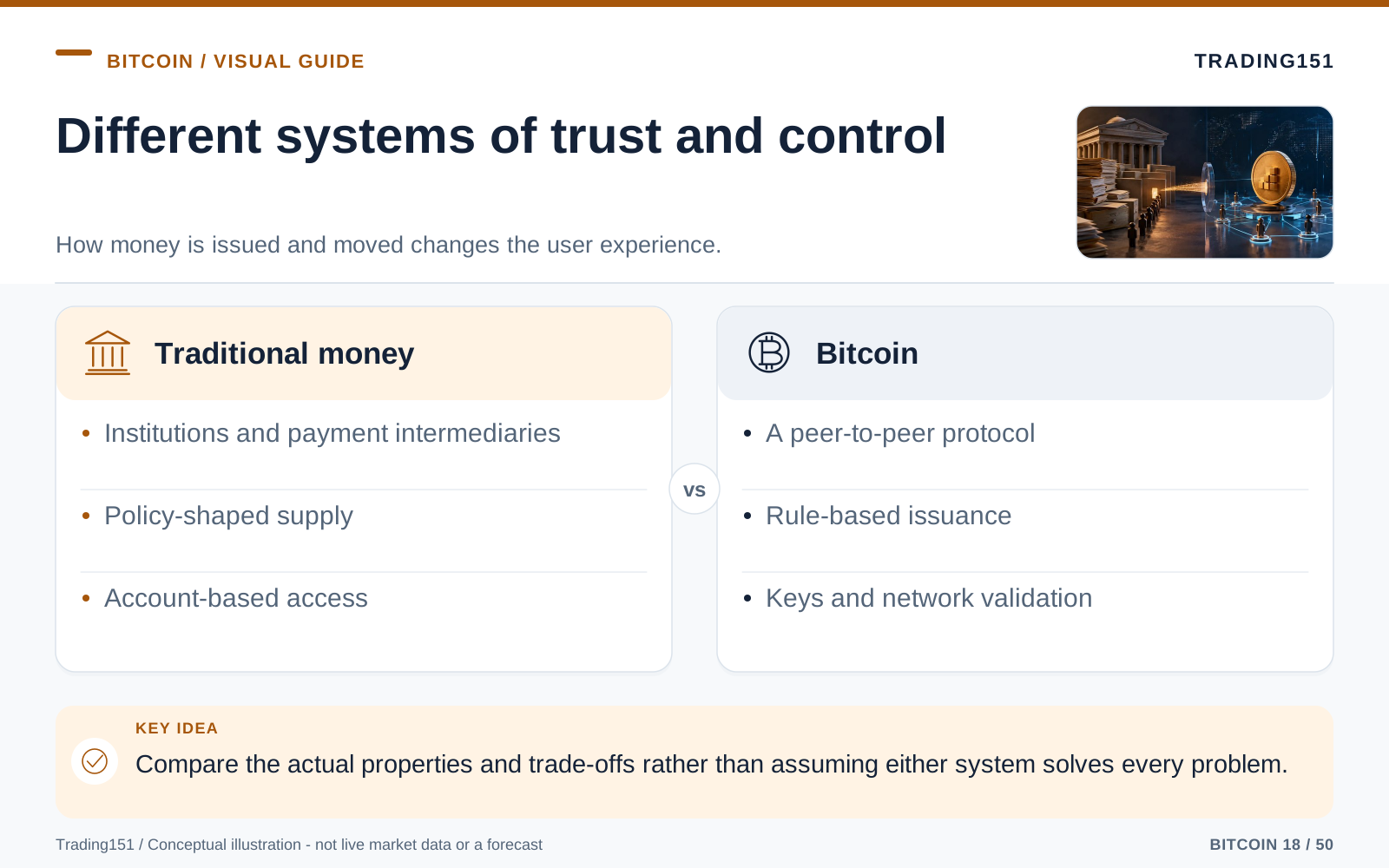
Read this diagram as text
- Traditional money
- Institutions and payment intermediaries; Policy-shaped supply; Account-based access
- Bitcoin
- A peer-to-peer protocol; Rule-based issuance; Keys and network validation
The Disruptor: Enter Bitcoin
Bitcoin burst onto the scene in early 2009, perfectly timed during the fallout of the global financial crisis when public trust in large banks and regulators was virtually zero. Its mysterious creator, operating under the pseudonym Satoshi Nakamoto, designed Bitcoin to be a purely peer-to-peer electronic cash system. The goal? A way for regular people to zap value directly to each other without needing a bank, a credit card company, or a government sitting in the middle taking a cut.
While that sounds wonderfully simple on paper, executing it was a legendary computer science breakthrough. For decades, digital money struggled with one complication: if a currency is just a computer file, what stops someone from copy-pasting it and spending the same digital coin twice? Banks fix the "double-spending" problem by locking their ledgers behind closed doors and maintaining strict private control over who owns what. Bitcoin solved it by doing the exact opposite. It created a completely public ledger verified in real-time by thousands of random participants.
How Bitcoin Works (Without the Tech Jargon)
Imagine a giant accounting notebook that meticulously records every transaction ever made. Now, instead of trusting one large bank to keep that notebook locked in a private vault, imagine that exact same notebook is copied and broadcast to thousands of computers all over the globe. Whenever someone tries to send Bitcoin, the entire network checks the math to ensure they aren't cheating and have the funds. Once verified, these new transactions are bundled together into a "block," chained to the previous blocks, and permanently recorded on everyone's copy of the notebook.
This is the blockchain. It's an entirely public, transparent record that is virtually impossible to hack or rewrite because you'd have to overpower thousands of independent computers simultaneously. No single CEO can just hit "edit" and award themselves a million extra coins. No shady government office can change the supply rules on a Friday afternoon. The whole machine runs on open-source code, clever financial incentives, hardcore cryptography, and a large network of users who don't have to trust each other for the system to work flawlessly.
This architecture is what gives Bitcoin its unique soul. It is radically open, it ignores all physical borders, its supply is mathematically capped, and it is resistant to being bullied or controlled by any single nation or corporation. Those exact traits are why die-hard fans view it as a historic revolution—and why harsh critics view it as a clunky, volatile, dangerous threat to normal society.
What Makes Bitcoin So Different?
Its supply is permanently capped. There will never, ever be more than 21 million Bitcoin. This hard, unchangeable limit isarguably its most vital feature. Unlike your local fiat currency, Bitcoin cannot be printed into oblivion just because politicians are dealing with a budget crisis or a recession. When you settle a Bitcoin transaction, you are trading an actual, scarce digital asset native to the network. You aren't just politely asking a bank to update an IOU spreadsheet. A traditional wire transfer moves a legal claim inside a highly regulated walled garden where an admin can reverse, pause, or freeze the money. Bitcoin just moves ownership using math—if you have the correct digital signature and the funds, the money moves. Period. One system relies on human admins and customer service; the other relies on pure, cold, final execution. Both approaches have serious trade-offs.
There is no central bank pulling the strings. Bitcoin has no CEO, no board of directors, no marketing department, and no Federal Reserve tweaking its rates. The rules are enforced globally by the network itself. While software upgrades can happen, they require a large, overwhelming consensus from the network to adopt, making sudden, top-down changes basically impossible.
It totally ignores borders. Sending Bitcoin to someone sitting on a different continent is exactly the same process as sending it to someone sitting in the same room as you. It bypasses the tangled web of correspondent banks entirely. The Bitcoin network does not care about national borders, public holidays, or banking hours. It is always awake.
You own it. If you hold your own Bitcoin in a private digital wallet and control the "private keys" (the password), you aren’t relying on a bank's promise that your money is there. You are personally custodying the asset. For folks who heavily value autonomy and financial independence, becoming your own bank is a large selling point.
It is radically transparent. Bitcoin’s entire transaction history is open to the public. Anybody with an internet connection can download the blockchain, verify the total coin supply, and watch money move between digital addresses in real-time. You might not know the physical identity of the person behind the address, but the financial ledger itself is laid bare in a way Wall Street never has been.
The Severe Trade-Offs of Bitcoin
Bitcoin’s superpowers come with severe baggage. The most glaring issue is price volatility. For a currency to be great for buying groceries, people need to know its purchasing power will be exactly the same tomorrow. Bitcoin routinely fails this test. The price can aggressively spike or crash by double digits in a matter of days, testing the sanity of even seasoned investors.
That wild volatility makes Bitcoin extremely awkward to use as everyday money. If you get paid your salary in Bitcoin on Friday, a market crash on Sunday might mean you suddenly can't afford your rent on Monday. If a coffee shop prices their lattes in Bitcoin, they’d have to update their menu boards constantly just to match fiat exchange rates. While long-term believers happily stomach these wild swings, for the average family or small business, it's a large logistical nightmare.
Being your own bank is also terrifyingly risky. Sure, holding your own private keys means nobody can ever freeze your account. But it also means absolutely nobody is coming to save you if you mess up. Forget a password, accidentally throw away the paper where you wrote your backup phrase, get tricked by a phishing scam, or simply type in the wrong receiving address, and your money is permanently gone. In the fiat world, a frantic phone call can sometimes reverse a bad mistake. In Bitcoin, mistakes are painfully final.
On top of all that, you have to navigate confusing tax laws, environmental debates over the energy required to mine it, clunky user interfaces, and an ecosystem riddled with scams. Centralized crypto exchanges routinely blow up or go bankrupt. Many people simply don't want the stress of managing self-custody, so they just leave their coins on big corporate exchanges—ironically bringing back the same centralized risks Bitcoin was invented to bypass in the first place.
Head-to-Head: How They Compare in the Real World
You can't really judge Bitcoin versus fiat based on Twitter arguments. You have to look at normal, everyday situations. What happens when you try to buy stuff, save for the future, send cash, or survive a financial crisis?
Grabbing a Cup of Coffee
Traditional money: Fiat absolutely crushes it here. You swipe a card, tap your phone, or hand over a five-dollar bill. It is instant and mindless. The entire global retail infrastructure is tailor-made to handle traditional payments smoothly.
Bitcoin: While you can buy coffee with Bitcoin (especially using faster secondary layers like the Lightning Network), it is nowhere near as seamless as Apple Pay. Bitcoin’s main network was built for absolute security and final settlement, not for firing off millions of micro-transactions for lattes. For casual, everyday retail, fiat remains the undisputed king of convenience.
Saving for the Future
Traditional money: Cash held in the currency of near-term expenses can provide useful nominal stability and ready access. Over longer periods, its purchasing power depends on inflation and the account's after-tax return. An account loses purchasing power when that return fails to keep pace with relevant price increases; the loss is not guaranteed in every currency, account, or period.
Bitcoin: Because it has a strictly enforced, limited supply, Bitcoin attracts people who are terrified of their money being inflated away by money-printing governments. A lot of folks treat it as a digital version of gold—a long-term store of value. The catch? The short-term price is violently unpredictable. It might protect you from government inflation, but it heavily exposes you to large market panic. It’s a very different kind of risk.
Sending Cash Across the Planet
Traditional money: Firing off an international bank wire is relatively safe, but it's often agonizingly slow, opaque, and packed with hidden fees. If you're an immigrant trying to send fifty bucks back to your family in a developing nation, those middleman fees can aggressively eat into the cash you worked hard to earn.
Bitcoin: This is where Bitcoin shines. It can instantly blast value across the globe, totally bypassing the slow, expensive correspondent banking system. This is a game-changer for people cut off from modern banking. However, the person receiving the Bitcoin on the other end still needs to know how to use a wallet safely, and they might still face a headache trying to convert that Bitcoin back into local cash to buy groceries.
Surviving a Financial Meltdown
Traditional money: If you live in a wealthy country with stable institutions, you probably never stress about your bank suddenly collapsing or your government freezing your ability to move your own cash. But in nations with corrupt governments or spiraling inflation, fiat currency can become a waking nightmare. People routinely find their life savings trapped in a currency that is hyper-inflating, with strict capital controls preventing them from escaping it.
Bitcoin: Because it is completely borderless and un-censorable, Bitcoin offers an escape hatch when a local government goes rogue or a currency collapses. It allows people to quietly store wealth and move it globally outside the broken banking system. That being said, using Bitcoin under an oppressive regime is dangerous and requires serious tech-savvy to stay safe. It isn’t magic armor, but it does give desperate people an option they didn't have before.
Bouncing Back from a Scam or Mistake
Traditional money: If someone skims your debit card, or a weird charge pops up on your statement, you can just call your bank's fraud department. It might take a few annoying phone calls, but the system is designed to reverse fraud and fix mistakes.
Bitcoin: Bitcoin transactions are permanent. Once the network confirms it, it is done. That is amazing for preventing chargeback fraud, but it is sharply unforgiving for normal people making simple mistakes. Send your coins to the wrong typo'd address? Hand over your keys to a scammer? Forget your password? There is no 1-800 customer service number to call. Your money is gone forever. With extreme freedom comes extreme personal responsibility.
The Big Picture: Who Do You Want in Charge of the Money?
When you strip away all the cryptography and banking jargon, this debate boils down to one human question: who do you trust to control the money?
Traditional fiat currency asks you to place your trust in human institutions. And frankly, the argument makes sense for a lot of people. The modern world is unusually complicated, and most people do not want the stressful burden of being their own bank. They want 24/7 fraud departments, government-backed deposit insurance, and legal systems to protect them. They want the government to step in and try to fix a crashing economy. When things explode, they want an adult in the room they can hold accountable.
Bitcoin forcefully shifts that trust away from human beings and places it into open-source code and mathematics. And the appeal of that is equally obvious. Human institutions constantly fail us. They print money recklessly, they cater to political insiders, they censor transactions, and they make backroom decisions the public has no say in. Bitcoin offers a system where the rules apply equally to everyone, the total supply is locked in stone, and nobody needs permission from a billionaire banker to participate.
The truth is, neither option is flawless. Human-run systems are prone to corruption, bad policy, and greedy mistakes. Code-based systems can be clunky, overly rigid, and substantially unforgiving when regular people make honest mistakes. You aren't choosing between "trust" and "no trust." You are simply choosing which flavor of risk you are willing to swallow.
Can These Two Worlds Coexist?
Online, this debate is usually framed as a bloody fight to the death—fiat will crush Bitcoin, or Bitcoin will annihilate fiat. In the real world, the most likely outcome is they just learn to live together. Traditional money is deeply, stubbornly entrenched in how governments collect taxes, how we pay rent, and how local courts settle lawsuits. It is not going to magically vanish just because a cool new digital savings technology was invented.
We are already seeing a hybrid future unfold. You might get your salary paid in US dollars, use a Visa card to buy your groceries, but dump your long-term savings into Bitcoin to protect against inflation. You might use fiat for your daily life, but use Bitcoin's network to instantly wire money to your cousin in Europe. Businesses might price their inventory in local currency, but keep Bitcoin on their balance sheets as a reserve asset. Financial systems have always operated in layers like this, and Bitcoin doesn't need to completely obliterate the dollar to become valuable global infrastructure.
By that same token, Bitcoin doesn't need to replace every currency on earth to be considered a large success. It's already carving out its own unique niche. For some, it’s a digital savings account. For others, it’s an un-censorable payment rail, a life raft against a collapsing local currency, or a protest against central banking.
A decent (if imperfect) comparison is physical gold. Nobody walks into a diner and tries to pay for pancakes with a gold coin. Yet gold still holds large global value, central banks hoard it, and investors love it precisely because it is scarce and outside the banking system. Bitcoin is much younger, substantially more volatile, and completely digital, but it occupies a very similar psychological space: it is an asset that isn't secretly someone else's debt.
Meanwhile, traditional finance isn't just sitting still and letting crypto eat its lunch. Banking apps are getting sleeker, digital payments are getting faster, and governments are frantically studying how to digitize their own currencies to compete. The future probably isn’t Bitcoin vs. Fiat in a cage match. It’s a large, messy, layered financial web where different tools simply fix different problems.
So, Which One is Better?
The smartest answer to that question is to ask another one: better for what?
If you need to quickly pay for a burger, cover this month's rent, predictably budget your small business, or just want a financial system where you can call a helpline when your card gets stolen, traditional fiat money is still the undisputed champion. It is stable, heavily regulated, and built for daily life.
But if you are deeply concerned about long-term inflation melting your savings, you want the freedom to send money globally without a bank asking questions, or you simply despise the idea that a handful of unelected central bankers can manipulate the value of your money behind closed doors—Bitcoin offers an alternative that fiat fundamentally cannot match. It offers true ownership and mathematical scarcity, completely detached from the traditional system.
Bitcoin is not a magical get-rich-quick cheat code, and fiat currency isn't automatically toilet paper just because inflation exists. A rational person can clearly see the utility in both. Keep your cash for paying the monthly bills, use your checking account for its safety and convenience, and perhaps look to Bitcoin if you're willing to trade price volatility and extreme personal responsibility for a piece of truly independent money.
Compare a payment from start to finish
Suppose someone earns wages in euros and wants to send money to a relative who spends a different currency. Compare what the recipient can actually use after every step, not just the advertised transfer fee. A Bitcoin route may involve buying bitcoin, paying a withdrawal or network charge, waiting for acceptance, and converting at the destination. A bank or remittance route has its own fees and exchange-rate spread. Availability and timing can matter as much as the headline cost.
Price exposure belongs in that comparison. A recipient who needs a fixed amount for a bill may not want the risk of the transfer asset moving before conversion. Someone receiving and retaining bitcoin is making a different choice. The same technology can be appropriate for one purpose and inconvenient for another.
Recourse is another trade-off. Intermediaries can introduce delays, restrictions, and counterparty risk, but they may also provide dispute procedures and fraud controls. A confirmed Bitcoin payment does not come with a built-in consumer chargeback. A merchant can refund a customer through a new transaction, but that requires cooperation rather than a network reversal button.
Avoid turning a practical comparison into a test of loyalty. The right question is which arrangement delivers the intended payment with acceptable cost, risk, and effort. That answer may differ between a routine domestic bill, an international transfer, and a long-term holding. No single feature decides all three.
Compare a failed payment, not only a successful one
Two payment methods can look similar when everything works. Their differences become clearer when the amount is wrong, a merchant does not deliver, an account is compromised, or the recipient cannot be reached. Examine the available reversal, complaint, and recovery procedures alongside speed and fees. Irreversibility can protect a recipient from chargebacks while making a sender's mistake harder to repair. Which feature is preferable depends on the transaction. 1, 2
Two Completely Different Visions
Bitcoin and traditional currencies are pitching two radically different visions of what money should be. Fiat is comfortable, heavily regulated, and wired into the fabric of society. It gives us convenience, legal protections, and the quiet comfort of the status quo. But it charges a heavy toll in the form of hidden inflation, slow borders, and a requirement that you blindly trust the institutions running the show.
Bitcoin is aggressive, borderless, mathematically scarce, and fiercely independent. It hands people true digital sovereignty and the ability to sidestep the traditional gatekeepers. But it demands a large toll in return: gut-wrenching price volatility, technical learning curves, and the concerning reality that if you mess up, there is no safety net to catch you.
The greatest thing to come out of this whole debate isn't about declaring a definitive winner. It’s the fact that money is no longer just a boring, unquestioned given. For centuries, regular people simply accepted whatever paper money their government handed them. Bitcoin violently disrupted that mindset. It has forced millions of people to look under the hood and ask hard questions: What is money? Who should be allowed to control it? Have banks earned our trust? And ultimately, how much personal responsibility are we willing to shoulder to truly own the wealth we worked so hard to build?
Traditional currency remains the undisputed king of our daily routines. Bitcoin is still the volatile, rebellious teenager of finance. But together, they prove something incredible: the future of money won't just be dictated from the top down by central banks. It’s going to be aggressively shaped by everyday people deciding what they value, who they trust, and what kind of financial freedom they really want.
Sources and further reading
- Bank of England: Money Creation in the Modern Economy
- Bitcoin Developer Guide: Transactions
- Investor.gov: Asset Allocation
Editorial revision: 7 October 2026. Numerical scenarios are hypothetical unless identified as historical. References support the added explanations and selected corrections; rules and product terms should be checked again before acting.