
A Bitcoin payment passes through several stages. A wallet constructs and signs a transaction; nodes that receive it check the relevant rules; a miner may include it in a block; later blocks add confirmations. These stages provide different kinds of assurance. Seeing a transaction in a wallet is not the same as knowing it has settled with the confidence appropriate to the payment.
The Problem Bitcoin Had to Solve
Before Bitcoin came along, digital money suffered from one glaring flaw: digital stuff is easy to copy.
If I send you a meme, an MP3, or a PDF, I’m not really giving up my copy. I’m just duplicating it and sending you a clone. That’s great for sharing information, but it’s a complete disaster for money. If a digital dollar could be copied and pasted like a JPEG, absolutely nothing would stop people from spending the same dollar infinitely.
In tech circles, this is known as the double-spending problem. Stripped of the jargon, it's just asking: how do you prove that a digital coin has only been spent once?
Traditional finance solves this by putting a single entity in charge. A bank keeps the master list of who owns what. If you try to spend money you don't have, the bank blocks it. If two payments clash, the bank decides which one wins. The whole system holds together because everyone agrees to trust the bank’s version of reality.
Bitcoin took a wild detour from this approach. Instead of handing the master ledger to one institution, Bitcoin shares it across a large global network of computers. Every participant can verify the rules for themselves. You don't have to take anyone's word for it.
It sounds almost too simple, but it was a large breakthrough. Bitcoin flipped the script from "Who do we trust?" to "What history can we independently prove?"
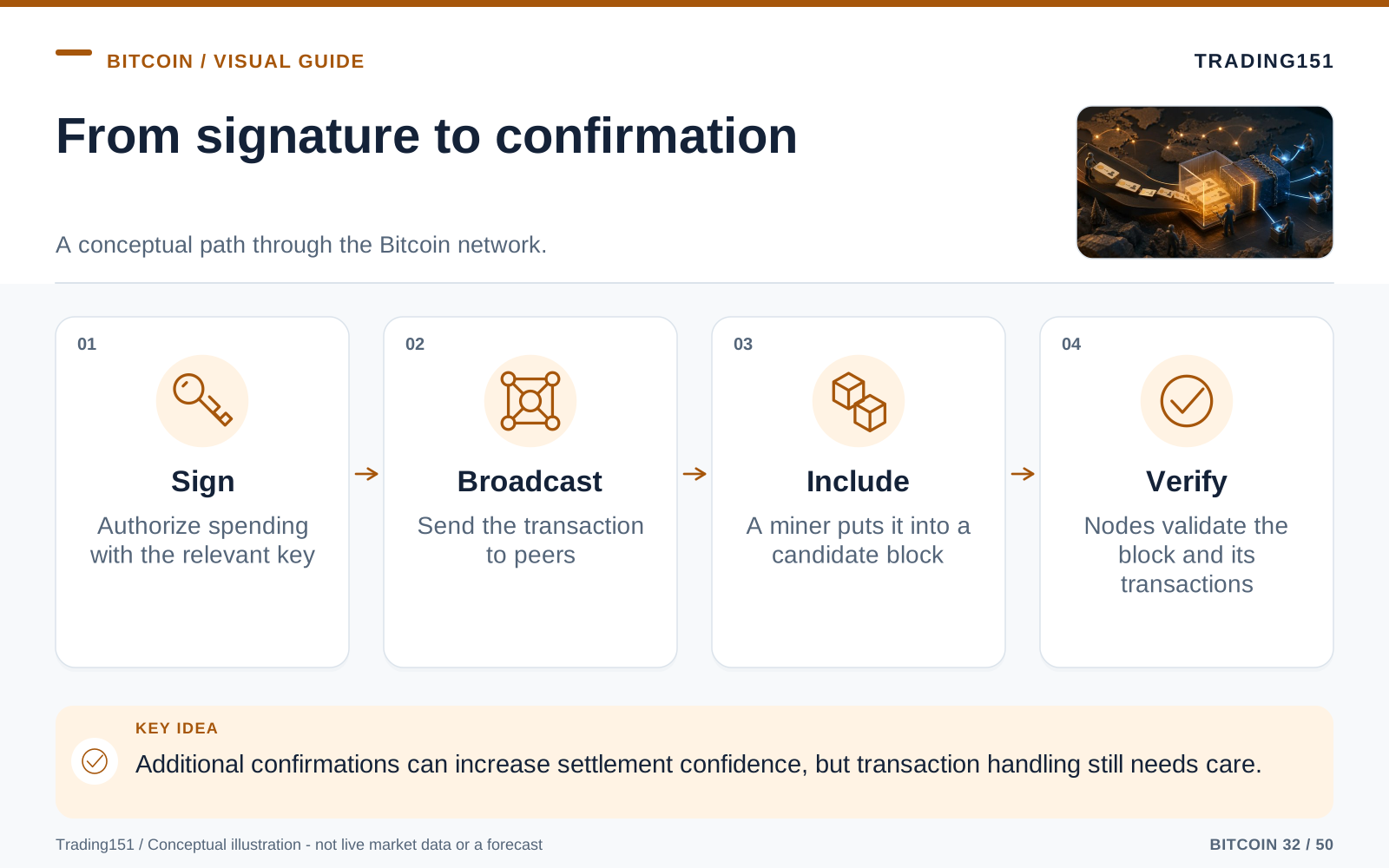
Read this diagram as text
- Sign
- Authorize spending with the relevant key
- Broadcast
- Send the transaction to peers
- Include
- A miner puts it into a candidate block
- Verify
- Nodes validate the block and its transactions
The Ledger: Bitcoin Doesn't Work Like Cash in Your Wallet
There's a common misconception that Bitcoin sits inside a digital wallet just like cash sits in a leather billfold. It really doesn't. There are no tiny digital coins saved on your phone, and your wallet isn't hoarding a private stash of Bitcoin waiting to be handed over.
Instead, Bitcoin tracks unspent transaction outputs—usually called UTXOs—rather than keeping a neat, editable balance sheet with everyone's name on it. Spending Bitcoin is a bit like handing a cashier a twenty-dollar bill for a seven-dollar coffee: the entire twenty is consumed, the shop gets its seven dollars, and the system spits a thirteen-dollar "change" output back to a new address you control. Your wallet software hides all this messy bookkeeping, which is fine until transaction fees or privacy become an issue. But under the hood, the size and history of those individual chunks of Bitcoin dictate exactly how a transaction gets stitched together, even if your screen just shows a simple balance.
Really, Bitcoin only exists as entries on a public ledger called the blockchain. This ledger tracks the entire history of every transaction: which outputs were created, which ones were spent, and which ones are still sitting there waiting to be used. Your wallet is honestly just a digital keychain and a personal accountant. It holds the cryptographic keys that give you the right to move specific chunks of value recorded on that public ledger.
And Bitcoin doesn't do account balances the way your checking account does. It relies on the UTXO model (unspent transaction output). A UTXO is just a piece of Bitcoin you've received but haven't spent yet.
Here’s a quick example. Let's say someone sent you 0.7 BTC last month, and someone else sent you 0.4 BTC today. Your app might cheerfully tell you that you have a balance of 1.1 BTC, but the network itself just sees two completely separate, unspent outputs. If you decide to send 1 BTC to a friend, your wallet will grab both of those outputs, combine them, send the 1 BTC to your friend, and route the remaining 0.1 BTC (minus a network fee) back to you as change.
This is crucial because verification isn't just a matter of checking your balance. The network's computers are checking to see if the specific chunks of Bitcoin you’re trying to move exist, legitimately belong to you, and haven’t already been spent by someone else.
Step 1: Your Wallet Builds the Transaction
Let’s pretend you’re sending 1 BTC to your friend, Sarah.
First, your wallet drafts a transaction. It essentially writes a note that says: "Take these unspent Bitcoin outputs that I own, and create new outputs that give 1 BTC to Sarah, and send whatever is left back to me as change."
This transaction draft includes a few key details:
- Inputs: The unspent chunks of Bitcoin your wallet is using to fund the payment.
- Outputs: The new destinations (Sarah’s address, and your change address).
- Amounts: Exactly how much value is going where.
- A fee: The small difference between the inputs and outputs, which gives miners a financial reason to process the transaction.
At this point, the money hasn't moved. Your wallet has just drafted a proposal. To make it real, it has to prove you have the right to spend those funds.
Step 2: Private Keys, Public Keys, and Digital Signatures
Ownership in Bitcoin boils down to cryptographic keys. But forget about passwords—these are mathematically linked strings of data that let you prove you own something without ever revealing the secret code that controls it.
Think of it like this:
- A public key (or address) is like a mailbox. Anyone can drop Bitcoin into it, and you can share the address with anyone.
- A private key is the physical key to that mailbox. It has to stay completely secret, because whoever holds it can spend the funds inside.
When your wallet builds the transaction for Sarah, it uses your private key to generate a digital signature. This signature mathematically proves that the owner of the private key authorized the payment, but it completely shields the private key itself.
That’s the genius of it. Anyone can look at the signature and verify it using public info, but nobody can reverse-engineer it to steal your private key. The network knows you have the authority to move the money, without ever seeing your secret code.
It’s a bit like signing a paper check, but backed by uncrackable math. A handwritten signature can be forged. A Bitcoin signature absolutely cannot be faked as long as your private key is secure. The math either works, or it doesn't.
Once signed, your wallet shouts the transaction out to the Bitcoin network. The payment has left your phone, but it isn’t final yet. First, it has to survive a severe inspection.
Step 3: The Network Interrogates the Transaction
Full nodes independently check transactions against consensus rules, including the validity of spending conditions and the availability of the inputs. Nodes also apply local relay and mempool policies, which are not identical to consensus rules. Passing those checks does not establish that a payment is lawful, sensible, or intended by the person who was persuaded to sign it.
A full node stores its own complete copy of the blockchain and fact-checks incoming transactions against the rulebook. It doesn't ping a central server to ask if a transaction is okay. It figures it out locally.
When your payment to Sarah hits a node, it gets grilled:
- Is it formatted right? The data has to perfectly match Bitcoin's required structure.
- Are the signatures legit? The node does the math to make sure the spender holds the private key.
- Do the inputs exist? The node checks the blockchain history to ensure the coins were created.
- Are those inputs still unspent? It makes sure you didn't already spend this same Bitcoin yesterday.
- Does the math add up? You can't output more Bitcoin than you input. No printing money out of thin air.
- Does it follow network policy? Nodes also check against rules designed to prevent spam and keep the network running smoothly.
If the transaction fails even one of these checks, the node instantly drops it. There’s no error message, no customer service ticket—the node just ignores it and refuses to pass it on.
If it passes, the node hands it off to other nodes, who run the same checks before passing it on again. A valid transaction ripples across the globe like a juicy rumor, but one that everyone independently fact-checks before repeating.
Step 4: The Mempool (Bitcoin’s Waiting Room)
Once a transaction survives the initial node interrogation, it usually gets dumped into the node’s mempool (memory pool). Think of the mempool as a crowded waiting room for valid transactions that are hoping to get packed into the next block.
People often talk about "the" mempool like it's a single, large bucket. In reality, every node maintains its own personal waiting room. They usually look pretty similar because nodes are constantly gossiping and sharing transactions, but they're never perfectly synced. A transaction might hit a node in Tokyo a few seconds before it hits one in New York.
Right now, your payment to Sarah is floating out in the open. It looks perfectly valid, but it is entirely unconfirmed. It’s not on the blockchain yet. If it’s a tiny payment for a cup of coffee, a merchant might trust it at this stage. But for any serious amount of money, you need a confirmation.
It’s basically a stack of signed checks sitting on a banker's desk. They're probably going to clear, but they aren't officially on the books yet.
Step 5: Fees Dictate Who Goes First
Space inside a Bitcoin block is strictly limited. When the network gets busy, miners physically cannot process every transaction in the waiting room at once. Naturally, they grab the transactions that pay the best fees relative to their data size.
This is why Bitcoin fees aren't tied to how much money you’re sending. Moving 0.01 BTC can sometimes cost more than moving 100 BTC if the smaller transaction is built from a dozen different inputs and takes up more data space. Miners only care about how much you're paying per byte of data.
Your wallet app usually does the math for you and suggests a fee based on how crowded the network is. If the mempool is a ghost town, a tiny fee works fine. If the market is going crazy and everyone is trying to transact at once, you’ll have to outbid people to get your transaction processed quickly.
And remember, this fee doesn’t go to some corporate middleman. It’s a bounty paid directly to the miner who manages to lock your transaction into a block.
Step 6: Miners Build Candidate Blocks
Miners are the heavy lifters of the network. Instead of just verifying and passing along transactions, they actively scoop them out of the mempool and try to bundle them into a brand-new block.
A block is just a package of transactions mixed with some metadata. It includes a digital link to the block that came before it, a summary of the new transactions, a timestamp, and a special random number that miners constantly swap out while trying to solve the network's puzzle.
But a miner can't just slap a block together and add it to the chain. They have to prove they did the work. This "proof-of-work" requirement is what makes the blockchain expensive to attack and easy to verify.
Miners aren't running these large server farms out of the goodness of their hearts. Mining is a severe, capital-intensive business requiring specialized computers, large amounts of electricity, and constant cooling. They do it for the payday. If a miner successfully adds a block, they get all the transaction fees inside it, plus the "block subsidy"—a chunk of freshly minted Bitcoin created by the network.
To claim this, every proposed block includes a special transaction called a coinbase transaction, where the miner essentially writes a check to themselves for the reward. But that check is totally worthless if the network rejects the block. They only get paid if they play exactly by the rules.
Step 7: Proof of Work (The World's Most Expensive Lottery)
People often describe proof of work as a complex mathematical puzzle. That makes it sound elegant. In reality, it’s not about solving a clever algebra equation. It’s brute force. It’s like buying millions of lottery tickets a second until you hit the jackpot.
Here’s how it goes: a miner takes all the data in their candidate block and shoves it through a cryptographic meat grinder called SHA-256. It spits out a "hash"—a long, seemingly random string of letters and numbers.
If you change a single comma in the block data, the hash completely changes. There is absolutely no way to predict what the hash will be. To win the right to add the block, a miner has to generate a hash that happens to start with a certain number of zeroes (based on the network's current difficulty).
So, the miner just keeps changing a random number in the block, hashing it, and checking the result:
Try a number. Hash it. Nope. Try another. Hash it. Nope. Try again.
Mining rigs are doing this trillions of times a second. The entire global network is basically stuck in a high-speed guessing game, burning immense amounts of electricity just to find the winning string of characters.
The network automatically adjusts the difficulty of this guessing game so that, on average, a miner finds a winning hash every ten minutes. Sometimes it takes two minutes, sometimes it takes an hour, but it averages out to ten over time.
Why force miners to do all this wasteful-sounding work? Because the cost is the security. A valid block proves that someone spent real-world money and electricity to create it. That large sunken cost is exactly what makes it nearly impossible for a scammer to go back and rewrite the blockchain's history.
Step 8: The Winner Broadcasts the Block
Eventually, a miner gets lucky and hits the winning hash. They immediately broadcast their victorious block to the rest of the network, hoping everyone else will accept it and start building on top of it.
The miner is essentially shouting: "I found it! Here’s the block, here are the transactions, and here is the mathematical proof that I burned the electricity. Look for yourselves."
And the network does exactly that.
The nodes don't care if the miner is a large publicly traded company or a guy in his garage. They independently verify the math. Every node checks that the proof of work is solid, the block links properly to the previous one, the transactions are perfectly valid, the miner didn't try to overpay themselves, and absolutely no coins were double-spent.
This dynamic is crucial. Miners propose the blocks, but the nodes enforce the rules. A miner could burn a million dollars in electricity creating a block with a bogus transaction in it, and the honest nodes would instantly reject it. The miner would lose all that money for nothing.
If the block is pristine, the nodes add it to their personal copy of the blockchain and broadcast it to everyone else. If your transaction to Sarah was in that block, congratulations—it just got its first confirmation.
Step 9: The First Confirmation
When someone says a transaction has one confirmation, it just means it has been successfully packed into a valid block and added to the blockchain.
One confirmation means the transaction is included in a block on the node's current accepted chain. That reduces some risks compared with an unconfirmed payment, but it is not universal finality. The appropriate waiting policy depends on the amount, the transaction's consequences, and the risk the recipient is prepared to bear.
But one confirmation isn't bulletproof finality. Because Bitcoin is a decentralized, global network, there can occasionally be brief disagreements about what the newest block is.
For instance, two miners on opposite sides of the planet might find a valid block at the same millisecond. Half the network sees Miner A's block first, and the other half sees Miner B's block. For a brief moment, the blockchain splits into two competing realities.
This isn't a flaw; it's just how a network without a central boss resolves a tie.
Step 10: More Confirmations Reduce Reorganization Risk
Nodes select the valid chain with the greatest cumulative proof of work. Chainwork is calculated from the work implied by block targets; it is not a measurement of electricity consumption. Additional confirmations generally make a transaction harder to reverse under the assumed attack model, but no fixed count provides unconditional immunity. A confirmation policy should reflect the recipient's actual exposure.
When competing valid branches appear, nodes may initially follow different tips. Further work can establish a preferred branch. Transactions removed by a reorganization may return to a node's mempool if they remain valid and meet its policies; transactions conflicting with the accepted chain cannot simply be relayed again as valid payments.
This is why people wait for multiple confirmations for big payments. Every new block added on top of yours buries it deeper under a mountain of proof of work.
If Sarah is just selling you a latte, waiting an hour for six confirmations is ridiculous. She’ll probably just accept the transaction the second it hits the mempool. But if she’s handing you the title to a used car, she’s going to wait.
To reverse a transaction with one confirmation, an attacker would have to out-mine the entire network to rebuild that block. To reverse one with two confirmations, they’d have to rebuild two blocks. The deeper it goes, the more mathematically absurd it becomes to attack.
That’s why waiting for "six confirmations" became the gold standard for large Bitcoin transfers. It’s not written in the code anywhere; it’s just a widely accepted rule of thumb. By the time six blocks are stacked on top of a transaction, reversing it would require so much computing power that it is functionally impossible under normal circumstances.
So, What Stops Double Spending?
Now we can finally put the double-spending question to bed.
Let’s say you try to rip off Sarah by sending the same Bitcoin to her and to someone else simultaneously. You broadcast two conflicting transactions, both trying to spend the same UTXO.
The network simply won’t tolerate both. If a node sees the first transaction, it will usually reject the second one from entering its mempool. And the moment one of those transactions gets mined into a block, the other one is instantly permanently invalidated because the original input is now officially marked as "spent."
The blockchain enforces a strict, chronological history. A piece of Bitcoin can only be spent once. Whichever transaction makes it into the confirmed chain first is the winner. The loser is rejected by the entire network.
This is why verification happens at every level. Your transaction is screened before it hits the mempool, screened by the miners who bundle it, screened by the nodes who receive the block, and ultimately cemented in place by an insurmountable wall of computational energy.
Why the System Doesn't Require Trust
You’ll often hear Bitcoin described as a "trustless" system. That’s a terrible word, because it implies nobody trusts anything. What it means is that the system drastically reduces the need to blindly trust any specific human or corporation.
You don't have to trust that the guy sending you money is an honest person. You just wait for confirmations. You don't have to trust that the miners are playing fair. Your node will reject them if they aren't. You don't have to trust a bank to keep the ledger updated. You can download the ledger and check it yourself.
Bitcoin replaces interpersonal trust with mathematical verification. The popular mantra "Don't trust, verify" isn't just a catchy bumper sticker—it is the literal operating system of the network.
Of course, this doesn't mean Bitcoin is foolproof for the end user. You can still absolutely lose your money by losing your private keys, getting phished, or accidentally sending funds to a typo in an address. The network strictly enforces the rules of the ledger, but it can't protect you from yourself.
The system is strict about the math, but totally unforgiving of human error.
The Beautiful Selfishness That Keeps It Running
The most brilliant part of this entire machine is that nobody has to be a good person for it to work.
Node operators enforce the rules because they want an accurate picture of their own money. Miners burn millions in electricity because they want the block rewards. Regular people pay transaction fees because they want their payments to go through fast. Wallet developers write better software because users demand safety and convenience.
It is a flawless alignment of incentives. Thousands of completely independent, self-interested people are economically forced to cooperate to maintain a ledger that is essentially impossible to fake.
If a miner tries to print free money, the network ignores them. If a scammer tries to double-spend, the network only accepts one reality. If an attacker tries to rewrite history, they go completely bankrupt trying to outpace the honest miners.
Bitcoin doesn’t rely on people being inherently good. It just makes honest behavior highly profitable and dishonest behavior catastrophically expensive.
The Journey in a Nutshell
So, what happens when you press that Send button?
Your wallet gathers up your unspent Bitcoin, writes a transaction, and digitally signs it with your secret key. It broadcasts this to the nodes, who ruthlessly check the math, the signatures, and the history. If it looks good, it hangs out in the mempools.
Miners scoop it up (usually because you tipped them well) and pack it into a candidate block. They engage in a frantic, global guessing game until someone finds the winning hash. That miner broadcasts the block, the nodes verify it hasn't broken any rules, and it gets permanently appended to the blockchain.
Your transaction gets its first confirmation. As more blocks pile on top of it every ten minutes, reversing that payment becomes an impossible feat of computational brute force. What started as a simple digital signature on your phone is now an immutable fact in a shared global history.
Valid, broadcast, and confirmed are different states
A valid transaction can remain unconfirmed. It may offer too little fee for current conditions, fail a node's relay policy, or not have reached a miner willing to include it. Each node has its own view of unconfirmed transactions, so there is no single global waiting room that every participant sees identically. A block explorer is a useful observer, not the network itself.
The first confirmation means the transaction appears in a block on the chain being followed. It does not create an absolute mathematical guarantee that the block can never be displaced. Additional confirmations make reversal more difficult under normal security assumptions, but the appropriate waiting policy depends on value, risk, and the recipient's requirements.
Fee management also depends on wallet and transaction details. Some unconfirmed payments can be replaced or accelerated using supported methods; others cannot be changed as easily. Use the wallet's documented procedure and verify the transaction status before sending another payment, which could result in paying twice rather than fixing the first one.
For a recipient, the practical questions are whether the output is addressed correctly, whether the transaction is confirmed, and whether the chosen acceptance policy fits the amount. For a sender, keep the transaction identifier and distinguish a wallet display delay from a network problem. Precise status language prevents a routine delay from becoming a costly sequence of improvised actions.
Confirmation policy belongs to the recipient
A sender may regard a payment as complete once it has been broadcast, while the recipient waits for several confirmations. Neither interface label changes the recipient's exposure. Agree on the acceptance policy before a time-sensitive transaction, especially where goods, services, or another asset will be released in return.
The policy can consider the amount, the consequences of a reversal, and whether the transaction looks unusual. It should also account for what happens during congestion or a delay. A deadline expressed as an exact number of minutes may be unsuitable when block intervals vary.
For recordkeeping, retain the transaction identifier, the intended amount, and the relevant invoice or agreement. A blockchain record can show a transfer without documenting the commercial purpose or whether the recipient fulfilled an obligation. Technical verification and business reconciliation answer different questions. Keeping both records avoids asking the ledger to prove more than it actually contains. 1, 2
Verification Without a Boss
If you look at it from the outside, Bitcoin verification sounds like a nightmare of jargon: signatures, hashes, mempools, nonces, nodes, and proof of work. But strip all that away, and it’s built on one beautifully simple concept: a transaction should only count if absolutely anyone can verify that it followed the rules.
That is Bitcoin's true innovation. It doesn't ask you to trust a black-box corporate database. It lays the ledger bare for the world to see. It turns ownership into unforgeable math, settlement into a public audit, and history into a fortress of electrical energy.
Next time you send Bitcoin, remember that it isn't just pinging a server at a payment processor. It's being signed by you, scrutinized by independent watchdogs, chosen by miners, locked in place by proof of work, and permanently etched into a database replicated all over the globe.
No teller stamps it. No manager approves it. No CEO has the power to stop it.
The transaction becomes real because it survives.
Sources and further reading
Editorial revision: 7 October 2026. Numerical scenarios are hypothetical unless identified as historical. References support the added explanations and selected corrections; rules and product terms should be checked again before acting.