
Short selling seeks to profit from a decline in a security's price, commonly by borrowing shares, selling them, and later buying them back. The mechanics create risks beyond being wrong about direction: borrowing costs can change, shares can be recalled, and losses can exceed the initial proceeds as the price rises. A sound negative view of a company is not enough if the position cannot survive its financing and execution requirements.
A Simple Analogy: Borrowing Sneakers Before the Price Drops
Before we get tangled up in margin accounts, broker fees, and short squeezes, let's step away from the stock market for a second.
Imagine your buddy Dave has a pair of limited-edition sneakers. They're deadstock—still in the box, never worn—and the resale market is going crazy. Right now, those shoes are selling for a cool $1,000. Dave loves them, but he’s not planning to lace them up anytime soon.
Now, you happen to follow the sneaker scene closely, and you hear a major rumor: the brand is dropping a large restock next week. Once the market is flooded with new pairs, they won't be rare anymore, and the price is going to crash from $1,000 down to maybe $400 overnight.
You don't own the sneakers, but you're dead set on the price dropping. So, you pitch Dave a deal.
- You borrow the sneakers. You ask Dave to lend you his pair for a little bit, promising you'll return the same model in the same pristine condition.
- You sell them immediately. You hop online and instantly sell them for the going rate of $1,000.
- You wait for the price to fall. The restock hits, everyone gets a pair, and just like you predicted, the resale value plummets.
- You buy them back cheaper. You find an identical, brand-new pair for $400 and buy it.
- You return the sneakers to Dave. You hand Dave back his shoes—same model, still fresh in the box.
- You keep the difference. You originally sold them for $1,000, bought the replacements for $400, and just made an easy $600 profit.
That is exactly how short selling works, just in everyday terms. You borrow an asset, sell it while it's expensive, wait for it to get cheap, buy it back, return it to the owner, and keep whatever is left over.
But let's imagine the alternate ending. What if the restock gets canceled? What if some large celebrity gets spotted wearing them, and suddenly the resale price rises sharply to $2,500? You still owe Dave a pair of shoes. To keep your promise, you’re forced to buy them back for way more than you sold them for. And that is exactly where the danger kicks in.
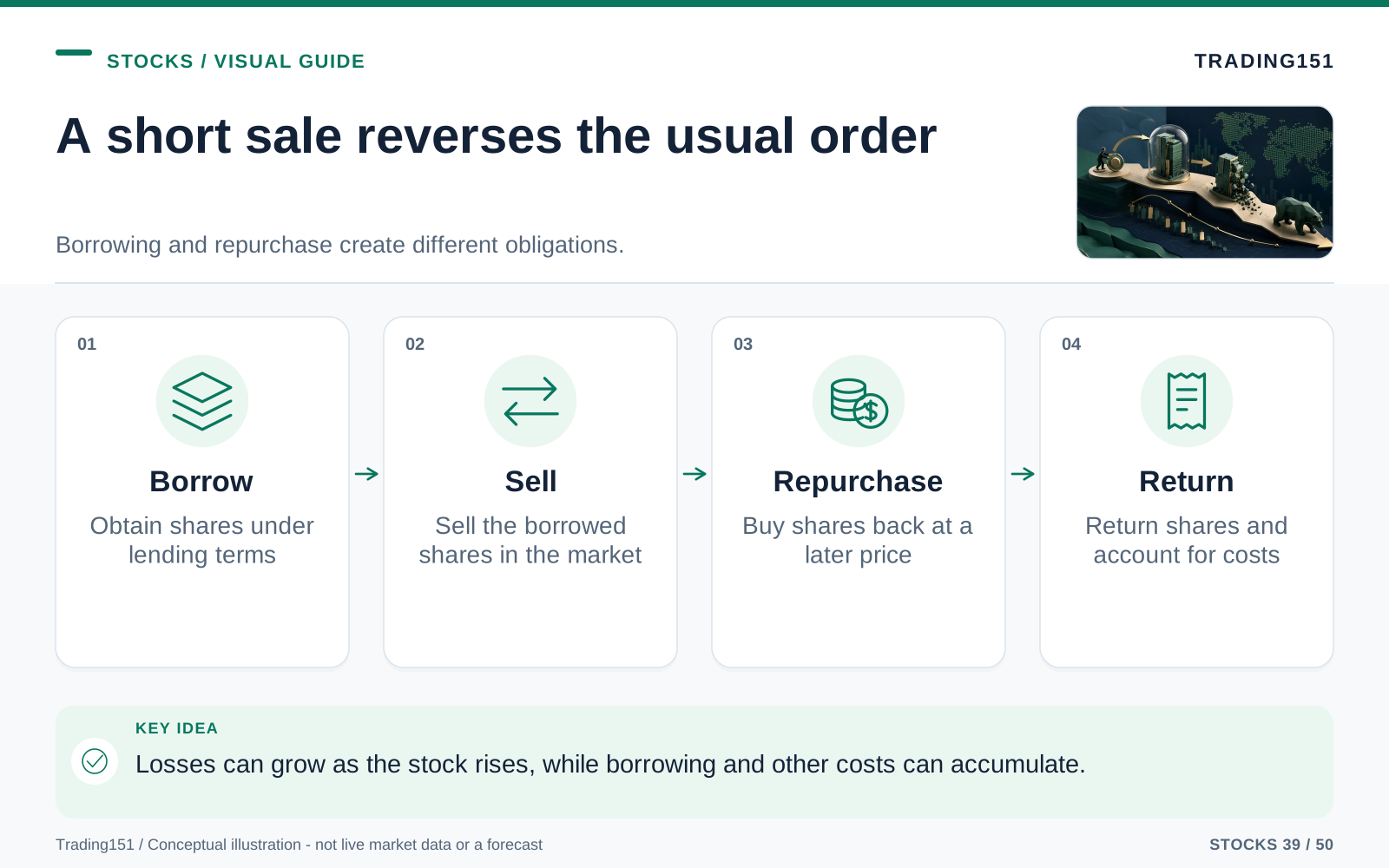
Read this diagram as text
- Borrow
- Obtain shares under lending terms
- Sell
- Sell the borrowed shares in the market
- Repurchase
- Buy shares back at a later price
- Return
- Return shares and account for costs
How Short Selling Works in the Stock Market
Stocks operate on the same logic as our sneaker story, except you're dealing with a brokerage account instead of your buddy. You don't have to cold-call random investors asking for their shares—your broker handles all of that heavy lifting behind the scenes.
Here is how the process plays out.
1. You Need a Margin Account
When you start investing, you usually open a cash account, meaning you can only buy stocks with the actual money you deposited. But if you want to short stocks, you'll need to upgrade to a margin account.
A margin account lets you borrow from your broker. Because shorting involves borrowing shares and taking on theoretically unlimited risk, the broker wants a safety net. They’ll require you to keep collateral—like cash or other stocks—sitting in your account.
This isn’t just a formality. The broker is protecting their own neck. If your short goes horribly wrong and the stock price rises sharply, someone has to pay for those shares. Your broker wants to make sure they aren't the ones left holding the bag.
2. Your Broker Locates Shares to Borrow
Once you hit the button to short a stock, your broker frantically starts looking for shares to borrow. They might pull them from their own inventory, from another client’s margin account, or from giant institutional investors. Some days, a stock is super easy to borrow; other days, it’s nearly impossible. It all depends on supply and demand. If everyone suddenly wants to short the same stock, borrowing shares gets tough—and expensive. The fees to borrow hard-to-find shares can eat up your profits even if the stock price doesn't budge.
People often overlook this step, but it’s crucial. Large, popular companies like Apple or Microsoft are usually easy to borrow. But smaller, more volatile companies—especially those everyone already expects to fail—are hard to borrow. Sometimes the fees are astronomical, or your broker might just flat-out refuse to let you short it.
3. The Borrowed Shares Are Sold
Once the broker secures the shares, they are instantly sold on the open market. Let’s say you decide to short 100 shares of a hyped-up company called OverHype Inc. At $50 a pop. That sale puts $5,000 into your account.
But here’s the catch: that $5,000 isn't yours to spend. It’s tied up in the trade. You sold something you don't own, and you still owe someone 100 shares. Until you close the position, the broker locks that cash down as collateral.
4. You Wait, Hoping the Price Falls
This is where things get stressful. A normal investor loves seeing their portfolio light up in green. As a short seller, you're praying for red. Every time the stock ticks down, you make money. Every time it ticks up, you lose.
If OverHype Inc. Tanks from $50 down to $30, you're looking good. You originally sold those 100 shares for $5,000, and now you can buy them back for just $3,000.
5. You Buy to Cover
To finally close things out, you don't just hit a regular "buy" button. You place what’s called a buy to cover order. This tells the broker you're buying these specific shares just to repay your loan.
So, you spend $3,000 to buy the 100 shares of OverHype at the new $30 price. Your broker takes the shares and gives them back to the original lender. You’re done. You sold for $5,000, bought back for $3,000, and walked away with a nice $2,000 profit (before taxes and broker fees, of course).
A Quick Profit-and-Loss Example
It always helps to look at the hard numbers. Keep in mind that the cash you get from shorting isn't a free loan—it sits in your account as collateral. And if the stock price goes up, your broker is going to demand even more collateral to keep the trade open, often forcing you to close out right when you're most convinced you're right.
Let's say you short 50 shares of a stock at $80.
- The setup: You sell 50 shares at $80, putting $4,000 in your account.
- The win: The stock tanks to $55. You buy back the 50 shares for $2,750.
- The profit: $4,000 - $2,750 = $1,250 in gross profit.
Now let’s look at the nightmare scenario.
- The setup: You sell 50 shares at $80, putting $4,000 in your account.
- The loss: The stock rises sharply to $120. You’re forced to buy back the 50 shares for $6,000.
- The damage: $6,000 - $4,000 = a $2,000 loss out of your own pocket.
Things can spiral out of control fast. When you buy a stock, the absolute worst case is losing your original investment if it goes to zero. But with a short, there is no ceiling. A stock can double, triple, or go up 1,000%, and you are still legally on the hook to buy those shares back at whatever crazy price the market demands.
Why Investors Short Stocks
Short sellers get a lot of hate, and people often paint them as vultures circling a dying company. Sometimes that reputation is totally justified. But the act of shorting isn't inherently evil. People do it for a variety of reasons, and they aren't always just cheering for someone else's downfall.
Speculation
This is the classic short seller you hear about on the news. A trader looks at a company and thinks, "This place is a mess and the stock is substantially overpriced." Maybe they're burning through cash, losing customers, or just riding a wave of ridiculous hype.
This kind of shorting is a direct gamble. You are saying, I think this company is worth way less than people are paying for it. If you're right, you get paid. If you're right but the market doesn't realize it for another two years, you can still go broke waiting for the correction.
Hedging
Not every short is an aggressive attack on a company. A lot of pros use shorting just as an insurance policy.
Imagine a fund manager who holds a lot of tech stocks. They love the companies long-term, but they're worried the whole tech sector is about to have a really bad quarter. Instead of selling off their entire portfolio—which triggers taxes and fees—they might just short a tech ETF. If the tech sector takes a hit, their short position makes money, which softens the blow of their other stocks dropping.
It’s hedging. It doesn't magically erase risk, but it definitely acts like a shock absorber.
Pairs Trading
Some traders like to play matchmaker with a strategy called pairs trading. They buy one stock they like and short a competitor they don't like. The idea isn't to guess what the whole economy is doing—it's just a bet on who will win between those two specific companies.
For example, if you think Home Depot is crushing it and Lowe’s is struggling, you might buy Home Depot and short Lowe’s. As long as Home Depot outperforms Lowe’s, you make money, regardless of whether the broader stock market is up or down that week.
Fraud Detection and Forensic Research
Some short sellers are essentially financial detectives. They obsessively dig into companies that look suspiciously successful. They read every boring legal filing, talk to former employees, visit warehouses, and hunt for red flags.
When they find proof of fraud or shady accounting, they publish large reports exposing the company—and, naturally, they short the stock first to profit off the fallout. It’s controversial because they have a large financial incentive to ruin the company's reputation. But some of the biggest corporate frauds in history only came to light because a short seller refused to buy into the hype.
Why Short Selling Is So Risky
It all sounds so rational on paper, but the stock market doesn't care about logic. A terrible company can stay substantially overpriced for years. A failing business can suddenly get a bailout. Stocks can shoot up for absolutely no reason at all. And as a short seller, you can easily be forced to close out your trade right before the stock finally collapses.
Your Potential Loss Is Theoretically Unlimited
If you buy a stock at $100 and it goes bankrupt, you lose $100. It sucks, but that’s the absolute rock bottom.
If you short a stock at $100, your maximum profit is $100 (if the company goes bankrupt). But your potential loss? Limitless. If the stock hits $200, you’re down $100 a share. If it gets squeezed to $1,000, you’re down $900 a share.
That is the horrifying math of being short: your upside has a strict cap, but your downside is a bottomless pit.
You Can Be Right and Still Lose Money
This is the most frustrating part of trading. You might be 100% correct that a company is garbage. The financials are awful, the product is a joke. But if the stock goes on a crazy irrational rally before it finally crashes, you can still lose everything.
Shorting isn't just about being right. It’s about timing, managing your account size, paying fees, and having nerves of steel. As the old saying goes, the market can stay irrational longer than you can stay solvent.
Margin Calls Can Force Your Hand
Because shorting can generate large losses, brokers watch you like a hawk. If your shorted stock starts climbing, your account might not have enough cash to act as collateral anymore. When that happens, you get hit with a margin call. Your broker basically says, "Give us more money right now, or we're closing your trade."
If you don't have the cash, they will forcibly buy the shares back at whatever the current price is to close the position. They don't care about your brilliant theory that the stock will crash next week. They only care about protecting their own money.
Borrowed Shares Can Be Recalled
Here’s a risk regular buyers never have to think about: the original owner of the shares might want them back. If they decide to sell, and your broker can't find another batch of shares to borrow, you’ll be forced to cover your short immediately, no matter what the price is.
It doesn't happen all the time, but it’s a constant looming threat. You’re playing with someone else’s toys, and they can take them away whenever they feel like it.
Fees Can Eat Into the Trade
Borrowing shares isn't free. While big companies are cheap to borrow, heavily shorted "meme stocks" or distressed companies can carry large borrow fees. These fees can drain your account so fast that the trade stops making sense.
Oh, and don't forget dividends. If the company pays out a dividend while you're shorting it, you have to pay that dividend to the person you borrowed the shares from. Short sellers don’t collect dividends; they pay them.
The Short Squeeze: When Short Sellers Become the Fuel
A short squeeze is the ultimate nightmare for a short seller. It happens when a heavily shorted stock suddenly starts going up. Panicking short sellers rush to buy shares so they can close their positions and stop the bleeding. But all that buying drives the price up even higher, which forces more short sellers to panic and buy, which drives the price up again. It’s a vicious, self-feeding cycle.
It doesn't even take real good news to start a squeeze. Sometimes a slightly less awful earnings report, a wild rumor on social media, or just the fact that too many people are shorting the stock is enough to light the match.
We all saw this play out perfectly with GameStop in early 2021. Wall Street was heavily shorting it because the business was struggling. But retail traders on the internet realized how deeply shorted it was and just started buying. As the price climbed, the hedge funds losing money were forced to buy shares to close their shorts, pushing the stock to astronomical heights and costing the pros billions.
The takeaway from GameStop wasn't that dying strip-mall retailers are suddenly great investments. The takeaway was that high short interest is a powder keg. When everyone is crowded on one side of a trade, a sudden move in the other direction causes absolute chaos.
What Short Interest Tells You
Even if you never plan to short a stock in your life, keeping an eye on short interest is super helpful. It gives you a read on how much the market hates a company and whether a short squeeze might be brewing.
- Short interest: The total number of shares currently shorted. It’s usually shown as a percentage of the shares available to trade.
- Days to cover (Short interest ratio): A rough guess of how many days it would take all the short sellers to buy back their shares, based on the stock's normal daily trading volume.
- Float: The actual number of shares out there available to trade. If a stock has a tiny float but large short interest, things can get volatile fast.
- Borrow rate: How much it costs to borrow the shares. A sky-high borrow rate usually means a stock is deeply hated and everyone is clamoring to short it.
Don't look at these numbers in a vacuum. A heavily shorted stock won't necessarily crash, and it won't necessarily squeeze. It just means the stock is heavily contested and you should tread carefully.
The Ethics of Short Selling
It’s easy to see why people hate short sellers. They profit off a company’s misery. When they drop a negative report, it can vaporize billions of dollars, crush retirement accounts, and cost people their jobs.
And yes, some short sellers are scumbags. There are definitely players who spread fake rumors, exaggerate flaws, and try to incite panic just to cash in on the crash.
But the flip side is equally important. A healthy market desperately needs skeptics. If everyone just blindly cheered for every stock to go up, prices would detach from reality entirely. Short sellers are the ones asking the tough questions, calling out ridiculous hype, and dragging large corporate frauds into the light.
The ethical line isn't about whether you're shorting a stock. It’s about whether you're telling the truth. A direct, well-researched critique is totally fair game. Making up lies to manipulate the price is where it crosses the line.
Short Selling Versus Buying Put Options
If you're confident a stock is going down, shorting isn't your only option. A lot of traders prefer to just buy put options instead. It's much safer because the most you can ever lose is whatever you paid for the option.
A put option gives you the right (but not the obligation) to sell a stock at a certain price before a specific expiration date. If the stock crashes, the option shoots up in value. If the stock goes up instead, the option just expires worthless, and you walk away.
The beauty of a put is the defined risk. You know exactly what you stand to lose the second you buy it. With short selling, your losses can spiral to infinity.
But puts aren't perfectly simple either. You're fighting the clock. Every day that passes, the option loses a little bit of value (time decay). You have to be right about the stock dropping, and you have to be right about when it drops. Still, for most regular investors, buying a put is a far better alternative than risking an uncovered short sale.
Short Selling Versus Inverse ETFs
Another option is buying an inverse ETF. These are special funds designed to do the exact opposite of the market. If the S&P 500 drops 1%, the inverse ETF goes up 1%.
These are great for quick, short-term hedges, but they are terrible long-term investments. Because of the way the daily math compounds, holding an inverse ETF for months or years will usually result in the numbers drifting way off from what you'd expect. Throw in leveraged inverse ETFs (like 2x or 3x funds) and things get even messier.
They’re a decent tool if you want to bet against the market for a few days without borrowing shares, but you really need to understand how they work under the hood before buying them.
Common Mistakes New Short Sellers Make
Short selling is unforgiving. If you're going to try it, make sure you don't fall for the usual traps.
- Shorting just because a stock is "too expensive." An overvalued stock can always become more overvalued. Price alone isn't a thesis.
- Ignoring the catalyst. Why would the market suddenly wake up and agree with you? Without a specific event to trigger a sell-off, you're just sitting there paying fees.
- Going in too heavy. Because your losses can expand infinitely, sizing your position properly is more important here than anywhere else.
- Underestimating the power of hype. "Story stocks" fueled by Reddit or aggressive marketing can ignore fundamentals for years.
- Forgetting about the fees. Borrow rates and dividend payments can slowly bleed a winning trade to death.
- Assuming garbage companies are easy money. The worst companies are often the most heavily shorted, making them prime targets for violent, account-destroying short squeezes.
Should the Average Investor Short Stocks?
Honestly? For the vast majority of people, shorting is absolutely not worth the anxiety. It requires obsessive monitoring, strict discipline, and an iron stomach for risk. It’s also stressful, forcing you to make tough decisions precisely when your emotions are running high.
When you buy a good stock, time is on your side. You can walk away for five years and just let it grow. When you short a stock, time is your enemy. Every day costs you borrow fees, you risk having to pay out dividends, and the overall market generally trends upwards over time.
That doesn't mean shorting is bad; it’s just a hyper-specific tool for advanced traders. A blowtorch is a useful tool, but you don't use it to toast your bread.
If you think a stock is garbage, you don't have to short it. "Doing nothing" is a highly underrated investment strategy. Sometimes the smartest play is to just grab some popcorn, sit on the sidelines, and protect your cash.
The borrowing arrangement can end before your thesis plays out
Suppose 100 borrowed shares are sold at $50, producing $5,000 of sale proceeds before costs. Buying them back at $40 creates a $1,000 trading gain before borrow charges and other obligations. Buying them back at $80 instead creates a $3,000 loss. The initial proceeds are not freely earned cash; they sit within a position subject to collateral and brokerage rules.
The stock can remain expensive or rise further while the business deteriorates. Other investors may disagree, a takeover may be announced, or a crowded short can face pressure as participants buy shares to close. Unlike a fully paid long share position, a short sale does not have a simple maximum loss equal to the purchase price.
Borrow availability is another moving part. A lender's recall or the broker's inability to maintain the borrow can force a close at an inconvenient time. Charges can rise, and the short seller may owe payments relating to distributions on the borrowed stock. Include those terms in the analysis rather than modeling only the eventual price change.
Define the acceptable exposure and exit conditions before entry, while recognizing that orders may not execute at the intended price. Options offer different ways to express a negative view, but introduce premiums, expiration, and their own risks. A bearish opinion can also be expressed by declining to own the stock. Taking no position avoids turning a valid criticism into an unsuitable leveraged trade.
The lender can matter as much as the thesis
A short position depends on arrangements for borrowing the shares. Availability, borrow charges, and recall risk can change while the trade is open. Being right about a company's prospects does not guarantee that the position can be maintained cheaply until the expected decline occurs.
Include those costs and constraints in the plan, along with the possibility of a sharp rise. The maximum gain on a share-price decline is limited, while the price can rise far beyond the entry level. A short should not be treated as an ordinary long position with the direction reversed; its funding and loss characteristics are different. 1, 2, 3
A Bearish View Still Needs a Risk Budget
Short selling is the ultimate proof that the stock market thrives on differing opinions. It gives traders a mechanism to call out overpriced companies, burst hype bubbles, and expose frauds. It keeps the market honest and helps people hedge their portfolios when the economy looks shaky.
But betting against a stock requires more than just knowing it's overvalued. You need a strong reason for the market to care, a timeline for when the drop will happen, and a strict exit plan if things go south. Because a stock can stay overpriced long enough to completely ruin a perfectly logical short seller.
For most of us, there are safer ways to express a negative opinion—like buying puts, using inverse ETFs, or simply selling out of a bad position. You aren't obligated to try and profit off every terrible company you see.
Understanding how short selling works is essential because it explains the hidden plumbing of the market and the chaotic mechanics behind short squeezes. But executing a short sale demands an high level of respect for risk. You're playing with borrowed shares, open-ended losses, and strict timelines. Skepticism is what starts the trade, but paranoid risk management is the only thing that will keep you alive.
Sources and further reading
- SEC Investor Bulletin: An Introduction to Short Sales
- Investor.gov: Stocks
- SEC Investor Bulletin: Trading Basics and Order Types
Editorial revision: 7 October 2026. Numerical scenarios are hypothetical unless identified as historical. References support the added explanations and selected corrections; rules and product terms should be checked again before acting.