
Scalping, swing trading, and position trading differ mainly in how long exposure is held and what kind of move the strategy seeks. Those differences change the demands on execution, monitoring, financing, and patience. None is inherently a suitable source of income. The sensible starting point is the time and attention actually available, followed by evidence that a defined approach can work under realistic conditions.
The Sprinter: Scalping
Scalping is the extreme sport of the trading world. It’s fast, intense, and completely unforgiving of hesitation. If you love rapid-fire decision-making and short, heavy bursts of deep focus, this might be your sweet spot. But if you hate pressure, scalping can feel like doing complex math while standing in front of a speeding train. It’s also sensitive to friction. A slightly wider spread, a split-second of slippage, or just a moment of self-doubt can eat up a huge chunk of your potential profit. Backtests often make scalping look easier than it is because they assume perfect entries and exits. Real scalpers need strong execution, realistic expectations about tick-level movements, and the self-awareness to walk away the second their focus starts to slip.
What Exactly is Scalping?
At its core, scalping is about skimming small profits from tiny price movements over and over again. Instead of waiting for a currency pair to trend for 100 or 200 pips, a scalper’s goal is to snatch up microscopic moves repeatedly throughout a trading session.
Most scalpers live on the 1-minute or 5-minute charts. Trades might last a few seconds or a few minutes—rarely much longer. You aren't trying to catch the whole trend. You just want to bite off a tiny piece, bank the cash, and move on to the next setup.
A hardcore scalper might execute dozens of trades in a single day. Others are a bit more selective, trading in high-frequency bursts during peak market hours, like the London or New York overlaps. But either way, the name of the game is repetition, precision, and flawless execution.
How Scalping Feels
From the outside looking in, scalping seems glamorous. Flashing numbers, fast wins, multiple monitors packed with charts. Living it, however, is a totally different story. It’s mentally exhausting in a way that catches most rookies off guard.
Once you're in a trade, the time for thinking is over. Now it’s pure management mode: hold for a second, cut the loss, exit, re-enter, step back. Just a few seconds of distraction can turn a perfectly good setup into a completely unnecessary loss.
Scalping forces you to live inside the market’s smallest hiccups. Every tick matters. Spread matters. A sudden internet lag matters. A moment of hesitation that wouldn't even register on a daily chart can be expensive on a 1-minute chart.
This is why the best scalpers are usually calm. They aren't chaotic adrenaline junkies; they operate more like surgeons. They are fast, yes, but highly controlled.
Where It Shines
- Instant Feedback: You don’t have to wait three days to find out if your idea was right. You know immediately. If you’re disciplined, this fast feedback loop can really speed up your learning curve.
- Zero Overnight Stress: Scalpers close their positions before logging off. You never have to worry about waking up to a blown account because of a midnight geopolitical shock.
- Endless Opportunities: A volatile session can hand you dozens of setups. You aren't sitting on your hands all week waiting for a single pristine entry.
- Great for Hyper-Focus: People who naturally lock in under pressure often love scalping because it keeps them heavily engaged, leaving no time to overthink.
Where It Falls Short
- Mental Burnout: Even when you’re winning, scalping is draining. A two-hour session can leave you feeling completely wiped out.
- Costs Eat Your Profits: When your target is only a few pips, transaction costs and spreads take a sharply large percentage of your edge.
- No Room for Error: A clumsy entry, a slow exit, or a quick revenge trade gets magnified instantly.
- One Mistake Costs Dearly: Because your profit per trade is small, a single oversized loss can wipe out a whole string of beautiful wins.
Who Should Scalp?
Scalping belongs to people who can make snap decisions without turning reckless. It’s for traders who have guaranteed, uninterrupted blocks of time during peak market hours, and who treat trading like high-performance work rather than a casual hobby.
It is a terrible idea for anyone who gets easily rattled, tries to multitask, chronically overthinks, or feels the urge to "win back" lost money immediately. Scalping will expose every emotional flaw you have, in real time.
The Beginner's Scalping Trap
A lot of new traders gravitate toward scalping for all the wrong reasons. They think shorter trades mean less risk. Not true—a badly managed 30-second trade can wreck your account just as fast. They also assume it’s easier to predict a tiny move than a big one. Also not true, because small moves leave zero margin for error.
Scalping isn't the shortcut beginners hope it is. You can absolutely master it, but it requires a level of strict, robotic discipline that most traders only find after the market has beaten it into them.
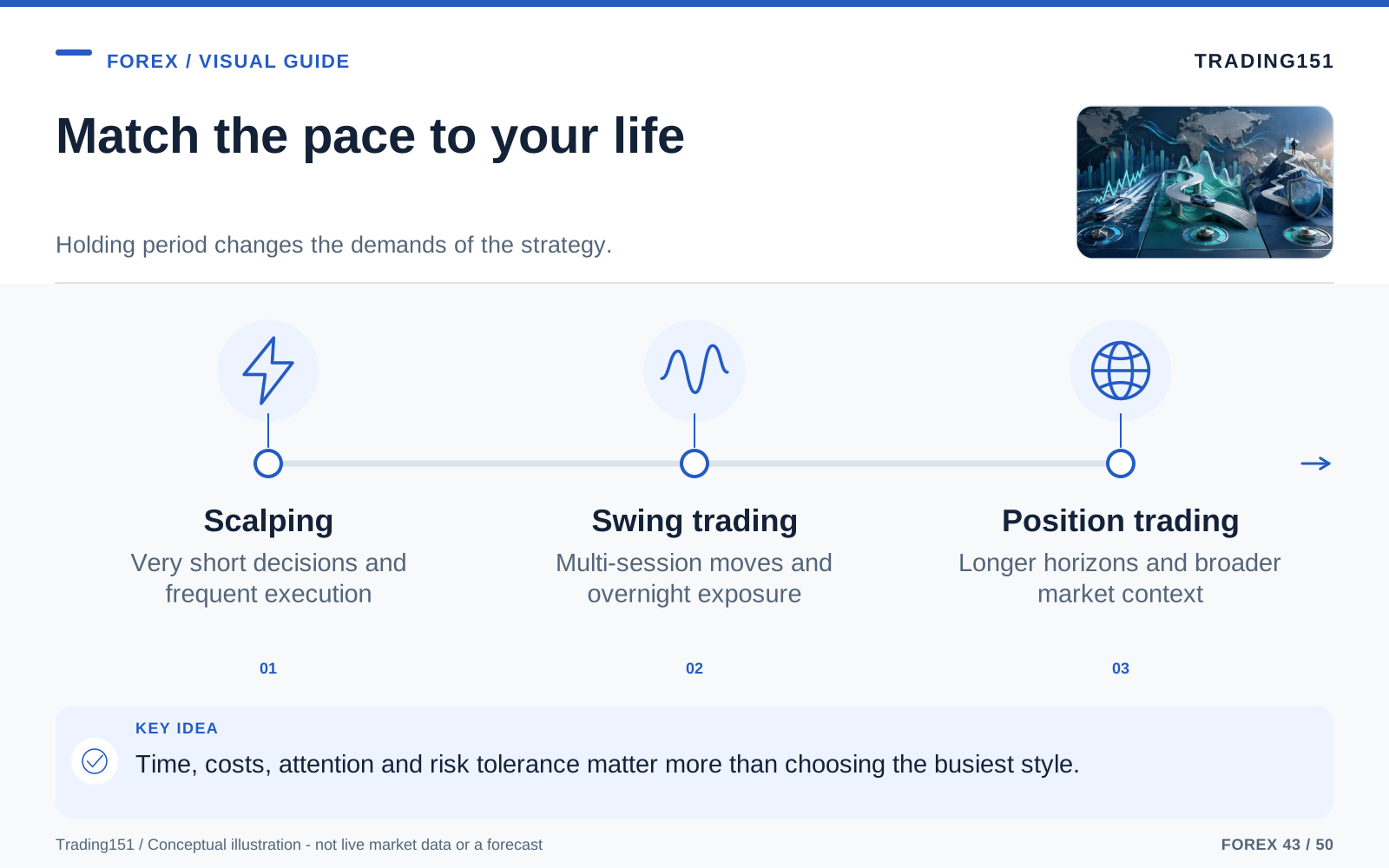
Read this diagram as text
- Scalping
- Very short decisions and frequent execution
- Swing trading
- Multi-session moves and overnight exposure
- Position trading
- Longer horizons and broader market context
The Middle Distance Specialist: Swing Trading
Swing trading is the sweet spot for a lot of retail traders. It’s active enough to keep you engaged, but slow enough to keep you sane. This is often where things finally "click" for people. You're trading screen time for a different kind of market exposure. Your trades will live through overnight rollover fees, economic data drops, and weekend news cycles, which means you have to use wider stops and size your positions accordingly. The slower pace definitely leads to better decision-making, but it doesn't mean you can just set it and forget it completely. You still need strict rules for managing risk and the willpower to ignore the noise on the lower timeframes.
What Exactly is Swing Trading?
Swing trading means holding a position for a few days—sometimes a few weeks—to catch a meaty "swing" in price. Instead of fighting tooth and nail over tiny market burps, swing traders zoom out and look for cleaner, more obvious moves within the broader market structure.
Markets don’t move in straight lines. They push forward, pull back, catch their breath, and push again. Swing traders look for the best places to step into that rhythm—buying pullbacks, playing breakouts, or riding trend continuations—and hold on long enough to grab a big chunk of the move.
You’ll usually be looking at the 1-hour, 4-hour, or daily charts. Timing still matters, but you aren't trying to out-click a trading algorithm. You’re simply trying to position yourself well and let the market do the heavy lifting.
How Swing Trading Feels
Swing trading feels much more intentional than scalping. You have time to map out a setup, set your levels, size the trade, and—crucially—walk away from the screen.
That doesn't mean it’s easy. It just trades the stress of speed for the stress of patience. A good swing trade needs time to marinate. The price might drift sideways for two days. It might dip into the red, test your nerves, and only move in your favor on day three. If you're an adrenaline junkie who needs constant action, this waiting period will drive you crazy.
But for a lot of traders, this is psychologically much healthier. You stop fighting every 5-minute candle and start focusing on structure, context, and proper risk-to-reward ratios.
Where It Shines
- Fits Around Real Life: You don't have to quit your day job to swing trade. You can easily manage it around work, school, or family life without staring at monitors for eight hours a day.
- Bigger Wins per Trade: One solid swing trade can cover a lot of ground, offering much larger profit targets than a scalp.
- Cleaner Technicals: Higher timeframes filter out a lot of the random market noise, making patterns and support/resistance zones much easier to read.
- Time to Think: You have the luxury of planning your moves. There's way less temptation to make impulsive, split-second decisions.
Where It Falls Short
- The Overnight Risk: The market doesn't sleep. If large news hits while you're in bed, the price can gap right past your stop loss before you can even open your app.
- It Tests Your Patience: Good swing trading is 90% waiting. Waiting for the setup, waiting for the entry trigger, and then waiting for the trade to play out.
- Swap Fees Add Up: Holding trades overnight incurs financing costs. If you aren't paying attention, these fees can quietly eat into your profits.
- The Urge to Meddle: Because trades stay open for days, it’s tempting to log in and mess with them—moving your stop to breakeven too early or taking profits prematurely just because you got bored.
Who Should Swing Trade?
Swing trading is perfect for people who want to take trading seriously but refuse to let it consume their entire lives. It’s ideal for traders who can draw up a plan, set price alerts, and give the trade the breathing room it needs to work.
It tends to attract patient, methodical folks. If you can accept that making money might take a few days, and you don’t need the constant dopamine hit of a flashing P&L, swing trading is a fantastic place to plant your flag.
Why It's the Most Popular Choice
There is a very good reason why most retail traders eventually settle into swing trading. It offers the best of both worlds. You’re involved enough to deeply learn the market, but you aren’t chained to your desk. You can analyze the charts with your morning coffee, check your phone at lunch, and still live a normal life.
For anyone wanting trading to complement their lifestyle rather than hijack it, swing trading is usually the most sustainable path.
The Architect: Position Trading
Position trading brings everything to a crawl. If scalping is a sprint and swing trading is a marathon, position trading is an expedition. You aren't hunting for quick momentum or a weekly swing. You are aligning your money with a large, underlying market narrative and holding tight while the day-to-day noise washes over you. These long-horizon trades are driven by macroeconomics—interest rates, capital flows, inflation data, and central bank policies—not a random head-and-shoulders pattern. Positive swap (carry) can be your best friend here, but the journey will inevitably involve deep, painful counter-trend pullbacks. The real skill is knowing the difference between normal market breathing and a fundamental shift that breaks your original thesis.
What Exactly is Position Trading?
Position trading is the absolute longest timeframe of the three. We’re talking about holding trades for weeks, months, or sometimes even over a year. At this level, the line between "trading" and "investing" gets pretty blurry.
Position traders are macro thinkers. They care deeply about what central banks are doing, geopolitical shifts, inflation, and economic growth. They might still look at a chart to time their entry, but the chart isn't the reason they are taking the trade.
A position trader might look at the global landscape and decide that one country's currency is fundamentally undervalued while another is facing an economic crisis. They build a position based on that big-picture view and basically ignore the daily squiggles on the chart.
How Position Trading Feels
This style demands a totally different brand of emotional discipline. It’s not about lightning-fast reflexes; it’s about having unshakeable conviction without crossing the line into stubbornness.
You have to believe in your thesis enough to stomach a month-long pullback, but you also have to be honest enough with yourself to pull the plug if the macroeconomic facts change. That is a notoriously hard balance to strike. It is easy to tell yourself you’re "thinking long term" when, in reality, you’re just holding a losing trade because you refuse to admit you were wrong.
At its best, position trading feels liberating. You aren't a slave to the charts. You do deep research, pick your spot, size the trade conservatively, and let time do the heavy lifting. At its worst, it’s just a convenient excuse for sloppy risk management.
Where It Shines
- Almost Zero Screen Time: This is the lowest-maintenance style there is. You never have to babysit a trade.
- Large Profit Potential: When you successfully catch a long-term macro trend, the payouts can be huge compared to the actual amount of work you had to put in.
- The Ultimate Filter: Intraday volatility means absolutely nothing to you. You’re focused entirely on the actual destination, not the bumps in the road.
- Perfect for Busy Lives: If you run a business, travel constantly, or just don't want to look at charts every day, this might be your only realistic option.
Where It Falls Short
- Takes a Bigger Bankroll: Because your stop losses have to be wide to survive months of volatility, you have to trade small position sizes. If you have a tiny account, waiting three months to make $40 can feel deeply unrewarding.
- Requires Iron-Clad Patience: I don't mean fake patience. I mean the kind of patience that lets you watch a trade go absolutely nowhere for six weeks without second-guessing your entire life.
- You Need to Understand Economics: You can't just draw lines on a chart here. If you are trading macro trends, you need to understand what drives global currencies.
- Capital Gets Tied Up: Your margin is locked into this trade for a long time, meaning you can't use that money for other opportunities that might pop up.
Who Should Position Trade?
Position trading attracts the analytical minds—the people who love reading economic reports and thinking in broad, global cycles. It appeals to traders who find short-term trading stressful or trivial and prefer a slow, deeply researched approach.
It’s also the default style for anyone with a relentlessly busy schedule. If you physically cannot check the markets during the day, position trading allows you to participate without dropping the ball on your actual life.
The Hidden Trap of Position Trading
Position trading looks easy from the outside. You barely place any trades, you don't look at charts, and you make fewer decisions. But the difficulty is entirely psychological and analytical. Your thesis has to be bulletproof. Your risk management has to be flawless.
Anybody can say, “I think the Euro is going up this year.” That’s the easy part. The hard part is knowing why, knowing exactly what economic data would prove you wrong, and sitting on your hands while the market takes the scenic route.
The Real Difference Isn’t Timeframe. It’s Lifestyle.
People love to compare these trading styles as if the only difference is how long you hold a trade. Minutes versus days versus months. Sure, that's technically true, but it misses the actual point.
These styles demand that you live your life differently.
A scalper needs uninterrupted silence, fast internet, and nerves of steel. A swing trader needs a solid daily routine, patience, and the ability to trust their analysis while they go mow the lawn. A position trader needs a macro worldview, deep conviction, and a lot of maturity.
So, the question you should be asking isn't, “Which style is the most profitable?” The question is, “Which style can I execute without constantly fighting my own personality?”
A Practical Way to Choose
If you’re still totally lost on which path to take, start by looking at your actual life, not your trading ambitions. Ambitions will lie to you; your daily schedule won't.
1. Be Honest About Your Time
- You have 2-3 hours of absolute quiet during major market opens: Scalping is definitely on the table.
- You can check the markets over coffee in the morning and briefly in the evening: Swing trading is going to feel very natural.
- You only have time to review things on the weekend: Position trading is probably your best bet.
2. Be Honest About Your Personality
- You think fast and stay ice-cold under pressure: You’ve got the right wiring for scalping.
- You love making a plan and letting it unfold: Swing trading will suit you perfectly.
- You are heavily analytical and naturally patient: You should seriously look into position trading.
3. Be Honest About Your Skill Level
- If you are a total beginner: Start with swing trading. It gives you the space to think, breathe, and learn without getting chewed up by high-speed algorithms.
- If you already have great discipline and execution skills: Scalping is a viable next step.
- If you have a background in economics and a larger account: Position trading might be a much better fit than you realize.
4. Be Honest About Your Bankroll
Account size isn't everything, but it definitely changes the psychology. Tiny accounts usually tempt people into scalping because they want to flip their money fast. Larger accounts make the slower, compounding gains of swing and position trading much easier to appreciate. That doesn't mean you can't swing trade a $500 account; it just means it will test your patience differently.
When you trade with a small account, a 2% gain on a month-long position feels like pennies, which pushes people to overtrade. On the flip side, a well-funded trader might love position trading because a quiet 5% return is a meaningful amount of money.
Risk Works Differently for Everyone
This is something nobody talks about enough: your relationship with risk changes completely depending on your style.
Scalpers use very tight stop losses, but they take a large amount of trades. That means their discipline has to be impenetrable. You can't let a trade run just because it's only a few pips away. Swing traders use wider stops and fewer trades, making proper position sizing critical. Position traders use wide stops, meaning they have to trade the smallest relative lot sizes to keep their overall account risk safe.
In plain English: "short-term" does not mean "safe," and "long-term" does not mean "risky." Risk isn't about the clock. It’s about how much money you lose when you're wrong, how strictly you honor your stop loss, and how often you jump into the market.
The Emotional Tax
Every style comes with a psychological price tag.
Scalping will leave you wired, overstimulated, and mentally fatigued. Swing trading will tempt you to micromanage perfectly good setups just because you're bored. Position trading will blur the line between being patiently right and stubbornly wrong. You won't see these emotional taxes in a backtest, but they will absolutely show up in your live account.
This is why picking a style is really an exercise in self-awareness. Eventually, the market will find out if your trading style clashes with your personality. If you force a fit, even a highly profitable strategy will crumble because you will inevitably sabotage it.
Can You Mix and Match?
Yes, but you have to be careful. You can mix styles, but you have to keep the rules—and ideally the accounts—completely separate. A 5-minute scalp that goes wrong should never magically become a "swing trade" just so you don't have to take the loss. And a multi-month position shouldn't be panic-sold because of a red candle on the 1-minute chart.
Some veterans pull this off beautifully. They might use a weekly chart to find the overall trend (position), use the 4-hour chart to wait for a pullback (swing), and then zoom into a 15-minute chart to get a laser-precise entry (scalp).
But that only works if you have strict boundaries. Blending styles becomes disastrous when a trader is just drifting without a plan, constantly changing the rules to justify whatever they are feeling in the moment.
A Simple Test to Find Your Style
If you're still on the fence, run a real-world test. Open a demo account, or use pennies on a live account. Spend two weeks strictly scalping. Then spend two weeks strictly swing trading. (Position trading takes too long to test quickly, but you get the idea).
Don’t just look at the P&L. Look at how you felt.
- Were you calm and collected, or sweating through your shirt?
- Did you follow your rules, or did you constantly mess with your trades?
- Did the routine fit smoothly into your day, or did it cause arguments at the dinner table?
- Did you finish the week feeling sharp, or completely burnt out?
- Did you enjoy the process enough to do it every day for the next five years?
Those answers matter infinitely more than most people realize. A strategy that looks like a goldmine on paper but makes you miserable in real life is not your strategy.
Match the holding period to the costs and the rest of your day
A short holding period makes small execution costs more important relative to the intended move. A strategy seeking a few pips may depend on fills and spreads that are difficult to obtain consistently. It can also require sustained attention at exactly the hours when the opportunity is supposed to appear. Calling it quick trading does not mean it requires little time.
Longer holding periods reduce the number of decisions but introduce other exposures. Financing charges can accumulate, and economic or political events can occur while the position is open. A stop placed before an overnight gap may not execute at the planned level. Less screen time is not the same as less market risk.
Test the routine as well as the signal. Record whether the strategy's required hours fit work, sleep, and other responsibilities. A method that repeatedly depends on unavailable attention is not practical even if its historical rules look attractive. Missed entries and improvised exits belong in the assessment.
Avoid changing style to escape an uncomfortable result. A scalp that moves against you does not become a position trade merely because holding it longer delays recognition of the loss. Each approach needs its own entry, invalidation, size, and review process. The best fit may also be not to trade forex at all, particularly when the expected demands exceed the resources available.
A style should fit the available attention
The time required by a strategy is a risk constraint, not merely a lifestyle preference. A person unable to monitor intraday positions should not rely on a method that requires immediate discretionary exits. Trial the routine alongside ordinary responsibilities before committing significant money. The question is whether the work can be done reliably on difficult days, not only when the calendar is unusually clear. 1, 2, 3
The Bottom Line: The Best Style is the One You Can Live With
There is no undisputed champion here. Scalping isn’t inherently smarter. Swing trading isn’t inherently safer. Position trading isn’t inherently wiser. They are just three different vehicles to get you to the same destination: extracting money from the market without losing your mind.
The ultimate choice is simply the one that aligns with your natural personality, your daily schedule, your attention span, and the actual amount of emotional energy you can dedicate to the screens every day.
That is the step almost everyone skips. People pick the style that sounds the coolest, rather than the one they can execute flawlessly.
A trader who calmly and consistently executes a boring swing trading plan for a year will always outperform the guy who substantially bounces between scalping, swinging, and holding every two weeks because he's chasing a thrill. Consistency always beats intensity. Every time.
So, as you weigh these three approaches, stop asking which one makes you feel like a "real trader." Start asking which one allows you to behave like a disciplined one.
That is where real profitability begins. Treat your style as a lifestyle choice, not just a technical strategy. Factor in your sleep, your job, your family time, and how you feel after taking a loss. A system might look like a money-printing machine on a spreadsheet, but if it slowly ruins your quality of life, you aren't going to stick with it. Sustainability isn't just a buzzword—it's your actual edge. It’s the only thing that ensures you’ll stay in the game long enough for the probabilities to finally work in your favor.
Sources and further reading
- BIS: April 2025 FX turnover, September 2025 preliminary release
- CFTC: Eight things to know before trading forex
- SEC Investor Bulletin: Stop, Stop-Limit and Trailing Stop Orders
Editorial revision: 7 October 2026. Numerical scenarios are hypothetical unless identified as historical. References support the added explanations and selected corrections; rules and product terms should be checked again before acting.