
A forex trading plan turns broad intentions into decisions that can be checked: what may be traded, what must happen before entry, how exposure is limited, and when trading stops. It should also cover the unglamorous failures, such as a lost connection or an unavailable price feed. A workable plan is specific enough to follow without pretending that every market situation can be predicted.
Why a Trading Plan Matters More Than Most Beginners Think
New traders usually spend their first few months obsessing over entries. They hunt for the perfect indicator, join signal groups, and stare at chart patterns, convinced the secret to wealth is just finding the right setup. Spoiler alert: it isn't.
The real account-killer is inconsistency. You trade one currency pair on Monday, juggle four on Tuesday, completely ignore your stop-loss on Wednesday, and then overtrade on Thursday to "make it all back." Without structure, you're just throwing darts. You can't measure your progress, which means you can't improve.
A trading plan fixes this chaos. It sets a baseline and turns trading from an emotional rollercoaster into a boring—but profitable—repeatable process.
At the bare minimum, your plan needs to answer these five questions:
- What exact setup am I looking for?
- Under what specific conditions will I sit on my hands and stay out?
- How much money am I willing to lose if I’m wrong?
- Where am I taking profit if I’m right?
- How will I review my trades and get better over time?
If your answers are vague, your profits will be too.
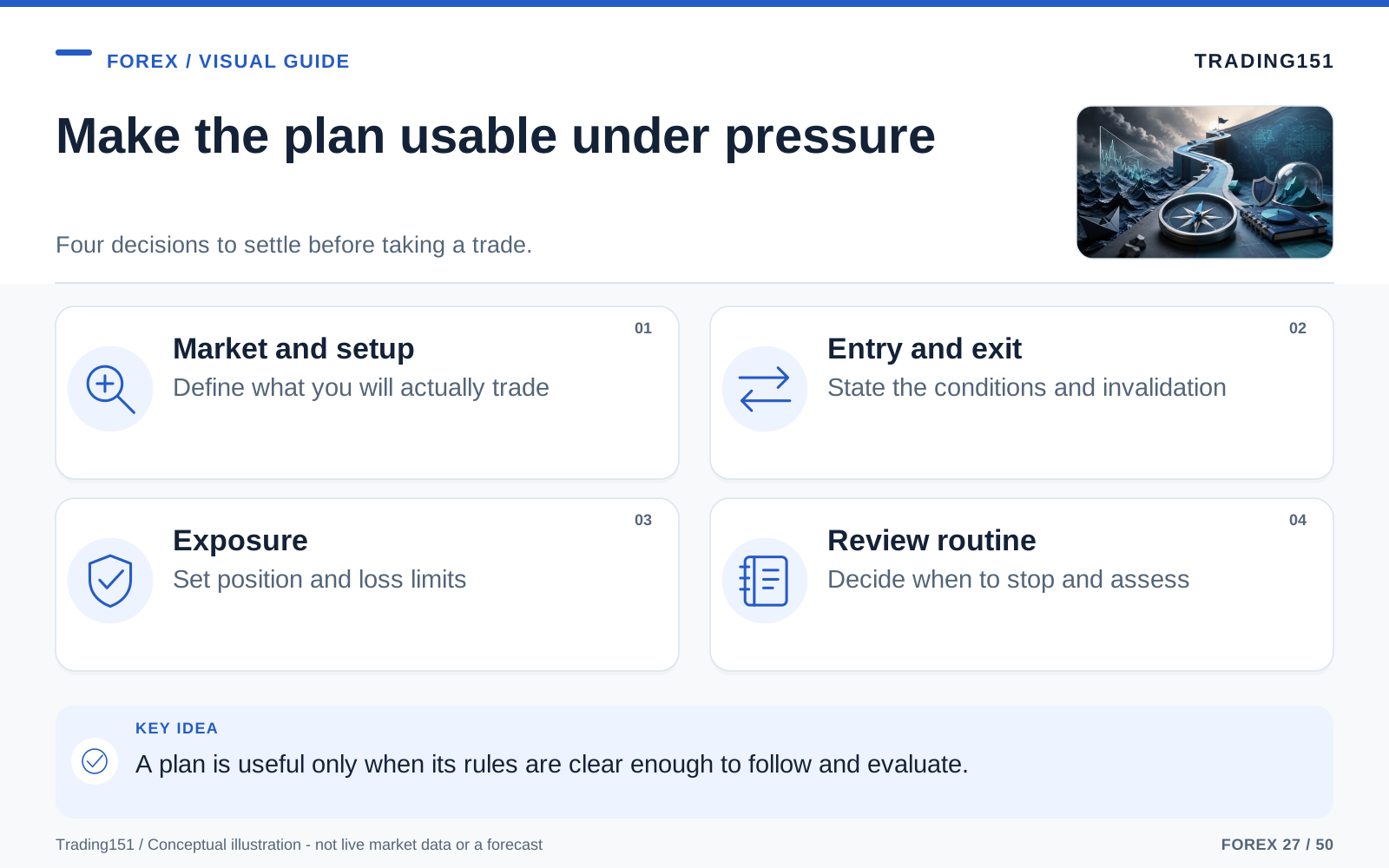
Read this diagram as text
- Market and setup
- Define what you will trade
- Entry and exit
- State the conditions and invalidation
- Exposure
- Set position and loss limits
- Review routine
- Decide when to stop and assess
Start With the Trader, Not the Chart
Before you even look at a moving average, you need to take a hard look at the person executing the plan: you. A strategy that makes one trader rich can completely bankrupt another if their personalities clash.
Some people thrive on adrenaline. They think fast and stay sharp through the chaos of rapid market moves. Others need time to breathe, analyze, and let a trade play out over a few days. Neither is better. It's just about what fits your wiring.
Ask Yourself a Few Basic Questions
- How much time do I have? Be direct here. If you work a 9-to-5, scalping the one-minute chart is going to ruin your workday and your account.
- How do I handle stress? Some folks are ice-cold under pressure. Others start sweating and moving their stop-losses the second a trade goes slightly red.
- Am I naturally patient or reactive? If sitting around waiting for a setup drives you crazy, swing trading might bore you to tears. But if fast-paced action exhausts you, day trading is going to burn you out fast.
- How much capital am I starting with? A tiny account doesn't mean you get a free pass to take reckless gambles. In fact, it means you have to be even more careful.
- What’s the end goal here? Are you looking for extra side money, a long-term skill, or a full-time career? Your expectations need to match your goals.
Why does this matter? Because a plan you can’t stick to is just a fantasy. It has to match your actual life.
Choose a Trading Style That Fits Your Life
Once you know your limits, it's time to pick a lane.
Scalping
Scalping is all about grabbing quick profits in minutes or even seconds. It’s for traders who can lock in, act instantly, and ignore the urge to second-guess every twitch of the chart. But it demands large screen time and laser focus. If you're checking your phone every five minutes, scalping will chew you up.
Day Trading
Day traders open and close everything before they go to sleep. It’s perfect if you want to be actively involved but hate the anxiety of waking up to a large gap against your position. It still takes serious prep and focus, but it’s a bit less frantic than scalping.
Swing Trading
Swing traders hold positions for days, sometimes weeks. This style gives trades breathing room. It’s arguably the most realistic choice if you have a full-time job, a family, or a life outside of charts. Plus, it’s psychologically easier because you aren’t living and dying by every five-minute candle.
Position Trading
The slowest of the bunch. Position traders play the long game, catching large trends over months. You need deep pockets of patience and the ability to completely ignore short-term market noise.
Keep in mind, there's no trophy for trading the fastest timeframes. Beginners often confuse "more action" with "more money." More often than not, it just means more mistakes.
Set Goals That Are Useful, Not Delusional
Want to ruin a trading plan fast? Tie it to a delusional money goal. If your mission is "turn $500 into $50,000 by Christmas," you are going to take ridiculous risks. It’s inevitable. Process goals, on the other hand, give you something you can measure and control. "Be disciplined" is a nice thought, but "only take trades that tick every box on my checklist" is a real standard you can grade yourself against. Keep in mind that performance goals need time. Chasing a specific monthly profit usually ends up with you forcing bad trades on the 30th just to hit a made-up number. Focus on the quality of your decisions instead.
A smart way to handle this is to split your targets into process goals and performance goals.
Process Goals
These are the ones that matter because you have 100% control over them.
- Never risk more than 1% on a trade for the next 30 days.
- Only place the trade if the setup meets every checklist rule.
- Journal every trade—yes, even the embarrassing ones—with screenshots and notes.
- Sit on the sidelines during major news events.
- Spend 30 minutes every Saturday reviewing the week's trades.
Performance Goals
These are fine to have, but they take a backseat to your process.
- Keep a positive win/loss expectancy over a batch of 30 trades.
- Maintain an average risk-to-reward ratio of at least 1:2.
- Cap your maximum weekly drawdown so one bad week doesn't blow the account.
- Focus on taking high-quality setups instead of obsessing over a large percentage return.
The pros don’t build their confidence around one lucky winning streak. They build it on strong daily habits.
Decide What You’ll Trade
Trying to watch 28 currency pairs at once is a great way to get overwhelmed and take sloppy trades. Having more options doesn't make you a better trader. Actually, when you're starting out, fewer is definitely better.
Pick a handful of pairs and get to intimately know how they move.
- EUR/USD is a great starting point. It’s substantially popular, super liquid, and the spreads are usually inexpensive.
- GBP/USD has a bit more kick to it. It moves faster and can feel a lot more aggressive.
- USD/JPY has its own unique heartbeat and often completely ignores what the European pairs are doing. It's worth studying in isolation.
- GBP/JPY (often called "The Beast") is notorious for large swings. It’s fun when you're right, but it will violently punish a bad entry.
The goal isn’t to collect currency pairs like trading cards. It’s about realizing that every market has a distinct personality, volatility, and way of reacting to news. Treat them differently.
Start small. Pick one to three pairs, master their quirks, and only expand when you're consistently profitable with them.
Define Your Edge in Plain Language
People love to overcomplicate this step. Your strategy doesn’t need to sound like it was written by a Wall Street quant. It just needs to be crystal clear and repeatable.
"I trade breakouts" means nothing. "I buy when the momentum looks strong" is just a guess, not an edge. Your setup needs to be so specific that if you gave your plan to a stranger, they’d point to the same entry you would.
Here’s a solid example:
I only look for buys when the price is sitting above the 200 EMA on the 4-hour chart. I wait for a clear pullback into a previously broken resistance level, then I drop to the 1-hour chart to look for a bullish engulfing candle. I only take the trade if my stop-loss gives me at least a 1:2 risk-to-reward ratio.
See the difference? It defines the big picture, the direction, the exact trigger, and the risk parameters. No guessing required.
Keep Your Strategy Simple Enough to Follow Under Pressure
A lot of traders slap 15 indicators on their screen—moving averages, RSI, MACD, Bollinger Bands, Fibonacci levels—and then stare blankly because three are telling them to buy and two are screaming sell.
Simple isn’t stupid. Simple is focused.
A perfectly fine strategy could just be:
- Market structure (are we making higher highs?)
- Support and resistance zones
- One tool to confirm the trend
- One specific candlestick pattern to trigger the entry
If you apply that with ruthless consistency, it’s all you really need.
Risk Management Is What Keeps You in the Game
Strategy gets all the likes on social media, but risk management is what pays the bills. You need rules that cap your losses per trade, but also limits on how much overall exposure you have at any one time. What happens if you hit your daily loss limit? Do you shut down the laptop, or do you start revenge trading? A plan is completely useless if it tells you exactly how to get into a trade but leaves you to figure out the risk when your heart is pounding and you're down 3%.
This is the line between a minor frustrating week and a blown account. Traders rarely lose all their money on one bad setup. They go broke because they double down, ignore their stops, or refuse to take a small loss until it becomes a catastrophic one.
Risk Per Trade
Decide exactly how much you're willing to lose on one idea. For most, risking 1% (or even less) of your account is the sweet spot. You might think that's too small, but once you start risking 3% or 5%, a totally normal losing streak will decimate your account and completely destroy your psychology.
The real superpower of risking small amounts isn't just the math. It’s peace of mind. You want the trade to matter, but you don’t want it to ruin your weekend.
Risk-to-Reward Ratio
You don’t need a 90% win rate to make money. If your average winner is twice the size of your average loser (a 1:2 ratio), you can be wrong half the time and still grow your account. It gives you a large psychological cushion.
Obviously, not every trade gives you the same payout, but your plan has to define the bare minimum you'll accept before risking a dime.
Maximum Daily and Weekly Loss Limits
You need circuit breakers to stop you from spiraling when things go wrong. Write these down:
- Stop trading for the day after two full stop-outs.
- Stop trading for the entire week if the account drops by 4%.
- Cut position size in half during a losing streak, rather than doubling up to "catch up."
Bad decisions travel in packs. After a painful loss, the urge to jump right back in and fix it is strong. That’s exactly when you need a hard rule to walk away.
Position Sizing
Your lot size shouldn't be based on how "sure" you feel about a trade. Confidence is a terrible risk model.
Whether it’s an A+ setup or a B- setup, the math stays the same: figure out where your stop goes, calculate the dollar amount you're willing to risk, and size the position to match.
Build Clear Entry Rules
A strict set of entry rules won’t guarantee every trade is a winner, but it will filter out the garbage setups you take when you're just bored. Write these rules like a checklist that a child could follow. Saying a chart "looks bullish" is subjective. Saying "price closed above the 50 SMA on the 1-hour chart" is a fact. Leave a little room for gut feeling if you must, but put strict boundaries around it. Otherwise, your brain will convince you that any chart looks like a good buy if you stare at it long enough.
The absolute best way to handle entries is a simple yes/no checklist. If a trade misses even one criteria, you skip it. No mental gymnastics. No "well, it's close enough."
For instance:
- Is the market clearly trending, or is it a choppy mess?
- Does this specific setup match the environment my strategy requires?
- Is the price sitting at a key, logical level?
- Do I have a crystal-clear entry signal or candlestick?
- Can I place my stop-loss in a safe, logical place, or am I just squeezing it in to make the math work?
- Does this setup give me my minimum 1:2 risk-to-reward?
- Is Jerome Powell about to speak and ruin my chart in five minutes?
- Am I calm and focused, or am I taking this because I'm mad at the market?
That last one is a lifesaver. You can have the most beautiful, technical setup in the world, but if you're taking it from a place of anger or desperation, you're going to mess up the management.
Plan Your Exits Before You Enter
The biggest red flag in trading is knowing exactly why you bought, but having zero clue when you're going to sell. Once real money is on the line, every tiny tick of the chart feels like a crisis. You end up trapped in a tug-of-war between fear and greed.
Stop-Loss Placement
Your stop-loss belongs exactly where your trade idea is proven wrong. Period. It doesn't belong where the dollar loss "feels okay," and it certainly shouldn't be a random 20-pip default you blindly use every time.
If you're buying because you expect a support level to hold, your stop goes underneath that support. If it breaks, your thesis was wrong. Accept it.
And for the love of all things holy: once the trade is live, never widen your stop just to avoid taking the hit. That’s not "giving the trade room to breathe." That’s denial, and it will cost you a fortune.
Take-Profit Rules
Whether you use a hard target, take partials, or trail your stop, you need to know your exit strategy before you click buy. You could:
- Close the whole trade at a predetermined zone.
- Cash out half when you're up 1:1 and let the rest run.
- Tuck your stop behind new higher lows as a strong trend develops.
The key is consistency. If you constantly panic and cut your winners for peanuts, but stubbornly hold your losers until they hit your full stop, the math is going to bleed your account dry.
Know When You Trade Best
The market is open 24/5, but you absolutely shouldn't be. Some traders kill it during the London session because the volume is pure and clean. Others love the volatility of the New York open. Maybe you prefer the quiet, slow grind of the Asian session.
Your plan needs to lock down:
- Which specific sessions you are allowed to trade
- Which timeframes you use to make decisions
- How often you're allowed to check the charts
- When you definitively close the laptop for the day
This is bigger than it sounds. Staring at charts all day is a guaranteed way to start hallucinating setups that aren't really there.
Create a Routine So Trading Doesn’t Become Impulsive
What you do before and after you trade is just as important as the trade itself. If you stumble out of bed, open your broker app, and just buy something because a green candle caught your eye, you're treating the market like a casino.
Before the Session
- Pull up the economic calendar. Know when the high-impact news is dropping.
- Mark your key daily and 4-hour levels so you know the big picture.
- Filter down your pairs to the one or two that look ready.
- Mentally rehearse what needs to happen for you to take a trade.
- Gut check: Are you exhausted, angry, or rushing to get to work? If yes, don't trade.
During the Session
- Let the trades come to you. Don't chase a moving train.
- Run through your checklist right before you enter.
- Calculate your position size properly.
- Once you're in, leave it alone. Don't micro-manage just because the price is wiggling.
After the Session
- Log your trades. Every one.
- Save screenshots of the entry and the exit.
- Did you follow your rules? Be honest.
- Grade your execution, not your PnL.
That last point is crucial. You can follow your plan perfectly and still lose money. You can break all your rules, take a stupid risk, and win. If you only judge your day by whether you made money, you'll eventually build terrible, destructive habits.
Journal Everything That Matters
I know journaling sounds like homework, but it’s the only way to get better. If you rely on your memory, you’re screwed. Our brains are wired to block out the dumb things we do and exaggerate our genius moments.
It doesn't need to be a masterpiece, but it needs enough raw data to spot your own bad habits over time.
Make sure you're tracking:
- Date, time, and currency pair
- Long or short?
- Your exact entry, stop-loss, and target
- Position size and dollar amount risked
- What kind of setup it was
- Screenshots of the chart at entry and exit
- Did you follow your rules? (Yes/No)
- Your mindset. Were you calm, anxious, greedy, bored?
That mindset piece is gold. You might realize you always take terrible trades when you're in a rush before work, or that you consistently revenge-trade after two back-to-back losses. You won't notice those toxic loops until you see them on paper.
Backtest Before You Trust the Plan
Please don't take a brand-new idea straight into a live account. It needs to be stress-tested first.
Whether you scroll back in time to backtest, forward-test on a demo account, or trade with microscopic penny sizes, the goal is the same: you need undeniable proof that your strategy has an edge, and proof that you are capable of executing it.
Testing helps you figure out the realities of your system:
- Does this setup absolutely fail in a ranging market?
- Which currency pair gives you the cleanest wins?
- What does a normal losing streak look like? (So you don't panic when it happens live).
- What's your realistic win rate?
- What kind of risk-to-reward does this yield in the real world?
Without this data, your confidence is completely hollow. The second you hit three losers in a row, you'll abandon the strategy entirely.
Make Room for Psychology, Because It’ll Show Up Anyway
Everyone thinks they have ice in their veins until real money is on the line. But the second a trade goes heavily in the red, or a winner misses your target by two pips and reverses, your logical brain shuts down and emotion takes the wheel.
A robust plan doesn't pretend you're a robot. It builds safeguards against your own human nature.
Common Emotional Traps
- FOMO (Fear Of Missing Out): Jumping in way too late because the candle is huge and you can't stand watching it go without you.
- Revenge trading: Angry-clicking "buy" after getting stopped out, desperate to win that money back instantly.
- Euphoria: Doubling your lot size after a three-trade winning streak because you suddenly think you're a market wizard.
- Micromanaging: Suffocating a perfectly good trade by moving your stop to breakeven way too early because a tiny red candle scared you.
- Paralysis: Staring at a flawless, A+ setup but refusing to place the trade because your last trade was a loser.
A good trading plan tells you what to do when these feelings hit. Maybe it’s a rule to walk away from the screens for 20 minutes after a loss. Maybe it's a rule to cut your lot size in half after a large winning streak. These aren't weaknesses—they're professional survival tactics.
Review the Plan Regularly, but Don’t Keep Reinventing It
Your plan isn't set in stone, but you shouldn't rewrite it every time you have a red week. This is a classic rookie mistake. You take three losses, panic, and suddenly you're trading a new timeframe with three new indicators on a completely different currency pair. You never stick with anything long enough to see if it works! Give yourself a set review period, and demand hard data before you tweak a rule. One nasty loss isn't a pattern, and a lucky winning streak isn't proof of genius. If you want to change something, write down why, what problem it solves, and how you'll test it. This keeps you from secretly rewriting your rules every time you're emotional.
A much healthier approach looks like this:
- Review your individual trades at the end of every week.
- Look at the big-picture math at the end of every month.
- Only make changes when you have hard data showing a clear pattern.
For example, if your journal shows that GBP/JPY accounts for 80% of your losses, stop trading it. If you notice all your best trades happen before lunch, and you give back profits in the afternoon, put a hard stop on trading after 12 PM.
Tweaking based on data is refinement. Changing strategies because you're frustrated is just gambling.
A Simple Trading Plan Template You Can Use
If you want to take all this theory and turn it into something real, here’s a bare-bones template to get you started:
- Trading goal: Build consistency, protect my capital, and execute 50 trades flawlessly to gather real data.
- Style: Swing trading.
- Pairs traded: EUR/USD and GBP/USD only.
- Trading sessions: London and the first half of New York.
- Timeframes: 4-hour chart for the trend, 1-hour chart to enter.
- Market condition: Trend following only. If it's a choppy, sideways mess, I don't trade.
- Setup: Wait for a pullback to a broken level, confirm with a bullish/bearish rejection candle.
- Risk per trade: 1% maximum. Absolutely no exceptions.
- Minimum R:R: 1:2.
- Daily loss limit: Two losing trades, and the laptop closes.
- Weekly loss limit: If I hit a 4% drawdown, I stop trading for the week and review my journal.
- News rule: Completely flat (no positions) 30 minutes before and after major economic releases.
- Journal rule: Screenshot and log every trade before I go to bed.
- Review schedule: Sit down every Saturday morning for 30 minutes to review the week.
It’s not flashy. It doesn't sound like a Wall Street movie. But it doesn't have to. A good trading plan just needs to be clear enough to anchor you when the charts are moving fast and your pulse is racing.
Write the rule for the day you are least likely to follow it
Start with a page you could use during an unsettled session. Name the instruments, permitted hours, setup conditions, and reasons not to trade. Define what counts as a completed signal rather than leaving room to decide after price starts moving. An elaborate document is not automatically more useful if its essential rules are difficult to find.
The stop-trading rule needs its own detail. Does a daily limit include open losses and charges? What happens when two positions lose together? Does reaching the limit prohibit new orders while existing positions follow their original exits? Resolve these questions before a stressful session makes an exception seem reasonable.
Add an operational fallback. Keep the broker's official contact route available separately from the platform, understand whether pending orders remain active after disconnection, and know how to verify an order's status. Repeatedly pressing a button when an application freezes can create several orders rather than rescue the first one.
Finally, distinguish a rule change from a rule breach. A planned review can produce a revised strategy for future trades. Changing the criteria while a losing position is open is a different event and should be recorded as such. The plan is not meant to prevent all losses. Its purpose is to make decisions consistent enough that the results can be interpreted and mistakes can be addressed.
Include a rule for doing nothing
A complete trading plan states when no new trade should be taken. Missing data, an unusually wide spread, an unresolved platform problem, or an upcoming event may all be reasons to wait. Defining those conditions in advance makes abstention part of the process rather than a sign of indecision. A plan that always produces a trade can be easier to market and harder to manage safely. 1, 2, 3
Final Thought
Most people jump into Forex desperately searching for a cheat code. They want the ideal indicator or the secret pattern that will make money print on demand. But the turning point in a trader’s career rarely comes from a magical new signal. It comes from structure.
A trading plan gives you that structure. It tells you when to strike, when to wait, when to walk away, and how to look in the mirror and judge your performance honestly. It acts as a bodyguard against your own worst instincts and gives you a real foundation to build on.
That’s the true power of a plan. It doesn't eliminate the uncertainty of the market—nothing ever will. What it does is eliminate the chaos from your own decision-making.
And in this game, that alone is enough to change everything. Just remember, a truly bulletproof plan also tells you when not to trade: if you slept terribly, if your internet is glitching, if spreads are insane, or if the market is behaving in a way your strategy wasn't built for. Saying "no" is half the battle. When those boundaries are set in stone ahead of time, walking away isn't a failure of courage—it's just you flawlessly executing your plan.
Sources and further reading
- BIS: April 2025 FX turnover, September 2025 preliminary release
- SEC Investor Bulletin: Stop, Stop-Limit and Trailing Stop Orders
- Investor.gov: Asset Allocation
Editorial revision: 7 October 2026. Numerical scenarios are hypothetical unless identified as historical. References support the added explanations and selected corrections; rules and product terms should be checked again before acting.