
Backtesting asks how a defined strategy would have behaved on historical data. It is useful for finding weak assumptions and estimating past trade-offs, but it cannot prove that an approach will make money in the future. The most important part is not the equity curve. It is whether the data, rules, and trading costs resemble decisions that could actually have been made at the time.
What Backtesting Means
At its core, backtesting is just taking a strict set of rules and dragging them back through historical price data to see what would have happened. You aren’t trying to predict the future. You’re just trying to answer one painfully honest question: Does this setup make money, or do I just really want it to?
That distinction is huge. A lot of beginners treat the market like a Vegas slot machine. They hit a winning streak of three or four trades and suddenly think they’ve cracked the code. The severe truth? Three wins prove absolutely nothing. Even ten wins don't mean much. Markets shift, and pure dumb luck can look a lot like skill for longer than you'd think.
Backtesting forces you to zoom out and look at a large sample size. It makes you watch how your strategy handles ugly, choppy markets, crazy news weeks, dead-quiet sessions, and those awful stretches where nothing seems to work. If a system survives all of those different environments, you might have something. If it only looked good during one perfect, trendy month, it belongs in the trash.
Simply put, you aren't hunting for a flawless system. You're just trying to see if your strategy deserves your hard-earned money.
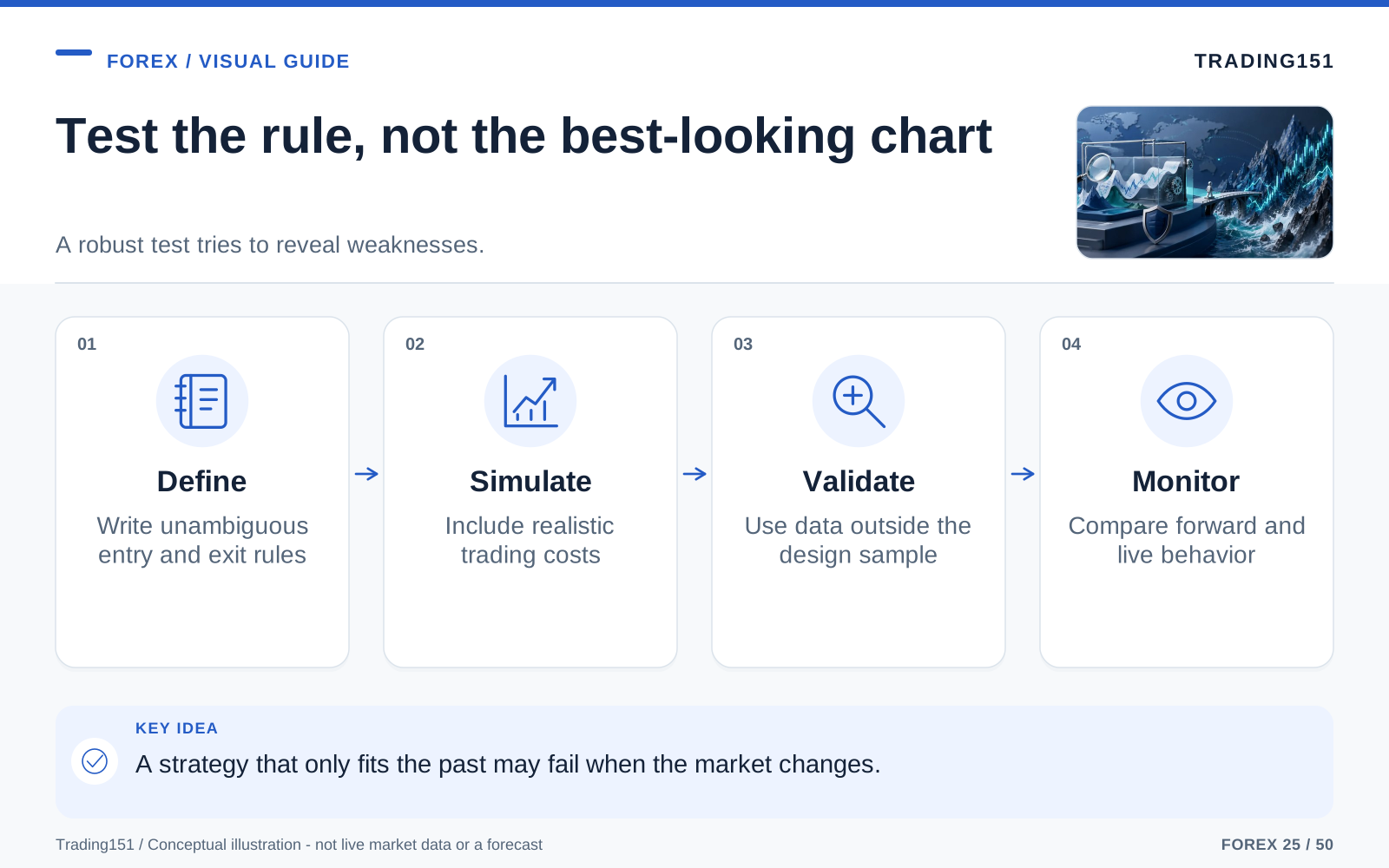
Read this diagram as text
- Define
- Write unambiguous entry and exit rules
- Simulate
- Include realistic trading costs
- Validate
- Use data outside the design sample
- Monitor
- Compare forward and live behavior
Why Backtesting Matters More Than Most Traders Realize
Sure, you backtest to see if a system was historically profitable. But the real value goes way deeper than just the bottom line.
For one, you gain context. Instead of living and dying by every trade, you start seeing the big picture over hundreds of setups. You learn how often your edge appears, what a normal losing streak looks like, and whether your success relies on winning often or just winning big.
More importantly, it builds bulletproof discipline. When traders abandon a strategy, it’s almost always emotional. They lose five times in a row, panic, tweak the rules, and destroy their edge entirely. But if you’ve backtested properly, you have data to lean on. When you know your system has survived six-trade losing streaks in the past and still ended the year in profit, you’re far less likely to do something stupid on trade number four.
Plus, it saves you real money. A failed backtest just costs you a few hours on a Sunday. A failed live test costs your actual account balance. I know which one I'd rather pay.
Before You Test Anything, Define the Strategy Properly
Here’s where most people mess up without even realizing it. They say they’re going to backtest, but what they do is scroll left on a chart and mentally tally up the setups that "look nice." That isn't backtesting. That's just telling yourself a bedtime story.
For a test to mean anything, your rules have to be so ridiculously specific that you could hand them to a stranger and they’d take the same trades you did.
What Your Rules Need to Include
- Market and pair: Which currencies are you trading? Just EUR/USD, or a whole basket of majors?
- Timeframe: Are we talking the 5-minute chart, the 1-hour, or daily candles?
- Session: Do you only trade the London open, or are you firing off trades any time of day?
- Setup conditions: What exact sequence of events has to happen before a trade is valid?
- Entry trigger: When do you place the trade? At the candle close, on a limit order, or buying a breakout?
- Stop loss placement: At what exact price point is your trade idea officially wrong?
- Take profit rule: Are you using a fixed target, trailing your stop, or exiting based on structure?
- Risk per trade: How much of your account are you risking every time you click buy or sell?
- Filters: Do you sit out during major news events or avoid trading against the higher timeframe trend?
If your rule is something like "buy when momentum looks strong," throw it out. It’s way too vague. You need something objective. "Buy when price closes above the 50 EMA, the RSI is over 55, and the pullback candle rejects previous support." Now that is testable.
The goal is black and white: every trade in your backtest is either a firm yes or a firm no. No improvising halfway through. No bending the rules just because a setup looks tempting.
Use Data You Can Trust
Backtesting with bad data is like trying to navigate with a map of the wrong city. If your historical data is full of holes or doesn't match the broker you trade with, your results are going to be completely misleading, no matter how carefully you log the trades. You have to watch out for things like time-zone mismatches, bid-ask discrepancies, daylight saving shifts, and broker-specific spreads. If your strategy relies on perfect, down-to-the-pip touches, even a tiny data error will ruin your results.
Bad data is sneaky. You might see missing candles, phantom price spikes that never actually happened, or substantially unrealistic spreads. A daily candle might close completely differently depending on the time zone of the server. A long-term swing trader might not care, but if you're scalping the 5-minute chart, these little glitches will completely distort your reality.
At a bare minimum, make sure your charts are clean and factor in the harsh realities of live trading. If your broker charges commissions, subtract them. If spreads blow out during rollover or around news releases, don't pretend you got filled perfectly. If you're trading weird exotic pairs, pay close attention to swap costs—they can eat your profits alive.
There’s an old rule in analytics: garbage in, garbage out. Trading is no different.
Manual vs. Automated Backtesting
You basically have two routes here: do it by hand, or make a computer do it. Both have a place, and both have trade-offs.
Manual Backtesting
This means sitting down, using the replay tool on TradingView or MetaTrader, hiding the right side of the chart, and pressing the "next candle" button over and over to execute your rules.
It is a grind, but man, does it teach you a lot. You start to feel the rhythm of price action. You begin to instinctively know when a setup is high-quality and when the market is just churning. You see how the trades unfold in real-time, not just what the clean, finished chart looks like after the fact.
That last part is critical. In hindsight, every winner looks obvious. It feels entirely different when you’re staring at the hard right edge of the screen trying to make a call without seeing the next twenty candles.
Manual backtesting is perfect if:
- You're still getting the hang of reading price action,
- Your strategy has some discretionary or visual elements,
- You don't know how to code,
- Or you want to build raw screen time and pattern recognition.
The catch? It takes a lot of time, and because you’re human, you’ll make mistakes. You might accidentally peek at the next candle, conveniently "forget" to log a loser, or get lazy after an hour. You have to be ruthlessly disciplined.
Automated Backtesting
This is where you code your rules into Python, Pine Script, or MQL and let the machine do the heavy lifting. The obvious perk? Speed. A computer can chew through years of data and thousands of trades in seconds. But remember, a computer will execute your flaws just as fast as your brilliance. Bad code might accidentally look into the future, assume you got filled at prices that never existed, or ignore the reality of a large red candle. You absolutely must double-check the bot's work line-by-line to make sure it's doing what you think it's doing.
Automation is awesome if your rules are 100% mechanical. It’s also great for testing a strategy across twenty different pairs without sacrificing your entire weekend.
But automated testing breeds a dangerous habit: over-optimizing. You can tweak the inputs until the equity curve looks like a straight line up, creating a "perfect" system that only works on past data and will immediately blow up your live account.
For a lot of us, the sweet spot is a hybrid approach. Start manually so you deeply understand the strategy on a human level, then automate it later if the rules are ironclad and you want to scale up.
How to Backtest Manually, Step by Step
If you've never done this before, grab a coffee and start here. It’s slower, but it forces you to engage with the market.
- Write down your rules. Don't keep them in your head. Put them in plain English before you open the charts.
- Pick your playground. Choose a specific pair, timeframe, and a wide enough date range to capture different market vibes.
- Wind back the clock. Scroll way back so you have no clue what happens next.
- Fire up replay mode. Step forward candle by candle.
- Stalk the setup. Wait until a setup meets every rule on your list.
- Log it. Write down the entry price, stop loss, target, and risk. Be exact.
- Let it play out. Fast forward until the trade hits your stop, target, or exit rule.
- Rinse and repeat. Do this until you have a large sample size. Then crunch the numbers.
Don't rush this just to hit 200 trades. The point is to test honestly.
How Many Trades Do You Need?
There isn't a magic number, but tiny samples are a trap. Testing 20 trades can make a terrible strategy look like a money-printing machine if you catch a lucky month, and it can make a brilliant strategy look broken during a slow week.
A good rule of thumb? Aim for at least 100 logged trades for day trading setups. If you’re a swing trader who only gets a few setups a month, you might need to test five years of data just to get enough variety. What matters most is that your sample includes bull markets, bear markets, and sideways chop.
The pickier your strategy, the more patient you have to be with your data collection.
What to Record in Your Backtesting Journal
If you aren't logging the data, you aren't backtesting—you're just playing video games with charts. You need a spreadsheet or a journal where everything is tracked consistently.
At the bare minimum, write this stuff down:
- Date and time
- Currency pair
- Timeframe
- Long or short
- Reason for entry
- Entry price
- Stop loss
- Take profit
- Risk-to-reward ratio
- The final result in R (e.g., +2R or -1R)
- Any random notes about the market context, mistakes, or weird price action
Thinking in R (Risk) is a game-changer. Instead of tracking arbitrary dollar amounts, track the multiples of what you risked. If you risk $50 (which is 1R) and make $100, you made +2R. If you get stopped out, you lost -1R. This levels the playing field and lets you judge the pure power of the strategy without worrying about account size.
Pro-tip: Screenshot your trades. Both the winners and the losers. Over time, that folder becomes a personal playbook you can study whenever you feel lost.
The Metrics That Matter
Beginners are obsessed with win rate. It strokes your ego to say you win 70% of your trades. But win rate in a vacuum is a practically useless metric.
You can win 80% of the time and still bleed your account dry if your losers are large. Conversely, you can win just 40% of your trades and be substantially profitable if your winners are twice the size of your losses.
Here is what you need to care about:
1. Win Rate
The percentage of trades that hit profit. Nice to know, but not the whole story.
2. Average Win vs. Average Loss
Are your winners bigger than your losers? This is the heartbeat of a profitable system.
3. Risk-to-Reward Ratio
If you risk 1 to make 2, your ratio is 1:2. The best strategies usually balance a realistic win rate with a solid payout profile when you're right.
4. Profit Factor
Total gross profit divided by total gross loss. If it's above 1.0, you're making money. The higher it is, the more cushion you have for mistakes, but if it’s absurdly high, you probably over-optimized your test.
5. Expectancy
This tells you exactly how much you can expect to make, on average, every time you take a trade. It cuts through the noise and answers the ultimate question: does this method have a statistical edge?
6. Maximum Drawdown
What was the ugliest, deepest hole your account fell into from its highest peak? This tells you how much pain you'll have to endure before the strategy recovers.
This isn't just a math problem; it's a psychology test. If your backtest shows a 28% drawdown, you have to look in the mirror and ask if you could mentally survive losing that much real money without panicking and abandoning the system.
7. Consecutive Losses
People ignore this one until it hits them in the face. If your backtest shows that a 6-trade losing streak happens regularly, you won't freak out when it happens live. You’ll just know it’s part of the process.
The Biggest Backtesting Mistakes Traders Make
It is dangerously easy to backtest terribly while patting yourself on the back for doing the work. Watch out for these traps:
Look-Ahead Bias
This is when you subconsciously use info you wouldn't have had at the time. "Oh, obviously I would have bought here, look at that large green candle." Yeah, but in real-time, you couldn't see that candle yet. Replay mode fixes this—but only if you're honest with yourself.
Curve Fitting
This is the trap of tweaking your rules until the past looks flawless. You find out the 50 EMA is okay, but wait, the 47 EMA caught that one perfect swing, and the 46 EMA makes the equity curve even smoother. Before you know it, you've built a hyper-specific strategy that perfectly trades past data but will get slaughtered in the future.
Good strategies are robust; they still work even if you tweak the parameters slightly. Fragile ones break the second you change a single input.
Ignoring Trading Costs
Spreads, commissions, swap fees, and slippage aren't rounding errors—they are the cost of doing business. A strategy might look incredible until you factor in the fees, especially on lower timeframes. Don't assume a fixed 1-pip spread if you're trading during wild news events. Bake in the true costs. If a tiny bump in spread kills your edge, your strategy is too fragile for the real world.
Cherry-Picking Setups
This is where discretion turns into delusion. You start skipping valid trades because they "looked weird," or you add a magic new filter after a trade loses to justify why you totally wouldn't have taken it. If the rule wasn't written down beforehand, you have to take the loss in the test. Period.
Testing Only One Market Condition
Trend-following strategies look like genius in a roaring bull market and look like garbage in a tight range. If you only test a clean, trendy year, you might think you found the ideal when you really just found a fair-weather strategy.
How to Tell if the Strategy Is Good
Everyone wants a shortcut here, but there isn't one. A robust strategy just makes logical sense, holds up over a large sample, and doesn't look suspiciously perfect.
Some good signs:
- The edge is consistent across a large sample of trades,
- The drawdowns don't make you want to throw up,
- It still works if you slightly adjust the parameters,
- The profits aren't totally reliant on one lucky month,
- And the actual logic of the setup makes intuitive sense to you.
Some warning signs:
- It only works on one highly specific pair,
- 90% Of the profits came from a handful of large winners,
- Changing one minor rule completely destroys the performance,
- The sample size is way too small to mean anything,
- Or it relies on zero slippage and perfect, down-to-the-pip fills.
A reliable strategy doesn’t need to be flashy. It just needs to be sturdy enough that you can trade it without constantly second-guessing yourself.
From Backtesting to Forward Testing
So you've got a killer backtest. Time to go all-in with your real account, right? Absolutely not. The next step is forward testing—running it on a demo account or with small real risk. Keep the last chunk of historical data untouched while you build the system, then test on that out-of-sample data. After that, take it to the live markets with no financial pressure. You want to see if the logic survives the messiness of live data, realistic execution, and actual platform behavior. If performance falls sharply, that's a red flag to investigate, not something to shrug off.
Forward testing forces you into the present tense. There’s no fast-forward button. You have to sit on your hands, wait for the alert, handle the anxiety of a slow-moving trade, and deal with real-world uncertainty.
This step bridges the gap between theory and reality. Backtesting proves the strategy works in a vacuum. Forward testing proves if you can execute it when the pressure is on.
It exposes all the practical stuff that doesn't show up on a spreadsheet, like:
- Whether you're awake and at the screen when setups happen,
- Whether your entries are even possible in fast-moving live conditions,
- Whether the boredom makes you force stupid trades,
- And whether the strategy still holds up in the current market vibe.
Keep forward testing until you've got a solid chunk of live trades under your belt—not five, not ten, but enough to prove your live execution matches your historical data.
A Simple Example of a Backtesting Workflow
Let’s walk through what this looks like.
Say your rough idea is: When we're above the 200 EMA on the 1-hour, I buy pullbacks that form a pin bar at support, aiming for 2R.
Now, tighten that up into strict rules:
- Trade only EUR/USD and GBP/USD.
- Long trades only.
- Price must be clearly above the 200 EMA.
- Price has to pull back and touch a drawn support zone.
- The signal candle has to close green with a noticeable bottom wick rejecting the zone.
- Enter at the open of the very next candle.
- Stop loss tucked just under the signal candle's low.
- Take profit fixed at 2R.
- Stand aside during high-impact news.
You take those rules, jump into replay mode, and log everything exactly the same way. After running a large batch, you review the scorecard.
Maybe it looks like this:
- Win rate: 44%
- Average winner: +2R
- Average loser: -1R
- Profit factor: 1.55
- Maximum drawdown: 9R
- Worst losing streak: 6 trades
It isn't flashy. You aren't going to get rich tomorrow. But it's consistently profitable, and most importantly, you understand the reality of what the strategy is.
When to Improve the Strategy and When to Leave It Alone
Tweaking a strategy to make it better is normal. Endlessly messing with it is a trap.
If your backtest exposes a glaring flaw—like taking severe losses during lunchtime chop—it makes total sense to add a time filter. Maybe one pair is a total drag on your equity curve, so you cut it entirely.
But remember, every time you change a rule, you reset the clock. You're testing a brand new strategy. You can't just slap a new indicator on and assume all your past data still counts.
This is where traders get paralyzed. They optimize, filter, and tweak endlessly because they're terrified of execution. At some point, you aren't improving the system; you're just hiding from live trading.
A good rule of thumb: refine slowly, and only when the data screams at you to do it. Don't change your system just because a random Tuesday felt frustrating.
What Backtesting Can’t Do
As powerful as backtesting is, it has limits. Knowing them keeps you grounded.
It can't guarantee you'll make money next year. Markets evolve. Volatility dries up or explodes. Central banks shift gears. A great strategy can still hit a three-month rut.
It also can't simulate the knot in your stomach. It’s super easy to "hold to target" when you're clicking through a chart on a Sunday afternoon. It's a whole different game when real money is flickering red and green and you're sweating over the close button.
Finally, it doesn't replace common sense. Even with a highly mechanical system, you still have to manage your risk, decide if the strategy fits your lifestyle, and make sure the drawdowns won't ruin your mental health.
Backtesting gives you the evidence, but you still have to drive the car.
Reserve a test the strategy has never seen
Divide the research into stages before adjusting parameters. Use one period to develop the idea, a separate period to assess changes, and a final untouched period for a more honest check. Once the final period has influenced another redesign, it is no longer untouched. Keep a record of how often this happens rather than treating each revised result as independent evidence.
Look for information arriving too early. A daily closing price cannot support an entry earlier that same day unless the rule uses only information already available. Economic data may later be revised, and a historical file can contain the revised figure rather than the original release. Even a technically correct program can therefore test an impossible trading process.
Costs deserve more than a single optimistic spread. Try wider spreads, worse fills, financing charges, and a delay between the signal and execution. If a small change removes the entire profit, the strategy may depend on an execution quality the account cannot obtain. A low average cost can also hide expensive trades concentrated around the very events the strategy targets.
Keep unsuccessful versions. A report showing only the winning variation conceals how much searching produced it. Compare the proposed strategy with a simple baseline, then examine drawdowns, turnover, and the distribution of individual outcomes. A backtest is most useful when it tells you what could go wrong, not when it supplies a flattering chart for a decision already made.
Save the test you expected to fail
Unsuccessful tests are part of the research record. Keeping only the best result hides how many opportunities there were to find a favorable pattern by chance. Record rejected ideas, parameter changes, and the reason a version was abandoned. That history helps explain whether the eventual strategy reflects a coherent hypothesis or an extensive search whose weakest results have disappeared from view. 1, 2, 3
Conclusion: Confidence Comes From Evidence
The best thing you get from backtesting isn't a spreadsheet. It isn't a sexy equity curve. It isn't the thrill of discovering a setup that kind of works.
It’s bulletproof confidence. The kind of confidence that comes from cold, hard evidence, not blind hope.
Without that, trading is a nightmare. Every loss feels like a personal attack. Every drawdown makes you want to quit and buy a new indicator. You just hop from strategy to strategy, never sticking around long enough to see if you have an edge.
But when you've put in the work, everything changes. You don't freak out over a loss because you know the math works out in the end. You start thinking in probabilities. You know exactly what a normal losing streak looks like, and you know what it takes to execute your plan.
The point isn't to be perfect; the point is to have clarity based on data.
So before you fund an account and start firing off trades on a setup that looks promising, slow down. Write down your rules. Test them sharply. Log the data. Stare at the numbers. Then test it live to prove you can handle it when the candles are moving.
It's a grind. It's not glamorous. But it’s the exact process that separates the gamblers from the professionals. Do yourself a favor: save your test rules, the date ranges, and your results in one place so you can look back at them later. If you tweak the system, make a V2 instead of deleting the old one. Treat it like real research, not just a screenshot you show your friends. That’s how you build an edge that pays.
Sources and further reading
- TradingView Pine Script Documentation: Strategies
- SEC Investor Bulletin: Trading Basics and Order Types
- BIS: April 2025 FX turnover, September 2025 preliminary release
Editorial revision: 7 October 2026. Numerical scenarios are hypothetical unless identified as historical. References support the added explanations and selected corrections; rules and product terms should be checked again before acting.