
AI can help a forex trader sort information, test a hypothesis, or monitor a strategy. None of those jobs is the same as knowing where a currency will trade next. The useful question is not whether a system uses impressive technology. It is whether you can identify the task it performs, check its output, and limit the damage when it makes a mistake.
From Trading Pits to Trading Models
The Forex market isn't a stranger to extreme makeovers. Before the luxury of trading on an iPhone, currency exchange was a loud, sweaty, physical hustle. Orders were shouted across rooms. Large deals went down over landline phones. If you wanted an edge, it mostly depended on who you knew, how fast you could talk, and whether you had the right hardware. It was chaotic, loud, and substantially human.
Then computers entered the chat, and everything flipped. Suddenly, the game was faster, cheaper, and entirely driven by data. Regular people sitting in their living rooms could tap into liquidity pools that were once heavily guarded by banks. Technical analysis exploded. Moving averages, RSI overlays, and limit orders effectively turned a bulky desktop monitor into a personal trading floor.
Not long after, we got rule-based automation. Traders started writing scripts and using Expert Advisors (EAs) to handle the boring stuff. And hey, those tools were—and still are—pretty useful. But they had a large blind spot: they were rigid. An EA only does exactly what you tell it to. If the 50 SMA crosses the 200 SMA, it buys. If RSI hits 30, it sells. It doesn't ask questions.
That kind of logic is totally fine until the market throws a curveball. Central banks pivot. A war breaks out. Liquidity vanishes. The textbook correlations you relied on for six months suddenly disappear overnight. A basic bot doesn't care; it just keeps running its outdated script until it blows up your account, unless you step in and fix the code.
This exact vulnerability is what opened the door for AI. Instead of blindly following hard-coded rules, machine learning systems hunt for hidden patterns inside large piles of data. They tweak their own behavior based on what’s working right now. They don’t just look at one MACD crossover; they can juggle thousands of variables simultaneously to find connections that a human brain couldn't possibly map out.
That doesn’t make them psychic. But it definitely makes them a whole different beast.
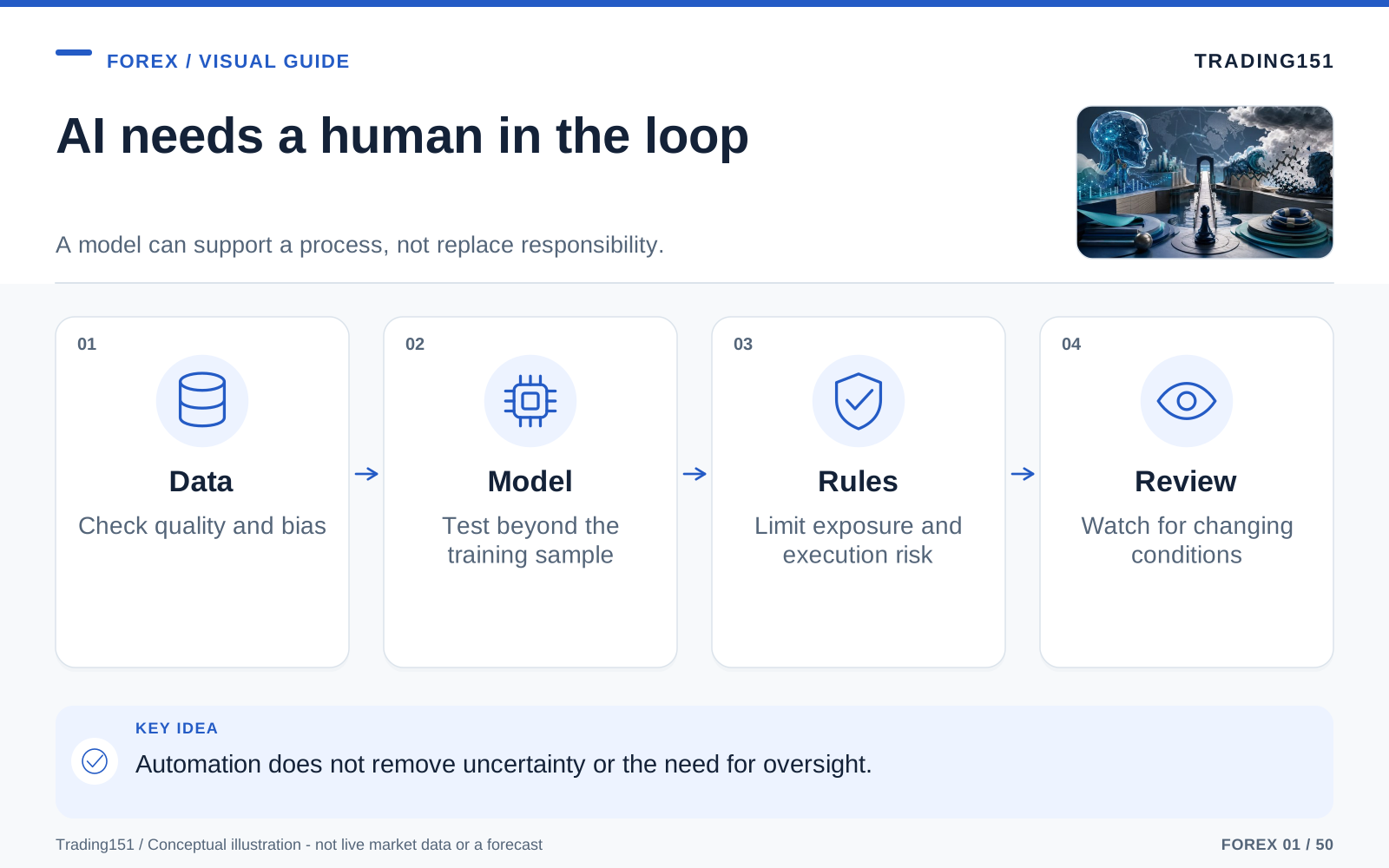
Read this diagram as text
- Data
- Check quality and bias
- Model
- Test beyond the training sample
- Rules
- Limit exposure and execution risk
- Review
- Watch for changing conditions
What AI in Forex Means
When you say AI trading, most people picture something out of a movie: a slick, glowing dashboard making brilliant trades on autopilot while the user sips a cocktail on a beach. The reality is way less cinematic, but a lot more fascinating. AI isn’t one single magic program. It’s an umbrella term. It covers machine learning models, text-reading algorithms, probability engines, and lightning-fast execution tools.
Some of these systems are built to flash buy and sell signals. Others just act like hyper-organized assistants—they rank setups, monitor risk, or read the news for you. Some never actually place the trade on a trade; they just hand you the best possible data so you can make the call.
AI trading is just statistics on steroids. The Forex market spits out a dizzying amount of data: tick charts, bid/ask spreads, bond yields, commodity prices, option expiries, and central bank speeches. Throw in breaking news, geopolitical chaos, and financial Twitter, and it’s just too much for a normal human to process.
That’s where AI shines. It can chew through all that noise, cross-reference it in real-time, and spit out insights without getting a headache. And unlike you, it doesn't need to step away to grab a sandwich during the London open.
How AI “Reads” the Market
An algorithm doesn’t look at a chart the way a veteran trader does. It doesn’t catch a "vibe" that the dollar is overbought, or sense that price action is getting jittery. It just sees data, math, and probability. That might sound a bit soulless, but in a lot of ways, it’s much safer. But here's the catch: the output is only as good as the data you feed it. If an AI accidentally gets trained on data that includes tomorrow's news (a rookie mistake data scientists call "leakage"), it will look like a genius in testing and fail miserably in real life. Making sure the machine isn't accidentally cheating is arguably the most critical part of building it.
1. Pattern Recognition at a Scale Humans Can’t Match
We humans love finding patterns. We’re wired for it. We spot a head-and-shoulders, a bull flag, or a double bottom, and we instantly compare it to the last ten times we saw it. But our brains have a nasty habit of playing tricks on us, mostly in the form of confirmation bias. If you're bearish on a pair, you will magically start seeing bearish patterns everywhere.
AI doesn’t have human intuition, but it has infinite memory. A good model can scan millions of past setups across dozens of pairs in seconds. It doesn't care if a pattern "looks" convincing; it only cares if the math holds up. It can spot obscure relationships—like how a sudden spike in 10-year Treasury yields might impact the Yen differently depending on what the price of oil is doing that exact minute.
Does every pattern it finds matter? No. A lot of it is just random noise. But when built right, the sheer scale of an AI's perspective is a large advantage.
2. Sentiment Analysis and the Language of Markets
If you trade Forex, you know that words move money. A single unscripted comment from the Fed Chair can send a currency pair into a nosedive. Traders spend hours trying to decode 'Fedspeak'—trying to figure out if a central banker sounded a little more hawkish than last month, or if they seemed nervous about inflation.
This is where Natural Language Processing (NLP) is a game-changer. NLP algorithms read through speeches, press releases, and news headlines the second they hit the wire. They aren’t just hunting for buzzwords; they’re analyzing the tone and context. If the European Central Bank tweaks the wording in a press release in a way that implies they're pausing rate hikes, an AI trained on their past statements will catch that shift instantly.
Sure, a sharp macro trader can do this too. But a machine can cross-reference today’s statement against the last decade of central bank transcripts in a fraction of a second, spotting subtle changes you'd definitely miss while frantically hitting refresh on your browser.
3. Predictive Analytics and Probabilities, Not Prophecies
Let's clear up a large misconception: AI does not predict the future. When people hear "predictive model," they assume the machine has a crystal ball. That's entirely wrong. A good AI model doesn't promise anything; it just gives you the odds. Financial markets are constantly shifting. A strategy that crushes it during a low-inflation, low-volatility year might lose money when things get chaotic. So, the probabilities have to constantly adapt.
Instead of aggressively claiming, "GBP/USD is going to 1.3000," a solid AI will tell you, "Based on the last thousand times we saw this setup in a similar macroeconomic environment, price moved up 60% of the time." That’s a much more grounded, realistic, and frankly, useful piece of information.
Trading is just the business of managing uncertainty. The best tech in the world won’t remove that uncertainty—it just gives you a better map to navigate it.
4. Execution and Risk Management
Everyone focuses on AI finding the perfect entry, but its real superpower is handling the boring stuff. Slippage, widening spreads, and sudden liquidity dry-ups can instantly turn a brilliant trade idea into a devastating loss.
Smart algorithms are amazing at optimizing entries, chopping large institutional orders into tiny invisible pieces, and dynamically shifting stop-losses when volatility spikes. It’s not the sexy part of trading, but in the professional world, elite risk management is the only reason you get to stay in the game.
Why Traders Are Drawn to AI
It’s really not hard to see why traders are obsessing over AI. It solves some of the most agonizing problems in trading, and surprisingly, most of those problems aren't about the market—they’re about us.
Emotion Doesn’t Get a Vote
Most traders don't blow up their accounts because they don't know how to read a chart. They blow up because they lose their minds. They panic and close a winning trade too early. They stare at a large red number and refuse to cut the loss because closing it makes it "real." They take a heavy hit in the morning and spend the afternoon revenge-trading trying to win it back.
AI doesn’t do any of that. It does not care. It doesn’t feel embarrassed when a trade goes south. It doesn't get greedy. It just executes the framework it was given. Compared to a deeply stressed human running on four hours of sleep and too much caffeine, a machine's ice-cold discipline looks like a superpower.
Of course, discipline only matters if the underlying strategy is good. A bot will happily execute a garbage strategy with flawless precision until your account hits zero. But stripping the emotion out of the click is undeniably huge.
It Never Stops Watching
Forex is a relentless 24/5 beast. It rolls from Tokyo to London to New York without hitting the brakes. Inevitably, the perfect setup is going to form while you are stuck in traffic, eating dinner, or fast asleep. Our attention span is substantially limited. An algorithm’s isn't.
You can have a system monitoring thirty different pairs, reading the news, and calculating volatility metrics all at once, just waiting to ping you when the stars align. You don't even have to let it trade for you; just having an untiring watchdog completely changes your workflow.
It Can Test Ideas Ruthlessly
Every trader has that one setup they swear by. We tell ourselves, "Whenever price does X, it almost always does Y." But human memory is famously terrible, and we tend to only remember the times we were right.
AI and quant tools are brilliant at killing our darlings. You can feed your favorite strategy into a machine learning model, and it will ruthlessly test it across decades of data. It will strip away your gut feelings and tell you exactly when your idea works, and when it falls apart. It’s a harsh reality check, but a necessary one.
Where the Hype Starts to Crack
If AI were truly a flawless money creation, humans wouldn't be trading anymore. Wall Street would just be a row of humming servers. We aren't there yet, and there are some very real reasons for that. AI is powerful, but it has some glaring blind spots that the internet marketers conveniently forget to mention.
The Black Box Problem
A lot of machine learning systems are essentially black boxes. You feed data in, and an answer pops out, but the messy, tangled math happening in the middle is completely unreadable—sometimes even to the guys who coded it. When things are going well, nobody cares. But what happens when the market goes crazy, and your model starts dumping positions for no obvious reason?
If you don't know why an algorithm is taking a trade, it’s hard to trust it when it enters a drawdown. Sometimes, a simpler, transparent model that you fully understand is infinitely better than a complex neural network that leaves you in the dark.
Overfitting Can Make a Model Look Brilliant Right Up Until It Fails
There is an old trap in algorithmic trading called "overfitting," and AI hasn't solved it. Overfitting is what happens when an AI studies historical data a little too closely. Instead of learning the general rhythm of the market, it memorizes the past.
When you look at the backtest for an overfitted model, it looks like a masterpiece. A perfect, smooth line going up. But the second you plug it into live markets, it faceplants. Why? Because the market changed. The inflation rate is different, the political landscape shifted, and the model doesn't know how to adapt because it was trained to solve yesterday's puzzle.
This is why veteran quants laugh at Instagram ads showing bots with 99% win rates. The market loves to punish false confidence.
AI Still Lacks Human Context
Algorithms are getting frighteningly good at reading text and gauging sentiment, but they still don't understand what they are reading. A large drop in the Euro isn’t always a technical retracement. Sometimes it’s a localized banking panic. Sometimes a war just broke out.
Humans understand context. We understand nuance. We know what a specific election result means for a country’s economy, or how a looming crisis feels before it shows up in the data. AI is fast, but it’s often trying to mathematically categorize a global panic while a human trader has already grasped the bigger picture.
Good AI Is Expensive, and Bad AI Is Everywhere
Let's be clear here: there is a universe of difference between the multi-million-dollar machine learning infrastructure used by hedge funds and the $49 "AI Trading Bot" being pushed in a Telegram group.
Real AI requires pristine data, heavy computing power, brilliant engineering, and constant maintenance. It’s an ongoing, highly expensive research project. It is not a magical plug-and-play USB stick.
Right now, the term AI is largely being used as snake oil. A lot of retail "AI" products are just basic, clunky scripts rebranded to sound futuristic. Do not blindly trust a product just because the landing page uses the word "algorithm."
The Human Role Is Changing, Not Disappearing
The smartest way to look at AI isn't as your replacement, but as your wingman. It completely dominates humans when it comes to speed, scale, and memory. But humans still win when it comes to navigating ambiguity, understanding deep context, and applying street smarts.
Think about chess. After IBM's Deep Blue beat Garry Kasparov, humans didn't stop playing. Instead, they invented "Centaur chess"—a human and a computer teaming up. The computer handles the insane, brute-force calculations, while the human guides the overarching strategy. Together, they are vastly superior to a solo computer or a solo human.
Forex is heading exactly the same way. The best modern traders are Centaurs. You let the AI scan the charts, aggregate the news, flag the anomalies, and crunch the risk metrics. Then, you step in, look at the board, and decide if the trade makes sense in the real world.
It’s not a compromise. It’s the ultimate evolution of the trader.
What a Smart Retail Trader Should Do
If you're trading your own account, your goal shouldn't be to find a magic black box so you can go play golf while it trades for you. That’s how you get scammed. The goal is to offload the grunt work to AI, while keeping your hands firmly on the steering wheel. Also, a quick word on security: never, ever hand over your broker logins, API keys, or personal data to some random "AI" platform you found on Twitter. Operational security is just as important as your win rate.
- Use AI to filter noise. Let software monitor your watchlists, track shifting correlations, and summarize breaking news. Save your actual brainpower for placing the trade.
- Use AI to review your own behavior. the best AI tools are the ones that analyze you. Plug your trading journal into an analyzer and let it tell you that you constantly lose money on Fridays, or that you always close your winners too early.
- Use AI to test, not to fantasize. Got a great trade idea? Prove it. Run it through a backtester to see if it holds weight. Try to break your own strategy before the live market breaks it for you.
- Stay suspicious of easy promises. "Easy money" in trading is almost always a marketing slogan for "you are about to get rugged." If a tool boasts impossible returns with zero drawdown, run the other way.
- Learn enough to ask better questions. You don't need a PhD in computer science, but taking a few days to understand basic statistics, how backtesting works, and the flaws of machine learning will make you practically immune to bullshit marketing.
When you start treating AI like a serious tool instead of a genie in a bottle, you gain a large advantage over the people hoping to get rich quick.
The Future Will Be Faster, Smarter, and More Uneven
We are still in the awkward teenage years of AI in Forex. The tech is useful, but the hype surrounding it is totally out of control. So where is this going?
For one, it’s going to get much cheaper and easier to use. Just like institutional charting software eventually trickled down to retail traders, high-level AI tools will soon be available via simple, drag-and-drop interfaces for everyone.
But because of that, the game is going to get significantly harder. When everybody has access to a supercomputer, tiny market inefficiencies get ironed out instantly. Strategies that used to work beautifully because only a handful of people knew about them will get crushed as millions of bots swarm the same setups.
The real edge in the future won't be about who can predict the next 10 pips. It will be about adaptability—having systems that instantly realize the market mood has shifted and know when to play defense.
And sure, people talk about quantum computing changing everything, and maybe it will. But no matter how fast the computers get, finance is ultimately tied to human nature. It's tied to politics, panic, greed, and completely random black swan events. The market will undoubtedly become more automated, but it will never be perfectly clean.
The Real Question Isn’t Whether AI Wins
People love framing this as an epic showdown: the gritty human trader versus the cold, calculating machine. It makes for a great headline, but it’s a totally flawed way of looking at the market.
Markets aren’t just a bunch of math equations balancing themselves out. They are physical manifestations of human fear, greed, leverage, and panic. Yes, AI is undeniably brilliant at mapping out those emotions and finding the hidden structures inside the chaos. It forces discipline where we naturally want to gamble.
But humans are still driving the economy. We still overreact to news, we still misprice assets, and we still panic-sell at the absolute bottom. The most profitable moments in trading often don't require the fastest calculation; they require the deepest understanding of human irrationality.
The traders who survive the next decade won't be the stubborn purists who refuse to use algorithms, nor will they be the lazy ones who hand their entire account over to a bot. The winners will be the ones who know exactly how to leverage the machine's horsepower while keeping their own hands firmly on the wheel.
Test what happens when the inputs are wrong
An AI model can produce a confident explanation from incomplete data. Imagine a tool that labels a central bank statement as unusually hawkish, but compares it with the wrong previous meeting. The summary may sound persuasive while the comparison underneath it is useless. A trader who acts on the summary inherits that error, whether or not the trade eventually makes money.
Give the tool a narrow, checkable assignment first. Ask it to extract the announced policy rate, identify the publication time, and point to the exact passages supporting its interpretation. Compare those results with the original release. For a numerical forecasting model, keep a record of the data available at each prediction time; revised economic figures must not quietly replace the values traders actually saw. That is a research control, not a cosmetic detail.
Operational tests deserve the same attention as forecast accuracy. What happens if a price feed freezes, an API returns an error, or a news item arrives twice? Does the program stop, flag the problem, or keep placing orders? A safe failure mode is usually more valuable than a polished dashboard.
Start with read-only access wherever possible. A system that helps you review trades does not need permission to withdraw money, and a tool that drafts research does not need permission to place orders. Expanding permissions should follow demonstrated reliability, not a persuasive demonstration. Human supervision only means something when the person supervising can see what the system did and stop it.
Keep a record that survives an impressive explanation
A model's explanation is easiest to trust when the trade has already worked. The harder test is whether the same reasoning was available before the outcome. Save the original prompt, output, source documents, and timestamp. Do not replace them with a cleaner explanation generated afterward. A later summary can be useful, but it belongs beside the original record, not in its place.
For a language model, repeatability also needs attention. A slightly different prompt or model version may produce a different interpretation of the same release. That may be acceptable for brainstorming and unacceptable for a rule that places orders. Decide which job the tool is doing before judging the variation. Where the result must be deterministic, ordinary validated code may be more appropriate than asking a language model to improvise the calculation.
There is also a difference between confidence and calibration. A statement such as 'the euro is likely to rise' is not a usable probability until its meaning and horizon are specified. Record predictions in a form that can later be scored, including abstentions and failures. A system that quietly skips its difficult cases can look more accurate than one that reports every attempt. Good records make that difference visible without relying on the model's own account of its performance. 1, 2
Conclusion: Keep the Machine Close, Not in Charge
AI is absolutely here to stay. It’s fundamentally wired into the modern Forex market, and it brings a level of speed and analytical firepower that you just can't compete with on your own. Used properly, it will sharpen your edge, act as an emotional buffer, and help you see the board much more clearly.
But it isn't magic. A beautifully coded model can still lose money. A lightning-fast bot can still completely misread a geopolitical crisis. An algorithm can crunch a million data points and still miss the one glaringly obvious thing right in front of its face.
That’s why you shouldn't look at AI with fear, and you definitely shouldn't look at it with blind faith. Treat it like a brilliant, tireless, but slightly reckless junior analyst. Let it do the heavy lifting. Let it scrub the data, test the math, and watch the charts while you sleep. But never let it make the final call without your blessing.
Trading has always been about making hard choices in the face of uncertainty, and that hasn't changed one bit. The only thing that has changed is the quality of the tools sitting on your desk. The machine is faster than you, and it’s definitely more disciplined. But true market vision, patience, and street smarts are still profoundly human traits. Give the AI a specific job, double-check its work, protect your downside, and know when to pull the plug. Because handing complete control over to a piece of software just because it looks futuristic isn't innovation—it's just a new way to blow an account.
Sources and further reading
- SEC/NASAA/FINRA: Artificial intelligence and investment fraud
- CFTC: AI trading bots and investment fraud
Editorial revision: 7 October 2026. Numerical scenarios are hypothetical unless identified as historical. References support the added explanations and selected corrections; rules and product terms should be checked again before acting.