
Copy trading delegates trade selection, but it does not delegate the consequences for your account. Your entry prices, position sizes, costs, and available margin may differ from the lead trader's. The platform's copying and exit rules matter as much as the performance record. Read those mechanics before deciding whose strategy looks appealing.
Part 1: Social Trading and Copy Trading Are Related, but Not the Same
People toss these terms around like they mean the same thing. They don't, and knowing the difference is pretty important.
What’s Social Trading?
Think of social trading as a large, market-focused community. On these platforms, you aren’t just staring at candlestick charts—you’re interacting with people. You can follow specific traders, read their hot takes on the market, dig into their past performance, and chat with them in the comments.
It’s basically Twitter or Reddit, but strictly for traders. Instead of sharing memes, users are swapping trade setups, chart analysis, and reactions to breaking news. One person might break down exactly why they’re shorting EUR/USD after a Fed meeting, while another drops a deep dive into gold and inflation. The real value here is the conversation and the exchange of ideas, not just the trades themselves.
That’s why social trading is so great for people who want to learn. It gives rookies a front-row seat to how veterans think, how they manage stress, and what they do when a trade suddenly blows up in their face.
What’s Copy Trading?
Copy trading takes that concept and fully automates it. You aren’t just watching from the sidelines anymore. Instead, you link your account to a specific trader and let the platform automatically mirror their every move.
If the pro you’re following buys GBP/JPY, your account buys it too. If they trim their position, yours does the same. When they cash out, you cash out. The software handles all the heavy lifting in the background, matching their trades to whatever amount of money you’ve decided to risk.
This hands-off approach is a large draw for beginners. It strips away the intimidating barrier to entry. You don’t need to know what a head-and-shoulders pattern is or how central bank interest rates work. You just ride the coattails of someone who already knows what they're doing.
But this convenience has a catch. When you aren’t the one placing the trade on a trade, it’s surprisingly easy to forget that it's your real money on the line. The automation makes the risk feel abstract right up until a large loss hits your account.
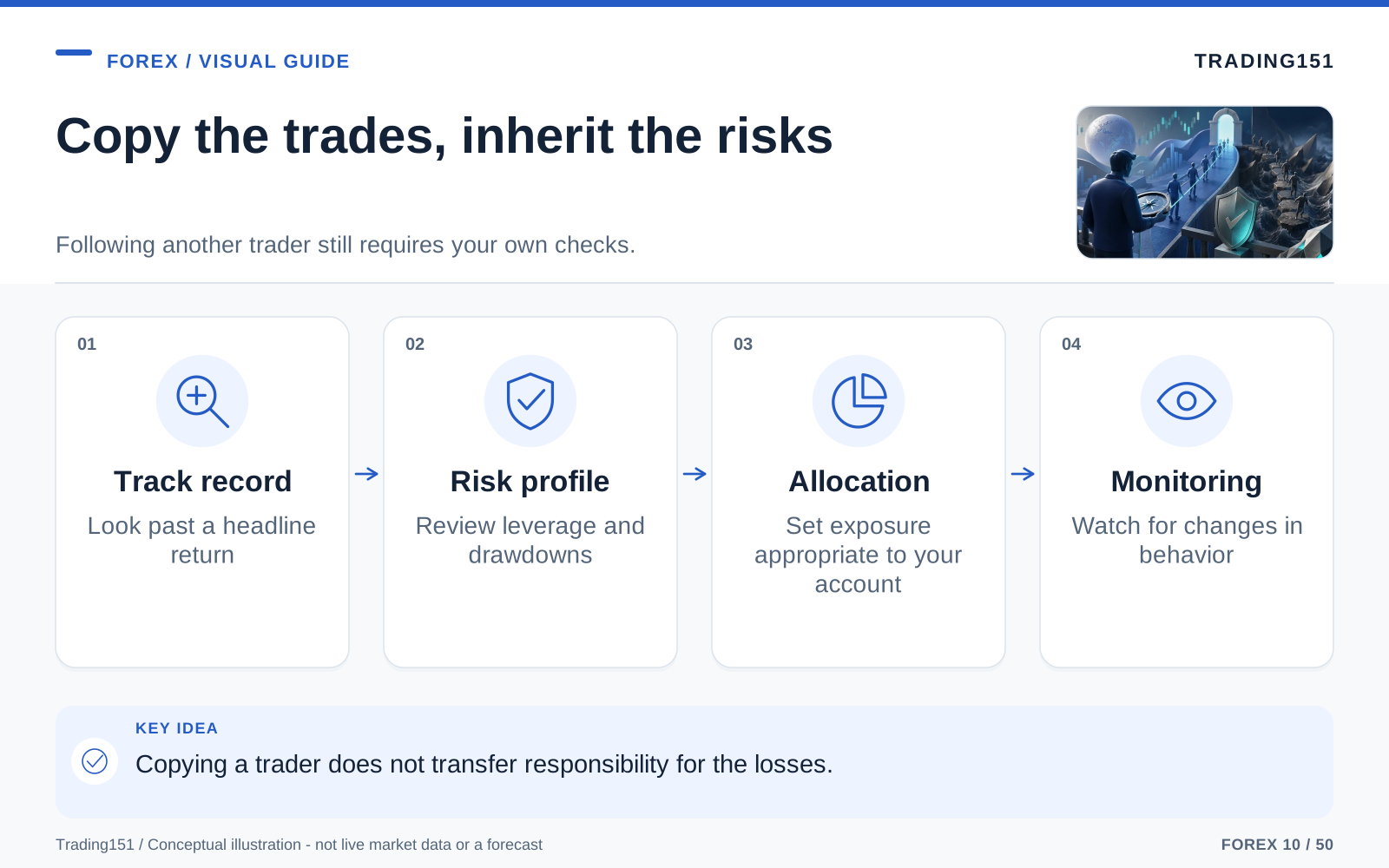
Read this diagram as text
- Track record
- Look past a headline return
- Risk profile
- Review leverage and drawdowns
- Allocation
- Set exposure appropriate to your account
- Monitoring
- Watch for changes in behavior
Part 2: Why So Many People Are Drawn to It
These platforms didn't just explode out of nowhere. They solve three large headaches that keep normal people away from Forex: no time, no experience, and no confidence.
1. It offers a shortcut through a steep learning curve
Forex is tough to master. Figuring out the technical charts is a large undertaking on its own. Throw in macroeconomics, geopolitical tensions, and risk management, and it’s no wonder beginners get scared off.
Copy trading feels like a cheat code. Instead of spending two years losing money while figuring out a strategy, a rookie can just piggyback on someone whose system already works. For most people, that feels way more doable than trying to become a Wall Street savant overnight.
And practically speaking, it makes sense. Most people don’t want to stare at charts all day. They have day jobs, kids, and real life to deal with. Outsourcing the heavy lifting to a pro fits perfectly into a busy schedule.
2. It makes trading feel less isolating
Trading can be a lonely game. When you win, you celebrate alone. When you lose, it feels deeply personal, and you often end up beating yourself up without even understanding what went wrong.
Social trading completely flips that dynamic. It brings banter, shared misery, and collective brainstorming to the table. When the market goes crazy, you can instantly see how hundreds of other people are handling it. Sure, losing money still hurts, but it hurts a little less when you’re not suffering in a vacuum.
There’s also something really reassuring about seeing the humanity in other traders. Watching a pro hesitate, tweak a trade, or take a bad loss reminds you that nobody is perfect, and making mistakes is just part of the game.
3. It creates the feeling of access
For the average retail trader, copy platforms feel like sneaking into a VIP room. You aren’t just reading bland market recaps on financial blogs anymore. You get to see real traders, live positions, actual risk metrics, and raw performance histories.
That transparency is a huge deal. People are way more comfortable putting their money on the line when they feel like they can see behind the curtain. Even if the transparency is sometimes a bit of an illusion, it beats throwing money into a random investment fund and hoping for the best.
Part 3: How the Mechanics Work
Strip away the social feeds and leaderboards, and the actual mechanics are pretty straightforward. A standard copy trading setup involves three pieces: the trader making the calls, the follower putting up the cash, and the platform linking them together. Just keep in mind that copying is rarely a flawless 1:1 mirror. As a follower, you might enter a split-second later, get a slightly different price, or run into rounding issues if your account is much smaller. Before you dive in, you really need to know how your platform handles partial fills, wild market hours, margin limits, and what happens when a lead trader adds to an open position.
- The lead trader: This is the person placing the trades. Depending on the site, they might be called a signal provider, a master trader, or a strategy provider.
- The follower: That’s you—the person allocating some (or all) of your capital to mirror the lead trader's moves.
- The platform: The software running in the background that instantly copies the lead trader’s actions into your account based on your settings.
A lot of beginners wonder if they need a large bankroll to follow a big-time trader. The short answer is no. Most platforms use something called proportional allocation. If the trader you're copying risks a tiny percentage of their large account on a specific trade, the platform will automatically scale that down and risk the same percentage of your smaller account.
That’s the magic that lets someone with $500 securely follow a trader dealing with $50,000 without blowing out their risk limits.
But proportional scaling isn't perfect. Differences in leverage, the platform's minimum trade sizes, and how fast your broker executes the trade can skew the results. Two people following the same trader might end up with slightly different profits or losses over a few months, especially in chaotic markets.
Fees, spreads, and small frictions matter more than people expect
It's tempting to just look at a trader's large monthly return percentage and assume your account will jump by the same amount. Unfortunately, the gap between their theoretical gains and your actual take-home profit is often eaten up by hidden frictions.
Platform fees, broker spreads, overnight swap charges, and bad slippage can quietly bleed your account. A couple of cents here and there might not sound like a big deal, but if the trader you follow takes dozens of trades a week, those micro-costs add up fast.
This is why you can't just pick a trader based on a flashy leaderboard. The specific conditions, fees, and rules of your own brokerage account play a huge role in your ultimate bottom line every day.
Part 4: The Benefits When It’s Used Well
It’s easy to harp on the negatives, but copy trading wouldn’t be a booming industry if it didn’t offer real value. When you use it smartly, the perks are hard to beat.
Learning by observation
The best thing about social trading is how it bridges the gap between reading about a strategy and seeing it in the wild. You can read a textbook about risk management, but it finally clicks when you watch a real trader slowly trim a losing position or sit on their hands during a chaotic news event.
That kind of real-time education is priceless. It teaches beginners that successful trading isn't about perfectly predicting the future or catching the absolute bottom. It’s about patience, managing risk, and surviving long enough to let the math work in your favor.
Access to different styles
Hanging around a social platform exposes you to substantially different trading personalities. One person might be a macro-swing trader holding trades for weeks, while another is a hyper-active scalper in and out in five minutes.
Seeing these different methods proves there’s no "one true way" to trade. It also lets smart followers build a diversified portfolio by allocating a little money to a steady, long-term trend follower and a little to an aggressive, short-term momentum trader.
A more structured way to delegate
If you have zero interest in reading charts yourself, copy trading feels much safer than throwing money at a shady investment guru you found on the internet. On legit platforms, you get to dig into a trader’s history, their max drawdown, how often they trade, and their overall risk score.
Does that mean it’s risk-free? Of course not. But it lets you make an educated bet. Instead of blindly trusting a stranger, you get to thoroughly vet their track record before handing over the keys.
Part 5: Where Things Go Wrong
The marketing pages conveniently gloss over the ugly side. They pitch copy trading as a clean, stress-free way to outsource the hard stuff, but the reality is that it often masks the true level of danger. Those public leaderboards are notorious for "survivorship bias." The traders who blow up their accounts quietly disappear, leaving only the lucky few who happen to be on a hot streak. A perfectly smooth upward chart might be hiding a reckless grid strategy or a trader who refuses to close large losing positions. You have to look at how they made their money, not just the flashy percentage at the top.
1. A beautiful track record can hide ugly behavior
A chart that goes up in a perfectly straight line looks incredible, but it’s often a large red flag. Sometimes, a lack of dips doesn't mean a trader is a genius—it means they are hiding their losses or taking concerning risks to avoid booking a red day.
The most common trick is aggressively averaging down, also known as a Martingale strategy. A trader takes a bad position, the market moves against them, and instead of cutting the loss, they double down. They keep adding to the bad trade, praying for a reversal. For a few months, this looks genius. They win small amounts constantly, and followers feel super secure.
But eventually, the market doesn't reverse. A large trend hits, their strategy crumbles, and the whole account gets wiped out in an afternoon. What looked like safe, consistent growth was really just a ticking time bomb.
2. Execution differences are real
Even if you find an honest, highly skilled trader, you might not get their exact results. The markets move fast. If a major news story breaks, prices gap in milliseconds. A lead trader might exit a trade at a great price, but by the time your platform triggers the copy, the price has shifted, leaving you with a worse fill.
A fraction of a pip might seem trivial, but if you're following someone who takes hundreds of trades a month trying to capture tiny profits, those execution delays will absolutely chew through your margins.
3. Hero worship clouds judgment
There’s a weird psychological trap in social trading: people start treating profitable traders like infallible gods. This is dangerous. Traders are humans. They get exhausted, they get greedy, they get distracted, and they make stupid mistakes just like the rest of us.
When followers put a trader on a pedestal, they stop thinking rationally. They ignore obvious red flags because they desperately want to believe their guru knows something the rest of the market doesn't. That kind of blind faith will cost you dearly.
4. Followers often sabotage the strategy themselves
Ironically, the biggest threat to a copy trader’s account is usually themselves. Even when they pick a brilliant strategy, they can't help but meddle. They panic and manually close a trade during a totally normal market dip. Or they get bored when a steady trader has a quiet month, so they pull their funds and dump them into a high-risk, flashy trader right before a large crash.
The truth is, people sabotage their own success. Copy trading doesn’t remove your emotions; it just shifts them from the act of trading to the act of managing the person you're following.
Part 6: What Smart Followers Look For
If you want to survive in this space, how you vet your traders is everything. The goal isn't to find the guy with the most explosive gains. The goal is to find a professional whose behavior makes sense and whose risk levels won't keep you awake at night.
Drawdown first, returns second
Amateurs look straight at the profit number because it’s exciting. Veterans look straight at the drawdown. Drawdown shows you how much blood was on the floor during the trader’s absolute worst losing streak. But it needs context: did they drop 15% using steady, disciplined lot sizes, or did they drop 15% because they panicked and started doubling their bets? You also have to factor in how that drawdown would hit your own account once fees and slippage are baked in.
A trader who hit 80% profit but had to endure a concerning 60% drawdown is going to be stressful to follow. Compare that to someone who made a quiet 25% but never let their account dip into scary territory. You have to ask yourself: could you honestly stomach a large plunge without hitting the panic button?
Track record over short bursts of brilliance
Anyone can get lucky for three months. A trending market can make an average trader look like a savant. But what happens when the trend stops? What happens when inflation numbers flip or correlations completely break down? A strategy that prints money in July might completely implode in October.
This is why longevity matters. You want to see a track record that spans a long time. A trader who has navigated different market climates is vastly more reliable than a hotshot who just had one lucky quarter.
Consistency of behavior
You have to look past the spreadsheets and analyze the trader's actual habits. Do they stick to their guns, or do they randomly quadruple their trade size after a losing streak to win it back? Do they hold their losers for weeks while instantly closing their winners? Do they take wild gambles during volatile news events?
When they talk on the social feed, do they explain their logic clearly, or are they just hyping up guaranteed moves? Their behavior reveals far more than their marketing stats do.
Real skin in the game
Always check if the trader is risking their own actual money. A lead trader slinging trades on a demo account or a tiny micro-account is going to act way more recklessly than someone who is trading serious live capital.
While a big account doesn't automatically mean they're a genius, it shows they have something to lose. People simply respect risk a lot more when a bad trade hurts their own wallet.
Diversification matters here too
Putting your entire bankroll behind one single trader is a recipe for disaster, no matter how flawless their history is. Good traders have bad months. Strategies fall out of sync with the market. Throwing all your eggs in one basket is completely unnecessary.
Smart followers treat copy trading like managing a mutual fund. They split their money across a few different traders with completely different styles, paces, and risk levels. If one trader hits a rough patch, the others can keep your overall account afloat.
Part 7: The Psychology of Being the Follower
It’s a common myth that copy trading is totally stress-free because someone else is doing the work. Let me tell you, once real money leaves your bank account, the psychological pressure is very real.
When you trade for yourself, at least you own the outcome. If you mess up, you know exactly why. But when you copy someone else, you're stuck in the passenger seat. You bear all the financial consequences, but you have zero control over the steering wheel. That feeling of helplessness drives some people crazy.
This hits hardest during a losing streak. Even if you picked a fantastic trader, there will be red weeks where you start doubting everything. You'll lie awake wondering: "Is this just normal volatility, or has this strategy broken down? Am I being patient, or am I just living in denial?" Sitting on your hands while your balance drops is agonizing.
The most successful followers know their exact role. They understand they aren't there to micromanage every trade. Their job is higher level: allocate funds smartly, watch for major behavioral red flags, and make cold, calculated decisions rather than emotional, knee-jerk reactions.
It takes a surprising amount of discipline. In a weird way, copy trading replaces the skill of reading charts with the skill of judging human character. You aren’t betting on currencies anymore; you’re betting on another human’s ability to handle financial stress without cracking.
Part 8: Regulation, Reputation, and the Future of the Space
As copy trading has exploded in popularity, regulators have finally started paying attention. Watchdogs in major markets are cracking down on how these platforms advertise, forcing them to be way more transparent about the real risks. But remember, the platform itself poses a risk. They can hike up fees, change their algorithm, or totally screw up how open trades are handled if your lead trader suddenly quits. Always verify who is holding your money and read the fine print on withdrawals. Don't let a bunch of positive social reviews blind you to the legal reality of who controls your cash.
This regulatory cleanup is a large win for users. A few years ago, this space felt like the Wild West. It was packed with shady influencers faking screenshots and luring beginners into high-risk gambling setups. Stricter rules make the whole ecosystem safer, even if they can't completely eliminate the bad actors.
At the same time, the tech is getting sharp. Modern platforms are rolling out deep analytics and AI tools that can instantly flag when a lead trader starts acting weird—like suddenly doubling their risk out of nowhere.
But no algorithm can replace your own common sense. A warning notification can tell you a trader is off their game, but it can't decide how much trust you should place in that change. You still have to do the thinking.
Understand what happens when you stop copying
A follower can join while the lead account already has open positions. Depending on the platform, those trades may be opened immediately at current prices, copied only when the next signal arrives, or handled through a different allocation method. The follower is not necessarily buying the same opportunity that produced the historical return.
Size differences can create further distortion. A small account may be unable to copy a position accurately because of minimum trade sizes. Rounding, different leverage, and a smaller cash buffer can change the risk even when the software works as designed. Compare the resulting exposure, not just the percentage allocation shown beside the trader's name.
Then examine the exit. Does pressing "stop copying" close all positions, leave them for you to manage, or prevent only new trades? Can the lead trader change strategy or take larger risks without advance consent? What happens during a connection problem? Those questions are easiest to answer before an adverse move creates urgency.
Keep a personal limit based on the amount you can afford to lose, and assess overlap between copied strategies. Several traders may all be expressing the same currency or risk-sentiment bet. Diversifying names does not necessarily diversify exposure. A good delegation arrangement leaves the follower with a clear account of what is owned, what could go wrong, and how control can be taken back.
Plan for a leader who changes strategy
Copying creates an ongoing dependence on another person's decisions. A leader who used modest positions last month may increase leverage, add unfamiliar instruments, or hold through news this month. Historical returns cannot guarantee that the copied behavior will remain the same.
Set limits at the follower-account level where the service allows them, and decide what changes would cause you to stop copying. Review open exposure rather than only the published return. The most important information may be a change in the way risk is taken, even before the performance chart begins to show it. 1, 2
Conclusion: Useful, Powerful, and Easy to Misunderstand
Social and copy trading have permanently transformed retail Forex. They’ve dragged a notoriously isolating industry out into the light, making it more accessible, transparent, and surprisingly human. They’ve given total beginners a chance to learn from the pros and jump into markets they previously wouldn't have touched.
That is valuable. Curing the loneliness of trading while giving rookies a front-row seat to professional market dynamics is a large step forward. It’s also brilliant for people who simply lack the time or desire to sit in front of charts all day.
But let's be crystal clear: it is not a magic ATM. It doesn’t eliminate risk; it just changes the shape of it. As a follower, you are still entirely responsible for managing your exposure, setting realistic expectations, and fighting the urge to chase the latest flavor-of-the-month trader.
The single biggest trap is thinking that because the trading is automated, your brain can be too. In this game, your judgment is everything. You aren't evaluating candlestick patterns—you're evaluating human beings. You have to gauge their discipline, their honesty, and their ability to navigate a chaotic market without losing their cool.
If you go into social trading with patience and a critical eye, it can be a phenomenal tool. But if you dive in lazily looking for easy money, it’s just a high-tech way to trust hope over evidence. Be smart: cap how much you give to any one trader, and set firm, emotionless rules for when to cut them loose. Review their habits regularly. Copy trading is a fantastic way to delegate, but you can never delegate ultimate responsibility. It's your money, your risk, and your call.
Sources and further reading
- SEC Investor Bulletin: Trading Basics and Order Types
- CFTC: Eight things to know before trading forex
Editorial revision: 7 October 2026. Numerical scenarios are hypothetical unless identified as historical. References support the added explanations and selected corrections; rules and product terms should be checked again before acting.