
Retail prop-trading programs commonly charge for an evaluation and offer access to a simulated or other defined trading arrangement if the participant meets their rules. This is not necessarily the same as employment at a proprietary trading firm or receiving the advertised account balance as real capital. The contract determines the exposure, permitted activity, payout conditions, and circumstances in which access can end.
Why Prop Trading Took Off in the First Place
Online evaluation firms market access to larger notional accounts in exchange for fees and compliance with trading rules. The appeal is understandable, but a small personal account does not create an obligation to seek leverage or to trade for income. Not trading can be the more suitable choice when losses or fees would strain the household budget.
Picture a skilled trader. Not a gambler chasing pumps, and not someone treating the market like a casino. Just a careful, methodical trader who journals their setups, understands risk management, and pulls in steady returns. The catch? Their trading account only has a grand or two in it.
About the math. Even if they pull off a stellar 5% return in a month on a small account, the money feels more symbolic than life-changing. It’s a nice confidence boost, but it’s not exactly going to pay the rent or feed a family. That tiny payout creates immense psychological pressure, and pressure makes people do stupid things.
When a trader realizes their small account isn't moving the needle, they start forcing trades. They crank up their lot sizes. They take sloppy setups just to be in the market. They stop thinking, "What’s my risk percentage?" and start thinking, "I need to make $500 this week." Suddenly, they aren't trading a strategy anymore; they're trying to force the market to give them a salary they haven't earned the capital for.
The advertised offer is conditional access to an account and possible performance-based payouts. Some accounts are simulated, including at stages described as funded. The contract, not the headline balance, determines what the trader controls and when money can be paid.
Passing an evaluation demonstrates that its specified conditions were met during that period. It does not prove a durable trading edge or guarantee later payouts. Understand the account model and operating rules before deciding whether the evaluation fee is a reasonable expense.
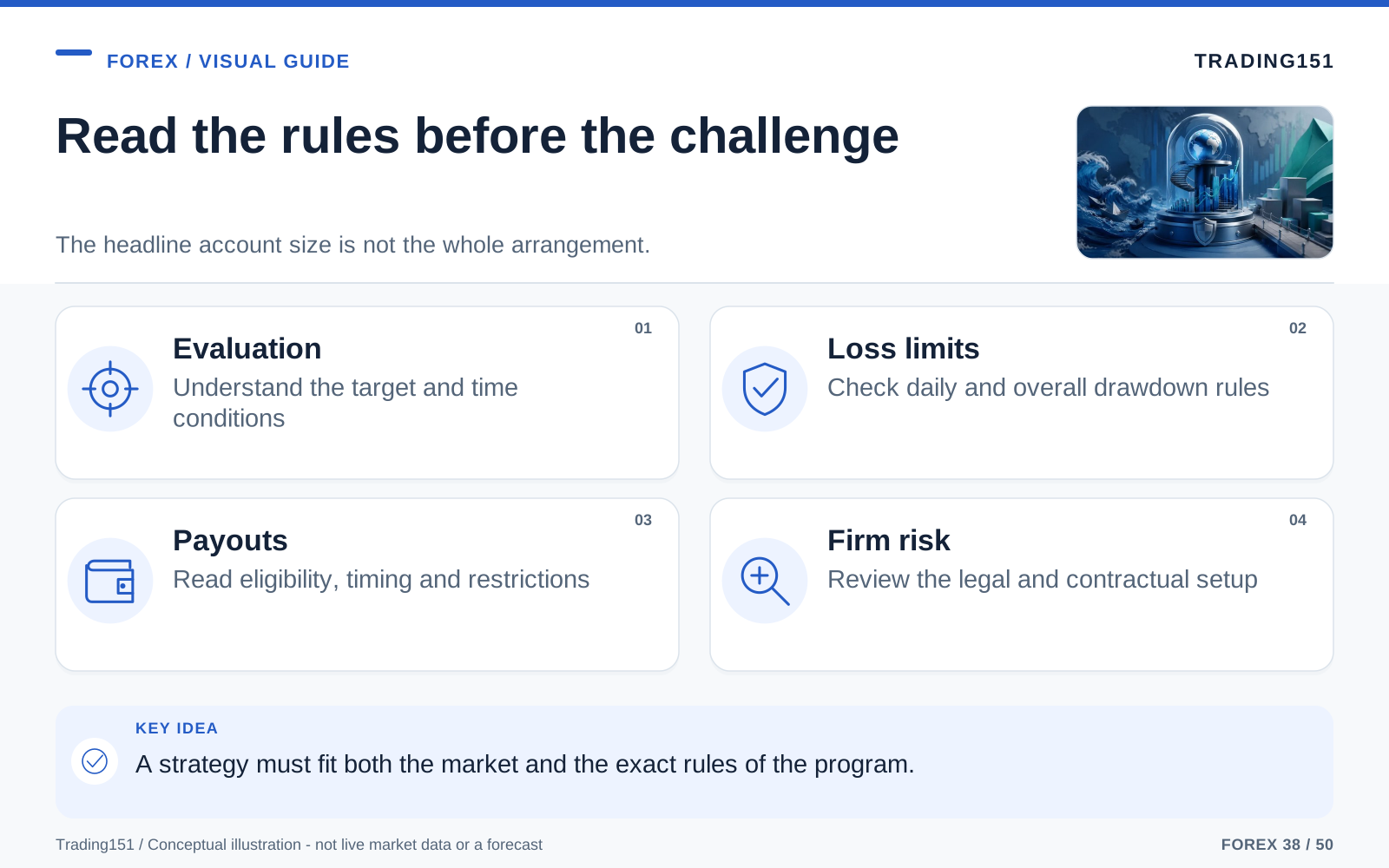
Read this diagram as text
- Evaluation
- Understand the target and time conditions
- Loss limits
- Check daily and overall drawdown rules
- Payouts
- Read eligibility, timing and restrictions
- Firm risk
- Review the legal and contractual setup
The Core Offer: Why It Feels So Attractive
The pitch you see in the ads is intoxicating: prove you’re not a degenerate gambler, and we’ll hand you a huge account. You split the profits, they take the risk.
It’s easy to see why people flock to this setup.
- Low barrier to entry: You don’t need to spend ten years saving up six figures to trade a decent size.
- Limited upfront commitment: In some arrangements the direct outlay is the evaluation fee, but resets, subscriptions, add-ons, and contractual liabilities must also be checked. Do not assume every firm's terms impose the same maximum loss.
- Conditional payout potential: An account may offer a share of eligible results, subject to its contract. The advertised balance is not money the trader owns or can withdraw, and a simulated profit is not automatically an enforceable cash payout.
- Built-in discipline: For traders who struggle with self-control, having a firm’s strict rules hanging over their head is exactly the guardrail they need to stop blowing accounts.
That is the marketing proposition, not proof that a particular firm will deliver it. Verify the legal entity, account model, payout conditions, fee schedule, and dispute process. Testimonials cannot replace those checks.
But the shiny "get funded" marketing can definitely blind people. New traders hear the word "funded" and conveniently ignore the severe reality of the evaluations. They picture the profit splits and the lifestyle, completely underestimating the mental grind, the suffocating rules, and the uncomfortable fact that they might not be half as disciplined as they think.
How Forex Prop Trading Works
While every firm has its own flavor, the standard online prop model usually follows a predictable playbook. But here's a crucial tip: pay as much attention to the fee structure as you do the trading rules. Things like reset fees, add-on features, and minimum trading days can drain your bank account fast. Treat these challenges as a strict business expense with a hard limit, not an arcade game where you keep inserting coins every time you lose.
1. The Evaluation or Challenge
Think of this as the tryouts. You pay an upfront fee for a demo account loaded with a specific balance. Your mission? Hit a target profit without breaking their strict risk management rules.
And the risk rules are the real test. They don’t care if you can YOLO your way to a large gain on one lucky gold trade. They want to see if you can survive the market without blowing up. It sounds simple, but in practice, it changes everything.
You'll usually have to navigate a minefield of rules like:
- Profit targets: Hitting a certain percentage gain, usually across one or two testing phases.
- Daily drawdown limits: Lose more than a set percentage in a single 24-hour period, and you fail instantly.
- Maximum total drawdown: Let the account drop below a hard floor, and it's game over.
- Minimum trading days: To prove you aren't just getting lucky on a single news event, many firms require you to trade for a minimum number of days.
- Restricted strategies: No cheating the system. Things like latency arbitrage, weird copy trading schemes, or platform abuse will get you banned.
2. Verification or a Second Phase
Some firms use a second evaluation phase with different targets or limits. Passing twice may reduce reliance on one favorable run, but chance and market conditions still matter. Neither a second phase nor a certificate establishes a lasting ability to trade profitably.
3. The Funded Stage
Pass verification, and you finally get the coveted funded account. But here's a secret: this might be a real live account, or it might just be another simulated account where the firm pays you out of their own pocket based on your performance. You need to know the difference before signing up.
Some firms copy your trades into the live market. Others just keep you on demo and manage the payouts through their own business revenue. Neither is inherently evil, but as a professional, you deserve to know exactly how the firm makes its money and where your payouts are coming from.
4. Payouts and Scale Plans
This is the fun part. Once funded and profitable, you get a cut of the gains—usually a very generous split in your favor. If you stay consistent, many firms will even scale up your account size. This is the dream scenario: turning small, consistent percentage gains into serious cash flow, all without risking your own savings.
Where the Pressure Really Lives: The Rules
Ask a rookie what makes prop trading hard, and they'll say "the market." Ask a veteran, and they'll give you the real answer: the rules. You have to read the fine print on drawdowns literally. A static drawdown limit, an end-of-day trailing limit, and an intraday trailing limit can produce totally different results from the same trades. Grab a pen and run the math before you pay. A lot of traders blow their accounts simply because they didn't understand how the firm calculated their losses.
The Forex market is already a meat grinder. Throw in strict loss limits, time pressure, the desperate desire to get a payout, and the looming anxiety that one mistake will strip your account away, and the psychological pressure goes sharply higher.
Daily Drawdown
This is the ultimate account killer. On a personal account, a red day just sucks. On a prop account, a bad day can instantly terminate your opportunity. That threat totally changes human behavior. Good traders suddenly get terrified and skip great setups. Or worse, they take a small loss, panic, and revenge-trade their way straight into an account breach.
The daily drawdown isn't just a math equation; it's a psychological trap. It instantly punishes emotional spirals, which is exactly why so many challengers fail under the pressure.
Maximum Drawdown
This is your hard floor. If your balance—or sometimes just your floating equity—dips below this line, you're done. It doesn’t matter if your strategy is fundamentally sound and would likely recover by Thursday. The firm pulls the plug.
This fundamentally shifts how you trade. With your own money, you might hold through a deep pullback because you trust your long-term edge. In the prop world, time is a luxury you simply don't have.
Rule Nuances That Matter More Than People Expect
The devil is in the details. Some firms base your limits on your closed balance, while others factor in floating open trades. Some even use a trailing drawdown that creeps up behind your high-water mark, essentially shrinking your breathing room every time you make a profit. Traders constantly get blindsided by this because they were too busy staring at the payout promise to read the FAQ.
You might also find rules banning trades during big news releases, prohibiting holding trades overnight or over the weekend, or banning certain assets. None of this is necessarily unfair, but it becomes a large problem if you don't realize your specific trading style is banned until after you've paid for the challenge.
Why So Many Traders Fail Prop Firm Challenges
Here's an uncomfortable reality: most people don't fail because the tests are impossible. They fail because the strict environment forces all their hidden, toxic trading habits out into the open.
Some guys overtrade out of boredom. Others use large lot sizes hoping to pass in a single day. Some can make money in a relaxed, rule-free environment but completely choke the second you put a stopwatch and a loss limit on them. And many just haven't accepted that trading is a game of probabilities, not absolute control.
But the biggest killer is desperation. A lot of people buy these challenges because they need a financial rescue mission. That mindset is absolute poison in the markets.
When you trade from a place of desperation, every tick of the chart feels heavy. A normal, acceptable loss feels like a personal attack. Missing a big trend feels unbearable. A winning streak makes you cocky. You stop trading the plan, and you start negotiating with your own fear, urgency, and fantasies all at once.
Knowing how to read a chart isn't enough. Plenty of people can identify a perfect setup. Very few can calmly execute it when their funded account is inches away from the daily loss limit.
The Real Advantages of Prop Trading
Despite all these warnings, prop trading isn't a scam. There are large, life-changing benefits to this model. To write it off entirely would be just as shallow as blindly glamorizing it.
Access to Capital
This is still the undeniable golden ticket. If you have an edge but you work a normal job, a prop firm gives you access to the kind of capital it would take you a decade to save up personally.
Capped Personal Risk
A fee-based evaluation can make the initial cash commitment clearer than a leveraged personal account, but the total outlay depends on the contract and repeated purchases. Set a maximum budget for the whole experiment, including subscriptions and resets. Expected payouts should not be treated as guaranteed income or used to fund essential bills.
A Professional Framework
The strict rules save a lot of traders from themselves. Knowing you can lose the account if you gamble forces you to start thinking like a professional risk manager instead of a thrill-seeker. You start sizing smaller, journaling more, and walking away when the market is choppy. In that sense, a prop firm is an amazing training ground.
Scalability
Growing a personal account slowly takes years unless you're injecting fresh cash or taking crazy risks. But with a prop firm, consistent payouts can quickly unlock multiple accounts or larger scaling plans. You can grow your trading business without draining your personal bank account to do it.
The Darker Side of the Industry
Now let's talk about the ugly stuff the flashy promotional pages conveniently leave out.
The Business Model Isn’t Purely Aligned With You
Prop firms are businesses, and a huge chunk of their revenue comes from people failing challenges. That means the firm makes a lot of money off a high failure rate. It doesn't mean every firm is running a scam, but it does mean their incentives aren't entirely pure.
The good firms definitely want a roster of elite traders bringing in real profit splits. But let's not kid ourselves—the industry as a whole is heavily subsidized by the endless conveyor belt of hopeful rookies who blow their challenge in the first week. Don't go in thinking the relationship is 100% supportive.
Emotional Burnout
Blowing a personal account is terrible, but losing a funded account hits completely different. You put in the work, you passed the grueling tests, you told your friends you finally made it, you started mentally spending the payouts... And then one rough week wipes it all out. The emotional crash is severe.
This is where the dark cycle starts: fail, get mad, buy a reset, rush it, fail again. Before you know it, you’ve spent thousands on evaluation fees and you're no closer to being funded. You aren't building a career at that point; you're just feeding a slot machine.
Firm Risk and Operational Risk
Even if you're a phenomenal trader, the firm itself can let you down. Terrible customer service, confusing rules, delayed payouts, sudden policy changes, or glitchy platforms can turn a great setup into a nightmare. Traders get so hyper-focused on passing the test that they forget to vet the actual company running it. You are trusting an online entity with your time and effort. Keep screenshots of your agreements, save your trade records, and please, do not rely on an unpaid prop firm payout to pay for your essential living expenses. The counterparty risk is very real, even when the dashboard says you're funded.
What Smart Traders Look for Before Choosing a Firm
Picking a prop firm shouldn't feel like buying a lottery ticket. Treat it like selecting a business partner. The headline profit split is cool, but the boring details are what will save you.
- Clarity of rules: Is the drawdown calculated fairly and in plain English, or is it hidden behind a maze of confusing jargon?
- Payout reputation: Do they pay their traders on time, without creating unnecessary drama?
- Support quality: When the platform freezes, do you get a real human resolving it, or a bot feeding you canned replies?
- Trading restrictions: Will you get banned for holding a trade over the weekend or trading during the news in a way that conflicts with your strategy?
- Platform transparency: Are they upfront about whether you're trading live funds or just demo trading for a simulated payout?
- Longevity and stability: Have they been around long enough to survive market volatility, or did they launch last month with a large affiliate marketing budget?
You don't need the universally "best" firm. You just need a reputable company whose rules align with how you naturally trade, and who has a proven track record of wiring the money.
The Human Side: What It Takes to Last
Everyone asks how to pass a challenge. That's the wrong question. The real question is how to survive once the account matters. The evaluation structure tempts you to do stupid things—like forcing a trade right before a deadline, skipping a perfect setup because you're close to a daily limit, or tripling your risk after a loss. If passing the test requires you to trade like a maniac, you're going to lose the funded account anyway. Your strategy should fit inside the rules naturally, not be created by them.
Stop Treating Each Account Like a Rescue Mission
If your electricity is about to get shut off and you're relying on a prop firm payout to save you, you've already lost. Trading with your back against the wall destroys your objectivity. You force setups, freeze at the worst times, and become emotionally chained to every tick of the chart. It’s impossible to trade well when you're in survival mode.
Trade Smaller Than Your Ego Wants To
This stings the ego, but it's the absolute truth: success in the prop space comes from restraint, not bold, aggressive moves. Dropping your risk-per-trade down feels painfully slow and boring, but boring keeps you in the game. A brilliant strategy is completely useless if you get kicked out of the firm before the law of averages can play out in your favor.
Think in Percentages, Not Dollars
Staring at your floating P&L in dollars is a guaranteed way to trigger an emotional meltdown. If you see a trade move a few hundred bucks in seconds, you'll panic and close it—even if the chart says the setup is still perfectly valid. Train your brain to only see risk units, percentages, and technical levels. Detaching from the monetary value is a superpower.
Keep a Journal That Tells the Truth
A trading journal isn't just taking screenshots of your winning charts to post online. It's a severe, honest record of your own psychology. Why did you take that trade? Were you calm? Did you jump in early because of FOMO? Did you cut a winner because you were terrified of the daily limit? If you can't be honest with yourself about your own toxic habits, you'll just keep repeating them.
Accept That Consistency Looks Boring From the Outside
Social media has completely warped what trading looks like. Real, profitable trading isn't yachts, large gamble trades, and fast money. It's repetitive. It's measured. It looks like a person staring at a chart, passing on mediocre setups, taking a perfectly executed loss, and moving on without throwing a tantrum. It isn’t glamorous, but it pays the bills.
So, Is Prop Trading in Forex Worth It?
For a specific type of person, absolutely. For others, it’s just a highly efficient way to burn money while living in denial about their trading skills.
It’s totally worth your time if you already have a backtested edge, respect risk management, and just lack the bankroll to make a decent living. It’s also fantastic if you know that having strict, external rules forced upon you makes you a better, more professional trader.
It’s probably not worth it if you're hopping between strategies every two weeks, chasing the high of hitting a home run, or hoping a funded account will magically fix your bad habits. In that case, the prop model won't solve your problems; it will just magnify them.
The severe reality is that passing a challenge doesn't magically turn you into a disciplined trader. It just reveals who you already are. The rules are unbending, the limits are transparent, and when things go wrong, there is absolutely nowhere to hide and no one to blame but yourself.
Read the payout contract, not just the account headline
An advertised $100,000 account may allow only a small fraction of that amount as a drawdown before termination. The economically relevant limit is the permitted loss under the exact calculation, not the large number in the account name. A trailing limit, a static limit, and a daily equity-based limit can produce very different outcomes from the same sequence of trades.
Read how fees and payouts interact. Include evaluation charges, resets, subscriptions, currency conversion, and any withdrawal conditions. A high payout percentage means little without knowing which results qualify, whether the environment is simulated, and what discretion the operator retains. Do not treat an unpaid dashboard balance as money already received.
Check prohibited strategies and event restrictions in writing. Rules may address news releases, overnight positions, copying, automated systems, or execution behavior. A method can appear acceptable during an evaluation and conflict with a later rule or review. Save the applicable contract and its date rather than relying on a promotional explanation.
The operator's solvency and conduct are risks separate from trading performance. Verify the legal entity and any relevant regulatory status, while recognizing that registration for one activity may not cover the service being sold. Participation should be assessed as a paid contractual arrangement with uncertain outcomes, not as a low-risk route to a salary. Repeated fees can become a substantial loss even when no conventional brokerage account is being depleted.
Budget the evaluation as an expense, not an asset
An evaluation fee buys access to a process under specified terms. It is not a deposit that automatically becomes trading capital, and it should not be counted as an investment recoverable from future payouts. Treat repeated attempts, subscriptions, and optional upgrades as real cash outflows.
Before paying, decide the maximum total amount that can be spent without affecting essential finances. Include the possibility of receiving nothing. A successful attempt does not make the earlier fees disappear; they belong in the calculation of the overall result.
The same discipline applies to time. Hours spent meeting account conditions have an opportunity cost even when they do not appear on a statement. A fair review asks whether the arrangement has produced a satisfactory result after all fees, time, restrictions, and uncertainty, rather than judging it by the largest notional account size ever displayed on the screen. 1, 2, 3
The Final Verdict
Forex prop trading has cracked open doors that used to be locked tight for the average retail trader. That’s a beautiful thing. If you have the talent but lack the cash, you now have a legitimate pathway to opportunities that used to be reserved entirely for Wall Street insiders.
But walking through that door means stepping into a pressure cooker.
It is not free money. It isn't a hack. It certainly doesn't eliminate the need for patience, grit, and ice-cold emotional control. Trading a prop account requires way more discipline than a personal account, simply because the leash is shorter and the punishments are instant.
If you treat it like a lottery ticket, it will chew you up, spit you out, and take your confidence with it. But if you treat it like a serious business endeavor—with a healthy respect for risk and realistic expectations—it really can be the stepping stone that changes your life.
Ultimately, that's the true promise of Forex prop trading. It won't make you an overnight millionaire, and it won't buy you an easy life of leisure. It just gives you a shot. A bigger stage. A way for people who have put in the hard work to finally get their hands on real capital and get paid what they're worth.
The vault may be open, but getting inside is only day one. The real challenge is keeping your cool, managing your risk, and being consistent enough to stay in the game. Put a hard cap on how much you'll spend on challenge fees, understand every drawdown calculation, keep your personal finances separate, and judge firms by their actions, not their glossy marketing payouts. The funds might be simulated or conditional, but the stress—and the potential rewards—are real.
Sources and further reading
- FSMA: Warning on proprietary trading firms and simulated trading
- FCA: Firm Checker
- BIS: April 2025 FX turnover, September 2025 preliminary release
Editorial revision: 7 October 2026. Numerical scenarios are hypothetical unless identified as historical. References support the added explanations and selected corrections; rules and product terms should be checked again before acting.