
An expert advisor follows instructions more consistently than a tired trader, including instructions that happen to be wrong. Automation can improve execution and make a strategy easier to test. It cannot turn an unprofitable idea into a profitable one by running it faster. Before choosing a forex robot, understand both its trading rules and the conditions under which it must stop.
What Algorithmic Trading Really Is
Strip away the terminology, and algorithmic trading is just rule-based trading translated into code.
You give the software a checklist, and it executes it. These instructions can be super basic—like buying when one moving average crosses another. Or they can be unusually complex, factoring in market volatility, the time of day, current spread conditions, and strict risk limits before even thinking about taking a trade.
But here is the kicker: the robot isn’t "thinking." It isn’t improvising or learning how to trade better on the fly. It is just doing exactly what it was told to do, nothing more, nothing less.
A lot of beginners picture a trading bot as this digital genius outsmarting the market in real time. In reality, most retail bots are just glorified automated checklists.
Think of it like a strict recipe:
- If price breaks yesterday’s high,
- And if volatility is above a certain level,
- And if the spread isn't ridiculous right now,
- Then open a buy trade, set a stop loss, and place a take profit.
That’s all it is: a set of conditions followed by an action.
In the Forex world, these algorithms usually run on platforms like MetaTrader 4 or 5, where they're dubbed Expert Advisors. The name gives them way too much credit. An EA isn't a wise market mentor whispering advice into your ear. It’s just a piece of software that follows orders with zero hesitation.
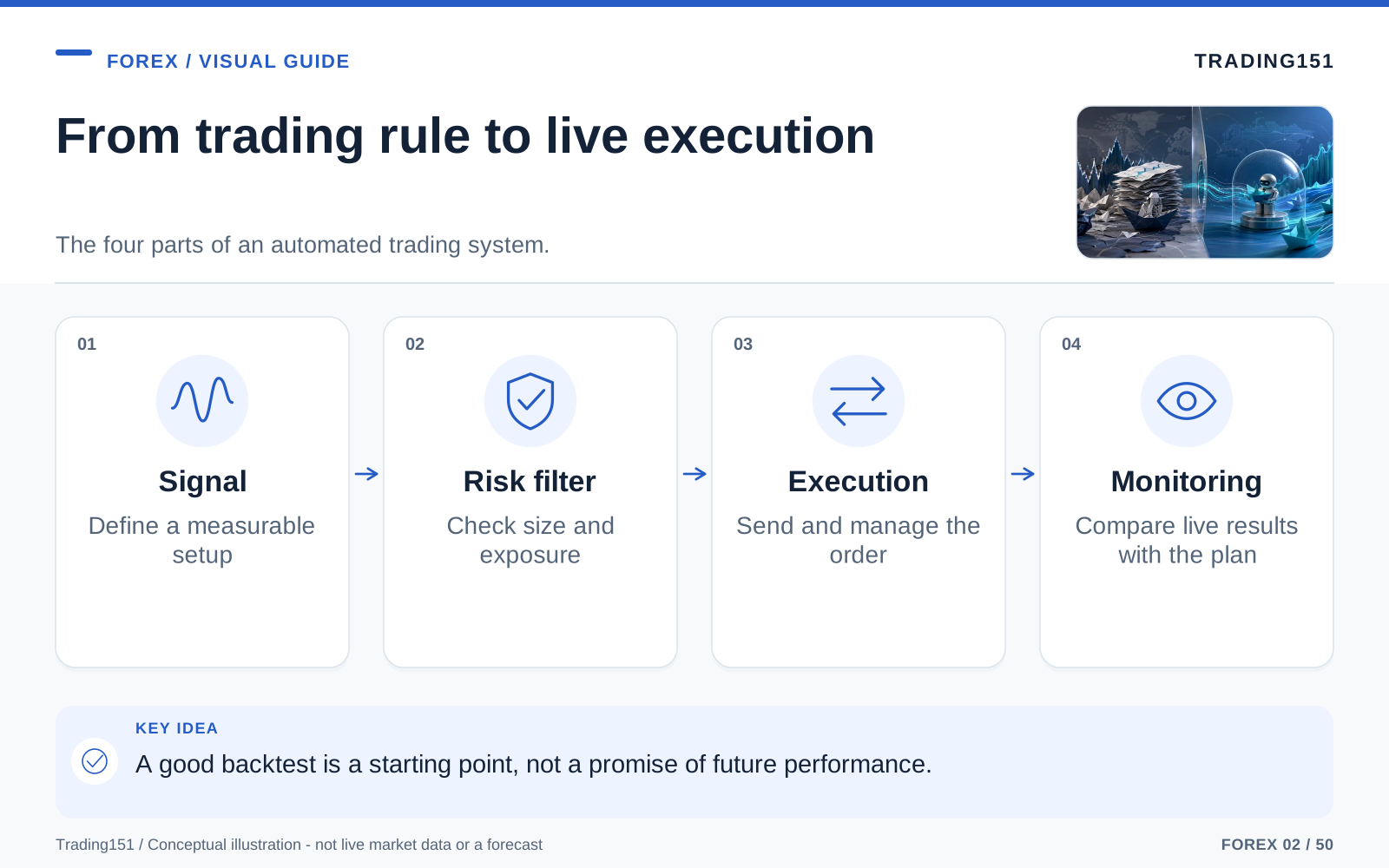
Read this diagram as text
- Signal
- Define a measurable setup
- Risk filter
- Check size and exposure
- Execution
- Send and manage the order
- Monitoring
- Compare live results with the plan
What an Expert Advisor Does Behind the Scenes
Once you drag an EA onto a chart and flip the switch, it starts watching price data tick by tick. If its specific conditions line up, it springs into action. It can open trades, trail stop losses, scale out of positions, or close everything down. But remember, it follows all instructions exactly—even the flawed or poorly coded ones. A real-world EA needs rules for everything: market hours, max spreads, duplicate signals, broker rejections, partial fills, internet drops, and what on earth to do after a server restart. These boring details rarely make it onto the glossy sales page, but they absolutely dictate whether your bot survives outside of a perfect simulation. Automation only feels seamless if the programmer thought of every "what if" scenario.
Some EAs are just simple utility tools. Maybe they just manage your open trades by moving your stop loss to break-even. Others are full-scale systems that handle everything from entry to exit without you lifting a finger.
What separates a trash-tier EA from a professional one usually boils down to the stuff people hate talking about. How does it react when a news spike widens the spread to 40 pips? What if the broker rejects the order? Does it have the sense to stop trading after a large drawdown? The charts in the marketing brochures always look perfectly clean. Live trading never is.
Why Traders Are So Drawn to Automation
The pull of trading robots makes total sense. They actively solve the things that make manual trading so exhausting.
1. They remove hesitation
A machine doesn’t freeze up. It doesn’t get shell-shocked because it just lost three trades in a row. It never decides to skip a perfectly good setup because the market "feels a bit weird today." If the rules say buy, it buys. If the stop is hit, it takes the loss. That level of icy discipline is practically impossible for a human to maintain day in and day out.
If your biggest enemy is your own psychology, handing the keys over to a robot feels like a large weight off your shoulders.
2. They can watch the market constantly
Forex runs around the clock during the week, but you have to sleep. You have a job, you have a life, and you are going to miss setups. An EA doesn't care if it's 3:00 AM on a Tuesday. It scans the charts endlessly, ready to pounce the second a setup forms.
That doesn't guarantee profits, of course, but it certainly gives you an edge in sheer endurance.
3. They make testing possible
This is arguably the biggest perk. To code a bot, you have to be sharply specific. You can't program a vibe like "buy when momentum looks strong." You have to define exactly what that means in hard numbers. Once you do that, you can run those rules through years of historical data to see if the strategy works over thousands of setups.
Even a flawed backtest teaches you way more than guessing ever will.
4. They can execute faster than humans
For certain short-term strategies, milliseconds matter. As a human, you have to see the signal, process it, click the mouse, double-check your position size, and hope price hasn't bolted. A robot clicks the button the exact millisecond the criteria are met.
Speed won't magically turn a bad strategy into a winner, but it definitely helps you capture your edge without missing a beat.
Where the Dream Starts to Crack
So, if bots are tireless, disciplined, and lightning-fast, why do so many retail traders blow their accounts using them? Because the live market is a substantially different beast than a backtesting simulator. You're suddenly dealing with shifting broker quotes, commissions, latency, and slippage. A bot that trades around news events or daily rollover might get chewed up in real life. This is why pros always test a new bot on a demo account tied to their specific broker, then step up to micro-lots, and meticulously compare the live trades to what the code was supposed to do.
The harsh reality is that automation doesn't fix a bad strategy. It just puts a bad strategy on fast-forward.
If you're a sloppy manual trader, your own hesitation might accidentally save you from taking every losing setup. A bad EA has no such restraint. It will faithfully execute a terrible plan until your account hits zero.
The bot is only as smart as the assumptions built into it.
The market doesn’t stand still
Markets evolve constantly. A breakout strategy that crushed it in a trending market will bleed you dry during a choppy, sideways summer. Correlations break down, liquidity dries up, and a single breaking news headline can completely flip market sentiment in a way no technical indicator was designed to catch.
Humans are messy, but we are adaptive. We can look at a chart and say, "Okay, things are getting weird, I'm sitting on my hands." A robot doesn't know the market changed unless you specifically programmed it to recognize that exact shift.
Backtests can be deeply misleading
This is where the industry gets really shady.
It's easy for a developer to tweak an EA's settings until its historical track record looks like a straight line up. It's called curve fitting. Instead of finding a genuine, repeatable market behavior, they just tweak the parameters to perfectly dodge past losses. It has basically memorized the past rather than learning a real edge.
A curve-fitted system looks like pure genius in a backtest and completely falls apart in reality. It’s like a student acing a test by memorizing the answer key instead of learning the subject.
Execution in real life is never as clean as it looks
Simulators assume a perfect world. Live trading is chaotic.
Orders get slipped. Spreads blow out at 5:00 PM EST. Your VPS connection might drop for three minutes. Brokers have weird execution quirks that never showed up in testing. A scalping bot that looked like an ATM machine in a backtest can become totally useless once real-world spread friction enters the chat.
This is why serious algo traders never stop at backtesting. They forward-test in live market conditions—usually on a demo first, and then with pocket change before risking real capital.
Robots lack judgment
An EA reads price. It doesn't read context.
If a currency pair completely tanks because of a surprise interest rate hike, a human trader knows to step away and let the dust settle. A robot programmed to "buy the dip" just sees a large discount and might keep buying all the way down into a margin call.
People assume a bot is smarter because it's disciplined. It isn't. It's just obedient.
The Most Common Types of Forex Robots
If you shop around for EAs, you'll start noticing they mostly fall into a few familiar buckets. Knowing how they work helps you spot their hidden traps.
1. Scalping robots
These bots hunt for tiny wins, holding trades for minutes or even seconds. They rely heavily on razor-thin spreads and flawless execution. They look appealing because they trade constantly and seem to win a lot.
- The upside: Lots of action and immediate feedback.
- The downside: They are fragile. A slight increase in your broker's spread or a tiny bit of slippage turns a winning scalper into a losing one instantly.
2. Trend-following systems
These aim to catch big directional moves and hold on for the ride, usually relying on breakouts or moving averages. They lose a lot of trades, but the winners are supposed to be big enough to cover the losses.
- The upside: They can rack up large profits when the market picks a direction and runs.
- The downside: They suffer slow, agonizing deaths in choppy, sideways markets. It’s psychologically tough to watch a bot take ten small losses in a row waiting for a runner.
3. Mean-reversion robots
These bots operate on the idea that if price stretches too far from its average, it’s bound to snap back. This works beautifully when the market is quiet. But sometimes, a breakout isn't just a temporary stretch—it's a brand new trend.
- The upside: Very consistent in calm, ranging markets.
- The downside: Gets absolutely steamrolled by strong trends that never look back.
4. Grid systems
A grid bot places a net of buy and sell orders at set intervals. As price bounces around, it cashes out the winners. In a sideways market, the equity curve looks like a staircase going straight up.
- The upside: Thrives in ranging conditions without needing pinpoint entry accuracy.
- The downside: If the market suddenly trends hard in one direction, you're left holding a large, growing bag of losing trades. It works beautifully right up until it doesn't.
5. Martingale systems
These are the absolute worst traps for beginners. A Martingale bot doubles down (or increases size) every time it loses, banking on the fact that a reversal will eventually happen and wipe out all the previous losses. For a long time, it feels like printing money.
Then, a trend goes a little further than usual, your position sizes snowball, and your entire account is vaporized in an afternoon.
- The upside: Produces a beautiful, fake sense of consistency that newbies love.
- The downside: designed to eventually blow your account.
If a vendor shows you a perfectly smooth equity curve with a 95% win rate, run. It's almost certainly Martingale logic hiding under the hood.
The Retail EA Market Has a Trust Problem
The commercial EA space is an absolute minefield of garbage. Anyone can fake a backtest by cherry-picking dates, ignoring real-world spreads, hiding the recovery logic, or optimizing the bot for just one specific currency pair. Ask for the hard rules, the test assumptions, and how it performs on totally unseen data. Be extremely wary of systems where the risk can't be explained simply. If the seller’s only response to your questions is more screenshots of profits, they are hiding something.
A lot of these products are just poorly coded, over-optimized junk wrapped in slick marketing. The sales copy is always a dead giveaway. If you see phrases like "guaranteed daily income," "zero risk," or "secret institutional algorithm," keep your wallet closed.
Real trading is boring. Systems that survive long-term are built around restraint, not flashy spectacle.
When you evaluate a bot, you need to ask the boring questions:
- What was the absolute worst historical drawdown?
- How badly does slippage affect the bottom line?
- What specific market conditions will cause this thing to lose?
- Does it try to recover losses by averaging down or doubling lot sizes?
- Has it been tested across different years and volatile market regimes?
- Has it been forward-tested on a live account, or just run through a simulator?
- Can the core strategy be explained to me in plain English?
If they can't answer that last one, walk away.
The Best Use of Automation Is Usually Not Full Blind Trust
People tend to view automation as a totally hands-off experience. But the most profitable algo traders I know use a hybrid approach.
Think of yourself as the strategist, and the machine as the executor.
The human decides the big picture: which pairs to trade, whether the current market volatility is safe, and if there's any major news coming up that could wreck things. The EA then handles the grunt work: staring at the chart, waiting for the perfect entry, placing the stop loss, and executing without hesitation.
This makes infinitely more sense than blindly slapping an EA on five different charts and going to the beach hoping it figures everything out.
The machine brings the discipline, speed, and consistency. You bring the context, restraint, and the common sense to recognize when the market has changed.
How to Start With EAs Without Doing Something Reckless
If you want to dip your toes into automated trading, treat EAs like heavy machinery. They are useful, but if you don't respect them, you will get hurt.
1. Start with a strategy you can explain
If you don’t understand why the bot is entering a trade, you have no business risking real money on it. You don't need to read the source code, but you should know the logic. What is it looking for? When does it take a loss? Why should this edge even exist?
2. Backtest first, but don’t worship the results
Backtesting is great for weeding out garbage ideas and getting a feel for the bot. But it is not a crystal ball. Treat backtests as an audition, not a promise.
Look at the drawdowns and the losing streaks, not just the final profit number. Make sure it didn't just get lucky during one really good trending year.
3. Forward-test on demo
Skip this step and you're gambling. A bot that crushes it in a simulator might get destroyed in today's live market. Put it on a demo account and watch how it handles real-time spreads, rollover hours, and session changes.
You aren't just seeing if it makes money; you're verifying that it behaves the way you expect it to.
4. Use tiny size when going live
When you finally flip the switch to a live account, trade pennies. Consider this the "paid observation" phase. You are just making sure the live execution matches the demo execution.
So many people blow up because they treat a promising two-week test as gospel and leverage way too aggressively.
5. Use a VPS if the system needs continuous uptime
If your bot needs to run 24/5, your home laptop and Wi-Fi aren't going to cut it. Rent a cheap Virtual Private Server (VPS). It keeps the bot running even if your power goes out, and usually offers better execution speeds.
6. Build in risk limits
A good setup doesn't just know how to trade; it knows when to quit. Use daily loss limits, maximum spread filters, and news filters to keep the bot grounded.
The safest bots out there aren't the most aggressive ones; they're the ones that know how to stay out of the market when things get ugly.
7. Monitor it like an operator, not a gambler
Stop thinking of bots as "set and forget." Think of them as "set, monitor, evaluate, and intervene." You still need to review the trades, check the server logs, and make sure the current market still suits the strategy.
It’s not quite the "passive income on a beach" fantasy, but it’s a lot closer to reality.
What Sensible Risk Management Looks Like in Automated Trading
It's weird how casual people get with risk management the second a bot is involved. Just because a computer is placing the trades doesn't mean you're immune to risk. Leverage doesn't care if a human hand or a script opened the position. You need hard limits and a kill switch. Set a maximum daily loss, cap your open risk, limit your allowed spread, and decide exactly what you'll do if the bot starts throwing tech errors. And pay attention to silence! If a bot that normally trades every day suddenly stops sending orders, it might be broken. You have to supervise the software because code will flawlessly execute a terrible mistake.
Keep these rules in mind above all else:
- Keep position sizing modest. Small sizes let you survive the inevitable losing streaks.
- Respect drawdown. If a bot had a 25% drawdown in historical testing, assume it will easily hit that (or worse) in real life.
- Avoid concentration. Running the same strategy on highly correlated pairs isn't diversification. It’s just multiplying your risk.
- Plan for failure. What happens if the broker's server freezes? What if your VPS disconnects? What if the market gaps?
- Don’t average down blindly. Most blown algo accounts don't die from one bad trade. They die from the recovery logic aggressively trying to average out of a large loser.
The harsh truth is most account blowups are caused by oversized risk and flat-out refusing to accept that a strategy can be wrong.
When an EA Can Be Worth Using
Look, I'm not totally against bots. Despite all the warnings, they are incredible tools when applied correctly.
An EA makes total sense when:
- Your strategy is 100% mechanical and repeatable,
- Execution speed really matters,
- Your own emotions are getting in the way of your results,
- You’ve rigorously tested the logic across multiple market conditions,
- You have hard risk controls baked in, and
- You are willing to act as a manager, not an absentee landlord.
When you use it like this, automation stops being a gimmick and becomes exactly what it was meant to be: a highly efficient tool.
When It Probably Isn’t
On the flip side, an EA won't save you if you don't understand trading in the first place. If you just want effortless income without doing the work, or if you're buying a bot based purely on some flashy Instagram screenshots, you're going to have a bad time.
EAs are also a terrible fit for traders who panic at the first sign of a drawdown, who constantly jump from system to system, or who are tempted by dangerous recovery methods that look smooth right up until they explode.
Automation can fix poor execution, but it cannot fix unrealistic expectations.
Give the robot a failure drill
A useful test for an expert advisor has nothing to do with finding a better moving-average setting. Disconnect its price feed in a controlled test. Restart the platform while a position is open. Simulate an order rejection. Then check whether the program reconstructs the account correctly instead of assuming that its last instruction succeeded.
Consider an EA that sends a buy order, loses its connection, and never receives confirmation. On reconnecting, it might send the order again. Without a check against the broker's actual positions and order history, the account could end up with twice the intended exposure. A backtest built only around price signals may never reveal that problem.
Write the operating limits separately from the entry logic. Those limits might cover total open exposure, acceptable spreads, repeated errors, and when stale data must stop new trades. Decide what the system should do with existing positions when a limit is reached; stopping new orders and closing everything are different actions with different consequences. Keep the settings and software version alongside each test result so that a later change does not become impossible to trace.
Finally, rehearse a manual shutdown. You should know how to disable the EA, inspect pending orders, and check the account from an independent connection. A rented server can improve uptime, but it cannot make faulty rules safe. Reliability means behaving sensibly when something goes wrong, not merely staying switched on.
Make changes reversible
Keep a working copy of the last stable version before changing an EA. Record what changed, why it changed, and the evidence that would justify keeping it. A small update to order handling can matter more than a visible change to an indicator. Test revisions separately from the live setup, and retain a way to restore the earlier version without guessing which settings it used. 1, 2
Conclusion: The Future May Be Automated, But Responsibility Still Sits With You
Algorithmic Forex trading isn't a scam, but it certainly isn't magic either. It’s just a method. Handled correctly, it provides structure, speed, and cold, hard consistency. Handled poorly, it’s just a highly efficient way to drain your bank account.
The real beauty of an Expert Advisor isn't that it replaces the trader. It’s that it handles the boring, repetitive grunt work of trading far better than we ever could. Bots don't get bored. They don't chase trades. They don't panic. And those are large advantages.
But they don't understand nuance. They can't read a market's mood. They don't step back and realize the global macroeconomic landscape has shifted in a way the code never prepared for. That job is entirely yours.
So go ahead and explore automation. Study it. Test it relentlessly. Let the machines do what they do best.
Just don't confuse a fast execution speed with actual market intelligence.
Ultimately, the person calling the shots isn't the robot—it’s the human who sets the rules, manages the risk, and knows exactly when to pull the plug. Keep meticulous records. Make sure you track the specific code version, settings, broker, and platform build you're using. A winning setup on one broker might be a loser on another. The best algo traders are boringly organized: they document changes, reproduce tests, verify live behavior, and cut risk instantly if something looks off. Treat your EA like a piece of serious operational infrastructure, not a magical black box that deserves your blind trust just because it made money last week.
Sources and further reading
Editorial revision: 7 October 2026. Numerical scenarios are hypothetical unless identified as historical. References support the added explanations and selected corrections; rules and product terms should be checked again before acting.