
Liquidity providers quote prices at which they are prepared to trade, helping currency buyers and sellers find a counterparty. That description is simple; the route from a bank's quote to a retail account is not. Aggregators, brokers, credit arrangements, and execution rules can all affect the price a trader actually receives. More quoted liquidity does not mean every order is guaranteed a fill.
What Liquidity Really Means in Forex
People throw the word liquidity around all the time in finance, usually dressing it up in boring, technical jargon. But really, it just comes down to this: how easily can you buy or sell something without forcing the price to move?
Cash is the ultimate liquid asset because everyone takes it immediately. A house? Not so much. Selling a house takes months of negotiation, paperwork, and waiting for the right buyer. Forex is liquid, but not because currencies have magical properties. It’s liquid because there’s almost always a large crowd of participants willing to trade at prices just a fraction of a pip apart.
But a tradable price isn't just a number; it’s a number tied to a specific volume. A quote might look great on your screen, but if there's only a tiny amount of currency available at that price, a big order will chew right through it and end up getting filled at much worse prices down the line. Retail traders don't usually trade big enough size to notice this daily, but you’ll absolutely feel it during major news events or the dead of night. Liquidity isn’t just a flashing quote—it’s the actual, physical ability to get a deal done.
When you buy EUR/USD, someone else has to sell it to you. When you close that trade, someone has to take it off your hands. A truly liquid market means you can find those counterparties instantly, without the price substantially jumping just because your order hit the tape.
Liquidity providers are the ones making sure those counterparties exist. By constantly offering both buy and sell prices, they build the "depth" that lets the market absorb orders smoothly. Without them, Forex would be patchy, expensive, and a nightmare to trade.
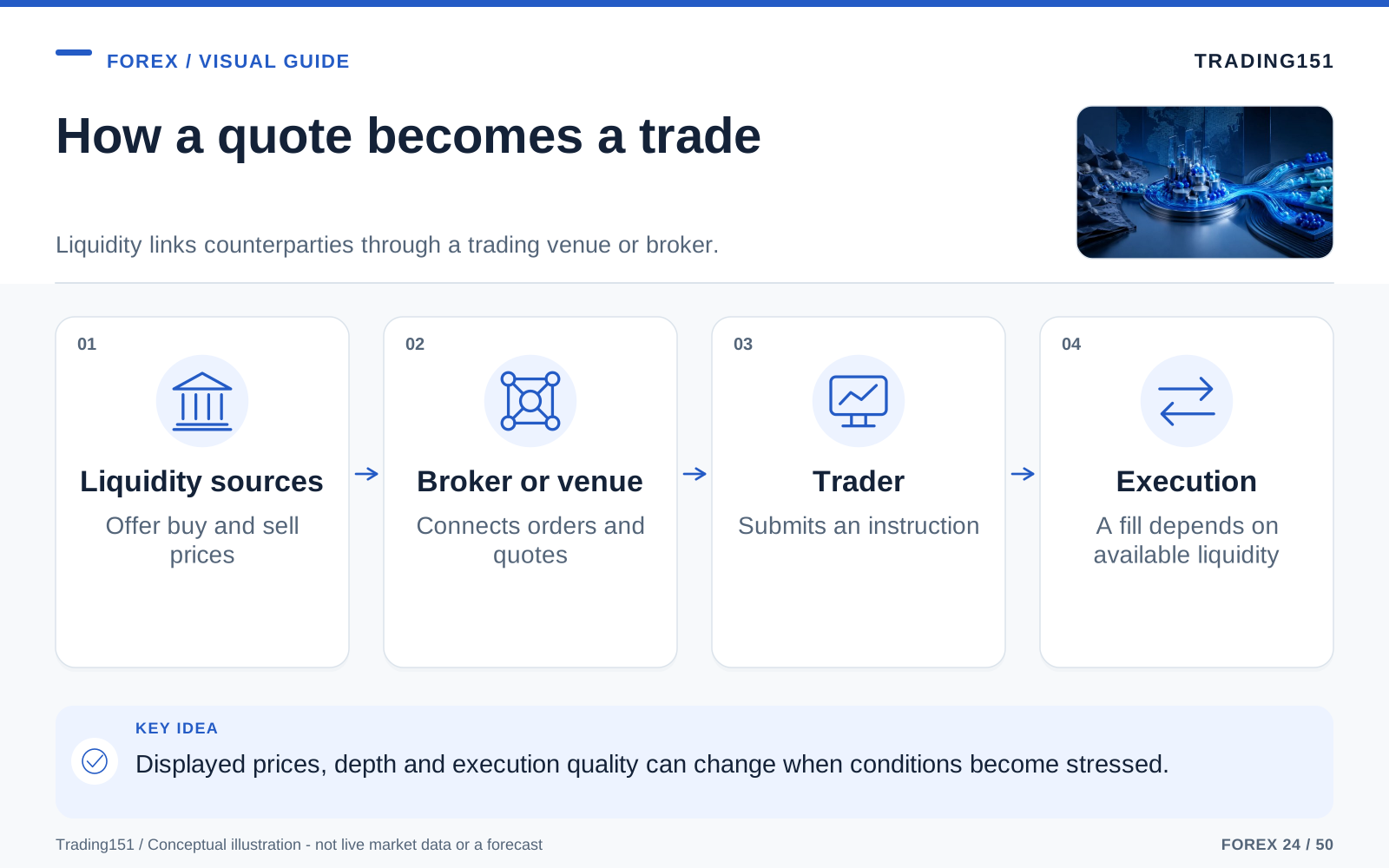
Read this diagram as text
- Liquidity sources
- Offer buy and sell prices
- Broker or venue
- Connects orders and quotes
- Trader
- Submits an instruction
- Execution
- A fill depends on available liquidity
Why Liquidity Providers Matter More Than Most Traders Realize
Most retail traders are laser-focused on direction. Is the euro rallying? Is the yen dumping? What's the Fed going to do? Those things matter, sure, but the actual quality of the market you're trading in matters just as much.
You and a friend could have the same trade idea, enter at the same time, and get totally different results. If one of you trades in a deep, highly liquid market and the other is stuck in a thin, unstable one, the difference will show up in your P&L. We're talking tighter spreads, instant fills, and skipping those random, frustrating price spikes that stop you out for absolutely no chart-based reason.
Liquidity providers control that environment directly. They dictate how easy it is to get in and out, how much you’re paying to transact, and whether the market holds steady or snaps when a big order comes through. They don’t just supply the market—they set the rules of engagement for everyone else.
The Main Types of Liquidity Providers
Not all LPs are created equal. The Forex market is layered like a cake, and liquidity flows from the large players at the top down through several middlemen before it ever hits your retail account.
Tier 1 Banks: The Core of the Interbank Market
At the very top are the Tier 1 global banks—the heavyweights. These are the institutions with the large balance sheets and global networks required to trade incredible volumes. They make up the "interbank market," swapping currencies with other global banks, hedge funds, multinational corporations, and governments.
When traders talk about "top-of-book" pricing or deep institutional liquidity, this is what they mean. To be blunt, these banks couldn't care less about a retail trader's micro-lot order. They deal in large scale. But the prices they set ultimately trickle down and shape the quotes you see on your broker's platform.
Prime Brokers and Prime of Prime Firms
The catch is, most retail brokers don’t have the financial muscle or the credit ratings to trade directly with Tier 1 banks. That’s where prime brokers and Prime of Prime firms step in.
Think of them as the ultimate middlemen. They have the deep pockets to connect to the top-tier banks, pool all those high-level price quotes together, and then pass them down to smaller brokers and trading firms that would never get access otherwise. They bridge the gap between Wall Street and your laptop.
This is why two different brokers can offer the same currency pair but give you entirely different trading conditions. A broker's liquidity network—who they buy their pricing from and how well they blend those feeds together—makes a large difference.
Non-Bank Market Makers
Over the last decade or so, a new breed of LP has taken over: the non-bank market makers. You might have heard of firms like XTX Markets, Citadel Securities, or Jump Trading. They aren't traditional banks; they’re tech-heavy firms that specialize entirely in making markets.
Their edge is sheer speed and computing power. Using ultra-low-latency networks and ruthless algorithms, they can update prices in fractions of a second. Often, they can quote tighter and faster than the old-school banks. In today's highly electronic markets, these tech-driven firms are an absolute powerhouse.
How Liquidity Providers Shape Price and Execution
It’s tempting to picture LPs as passive warehouses that just spit out prices, but they are highly active players. They manage risk, shuffle inventory, and fiercely compete with one another. If an LP ends up holding too much exposure in one direction, they’ll tweak their prices to attract flow that balances their books. Multiply that by dozens of firms adjusting to each other in real-time, and you realize the retail price you see isn't just "the truth"—it's the ongoing result of a large, algorithmic tug-of-war.
1. They Influence the Spread
The spread is simply the gap between the buy and sell price, and it's where you feel the LP's presence most directly.
When multiple LPs are fighting for order flow, spreads shrink. Bank A offers a price, Bank B beats it by a fraction of a pip, and a high-speed market maker undercuts them both. That severe competition is great for you because it makes trading cheaper.
It's why spreads are razor-thin during the London and New York session crossover. Everyone is awake, volume is large, and the competition is fierce.
But when the crowd thins out—during late U.S. trading hours, rolling into the weekend, or during major holidays—LPs widen their quotes. They do this to protect themselves from getting caught off guard in a slow, unpredictable market. You feel this instantly: trades get more expensive to open, and your stop-losses suddenly look dangerously vulnerable.
2. They Create Market Depth
Liquidity isn’t just having a price available; it’s about how much volume you can push through at that price before the market budges.
Traders call this depth. A deep market can swallow a large institutional sell order without flinching. A shallow market can’t. In a deep market, a big order will still move the price, but smoothly. In a shallow market, even an average-sized order can eat through the available liquidity and cause the price to jolt aggressively.
LPs create this depth by layering executable prices at multiple levels. They essentially build the shock absorbers that keep the market from violently swinging every time decent volume hits the tape.
When depth is solid, price action is smooth. When it vanishes, the market gets erratic, fragile, and twitchy.
3. They Affect Volatility in Real Time
Volatility doesn’t just happen because a central bank raised rates or an inflation report came in hot. It happens because of how the market digests that news.
A major geopolitical shock might barely ripple a market if LPs hold their ground and keep offering deep liquidity. But if those same LPs get spooked and pull their quotes, that exact same news event will cause large, violent price swings, huge gaps, and terrible slippage.
That’s a hard truth about Forex: volatility isn’t just about the news itself. It’s about how much liquidity is sitting there waiting to absorb the reaction.
Why Liquidity Sometimes Disappears When It’s Needed Most
Nothing is more infuriating than watching a large news event unfold, gearing up for a clean breakout, and instead getting hit with large spreads, delayed fills, and execution prices that are miles away from where you clicked.
Why does liquidity vanish right when you feel you need it most? Because LPs aren't running a charity. They are businesses, and their number one job is managing their own risk.
When market uncertainty rises sharply, quoting tight prices becomes financial suicide. The risk of an LP getting caught on the wrong side of a violent, fast-moving trend is simply too high. So, they do exactly what any rational business would do: they pull back.
They widen their spreads, slash the volume they're willing to trade, or just turn off their pricing engines for a few moments until the dust settles.
To you, it feels like the floor just fell out of the market. To them, it’s just basic survival.
Slippage: The Retail Trader’s Most Common Encounter with Liquidity Risk
Most everyday traders don’t give a second thought to liquidity providers—until they get hit with slippage. That’s the moment the whole concept suddenly gets very real.
Slippage is what happens when you click to buy or sell at one price, but your trade goes through at a worse one. Sometimes it's just a fraction of a pip. Other times, it's a severe hit.
Let’s say you have a stop-loss set. You assume that if the price hits that line, you're out. But in a fast-moving market, the liquidity at your specific price point might evaporate before your order even registers. The market simply skips over your price to find the next available buyer or seller, which might be significantly further down the chart. Your trade gets filled there instead.
That nasty gap between where you wanted to exit and where you exited is the cost of doing business in a real-world market, where a price on a screen doesn't guarantee the volume is there to back it up.
In a calm market, slippage is barely noticeable. During a major data drop, it can easily ruin a trade.
When Liquidity Vanishes Entirely: Flash Moves and Market Dislocations
In rare, extreme situations, LPs backing away does more than just widen the spread—it creates a total market vacuum.
If no one is willing to quote prices or take the other side of a trade, the price just freefalls (or rises sharply) looking for the next pocket of liquidity. Instead of moving in a smooth line, the market teleports from one level to another.
This is exactly how flash crashes happen. It’s not always because a piece of news was apocalyptic. Often, it's just that the usual network of buyers and sellers collectively stepped away from their desks at the worst possible moment.
The classic example is the Swiss Franc shock of January 2015. When the Swiss National Bank unexpectedly dropped its currency peg, liquidity vanished instantly. Prices lurched violently, and thousands of traders (and brokers) discovered that the market they thought they were trading was totally broken. Accounts were wiped out because trades simply couldn't be closed.
It was a painful reminder that LPs are the glue holding the market together. When they leave, the market turns into the Wild West.
Do Liquidity Providers Trade Against You?
This is probably the biggest myth in retail trading. It’s common to hear frustrated traders claim that "the LPs are hunting my stops" or actively trading against them personally. It’s a comforting thought after a string of bad losses, but it fundamentally misunderstands how the big players operate.
Real institutional liquidity providers are not sitting in a high-rise somewhere plotting how to steal your $50 stop-loss. Their business model is about scale: capturing the tiny spread on millions of trades, turning over large volume, and constantly balancing their overall risk.
Now, they aren't stupid. They use complex math to make sure they aren't taking on toxic trades, and they absolutely protect their own downside. But they aren't "gambling" against individual retail accounts. They're running a large wholesale pricing business.
The confusion usually stems from mixing up true institutional LPs with shady retail brokers who run internal dealing desks and warehouse your risk. But at the actual LP level, the name of the game is risk management and volume, not personal vendettas against retail traders.
The Technology Behind Modern Liquidity Provision
The movie version of currency trading—guys in suspenders screaming into landline phones on a chaotic trading floor—is dead. Today, liquidity is managed by algorithms and pricing engines sitting in heavily air-conditioned server farms.
This shift to tech has completely rewired how the market behaves.
Faster Price Updates
Modern LPs process data at mind-bending speeds. If conditions change on one side of the globe, algorithms adjust prices everywhere else in milliseconds. This makes the market efficient, wiping out stale prices and arbitrage opportunities almost instantly.
Better Aggregation
Today’s platforms can pool quotes from dozens of LPs in real-time. Instead of being stuck with whatever price one single bank is offering, brokers can instantly scan the network and route your order to whoever is offering the best deal. Under normal conditions, this means tighter spreads and noticeably faster execution.
The Problem of “Phantom” Liquidity
But tech brings its own headaches, mainly something called "phantom liquidity." Just because you see a large block of orders on the screen doesn't mean it’s going to stick around. High-frequency algorithms frequently flash large quotes only to cancel them milliseconds before a trade can execute.
Sometimes the market just moves too fast, and the quote vanishes before your order reaches the server. The reality is, what looks like a deep, safe market on your screen can sometimes be an illusion. That’s why tracking your actual execution stats over time is way more valuable than just staring at the order book in the moment.
Why Broker Choice Is Really a Liquidity Question
When traders shop around for a broker, they usually compare flashy interfaces, leverage limits, or sign-up bonuses. That stuff is fine, but the only question that truly matters is: How good is their access to liquidity?
Don't just look at marketing buzzwords like "ECN" or "Institutional Pricing." Watch how they behave. Track the spreads during the Asian session. Notice how badly you get slipped during a payroll report. See what happens when the market goes crazy—do your orders get rejected?
A broker hooked up to a deep pool of top-tier LPs will give you tighter, more reliable execution, even when things get rocky. A broker with weak liquidity connections might look great on a quiet Tuesday afternoon, but the second volatility spikes, their feeds will choke, and you'll pay the price.
When people complain about their broker "manipulating" the charts, half the time it's not malice—it’s just garbage liquidity. Picking a broker isn't about customer service; it’s about choosing your gateway to the real market.
What Traders Can Learn from Liquidity Behavior
You don't need a Wall Street background to use this stuff to your advantage. Just paying attention to how liquidity ebbs and flows can save you a lot of money and frustration.
- Trade when the big players are awake. The overlap between the London and New York sessions is when liquidity is thickest and spreads are tightest.
- Respect the news. Fast markets during major data drops aren't just volatile; their execution is dangerously unpredictable.
- Watch the clock. Spreads naturally blow out during the daily rollover (5 PM New York) and on bank holidays. Getting into a trade during these dead zones is an easy way to start off in the red.
- Accept slippage as a cost of business. It’s not a broker conspiracy; it's just the mechanical reality of a thinning market. Factor it into your risk management.
- Judge brokers by their worst moments, not their best. Anyone can offer a zero-pip spread when the market is dead. The real test is how they fill your order when all hell breaks loose.
Once you know when the market is sturdy and when it’s fragile, you'll stop stepping into avoidable traps.
The Future of Liquidity in FX
The way liquidity works behind the scenes is constantly shifting. Non-bank tech firms are dominating more of the space, and voice-trading is largely a relic of the past. Regulators are also keeping a closer eye on things to prevent another total market freeze.
Meanwhile, the crypto and decentralized finance (DeFi) worlds are forcing traditional finance to take hard looks at new ways to pool and price assets. While standard Forex isn't going to turn into a blockchain overnight, ideas like automated market makers and alternative trading venues are definitely creeping into the conversation.
The bottom line? The back end of the market is getting faster, smarter, and complex. But for you, the retail trader, the goal remains exactly the same: navigating it effectively.
Follow the quote, the order, and the legal relationship
Imagine seeing a tight spread on a trading platform and submitting an order larger than the quantity available at that price. Some of it may execute at the best quote, with the remainder filled elsewhere or rejected under the venue's rules. A screenshot of the best bid and ask does not reveal the total cost of that order.
Several practical questions help explain an execution. Was the broker acting as principal or agent? Was the displayed price firm or subject to an execution check? Was the order filled in one transaction or split across providers? These distinctions are more informative than an unexplained claim that every trade goes straight to an interbank market.
Names such as STP and ECN do not, by themselves, settle the question of conflicts or execution quality. Read the customer agreement and execution policy. Ask how markups, commissions, rejected orders, and price improvements are handled. A broker may describe its technology accurately while leaving the commercial relationship unclear.
Assess the service with your own order sizes and trading hours. Record the requested price, fill price, available spread, and whether the order coincided with a release or a thin session. A few unpleasant fills do not automatically prove misconduct, but a consistent pattern deserves investigation. The useful comparison is between documented execution outcomes under similar conditions, not between marketing labels.
Ask what an execution label actually promises
Terms such as STP, ECN, and liquidity-provider access describe aspects of a broker's arrangement, but their marketing use does not establish the complete order-handling process. Read the execution policy, counterparty terms, and available disclosures. The practical questions concern who fills the trade, how prices are formed, when orders can be rejected, and what happens during stressed conditions. A label is a starting point for those questions, not the answer. 1, 2
The Takeaway
Liquidity providers aren’t exactly the rockstars of the Forex world, but they are the engine under the hood. They are the reason you can click a mouse in your living room and instantly own euros, yen, or pounds. They keep the costs down, soak up the buying and selling pressure, and keep the charts moving smoothly on a normal day.
And when things aren't normal, their sudden absence is a severe reminder of who really runs the show.
Forex doesn't just magically work because everyone loves trading currencies. It works because large financial institutions are putting their capital on the line to make the market happen. When they feel confident, trading is seamless. When they panic and pull back, the entire system shudders.
Understanding this isn’t just some technical economic theory. It’s highly practical. It tells you why spreads randomly widen, why you get slipped during news events, why some hours are safer to trade than others, and why the market sometimes behaves in completely irrational ways that totally defy your technical analysis.
Your charts will tell you what the price used to be. Liquidity dictates whether you can trade that price right now. You don’t need to map out the entire global banking network to be a profitable trader, but you do need to respect the mechanics. Trade when the market is deep, tread lightly during major shocks, and remember that behind every candlestick, there's a living, breathing network of liquidity—and it's constantly changing its mind.
Sources and further reading
- BIS: April 2025 FX turnover, September 2025 preliminary release
- SEC Investor Bulletin: Trading Basics and Order Types
Editorial revision: 7 October 2026. Numerical scenarios are hypothetical unless identified as historical. References support the added explanations and selected corrections; rules and product terms should be checked again before acting.