
Forex sessions describe periods of activity centered on major financial locations, not a single exchange opening and closing around the world. Activity varies by currency, event, and day. Session labels can help organize a routine, but their clock times need careful handling because daylight-saving changes do not occur everywhere or on the same dates.
Why Trading Sessions Matter More Than Most Beginners Realize
It’s tempting to look at Forex as one giant, continuous loop. But while it’s technically a single global market, the vibe on the charts changes depending on which major financial centers are awake. Liquidity, spreads, momentum—they all ebb and flow as the day goes on. And remember, session times aren't carved in stone. Daylight saving time can shift London or New York by an hour depending on where you live, and your broker's server time might be completely different. You always have to adjust your mental clock when the seasons change. If you backtest a strategy in the wrong time window, it’s basically a completely different strategy, even if the candlestick patterns look identical.
A setup that prints perfectly during the London session might just chop you out during Tokyo. A tight range that held all night can get absolutely shredded the second European banks open for business. A chart that looks beautifully calm at 7:30 AM can turn into a violent mess at 8:30 AM on the dot when U.S. inflation data drops.
Thinking in terms of sessions just makes your life easier. It answers the questions you care about when you sit down at your screen:
- Am I going to see clean trends today, or just choppy sideways garbage?
- If I buy this breakout, will it run, or is it a fakeout?
- Are my spreads going to be tight enough to trade, or are they about to widen out?
- Is this a good time to scalp, look for a swing trade, or just close the laptop entirely?
Session patterns can help organize a trading plan, but they are not dependable daily scripts. Compare the same pair and time window over many days, including holidays and news releases, before treating a pattern as useful.
Technically, there are four main sessions if you count Sydney, but most of the world's currency volume is driven by the big three:
- Tokyo kicks off the main flow of the trading day in the Asia-Pacific region.
- London brings substantial European activity, though the session does not reliably determine the direction of the whole trading day.
- New York adds U.S. dollars to the mix, dumps major economic data on the market, and creates the most heavily traded overlap of the day.
Get to know these three, and you'll immediately see why certain pairs suddenly wake up, why some breakouts have juice, and why others just flatline.
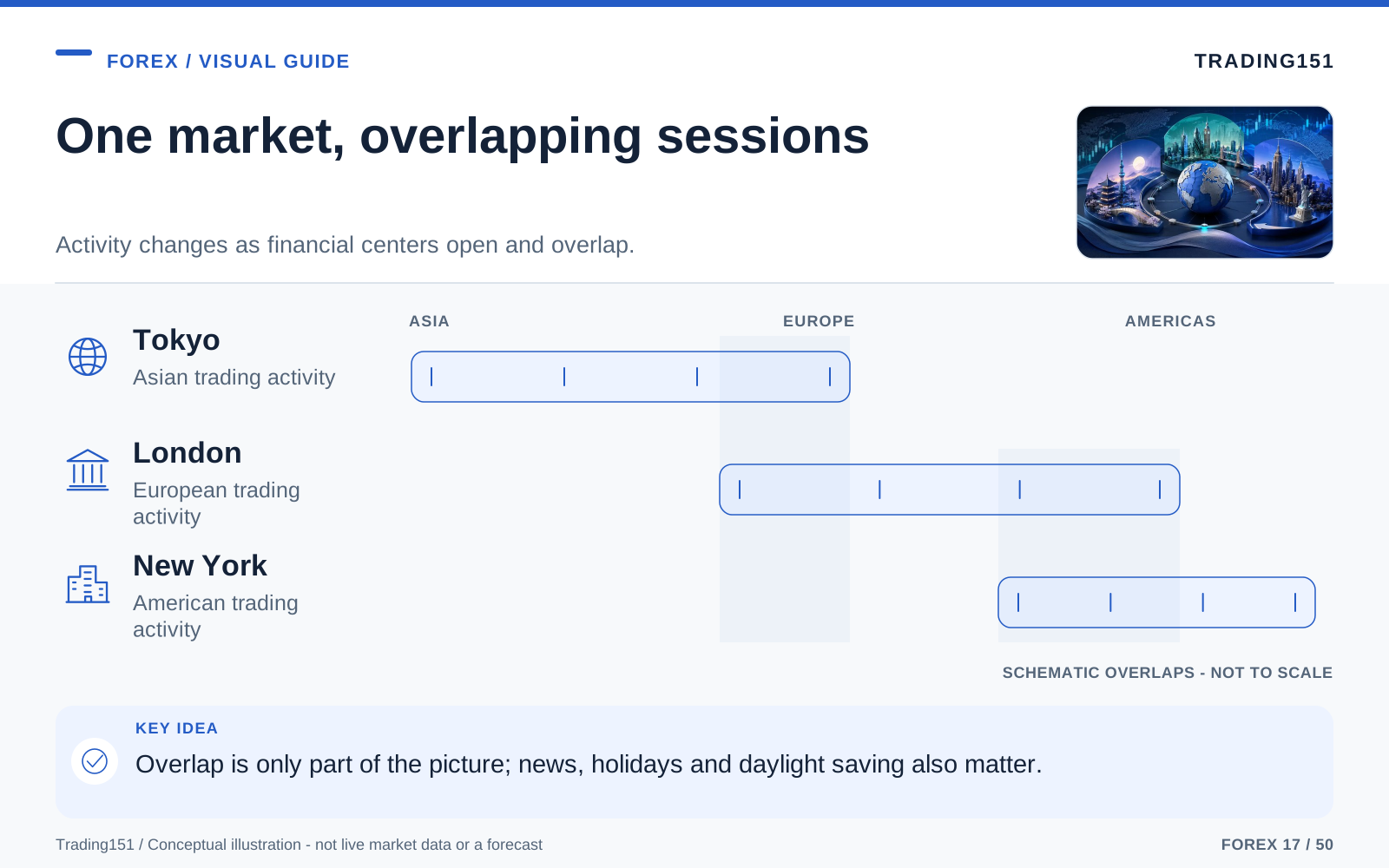
Read this diagram as text
- Tokyo
- Asian trading activity
- London
- European trading activity
- New York
- American trading activity
1. The Tokyo Session: Quiet, Orderly, and Often Underestimated
A common planning window for Tokyo is 09:00 to 18:00 Japan Standard Time, or 00:00 to 09:00 UTC. Japan does not switch to daylight saving time. The corresponding New York clock time therefore changes between winter and summer. Regional announcements can produce sharp moves in yen, Australian-dollar, and New Zealand-dollar pairs even when other currencies are relatively quiet.
The Tokyo session is where the new trading day finds its footing. We call it "Tokyo," but it really represents the whole Asia-Pacific block—institutions in Japan, Singapore, Hong Kong, Australia, and New Zealand are all driving the action here.
What the Session Feels Like
Compared to the wild swings of London and New York, Tokyo is a slow burn. That doesn't mean it’s useless, and it certainly doesn't mean you can't make money. It’s just a different beast entirely.
Some pairs spend quieter Asian hours within narrow ranges, but a range should be observed rather than assumed. Regional policy decisions, economic releases, holidays, or an unresolved global event can change that pattern abruptly.
A quieter window may suit a slower decision process. It is not inherently easier or safer: limited movement can leave little room to cover spreads, and a sudden change in liquidity can make an exit expensive.
What Usually Happens During Tokyo
- More chop, less drama: Pairs often drift sideways for hours, especially on quiet news nights.
- The spotlight is on JPY, AUD, and NZD: Anything tied to the Asia-Pacific economy is going to be more active.
- Test the range hypothesis: Compare support and resistance setups during these hours with a consistent record of failures, execution costs, and news conditions. Time of day alone does not validate technical analysis.
- Smaller moves: Whether this is a good or bad thing depends entirely on your trading style.
Beginners love to write Tokyo off as "boring." But boring is highly underrated. A slow, quiet session is often exactly what you need to clearly define your risk, spot structural patterns, and avoid getting caught in emotional, split-second trades.
Who Tends to Like the Tokyo Session
Tokyo is built for traders who hate chaos. If your edge relies on trading ranges, fading the highs and lows, or buying bounces at clear technical levels, this session is your best friend. It’s perfect for people who like to take their time planning a trade without the market moving 20 pips while they calculate their lot size.
It’s also practical if you live in North America and work a 9-to-5. The Asian session runs through the evening, meaning you can sit down after dinner, analyze the charts, and place your trades without having to sacrifice sleep.
Pairs That Often Make Sense Here
USD/JPY, AUD/USD, NZD/USD, AUD/JPY, and NZD/JPY are the heavy hitters. You can technically trade anything, but these pairs are the ones naturally awake and reacting to regional money flow.
Where Traders Get Caught Out
The biggest trap in Tokyo is sheer boredom. Because the market is slow, you might find yourself forcing trades just to feel like you're doing something. You start hunting for 5-pip moves, overtrading microscopic ranges, and eventually losing money to spreads and commissions on setups that were never going anywhere to begin with. The trick to Tokyo isn't trying to force action—it's having the patience to wait for it.
2. The London Session: Where the Market Wakes Up Properly
For planning, London is often treated as roughly 08:00 to 17:00 local time: 08:00 to 17:00 UTC in winter and 07:00 to 16:00 UTC during British Summer Time. These are conventional session windows, not the opening hours of a single central forex exchange.
If Tokyo is a slow walk, London is a sprint. This is the session that breathes real life into the market. As the large European financial hubs boot up, volume spikes, and pairs that spent the last eight hours doing absolutely nothing suddenly rip in one direction.
London is an important trading center, but activity later in the day can reverse an earlier move. Avoid treating the European opening direction as a forecast for the close.
What Changes When London Opens
As European participation increases, quotes and trading activity can change quickly. A move through the Asian range may activate stops or new positions, but a price chart cannot establish that London traders deliberately hunted a particular set of retail orders.
That raw energy is why veteran traders love London, but it’s exactly why new traders get their faces ripped off. The opportunities are large, but the market takes zero prisoners.
The Classic London Open Pattern
One pattern worth testing is a break out of the preceding Asian range. Sometimes it continues; sometimes price returns inside the range. Neither outcome has a universal fifty-fifty probability. Define the range, breakout threshold, entry, and exit before measuring how often the setup works after costs.
This is why breakout traders live for this session. The momentum they’ve been waiting for all night finally arrives when Europe clocks in.
What Traders Usually Notice During London
- Real momentum: When price moves, it travels. It doesn't just stall out after ten pips.
- Follow-through: If a breakout is genuine, it has the volume behind it to keep going.
- EUR and GBP pairs run the show: Currencies tied to Europe are going to be active and highly liquid.
- Fast-paced action: Great if you're laser-focused; devastating if you hesitate.
Also, keep in mind that London isn't just about the frantic opening bell. It often provides the cleanest, most technical price action of the entire day—at least until the U.S. data drops and messes everything up later on.
Who This Session Suits Best
London is for momentum junkies. If you want to trade breakouts, ride trends, and see your trade hit its take-profit within a few hours, this is where you belong. It’s vastly superior to trying to squeeze blood from a stone during a sleepy night session.
It’s also ideal for the "sniper" mentality. You don't need to sit at your desk for nine hours. Plenty of highly profitable traders just trade the first two hours of London, catch the initial expansion, and log off for the day.
Pairs to Watch During London
Anything with a Euro or a Pound is going to give you action. EUR/USD, GBP/USD, EUR/GBP, GBP/JPY, and USD/CHF are usually the most reliable movers.
What Makes London Tricky
The same volatility that makes you money can easily take it away. Fakeouts (or "liquidity grabs") are everywhere. The market will gladly spike past the overnight highs, convince every retail trader on earth to hit 'buy', and then mercilessly dump. If you jump in late with a sloppy stop loss, you’re just providing exit liquidity for the pros. In London, structure and timing are everything. You can't just wing it.
3. The New York Session: Fast, News-Driven, and Often Unforgiving
A common New York planning window is 08:00 to 17:00 Eastern Time. That corresponds to 13:00 to 22:00 UTC during standard time and 12:00 to 21:00 UTC during daylight saving time. Use the actual release calendar and your broker's hours rather than assuming every instrument follows this convention.
By the time New York rings the bell, the market already has a storyline. Asia laid the foundation. London set the trend. Then the U.S. steps in, throwing the world’s reserve currency into the mix alongside heavy-hitting institutional money and a relentless schedule of economic data.
If you live in the Americas, this is probably the session you know best. It’s also the session that will test your emotional discipline harder than anything else.
The Defining Feature of New York
New York is entirely at the mercy of the news calendar. We're talking CPI numbers, Non-Farm Payrolls, GDP updates, and whatever the Federal Reserve decides to say into a microphone that day. These events can flip a market’s trend in 30 seconds. Even if you consider yourself a pure technical trader, you have to respect the fundamentals here, because the volatility does not care where you drew your trendline.
Some mornings, New York trends beautifully. Other mornings, price action looks like a heart monitor—spiking substantially up and down, triggering everyone’s stop losses, and leaving both buyers and sellers stranded.
What to Expect During the Session
- A frantic morning: The early hours are intense, largely because London is still open and trading alongside New York.
- News takes the wheel: A single red-folder news release can completely invalidate a perfect technical setup.
- The "New York Reversal": It’s common for U.S. traders to completely reverse the trend that London spent all morning building.
- After Europe closes, activity in some pairs can decline. U.S. announcements, policy decisions, and other events can still produce large moves, so an afternoon session should not automatically be treated as quiet.
That last point traps so many people. New York is amazing in the morning and absolutely severe in the afternoon. So many traders make great money at 9:00 AM, only to give it all back at 2:00 PM because they refused to stop trading when the volume dried up.
Who Usually Thrives in New York
This session belongs to traders who think fast and actively watch the news. If you thrive on volatility, love playing intraday momentum, and know exactly when the data drops are happening, New York is a playground. But if sudden 40-pip spikes stress you out, or if you refuse to check the economic calendar before taking a trade, New York will chew you up.
Trading the U.S. session is great, you just have to respect it. It is not for casual, set-and-forget trading.
Pairs Commonly Traded in New York
If it has a USD attached to it, it’s in play. EUR/USD, GBP/USD, USD/JPY, and USD/CAD are the main attractions. You’ll also see big moves on commodity currencies (like AUD or CAD) if U.S. news impacts the broader global risk appetite.
The Hidden Danger of the Session
A lot of rookies think "more volatility = more money." Sometimes, sure. But usually, it just means dirtier price action, large spread spikes during news, and getting violently stopped out right before the market goes your way. Succeeding in New York means learning how to tell the difference between real institutional momentum and pure, chaotic noise.
The Overlaps: When the Market Is Most Alive
An overlap brings participants from two regions into the market at once. That can improve available liquidity, but news and rapid repricing can still widen spreads or cause slippage. An overlap is a useful context for testing a strategy, not a guarantee of high volume or reliable follow-through on every day.
Overlaps are when the big players are fighting for position. Order flow is heavy, and price moves with actual intent rather than just wandering aimlessly.
London-New York Overlap: The Busiest Window of the Day
The London-New York overlap is commonly about 08:00 to 12:00 New York time when the two cities are on matching winter or summer schedules. The United States and United Kingdom change their clocks on different dates, so check the actual overlap during the transition weeks.
This four-hour window is the ideal for day traders. Europe is still firing on all cylinders, the U.S. just walked into the office, and the heaviest economic news of the day is hitting the wires. Because so much money is changing hands, spreads on the majors are practically zero, and the market has the gas to push through major levels.
It’s no surprise that most professionals build their entire workday around this specific window. It offers the perfect mix of high volume, extreme volatility, and clean follow-through.
More activity does not necessarily mean an easier trade. A setup must still offer enough expected movement to cover costs, and the exit needs to account for releases that can change prices abruptly.
Tokyo-London Overlap: Shorter and Less Reliable
Using the planning windows above, Tokyo and London overlap around 08:00 to 09:00 UTC in the UK winter and 07:00 to 09:00 UTC during British Summer Time. Broker session indicators may use different conventions, so confirm their settings before relying on them.
This overlap is quick, and a bit weird. Asia is packing up to go home right as London traders are having their morning coffee. Sometimes, the transition is super smooth and trends just carry over. Other times, the market just sort of thrashes around because the Asian closing flows are clashing with the European opening flows.
You can definitely trade it, but it takes a trained eye to navigate. Most traders are better off just waiting for London to fully establish itself, or focusing their energy on the London-New York overlap instead.
Choosing the Right Session for Your Trading Style
Session knowledge is useless until you map it to your actual life.
So many traders make this game difficult by trying to trade the "best" session, rather than the session that fits their personality. There is no one-size-fits-all answer here. Your ideal session depends on your stress tolerance, your specific strategy, your day job, and whether you like waking up at 3 AM.
If you thrive on adrenaline, you’ll probably fall asleep trading Tokyo. If you need clean, quiet charts to think clearly, New York news spikes will give you a heart attack. And if you work 40 hours a week, trying to trade the London open might physically burn you out within a month.
Stop trying to force yourself into a trading routine that doesn't fit you. The smartest thing you can do is figure out when you make your best decisions, and trade that window.
If You Prefer Calm, Structured Conditions
The Tokyo session is calling your name. It rewards patience, respects support and resistance, and moves at a pace that won't make you sweat. This is highly recommended for newer traders who are still trying to figure out how price moves between levels without the anxiety of heavy volatility.
If You Prefer Momentum and Clean Breakouts
The London session is your sweet spot. It’s hands-down the best environment if you want to enter a trade and immediately see it start running. If you love catching early directional moves and riding the wave, this is where you want to be.
If You Trade Around Economic Data or Fast Intraday Moves
The New York session will feel like home. Just promise yourself one thing: never take a trade without checking the economic calendar first. Treat the news as a core part of your strategy, not an afterthought.
If You Want the Highest Concentration of Opportunity
The London-New York overlap is one window to investigate for day trading. Compare it with your available hours, preferred pairs, and actual records rather than assuming every professional trader makes the same choice.
Matching Trading to Your Real Life, Not an Idealized One
Let’s talk about the elephant in the room: your lifestyle. The "best" time to trade is the time when you are well-rested, focused, and uninterrupted. It doesn't matter how amazing the London setup is if you're trying to trade it while hiding your phone under your desk at your day job, or while running on two hours of sleep. Fatigue and distractions are the silent killers of trading accounts. You will always make better decisions trading a "slower" session with a clear head than trying to force trades during a popular session when you're exhausted.
You could have the greatest trading strategy in the world, but if you're trying to execute it while wrangling kids or falling asleep at your keyboard, you are going to lose money. The market has a funny way of exposing when you aren't at your best.
A huge percentage of trading losses have absolutely nothing to do with bad technical analysis. They come from bad timing, sleep deprivation, and forcing trades when you should have been doing something else.
Here’s what that looks like in the real world:
- The 9-to-5 worker: If you have a traditional day job, waking up for the London open might be miserable. Instead, trading the evening Tokyo ranges or catching a specific setup during your New York lunch break is way more sustainable.
- The early bird: If you naturally wake up before the sun, the London open or the early hours of the London-New York overlap are an absolute goldmine for you.
- The evening side-hustler: Don't stress yourself out trying to trade wild U.S. news after a long day of work. The slower, more technical Asian session is probably exactly what you need.
- The full-time trader: You have the luxury of choice. Be ruthless with your time. Pick the one or two hours where your edge plays out perfectly, take your trades, and walk away from the screens.
There is zero glory in sacrificing your health to trade the "perfect" session. Successful trading is repetitive, kind of boring, and highly sustainable. Find a routine you can stick to without losing your mind—that’s how you survive in this game long-term.
The Weekly Rhythm Matters Too
It’s not just about the time of day; the day of the week changes the mood of the market, too. A chart on a quiet Monday morning behaves very differently than a chart on a chaotic Thursday afternoon.
- Monday: The market is usually wiping the sleep from its eyes. Price action is often slow and non-committal as big players figure out their bias for the week.
- Tuesday to Thursday: This is the sweet spot. These three days are the engine of the Forex market. Volume peaks, trends establish themselves, and the best setups usually appear here.
- Friday: The morning is usually great, especially during the London-New York overlap. But by Friday afternoon? It’s a ghost town. Big institutions are closing out their positions and taking risk off the table for the weekend.
Treat Friday afternoons like a minefield. Liquidity completely dries up, spreads get weird, and price can act erratically. I can't tell you how many traders ruin a perfectly profitable week by taking one last stupid trade on a Friday afternoon just because they were bored.
And then there’s weekend risk. If you leave a trade open over the weekend, you are completely at the mercy of whatever happens in the world while the markets are closed. A sudden geopolitical event or a surprise central bank announcement can cause price to "gap" aggressively by the time markets open on Sunday evening, blowing right past your stop loss. Swing traders plan for this. Day traders should avoid it entirely.
A Few Practical Rules That Make Session Trading Easier
You really don't need a large wall of monitors or a complex algorithm to use session timing to your advantage. Just build a few simple habits into your daily routine:
- Know what time it is before you look at a chart. Don't treat a 2 PM setup the same way you’d treat an 8 AM setup. The context is completely different.
- Check the news calendar. every day. Especially if you trade London or New York.
- Trade the pairs that are awake. Sounds like common sense, but so many beginners get frustrated trying to trade the Euro in the dead of the Asian session.
- Adjust your expectations. Trading a slow session? Take smaller profits. Trading a fast session? Keep your stop-losses tight and expect wild swings.
- When your session is over, walk away. You don't need to stare at the chart all day.
That last rule is arguably the most important one on the list. The fastest way to destroy your trading account is to keep clicking buttons after your specific edge has passed. The best traders know exactly when they are "on the clock" and, more importantly, when they are off it.
Put the session and the date in the same timezone
London, New York, and Tokyo do not keep a fixed year-round relationship on every chart. Tokyo does not observe daylight saving, while London and New York do, using different changeover schedules. For part of the year, the usual time difference between the latter two shifts. A session strategy coded with a fixed UTC offset can therefore trade at the wrong local time.
Record the intended local reference explicitly, such as a named timezone rather than an ambiguous abbreviation. Then check how your platform displays server time and how historical data handles daylight saving. The same care applies to economic announcements: an event scheduled for 8:30 a.m. New York time is not tied to one UTC hour all year.
A practical journal can contain the date, local market time, platform time, and the relevant session label. That makes it easier to distinguish a genuine change in market behavior from a clock-conversion mistake. Holidays and shortened dealing days deserve their own notes rather than being forced into the standard weekly pattern.
Treat statements about a session's personality as tendencies to investigate, not rules. A usually quieter period can contain a major policy announcement or a sharp repricing. The clock helps identify who is likely to be active; it does not guarantee a narrow range, a clean breakout, or a particular level of liquidity on the day you trade.
Keep a session record in two time zones
Record the market reference time and your local time beside important events. This makes daylight-saving mismatches easier to notice, especially when the United States and Europe change clocks on different dates. Broker-server time may add another convention.
A trading journal that stores only the hour shown on a screenshot can become ambiguous months later. Include the date, time zone, and source feed. Those details matter when comparing session behavior or trying to reproduce a test. A setup described as 'the London open' is not precise enough until the opening window and time standard have been defined. 1, 2
Final Thoughts: Trade the Clock, Not Just the Chart
When you pull up a Forex chart, it looks like one endless, continuous line. But beneath the surface, the market has multiple split personalities. It shifts and evolves as different parts of the world wake up, go to work, and go to sleep. Tokyo gives you steady structure. London brings aggressive momentum. New York throws large volume and volatile news into the blender.
You do not need to master all of them. In fact, trying to trade every session is a guaranteed recipe for burnout, revenge trading, and blown accounts. What matters is finding that one specific pocket of the day that matches how your brain works and how you want to trade. Once you find it, study it until you know exactly what a "normal" day looks like in that window.
Once you cross that bridge, session timing becomes your biggest advantage. The market suddenly stops feeling like a slot machine. You stop expecting large breakouts during quiet hours. You stop forcing random trades when the volume is dead. You finally start separating useless chart movement from actual, high-quality opportunity.
The ultimate goal of trading isn't to be glued to your screen 24/7. It’s to show up exactly when the market conditions favor your specific edge, execute your plan, and log off.
Once that clicks, the clock is no longer just background noise—it becomes the core of your strategy. Start logging the time of day in your trading journal. Give it a few weeks, and the data will speak for itself. You might realize your favorite pair only trends cleanly between 8 AM and 10 AM, or that you always seem to lose money when you trade after lunch. In Forex, time isn't just a number on your screen. It dictates the liquidity, the volume, and the actual quality of every setup you take.
Sources and further reading
- BIS: April 2025 FX turnover, September 2025 preliminary release
- CFTC: Eight things to know before trading forex
- OANDA: Hours of Operation and Trading Interruptions
Editorial revision: 7 October 2026. Numerical scenarios are hypothetical unless identified as historical. References support the added explanations and selected corrections; rules and product terms should be checked again before acting.