
Trading psychology is not a substitute for a sound strategy, realistic costs, or limited exposure. It concerns how people behave while trying to follow a process under uncertainty. The most useful safeguards turn vague intentions into actions: when to stop, what to check, and what must be written down before another order is allowed.
Why Live Trading Hits Completely Differently
One of the most maddening things for a newer trader is the demo-to-live transition. You crush it on a practice account, but the second you go live, you feel like a totally different person. Same chart, same setup, same strategy—but suddenly, you're a mess.
On a demo account, placing the trade feels effortless. You enter cleanly, let trades breathe, and follow your rules with almost robotic discipline. Why? Because nothing is at stake. There’s no real financial pain or emotional baggage attached to a loss. Your mind stays neutral.
Throw real capital into the mix, and the emotional temperature spikes. Your brain stops viewing a trade as a simple probability equation and starts treating it like an active threat to your survival. A tiny drawdown suddenly feels like a personal attack. A winning trade feels so fragile you just want to cash it out immediately. Every tick starts carrying way more weight than it deserves.
That mental shift changes everything. You stop reading the market objectively and start reacting to what the trade represents. A setup stops being a setup—it morphs into your rent money, your self-worth, your hopes, and your deepest frustrations, all bundled into one mouse click.
Live trading strips you down and reveals who you really are in a way demo trading never could. It exposes the large gap between knowing what to do and doing it when the pressure is on.
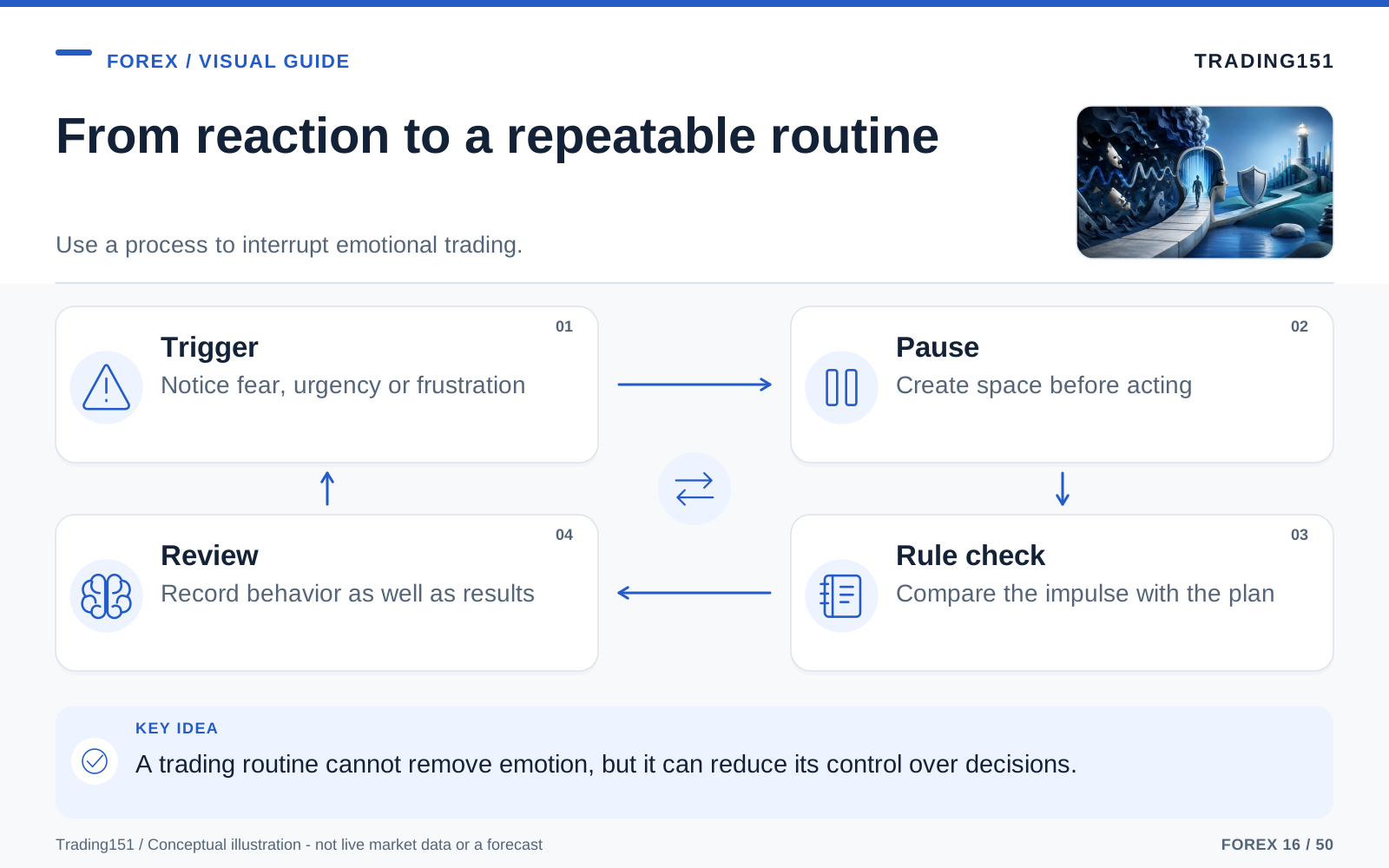
Read this diagram as text
- Trigger
- Notice fear, urgency or frustration
- Pause
- Create space before acting
- Rule check
- Compare the impulse with the plan
- Review
- Record behavior as well as results
The Market Isn't Your Enemy
It’s so easy to blame the market. After a severe stop-out, a fakeout, or a nasty losing streak that seemingly came out of nowhere, it really feels like the market is out to get you. But the market isn’t attacking you. It’s not hunting your specific stop loss, and it certainly isn't punishing you for clicking buy.
The market is just doing its thing: moving, reacting, pulling back, shaking out weak positions, and creating endless uncertainty.
Your real opponent is your own mind trying to cope with that uncertainty.
Your mind is what turns a standard, statistical loss into a full-blown crisis. It's that little voice whispering, "Just widen the stop loss this one time," or "You have to make that money back right now." It’s the part of you that craves instant emotional relief over long-term profitability.
Simply put, the most expensive mistakes you make won't happen because you didn't know enough about technical analysis. They happen because you couldn't manage yourself.
The Hidden Saboteurs: Cognitive Biases in Trading
Cognitive biases are just mental shortcuts. In our daily lives, they help us make fast decisions without getting overwhelmed. But in trading? They usually distort our judgment at the absolute worst times. They make us feel bold when we should be careful, impulsive when we need to wait, and stubborn when we should adapt.
These biases are much easier to handle when you can spot them in your behavior. For example, confirmation bias might look like frantically hunting for a new indicator to justify a trade that's already failing. Loss aversion might show up as you dragging your stop loss further into the red. Naming the bias helps, but learning your own personal "tells" is even better. It gives you an early warning system you can recognize in real-time.
Most of the time, we don't even realize these biases have taken the wheel. They don't announce themselves; they sneak in disguised as intuition, conviction, or just "common sense."
Here are a few of the usual suspects.
1. Loss Aversion: Why Small Hits Feel So Large
Humans are wired to feel the pain of losing much more intensely than the joy of winning. In the markets, this imbalance is everywhere.
You see it when you snatch a tiny, premature profit just because you're terrified the market will take it back. You see it when you refuse to close an obviously doomed position because officially taking the loss feels worse than clinging to false hope. And you definitely see it when you keep moving your stop loss further away because you just can’t stomach being wrong.
Loss aversion doesn’t just make you feel bad—it completely warps your behavior. It pushes you to do the exact opposite of what makes money: it makes you cut your winners short and let your losers bleed.
How to fix it: You have to reframe what a loss means. A predefined, controlled loss isn’t a failure. It’s simply a business expense. If you planned your risk before you entered, getting stopped out doesn't mean you messed up. Often, it means you did exactly what you were supposed to do to protect your account.
2. Confirmation Bias: Only Seeing What You Want to See
Let's say you decide the British Pound is looking bullish. From that exact moment, your brain starts building a defense case. You spot every bullish pattern on the chart. You zero in on positive news headlines. You find that one analyst on Twitter who agrees with you. Meanwhile, your brain conveniently ignores all the warning signs. That heavy resistance on the higher timeframe? The bearish divergence? Completely ignored.
That selective blindness is confirmation bias at work.
Once we form an opinion, human nature makes us want to defend it. Instead of reading what the market is doing, you start arguing with it. You stop asking, "What is most likely to happen next?" and start demanding, "How can I prove my idea is right?"
How to fix it: Before you hit the buy button, force yourself to argue the other side. Write down exactly why the trade might fail. Where is the level that proves your idea is dead wrong? If you can’t easily argue the bearish case for your bullish trade, you probably aren’t seeing the chart clearly yet.
3. The Gambler’s Fallacy: Believing a Reversal is "Due"
"It’s dropped for five straight days. It has to bounce soon."
That logic has blown up countless trading accounts.
The gambler’s fallacy is the dangerous assumption that just because a trend has gone on for a while, the opposite outcome is suddenly "due." But the hard truth is that markets don't care about your sense of fairness. Trends can stretch much, much further than anyone anticipates, and trying to predict the exact bottom is a great way to get run over.
A market can stay overextended and substantially irrational much longer than your margin balance can stay solvent.
How to fix it: Stop trading what you think should happen based on how far price has moved. Trade what is happening. Reversals need actual structural confirmation. Until that happens, the trend is still the trend.
4. Recency Bias: Letting Yesterday Dictate Today
As traders, we tend to have terrible short-term memories.
After three or four winning trades, you start feeling invincible. You're in the zone. So, what happens? You increase your position size too fast. You take sloppy, low-quality setups because you feel like you have a magic touch. Then the market swiftly reminds you that overconfidence is a quick killer.
On the flip side, after a string of losses, you feel broken. You start skipping perfectly good setups because you're scared. You hesitate. A strategy that worked fine last month suddenly feels useless, even though your edge hasn't changed at all.
Recency bias tricks you into judging your entire trading career based on your last three trades.
How to fix it: Only judge your performance in large chunks—think 20 or 50 trades, not just what happened this morning. One single trade proves nothing. Consistency comes from letting your edge play out over a large sample size, not overreacting to the most recent result.
5. Anchoring: Getting Obsessed with One Price
Anchoring is when your brain gets stuck on a specific number—usually your entry price—and refuses to let go.
Imagine buying gold at 1950. It drops to 1900. The market structure is now bearish, momentum is gone, and your original idea is completely dead. But all you can think about is holding on until it gets back to 1950 so you can scratch the trade at break-even. You aren't making decisions based on the market anymore; you're making decisions based on your emotional attachment to the number 1950.
Spoiler alert: the market does not care where you entered. It owes you nothing.
How to fix it: Ask yourself this one severe question: If I wasn't already in this trade, would I buy it right now at this current price? If the answer is no, it’s time to cut the cord.
6. Overconfidence: When Winning Breeds Bad Habits
Overconfidence is sneaky. It doesn't usually look like reckless gambling right away; it just feels like progress. You catch a few great trades, you feel in sync with the charts, and slowly, without realizing it, you lower your standards. Your strict rules become "guidelines." You risk just a little bit more. You get a little less patient.
This is a dangerous trap because it hits you right when you feel most successful. The market might forgive your sloppiness for a week or two, but eventually, it always collects the bill.
How to fix it: Treat your winning streaks with the same strict routine as your losing streaks. Success doesn't give you a free pass to get lazy. Winning streaks require even more focus to keep your ego in check.
7. The Need to Be Right
If you ask a trader what they want, they’ll say "to make money." But in the heat of the moment, what most of us really want is to be right.
The ego's need to be right is what makes us argue with the charts, ignore stop losses, and hold onto garbage trades because closing them would mean admitting defeat. It turns a simple probability game into a personal test of your intelligence.
But trading isn't a debate club. You don't get paid for proving a point. A trader who is right only 40% of the time with great risk management will easily outperform a trader who is right 70% of the time but refuses to take small losses.
How to fix it: Disconnect your self-worth from the outcome of the trade. A loss doesn't mean you're stupid, and a win doesn't make you a genius. Rate your days on how well you followed your rules, not on how much money you made.
How FOMO and Revenge Trading Take Over
When a trader blows up an account, it usually happens through one of two doors: the fear of missing out (FOMO) or revenge trading. Both of these impulses create a false sense of extreme urgency. FOMO screams, "You have to get in right now!" while revenge trading screams, "You have to win that money back right now!"
Just forcing a simple ten-minute pause can break the spell. Some traders use software lockouts, step away for a coffee, or force themselves to analyze the higher timeframe before clicking anything. It sounds basic, but it puts much-needed space between your raging emotions and your mouse hand.
FOMO usually kicks in when the market takes off without you. A large green candle prints, Twitter is going crazy about it, and suddenly you feel left out. You irrationally convince yourself there’s still meat on the bone, even though your entry advantage is completely gone. You chase it, buy at the absolute top, and get instantly punished on the pullback.
FOMO isn’t really about the money. It’s about the emotional pain of being left behind. That sting makes you do things you'd never do with a clear head.
Revenge trading is a different beast, but equally toxic. It happens right after a loss—especially a loss that felt "unfair." Maybe you did everything right and still got stopped out by a single pip. Your brain hates that feeling and demands immediate relief. It wants the money back, sure, but mostly it wants to erase the feeling of being wrong.
So, you jump right back in. You double your lot size. You don't even wait for a setup. You're just blindly throwing punches at the market trying to feel better.
This is where a totally normal, manageable losing day spirals into a blown account.
The takeaway: Both FOMO and revenge trading destroy your patience. And as a retail trader, your patience is one of the very few real edges you have.
The Emotional Cycle Most Traders Never Notice
There’s a predictable loop that plays out on the charts every day.
- Excitement: You log in, scan the charts, and everything looks like a large opportunity.
- Commitment: You take a position, feeling totally confident it's going to hit your take-profit.
- Discomfort: Price pulls back against you. The anxiety starts to bubble up.
- Rationalization: You start ignoring bearish signs and making up excuses for why the trade is still good.
- Fear or Frustration: Panic sets in. Your analytical brain shuts down.
- Impulse: You do something dumb—move your stop loss, cut the trade right before it reverses in your favor, or double down on a loser.
- Regret: The dust settles, and you realize the real damage didn't come from the market, but from how you reacted to it.
Once you recognize this cycle, you can start catching yourself in phase three or four before you hit phase six. Most major trading mistakes aren’t spontaneous; they are the grand finale of a chain of emotional micro-decisions that started way earlier.
Building Real Mental Strength
The goal isn't to become a dead-eyed, emotionless robot. That’s impossible. The goal is simply to stop letting your emotions drive the car. You don't have to stop feeling fear; you just have to stop letting fear click the mouse.
Mental strength is mostly about preparation. By using predefined position sizes, setting price alerts instead of staring at candles, and having hard daily loss limits, you reduce the number of high-stress decisions you have to make on the fly. Being calm isn't a personality trait you're born with—it’s the result of having strict routines you built when you were thinking clearly.
Good trading psychology usually looks boring. It’s not about heroic, gutsy calls. It’s about sticking to the plan, respecting your stop loss, accepting when the market is doing nothing, and shutting your laptop when you hit your limit.
Here’s how you build that kind of discipline.
1. Journal Your Mindset, Not Just Your Math
Most traders log their entries, exits, and P&L. That’s great, but it’s only half the story. If you want to fix your head, you need to track what you were feeling, not just what the candles were doing.
Before you take a trade, quickly jot down:
- Your mood (Are you bored? Anxious? Feeling cocky?)
- The real reason you're entering (Is it a genuine setup, or are you just chasing?)
- Whether the setup meets 100% of your rules.
Afterward, rate the quality of your decision, not just the financial result. A beautifully executed trade that hits your stop loss deserves a much higher score than a garbage, impulsive trade that luckily made you a few bucks.
2. Think in Probabilities, Not Predictions
Deep down, we all want certainty. We want the chart to validate our genius. But trading doesn't reward certainty; it rewards those who can flawlessly execute in an environment of total uncertainty.
Amateurs think, "This trade is going to hit my target." Professionals think, "This setup gives me a mathematical edge over the next 100 trades, so I'm taking it."
When you shift to probability thinking, the outcome of any single trade loses its emotional power. You stop demanding that every position be a winner. Losses stop feeling like personal insults and start feeling like normal business expenses.
3. Fight Decision Fatigue
Staring at charts for six hours straight drains your mental battery faster than you realize. A mediocre setup that you would have easily ignored at 8:00 AM suddenly looks tempting by 1:00 PM, purely because you're tired of waiting.
That is how sheer boredom disguises itself as market intuition.
Protect your mental energy by creating boundaries. Trade specific time windows. Stick to a few specific pairs. Use a literal checklist. The fewer unnecessary decisions you make, the more focus you’ll have when a real setup finally appears.
4. Define Your Risk Before Every Trade
Nothing calms the mind faster than knowing exactly what the worst-case scenario is before you enter. Undefined risk causes panic. Defined risk creates peace.
If you constantly change your lot sizes based on how "sure" you feel, your emotions will be a rollercoaster. One loss feels fine, the next ruins your week. By risking a fixed, manageable percentage on every trade, you give yourself the mental breathing room to think clearly.
5. Build a Personal Circuit Breaker
Every trader needs a kill switch. Not a "maybe I should stop now" thought, but a concrete, non-negotiable rule.
It could be a maximum dollar loss per day, a cap of three consecutive losing trades, or simply: If I feel the burning urge to revenge trade, the platform gets closed immediately.
Emotional spirals act like quicksand—the harder you fight in the moment, the worse it gets. The only way to survive is to step away before it pulls you under. Sometimes, the most profitable decision you make all week is walking away from the desk.
6. Decouple Your Self-Worth from Your P&L
This is a deep one. For many of us, a red day doesn’t just mean we lost a few bucks; it feels like proof that we are undisciplined, failing at life, or not smart enough to make this work.
You cannot trade effectively if your self-esteem is riding on every candlestick.
The market isn't grading your worth as a human being. It’s just showing you order flow and probability. That’s it. The more secure you feel outside of trading, the better you will trade inside of it.
7. Master the Art of Sitting Still
This might be the rarest skill in the trading world.
A large chunk of your losing trades probably didn't come from bad technical analysis. They came from the absolute inability to just sit on your hands and do nothing. Waiting is agonizing. Watching the market trend without you sucks. Closing your laptop without taking a single trade feels like a wasted day. But forcing a trade out of thin air just to feel productive is the fastest way to bleed your account dry.
True patience isn't passive. It is an active, aggressive choice to protect your capital until the odds are heavily in your favor.
Quick Questions to Ask Before You Click
When your heart is beating fast and you're hovering over the buy button, force yourself through this quick checklist:
- Is this exact setup written in my trading plan?
- Would I still take this trade if I hadn't looked at my daily profit and loss yet?
- Am I entering because I have a real edge, or just because I feel impatient?
- Where is my stop loss, and am I 100% at peace with losing that amount?
- What price action would prove my idea wrong?
- If this hits my stop loss, will I still be okay with the decision because I followed my rules?
If you can’t answer those calmly and step away. You aren't ready to take the trade.
What the Pros Figure Out Early
Professional traders aren't ice-cold machines. They feel the same frustration, doubt, and pressure that you do. The difference is that they’ve built systems to prevent those feelings from touching their mouse. They also know that a good decision and a winning trade are two entirely different things. You can follow your plan perfectly and still lose, or you can take a terrible, impulsive gamble and get lucky. Judging yourself purely by the money rewards luck and punishes good discipline.
Pros know that one good trade doesn't make them a god, and one bad trade doesn't make them a failure. They embrace the fact that real discipline is boring, and they are perfectly fine with being bored. They know capital preservation will always trump catching the exact top or bottom.
But most importantly, they don't look to the market for emotional validation. They don’t need a winning trade to feel good about themselves. That emotional independence is what makes them profitable.
Make the pause an observable rule
A rule such as "do not revenge trade" is easy to endorse and hard to enforce in the moment. A more observable version might require logging the closed trade and taking a defined break before considering another entry. The break is not a profit-producing technique. It creates space to notice whether the next order satisfies the original plan or merely expresses frustration.
Choose triggers based on behavior as well as account results. Repeated order errors, skipping preparation, or trading while unable to concentrate can justify stopping even on a profitable day. Conversely, a normal losing trade executed according to plan does not necessarily imply a psychological problem. Treating every loss as a failure of mindset can conceal weaknesses in the strategy itself.
Keep the review language neutral. "Entered before the signal closed" is more useful than "I am hopeless at discipline." The first statement identifies an action that can change. The second turns the review into a judgment about identity and often makes it harder to look honestly at the next trade.
If trading starts interfering with bills, sleep, relationships, or the ability to stop, reducing or ending the activity matters more than optimizing a routine. Money already lost does not create an obligation to keep trading. A process that permits a genuine pause is more credible than one that treats persistence as the answer to every setback.
Take the decision away from the difficult moment
A rule is easier to follow when it has a practical mechanism behind it. A written daily limit, a maximum order size, or a scheduled break can be more effective than telling yourself to stay calm while a position is moving against you.
Choose a control that addresses a recurring behavior, then observe whether it helps. The goal is not to suppress every feeling or to interpret normal anxiety as personal failure. It is to reduce the number of consequential decisions made while tired, hurried, or focused on recovering a loss. Emotional awareness becomes useful when it changes the routine. 1
The Ultimate Trade is the One Against Yourself
Forex gets marketed as a fast-paced world of financial freedom and luxury lifestyles. But behind the screens, it is really an endless grind of repetition, restraint, and holding a mirror up to your own flaws. The market ruthlessly exposes your impatience, your ego, and your deepest fears regarding risk and control.
That’s what makes trading so difficult—but it’s also what makes it so transformative for the people who stick with it.
A chart is never just a chart. On your best days, it’s a canvas where your preparation meets discipline. On your worst days, it shows you exactly where you lack control, where you force things, and where you still need to grow up as a trader.
Mastering trading psychology isn't about killing your emotions. It’s about becoming direct with yourself. Honest about your bad habits. Honest about your triggers. Honest about what you control.
You can't control the banks. You can't control the news. You can't control the next candle.
But you can control your risk. You can control your daily routine. You can control whether you chase a pump, panic-sell a dip, or quietly execute your edge day in and day out.
Your true advantage isn't a secret indicator. It’s the ability to keep making logical, process-driven decisions while your emotions are screaming at you to do the opposite.
So tomorrow, before you even think about placing a trade, take a deep breath. Check your ego at the door. Stick to your plan. And remember that the hardest work in trading doesn't happen on the chart.
It happens in your own head. You don't need to banish your emotions to succeed; you just need to start listening to what they are telling you. Hesitation might just mean your lot size is too big. Anger might mean you need a nap. Urgency usually means your plan is too loose. Write these feelings down without beating yourself up. You aren't trying to become a machine—you're just trying to stay aware enough so that your emotions don't quietly rewrite your trading plan while you aren't looking.
Sources and further reading
Editorial revision: 7 October 2026. Numerical scenarios are hypothetical unless identified as historical. References support the added explanations and selected corrections; rules and product terms should be checked again before acting.