
Forex risk management begins with exposure, not confidence. Decide how much damage a trade could do to the account, then consider the position size, stop distance, execution conditions, and other open trades. A stop order helps define a plan, but an ordinary stop does not guarantee the final loss. The account needs room for the difference between the plan and the fill.
Why Smart People Still Blow Up Trading Accounts
One of the wildest things about the markets is that being smart doesn't protect you. I know plenty of highly intelligent, disciplined people who consistently lose money trading. It’s not because they can’t read a chart. It’s because trading actively triggers the exact human emotions that are the hardest to control. When you take a large loss, the math works against you. If you lose 50% of your account, you don't need 50% to get back to even—you need a 100% gain just to break even. This severe math means protecting your capital isn't playing scared; it's the only way to ensure you can trade tomorrow. Brainpower won't save you if your risk is so high that one bad streak wipes you out.
We've all been there. You nail a few trades in a row, and confidence quietly turns into arrogance. You start feeling like you can predict the future. Suddenly, your position sizes get a little bigger. Your strict rules turn into "loose suggestions." You tell yourself this specific setup is just too perfect to stick to normal risk limits.
Then reality hits. The trade moves against you. But because closing it means admitting you messed up, you hold on. You widen your stop loss. Maybe you delete it entirely, or even worse, you add to the losing position hoping it turns around. What felt like "conviction" is really just your ego refusing to take a small loss.
This is why your risk rules need to be mechanical. When the market is closed, we all agree on the logical stuff. But when the charts are moving, money is on the line, and your heart is beating faster, logic goes out the window. If your trading plan relies on you acting like an emotionless robot in the heat of the moment, you don't really have a plan.
The best traders in the world still feel fear and greed. They just build systems that prevent those emotions from grabbing the steering wheel.
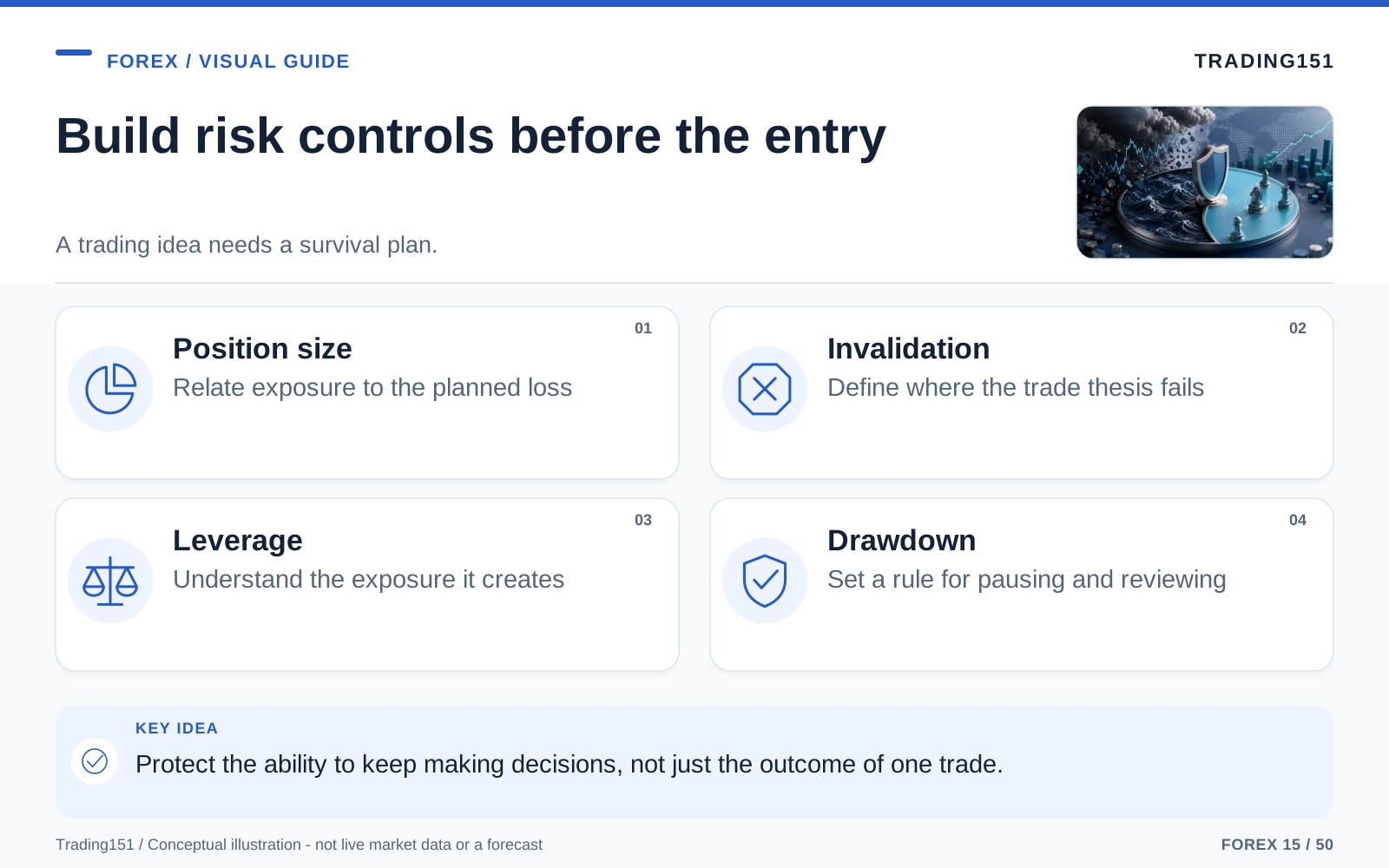
Read this diagram as text
- Position size
- Relate exposure to the planned loss
- Invalidation
- Define where the trade thesis fails
- Leverage
- Understand the exposure it creates
- Drawdown
- Set a rule for pausing and reviewing
1. Position Sizing: The Foundation of Everything
If I could write one rule in permanent marker on every beginner’s monitor, it would be this: never risk too much on a single trade.
A percentage limit is a planning rule, not a guarantee about the final loss. On a $5,000 account, a 1% risk budget is $50. Position size can be calculated so that the expected loss at the planned exit is near that amount, but gaps, slippage, fees, and execution failures can produce a larger loss. Even 1% may be too much when positions are correlated or the trader cannot afford further losses.
New traders always fight me on this. They think risking small means settling for tiny profits. What they don't realize is that risking too much doesn't just bump up the potential reward—it dramatically increases the odds that you'll panic, make emotional choices, and eventually destroy your account.
People really underestimate drawdowns. A 10% dip in your account is annoying. A 20% drop hurts. But a 40% loss? That completely messes with your head. Once you're in a deep hole, you stop trading objectively. You just want your money back. You start forcing bad setups, and a bad situation spirals into a total disaster.
Like we talked about, the math gets concerning fast. Lose 10%, you need roughly 11% to recover. Lose 25%, you need 33%. Lose 50%, and you have to double your remaining money just to get back to square one. The deeper you dig the hole, the more exhausting it is to climb out.
Keeping your risk small means your losses stay completely boring. A rough week doesn't ruin your month. More importantly, it gives your trading strategy enough time to play out over a meaningful sample size.
How to size your positions
So many people do this backward. They decide they want to trade a full lot, and then they just slap a stop loss wherever it fits on the chart. The right way to do it is the exact opposite:
- Figure out exactly how much dollar amount you are willing to lose on the setup.
- Find the logical place for your stop loss based on the market structure, not your wallet.
- Adjust your position size so that if your stop gets hit, you only lose that pre-decided cash amount.
Doing it in this order is crucial. It stops your ego from dictating how much risk you take. Every trade should start by accepting the loss, not dreaming about the profits.
2. Define the exit and understand its limits
A stop order can enforce an exit discipline, but the stop price is not a guaranteed execution price. In a fast or gapping market, the fill can be substantially worse. A stop-limit order controls the acceptable execution price but can remain unfilled. Size exposure with those failure cases in mind rather than treating a small allowance for slippage as sufficient in every market.
Using a stop loss doesn't mean you expect every trade to fail. It just means you acknowledge that markets can flip faster than you can react. A stop is your predetermined exit point—the exact level where you can objectively say, "Okay, my idea was wrong here, time to get out."
That objectivity matters way more than you think. Without a stop, a losing position turns into a toxic hostage situation. You refuse to close it because taking the loss makes it "real." Minutes turn into hours. A manageable, everyday loss balloons into the trade that ruins your entire week.
I hear a lot of people say they use "mental stops." Honestly? Mental stops usually only work in your head. When the market approaches that level, it’s far too easy to negotiate with yourself. "Let me just give it a little more room." Before you know it, you aren't trading a strategy anymore; you're just doing emotional damage control.
A broker-held stop can reduce the temptation to postpone an exit. Its protection still depends on the order type, market conditions, and the broker's execution arrangements. It is one part of risk control, alongside position size, leverage limits, and plans for outages.
Where should you put your stops?
Don't just place a stop at an arbitrary 20 pips because it's a nice, round number. It needs to go at the exact spot where your trading idea is proven wrong.
If you buy a bounce off support, your stop belongs just below the point where that support has clearly failed. If you’re trading a breakout, put it where the breakout proves to be a fake-out. Also, factor in how wild the market is. If a pair naturally swings 50 pips in a session, a 10-pip stop is just begging to get taken out by random noise.
The goal isn't to have the tightest stop possible. The goal is to have a stop that makes structural sense.
Here's a crucial distinction: a good stop loss is meant to protect your trade idea, not your ego. Too many beginners put their stops where they feel financially comfortable, even if that level makes zero sense on the chart. That usually results in the worst of both worlds—stops that are too tight to survive normal market breathing, but still painful enough to sting when they inevitably get hit.
3. Respecting Leverage: A Double-Edged Sword
Leverage is the whole reason most people are drawn to Forex. It lets you control large positions with a tiny amount of cash. But let’s be clear: leverage is a tool, and if used carelessly, it’s absolute gasoline on a fire.
A lot of beginners get into trouble because they view their broker’s maximum leverage as a recommendation. If the platform offers 1:200 or 1:500, they figure using a huge chunk of it must be standard practice. Trust me, it’s not.
Leverage amplifies everything. Yes, it boosts your winners, but it also magnifies the market noise, the stress, the slippage, and your own mistakes. A perfectly fine trade idea that you could have survived easily at a normal size becomes an account-threatening disaster once you amplify it too aggressively.
One of the smartest things you can do is separate the leverage your broker allows from the leverage you use. Just because they let you take a large position doesn’t mean you should. The pros keep their day-to-day exposure small enough that a normal, everyday loss is just a minor annoyance, not a tragedy.
Rule of thumb: if every tiny 1-minute candle makes your heart race and changes your mood, your analysis isn't the problem. Your position size is.
A quick reality check
Before you click buy or sell, ask yourself this: "If this trade goes against me in a totally normal, expected way, am I still going to be thinking clearly?" If the honest answer is no, you are trading too big.
It’s the ultimate litmus test. It has nothing to do with theoretical maximums, what the broker permits, or what some guy on Instagram claims he’s trading. It’s simply about making sure your size allows you to stay sane when the market starts shifting.
4. Let the Risk-to-Reward Math Work for You
Here is one of the most liberating truths about trading: you don’t have to be right all the time to make money.
I know that sounds backward, especially when you're new and assume profitability means nailing your predictions 90% of the time. But in the real world, what matters is the relationship between how much you lose when you’re wrong and how much you make when you’re right.
If you risk $100 to make $100, you have a 1:1 risk-to-reward ratio. If you risk $100 to make $200, that’s 1:2. Risk $100 to make $300, and you’re at 1:3.
The bigger your winners are compared to your losers, the less often you need to win to stay in the green. Now, this doesn't mean you should force ridiculous, pie-in-the-sky targets on every trade. But mathematically, if you consistently risk more than you stand to gain, you are climbing a very steep hill.
Think about it like this: Over 10 trades, you risk $100 each time, aiming to make $200. Let's say you only win 4 of them and lose 6.
- Your 4 wins make you $800 (4 x $200).
- Your 6 losses cost you $600 (6 x $100).
- Net result: You’re up $200.
You were wrong way more often than you were right, and you still came out ahead. That’s the magic of a solid risk-to-reward structure. It gives you breathing room. You don’t need to be a psychic; you just need to manage the downside and let the strong setups pay properly.
Psychologically, this is large. When you have sensible risk-to-reward criteria, you stop feeling the intense pressure to be perfect. You accept that you don't have to predict every market turn. You just execute the plan and let the math work in your favor.
5. The Hidden Trap of Currency Correlation
A classic trap a lot of us fall into is thinking that opening multiple trades automatically means we're "diversified." Sometimes it does, but often, it really doesn't. Correlation is a tricky beast that changes constantly. Two pairs might move in total sync for months and then completely split apart based on one central bank's speech. Still, obvious overlaps are easy to spot. You have to group your trades by the core economic idea behind them and ask yourself what happens if that idea fails across all those pairs at once.
Currencies don't trade in isolation. If you buy EUR/USD, buy GBP/USD, and sell USD/CHF all at the same time, you might feel like you’ve found three separate setups. But in reality, you’ve just taken one large bet against the US Dollar.
This is dangerous because losses tend to cluster. If the Dollar suddenly spikes, all three of those trades will immediately go red. It’ll feel like a sudden streak of bad luck, but the real issue started hours ago when you blindly stacked correlated risks.
Related positions can concentrate exposure even when each has a separate risk budget. Three trades that each plan to risk 1% may amount to roughly 3% of planned loss on a shared catalyst, with actual losses potentially higher if execution deteriorates. Review the combined currency and event exposure rather than counting the trades as independent bets.
You don’t need a PhD in economics to manage this. Just make it a habit to pause and ask, "What specific currency am I betting heavily on right now?" Just stopping to think about that will save you from quietly doubling or tripling your risk without realizing it.
How to handle correlation practically
- Size down if you’re taking multiple setups tied to the same currency theme.
- Don't open a bunch of highly similar positions at once unless you’re doing it on purpose.
- Look at your open trades as one combined portfolio, not just a bunch of random, isolated charts.
That last point is huge. You can follow your rules perfectly on a trade-by-trade basis and still be substantially overexposed when you zoom out and look at the big picture.
6. Respect the News (Don't Be a Hero)
The Forex market isn’t operating in a vacuum; it’s driven by the real world. Interest rate hikes, inflation reports, jobs data, and sudden geopolitical news can shock the charts in a matter of seconds. When that happens, your normal, textbook trading rules get thrown out the window.
Spreads blow out, liquidity dries up, and slippage gets ridiculous. Price will often blast right through the support levels that looked strong a minute earlier. It’s not that you can’t trade during news events, but the risks are completely different from a quiet Tuesday afternoon.
A lot of beginners flock to these volatile moments because the fast movement feels like a goldmine. It feels like opportunity is everywhere. And sometimes it is. But fast candles don’t always equal clean setups. A chaotic chart is just as likely to hand you a terrible fill and trigger emotional panic as it is to hand you a profit.
Here is a substantially underrated skill: just sitting on your hands. There is absolutely no shame in stepping aside before a large news release if your strategy doesn't rely on it. Staying flat is a perfectly valid position. Waiting is a decision. Choosing to protect your capital while the market loses its mind is a hallmark of a pro, even if it feels boring.
If you do decide to hold trades through major news, your risk parameters have to adjust to that uncertainty. You might need wider stops, smaller position sizes, and much more realistic expectations. Good risk management isn’t just about setting a stop; it’s about recognizing when the weather has changed and adjusting your sails.
7. Guard Your Emotional Capital
Not all trading damage shows up in your account balance right away. A lot of it quietly eats away at your decision-making. And here's the thing—your ability to make good choices has a daily limit. Exhaustion, frustration, or a streak of trades that almost worked can turn a perfectly fine setup into a terrible, emotionally driven mistake. Setting a hard cap on your trades for the day, a strict loss limit, and forced breaks aren't signs of weakness. They are the armor you wear because you understand that your mental bandwidth is just as valuable as the money in your account.
We all know the feeling. You take three losses in a row, and even if you're usually calm, you start getting defensive or impatient. You stop waiting for your premium setups. You jump in early. You exit badly. You start taking trades just because you feel like you have to "do something." This is the classic revenge trading spiral, and it rarely taps you on the shoulder to announce itself. It just masquerades as a feeling of urgency.
This is why "emotional capital" is a real thing. It’s your ability to look at the chart objectively without dragging the baggage of your last loss into the current trade. Once you drain that tank, even the best strategy will fail because the person executing it is no longer thinking clearly.
You need a personal circuit breaker. Maybe it’s a strict daily loss cap, a rule to stop after three consecutive losers, or a mandatory walk around the block after a stressful session. What the rule is doesn’t matter nearly as much as having it and respecting it.
Honestly? Sometimes the absolute best trade you can make all day is clicking the 'X' in the corner of your platform and walking away.
It might sound dramatic, but it saves accounts. Stepping away protects your next decision. It stops one bad afternoon from snowballing into a second and third layer of damage. The pros know that sometimes, professionalism looks a lot less like action and a lot more like restraint.
8. Keep a Journal That Doesn't Lie to You
I know, keeping a trading journal sounds tedious. But you’d be amazed at how easily we lie to ourselves when we don't track our actions.
Human memory is painfully selective. After a severe week, we only remember the "unlucky" wicks that stopped us out, or the large move we would have caught if we hadn't hesitated. What we conveniently forget are the trades we took out of sheer boredom, the stops we moved out of fear, or the oversized positions we took because we were feeling cocky.
A good journal forces you to look in the mirror. You can't hide from the data.
But the best journals track way more than just the numbers. Yes, write down your entry, exit, stop, target, and result. But write down the context, too. Why did you take it? What was the market doing? Did you follow your plan? Were you feeling calm, rushed, or annoyed? Did you mess with the trade after you opened it?
Those little details are gold. A lot of the time, consistent losing isn't a problem with your strategy; it’s a problem with your behavior. A journal helps you untangle the two.
Questions you should ask yourself every weekend
- Did I follow my risk rules consistently this week?
- Which of my losses were just part of the game, and which were totally avoidable mistakes?
- Am I waiting for my A+ setups, or am I just clicking buttons to feel busy?
- Do I tend to make terrible decisions during specific times of day or market conditions?
- What is the one repeated habit that cost me the most money this week?
That last question is usually where the magic happens. Most struggling traders don’t need a fancy new indicator; they just need to identify and kill one or two really expensive bad habits.
9. Adjust Risk to the Market, Not Your Mood
The market changes its personality constantly. Some weeks, it moves clean and follows the technicals perfectly. Other weeks, it's choppy, thin, erratic, or entirely driven by random headlines. One of the clearest signs that you're maturing as a trader is realizing your risk shouldn't be stubbornly fixed; it should adapt to what the market is currently giving you.
I'm not saying you should overhaul your whole system every Tuesday. I'm saying you need to recognize when the water is muddy and dial back your exposure. If you normally risk 1% when conditions are great, drop it to 0.5% when the market is acting crazy. That’s not being scared. That’s just being smart.
On the flip side, we often increase our risk for totally wrong reasons. We size up because we're frustrated and want to force a winning day. Or we size up because we just had three winners and feel invincible. In both cases, the decision is fueled by mood, not market quality.
Good risk management asks a very simple question: "What does the market deserve from me today?" Some days deserve your full normal risk. Other days deserve a tiny position, extreme patience, or no trades at all.
The hidden benefit of sizing down in ugly markets is that it protects your confidence. Small losses are easy to brush off. You stay flexible and objective. So when the good setups finally return, your head is still clear enough to capitalize on them.
10. Use a Pre-Trade Checklist to Bypass Emotion
One of the easiest, highest-ROI changes you can make is creating a quick pre-trade checklist. I'm not talking about a 10-page manual nobody ever reads. Just a fast, mental (or physical) routine you run through before clicking the mouse.
The goal is simple: force yourself to make the important decisions before the adrenaline hits.
A good checklist looks something like this:
- What’s the actual setup here, explained in one simple sentence?
- Where on the chart does this idea technically fail?
- Exactly how many dollars am I risking if it hits that level?
- Does the potential reward justify that risk?
- Are there any large news drops coming up soon?
- Am I already heavily exposed to this specific currency?
- Am I taking this because it’s a valid setup, or just because I’m bored and want action?
Do not skip that last question. You’d be shocked how many trades are born purely out of boredom, FOMO, or the desperate urge to make back yesterday's loss. A quick checklist acts as a filter to catch that garbage before it costs you money.
Think of it as adding a tiny bit of friction exactly where you need it. You want the decision to trade to feel a little bit deliberate and hard before you enter, so it doesn't feel agonizing after.
What Risk Management Really Gives You
People talk about risk management like it’s just a seatbelt meant to keep you from flying through the windshield. It definitely does that, but it gives you something much more valuable over the long haul: actual consistency.
When you finally cap your losses, your results start making sense. You can see clearly if your strategy works. You can pinpoint what you’re doing wrong. You can review your month without one random, tilted trade ruining all your data. You can't improve what you can't measure, and you can't measure chaos.
It also completely changes how you interact with the charts. You stop desperately needing every trade to be a winner. You stop taking a stopped-out position as a personal insult to your intelligence. Yes, losing money still stings, but it stops ruining your day. Losses just become an ordinary business expense.
That mental shift is everything. Traders who survive long enough eventually stop chasing the illusion of certainty. They start thinking in probabilities. They know for a fact some trades will fail, and their confidence comes from knowing that those failures won't hurt them.
Put a price on the loss before choosing the size
Suppose a hypothetical $5,000 account sets a planned risk budget of $25 for a trade. On EUR/USD in a dollar account, a standard 100,000-unit lot has a pip value of $10 under the usual 0.0001 pip convention. With a 20-pip stop and no costs, the calculation would allow 0.125 lots: $25 divided by $200 of risk per standard lot.
That is only the starting calculation. If commissions, spread treatment, and a slippage allowance add another 5 pips of expected cost or adverse movement per standard lot in your model, the same budget allows 0.10 lots instead. Broker increments, minimum size, and the exact order structure must be checked. Other currency pairs and account currencies require different pip-value calculations.
Also ask what happens if the planned exit is unavailable. A gap can produce a loss beyond the estimate, and a stop-limit order can remain unfilled. Some products offer contractual guaranteed stops for a charge and under specified conditions, but that is not a feature to assume.
Finally, aggregate the account's exposure. Several individually small trades can depend on the same currency move. Risk management is not complete when every ticket has a modest percentage beside it. It is complete only when the combined positions, plausible execution problems, and available cash make sense together. The example illustrates sizing arithmetic, not a recommended risk percentage.
Leave room for an operational failure
The loss budget should consider what happens when the platform cannot be reached or an order is rejected. Keep the broker's independently verified contact route and know how to inspect open positions from another supported connection. Do not assume that logging out closes a trade or cancels a pending order. These details are less exciting than entry signals, but a misunderstanding about order state can produce exposure that was never intended. 1, 2, 3
Conclusion: The Traders Who Last Are Usually the Ones Who Learn to Defend First
The Forex market is funny; it rarely rewards maturity right away. When you first start, being aggressive looks awesome. High risk feels exciting. Making fast money on a large lot size makes you feel like a genius. But as the years go on, the guys who are still around are the ones who mastered the quiet, unsexy skill of losing properly.
They keep their position sizes boring. They put their stops at logical levels and then keep their hands off the mouse. They treat leverage like a loaded weapon, not a toy. They watch out for currency correlation. They size down when the market is a mess. They walk away when they're angry. And they look at their own mistakes honestly enough to fix them.
Is it flashy? No. Will it sell a fantasy? Probably not. But it’s real, and real is what lasts.
In trading, survival isn't just the waiting room you sit in before you become successful. Survival is the success—at least in the beginning. Staying alive is what buys you the screen time, the data, and the emotional resilience to eventually become a master.
The market is still going to humble you. You’re going to have losing streaks, deal with erratic price action, and watch setups that looked totally flawless crash and burn. Risk management doesn’t magically erase those realities. It just makes sure those bad days don’t get to end your career.
That is the whole game. Stay solvent. Keep your head clear. Protect your downside at all costs. If you can do that consistently, you give yourself a real shot at lasting. You also need to plan for the freak accidents: what if your internet drops? What if a large weekend news gap skips your stop? The fixes are simple—smaller sizes, closing out before the weekend, having your broker’s app on your phone—but you have to figure them out before panic sets in. Real resilience is just expecting things to go wrong sometimes, instead of assuming every trade will go exactly to plan.
Sources and further reading
- Investor.gov: Asset Allocation
- SEC Investor Bulletin: Stop, Stop-Limit and Trailing Stop Orders
- FCA: Restrictions on CFDs sold to retail clients
- CFTC: Eight things to know before trading forex
Editorial revision: 7 October 2026. Numerical scenarios are hypothetical unless identified as historical. References support the added explanations and selected corrections; rules and product terms should be checked again before acting.