
Liquidity concerns the ability to trade an amount without an excessive price concession. Volatility describes the extent of price changes, while slippage is the difference between an expected or requested price and the execution received. They are related but not interchangeable. A liquid market can move sharply, and a quiet-looking market can have little depth when an order arrives.
1. Liquidity: How Easy It is to Get a Fair Trade
Simply put, liquidity is just how easily you can buy or sell something without moving the price. In a highly liquid market, there are plenty of buyers and sellers hanging out near the current price. In a thin, illiquid market, it's a ghost town. There are fewer orders, and usually big, empty gaps between price levels. It's not just about a tight spread on your screen—that can vanish the second a large order comes through. While retail platforms don't show us the full order book, you can still feel liquidity in real-time by watching how spreads act, if your orders are slipping, and how things get messy around news or the daily rollover.
Think of it like trying to sell a used car. If you're selling a Honda Civic, you'll find a buyer today and get pretty close to your asking price. If you're trying to sell a highly modified, custom-built race car, you might wait months and have to drop your price significantly just to find someone willing to take it. That’s liquidity in a nutshell.
Now, people always say "forex is the most liquid market in the world." True, but that doesn't mean every currency pair is liquid 24/7. It fluctuates substantially, and that catches a lot of traders off guard.
Not All Currency Pairs Trade the Same Way
The major pairs, especially the ones tied to the US dollar, have large liquidity pools. EUR/USD, USD/JPY, and GBP/USD have constant traffic from banks, hedge funds, and algorithms. Because so much volume is flowing through them, getting into and out of trades is usually smooth, and spreads stay tight.
Crosses and exotic pairs are a completely different animal. Something like EUR/GBP gets plenty of action, but it’s noticeably thinner than the big dollar pairs. And exotics like USD/TRY or USD/ZAR? They take no prisoners. It only takes a tiny bit of buying or selling to send them flying, and you're paying a huge markup in spreads right out of the gate.
Liquidity Changes with the Clock
The time of day matters way more than most beginners think. Yes, forex is a 24/5 market, but the actual volume peaks and valleys depending on which global financial hubs are awake.
The London session is notoriously heavy. New York brings serious volume too. When those two overlap in the morning (US time), that’s the golden window. You usually get the best mix of deep liquidity, tight spreads, and clean moves. It's not always easy trading, but at least there's enough volume to process orders properly.
But then you have the dead zones. Right after New York closes and before Tokyo wakes up, the market dries up. You'll see the same drop-off on Friday afternoons, around major bank holidays, or right before a large news event when the big players pull their orders and step to the sidelines.
This is why the same trade setup works differently depending on the time of day. A technical breakout during the London open might trigger perfectly and run. Try that same breakout at 4 PM in New York, and you'll likely get hit with a wide spread, a fake-out, and a terrible fill.
What Liquidity Looks Like in Practice
When liquidity is healthy, you’ll notice a few obvious signs on your screen:
- Tight spreads: The gap between the bid and ask is minimal.
- Snappy execution: Your market orders fill almost exactly at the price you clicked.
- Stable price action: It takes serious money to bully the market around, preventing random, jagged spikes.
- Technical reliability: Support, resistance, and price patterns just tend to work better when the market is crowded.
When liquidity vanishes, things get ugly fast. Spreads blow out. Candles look like barcodes, full of weird gaps and wicks. Tiny trades can cause excessively large price swings. Your stops get hunted with ease. If you took a loss and thought, "That was a weird trade," there's a good chance you were just trading in a low-liquidity wasteland.
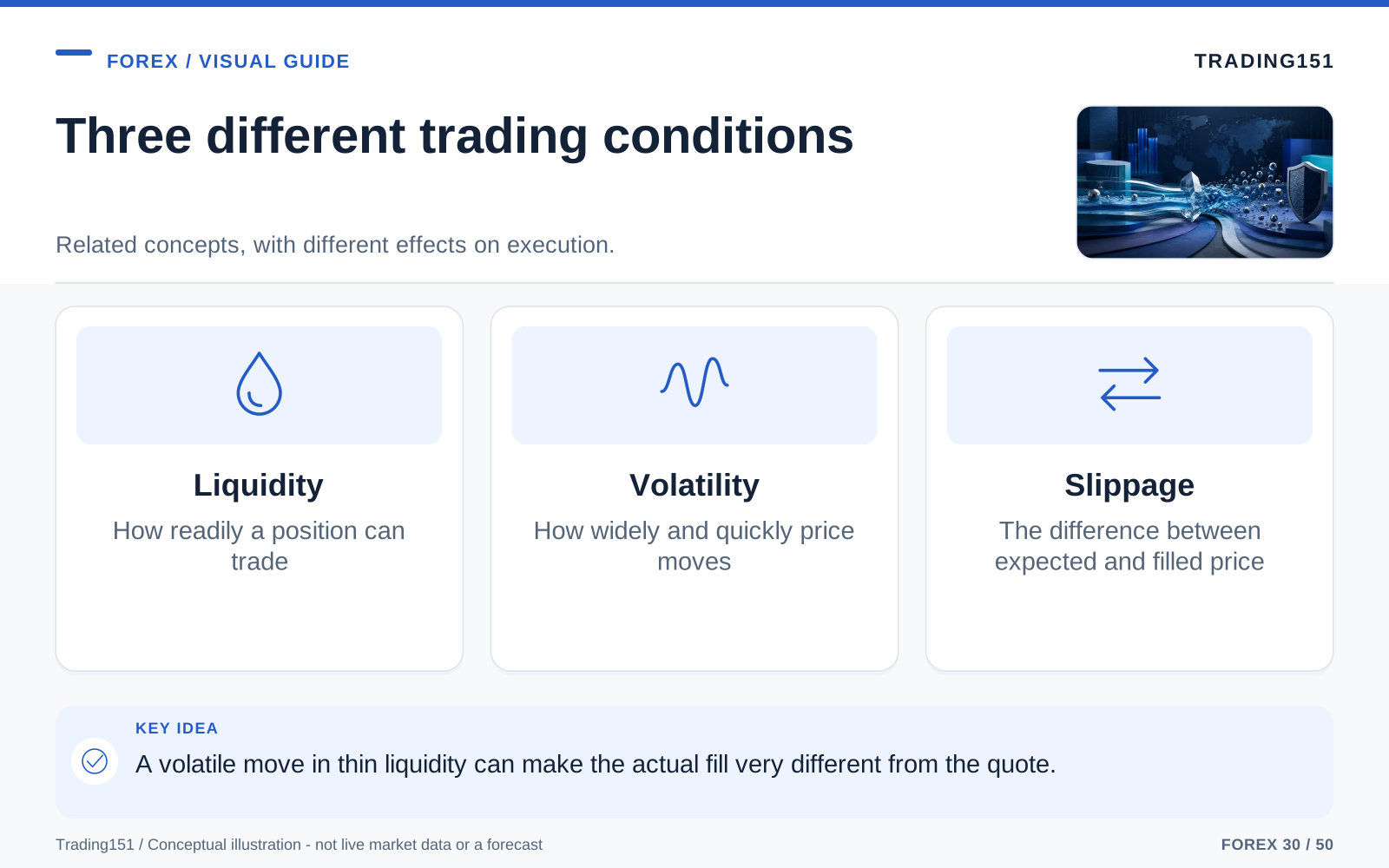
Read this diagram as text
- Liquidity
- How readily a position can trade
- Volatility
- How widely and quickly price moves
- Slippage
- The difference between expected and filled price
2. Volatility: How Fast and How Far Price Is Moving
Think of liquidity as the depth of the ocean, and volatility as how large the waves are. Volatility is just the speed and size of price swings. A low-volatility market just kind of drifts along aimlessly. A highly volatile market rips up and down, making you feel like it's changed its trend four times in ten minutes. It completely changes the scale of your charts. A 20-pip stop-loss might be safe during the Asian session, but it will get instantly vaporized during a CPI release. You have to adapt your sizing and expectations to the current market speed, not whatever happened yesterday. You don't want to avoid volatility—it's how we make money—but you definitely shouldn't use a quiet-market strategy in a fast-market environment.
Volatility itself isn't the enemy. It’s just movement. If the market doesn't move, you can't cover your spreads and make a profit. But when things get too crazy, risk management becomes a nightmare, especially when the price starts teleporting past your levels instead of smoothly trading through them.
Quiet Markets and Fast Markets
We’ve all seen those days where a pair just refuses to go anywhere. It bounces in a tiny 15-pip box, candles overlap, and every breakout fails immediately. That’s low volatility. It’s boring, but at least it's relatively safe.
Contrast that with days where a single headline drops and all hell breaks loose. The market travels a distance in three minutes that would normally take a week. That’s high volatility. It’s where the big money is made, but it's also where undisciplined traders blow their accounts.
What Causes Volatility?
Markets get volatile when they are forced to reprice an asset immediately. It could be an unexpected rate hike, large inflation numbers, a random geopolitical crisis, or even just a key technical level breaking that triggers an avalanche of stop-loss orders.
Sometimes you can see it coming. Everyone is leaning one way ahead of a major news event, the result surprises them, and they all rush for the exit at once. Other times, a random headline hits the wires and the market just detonates without warning.
Volatility Feels Different Depending on Liquidity
This is where a lot of traders get it wrong: volatility isn't just about the size of the move; it's about the quality of the move. A highly liquid market can be volatile but still give you clean, readable price action. The price is moving fast, but there's enough volume to keep things orderly.
But mix high volatility with low liquidity? That’s toxic. That's when you see those horrible 50-pip whipsaw candles that stop out both buyers and sellers in the blink of an eye. The price is flying around, but because there are no orders to absorb the impact, it just thrashes violently.
Fast movement in a thick market equals great trading. Fast movement in a thin market just equals expensive gambling.
3. Slippage: The Gap Between Your Plan and Your Fill
Choosing how to enter a trade is always a compromise. A market order guarantees you get in right now, but you might not love the price. A limit order guarantees your price, but you might get left behind entirely. Understanding this trade-off beats hoping one order type will flawlessly handle every situation. It just comes down to what you care about more in that moment: definitely being in the trade, or strictly controlling the entry price.
Slippage is simply the difference between the price you clicked and the price you got. You see 1.0550 on the screen, you hit buy, and you assume that’s where you'll get filled. Sometimes you do. But sometimes, by the time your order hits the broker's server, the market has already moved.
Sometimes you slip by a fraction of a pip. Other times, you get dragged ten pips away from your intended entry, and it stings.
People love to cry "broker manipulation" when this happens. It feels unfair. But honestly? It's just the market doing its job. If the price you wanted is gone by the time your ticket arrives, you get the next best available price. It’s not a scam; it’s just how order matching works.
Why Slippage Happens
Slippage usually bites you in a few specific scenarios:
- Things are moving way too fast. In the milliseconds it takes your order to process, the price has already bolted.
- The order book is totally empty. There isn't enough volume at your price to fill your whole trade, so the rest of your position gets filled at progressively worse prices.
- The spread blows out. The chart might look totally still, but the actual bid/ask prices have gapped apart behind the scenes.
- You're market-executing during news. A market order tells your broker, "I don't care what it costs, just get me in," which is risky when the market is jumping.
Negative Slippage and Positive Slippage
We always talk about slippage like it’s a curse, but that’s not entirely fair. Negative slippage is when you get a worse price. Positive slippage is when you get filled at a better price than you clicked. Yes, it really happens.
Of course, we only remember the negative slippage because it costs us money. An entry that slips five pips against you ruins your risk-to-reward ratio. A stop-loss that slips large pips turns a standard 1% loss into a 3% disaster. Those are the ones that leave a scar.
Stops Slip Too
This is a tough pill to swallow: your stop-loss is not a bulletproof vest. It does not guarantee you will exit at that exact price. A standard stop-loss is just an instruction that says, "If the price hits this level, turn my trade into a market order to get me out." If the market falls sharply and skips right over your stop-loss price, you are going to get filled at whatever terrible price is currently available at the bottom of the gap.
This happens constantly during large news events, over weekend gaps, or during flash crashes. People always think their platform broke. It didn't. The market just moved too fast for your order to grab the price you wanted.
4. Why These Three Forces Are Tied Together
You can't really isolate liquidity, volatility, and slippage.
In the real world, they are completely tangled up with each other.
When liquidity is high, spreads are tight, and slippage is rare. The market can move, but it has the muscle to handle the volume smoothly.
But the second liquidity dries up, the market turns fragile. It takes barely any volume to push the price around, which causes volatility to spike. And once the price is ripping around in an empty market, nasty slippage is practically guaranteed.
The real danger isn't one of these things happening alone—it's all three hitting you at the same time.
A Familiar Example: A Central Bank Announcement
Think about a typical FOMC rate decision.
Minutes before the release, the large institutional players pull their orders off the book. Nobody wants to hold large risk into a blind event. Because they pull their orders, liquidity instantly evaporates.
The clock strikes, and the Fed drops a surprise rate hike. Traders immediately scramble to buy the dollar. Because the market is totally thinned out, there’s no resistance. The price violently rockets upward. Boom—that’s volatility.
Right at that moment, you decide to market-buy. You click the button based on the price on your screen, but that price is already ancient history. There is zero liquidity at that level. Your order gets dragged five, ten, maybe fifteen pips higher before it finally finds someone willing to sell. Boom—that’s slippage.
There’s no big conspiracy against you. It was just a thin market, a sudden burst of movement, and a delayed fill. Once you see the mechanics behind it, it makes total sense.
5. Reading Market Conditions Before You Trade
You level up as a trader the moment you stop asking, "Is this a good setup?" and start asking, "Is this a good setup for the current market conditions?"
A perfectly good technical pattern in a thick, stable market is absolutely worth taking. That exact same pattern right before the daily rollover or five minutes before CPI? Probably not worth the execution risk.
Before you click buy or sell, run through a quick mental checklist:
- Which trading session are we in right now?
- Does this specific pair have volume at this time of day?
- Look at the spread—is it normal, or is it getting abnormally wide?
- Is there a red-folder news event dropping in the next hour?
- Am I about to use a market order in a jumpy, fast-moving market?
- Is my stop-loss wide enough to survive the current spread and volatility?
It’s not thrilling stuff, but asking those questions will save you from so many stupid, completely avoidable losses.
6. Practical Ways to Manage Liquidity, Volatility, and Slippage
Knowing the theory is great, but surviving the real market is what matters. Here is how experienced traders handle these forces without constantly getting chewed up. Try keeping track of this stuff in your trading journal. Note the spread, what price you asked for, what you got filled at, and whether the market felt slow or chaotic. After a while, you'll start noticing trends—like how certain pairs cost way too much to trade at 5 PM, or how a specific scalping strategy just doesn't survive normal slippage. That kind of real-world data helps you tweak your strategy and even decide if you need a better broker.
A. Trade When the Market Is Alive
If your edge relies on tight spreads, precise entries, and actual momentum, you have to trade when the big players are at their desks. For the majors, the London session and the New York overlap are simply the best times to trade.
You can trade other hours, but you need to be way more cautious. If you’re trading the Asian session or a Friday afternoon, you better have a strategy specifically built for slow, choppy environments.
B. Be Careful Around Scheduled News
Trading volatile markets is totally fine, but you have to know the difference between normal market flow and news-driven chaos. Taking a breakout at 10 AM on a quiet Tuesday is completely different from taking a breakout thirty seconds before Non-Farm Payrolls.
Beginners never realize just how wide spreads can get during major data drops. You could be right about the direction of the trade, but still lose money because your entry was terrible or your stop got tagged by a freak spread spike.
Unless you have a dedicated news-trading strategy, sitting on your hands for five minutes before and after a major release is usually the smartest play.
C. Use Limit Orders When Price Matters More Than Urgency
A market order basically yells at the broker, "Get me into this trade right now, no matter the cost." A limit order says, "I only want in if I can get this exact price, or better."
That difference is huge. If your strategy requires pinpoint entries, limit orders keep you from overpaying. The catch? You will definitely miss trades when the price doesn't quite reach your limit. Over time, most traders realize that missing out on a trade hurts way less than getting dragged into a terrible entry because of a market order in a thin market.
Limit orders don't magically fix everything, but they keep you safe when hitting a precise level is the whole point of your setup.
D. Match Position Size to Conditions
When the market gets wild and liquidity dries up, the smartest thing you can do is cut your position size. It’s such an easy adjustment, but so few people do it.
If the market is swinging substantially and you need to use a wider stop-loss just to survive the noise, keeping your normal lot size will massively inflate your risk. You might think you’re sticking to your plan, but you're taking on way more exposure just because the environment changed.
Sizing down keeps you in the game, and it keeps you sane. It’s a lot easier to hold a trade when every little tick against you isn’t threatening to blow your account.
E. Give Your Stops Enough Room for the Real Market
Placing a 10-pip stop-loss just because it gives you a nice 1:3 risk/reward ratio is a terrible idea if the market is currently swinging 30 pips a minute. You’re just offering yourself up as liquidity. You have to adapt your stops to what the market is doing right now.
If it's a quiet day with a tight spread, a tight stop works. If things are chaotic and the spread is widening, that same stop-loss will get triggered by random noise.
This doesn't mean you should use a large 100-pip stop just to be safe. It just means your stop needs to be placed at a level where your trade idea is proven wrong, not just a spot where a slightly wide spread will randomly knock you out.
F. Pay Attention to the Spread, Not Just the Chart
It’s so easy to get mesmerized by the candles and completely ignore the spread—until it robs you. But the spread is quite the cost of doing business. It dictates your entry, where your break-even point is, and whether your stop gets tagged prematurely.
A chart might look perfectly flat while the spread is secretly tripling in the background. If you're scalping or trading on low timeframes, that spread is everything. A 10-pip target is a breeze when the spread is 0.5 pips. It's a nightmare when the spread is 3 pips.
Treat the spread as a core part of the setup, not an afterthought.
G. Know Your Broker’s Execution Model
Not all brokers are created equal. They process orders differently, and their execution quality varies substantially. Some run a B-book and internalize your trades, while others send them straight to external liquidity providers. Some give you a raw 0-pip spread but charge a commission, while others bake everything into a wider spread.
Don't get distracted by the fancy marketing terminology. What matters is how your orders fill when things get heated. Are you getting hit with constant requotes? Does the slippage get ridiculous during news events? Are your stop-losses respected? Your broker is the bridge to the market, so take the time to test them, compare them, and switch if they suck.
7. The Psychological Side Most Traders Learn the Hard Way
Getting screwed by bad execution doesn’t just hurt your account balance; it wrecks your mindset.
You hit buy, you get slipped five pips, and suddenly you're starting the trade angry. Or your stop-loss gets triggered by a random spread spike, and you immediately convince yourself the broker is hunting you. Or maybe you get a bad fill, watch the price go exactly to your target, and start revenge trading out of pure frustration.
That lack of understanding directly causes self-destructive behavior.
Once you truly grasp how liquidity and slippage work, you stop taking bad fills personally. Obviously, you still want good entries, but you stop seeing normal market mechanics as some kind of betrayal. This shifts your whole perspective, and it is the only way to stop revenge trading and making impulsive mistakes.
You stop expecting a chaotic market to give you flawless entries. Instead, you start asking yourself: Was I trading at a stupid time? Should I have used a limit order? Did I completely forget about a news event? Taking accountability for your execution environment is so much healthier than just screaming at your monitor.
8. A More Mature Way to Think About “Good” Trading
Most amateurs measure a trade entirely by the result. If it made money, they're a genius. If it lost money, the market is rigged. That mindset won't keep you alive for long.
You can execute a flawless trade and still hit your stop-loss. You can make a boneheaded, undisciplined mistake and accidentally make a profit. What separates a good trader from a gambler is knowing if the trade made logical sense for the current market conditions.
That's exactly why understanding liquidity, volatility, and slippage is a superpower. It gives you a real framework to evaluate yourself.
Maybe your technical analysis was a masterpiece, but the trade was still garbage because you market-bought into a large news spike. Maybe the setup was beautiful, but you tried to trade it at 4 PM on a Friday when there was zero volume. Maybe your stop was mathematically correct based on the chart, but totally clueless because volatility had just tripled.
Recognizing those nuances is the difference between a professional and an amateur just pressing buttons.
A stop price is a trigger, not a promised fill
Consider a buy order submitted when the best displayed ask is 1.1000. If that quote disappears before execution, the order may fill at 1.1003 instead. For many non-yen currency pairs, the difference is three pips. Whether that is a minor cost or a serious problem depends on the position size and the strategy's expected return per trade.
A conventional stop order commonly becomes a market order when triggered, so the eventual fill can be worse than the stop level. A stop-limit order controls the acceptable execution price but may remain unfilled if the market moves past it. These orders solve different problems; neither offers a universal escape from a fast market. Broker-specific guaranteed stops, where offered, have their own terms and charges.
Measure slippage by order type and conditions. Entries around major releases should not be mixed indiscriminately with small orders in ordinary trading. Also record favorable price improvements rather than counting only the adverse cases. The distribution, including rare large outcomes, tells more than a single average.
Use that evidence in position sizing and strategy testing. A setup targeting a few pips may be much more sensitive to a small execution deterioration than one seeking a larger move. The risk plan should reflect what the account can actually execute, not what an ideal chart implies. Spread, slippage, and financing are part of the trade rather than administrative details added afterward.
Leave a record of the order instruction
When an execution looks wrong, the original order type, limit, trigger, timestamp, and status matter. Keep those details with the confirmation and available quotes. A chart screenshot alone may not show the bid or ask relevant to the trade. Clear records make it easier to distinguish normal spread or slippage effects from an actual order-handling problem that should be raised with the provider. 1, 2, 3
9. Final Thoughts: Trade the Market You have, Not the One You Wish You Had
Trading forex isn't just about drawing lines and guessing where the price will go. It’s a living, breathing environment that reacts to time, volume, and urgency. Liquidity dictates how deep the water is. Volatility dictates how violently the waves crash. Slippage is just what happens when your order collides with those harsh realities.
Once you accept how these three forces operate, a lot of the rage just disappears from your trading. You aren't shocked when spreads blow out during a dead session. You stop trying to force entries into every fast-moving candle just because it looks exciting. You stop expecting perfect, surgical fills when the market is behaving like a warzone.
And that acceptance is the bedrock of real risk management.
You aren't going to eliminate volatility, you aren't going to outsmart slippage forever, and you certainly can't force the market to give you deep liquidity at 2 AM. Your only job is to read the environment, adapt to it, and play the game based on the current rules.
In practice, this just means sticking to the busy hours when possible, avoiding the gambling around major news releases, using limit orders to protect your entries, sizing down when things get crazy, and factoring the spread into every trade you take.
If you do that consistently, you stop feeling like a victim of the market and start feeling like you're moving with it. It might not seem like a large shift from the outside, but you will absolutely see the difference in your stress levels and your equity curve.
Candlesticks and chart patterns will always get the spotlight, but the invisible forces behind them are what dictate your success. Master how liquidity, volatility, and slippage work, and the market will instantly feel less random, less aggressive, and way more readable. A line on a chart only tells you where the price went; it doesn't tell you how painful it was to get filled along the way. Be smart about your planning. Bake realistic spreads into your backtesting, expect your stops to slip occasionally, and turn your lot size down when the volume dries up. If your strategy can survive all that friction, you’ve got a real edge.
Sources and further reading
- SEC Investor Bulletin: Trading Basics and Order Types
- SEC Investor Bulletin: Stop, Stop-Limit and Trailing Stop Orders
- BIS: April 2025 FX turnover, September 2025 preliminary release
Editorial revision: 7 October 2026. Numerical scenarios are hypothetical unless identified as historical. References support the added explanations and selected corrections; rules and product terms should be checked again before acting.