
Recovering from trading losses begins with limiting further damage and understanding what happened. The goal is not to win the money back on a deadline. A loss can come from ordinary strategy variation, excessive exposure, poor execution, or an approach that never had a reliable edge. Those causes need different responses, and a pause can be more useful than another trade.
Phase 1: Stop the Bleeding Before You Do Anything Else
The biggest danger after a large loss isn’t the money you just lost. It’s what you do in the next five minutes. Your first and only job right now is to stop a bad financial hit from turning into a total behavioral meltdown. Cancel your pending orders, check your exposure, and walk away. Don't start analyzing what went wrong while you're secretly hunting for a new setup. The market isn't going anywhere, but your account balance will if you let panic dictate your risk.
When we take a hit, our nervous system practically screams for relief. We feel this overwhelming frustration and reach for another trade almost instinctively. Not because the setup is good. Not because we have an edge. Just because our brain desperately wants to get back to breakeven and erase the pain.
That exact urge is what blows accounts to zero.
Close the platform
Not in five minutes. Not after you check one more timeframe. Right now.
Close your broker's terminal. Shut down TradingView. Put your phone in another room. You need physical distance from the market. When you’re flooded with adrenaline and regret, you aren’t making trading decisions anymore. You’re making pain-management decisions, and those usually end up costing you a fortune.
Revenge trading rarely feels like a mistake in the moment. It feels justified. It feels like you're taking control. But 99% of the time, it’s just pure emotion wearing a mask of confidence.
Let the loss land
You don’t have to fake a smile and pretend it’s just part of the business. Suppressing it usually makes it worse.
Losing money sucks. If it was a big loss relative to your account size, it can make your stomach churn. Your chest gets tight, your thoughts race, and you bounce between cursing the market and hating yourself. That’s not a sign of weakness. That’s just human stress chemistry doing its thing.
Go outside. Lift some heavy weights. Take a hot shower. Vent to a friend who gets it. Write down how frustrated you are without trying to sound like a stoic professional. The goal isn't to throw a pity party, but to let the emotional wave wash over you so it stops hijacking your brain.
Give yourself a mandatory time-out. For a lot of traders, 24 hours is the bare minimum. If you took severe damage, giving yourself 48 hours completely away from the charts is usually a better call. The market will still be there on Monday. Your capital might not be if you rush it.
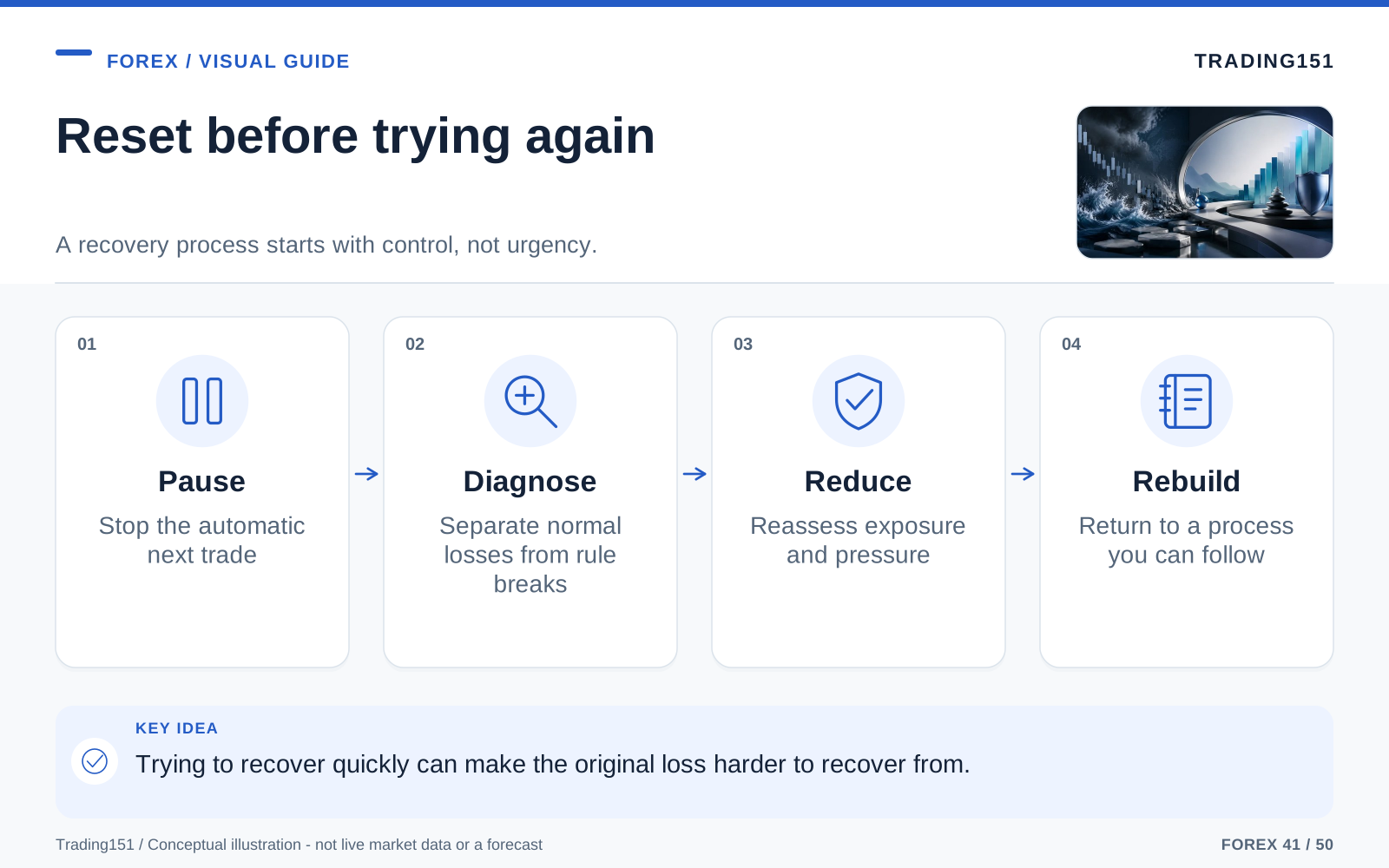
Read this diagram as text
- Pause
- Stop the automatic next trade
- Diagnose
- Separate normal losses from rule breaks
- Reduce
- Reassess exposure and pressure
- Rebuild
- Return to a process you can follow
Phase 2: Separate a Bad Day From a Broken System
Once your heart rate is back to normal, the real work starts. This is where you need severe honesty, not false confidence. You have to categorize the loss before you try to fix anything. A normal loss from a solid strategy doesn't need fixing. An execution error means you need to tweak your process. Breaking a hard rule means you need better behavioral guardrails. Don't mix these up, or you'll end up throwing away a perfectly good trading system just because you had a momentary lapse in discipline.
Not every red trade means your strategy is garbage. Not every drawdown means you’re a terrible trader. Sometimes you do everything right, and you still lose. But other times, the loss has nothing to do with probability and everything to do with you acting like a gambler. You have to figure out which one just happened.
Run a proper post-mortem
Treat this trade like a crime scene. Pull up the chart, your execution history, and your notes. Then, ask yourself these questions and don't lie about the answers:
- Was this setup part of my plan, or did I just squint until it looked like one?
- Did I calculate my position size based on my rules, or based on how greedy I felt?
- Did I place my stop-loss at a logical technical level, or just where I hoped price wouldn't go?
- Did I move, widen, or delete my stop once the trade went into the red?
- Did I average down into a losing position?
- Was I trading right in the middle of a crazy news event without adjusting for the chop?
- What was my headspace like before I even clicked the mouse?
These questions matter because catastrophic losses are almost never just one mistake. They are a chain reaction of little compromises. Maybe you entered impulsively. Maybe you went way too heavy on the lot size. Maybe the real mistake happened three hours earlier when you sat down at your desk exhausted, irritated, and just wanting to make something happen.
If you skip this review process, you’re suffering the pain without extracting the lesson. Pain by itself doesn't make you a better trader. Reflection does.
Figure out what kind of loss it was
This is crucial, because you can't treat every loss the same way.
A clean loss is when you executed your plan perfectly, respected your risk parameters, took the stop like a professional, and the market just didn’t hand you a win. Those sting, sure, but they don't mean you need to change anything. They’re just the cost of doing business.
A dirty loss is when the market exposed your lack of discipline. You chased a candle. You maxed out your leverage. You took a setup you knew you shouldn't have. You moved your stop because your ego couldn't handle taking a small L.
Clean losses just require patience. Dirty losses require rule changes, stricter limits, and usually a heavy reduction in position size until you get your act together.
Phase 3: Own the Mistake Without Letting It Define You
There’s a mental trap we all fall into after a painful hit. We either play the victim, or we completely self-destruct.
The victim says, “The market is rigged. The broker hunted my liquidity. It was just a freak news spike.” The self-destructor says, “I’m a total idiot. I always ruin my progress. I’m never going to make it as a trader.” Both mindsets are useless. One protects your ego; the other crushes it. Neither one helps you trade better tomorrow.
The healthiest way to handle it is simple but tough: own exactly what you did wrong, and stop there.
If you threw your rules out the window, admit it. If you risked way too much, own it. If you traded while you were emotionally unhinged, write that down. But do not turn a bad trading decision into a summary of your worth as a human being. You made a bad call, or maybe a string of them. It’s serious, and it costs money, but it doesn't mean you're fundamentally broken.
Professional traders aren't people who never make mistakes. They’re just people who stopped lying to themselves about why they made them.
Phase 4: Reframe the Loss the Right Way
People love to call trading losses "tuition." It’s a nice thought, but it only works if you’re learning something.
Calling it tuition shouldn’t be a convenient way to brush off reckless behavior. If you blew half your account because you refused to use a stop-loss for the tenth time this year, that’s not tuition. That’s just stubbornness. A lesson only counts if your behavior changes afterward.
That said, the concept is true. Trading has a steep learning curve, and the market charges you in real dollars to learn its lessons. You can't learn emotional control, patience, and risk management from a textbook. The market has to beat those concepts into you.
So ask yourself: what exactly did this loss pay to teach you?
- Did it teach you that your lot sizes are way too big for your actual risk tolerance?
- Did it show you that you're highly prone to overtrading right after a winning streak?
- Did it reveal that you don’t trust your edge, which is why you keep micromanaging trades?
- Did it prove that you have no business trading when you're running on four hours of sleep?
The second you can articulate exactly what you learned, the loss stops being pure damage and starts being a tool.
Phase 5: Shrink the Game and Rebuild Your Base
One of the toughest pills to swallow after a major loss is realizing that your next move isn’t a heroic, movie-style comeback. It’s a large step back. You need to frame your recovery in terms of good execution, not dollars earned. Drawdown math is severe: the deeper the hole, the harder you have to work just to get back to zero. If you try to aggressively risk your way out of it, you'll likely dig your grave. Dialing your risk down slows the financial recovery, but it radically speeds up your mental recovery. Take that trade-off every time.
You need less risk, less pressure, and a lot less drama on the charts.
Go back to demo or trade embarrassingly small
Your ego is going to fight you on this. Ignore it.
After a rough loss, your perception is completely warped. You might feel recklessly aggressive, or you might feel totally paralyzed. Neither state is going to make you any money. Sizing down gives you the breathing room to practice executing your edge without your heart pounding out of your chest on every tick.
If you can stomach going back to a demo account for a week or two, do it. If demo trading makes you lazy and careless, trade micro-lots. Trade the absolute smallest size your broker allows. The goal right now isn't to pay your rent. The goal is to repair your mind.
You have to rebuild trust with yourself. You don't earn that trust back with one lucky home run trade. You earn it by proving, over and over, that you can follow your rules even when it’s boring.
Lower risk until it feels almost boring
Most traders don’t blow up because they can’t find support and resistance. They blow up because they trade sizes that completely overload their emotional capacity.
It’s easy to write "I will risk 2%" in your trading plan. It’s a lot harder to sit on your hands while that 2% goes into deep drawdown in real time. A lot of traders find out the hard way that their actual emotional tolerance is a fraction of what they thought it was.
If you’re trying to recover, strip your risk down to the studs. Risk 0.25% or 0.5% per trade. Yes, the green days will be tiny. That is exactly the point. Taking the money off the table allows you to see the market clearly again.
Set a strict daily loss limit, too. If you hit it, shut the laptop. No arguing with yourself, no "just one more setup to get back to even." You have to respect this rule even when you absolutely hate it.
Phase 6: Rebuild the Process Before You Chase the Money
So many recovery plans fail because the trader is lying to themselves. They say all the right things about discipline, and maybe they even trade small for a few days, but deep down, they have one obsessive goal: get the money back right now.
That desperation bleeds into everything you do.
It makes you jump into mediocre setups because you can't stand waiting. It makes a $20 win feel like an insult compared to the $1,000 you lost last week. And because that big red number is still haunting you, you start ramping up your lot sizes again way too soon.
Your recovery only starts working the moment you stop staring at your account balance and start staring at your execution.
Define what a good trading day is
A good trading day doesn't always end in green.
A good day looks like this:
- You waited patiently for your actual setup instead of forcing something.
- You used the correct position size.
- You let your stop loss do its job without interfering.
- You didn’t revenge-trade after a loss or chase a move you missed.
- You walked away when your session was over.
If you did all of those things and still took a loss, congratulations—you had a professional trading day. It might not feel great in the moment, but that exact behavior is what builds a profitable career over the next five years.
Conversely, if you broke all your rules and made a bunch of money, you didn't have a successful day. You just got rewarded for terrible habits. Those are the kinds of wins that eventually lead to blown accounts.
Create a short pre-trade checklist
When your emotions are running hot, you can't rely on your intuition. You need to make your decisions as mechanical as possible for a while.
Before you even touch the buy or sell button, force yourself to answer these five questions:
- Is this exact setup in my trading plan?
- Where is my stop going, and what is the technical reason for it being there?
- Exactly what percentage of my account am I risking on this?
- Are there any high-impact news events dropping in the next hour?
- Am I emotionally calm and fully prepared to lose this money?
If you hesitate on any of those answers, take your hand off the mouse. It sounds basic, but a simple checklist is often the only thing that stops you when your brain is frantically looking for a reason to gamble.
Phase 7: Journal Like Someone Who Wants the Truth
A trading journal is absolutely worthless if it’s just a fantasy log of the trader you wish you were.
You have to track more than just your entries and exits. Write down why you took the trade. How were you feeling before you took it? What stupid things did you do while the trade was running? Did you follow your plan? Take screenshots. Note what time of day it was. Be honest if you were exhausted, bored, overconfident, or distracted.
If you do this consistently, patterns will start staring you in the face.
You might realize that your biggest losses always happen on Thursday afternoons. Or that you consistently sabotage yourself right after a three-trade winning streak. Or that you lose money every time you miss your morning entry and try to force a midday trade to make up for it.
That kind of data is gold. It gives you something real and tangible to fix.
Keep it simple so you do it. Three honest bullet points in a notebook after every session is infinitely better than a large, complicated spreadsheet that you stop using after three days.
Phase 8: Fix the Life Around the Trading
People hate talking about this part because it’s not as exciting as discussing moving averages or order blocks, but it matters way more than most traders want to admit.
How you trade is a direct reflection of how you live. If you’re sleeping four hours a night, chugging caffeine, fighting with your partner, and stressing about bills, it is going to show up on your charts. You can have the best trading strategy in the world, and a chaotic personal life will still destroy your edge.
Sometimes a bad streak isn't a technical problem. It's an energy problem. You’re mentally tapped out before you even boot up your broker.
Don’t make trading your whole identity
If your entire sense of self-worth relies on your P&L, every loss feels like a threat to your existence. A red week doesn’t just mean you lost some capital; it means you're a failure as a person. You cannot trade objectively with that kind of weight on your shoulders.
You need things in your life that have absolutely nothing to do with pips, win rates, or equity curves. Go to the gym. Hang out with friends who don't know what Forex is. Get some sleep. Have a hobby. You have to remember that you are a human being first, and a trader second.
It’s weird, but it’s true: the less you obsess over trading, the better you usually perform. You stop forcing setups. You stop acting desperate. You just let the market do its thing.
Be honest about financial pressure
If you’re trading with money you cannot afford to lose, you are playing on hard mode. The charts become loaded with the pressure of rent, car payments, and debt. You stop trading what you see, and start trading what you need. That urgency forces you to overleverage and overtrade.
If you’re in this boat, you have to face reality. You might need to slash your risk to pennies, or even stop live trading completely until your day job or savings are more stable. Taking a break isn't failing. It’s just applying risk management to your real life.
Phase 9: Know When You’re Ready to Scale Again
Patience is arguably the most vital skill in recovery. And not just sitting around waiting, but active, measured patience. Before you even think about sizing back up, set hard, objective rules for when you’re allowed to do it. Tell yourself, "I need 20 disciplined trades, a fully updated journal, and zero broken rules before I increase my risk." When you hit the milestone, bump your size up just a little bit, and see how you handle it. You want your confidence to come from hard evidence, not just a fleeting feeling of invincibility.
You don't get to scale up just because you’re bored of making small profits. You scale up because the data proves you're ready.
Look for actual proof, such as:
- A solid month of disciplined, rule-following execution.
- Never once breaking your daily loss limit.
- Leaving your stop-losses alone once placed.
- Taking a loss and just walking away, zero revenge trades.
- A journal that proves you're keeping your emotions in check.
When those habits feel locked in, increase your size a little. Don't jump straight from 0.25% back to 2%. Go to 0.5%. Let your brain and your heart rate get used to the slightly bigger numbers. The goal is to test the waters and see if your discipline holds up when the money gets a bit more real.
If you size up and immediately start making stupid mistakes again, congratulations—you just found your current emotional ceiling. Drop the size back down and keep working. There's zero shame in that. Catching it early is a large win.
Phase 10: Accept That the Scar Is Part of the Education
Huge losses leave a permanent mark on your trading psychology. And they should.
You don't need to carry the guilt forever, but that memory acts as a protective shield. When you’ve felt the gut-wrenching pain of overleveraging, ignoring a stop, or going on a tilt-fueled rampage, you develop something valuable: a deep respect for the market.
That respect changes you. It makes you hesitate before doing something impulsive. It reminds you that one reckless hour can completely wipe out three months of grinding. It cements the reality that in this business, survival isn't just a side goal. Survival is the entire job.
Don't try to forget the loss. Just turn the memory of it into a guardrail that keeps you on the road.
A smaller account does not need a faster strategy
The arithmetic makes urgency dangerous. A 20% loss requires a 25% gain on the remaining balance to return to the starting point. A 50% loss requires a 100% gain. Increasing exposure to chase that recovery also increases the chance of making the shortfall worse. The previous account high is not a target the market has any obligation to revisit.
Separate the financial problem from the trading review. Protect money needed for living costs and do not assume future trading profits will cover an immediate bill. If losses involve borrowed money or unaffordable commitments, address those obligations directly. Trading under pressure to repair the household budget can make an already difficult activity harder.
Review the records without grading decisions solely by their outcomes. Was the planned size followed? Did costs differ from the test? Were several positions exposed to the same event? Did a rule change after entry? These questions can identify a correctable process failure, but the answer may also be that the strategy lacks adequate evidence.
Returning to live trading is optional. A practice account can help test an operational change, though it does not reproduce every live condition or emotion. If the activity feels compulsive, disrupts sleep, or repeatedly breaks agreed financial limits, stop and seek appropriate support. The meaningful recovery is restored financial control, not simply a new series of trades aimed at erasing an old number.
Recovery does not require returning to the same market
After a serious loss, the first task is to restore financial stability and understand what happened. That may lead to smaller positions, a different approach, or a decision not to resume active trading. There is no requirement to recover the money through the instrument that lost it.
A target based on 'getting back to even' can encourage unsuitable risk because it ties the next decision to a past price. Evaluate future choices using current resources, obligations, and evidence. The earlier loss matters to the budget and the lessons learned, not as an instruction that the market owes a particular return. 1, 2, 3
The Way Back Is Usually Quieter Than People Expect
Recovering from a major Forex drawdown is rarely glamorous. It’s not one large, all-in trade that magically restores your account balance and makes you feel like a genius. It’s usually not a perfect month with a 90% win rate, either. The reality of bouncing back is a lot quieter.
It looks like cutting your lot size in half. It looks like taking fewer setups. It looks like logging off at 10 AM because the market is choppy. It looks like taking a clean loss, closing the laptop, and going about your day instead of spiraling. Mostly, it just looks like you growing up as a trader and becoming a lot less reactive.
We rebuild by taking a painful, chaotic event and responding to it with a boring, steady, deliberate routine.
If you just took a heavy hit, stop wasting your energy trying to pretend it didn't phase you. It did. Now extract the lesson. Slow your pace down. Tighten up your rules. Start respecting risk in a way you obviously weren't before.
You don’t need to win it all back by next Friday. You just need to focus on becoming the kind of trader who can survive in this arena for the next ten years.
That’s a real comeback. Keep in mind that a blown account often shines a light on things totally unrelated to your strategy—like hidden debt, sleep deprivation, or this toxic idea that trading is going to instantly fix all your financial problems. If that hits home, you need to work on those things outside the charts, maybe even talk to a professional or someone you trust. Real recovery isn’t just about finding the perfect entry strategy. It’s about building a life where you can sit down at your desk and make sane, rational decisions again.
Sources and further reading
- BIS: April 2025 FX turnover, September 2025 preliminary release
- Investor.gov: Asset Allocation
- SEC Investor Bulletin: Stop, Stop-Limit and Trailing Stop Orders
Editorial revision: 7 October 2026. Numerical scenarios are hypothetical unless identified as historical. References support the added explanations and selected corrections; rules and product terms should be checked again before acting.