
A trading journal is a record of decisions, conditions, and results. It becomes useful when it helps answer a specific question: whether a setup works after costs, whether execution is deteriorating, or whether an avoidable habit is increasing losses. A folder full of screenshots is not enough on its own. The entries need a consistent structure and a review that leads to a concrete change.
Why a Trading Journal Matters More Than Most Traders Realize
When most people hear the word "journaling," they picture a boring log of wins and losses. That’s part of it, sure, but it barely scratches the surface. A solid journal does so much more than just act as a receipt for your trades.
It shows you the truth, not the version your memory prefers
Human memory is biased, especially when money is on the line. We love to remember the large wins that made us feel like rockstars and the dramatic, unlucky losses that stung. But what usually slips our minds are the quiet, sneaky habits that slowly bleed an account dry: getting in a candle too early, choking a winner out too soon, shifting stops out of fear, or forcing mediocre setups just because we're bored.
Your journal doesn't care about your ego. It captures exactly what happened in real-time, stripping away the sanitized story you try to tell yourself later.
It turns trading into a process you can improve
You can’t fix what you don’t measure. If your post-market review consists of grumbling, "Man, I had a bad week," you have absolutely nothing to work with. But if your journal points out that 80% of your losses came from trades outside your core strategy, or that you crush it during the London session but get chopped up in New York, you suddenly have a clear path forward.
That’s the moment trading stops feeling like a slot machine. You stop trading based on your mood and start relying on hard evidence.
It separates strategy problems from discipline problems
This is huge, and it’s something a lot of people miss. Sometimes we think our strategy is garbage, when in reality, our execution is what's broken. Other times, we follow our rules perfectly, but the setup itself just doesn’t have an edge. Without a journal, those two completely different issues just blur together into one big mess of frustration.
Journaling forces you to ask the right questions. Did the trade fail because the market structure was weak? Or did you FOMO in late, over-leverage, and panic at the first red candle? Those are two very different problems that need totally different fixes.
It keeps emotion from running the whole operation
The markets will take you on a wild emotional rollercoaster. A string of losses makes you gun-shy; a winning streak makes you feel invincible. Both extremes are toxic. Writing things down acts as a speed bump between your feelings and your mouse clicks. It forces you to take a breath, articulate your reasoning, and look at your own behavior rationally.
More often than not, that little pause is the only thing standing between learning a valuable lesson and repeating an expensive mistake.
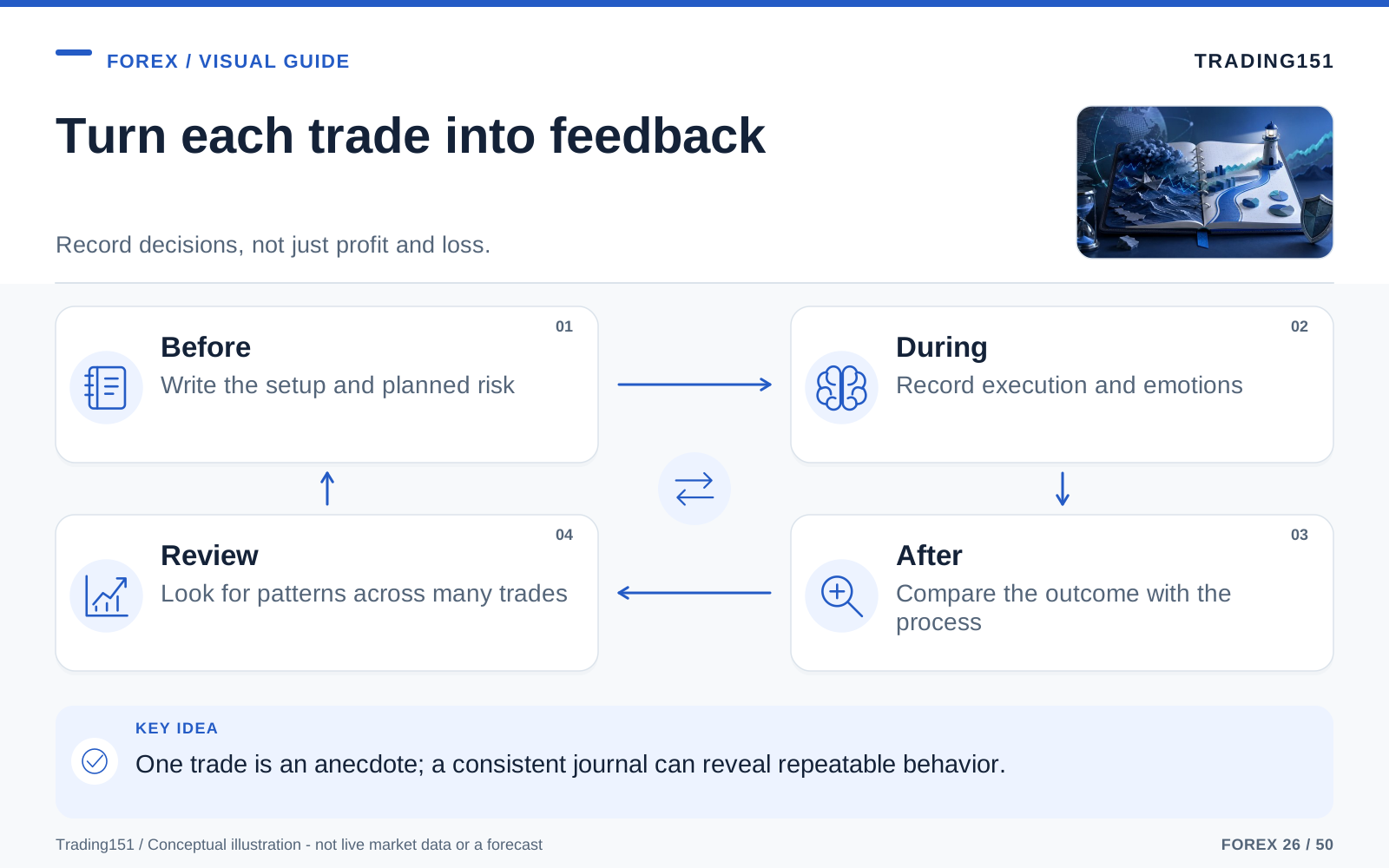
Read this diagram as text
- Before
- Write the setup and planned risk
- During
- Record execution and emotions
- After
- Compare the outcome with the process
- Review
- Look for patterns across many trades
What a Good Forex Trading Journal Should Contain
The best journals track two things at once: the math behind the trade and the mindset behind the trader. If you only track the numbers, you ignore the human element holding the mouse. If you only vent about your feelings, you miss the hard data that proves whether your strategy prints money.
You really need both sides of the coin.
Part 1: The mechanical side of the trade
This is the raw data. It gives you an objective baseline for your performance. You'll want to log things like your planned vs. Actual entry, stop loss, targets, position size, and what session you were trading. Maximum adverse and favorable excursion (how far the trade went against you or for you before closing) are great for extra context. But a quick rule of thumb: don't track a metric just because it makes you feel like a Wall Street quant. Only track things that you will use later to answer a specific question about your trading.
- Date and time: Don't just log the hour; note the session. The London open, the New York crossover, and the sleepy Asian session all behave very differently.
- Currency pair: EUR/USD, GBP/JPY, USD/CAD, etc. Over time, you’ll naturally see which pairs respect your strategy and which ones act like a siren song for bad decisions.
- Direction: Long or short.
- Timeframe: Note the timeframe you entered on, plus the higher timeframe you used to grab your overall bias.
- Entry price: Where you got filled.
- Stop-loss: The specific price that proved your trade idea wrong. Tracking this shows whether you're placing stops logically or just picking arbitrary numbers out of fear.
- Take-profit or target area: Where you planned to get out, not just where you blindly hoped the chart would go.
- Position size: Your lot size or units traded.
- Risk per trade: How much of your account balance was on the line, ideally as a percentage.
- Risk-to-reward ratio: What you were risking versus your potential payout.
- Exit price: Where you finally pulled the plug—whether it hit your stop, smacked your target, or you manually closed it out.
- Result: Profit or loss in pips, dollars, or percentages.
- Screenshots: Take one when you enter, one when you exit, and maybe one of the higher timeframe to show the big picture. These are pure gold. Numbers are great, but a picture of a chart tells a story numbers never could.
Looking at that list, it might feel like a lot of work. But once your template is set up, filling it out becomes second nature.
Part 2: The psychological side of the trade
This is where the real magic happens. So many traders keep beautifully color-coded spreadsheets but still blow accounts because they never track what was going on in their own heads. They know what they did, but not why they did it. Try to avoid vague, useless notes like "felt bad today." Be specific. Note if your hand was itching to move a stop loss, if you checked the P&L twenty times in five minutes, if you slept terribly the night before, or if you took the trade right after a fight with your spouse. You can fix specific behaviors. Broadly labeling yourself "undisciplined" just makes you feel guilty without offering a way to improve.
- Setup reason: Why did you take this? Write it out plainly. E.g., "Pulled back into demand during London open with a bullish engulfing confirmation."
- Market context: Was it trending? Choppy? A low-volume holiday? Context is everything.
- Pre-trade emotional state: Were you calm, exhausted, bored, arrogant, or distracted? It sounds trivial until you look back at a month of data and realize every large loss happened on days you felt "annoyed."
- Rule adherence: Did you follow your own plan? If you bent a rule, which one was it?
- Trade management notes: Did you choke the trade by moving your stop to breakeven too fast? Did you take profits early just to feel a win? Did you hold a loser out of pure stubbornness?
- External factors: Kids screaming in the background? Rushing before your 9-to-5? Hungover? Real life bleeds into the charts way more than we like to admit.
- Post-trade reflection: Was this a solid trade that just had a bad outcome, or a terrible, impulsive trade that you got lucky on? That difference matters way more than the actual dollar amount.
I really want to emphasize that last point. A losing trade that followed your rules perfectly is still a "good" trade. A winning trade that you YOLO'd into is a "bad" trade. If you only judge yourself by whether the P&L is green or red, your journal won’t teach you a thing.
The Best Format for Your Journal
Don't get hung up on finding the "perfect" platform. The best journal is simply the one you’ll open up and use, especially on those miserable, red days when logging your mistakes is the absolute last thing you want to do.
Pen and paper
A physical notebook is surprisingly powerful, especially for tracking your mental state. Writing by hand physically slows you down, making your reflection feel a lot more intentional and a lot less robotic.
- Best for: Traders who want a distraction-free, intimate way to process their sessions.
- Weak spot: You can't easily filter data or run performance math without a calculator and a headache.
Excel or Google Sheets
This is still the bread and butter for most traders. You can customize the heck out of it, run formulas to track your win rate automatically, and filter your trades by day, session, or setup.
- Best for: People who love clean data and flexibility without paying monthly subscription fees.
- Weak spot: Tying screenshots and long journal entries into spreadsheet cells feels clunky. You usually have to pair it with a separate folder of images or a notes app.
Notion, Evernote, or similar tools
These are awesome if you want structure paired with deep-dive notes. You can keep a clean database of your numbers, but click into any trade to pull up a full page for your charts, notes, and post-trade venting.
- Best for: Highly visual traders who want an organized, aesthetically pleasing workspace.
- Weak spot: It’s really easy to fall into the "productivity trap"—spending ten hours building the perfect Notion dashboard instead of trading and journaling.
Dedicated journaling software
Tools like TradeZella, TraderSync, or Edgewonk are built for this exact purpose. A lot of them let you import your broker data with a few clicks and will automatically spit out deep analytics.
- Best for: Traders who are committed to the process and want to save time on data entry.
- Weak spot: They cost money. Plus, it’s easy to just look at the fancy auto-generated pie charts and completely skip the hard work of reflecting on your actual behavior.
If you’re new to this, a basic, ugly Google Sheet is totally fine. You don’t need a NASA-level command center on day one. You just need a habit you can stick to.
A Simple Journal Template You Can Start Using Right Away
If setting this up sounds exhausting, keep it dead simple. A bare-bones template just needs these columns:
- Date
- Pair
- Session
- Setup type
- Long or short
- Entry
- Stop-loss
- Target
- Risk percentage
- Position size
- Exit
- Result
- Did I follow my rules?
- How was I feeling before entry?
- What did I do well?
- What needs work?
- Link to screenshots
That is more than enough to get the ball rolling. You can always get fancier later once logging your trades becomes second nature.
What Most Traders Learn Once They Journal Consistently
Once you’ve got a few weeks of honest data under your belt, patterns will jump off the page. Some will make you feel great about your edge. Others will be painfully embarrassing to look at. Either way, they are valuable.
You might realize that your prime, A+ setups print money, but you're cannibalizing all those profits by taking garbage boredom trades in the middle of the day. You might see that your entries are perfectly fine, but your exits are dictated entirely by panic. You might even realize that trading GBP/JPY always ends in a blowout for you, while EUR/USD steadily grows your account.
A lot of traders also come to a sobering realization: their charting skills are fine, but their trigger finger is too itchy. They are simply overtrading.
That kind of realization is exactly why we do this. A journal doesn't just show if you can find a setup; it shows if you possess the patience to wait for it.
How to Review Your Journal So It Helps
Writing down your trades is only half the battle. The magic happens when you review them. Don’t just look at one painful loss and spiral. Look at your trades in batches. Compare similar setups, sessions, and market conditions. Separate the trades where you followed your rules from the ones where you went rogue. If you only have a small sample size, use it to ask questions, not make sweeping conclusions. If you spot an issue, tweak one small thing and test it. Don't throw your whole strategy in the trash just because you had a bad Tuesday.
Your journal shouldn’t be a graveyard where you dump your trades and walk away. It has to be an active feedback loop. The absolute best way to do this is a weekly review, ideally on the weekend when the markets are closed and your emotions have cooled off.
During your weekly review, ask questions like these:
Did I follow my trading plan? Not "kind of." Not "mostly." Did you follow it to the letter—yes or no? Go through every trade and explicitly label it as rule-based or improvised.
Were my losses acceptable? There is a large difference between a clean, technical loss taken by the book, and a messy, self-inflicted loss caused by tilt. One is just the cost of doing business. The other is entirely avoidable.
Which setups performed best? Whether you trade breakouts, pullbacks, or ranges, look at them in isolation. Find out where your true edge lives.
What time of day suits me best? You might be a sniper during the London open, but totally lose your edge in the afternoon chop. Your data will expose this.
How did I manage trades once I was in them? Are you habitually taking profits too early out of fear? Are you dragging your stop loss down because you refuse to accept a loss? Be direct.
What was happening in my life when I traded badly? People really underestimate this one. Lack of sleep, stress at your day job, or rushing out the door often leave large fingerprints all over your trading account.
When you wrap up your review, don’t try to fix ten things at once. Pick one or two hyper-specific things to focus on next week. Set a measurable goal. For example:
- I will absolutely not trade between 12:00 PM and 2:00 PM.
- I will only take a reversal trade if the higher timeframe confirms it.
- I will not touch my stop-loss once the trade is live.
- If I take two losses in a single day, I am shutting down my platform.
That is how journaling moves the needle. Not by writing down poetry about your feelings, but through highly focused, incremental tweaks.
Monthly Reviews: Where Bigger Patterns Become Clear
Weekly reviews catch your immediate screw-ups. Monthly reviews let you zoom out and see the real macro trends in your trading.
At the end of the month, step back from the micro details and ask yourself:
- What was my total return?
- What was my average win compared to my average loss?
- Which setup type printed the best results?
- Which pair drained the most energy and capital?
- How many trades did I take that were entirely outside my plan?
- Did I improve from last month, or was I just clicking buttons?
This is also the perfect time to read through your written notes, not just the spreadsheet numbers. You’ll usually spot a recurring emotional loop: getting impatient after a boring morning, feeling invincible after three wins, hesitating after a drawdown, or totally losing your mind trying to win back a week's worth of losses on a Friday afternoon.
Once those patterns are visible, they lose their power. You can anticipate them instead of getting blindsided.
Common Mistakes Traders Make With Journals
A lot of traders start journaling with fantastic intentions and still get absolutely nowhere. Usually, it’s not a lack of effort. It’s a flawed approach.
Making the journal too complicated
If it takes you twenty minutes to log a single trade, you are going to quit. I guarantee it. Make it detailed enough to pull insights, but lightweight enough that you can maintain it when you're exhausted.
Only journaling the bad days
Some people only open their journal when they take a beating, treating it like a confessional booth. If you ignore the journal on your green days, you're missing half the data. You need to study your winning behaviors just as intensely as your losing ones.
Writing vague reflections
Writing "I need to be more disciplined" is utterly useless. It sounds nice, but it gives you nothing to work with. A much better note is: "I entered right before the 15-minute candle closed out of FOMO, and I paid for it." Now you have an actual behavior to fix.
Judging trades only by profit or loss
This is a large trap. If you take a terrible, rule-breaking trade but it happens to hit take-profit, and you label it a "good trade" just because it made money, you are training yourself to be reckless. Your journal needs to teach you to grade your execution, not just the financial outcome.
Skipping entries after embarrassing mistakes
Ironically, the trades that make you cringe the hardest are the ones that hold the biggest lessons. Did you revenge trade? Triple your lot size? Move your stop into oblivion? Log it. Especially those.
How to Make Journaling a Habit Instead of a Phase
People rarely quit journaling because they think it doesn't work. They quit because it feels like a chore, and the habit never truly locks in. The secret is to ruthlessly eliminate the friction. Build your template in advance, grab your screenshots the literal second you close the trade, and block out ten minutes at the end of your session to log it. If your process takes an hour, you’ll skip it on your busiest, most stressful days—which happen to be the days you need to journal the most. Consistency always beats complexity.
Make it painfully easy for yourself:
- Use a plug-and-play template so you aren't staring at a blank screen.
- Snap your screenshots instantly. If you tell yourself "I'll grab them later," you won't.
- Log the trade while the emotions and logic are still fresh in your mind.
- Treat your weekly review time like a non-negotiable doctor's appointment.
- Start by tracking just a few key metrics, and only add more if you need them.
Always remember what the journal is for. It’s not a tool to shame yourself. It’s a tool to upgrade yourself. Nobody cares if your logbook looks pretty. The only thing that matters is that it's radically honest.
Give the journal a question to answer
Choose one question for the next review period. For example: do trades taken outside the planned session perform differently from trades taken within it? Record the session and the reason for entry before knowing the result. Otherwise, an unsuccessful trade can easily be relabeled as an exception while a successful one is counted as part of the strategy.
Use separate fields for the planned trade and the executed trade. Include the original entry, invalidation point, intended size, actual fills, and all charges. This makes it possible to distinguish a weak idea from an order-handling problem. A useful journal can show that the setup was followed correctly and still lost money; that is a normal outcome worth retaining.
A short note often explains more than a long account of the day's mood. "Entered after the planned cutoff because I had missed the earlier move" identifies an observable action. "I need more discipline" does not specify anything that can be changed or measured. Keep the wording factual enough that another reader could understand what happened.
Review groups of comparable trades, not just the most memorable loss. Small samples can make random differences look meaningful, so treat early findings as questions rather than verdicts. Finish the review with one adjustment, a reason for making it, and a date to assess it. Without that last step, journaling can become another way of replaying trades instead of learning from them.
Review a small set of questions consistently
A journal becomes difficult to use when every trade produces a different essay. Keep the core fields stable: the setup, intended risk, reason for entry, execution, exit, and any departure from the plan. Add a screenshot only when it preserves information that the written record cannot capture clearly.
At review time, look for recurring decisions rather than memorable stories. Are losses larger after a particular rule is ignored? Are costs overwhelming a short holding period? Does the trader repeatedly enter before the required condition appears? A journal earns its place when it leads to a specific, testable improvement, not merely a longer archive of emotions. 1, 2, 3
Final Thoughts: The Journal Is Really About Self-Management
On the surface, a trading journal looks like a spreadsheet for your trades. But in reality, it’s a tracking tool for you.
It shows exactly who you become under pressure. It reveals your patience, your impulsivity, your fear, and your resilience. It completely strips away your ability to make excuses, forcing you to look at exactly where you need to step up.
That’s why journaling is the great equalizer. Anybody can draw lines on a chart, spot a trend, and rattle off buzzwords about risk-to-reward. But very few people can execute a boring, systematic plan day after day, especially coming off a nasty loss or a euphoric win streak.
A journal is the bridge between knowing what to do and doing it.
You don’t need to have a perfect system on day one. Just start. Set up a basic spreadsheet. Be direct about every click of the mouse. Look at your data at the end of the week. Find your patterns, make a tiny adjustment, and then do it all over again.
Give it time, and your journal will become so much more than a ledger. It becomes raw, unfiltered proof of the trader you are when nobody else is in the room. Treat it right, and it will be your clearest, fastest path to becoming the calm, precise, consistently profitable trader you want to be.
So open up a blank document today. Make your first entry. Save that first screenshot. It might feel like a tiny, insignificant step right now, but this is the exact behind-the-scenes habit that separates the pros from the gamblers. Protect this data. Keep it secure, back it up, and treat it like the blueprint to your trading business. Because ultimately, the ordinary trades, the dumb mistakes, and the small, daily corrections are exactly what build a successful career.
Sources and further reading
- Investor.gov: Asset Allocation
- BIS: April 2025 FX turnover, September 2025 preliminary release
- TradingView Pine Script Documentation: Strategies
Editorial revision: 7 October 2026. Numerical scenarios are hypothetical unless identified as historical. References support the added explanations and selected corrections; rules and product terms should be checked again before acting.