
Range trading seeks opportunities when price repeatedly moves between an upper and lower area rather than trending persistently. The challenge is recognizing that a range is a description of recent behavior, not a promise that the next move will remain inside it. A useful plan defines the boundaries, entry conditions, and response to a break before an apparent bargain becomes an expanding loss.
Part 1: What a Ranging Market Really Looks Like
A ranging market is essentially stuck on repeat. It keeps rallying up to the same general ceiling, dropping down to the same general floor, and failing to build any real trend. You aren't seeing stair-stepping higher highs or lower lows. You're just watching price bounce around inside a box. A real range needs to show that both sides are actively rejecting price—it’s not just a brief pause after a big move. You want to see meaningful reactions at the edges and steady volatility. If it's just a tiny, tight consolidation, the market is probably just catching its breath before continuing the trend, which makes trying to trade the edges pretty dangerous.
Think of it like a tennis ball bouncing down a narrow hallway. It smacks one wall, bounces back, hits the other wall, and keeps doing that until someone opens a door. On your chart, those walls are support and resistance.
- Resistance is the ceiling. It’s the upper zone where the market just can't seem to push higher. Sellers step in, buyers lose their nerve, and the move dies out.
- Support is the floor. It’s the lower zone where buyers suddenly find the price too cheap to ignore. Demand kicks in, sellers take their profits, and the price bounces back up.
Notice I said "zone," not a laser-thin line. One of the quickest ways to lose money as a beginner is assuming support and resistance are exact, down-to-the-pip prices. Real markets are messy. Price will regularly overshoot your line by a few pips, fall short on the next swing, and still be respecting the same structural boundary.
When price just keeps ping-ponging between these zones, you're looking at a market in equilibrium. Buyers think the bottom is a steal. Sellers think the top is overpriced. Until somebody brings enough money to the table to tip the scales, the market is just going to keep doing laps.
Why Ranges Form in the First Place
The market doesn't go sideways just to annoy you. Ranges happen for specific reasons—usually because participants are undecided, digesting recent moves, or quietly getting their orders filled.
- Everyone is waiting on the news. If a large inflation report, a central bank rate decision, or a huge geopolitical event is looming, big money tends to sit on the sidelines. The market drifts sideways while everyone waits to see what happens.
- The market just needs a breather. After a crazy rally or a steep crash, people take profits. Latecomers get trapped. The market has to cool off, and that "cooling off" phase often turns into a sideways range.
- Big players are quietly building positions. Hedge funds and institutions can’t just drop a large order into the market without ruining their own entry price. They have to sneak their trades in over time, which can keep the market contained in a range while they work.
- Everyone agrees on the price. Sometimes, buyers and sellers just temporarily agree that a currency pair is valued fairly right where it is. It’ll just rotate quietly until a new piece of data shakes things up.
Understanding this matters because it reminds you what you're dealing with: equilibrium, not momentum. You aren't trying to surf a wave. You're just playing the bounces.
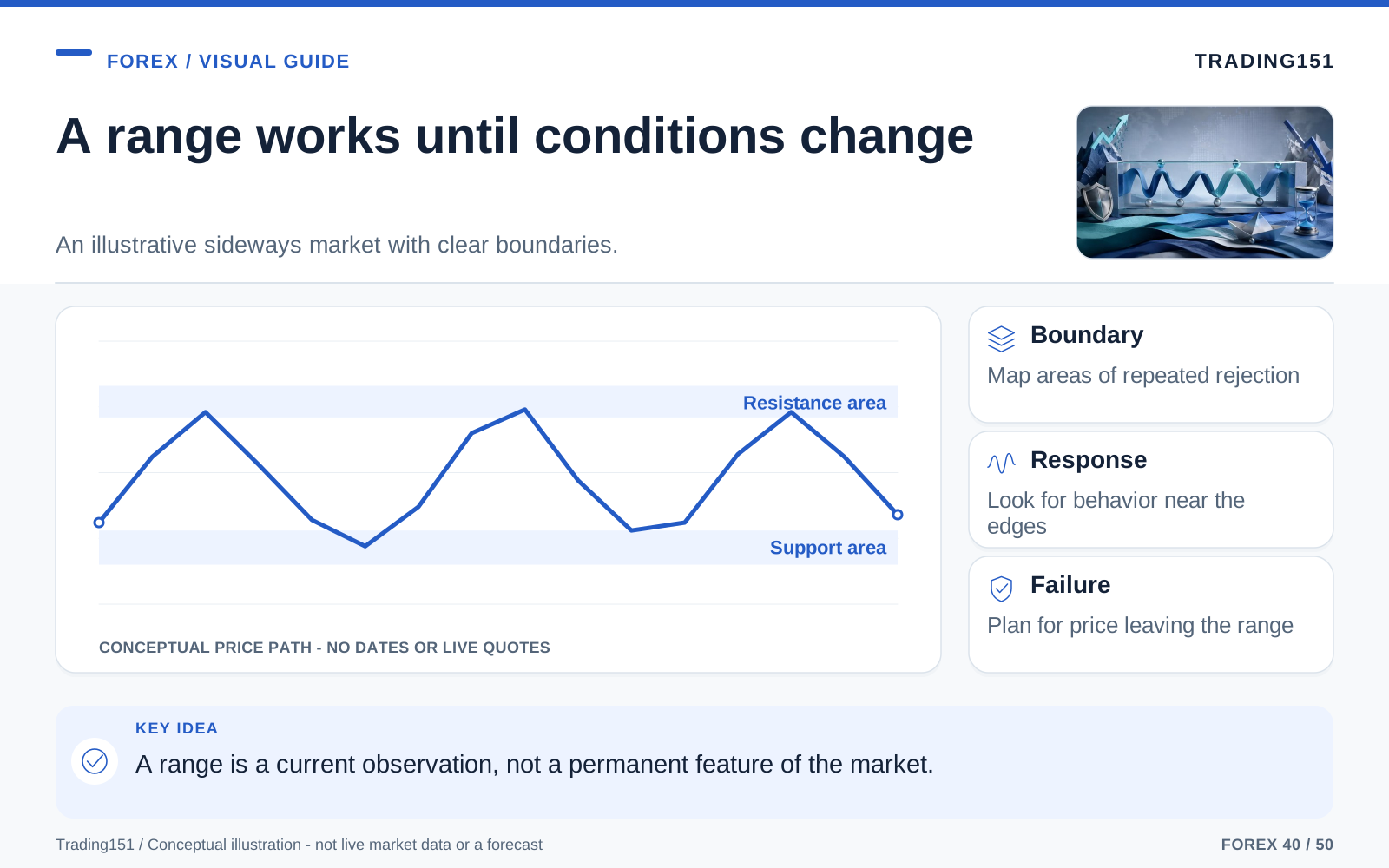
Read this diagram as text
- Boundary
- Map areas of repeated rejection
- Response
- Look for behavior near the edges
- Failure
- Plan for price leaving the range
Part 2: How to Identify a Real Range Instead of Guessing
A lot of people see three sideways candles and immediately scream, "It's a range!" That’s a trap. A genuine range has to prove itself by rejecting the edges multiple times. If it hasn't done that, you might just be looking at a quick speedbump in an ongoing trend.
Start With the Chart, Not the Indicator
Do yourself a favor: before you throw five indicators on your screen, just zoom out. If you're stared down at the last ten candles, every tiny pause looks like a large reversal. Pull back and look at the last 50 or 100 candles. The real story usually becomes obvious instantly.
Ask yourself:
- Is the price traveling sideways, or is it still subtly grinding up or down?
- Are buyers consistently stepping in at the same lower zone?
- Are sellers consistently swatting the price down at the same upper zone?
- Are we boxed in, or is the market still making obvious trending pushes?
As a rule of thumb, you want to see the market test and reject both the top and the bottom at least twice before you start trusting the range. Two touches on resistance and two on support usually confirm the box is real. More touches are even better, as long as the price action isn't getting chaotic.
What a Healthy Range Looks Like
Not all sideways markets are worth your time. The ones you want to trade share three traits:
- Obvious walls. You should be able to spot the top and bottom zones instantly. If you have to squint and force a box onto the chart, it’s not a good range.
- Clean rejections. When price hits the edge, it should react. You want to see sharp pullbacks, hesitation, big wick rejections, or clear reversal candles.
- Room to breathe. If a range is only 15 pips wide, don't bother. By the time you factor in the spread and the random chop, the risk isn't worth the tiny reward. You need enough meat on the bone to make the trade make sense.
It's totally fine if the middle of the range is full of messy, overlapping candles. But if the edges are substantially spiking all over the place and the boundaries keep expanding, stay away. That’s a warning, not an opportunity.
Indicators That Can Help
Indicators shouldn't be making the decisions for you. They’re just there to back up what your eyes are already seeing. That said, a few tools do shine in sideways markets.
ADX (Average Directional Index)
The ADX doesn’t care if price is going up or down; it just measures how strong the trend is. In a choppy, sideways market, the ADX will drop. Most traders look for an ADX below 20 or 25 to confirm the market has lost its trending momentum.
Bollinger Bands
When Bollinger Bands flatten out horizontally and price starts ping-ponging between the top and bottom bands, you’ve likely got a range on your hands. When the bands squeeze together, it also tells you volatility is dying down, which is classic consolidation behavior.
RSI or Stochastic
Oscillators are practically useless in a raging bull market, but they are fantastic in a range. If price hits your resistance zone and the RSI is screaming "overbought," that’s a nice piece of added confidence for a short trade. If it hits support and RSI is oversold, it backs up your long idea. Just remember: they are clues, not buy/sell buttons.
Part 3: The Logic Behind the Trade
Once you’ve found a solid range, the game plan is simple: buy near the floor, sell near the ceiling, and stay the hell out of the middle.
It sounds ridiculously easy, but people mess this up every day because they get impatient, place the trade too early, or trade in the absolute worst spot on the chart.
Stay Out of the Middle
The dead center of a range is where trading accounts go to die. There is zero edge in the middle. You’re too far from support to get a good price on a long, and too far from resistance to justify a short. There’s no structural reason to take a trade there. If you enter in the middle, your stop loss still has to go all the way outside the boundary, which means your risk is huge and your potential reward is tiny. If you just treat the middle of the box as a strict no-trade zone, you will instantly filter out half the bad trades you usually take.
And yet, impatient traders just can't help themselves.
A great range trader is perfectly happy doing absolutely nothing until price reaches a zone that matters. If you have to sit on your hands for three hours, do it. The market doesn't hand out paychecks for how many buttons you click. It pays you for your timing.
Strategy A: Playing the Bounce
This is the bread and butter of range trading.
- Wait for the approach. Let the price come all the way to the outer edge of the support or resistance zone. Don't front-run it.
- Look for a reaction. Just touching the zone isn't a green light. You need proof the level is holding. Look for a pin bar, a big engulfing candle, a long wick, or just a clear failure to push through.
- Get in on confirmation. Some people buy as soon as the rejection candle closes. Others wait for the price to break the high (or low) of that candle. Either way, you are letting the market show its cards first.
- Hide your stop outside the zone. Your stop loss goes safely on the other side of the boundary. (We’ll talk more about this in a minute).
- Target the other side. You want to aim for the opposite boundary, but here’s a pro tip: take your profits just a little bit before the extreme edge. The market often reverses right before hitting the exact line, and front-running your exit slightly ensures you get paid.
For example, if EUR/USD is stuck between 1.0800 and 1.0860, and it drops down to 1.0805, you don't just blindly hit buy. You watch to see if buyers step up. If they do, take the trade. If it just slices straight through, you saved yourself a loss.
Strategy B: The False Breakout Trap
False breakouts are where range trading gets fun. A ranging market is full of two types of people: guys trading the bounce, and guys waiting for the large breakout. That dynamic creates the perfect trap.
Here’s how it usually plays out:
- Price aggressively pushes past support or resistance.
- Breakout traders aggressively jump in, thinking "This is it!"
- The momentum suddenly dies.
- Price violently reverses and closes right back inside the range.
This is a brilliant setup. It shows you that the breakout lacked real money, and now, all those breakout traders are trapped in a bad position. As they panic and close their trades, their buying/selling pressure fuels your trade in the opposite direction.
The trick here is patience. Don't trade the poke. Wait for the candle to officially close back inside the range boundary before you assume the breakout failed.
Strategy C: Scaling Out for Sanity
If you're tired of watching a winning trade go halfway across the range and then reverse back to your entry, try scaling out. Take half your position off the table when price hits the middle of the range, move your stop to breakeven, and let the rest ride toward the opposite boundary.
It’s not a strict rule, but in choppy markets where price doesn't always make a clean trip from A to B, paying yourself along the way is a large psychological relief.
Part 4: Risk Management Is What Keeps Range Trading Viable
Because ranges have such nice, visible walls, they can lull you into a false sense of security. You start getting lazy with your stops. But here is the severe truth: every range will break eventually. And when they finally break, they tend to explode. If you've been racking up nice little wins all week, one sloppy trade without a stop loss when the market finally trends will wipe out all your hard work. You have to factor in the spread, avoid revenge-adding to losing positions, and know exactly when the range is dead.
A range is just a temporary truce between buyers and sellers. The longer it goes on, the more explosive the inevitable breakout will be.
Where the Stop Loss Goes
If you buy at support, your stop goes below the support zone. If you short at resistance, your stop goes above it. Notice I said below or above the zone—not exactly on the line.
Why? Because institutional algorithms love to hunt tight stops. The market will frequently poke slightly past a level, trigger a bunch of stop losses, and then immediately reverse in the original direction. If your stop is too tight, you’ll be dead right about the direction and still lose money.
That said, "giving it room" doesn't mean "put your stop 100 pips away." Give it a logical buffer based on the pair's normal volatility. If the trade breaks past that buffer, the range is probably over, and you want to be out anyway.
Use Math, Not Hope
A lot of guys widen their stops to avoid getting wicked out, but they forget to shrink their lot size. Suddenly, a standard risk trade turns into a large account hit. Do it in this order:
- Decide your max dollar or percentage risk (e.g., 1% of your account).
- Find the logical place for your stop loss on the chart.
- Tweak your lot size so that if your stop gets hit, you only lose that 1%.
You never move the stop to fit your favorite lot size. You change the lot size to fit the structure of the chart.
Is the Juice Worth the Squeeze?
Range trading is awesome because you can usually get great risk-to-reward ratios. You risk 20 pips outside the boundary to make 60 pips targeting the other side.
But if the range is super narrow, or your stop has to be large because the wicks are crazy, the math might not make sense. If you're risking 30 pips to make 30 pips, just skip it. Professional trading is about knowing when to pass on a mediocre setup.
Part 5: The Mental Side of Range Trading
Here’s the dirty little secret about range trading that nobody talks about: it is difficult emotionally. Not because it’s stressful, but because it is painfully boring.
There is zero adrenaline in watching a currency pair crawl 15 pips over four hours. There's no glamour in executing the same boring setup at the same price zone three days in a row. It doesn't scratch the itch for action, and that’s exactly why traders sabotage themselves.
You get bored, so you place the trade too early. You get impatient, so you take a garbage setup in the dead center of the range. The market pokes resistance by two pips, you panic, assume it’s a large breakout, and flip your position—only to watch it reverse. You try to force a trend narrative onto a market that is clearly just killing time.
To trade a range well, you have to quiet your mind.
You have to make peace with repetition. You have to be okay with sitting on your hands for hours, accepting small, methodical wins instead of holding out for the "trade of the year."
Think about it like this:
- Trend trading is for the days you need conviction and aggression.
- Range trading is an exercise in patience, discipline, and absolute emotional control.
If you try to apply a breakout, trend-following mindset to a sideways market, you will get chopped to pieces. Know what environment you are in, and adjust your brain accordingly.
Part 6: When You Shouldn’t Trade the Range
Some of the dumbest losses happen because a trader keeps trying to play the bounce long after the market’s behavior has completely changed. Knowing when to stop is a superpower. You have to watch for shifting momentum: are price pullbacks getting shallower? Are the candles clustering tightly against one wall? Is a major news event coming up? Any of these can signal that the balance of power is shifting. Continuing to sell the top just because "it worked yesterday" is how a calm strategy turns into a blown account.
1. Five Minutes Before the News
If Non-Farm Payrolls or a Fed rate decision is dropping in ten minutes, that beautiful range on your chart means absolutely nothing. Major news events inject the exact kind of momentum that shatters ranges.
Even if that support level has been a concrete floor all week, a surprise inflation print will slice through it like butter. Close your range trades before major catalysts. It’s just not worth the gamble.
2. When the Box Starts Morphing
A good range is neat. An unstable range gets sloppy. If you notice the market making slightly higher highs and slightly lower lows, creating a megaphone shape, back off. Volatility is expanding, the boundaries are failing, and the market is no longer respecting the zones.
Once the walls get blurry, the bounce strategy stops working.
3. When Price Is Squeezing
If the highs are getting lower, and the lows are getting higher, you aren't in a horizontal range anymore—you're in a triangle. The market is coiling up like a spring, storing energy for a breakout.
If you keep trying to trade the bounces in a tightening wedge, you are going to get run over when that spring finally releases. The environment has changed, so your strategy has to change.
4. When the Setup Becomes Too Obvious
This sounds counterintuitive, but when a range has been bouncing perfectly for way too long, it becomes dangerous. Every retail trader on earth sees it. Huge pools of stop-loss liquidity build up just outside the boundaries. This makes it a prime target for institutional sweeps and severe false breakouts. It doesn't mean you can't trade it, but it means you can't be lazy. Stop using blind limit orders and demand strong confirmation before you jump in.
Part 7: A Practical Workflow for Your Next Range Trade
When you sit down at your desk, don’t immediately ask, "Where's my entry?" Ask, "What kind of mood is the market in today?" That shift in thinking changes everything.
Next time you see sideways action, run through this checklist:
- Zoom out. Look at the big picture to make sure you're in a range.
- Map the walls. Highlight the zones where price is clearly reacting. Don't stress over single wicks; look for the heavy traffic areas.
- Verify the trap. Make sure price is respecting the box and not just slowly grinding in one direction.
- Check the math. Is the distance from the top to the bottom worth the spread and the risk?
- Glance at your indicators. Low ADX or flat Bollinger Bands? Great, the tools agree with your eyes.
- Wait for the approach. Let the price come to the edge. No edge, no trade.
- Demand proof. Wait for the market to print a rejection candle to prove the zone is still active.
- Hide the stop properly. Put it outside the "danger zone," giving it enough room to breathe.
- Set a smart target. Aim for the opposite edge, but shave a few pips off just to make sure your limit order gets filled.
- Let it work. Once you're in, step back. Don't hyperventilate over every 1-minute candle. Let the market do its thing.
Part 8: The Real Skill Is Adapting to What the Market Is Offering
You really level up as a trader when you stop trying to force the market to fit your favorite strategy. A lot of guys only want to trade trends because it feels powerful. Others only want to trade ranges because they like the sense of control. If you only have one gear, the market will eventually crush you.
The smartest approach is simple: figure out what the market is doing right now, and pull out the tool that matches it.
If the chart is trending hard, stop trying to pick tops and bottoms. If it's stuck in a box, stop buying breakouts that keep failing. Your edge doesn't just come from a good strategy; it comes from applying the right strategy to the right environment.
Range trading forces you to develop this awareness. It teaches you to slow down, read the room, and realize that you don't need a crazy 200-pip run to make a living. Often, the best trades of the week are the quiet, boring ones that everyone else ignored.
The boundary is an estimate, not a wall
Draw the range using information available before the trade. Specify how many tests or how much history is required, and whether the boundary is a precise level or an area. If the edges are moved every time price crosses them, the method can explain any chart without offering a decision that could be followed in real time.
Check whether there is enough room after costs. Buying near the lower area is not automatically attractive if the intended exit is only a little above the entry or if the spread consumes much of the expected move. The distance to the invalidation point matters as much as the apparent distance to the opposite edge.
A break does not have to announce itself dramatically. Price can drift beyond the old area, return briefly, and then continue. Decide whether invalidation depends on a tradeable price, a completed candle, or another observable condition, and understand the execution risk that follows. Widening the stop simply to preserve the idea changes the original trade.
Keep records of the ranges that failed as well as the ones that held. Repeatedly buying every decline can resemble a profitable range strategy for a while and then create a large directional exposure. The method should identify when it has stopped being a range trade. That exit rule is more important than confidence that an often-tested level must hold one more time.
A range needs an expiry rule
A range-trading plan should state when the range is no longer considered active. Otherwise, every move outside it can be dismissed as one more false breakout. Define the relevant price, time, or volatility condition before entering. The rule may occasionally exit before a reversal, but it makes the risk finite in the plan rather than dependent on an endless expectation that price will return. 1, 2, 3
Conclusion: There’s Money in the Quiet Parts of the Chart
Range trading isn't going to make for a great Hollywood movie, but that’s exactly why it works. It forces you to rely on structure, patience, and risk management rather than hype and adrenaline. It pays the trader who can identify the boundaries, sit back until the price comes to them, and execute without emotion.
Obviously, you don't trade every sideways mess you see. Some are too tight, some are too chaotic, and some are just ticking time bombs waiting for a news release. But when you find that perfect, clean box with respected walls and plenty of room to move, it's one of the highest-probability setups in the game.
There’s a real maturity that comes with embracing the quiet markets. You stop needing the chart to entertain you. You stop desperately chasing every green candle. You finally realize that long-term profitability is mostly just about doing the boring, simple things perfectly, over and over again.
So next time you open a chart and it looks like a flatline, don't immediately click away. It might not be dead—it might just be ranging. And if you know what you're doing, that boring sideways shuffle is packed with opportunity. Range trading really just asks you to be patient twice: once while you wait for the price to hit your zone, and again while you wait for proof that the zone is going to hold. Protect your downside, accept that breakouts happen, and never force a range strategy in a trending market. As long as the market is willing to bounce, there's money to be made.
Sources and further reading
- CFTC: Eight things to know before trading forex
- SEC Investor Bulletin: Stop, Stop-Limit and Trailing Stop Orders
- BIS: April 2025 FX turnover, September 2025 preliminary release
Editorial revision: 7 October 2026. Numerical scenarios are hypothetical unless identified as historical. References support the added explanations and selected corrections; rules and product terms should be checked again before acting.