
A breakout is a move beyond a defined range or level. It can lead to a sustained trend or fail quickly, and the difference is not obvious in advance. A breakout strategy needs more than a line on a chart: it needs a precise trigger, an acceptable entry cost, and a plan for the move that does not continue.
What a Breakout Really Means
Cut the noise, and a breakout is a pretty simple concept. Price has been boxed into a specific area, and it finally breaks out of that zone with enough aggression to tell us that the game has changed.
That box could be a horizontal range, a trendline, or the edges of a wedge, triangle, or channel. The exact shape isn't what matters most. What matters is the story: the market respected a boundary for a while, and now it refuses to.
Think of a breakout as the exact second a hidden imbalance becomes obvious. For a while, buyers and sellers were locked in a stalemate. Price rotated, stalled, and coiled up. But then, one side overpowers the other. And they usually don’t do it quietly. You see it in bigger candles, aggressive closes, and a sudden willingness to push into territory that was totally off-limits just a few hours ago.
That’s why breakouts feel so dramatic. They aren’t random spasms. It’s the market shifting gears from balance to imbalance, from "wait and see" to "let's go."
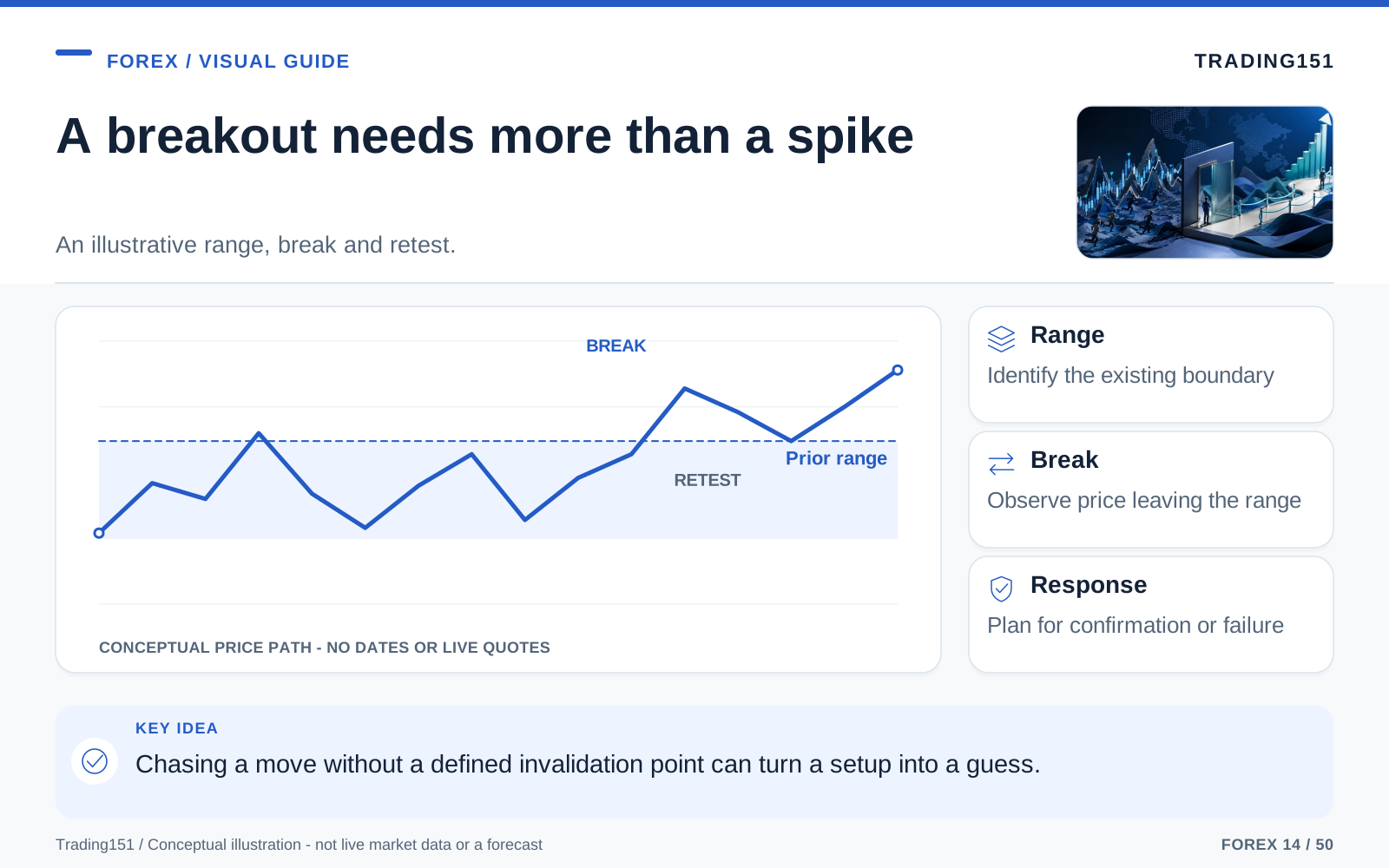
Read this diagram as text
- Range
- Identify the existing boundary
- Break
- Observe price leaving the range
- Response
- Plan for confirmation or failure
Why Breakouts Happen in the First Place
Breakouts don't happen just because you drew a nice, neat line on your chart and the market decided to play along. They happen because those lines represent real money and real decisions made by other human beings and algorithms.
A resistance level is just a visual record of where sellers kept stepping in, while support shows where buyers held the line. The longer those zones survive, the more eyeballs they attract. Traders build entire strategies around them. People place entry orders, map out profit targets, and tuck their stop-losses safely behind those boundaries.
The real magic happens when price finally punches through.
Once an obvious level cracks, a chain reaction of orders gets triggered all at once. Breakout traders jump in to ride the wave. People who bet on the level holding are suddenly trapped and forced to buy or sell to cover their losses. Stops get hit, which just adds more fuel to the fire. New momentum traders see the speed and pile in. It’s a self-feeding loop, and catching that frenzy is exactly what you want as a breakout trader.
This is why we care so much about obvious levels. The more people staring at the same boundary, the more explosive the reaction will be when it finally breaks.
Why Traders Are Drawn to Breakout Strategies
It's not hard to see why this style of trading has survived for decades.
For one, it’s clear. Either price is stuck inside the range, or it isn’t. Either the boundary is holding, or it’s broken. When you compare that to a chart cluttered with five different lagging indicators all telling you different things, breakouts feel wonderfully simple.
They also move fast. You’re aiming to jump in right as momentum hits the gas, rather than trying to catch a trend that’s already exhausted. A great breakout rarely hangs around to give you time to think. It either goes, or it fails. A lot of traders love that straightforwardness.
Plus, it just makes logical sense. You aren’t buying blindly just because price "feels" cheap, or shorting because it looks too high. You’re waiting for the market to prove it has the juice to leave one zone and attack another. That proof matters.
But the thrill of the breakout is exactly what makes it so dangerous. Fast markets trick you into feeling confident. We see speed and assume it means strength. Sometimes that big breakout candle is the start of a large trend, but other times, it's just a nasty trap right before a reversal. Figuring out which is which is where the actual trading skill comes in.
The Anatomy of a High-Quality Breakout
Not every random push through support or resistance is worth risking your hard-earned capital. The best setups usually share a few common traits. Once you train your eyes to see them, the garbage setups become a lot easier to ignore. A good breakout usually stems from tight compression, multiple tests of a level, and a glaring imbalance when the dam finally breaks. But you have to read the whole story. A large candle could just be exhaustion, and a quiet range can sometimes stay quiet forever. You have to look at the context, the close, and whether the market accepts the new prices.
A clearly defined structure
The best setups jump off the chart at you. A tight box with clean touches. A triangle that’s been squeezing price into a corner. A trendline the market has bumped its head on repeatedly. If the structure looks like a chaotic mess, the breakout will probably be a mess, too.
Tension before release
Great breakouts usually follow a period of intense compression. The candles get smaller, volatility dries up, and price coils like a spring. The chart starts to feel cramped. That tightening is important because it means energy is storing up. When that pressure finally bursts, the move is usually sharp.
A strong close beyond the level
A long wick poking through resistance is absolutely not the same thing as price accepting that new level. One of the best, simplest rules you can adopt is just waiting for the candle to close past your line. You'd be amazed at how much money and heartache that one little habit will save you.
Follow-through
A genuine breakout shouldn't need you to sit there cheering it on. It needs to prove it wants to keep going after that initial shove. If price breaks out and immediately goes completely flat, take that as your first major red flag.
Context that supports the move
A breakout that lines up with the bigger picture trend, happens during an active trading session, and coincides with rising volatility has a much better shot than a random spike during the dead of the Asian session. Context doesn't guarantee a win, but it heavily skews the odds in your favor.
The Three Core Parts of a Breakout Plan
A big reason people fail at this is that they only focus on the exciting part: the explosive candle breaking the line. But a real breakout trade has three distinct phases, and you can't ignore any of them.
1. The setup
This is the staging area. The range, the wedge, the flag. If there's no clear structure to break out from, you're not trading a breakout—you're just gambling on random market noise.
2. The trigger
This is the exact green light that tells you to get in. It could be a solid candle closing past resistance. It could be a successful retest. Or maybe it's a stop order you placed in advance. The key is knowing exactly what your trigger is before it happens, rather than making it up on the fly when your heart starts beating faster.
3. The confirmation
This is the evidence that proves the move is real and not just a sloppy fakeout. It might be a surge in volume, the strength of the candle's close, or how price acts when it pulls back. You're never going to get 100% certainty, but you need enough clues to ensure you aren't just blindly buying every tiny poke above a line.
Breakout Setups Worth Knowing
Traders have plenty of ways to play breakouts, but a few classic patterns stand the test of time because they are common, easy to spot, and they just flat-out work.
Horizontal range breakouts
This is the bread and butter. Price bounces between a clear floor and ceiling for a while, until one side finally caves in. These are great because the market is explicitly telling you where the buyers and sellers are camped out.
And remember, the more times a level gets tested and holds, the bigger the deal it is when it finally breaks. A breakout from a zone that held five times is way more meaningful than a break of a level price barely noticed.
Triangle breakouts
Triangles happen when price just keeps squeezing into a tighter and tighter corner. In a symmetrical triangle, it’s a coin toss—nobody has control yet. In an ascending triangle, buyers are aggressively pushing into resistance. In a descending triangle, sellers are relentlessly hammering support. Because price is visibly compressing, these patterns can trigger some beautifully violent breakouts.
Flag and pennant breakouts
You usually see these after a large, sudden move. The market surges, takes a breather in a tight little angled channel or triangle, and then rips again in the original direction. This isn't about calling a reversal; it's a continuation play. Simply put: the market catches its breath, then keeps running.
Trendline breaks
Breaking a trendline can mean the trend is continuing, or it could be the very first sign of a major reversal. Because of that ambiguity, you have to be careful. A single wick breaking a slanted line doesn't mean the trend is dead. It’s usually best to wait for some structural proof, like a lower high forming in what used to be an uptrend, before jumping in.
Three Practical Breakout Strategies
Let's get out of the textbook and into the actual markets. Here are three highly practical ways people trade breakouts every day.
1. The London session breakout
The Asian session is notorious for tight, sluggish price action on the major pairs. But when London wakes up, liquidity floods in and things get moving fast. That transition is a prime hunting ground for breakouts.
How traders often approach it:
- Mark the highest and lowest points of the Asian session range.
- Wait for the London open and watch how price behaves near those edges.
- Look for a strong, aggressive push and a firm close outside the range.
- Don't jump the gun just because a wick popped out. Wait for the actual close.
- Put your stop-loss somewhere that proves the trade is wrong, rather than just picking a random 15-pip distance.
This works beautifully when the original range was tight and the breakout happens with obvious conviction instead of stuttering along.
2. The retest breakout entry
This is for the patient trader. Instead of lunging at the initial break, you let it go. You wait for price to circle back to the broken level and prove that the old ceiling is now acting as a new floor. Keep in mind, the market doesn't owe you a retest. Sometimes a great trade leaves without you, and sometimes a terrible trade retests five times before dying. You have to clearly define what a retest means to you and stick to it, otherwise you'll just end up chasing a trade out of pure frustration.
How traders often approach it:
- Find a very clear support or resistance level.
- Let price break and close through it.
- Sit on your hands. Let price pull back.
- Watch that retest carefully. If old resistance turns into new support, you have a large clue.
- Place the trade only when you see price reject the old zone and start moving in your direction again.
Yes, you’ll miss the runaway trains with this method. But it saves you from so many severe fakeouts and gives you an logical place to hide your stop-loss.
3. The continuation breakout after consolidation
Sometimes a pair is already trending hard, and then it just stops to rest in a tight little box or flag. These are fantastic because you get to hitch a ride on an established trend without feeling like you're chasing the initial crazy spike.
How traders often approach it:
- Spot a strong, undeniable directional trend.
- Wait for a neat, orderly consolidation pattern to show up.
- Watch for the breakout to happen in the direction of the main trend.
- Be careful if the consolidation drags on forever or starts looking erratic.
- Use the edges of the consolidation pattern to figure out your risk.
This play shines when the bigger trend is healthy and the "pause" looks controlled, rather than a volatile mess.
The Problem Every Breakout Trader Faces: False Breakouts
Now for the part nobody likes to talk about, but everyone desperately needs to understand. A fakeout isn't just a random wick over a line. It’s when price breaks out, fails to hold its ground, and crashes back into the range, trapping everyone who bought the breakout. Paying attention to how fast the market rejects the level and pushes back inside is way more important than measuring how far it overshot the line. Sometimes, a severe fakeout is a fantastic setup for a reversal trade.
A false breakout is agonizing. Price pushes just far enough past your line to trigger your entry and everyone's stop-loss orders. Then, immediately, it does a 180 and plunges right back into the range. It's maddening because for about thirty seconds, you felt like a genius. The level broke, the momentum was there, you clicked buy. And then the market laughed in your face.
Why does this happen? Sometimes the market just runs out of gas. Other times, the level was so obvious that every amateur jumped in too early, leaving no buyers left to sustain the move. And often, institutional players purposefully shove price past a level just to trigger all the stop-loss orders sitting there, grabbing that liquidity so they can take price in the opposite direction. The result is always the same: early buyers get trapped and slaughtered.
This is why you can't just trade based on speed. Anyone can click 'buy' when a green candle crosses a line. The actual skill is having the judgment to read whether the market is truly accepting those new prices, or just fishing for liquidity.
How to Defend Yourself Against Fakeouts
You are never going to avoid false breakouts entirely. It's part of the game. But you can drastically reduce how often you get suckered by them.
Wait for the close
I know it sounds overly simple, but it is one of the most profitable habits you can build. A candle that spikes over a line and then closes back inside the range is screaming a totally different story than a candle that closes firm and tall on the other side.
Use the retest
Again, they aren't guaranteed, but they are golden when they happen. When a broken level flawlessly flips its role from resistance to support, it proves the market is respecting the breakout.
Avoid trading weak market conditions
Breakouts that happen when the market is thin or asleep usually lack the firepower to keep going. If the volume isn't there, the move will likely fizzle out.
Be suspicious of oversized first candles
A giant, explosive breakout candle looks tempting, but usually, it just means you're late to the party. If that one candle already did all the heavy lifting and you have to put your stop miles away, just let it go. It's not worth forcing.
Respect obvious failed follow-through
If it breaks out and immediately starts stalling, hesitating, or sinking back into the range, don't sit there trying to mentally justify the trade. The market doesn't owe you anything. Cut it.
Where to Enter a Breakout Trade
There isn't one perfect way to enter, but most traders fall into one of three camps.
Aggressive entry
You jump in the absolute second price crosses the line, or right as the breakout candle closes. You get the best possible price, but you also eat the highest number of fakeouts.
Conservative entry
You wait patiently for a retest. You only enter if the old level proves it can hold. It’s way safer, but you have to make peace with the fact that you will miss out on the ultra-aggressive trends that never look back.
Stop-entry approach
You leave a buy-stop or sell-stop order waiting just outside the boundary, letting the market automatically pull you into the trade. It's convenient, but dangerous if you don't factor in context. An automated order can't read market structure for you.
The style you choose matters a lot less than how consistently you apply it. A slightly boring, mediocre strategy executed with total discipline will always beat a "genius" strategy traded emotionally.
Where to Place the Stop Loss
Your stop-loss belongs at the exact point where your trade idea is proven wrong. That sounds like common sense, but you'd be shocked how many people place their stops based on how much money they want to lose, rather than what the chart is doing.
For a breakout, that invalidation point is usually tucked back inside the structure you just broke out of. If price breaks out, but then drops back in and starts getting comfortable inside the old range, your breakout premise is dying. When that happens, you want out.
You don't want a stop so tight that a random gust of wind knocks you out of the trade, but you also don't want it so wide that a single fakeout ruins your week. It’s always a balancing act.
How Traders Often Set Targets
Exits are deeply personal, but here are a few common approaches.
- Measured move: Take the height of the range you just broke out of, and project that same distance forward as your first target.
- Key structure: Just look left. Find the next obvious major support or resistance level on the chart and aim for that.
- Risk-to-reward framework: Some traders completely ignore structure for their exits and strictly demand a 1:2 or 1:3 reward ratio before they’ll even touch the trade.
- Trailing approach: If you catch a genuine trend, trailing your stop behind new higher lows or lower highs is a great way to stay in the move longer.
There's no magical exit strategy. The goal is just to avoid the two fatal extremes: panicking and taking a tiny profit out of fear, or being so greedy that you let a large winner turn into a loser because you thought it would run forever.
Risk Management Matters More Than the Setup
I know this isn't as fun as talking about chart patterns and killer entries, but it’s the only thing that will keep you in the game. Breakouts usually happen when volatility is exploding, which means you might suffer slippage. The price you clicked might not be the price you get. You have to size your positions to account for that. Also, be wary of entering after large candles that force you to put your stop-loss in another zip code. A smaller position size taken safely is always better than a huge position taken out of FOMO.
Breakout trading throws off some large, glorious wins, but it also has a naturally high failure rate. Great setups will fail. Text-book retests will crumble. If you are trading too big, a string of fakeouts will blow up your account before your winning edge ever has a chance to kick in.
This is why the pros always think about risk first. How much of my account is exposed? Where exactly is my stop? Is the potential reward even worth this risk? Am I taking this trade because it’s a high-quality setup, or just because I’m bored and want some action?
Keeping your risk small on each trade does more than just protect your capital. It protects your mental state. When a loss is manageable, you won't panic, you won't move your stop, and you certainly won't revenge-trade.
The Psychological Side of Breakout Trading
Breakouts are inherently emotional. They are fast, flashy, and dramatic. And that makes them the perfect breeding ground for stupid decisions.
The biggest trap is FOMO. You see a large candle taking off without you, and suddenly all your strict entry rules go out the window. You convince yourself that this setup is foolproof and you absolutely cannot miss it. That is the exact moment discipline falls apart.
Impatience is a close second. We all love the rush of the breakout, but we hate the hours of boring consolidation that come before it. People get tired of waiting and start trying to predict the breakout. They buy right below resistance. They sell right above support. They try to force the market's hand before it has proven anything.
And then there’s the pure frustration of the missed trade. Sometimes a flawless setup rockets away without ever giving you a retest or a clean entry. Your rules kept you perfectly safe, but they also left you empty-handed. That stings. But you have to remember: your job isn't to catch every move. Your job is to trade in a way that keeps you solvent and consistent.
To survive this style of trading, you need a very specific mindset: totally calm while waiting, decisive when the signal triggers, and completely emotionless once the trade is on.
A Simple Breakout Checklist
Before you click buy or sell on a breakout, do yourself a favor and run through this quick checklist:
- Is the pattern clear and obvious, or am I squinting to make it fit?
- Has the market been squeezing and compressing, or is it just acting erratic?
- Did the candle close past my line, or did it just wick through?
- Do I have clear air ahead, or am I buying straight into a brick wall of resistance?
- Does the session and market context support a big move right now?
- Is my stop-loss placed somewhere logical that proves the trade is dead?
- Does the potential payout justify the risk I'm taking?
- Am I taking this because it's a beautiful setup, or just because I'm sick of waiting around?
Be honest with yourself on that last one. It matters more than you might want to admit.
Measure the cost of waiting for confirmation
Imagine a range capped at 1.1000. One rule buys as soon as price crosses that level; another waits for a completed candle; a third waits for a return to the level. Each rule changes the trade. The first can enter earlier but catches more brief excursions. Waiting may filter some failures while producing a worse entry or no entry at all. None is automatically the cautious or superior choice in every market.
Test the complete trade rather than just the proportion of false breakouts. A rule that avoids several small losses may also miss the few large moves that made the approach worthwhile. Record missed entries and price slippage, not only the trades that filled neatly. Otherwise the comparison favors the rule whose inconvenient outcomes were left out.
Position size should respond to the actual entry and invalidation distance. If confirmation places the entry farther from the stop, keeping the same trade size increases the planned cash risk. Reducing size preserves the budget but changes the potential return in currency terms. That adjustment belongs in the strategy, not in a hurried decision after the signal.
A useful breakout plan also allows no trade. A move can be genuine and still offer an unattractive entry once spreads widen or the price travels too far. Recognizing that distinction helps separate identifying market behavior from finding an opportunity your account can sensibly take.
Define a failed breakout before entering
A breakout rule needs more than a line above which to buy. Decide what counts as failure: a return inside the range, a closing price, a time limit, or another clearly specified event. These alternatives can produce different trades and costs.
Avoid changing the definition because a particular position feels close to recovering. The original hypothesis may still be worth testing, but the live trade should not become an improvised experiment. A documented failure rule also makes a review more informative: it separates losses that were expected within the method from losses caused by abandoning it. 1, 2
The Final Word
People gravitate to breakout trading for good reason. You get to jump in at the exact moment the market stops messing around and finally steps on the gas. When you catch a beautiful, clean break, it feels effortless. Momentum does all the heavy lifting, the chart clears out, and the move basically manages itself.
But that adrenaline rush is exactly what tempts people into careless decisions. A breakout isn't real just because price accidentally stepped over a line for a few seconds. Real, professional breakout trading requires context, structure, confirmation, strict risk control, and the willingness to sit on your hands for way longer than feels comfortable.
If you can train yourself to only focus on clean setups, accept that fakeouts are just a business expense, and view patience as an active trading tool rather than an annoyance, breakout trading stops being chaotic and becomes practical.
You don't need to catch every breakout. You don't need to chase every giant candle. You just need the mental toughness to strike when the market is ready, and the discipline to walk away when it's playing games.
Ultimately, your edge isn't just your strategy—it's your discipline. You have to make peace with two frustrating facts: some amazing moves will leave without you, and some picture-perfect setups will fail miserably. A trading plan doesn't prevent either of those things. But it gives you the structure, the triggers, and the risk limits you need so that a single bad trade doesn't demand an emotional response. Your edge comes from showing up consistently and managing risk, not from catching every train that leaves the station.
Sources and further reading
- SEC Investor Bulletin: Trading Basics and Order Types
- CFTC: Eight things to know before trading forex
Editorial revision: 7 October 2026. Numerical scenarios are hypothetical unless identified as historical. References support the added explanations and selected corrections; rules and product terms should be checked again before acting.