
Pips describe a conventional price increment, lots describe position size, and the spread is the gap between the available bid and ask. Together they help translate a currency quote into the cash cost and exposure of a trade. The details depend on the pair and contract specification. A pip is not a fixed dollar amount, and a platform's smallest displayed increment may be a fraction of a pip.
Why These Three Concepts Matter So Much
Beginners usually want to dive straight into strategy. They’re obsessed with finding the "best" indicator, the most profitable time frame, or figuring out whether they should trade news or breakouts. I get it, but that’s putting the cart before the horse.
Structure has to come before strategy. You need to know how the market measures a move, how your trade size impacts your wallet, and what the broker charges you just to get in. That’s exactly what pips, lots, and spreads are for.
- Pips measure the distance the price moved.
- Lots dictate how much you’re buying or selling.
- Spreads are your entry ticket—what it costs to take the trade.
If you're hazy on any of these, your trading is going to feel out of control. You might win a trade and have no clue why you made that specific amount. You could lose way too fast and realize (too late) that your position was large. Or maybe you'll blame a "bad strategy" when the real culprit was just a ridiculously wide spread.
So yeah, these aren't just vocab words to memorize for a quiz. They are the actual mechanics of the market. Every trade you place will rely on all three.
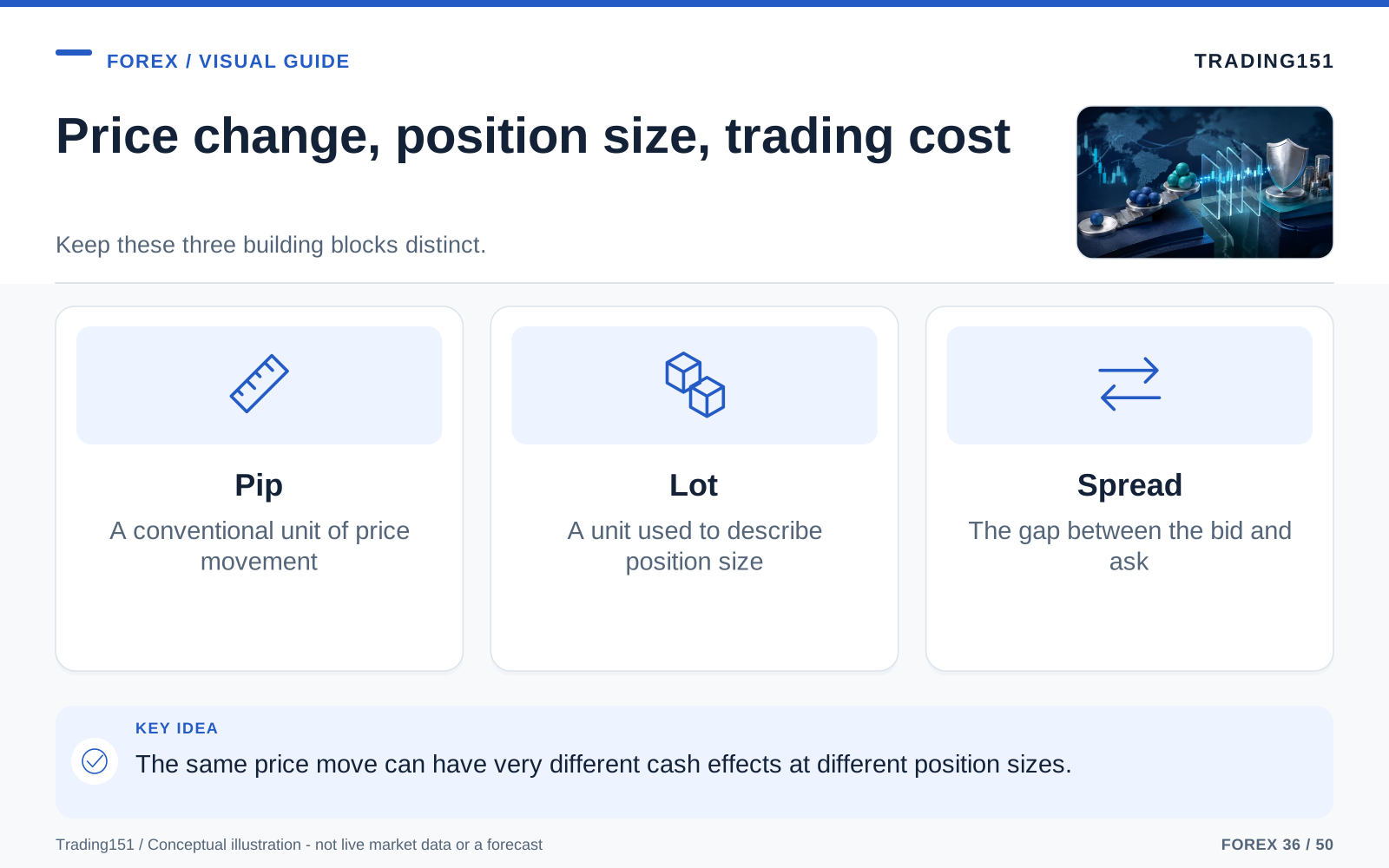
Read this diagram as text
- Pip
- A conventional unit of price movement
- Lot
- A unit used to describe position size
- Spread
- The gap between the bid and ask
Part 1: Pips — How Forex Measures Movement
Let’s start small: the pip. A pip's cash value isn't always fixed to your account's currency. It shifts based on the exchange rate, the pair you're trading, and your position size. While platform calculators are great, knowing how this works prevents nasty shocks when you switch from trading EUR/USD to a Japanese yen pair. Remember, the visual distance on your chart is only half the risk equation—the actual cash value of that distance is what matters.
What’s a Pip?
A pip is just the standard unit for measuring price changes in Forex. Think of it as a ruler. If you were building a house, you'd use inches or centimeters. In Forex, you use pips.
Don't worry about the history of the word (some say it means "percentage in point," others argue for "price interest point"). What matters is how you use it.
Traders rarely talk about price moves in dollars and cents. Instead of saying, "EUR/USD went up by a tenth of a cent," they’ll just say, "EUR/USD moved 10 pips." It’s a much cleaner way to talk about the market.
How to Read a Pip on Most Currency Pairs
For the vast majority of major pairs, prices are quoted out to four decimal places.
- EUR/USD = 1.1050
On these pairs, a single pip is usually that fourth decimal place.
So, if EUR/USD ticks up from 1.1050 to 1.1051, that’s a 1-pip move.
If it jumps from 1.1050 to 1.1060, you just saw a 10-pip move.
It sounds tiny, right? But in Forex, those micro-movements are a big deal because traders use leverage and large position sizes. A few pips can translate to serious money, depending on how heavy your trade is.
The Japanese Yen Exception
Of course, there’s always an exception, and in Forex, it’s the Japanese yen. Pairs with the JPY are generally quoted to two decimal places instead of four.
- USD/JPY = 110.25
Here, one pip is the second decimal place.
If USD/JPY slides from 110.25 to 110.26, that’s a 1-pip move.
Once you wrap your head around the "yen exception," it stops feeling like a trick and just becomes second nature.
What Are Pipettes?
Depending on your broker, you might see an extra number at the end of the price. For example, instead of EUR/USD sitting at 1.1050, it might read 1.10508.
That little extra digit is a pipette, which is just a tenth of a pip.
Don't stress over pipettes when you're starting out. Brokers use them for ultra-precise pricing, but when traders chat about their day, they stick to whole pips.
If your screen says you caught a 15.7 pip move, most folks will just round up and say they grabbed roughly 16 pips.
Why Pips Matter in Real Trading
Pips are the universal language for risk, reward, and tracking opportunity.
You might place a stop-loss at 20 pips. You might aim for a 50-pip target. At the end of the week, you might calculate that you're up 120 pips overall. It’s how we measure success without bringing actual dollar amounts into the conversation.
And that distinction is huge. A 30-pip move is exactly the same whether you risked two bucks or two thousand. The market did its thing. The only variable is how much that move meant to your bankroll—which brings us directly to lot sizing.
Part 2: Lots — How Much You’re Trading
If pips measure the distance, lots measure your skin in the game. "Lot" is just trader slang for your position size. What really matters is how that size pairs up with your stop-loss. Even a tiny micro lot can burn a hole in your pocket if your stop is miles away. You always have to figure out your position size and stop-loss together—never just guess based on whether the lot number "looks" small enough.
You don’t buy individual "shares" of a currency like you would with stocks. You trade them in standardized batches called lots.
This is where trading gets real. Your lot size dictates exactly how much cash every pip is worth.
Why Lot Size Is a Bigger Deal Than Most Beginners Realize
A lot of rookies are obsessed with finding the perfect entry. They'll spend hours analyzing a chart to pinpoint exactly where to buy, but they barely spend a second thinking about how much they're buying. Big mistake.
You can mess up your entry and still be okay if your sizing is smart. On the flip side, you can predict the market perfectly and still wreck your account if you trade too heavy. A mediocre strategy with strict sizing rules will always beat a great setup paired with reckless gambling.
Lot size is the bridge between market movement and your actual money. Without it, pips are just lines on a screen.
The Main Lot Sizes in Forex
Most retail brokers give you a few standard options. You don't need to be a math genius here, just know the big three.
1. Standard Lot (1.00)
- Size: 100,000 units of currency
- Typical pip value: about $10 per pip (on most USD pairs)
This is the big leagues. A quick 10-pip fluctuation means you're up or down a hundred bucks. Catch a 50-pip swing and that's $500. It feels amazing when you're winning, but it's severe when the market turns on you.
For almost all beginners, a standard lot is way too heavy. It’s thrilling right up until a totally normal market pullback eats a large chunk of your capital.
2. Mini Lot (0.10)
- Size: 10,000 units of currency
- Typical pip value: about $1 per pip
This is the sweet spot for a lot of traders once they get the hang of things. A 25-pip loss means you're out $25. A 40-pip win puts 40 bucks in your pocket. The stakes are real, but they aren't going to knock the wind out of you.
3. Micro Lot (0.01)
- Size: 1,000 units of currency
- Typical pip value: about $0.10 per pip
If you're new, this is where you belong. Not because it’s glamorous, but because it buys you time to learn. You can make plenty of stupid mistakes here without destroying your account.
Take a 30-pip hit on a micro lot, and you're down roughly $3. You survive to trade another day while still feeling the reality of a live market.
4. Nano Lots and Flexible Position Sizes
Some platforms let you slice it even thinner with nano lots, or let you type in custom amounts between the standard labels. The exact names don't matter much. Just remember the golden rule: the bigger the lot, the heavier the pip.
A Simple Way to Think About It
Imagine pips are the miles you're driving, and lot size is how much cargo is in the trunk. The car covers the same distance no matter what, but the fuel you burn depends entirely on how heavily the car is loaded.
Bringing it back to trading:
- A 10-pip move on a micro lot is barely a blip on your screen.
- A 10-pip move on a standard lot can make or break your day, depending on the direction.
Same exact market move, substantially different financial outcomes.
How Leverage Makes This More Dangerous
We can't talk about lots without mentioning leverage. Brokers let you control large amounts of money using just a little bit of your own cash. So, someone with a few hundred bucks can suddenly trade like they have thousands.
Brokers love to market leverage as a superpower. And technically, it is—but for an inexperienced trader, it’s mostly just a hazard. It makes oversized trades feel dangerously accessible.
You log in, realize the software will let you place a large trade, and the temptation kicks in. That’s exactly how beginners with micro-lot budgets end up taking standard-lot risks.
The market doesn't care that your broker approved the trade. If your size is too big, a totally normal price swing will wipe you out.
The Real Lesson About Lot Sizes
Sizing isn't a macho thing. Trading big doesn't make you a "serious" trader. It’s purely a risk management tool.
Trading small doesn't mean you lack confidence; it means you want to stick around long enough to get good. Survival is way more important than trying to look aggressive for a few trades.
If you're a beginner, do yourself a favor and deliberately trade a fraction of the size your ego wants you to. It's hard to blow up an account if you're patient and trade small. It’s painfully easy to ruin one if you try to force fast growth.
Part 3: Spreads — The Cost of Opening a Trade
Finally, we have the spread. If you're trading short-term, the spread has to be weighed against your profit target. A two-pip spread is nothing if you're swinging for 150 pips, but it's a large roadblock if you're only scalping for five pips. This ratio explains why a strategy can look flawless on a chart but fall apart in real life. You have to factor your trading costs into the setup beforehand, not just subtract them as an afterthought.
A lot of newbies only discover this when they hit "buy" for the first time and instantly see a negative number on the screen. It’s pretty unsettling if no one warned you.
You hit buy, the market hasn't even moved yet, and somehow you're already in the red. You didn't do anything wrong, and the software isn't broken. You just paid the spread.
What’s the Spread?
Simply put, the spread is the gap between the bid price and the ask price.
- Bid = the price you can sell at
- Ask = the price you can buy at
The ask is always a tiny bit higher than the bid. That difference is the spread, and it’s one of the main ways your broker (or liquidity provider) gets paid.
A Familiar Real-World Analogy
You've seen this in real life. Think of those currency exchange booths at the airport. They have one rate for buying euros and a completely different rate for selling them back. They pocket the difference.
Forex is exactly the same. You never get a perfectly neutral entry price. Crossing the bid/ask spread is just the built-in toll you pay to get into the market.
A Quick Example
Let’s say you pull up EUR/USD and see this:
- Bid: 1.1050
- Ask: 1.1052
The gap is 2 pips. That means your spread is 2 pips.
If you hit buy, you enter at the ask price of 1.1052. But if you panicked and closed the trade that exact same second, you’d have to sell at the bid price of 1.1050. So the moment you open the trade, you're 2 pips in the hole.
Why Trades Start in Negative Territory
It feels like a rip-off at first, but it’s completely normal.
The spread is your entry fee. The market has to move in your direction just enough to cover that fee before you even hit break-even.
So if the spread is 2 pips, you need the chart to move at least 2 pips your way just to get back to zero. Anything after that is your actual profit.
Why Spread Size Matters More Than You Think
A pip or two might not sound like much, but they add up fast—especially if you're taking a lot of quick trades.
Think about it: if you're a scalper hunting for a quick 5-pip win, a 2-pip spread eats up a huge chunk of your potential gain instantly. In that world, the spread isn't just a footnote; it's a major hurdle.
On the flip side, if you hold trades for days looking for 100-pip moves, a 2-pip spread barely registers. It’s a cost of doing business, but it’s not going to dominate the trade.
Fixed vs. Variable Spreads
Brokers generally offer two models: fixed or variable spreads.
- Fixed spreads stay locked in place during normal hours.
- Variable spreads fluctuate based on how fast or thin the market is moving.
Variable spreads are super common. They can get cheap when the market is calm. But the second a major news story breaks or things get chaotic, those spreads stretch out violently.
A trade that normally costs 1 pip to enter could suddenly cost 5, 8, or more. That’s why smart traders often step away during major economic announcements. The crazy price spikes are bad enough, but a suddenly large spread can become part of the problem.
When Spreads Tend to Widen
Spreads get unpredictable and nasty when the market is stressed or empty. Watch out during:
- Major economic news drops
- The transition between trading days (rollover)
- Holidays or times of low liquidity
- Panic moments or sudden geopolitical events
A currency pair might be cheap to trade in quiet conditions, but become completely toxic in seconds when chaos hits.
Part 4: How Pips, Lots, and Spreads Work Together
It’s easy enough to understand these things one by one. But the real "aha" moment happens when you see them working together in a live trade.
Let’s walk through a realistic scenario.
Meet Alex
Alex has a $1,000 trading account. He’s relatively new, so instead of playing hero, he decides to keep his risk tight.
He’s watching GBP/USD and thinks the pair is heading higher.
Step 1: Alex Chooses a Lot Size
He opts for 1 micro lot (0.01).
On GBP/USD, that means every pip is going to be worth about $0.10.
That choice alone tells us something important about Alex. He’s prioritizing defense. He isn't daydreaming about how much he might win; he’s calculating what happens if he’s wrong.
Step 2: Alex Checks the Spread
The broker's quote looks like this:
- Bid: 1.3000
- Ask: 1.3002
That’s a 2-pip spread.
So, right off the bat, he knows it's going to cost him 2 pips just to get in.
Step 3: Alex Enters the Trade
He clicks Buy, getting filled at the ask price of 1.3002.
Immediately, his account shows he's down about $0.20.
He doesn't panic. The market didn't instantly drop against him; that’s just the spread doing its thing.
Step 4: The Market Moves
After a while, GBP/USD climbs, and the bid price hits 1.3052.
Let’s do the math from his entry:
- Entry: 1.3002
- Current bid: 1.3052
- Difference: 50 pips
For a position like this, catching 50 pips is a solid move.
Step 5: Alex Closes the Trade
He takes his profit and closes the position.
- Pips gained: 50
- Value per pip: $0.10
- Total profit: about $5.00
Okay, five bucks isn't going to buy a sports car. But the dollar amount misses the point. Alex identified a setup, managed his risk, understood his costs, and let the trade play out exactly the way he planned.
Now Change Only the Lot Size
What if Alex had taken the same trade, but went with a mini lot (0.10) instead?
Nothing else changes. Same pair, same entry, same spread, same 50-pip climb.
But because his pip value is now roughly $1 per pip, the math shifts:
- 50 Pips x $1 = $50 profit
Sounds awesome, right? But remember, risk swings both ways.
If the market had tanked 50 pips against him, his losses would look like this:
- Micro lot: down roughly $5
- Mini lot: down roughly $50
- Standard lot: down roughly $500
And that is the biggest lesson in Forex. Pips tell you how far the market went. Lot size dictates how much it hurts or helps your wallet. And the spread is just the toll you pay at the gate.
Part 5: Risk Management Lives Here
People tend to treat risk management like it’s some separate, advanced topic. It’s not. Risk management starts the exact second you combine pips, lots, and spreads. The best habit you can build is a simple routine: decide how much cash you're willing to lose, find a logical place for your stop-loss, check the pip value, and shrink your lot size until the math fits your budget. This keeps you from forcing a trade to fit your greed. It also means you can trade a wide stop just as safely as a tight one, as long as you adjust your size.
Practically speaking, managing risk just means making sure a single bad trade doesn't ruin your month.
You should be asking yourself things like:
- How many pips away is my stop-loss?
- How much does each pip cost based on my current lot size?
- Did I factor the spread into my entry?
- If I get stopped out, what percentage of my account goes up in smoke?
These aren't advanced trader secrets. They are the bare minimum. The traders who survive year after year run through this checklist on every trade, even the ones that look like a sure thing.
A Simple Risk Example
Let’s say you’ve got $1,000 in your account, and you promise yourself you'll never risk more than 1% on a single idea. So, your absolute worst-case scenario is losing $10.
If your chart tells you your stop-loss needs to be 20 pips away, simple math says each pip can only be worth $0.50 if you want to stay under that ten-dollar limit.
That calculation instantly rules out a standard lot. Even a mini lot is too heavy. Suddenly, choosing a lot size isn't a guessing game anymore. It’s a hard number dictated by your own risk limits.
This is how professionals think. Not, "How much can I make?" but, "How much am I willing to bleed if I'm wrong?"
Part 6: Common Beginner Mistakes With Pips, Lots, and Spreads
Even when you know this stuff backward and forward, it's easy to stumble in real time. Usually, it’s not a lack of knowledge—it’s just emotions taking over.
1. Trading Too Big for the Account
This happens constantly. You see a setup that looks absolutely perfect, so you decide to go a little heavier than usual. It feels justified because you're so sure it's going to work. But the market doesn’t care how confident you are.
One rogue spike, one random pullback, and you take a large hit that was entirely preventable.
Most blown accounts don't happen because a trader was clueless. They happen because the trader got cocky and ignored their sizing rules.
2. Ignoring the Spread on Short-Term Trades
If you love quick trades, the spread is your worst enemy. Trying to scalp a few pips is hard when your entry cost eats half your target. A spread that looks harmless on a daily chart can quietly wreck the math of a 1-minute scalp.
You can still trade short-term, but you have to be hyper-aware of the spread and pick your pairs and trading hours very carefully.
3. Treating Pip Counts and Dollar Amounts as the Same Thing
One trader says, "I made 30 pips today." His buddy says the same thing. But their bank accounts might look completely different. One made $3, the other made $300, and someone else made $3,000.
The pip count tells you if your strategy is working. The lot size tells you what it paid. Mixing up those two metrics creates bad habits and confusion.
4. Forgetting That Different Pairs Behave Differently
We always use major USD pairs for examples because the math is super clean. But the second you dip your toes into cross pairs or exotic currencies, pip values can get weird.
That’s why veteran traders still use pip calculators before touching an unfamiliar pair. It’s not rookie behavior; it’s just common sense.
5. Increasing Size After a Loss Out of Frustration
Ah, revenge trading. You take a small hit, get mad, and decide you're going to double your size on the next trade just to "make it back."
It almost never works, and usually just makes a small problem a lot worse.
When you’re tilted, sizing up is the last thing you should do. The right move is to step back, stick to your plan, and keep your risk steady.
Part 7: A Better Way to Learn This as a Beginner
Reading articles is great, but the only way to truly get this stuff into your blood is to watch it happen live.
Open a demo account, or fund a live account and trade the smallest micro lot your broker allows. Watch how the candles move. Notice the difference between a busy morning session and a dead afternoon. Open a trade and watch the spread put you in the red instantly. Play around with different lot sizes and see how the math changes in real time.
Messing around on a platform is worth a hundred YouTube tutorials. Once you feel it happen, the abstract concepts just click.
Soon enough, you'll look at a chart and instantly visualize what a 15-pip stop means for your balance. You'll stop wondering why one trade hurt more than another. Best of all, you’ll start obsessing over your risk before you even think about your reward—which is the hallmark of a trader who survives.
Convert the pip movement into your account currency
For a conventional EUR/USD position of 10,000 euros, a one-pip move of 0.0001 corresponds to one U.S. dollar. A 20-pip move therefore represents $20 before costs. With 100,000 euros of exposure, the same move represents $200. The chart has moved by the same amount, but position size changes the cash result tenfold.
When the quote currency differs from the account currency, a conversion is needed. A pip value calculated in yen, for example, is not automatically the same number in dollars or euros. The conversion rate can change as the market moves. Use the broker's current contract specifications and verify the calculation rather than relying on a pip-value table detached from the actual instrument.
A standard lot conventionally represents 100,000 units of the base currency in many retail forex products, but not every instrument on a platform uses that specification. Metals, indices, futures, and broker-defined contracts can differ. Check the contract size, minimum trade size, and permitted size increment before applying a familiar formula.
The spread becomes a cash cost through the same position-size calculation. A one-pip spread is about $1 for the 10,000-euro example, before commissions and any financing. Compare total expected costs with the strategy's target, not just with the account balance. Small price increments are easy to dismiss until they are multiplied by a large position or repeated across many trades.
Confirm the contract specification
The value of a point or pip depends on the instrument, position size, and account currency. A familiar symbol does not guarantee identical specifications across brokers or products. Check the contract details and calculate the cash effect of a small price move before entering. This is especially important when moving from a standard currency pair to metals, indices, or a broker-specific contract whose quotation convention is different. 1, 2
Conclusion: Learn the Mechanics, Then Build the Strategy
Forex looks intimidating from the outside, but the engine running it is pretty basic once you peek under the hood.
Pips track the distance. Lots control the financial impact. Spreads are your cost of doing business.
Get comfortable with those three things, and everything else gets easier.
Without them, trading feels chaotic and random. With them, you can read the story the market is telling you. You know exactly what you're risking and what it costs to play. And having that clarity takes a huge weight off your shoulders.
Trading is stressful enough without fighting the basic math. Lock down these mechanics so you can save your mental energy for the hard stuff—like patience, discipline, and keeping a cool head when the market gets crazy.
Start small, keep your ego in check, respect the broker's spread, and train your brain to think in pips, not dollars. Once you do that, the charts stop looking like a secret code and start looking like opportunity. Oh, and before you ever click buy on a live account, always check the broker's contract specs for that specific pair. Suffixes, swap fees, and tick values can vary substantially from broker to broker. Taking ten seconds to double-check is always worth it. Pips, lots, and spreads aren't just vocabulary words—they're the very tools you use to turn a theory on a screen into actual money in your account.
Sources and further reading
- BIS: April 2025 FX turnover, September 2025 preliminary release
- FCA: Restrictions on CFDs sold to retail clients
Editorial revision: 7 October 2026. Numerical scenarios are hypothetical unless identified as historical. References support the added explanations and selected corrections; rules and product terms should be checked again before acting.