
A forex broker is more than a trading screen and a quoted spread. The account agreement determines who holds your money, which rules apply, and what happens during a dispute or failure. A familiar brand can operate through several legal entities with different protections. Check the entity serving you before comparing the platform's features.
1. Regulation Comes First, Always
Let's get one thing straight right out of the gate: regulation isn't a bonus feature. It’s the absolute bare minimum. And don't just take their word for it. Go straight to the regulator's official website, look up the legal company name and license number, and make sure the web address matches. Clone scams are everywhere—they’ll steal a legit company's name but use a different domain or phone number. A slick website means nothing; an official registry match means everything.
Because the Forex market is decentralized, there’s no central exchange watching every move. That flexibility is great, but it also opens the door for shady behavior. A broker can have a gorgeous app and a support team that answers in two seconds, and still be totally unsafe. Good design is cheap. Trust is something else entirely.
When a respected authority regulates a broker, they have to play by strict rules designed to protect you. These rules dictate how they hold your money, how they handle complaints, the risk warnings they have to provide, and how much cash they need on hand to keep from going bankrupt.
The biggest perk here is segregated funds. In plain English? Your money doesn’t get mixed up with the broker’s operational cash. If the company goes belly up, that separation is what saves you from losing everything.
Which Regulators Matter?
Not all licenses are created equal. Some offshore islands hand out "licenses" that sound fancy but do absolutely nothing to protect you. You want a broker watched by a regulator with actual teeth and enforcement power.
- United States: the CFTC and NFA
- United Kingdom: the FCA
- Australia: ASIC
- Canada: IIROC or its current successor framework depending on the province and structure
- European Union: regulators operating under MiFID rules, with CySEC being among the most common
- Singapore: MAS
- Switzerland: FINMA
The bottom line is simple: a tough regulator means less room for the broker to play games with your money.
Don’t Take the Broker’s Word for It
Seriously, don’t just trust a little badge on their homepage that says "fully regulated." Do the legwork. Go to the regulator’s site and look them up. Match the company name, the registration number, and the country. Scammers are notoriously good at spoofing real companies or using slightly altered names.
If a broker claims to hold three different licenses, check all three. If things don’t perfectly line up, walk away. This isn't the time to be generous and give them the benefit of the doubt.
Oh, and watch out for this classic trick: large brokers often have multiple subsidiaries. Their UK branch might be strictly regulated, while their offshore branch offers insane leverage with zero protection. They share the same logo, but the legal safety net protecting your account is completely different. Make sure you know exactly which branch you're signing up with.
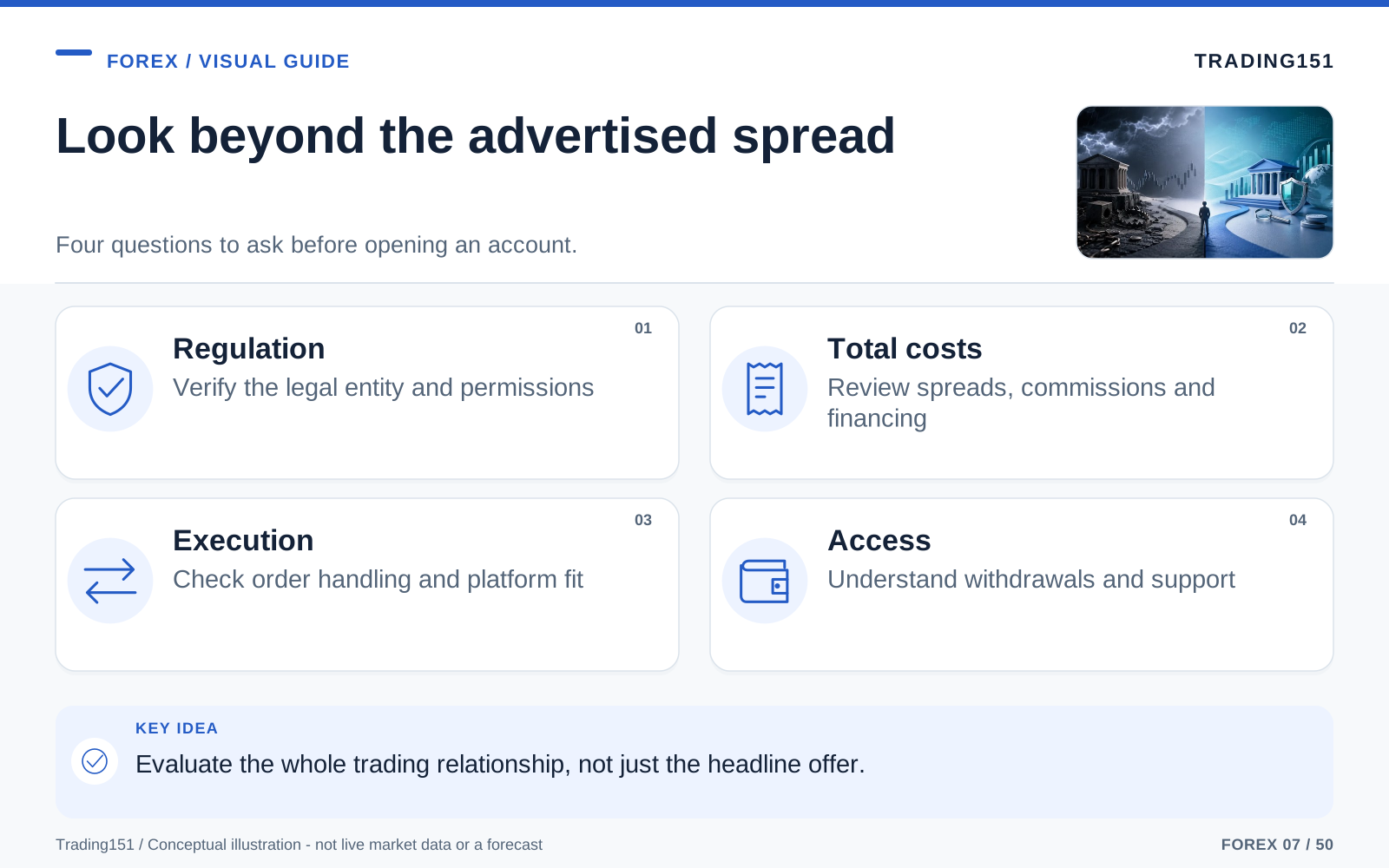
Read this diagram as text
- Regulation
- Verify the legal entity and permissions
- Total costs
- Review spreads, commissions and financing
- Execution
- Check order handling and platform fit
- Access
- Understand withdrawals and support
2. Understand the Broker’s Business Model
Most traders never stop to ask a very basic question: how is this company making money off me?
You don’t need a finance degree to figure it out, but you do need to understand the basics. If you don't know how your broker gets paid, you'll have a hard time spotting conflicts of interest or figuring out if you're getting ripped off on fees.
Market Makers
Market makers do exactly what it sounds like—they create the market for you, often taking the opposite side of your trade internally. It’s common, and it’s not inherently evil. Plenty of solid, well-known brokers operate this way responsibly, especially for everyday retail traders.
The perks? They usually offer simple pricing, low minimum deposits, and fixed spreads. If you're a beginner, that predictability can be really nice.
But the conflict of interest is staring right at you. If they take the other side of your trade, your loss is their gain. That doesn't mean every market maker is actively trying to sabotage you, but it definitely means you should keep your guard up.
STP and ECN Brokers
With STP (Straight Through Processing) or ECN (Electronic Communication Network) models, the broker acts more like a middleman, routing your trades to outside liquidity providers. In this setup, they usually make their money through a flat commission or by slightly marking up the spread.
Active traders usually love this setup because it removes that weird feeling that the broker is betting against them. Scalpers and algorithmic traders, who need lightning-fast, precise execution, swear by it.
Just a heads-up, though: don't trust the ECN or STP label blindly. Marketing departments love throwing those acronyms around a little too loosely. Their actual pricing transparency and real-world reputation matter way more than the jargon on their homepage.
What You Should Look For
You aren't hunting for a flawless business model—because there isn't one. You're looking for transparency. A good broker will clearly explain how they handle your trades and how they get paid. If they make big claims but dodge the specifics about their fees or liquidity, just move on.
A trustworthy broker can give it to you straight, in plain English, whether they act as the principal, if they internalize trades, or if they use external liquidity.
3. Spreads, Commissions, and the Costs That Quietly Drain Accounts
Trading costs rarely feel like a big deal in the moment. That’s exactly why they’re so dangerous over time. You can lose money for months due to bloated costs and bad execution without ever realizing your strategy wasn't the actual problem. You have to compare costs based on how you trade. If you trade rarely, a slightly wider spread with no commission might be fine. But if you scalp all day, you probably want raw spreads and a flat commission. Throw in overnight fees, currency conversion, data charges, and inactivity penalties, and it adds up fast. Oh, and that advertised "spreads from 0.0" claim? It’s almost always a marketing trick that you'll never actually see during normal trading hours.
Think of trading fees like friction in an engine. A little bit seems fine, but enough of it will completely destroy your performance in ways you can't ignore.
The Spread
The spread—the gap between the buy and sell price—is the first cost you pay on almost every trade. It matters a lot more than most beginners realize.
Like I mentioned, brokers love advertising unbelievably low minimum spreads. But the "minimum" spread is rarely the spread you get when you're trading. You need to know the average spread during normal market hours for the specific pairs you plan to trade.
If you're trading EUR/USD during the London and New York overlaps, look at the typical costs then. If you trade wild, volatile pairs or place trades late at night, your real costs are going to look substantially different.
The Commission
Raw-spread accounts usually charge a flat commission per trade. Beginners see that upfront fee and immediately assume it's the more expensive option. It usually isn't. Paying a transparent commission to get a razor-thin spread is often way cheaper overall than trading on a "zero commission" account with massively inflated spreads.
Do the math. The only way to compare brokers fairly is to look at the total, all-in cost of a typical trade. Never compare a raw spread to a standard spread without factoring the commission back into the equation.
Swap and Overnight Financing
Here’s where a lot of swing traders get ambushed. If you hold a position overnight, you either pay or receive a "swap" fee, depending on the currency pair and the direction of your trade. If you’re day trading, you can ignore this. But if you hold trades for days, it’s huge.
A trade that looks like a winner on your chart can become a loser if those overnight swap fees quietly eat away your profits. Always check these rates before you lock in a broker.
Other Small Fees That Add Up
Don’t forget to check for deposit fees, withdrawal charges, inactivity penalties, and currency conversion fees. Individually, they sound tiny. But as a whole, they tell you exactly how a broker treats its clients.
A clean, simple fee schedule is a great sign. A cluttered PDF full of awkward exceptions and hidden traps is a large red flag.
4. Execution Quality Matters More Than Marketing Claims
Every broker claims to have "lightning-fast execution." That phrase has been used so much it means absolutely nothing anymore. The only way to judge execution is over a sample of trades—not just one lucky or unlucky fill. Keep an eye on the price you requested versus the price you got, the time of day, and the market conditions. Both positive and negative slippage happen in a real market. What you're watching out for is a suspicious pattern where you consistently get bad slippage, and never get a better price when the market jumps in your favor. A handful of real, small test trades will tell you way more than their marketing pages ever could.
Forget the slogans. All that matters is what happens when you click a button in a live, moving market.
Slippage Is Real, but It Shouldn’t Feel One-Sided
Slippage happens when the market price changes in the split second between you placing an order and the trade going through. In fast-moving markets, it’s completely normal.
But here’s the catch: it shouldn’t be a one-way street. A fair broker will give you positive slippage just as often as negative. If every market jump magically seems to work against you, that demands your attention.
Who Needs Fast Execution Most?
If you scalp, trade news breakouts, use automated bots, or rely on super tight stop-losses, execution is your lifeblood. A one-second delay or two extra pips of slippage can completely destroy a short-term strategy.
If you’re a swing trader holding positions for weeks, a slight delay won't kill you. You still want a reliable broker, but you aren't fighting to capture three pips in a five-second window.
Test This Before You Commit
Demo accounts are great, but they won't tell you the truth here. Demo servers run perfectly smoothly because there's no real liquidity to worry about. The only real way to test a broker is to open a live account, throw in a little bit of money, and place some micro-trades during normal market hours and mild volatility.
Doing that for a week will teach you more about a broker than reading reviews for a month.
5. The Platform Should Fit the Way You Trade
The platform is where you live. It’s your charting desk, your execution terminal, your trading journal, and—on bad days—your biggest source of stress.
If the software feels clunky, every thing you do becomes annoying. That matters way more than people realize. Trading is stressful enough on its own; you don't need a laggy interface making it worse.
MetaTrader 4 and MetaTrader 5
Good old MetaTrader 4. It’s still massively popular because it’s familiar, stable, and has thousands of custom tools available. It might not win any design awards, but it gets the job done reliably.
MT5 is the modern, beefed-up upgrade. It supports more markets, offers better timeframes, and has deeper features. A lot of new traders love it instantly, while veterans stubbornly stick to MT4 because that’s where all their habits are built.
CTrader
If MetaTrader isn't your thing, cTrader usually is. People love it for its clean interface and top-tier order management. Active day traders usually find it a lot more intuitive to navigate.
Web Platforms and TradingView Integration
A lot of brokers now offer native web platforms that are fast and super simple to use. The best ones integrate directly with TradingView. If you already spend all your time analyzing charts there, being able to execute trades right from that same screen without switching mental gears is a large quality-of-life upgrade.
For some traders, this feature alone is the deciding factor.
Things to Check Yourself
- Charting: Do the charts feel smooth and easy to analyze?
- Order entry: Can you get in, modify, and get out of trades fast?
- Mobile app: Does the app work when you need to manage a trade away from your desk?
- Stability: Does it freeze, lag, or randomly crash during major news events?
- Customization: Is it easy to save your favorite templates, layouts, and watchlists?
You’re going to stare at this software for a surprising amount of time. Make sure it feels like a helpful tool, not a daily obstacle.
6. Customer Support Becomes Important the Moment Something Goes Wrong
Nobody cares about customer service until their money is on the line. Then, suddenly, it's the only thing that matters.
Picture this: your withdrawal gets stuck, a verification check stalls out, the platform crashes right as the market moves, or you accidentally hedge a position when you meant to close it. These aren't just "what ifs." They happen.
When panic sets in, the absolute last thing you want to deal with is a chatbot, a copy-pasted script, or a rep who clearly has no idea what you're talking about.
How to Test Support Before You Deposit
Open their live chat or fire off an email before you ever send them a dime. Don't just say "Hi, are you there?" Ask them highly specific, technical questions:
- Which bank holds your segregated client funds?
- Exactly which legal entity will my account fall under?
- Are there any restrictions on scalping or automated bots?
- What is your exact timeline and process for handling withdrawals?
- Do you offer negative balance protection if the market gaps substantially?
You aren't just testing how fast they reply. You're testing clarity, competence, and whether you're talking to a real human. A support team that gives you solid, thoughtful answers before you're even a client is a huge green flag.
Also, make sure their support hours match your trading hours. World-class support is totally useless if they're asleep when you're trading the Asian session.
7. Deposits Are Easy; Withdrawals Reveal Character
It’s the oldest rule in the brokerage book: almost every firm makes depositing money completely effortless. The true test is how they handle withdrawals. Doing a small test withdrawal early on is the smartest thing you can do. It proves whether their identity checks make sense, if their timelines are honest, and if they let you take your money without a fight. Read the fine print on withdrawals before you fund the account, especially the rules about returning money to the original card. Sometimes a delay is just standard compliance, but if they suddenly invent new taxes, ask for extra deposits, or constantly shift the goalposts, run.
If a broker takes your money in five seconds but turns your withdrawal into a two-week bureaucratic nightmare, they're showing you exactly where their priorities are.
What Good Withdrawal Handling Looks Like
- A clear, upfront list of withdrawal methods
- Realistic processing times that they stick to
- Zero (or very low) withdrawal fees
- A simple identity verification process that doesn't drag on forever
- Zero pushback or pressure from "account managers" when you ask for your cash
On the flip side, bad withdrawal practices are easy to spot once you know the signs. They'll suddenly need documents you already sent weeks ago. They’ll trigger a random "compliance review" right when you want to cash out. Or worse, a pushy sales guy will call to convince you to leave your money in because of some "unmissable upcoming market opportunity."
Let me be clear: none of that is normal. None of it should be tolerated.
When reading reviews online, specifically look for withdrawal complaints. A couple of angry people who blew their accounts don't mean much, but a recurring, consistent theme of people begging to get their money back is a large warning sign.
8. Account Types Should Match Your Experience Level
Beginners constantly make the mistake of choosing the "Pro" or "VIP" account because it sounds professional, rather than picking the account that fits where they are right now.
If you're just starting out, you don't need a high-volume institutional account. You need an account that lets you trade tiny sizes so you can survive your inevitable mistakes and build discipline without feeling sick to your stomach.
Micro, Cent, and Small-Lot Access
This matters way more than flashy deposit bonuses. Being able to trade micro lots gives you the room to learn with real money and feel real psychology, but with drastically scaled-down risk. That is exactly what most new traders need.
Finding a broker that lets you trade 0.01 lots isn't just a minor detail. It’s essentially finding a broker that gives you the risk-control tools to survive your first year.
Demo Accounts Still Matter
Demo accounts aren't just toys. They are your rehearsal space. You can use them to figure out how the software works, test different order types, and practice your daily routine before emotions take over. It won't ever teach you real trading psychology, but it’s still useful.
Just don't get trapped in demo mode forever. Use it to learn the mechanics, then move to a very small live account so you can start dealing with real-world pressure.
9. Leverage Is Powerful, but It Isn’t a Gift
Leverage is the shiny object brokers use to lure you in, and it’s arguably the most heavily misunderstood tool in Forex.
On paper, extreme leverage sounds incredible. You can control a large position with almost no money down. That's the seductive part. But here's what the marketing leaves out: leverage multiplies your losses exactly as efficiently as it multiplies your wins.
So many beginners hunt for brokers offering the highest leverage possible, thinking it’s more opportunity. Instead, it just guarantees they have absolutely zero room for error. A minor market pullback that you’d easily survive at normal leverage will instantly wipe out an over-leveraged account.
Smart traders don't pick a broker just because they offer a 1000:1 ratio. They look for a broker that gives them reasonable tools, sensible risk limits, and position sizing they can sleep with at night. More leverage isn't better. It's usually just more dangerous.
Definitely check if the broker offers negative balance protection, especially if you plan on holding leveraged trades through wild news events. If the market flash-crashes, this protection is the only thing stopping you from owing the broker money you don't have.
10. Educational Content and Research Aren’t Essential, but They Tell You Something
Look, you shouldn't rely on your broker to teach you how to trade. Their incentives aren't always fully aligned with yours. But the quality of their educational material tells you a lot about the company's culture.
A company that invests in solid market analysis, decent webinars, and realistic beginner guides is usually trying to build a long-term relationship with you. That's way healthier than a broker whose entire vibe is basically "deposit now, trade bigger!"
A few nice-to-have extras include:
- Built-in economic calendars
- Easy-to-use pip and margin calculators
- Solid tutorials on how to use their platform
- Actual, fluff-free daily or weekly market commentary
- Beginner guides that are direct about the risks involved
- Webinars that teach, rather than just selling you stuff
You obviously shouldn't choose a broker based solely on their blog, but it does help you read the room. Are they trying to support traders, or just churn through fresh deposits?
11. Read Reviews Carefully, Not Naively
Reading online reviews is a minefield, but it’s worth doing if you know how to filter the noise.
Broker review pages are full of garbage. You’re going to see unhinged one-star reviews from guys who over-leveraged, blew their account, and desperately need to blame the broker. You’re also going to see suspiciously glowing five-star reviews that sound exactly like marketing copy. Ignore both extremes.
You're looking for recurring patterns.
If thirty different people across three different forums all complain that withdrawals take weeks, support vanishes during a crisis, spreads widen unusually during news, or trades get manipulated—believe them. If the complaints are just vague rants from people who clearly don't understand basic margin mechanics, take it with a grain of salt.
Also, pay attention to how the broker replies to bad reviews. A professional, specific response shows class. Complete silence or getting hyper-defensive is a terrible look.
12. Watch for Sales Tactics That Feel Wrong
Sometimes, your gut is your best defense. If your interactions with a broker start to feel pushy, slippery, or weirdly aggressive, listen to that instinct.
Steer clear of any broker that:
- Spam-calls you the second you register an account
- Pressures you to "deposit more" before you've even placed a single trade
- Promises exceptional, guaranteed returns
- Lures you in with large deposit bonuses that secretly lock up your funds
- Pushes you toward sketchy "managed accounts" or secret copy-trading strategies
- Uses FOMO to pressure you into depositing today because a "huge market opportunity" is about to disappear
Legitimate, serious financial companies do not hustle you like a used-car salesman. Aggressive pressure isn't professionalism. It just proves their business model relies more on trapping your deposit than on keeping you around as a long-term trader.
13. Match the Broker to Your Style, Not Somebody Else’s
If you go online and ask, "What’s the best Forex broker?" you’ll get fifty completely different answers, which is confusing.
Here is the truth: there is no single perfect broker for everyone.
The broker that works flawlessly for a scalper might be a total nightmare for a swing trader. A broker built for people running complex bots might feel overwhelming if you just want to trade off your phone. A beginner with a hundred bucks needs entirely different things than an experienced pro managing large positions.
Stop asking "who is the best" and start asking the more useful question: Which broker fits the way I trade, the amount of cash I'm risking, and the tools I need?
Answering that question almost always leads to a better decision.
14. A Practical Checklist Before You Fund an Account
Let's make this simple. Before you wire any money to any broker, run through this quick checklist:
- Verify regulation directly on the official regulator's website.
- Confirm the legal entity to know exactly which branch of the company you're signing up with.
- Compare all-in trading costs for the specific pairs you plan to trade.
- Test the platform on a demo account first.
- Contact support with a few hard, technical questions.
- Read the withdrawal policy carefully so you know how to get your money out.
- Check for small-lot trading if you’re a beginner who needs to start small.
- Review leverage and protections including margin rules and negative balance protection.
- Search for review patterns rather than trusting isolated, angry comments.
- Start small even if everything looks perfect on paper.
That last one is huge. You absolutely do not need to throw your entire trading bankroll into a new broker on day one. A small initial deposit lets you test the live servers, ping their support, and process a test withdrawal without risking real damage.
15. The Final Decision Is Part Logic, Part Experience
Eventually, you have to close the comparison spreadsheets and just trust your real-world impression. Two brokers might look identical on paper, but once you start interacting with them, one will just feel noticeably more transparent, more stable, and easier to deal with.
Obviously, don't ignore due diligence for a "good vibe," but user experience matters. Good brokers tend to make things feel straightforward. Finding information is easy. Fees are fully transparent. The software just works. Support answers you without dodging the question. Nothing feels theatrical.
Bad brokers always seem to create unnecessary friction right from the start. Their phrasing is weirdly vague. Their sales pitch is louder than their risk warnings. Important rules are buried deep in fine print. The whole setup just feels a little too desperate for your cash.
Pay close attention to that difference.
The legal entity matters more than the brand
Suppose a broker advertises regulation in several countries. That does not establish that your account falls under the strongest regime on the list. The agreement may place you with another group company. Find the legal entity's full name, registration details, governing law, and complaints procedure, then verify them independently. Group branding is not the same thing as account-level protection.
Read any invitation to become a professional client particularly carefully. Higher leverage can come with fewer retail protections. An experienced-sounding classification does not make a loss easier to absorb. Ask exactly which protections change, including any limits on liability and access to compensation or dispute schemes.
Compare costs using a sample trade that resembles your intended activity. Include the spread, commissions on both sides, financing over the planned holding period, currency conversion, and withdrawal charges where applicable. A headline spread beginning at zero tells you little about the cost of the trade you are likely to make.
Keep your test focused on verifiable behavior: whether the platform reports fills clearly, whether statements reconcile, and whether support answers questions about the contract. One smooth demo or small withdrawal is useful experience but not proof against future misconduct or insolvency. The selection process should leave you with a documented explanation of the arrangement, not merely a good impression of the salesperson.
Check the entity after opening the account
The brand on the website may operate through several companies. Confirm which legal entity appears in the agreement and whether it matches the register entry you checked. A change of residence or product can sometimes involve different terms or an affiliate. Keep a copy of the agreement and review notices about transfers. Regulatory protection follows the actual arrangement, not simply the familiar logo displayed above it. 1, 2, 3
The Takeaway
I know picking a Forex broker isn’t exactly the most thrilling part of trading, but it is undoubtedly one of the decisions with the biggest long-term consequences on your success.
A great broker won't magically make you profitable. They won't fix your revenge trading, your poor risk management, or your terrible entries. But what they will do is give you a fair, level playing field where your actual skills can grow. That is huge. A shady broker will ruin your edge before your strategy even has a chance to work.
Take your time here. Verify their licenses, do the math on their fees, test out the platform, grill their support team, and read the fine print. Start small and force them to prove they deserve your business before handing over serious capital.
The market will be here tomorrow. There is absolutely no reason to rush and accidentally send your money to the wrong company.
The right broker isn't the one screaming the loudest about zero spreads and huge bonuses. It’s the quiet, reliable one that handles your money safely, fills your orders accurately, and lets you withdraw your profits without a fight. In the long run, that’s exactly the partner you want. And remember, choosing a broker isn't a one-and-done deal. Keep an eye on your statements, save your support chats, and check in occasionally to make sure their licensing hasn't suddenly changed. Trading is hard enough as it is. Your broker shouldn't be an obstacle—they should fade smoothly into the background, doing exactly what you need them to do when things go right, and being there to help when things go wrong.
Sources and further reading
- FCA: Firm Checker
- FCA: Restrictions on CFDs sold to retail clients
- CFTC: Eight things to know before trading forex
Editorial revision: 7 October 2026. Numerical scenarios are hypothetical unless identified as historical. References support the added explanations and selected corrections; rules and product terms should be checked again before acting.