
News trading tries to profit from the way prices adjust to new information. The difficulty is that the information, interpretation, and execution all change quickly. A headline can arrive alongside revisions, a policy statement, or details that reverse the initial reading. Traders therefore need more than a directional opinion: they need a plan for uncertain fills, competing interpretations, and the possibility of not trading at all.
Why News Moves Currencies So Fast
At its core, Forex is a game of comparisons. You aren’t buying a share in a company; you’re weighing one currency against another. Because of that, every major economic report instantly triggers a much bigger question: which economy is stronger right now, and which central bank is going to make the next move?
Take inflation, for example. If US inflation comes in hotter than expected, traders immediately assume the Federal Reserve will have to keep interest rates high. High rates attract capital, which drives up the dollar. That same domino effect applies to jobs data, wage growth, consumer spending, and whatever the central banks are hinting at.
Markets move at lightning speed during these moments because they aren’t just reacting to the headline number. They’re aggressively repricing the future. One single data drop can shift expectations for the next several months of economic policy.
That’s why a seemingly small miss on a spreadsheet can trigger an absolute meltdown on the charts. It’s never just a report. It’s a glimpse into what happens next.
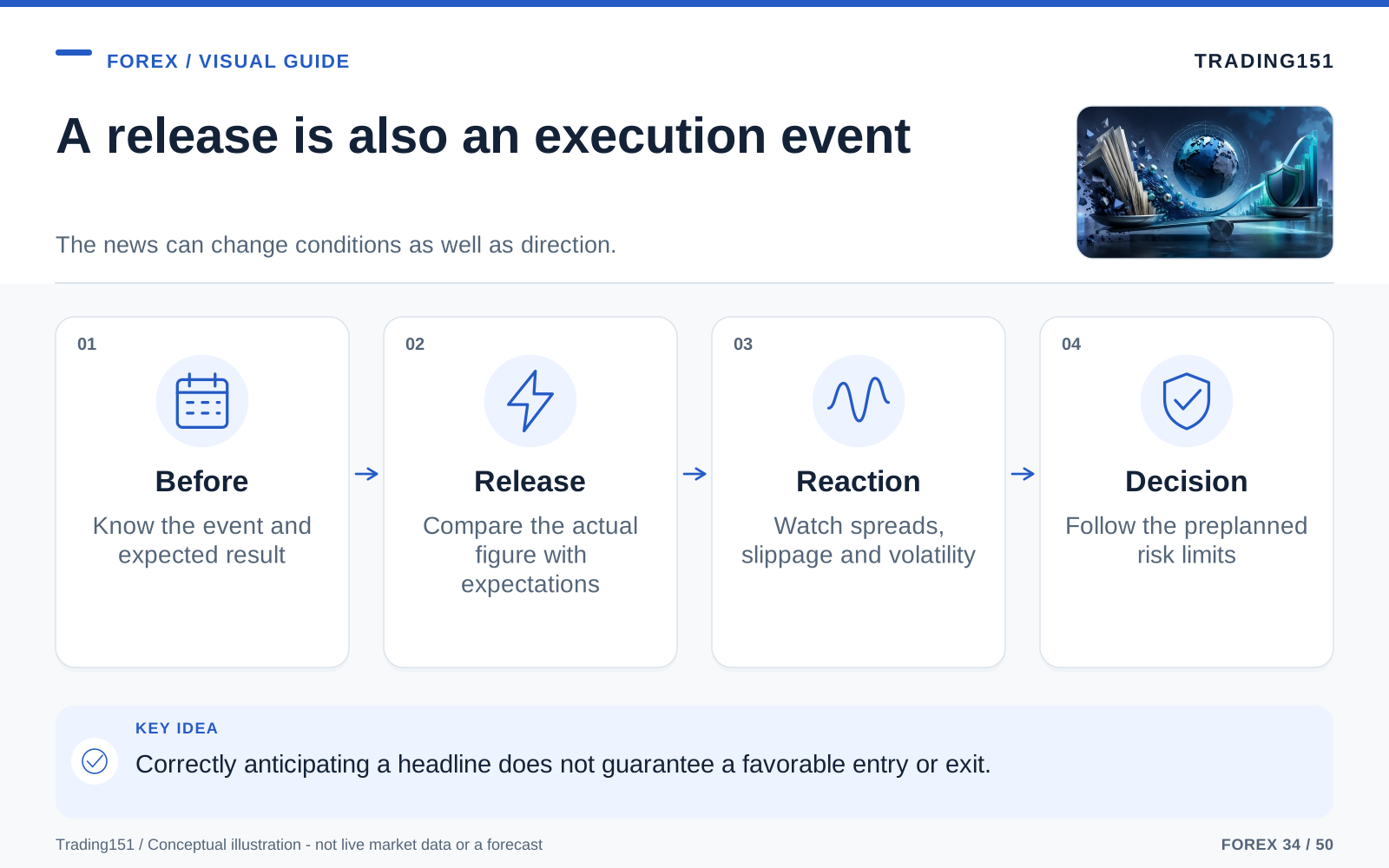
Read this diagram as text
- Before
- Know the event and expected result
- Release
- Compare the actual figure with expectations
- Reaction
- Watch spreads, slippage and volatility
- Decision
- Follow the preplanned risk limits
Why Traders Are Drawn to News Trading
If we're being honest, a lot of the appeal is purely emotional. Trading the news feels alive. Even guys who stick to slow, boring, methodical setups will admit there’s a certain thrill to a big release. The market stops feeling like a math equation and starts feeling immediate.
But there’s a highly practical reason we keep coming back to it, too: volatility compresses time.
On a quiet Tuesday, a pair might drift aimlessly for six hours before giving you a clean move. During a major release, that exact same distance gets covered in four seconds. For short-term traders, that efficiency is intoxicating. Why sit through a whole day of chop when one event can hand you the range and momentum you need?
Plus, news gives us a narrative. A trade stops being "a bounce off the 50 SMA" and becomes "inflation is sticky, rate cuts are delayed, and the dollar is a wrecking ball." That story helps contextualize the market, but it’s a double-edged sword. Buy into your own narrative too heavily, and the market will gladly humble you the second you think you've figured it out.
The News Releases That Really Matter
The economic calendar is packed every day, but most of it is just noise. If you try to trade every red folder on the calendar, you’re just going to burn out. The market really only cares about data that alters the outlook on monetary policy, economic growth, or overall risk appetite.
1. Interest Rate Decisions and Central Bank Press Conferences
These are the undisputed heavyweights. When the Fed, ECB, Bank of England, or Bank of Japan steps up to the mic, the market hangs on every word. The actual rate hike or cut matters, sure, but the nuance in their statement usually matters way more.
A central bank can leave rates completely untouched, yet send the market into a frenzy just by sounding a little more cautious or aggressive than expected. A single thrown-away comment about a resilient labor market can flip the entire bias of the day.
Rookies focus solely on the rate number. Veterans are listening to the press conference, reading the vote split, and analyzing the forward guidance to find where the real money is moving.
2. Employment Data
In the US, Non-Farm Payrolls (NFP) is the obvious rockstar. It’s a large deal because job market strength dictates consumer spending and wage pressure, which ultimately forces the Fed’s hand. But NFP isn’t just a single number. You’ve got the unemployment rate, wage growth, and—crucially—revisions to the previous month’s data.
This multi-layered data is exactly why news trading traps so many people. You might see a large headline jobs number and instantly buy the dollar, completely missing the fact that wage growth unexpectedly tanked and last month's numbers were quietly revised downward. By the time you figure that out, your trade is already deeply in the red.
3. Inflation Reports
CPI (Consumer Price Index) numbers are known for ripping currencies apart, mainly because inflation dictates everything a central bank does. If it’s cooling off, traders start betting on rate cuts. If it’s sticky and stubborn, those cuts get priced out.
And just like employment data, the headline is only bait. Core inflation, services, shelter costs—the granular details dictate the follow-through. The headline causes the initial spike, but the underlying details dictate where the trend goes.
4. GDP and Growth Data
GDP gives us the macroeconomic big picture. It doesn't always trigger the same violent, face-melting spikes as CPI, but it lays the groundwork for what policymakers can get away with. A strong, growing economy gives a central bank the cover they need to keep rates high. A shrinking economy puts their back against the wall.
5. Retail Sales, PMIs, and Other High-Impact Reports
These might not trend on social media, but they move markets more than newer traders realize. Retail sales give us a pulse on the everyday consumer. PMI (Purchasing Managers’ Index) is an awesome leading indicator for business expansion or contraction. And if you’re trading crosses, never ignore local employment or inflation data from the UK, Europe, or Australia—it can hit the pound or the euro just as hard as US data hits the dollar.
You don't need to memorize the calendar. Just figure out what drives the specific pairs you trade.
The Number Isn’t Enough: Expectations Are Everything
The biggest rookie mistake is thinking the market just reacts to whether news is "good" or "bad." That’s not how this works. Price reacts to how the actual number compares to what everyone expected it to be. And it goes deeper than that: the consensus forecast is just an average. You have to consider positioning, whispers, and underlying trends. A result that beats the official estimate might still trigger a large sell-off if the big money was secretly positioned for an absolute blowout. Read the release as a shift in expectations, not a simple pass/fail grade.
If the market is expecting the Fed to sound terrified, and instead they just sound mildly concerned, the dollar will probably rally—even if they still cut rates. The market isn’t grading the economy on a scorecard. It’s playing a large game of expectation versus reality.
That’s what people mean when they say something is “priced in.” By the time the data drops, institutional money has already spent weeks building positions based on what they think will happen. If the news just confirms what they already believed, there's no reason to keep pushing the price. Instead, they take profit, and the market violently reverses.
Hence the oldest cliché in the book: “buy the rumor, sell the fact.” The real move happens before the event; the event itself is just the exit liquidity.
What News Trading Feels Like in Real Time
If you read a textbook, news trading sounds structured and logical. Sitting at a desk and doing it is a totally different reality.
You can spend an hour analyzing a release, planning your entries, mapping out scenarios, and promising yourself you won't do anything stupid. Then the clock hits 8:30. The price instantly teleports twenty pips up, vanishes, and reappears forty pips down. The spread blows out to a size that makes your stomach drop. That beautiful, clean setup you mapped out in your head has completely evaporated.
When you see a pro sit through a major release without flinching, it’s not because they’re fearless. It’s because they’ve been beaten up enough times to know exactly how ugly the execution is going to be. They know that a great trade idea doesn't mean a damn thing if you get a terrible fill.
That large gap between theory and execution? That is the entire reality of news trading.
The Risks Retail Traders Underestimate
Retail guys rarely blow their accounts during news because they didn't understand the economics. They blow up because the market physically behaves differently during a release than it does during a normal Tuesday afternoon. Normal support and resistance levels mean absolutely nothing for those first few seconds. Spreads widen, liquidity evaporates, and your stop loss might get triggered miles away from where you placed it. You have to size your positions based on that chaotic environment, not the calm thirty minutes leading up to it. And if your account can't handle a large slippage hit, your position size should be exactly zero.
Liquidity Can Vanish
In the minutes before a large data drop, the big players simply step out of the way. No market maker wants to aggressively quote prices when a single headline could instantly torch their book. With all that heavy liquidity pulled from the market, it gets dangerously thin. Thin markets move aggressively and give you terrible fills.
Spreads Can Widen Dramatically
A one-pip spread is cute during the Asian session, but it can turn into an absolute monster during CPI. When spreads blow out, your entry price and stop loss calculations get completely distorted. It’s a hard lesson to learn when you enter a trade, the chart barely moves, but you’re instantly down big just because of the spread.
Slippage Isn’t a Technicality
Slippage sounds like a minor annoyance until it costs you half your account. You hit "buy" at one price, but because the market is moving so fast and liquidity is so thin, your broker fills you at a much worse price. In calm conditions, it’s a fraction of a pip. During a major release, it can be ten, twenty, or thirty pips. It completely destroys the risk-to-reward ratio you thought you had.
Risk management isn't just picking a spot on a chart for your stop loss; it's knowing whether you can get out at that price when all hell breaks loose.
The First Move Isn’t Always the Real Move
There is nothing more infuriating than the initial news spike that immediately reverses. A lot of the time, that very first candle is just high-frequency algorithms reacting to the headline number in a fraction of a millisecond. Then, a few seconds later, human traders process the underlying details, realize the headline was misleading, and hammer the price in the exact opposite direction.
This is exactly how impatient traders get trapped buying the top or shorting the absolute bottom in the first ten seconds. They’re trading the motion, not the context.
Your Own Emotions Become Part of the Trade
Speed amplifies everything. Fear, greed, FOMO, and the desperate urge to fix a losing trade all hit you at 100 mph. When the candles are flying, traders make remarkably stupid decisions, and they make them fast. They widen stop losses they swore they’d respect. They revenge-trade because they missed the initial burst.
The real danger isn't the market itself. It’s what the market tricks you into doing.
Three Common Ways Traders Approach the News
There isn't one magical way to trade an economic event, but most people fall into one of three camps.
1. The Pre-Release Breakout Straddle
This is the adrenaline junkie's favorite method. You drop a buy stop above the current price and a sell stop below it right before the news hits, hoping the volatility catches one and rides it to profit. Sounds brilliant in theory, right? In reality, it’s a great way to get chewed up. Often, the initial whipsaw will trigger both of your orders at terrible prices, leaving you holding two losing positions while the market figures out where it wants to go. If you’re going to try this, don’t base it on the days it goes perfectly. Base it on how your broker handles the absolute worst-case scenario.
At a glance, it feels proactive. But when the spreads widen and slippage kicks in, the price may spike into your buy order, reverse instantly, trigger your sell order, and leave you severely underwater. Brokers love it because it generates volume. That doesn’t mean it’s a smart way to protect your capital.
2. Trading the Reversal After the First Spike
This strategy relies on the idea that the first reaction is almost always an overreaction. You wait for the initial panic to shoot the price up or down, then you fade it, betting that it’s going to snap back to reality.
When you nail it, you look like a genius. But when you’re wrong, it hurts. Badly. Sometimes that large first spike isn't an overreaction—it’s the start of a huge, fundamental shift in the market. Stepping in front of it is like trying to stop a freight train with your bare hands.
3. Waiting for Confirmation After the Dust Settles
This is definitely the least sexy approach, but for most everyday traders, it’s the only one that makes sense. You just sit on your hands and let the initial madness pass. Let the algorithms fight it out. Wait for the spreads to return to normal, let the chart form some actual structure, and see what the real, sustained direction is going to be.
Sure, you’ll miss that first explosive candle. A lot of traders hate that. But missing the initial chaos is not the same as missing the trade. Institutional moves take hours to play out, not seconds. Sitting on the sidelines might feel boring compared to the rush of clicking buttons at 8:30 AM, but being bored is a highly underrated skill in trading.
Which Pairs Are Best for News Trading?
Not all charts react the same way to a release. If it’s a US data drop, dollar pairs are obviously taking center stage. EUR/USD, GBP/USD, USD/JPY, and gold get all the heavy volume because the liquidity is deep and the market reacts instantly.
But don't mistake deep liquidity for safety. When major news hits, even EUR/USD can act like a penny stock.
It’s also worth thinking about how you want to be exposed. If you're trading US CPI, EUR/USD gives you a pretty clean read on the dollar. But USD/JPY brings bond yields and safe-haven sentiment into the mix, making it much more erratic. GBP/USD can get weird if there’s local UK news pushing and pulling at the same time.
Rookies always flock to whatever pair is moving the fastest. That’s a mistake. The best trade is usually the pair with the cleanest, most predictable structure, not the one that’s giving everyone whiplash.
A Better Question: Should You Trade the Release at All?
This is the question you should be asking yourself.
You really don’t have to be in the market the exact millisecond a number crosses the wire to make money. Some of the most consistently profitable traders I know have a strict rule: hands off the keyboard during the release. They watch, they let the market tip its hand, and they only look for entries once the dust settles.
It sounds overly cautious, but there's a reason the veterans play it this way. They know that protecting your capital is way more important than looking brave. There will always be another CPI, another NFP, another setup. The desperate need to be in the market right at the open is usually just ego masquerading as confidence.
Sometimes, the absolute best news trade you can take is no trade at all.
How to Prepare Like a Serious Trader
If you absolutely insist on trading the news, how you prepare beforehand dictates whether you survive. Having a solid routine won't eliminate the risk, but it will stop you from doing something stupid in the heat of the moment. You need to know the time, the expected number, the previous number, the potential revisions, and where you draw the line on spreads. Decide right now: are you trading the initial spike, waiting for structure, or sitting it out entirely? And after it's over, log exactly what happened. Building your own database of how markets react is infinitely better than vaguely remembering what happened last month.
- Check the calendar early. Don’t find out about an ECB rate decision because your chart just had a seizure. Know exactly what’s coming, when it’s dropping, and who it’s going to impact.
- Know the consensus forecast. The reaction is entirely based on the surprise factor. A data point without expectations attached to it is totally useless.
- Read the surrounding narrative. Is everyone currently panicking about inflation? Are they worried about a recession? The same CPI number will trigger totally different reactions depending on the current macro mood.
- Map both directions before the release. Decide ahead of time what needs to happen for you to buy, sell, or walk away. It is a thousand times easier to think clearly before the chaos starts than during it.
- Reduce size. Even a flawless setup can get ruined by a bad fill. Cutting your position size gives you the breathing room to absorb a slippage hit or a momentary whipsaw without blowing your week's profit.
- Know your broker’s behavior. Brokers handle volatility differently. If you’ve never watched how your specific platform behaves during NFP, sit this one out and just watch the spread. Don't risk money testing their servers.
- Accept the possibility of doing nothing. If the price action is a mess, let it be a mess. Just because you spent an hour prepping for a trade doesn’t mean you owe the market an entry.
The Psychological Trap Nobody Talks About Enough
The hardest part of trading the news isn’t the actual event. It’s the mental gymnastics you put yourself through five minutes later.
If you nailed the trade, you suddenly feel invincible, which is a great way to over-leverage and lose it all on the next setup. If you missed it, the FOMO kicks in and you end up chasing a terrible entry at the top of a candle. If you got chopped up, you start revenge-trading trying to win it back before lunch. Any of those reactions will do way more damage to your account than the news release itself.
High-impact news acts like a magnifying glass for your personality flaws. If you're slightly impulsive, you'll become reckless. If you're hesitant, you'll completely freeze. This is why keeping a journal is so crucial. You’ll start noticing your own toxic patterns. Maybe you do great when you wait 15 minutes, but you get slaughtered every time you try to trade the headline. Maybe your macro analysis is dead-on, but your timing is always early. Often, the economic data isn't your problem—your problem is the impulsive click you make three minutes after the data comes out.
Figuring out your own mental triggers is worth a hundred times more than memorizing candlestick patterns.
What Beginners Usually Get Wrong
New traders almost always think news trading is a game of speed. It’s a game of extreme restraint.
They get tunnel vision on the headline number and completely ignore the revisions or the underlying details. They assume a strong number on the calendar means the currency has to go straight up. They double their position size because they think the setup is a "sure thing," using their normal, tight stop losses in an environment that requires a large buffer. They watch a few viral clips of someone making five grand in ten seconds and assume they understand event risk.
The ultimate mistake is treating this like an extreme sport. Yeah, the flashing lights and fast candles are exciting, but excitement doesn't pay the bills. The market doesn't hand out cash for bravery. It pays the people who meticulously manage their risk and wait for everyone else to make a mistake.
A Sensible Way to Learn It
If you want to get good at trading event risk, spend some time watching from the bleachers first. Pick one specific release—like NFP or CPI—and just watch how your favorite pair reacts to it over a few months. Watch the first ten seconds. Watch the five-minute chart. Watch how the next four hours play out. How often does that first large candle hold? When do the spreads finally settle down? What happens when the headline number beats expectations, but the underlying data is garbage?
Getting those reps in builds real market intuition. And intuition, much more than raw guts, is what keeps you profitable in crazy conditions.
When you do finally place the trade, trade excessively small. Trade so small that a terrible fill is just a mild annoyance, not a day-ruiner. Trade small enough that you're analyzing the market, not just sweating over your P&L.
The first price move is not the whole announcement
Suppose a policy rate is left unchanged, as expected, but the accompanying statement changes the likely path of future decisions. A trader focusing only on the headline may interpret the announcement as uneventful, while the market responds to the new guidance. The relevant surprise is the difference between the full announcement and prior expectations, not simply whether the rate changed.
The same problem arises with data releases. A strong current figure can arrive with a substantial downward revision to the previous period. Different components may point in different directions. Avoid deciding that the market is irrational merely because its reaction does not match the first number on an economic calendar.
Execution can dominate a small expected advantage. Spreads may widen, resting orders may trigger at worse prices, and a rapid reversal can reach both sides of a tightly placed bracket. An order arrangement that looks balanced in a quiet market is not necessarily protected against a gap or a sequence of fast fills.
Define which events you will trade and which you will simply observe. Record the expected release, the actual information available at entry, and the execution received. A later explanation should not replace that original record. News trading is a specialized use of information under difficult conditions, not a shortcut around the need for evidence that a strategy works after costs.
A fast reaction is not necessarily an informed one
The first move after a release can occur before a trader has read the details. A headline may omit revisions, components, or qualifying language. Decide in advance whether the strategy genuinely requires immediate execution or whether it depends on information that takes longer to assess. Speed is useful only when it serves a defined method; reacting before understanding the release is not an analytical advantage. 1, 2, 3
Conclusion: Respect the Release
News trading sits right at the chaotic intersection of global economics and raw human emotion. That’s why we love it. In a matter of seconds, you get to watch macroeconomic theory, central bank policy, algorithmic execution, and pure crowd panic fight it out on a single chart.
Yes, that collision creates incredible opportunities. But it also creates devastating traps for anyone who confuses wild volatility with a clear direction.
If you take anything away from this, let it be this: you do not need to be the fastest gun in the room. You don’t need to catch the absolute bottom of a volatile spike. You don’t need to prove to anyone that you can trade the headline like a Wall Street wizard. Your only job is to make rational decisions that keep you in the game long-term.
Sometimes that means trading the pullback an hour after the news hits. Sometimes that means turning off your screens entirely. And sometimes that means watching a beautiful 100-pip move happen without you, and being completely fine with it.
Walking away isn't weakness. In this game—especially around major data releases—walking away is the ultimate sign of a professional.
There will always be another headline. The market will always react. The economic calendar is a never-ending conveyer belt of opportunity. The real skill is knowing exactly when to step up to the plate, and when to let the storm pass without trying to catch lightning in a bottle. News changes the game by forcing expectations to shift violently, usually faster than your broker's servers can handle. You are under zero obligation to participate in that initial mess. Waiting a few minutes for a clean, recognizable setup to form might mean you miss the first chunk of the move, but it drastically increases your odds of keeping your money. The best trade isn’t the one that looks the most exciting; it’s the one you can survive, repeat, and compound over time.
Sources and further reading
- BIS: April 2025 FX turnover, September 2025 preliminary release
- Bank of England: Money Creation in the Modern Economy
- SEC Investor Bulletin: Trading Basics and Order Types
Editorial revision: 7 October 2026. Numerical scenarios are hypothetical unless identified as historical. References support the added explanations and selected corrections; rules and product terms should be checked again before acting.