
Currency pairs express the price of one currency in another. Labels such as major, minor, and exotic are market conventions rather than guarantees about liquidity or risk. The practical questions are which currencies you are exposed to, what the trade costs at your chosen time, and how sharply conditions could change. A familiar label does not replace those checks.
The Basic Idea: Why Currencies Are Traded in Pairs
Before we dive into the specific categories, let's look at the core engine of every Forex trade. Sure, reading a pair from left to right makes the math easy to digest, but you really need to think about the relationship in both directions. If you're feeling optimistic about GBP/JPY, you aren't just saying "the British pound looks great." You're specifically betting that the pound is going to outrun the Japanese yen. This mindset forces you to compare two completely different economies and central banks. It also explains why a fundamentally strong currency can still lose ground if the currency it's paired against happens to be even stronger.
When you pull up a chart for a pair like EUR/USD, you’re looking at a relationship. The first currency is the Euro; the second is the US Dollar. The price simply tells you how many dollars it takes to buy a single euro.
But when you're trading, that chart represents a tug-of-war. It's a real-time contest between two large economies, their interest rates, and the broader narrative of where global wealth wants to park itself.
If traders think Europe is booming while the US economy is stalling, the Euro is probably going to climb against the Dollar. But if the Federal Reserve hints at hiking interest rates while Europe struggles, the Dollar takes the driver's seat.
So, when a trader tells you they’re bullish on EUR/USD, they aren't declaring that the Euro is the greatest currency on earth. They’re just saying, "Right now, I think the Euro is going to perform better than the Dollar."
That head-to-head matchup is the heartbeat of Forex. It’s rarely about absolute perfection; it’s about relative strength.
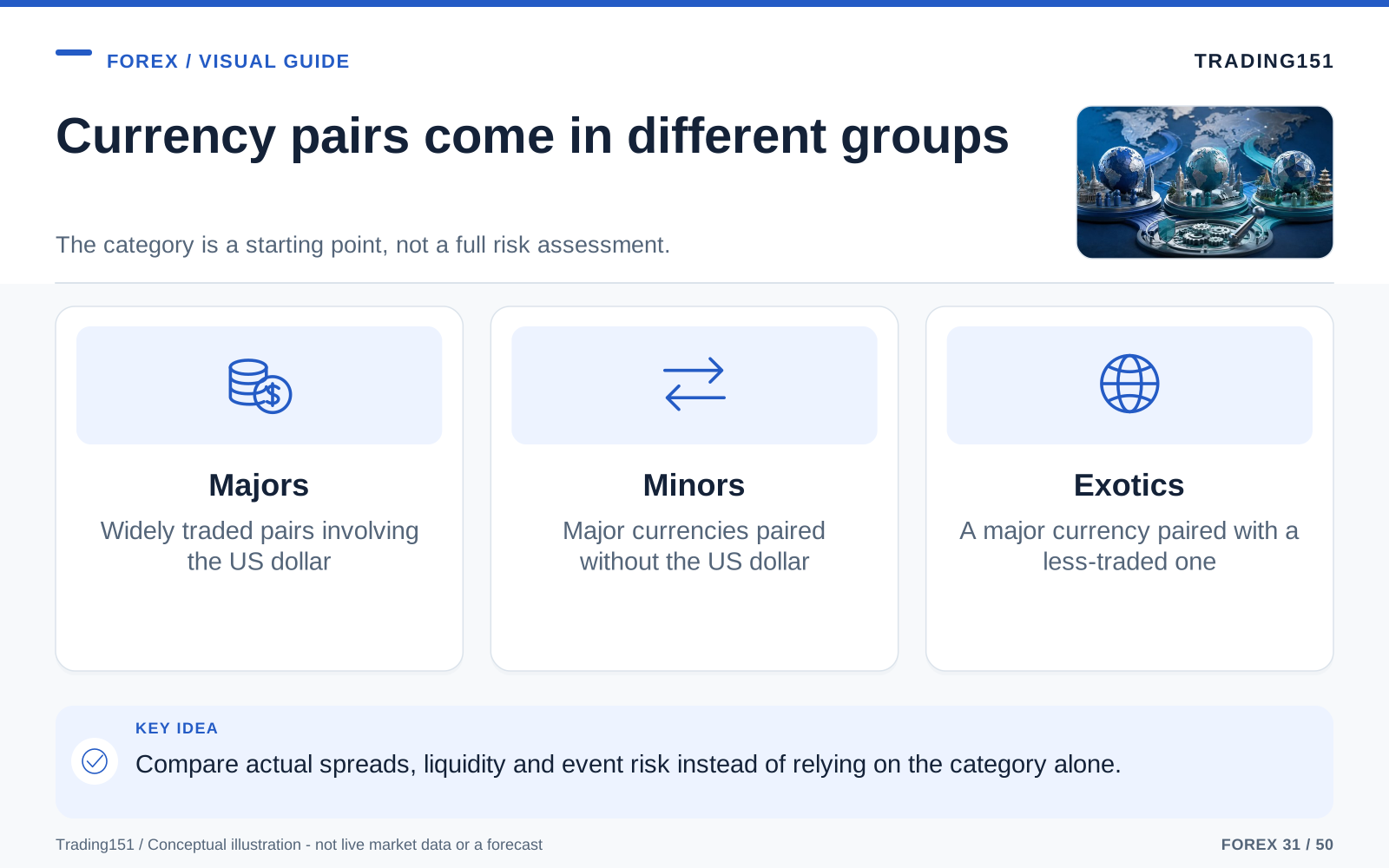
Read this diagram as text
- Majors
- Widely traded pairs involving the US dollar
- Minors
- Major currencies paired without the US dollar
- Exotics
- A major currency paired with a less-traded one
1. Major Currency Pairs: The Core of the Market
If Forex had a main stage, this would be it. Now, don't mistake "deep liquidity" for "boring." Major pairs can still swing violently when big news breaks. But because so many people are trading them, the costs are usually low and predictable. For someone just starting out, this offers a clean learning environment: if you lose money on a trade, it’s probably because your idea was wrong, not because a wonky spread or a ghost-town order book messed up your execution.
The majors are the most heavily traded pairs on the planet. They feature the world's most powerful economies, attract the lion's share of trading volume, and offer the smoothest overall trading experience.
The rule of thumb here is simple: a major pair always features the US Dollar (USD) on one side, paired with another global heavyweight.
Why is the Dollar always invited to the party? Because it’s the undisputed anchor of the global financial system. It’s the world's primary reserve currency, the standard for international trade, and the benchmark for pricing commodities like oil and gold. Naturally, any pair involving the USD is going to draw a large crowd.
What Makes the Majors Different?
- Incredible liquidity: There is a large ocean of buyers and sellers at almost any given moment, making it a breeze to get in and out of trades.
- Tight spreads: Because the volume is so high, brokers charge very little to facilitate the trade. The gap between the buy and sell price is tiny, keeping your costs down.
- Better market depth: It takes a large amount of money to move these markets. A single large order won't cause the random, erratic price spikes you might see in smaller pairs.
- Endless information: You will never struggle to find news, economic data, or analyst coverage for these economies.
The Main Major Pairs
- EUR/USD – The king of the hill. It’s the most traded pair in the world, matching up the two largest economic blocs. Because it's so liquid, many treat it as the ultimate benchmark for the entire Forex market.
- USD/JPY – A fascinating pair combining the US Dollar with the Japanese Yen. The Yen has a reputation as a "safe haven," meaning this pair can move aggressively when global panic sets in and investors run for cover.
- GBP/USD – Often called "Cable," this one has a bit more attitude than EUR/USD. It tends to move with more aggression, making it a favorite for day traders looking for action.
- USD/CHF – The Swiss Franc is the financial world's equivalent of a concrete bunker. Investors flock to it for stability, so this pair gets a lot of attention when the world feels unpredictable.
- AUD/USD – The "Aussie" is deeply tied to commodity prices (like iron ore and coal) and the economic health of Asia, particularly China. It has a completely different vibe than the European pairs.
- USD/CAD – Canada is a large oil exporter, so you can't really trade the "Loonie" without keeping one eye glued to crude oil prices.
- NZD/USD – The "Kiwi" is another commodity-linked currency. Traders watch it closely for shifts in global growth and agricultural exports.
Why Beginners Usually Start Here
If you're new to the game, the majors are absolutely the place to cut your teeth. That doesn't mean you can't lose money—you definitely can—but the markets are much easier to read. These pairs generally follow the rules. They react logically to inflation data, central bank meetings, and employment reports.
Don't get it twisted; they can still be volatile. A surprise rate hike can send EUR/USD flying in seconds. But compared to the wild west of thinner markets, the majors usually behave in a way that makes fundamental economic sense.
Plus, they are just way cheaper to trade. When you're learning, you're going to make mistakes. If you’re also paying large spreads on every trade, those mistakes get very expensive, very fast. Tight spreads give you the breathing room to learn, test your strategies, and survive your first few months.
The Personality of the Majors
Spend enough time watching the charts, and you'll realize every pair has its own distinct rhythm.
EUR/USD is generally smooth and technical. GBP/USD is punchy and prone to sudden bursts of energy. USD/JPY is a constant balancing act between interest rates and global fear. AUD/USD and NZD/USD move to the beat of global trade and commodity cycles. USD/CAD lives and dies by oil. USD/CHF quietly absorbs the market's anxiety.
Learning these quirks takes screen time, but it’s invaluable. Traders who stick to just one or two major pairs eventually develop a gut feeling for how they move—knowing when a breakout is legit and when the market is just making noise.
2. Minor Currency Pairs: The Crosses Without the Dollar
Once you’ve got a handle on the majors, you’ll likely wander over to the minors—often referred to as crosses. Crosses are fantastic because they let you see what's happening behind the scenes of the US Dollar. If EUR/USD and GBP/USD are both shooting up, looking at EUR/GBP tells you which European currency is the strongest. It's a great way to avoid accidentally doubling your exposure to the Dollar. The cross isn't just an extra chart to clutter your screen; it’s a surgical tool for expressing a very specific market view.
Simply put, minor pairs do not include the US Dollar. They just match up the other major currencies against one another. Think EUR/GBP, EUR/JPY, or AUD/NZD.
You’re dealing with the same economies you already know, just without the greenback sitting in the middle.
Back in the day, if you wanted to trade the British Pound against the Japanese Yen, you essentially had to do the math yourself by routing the trade through the US Dollar. Thanks to modern electronic trading, you don't have to do that anymore. These pairs trade directly and have plenty of action on their own.
What Minor Pairs Tend to Offer
- Solid liquidity: They’re definitely active, even if they don't have the bottomless depth of EUR/USD.
- Slightly wider spreads: It’s going to cost you a little bit more to trade a minor than a major, but it's usually still very reasonable.
- Clearer regional stories: Without the Dollar hogging the spotlight, you can get a crystal-clear look at how two specific economies stack up against each other.
- Beautiful trends: When the stars align, some of these minor pairs can produce clean, sustained trends.
Common Minor Pairs
- EUR/GBP – This is the classic European rivalry. It’s a direct look at the Eurozone vs. The UK, and it gets interesting when their central banks start moving in different directions.
- EUR/JPY – A great way to play European economic news against Japan's unique safe-haven status.
- GBP/JPY – Affectionately (and sometimes fearfully) known as the "Beast" or the "Widow-maker." It moves fast and covers large distances. Traders either love the thrill of it or avoid it like the plague.
- EUR/CHF – Usually a pretty quiet, subdued pair, heavily anchored by the tight economic ties between Switzerland and the Eurozone.
- AUD/NZD – A hyper-local matchup between two neighboring, commodity-heavy economies. It’s a favorite for traders who like to play the subtle differences in their interest rates.
- CAD/JPY and AUD/JPY – These are great if you want to trade global risk appetite and commodities without having to worry about what the US Dollar is doing.
Why Some Traders Prefer Minors
There are days—or even whole months—when the US Dollar just completely hijacks the market. When the Federal Reserve makes a large announcement, every major pair just becomes a proxy for the Dollar. The charts become noisy and erratic.
In those moments, the minors are an escape hatch. If the Dollar is having a meltdown, a pair like EUR/JPY might just be quietly trending based on its own fundamentals. It lets you step away from the Dollar drama and focus on cleaner setups.
That’s why a lot of intermediate traders migrate toward the crosses. They offer a lot of variety and let you get creative with your market theories.
The Catch
Don't assume minors are easier just because the Dollar is out of the picture. You have to stay on top of two entirely different regional storylines. And as mentioned, pairs like GBP/JPY can be violent. A sudden swing can feel amazing when you're on the right side of it, but it will absolutely demolish your account if you aren't using a stop loss.
Minors are the perfect middle ground. They aren't as basic as the majors, but they aren't the chaotic minefield of the exotics. For a lot of folks, this is where trading gets fun.
3. Exotic Currency Pairs: Higher Risk, Thinner Markets
And then, there are the exotics. This is where technical analysis often takes a backseat to politics. A beautiful chart pattern means absolutely nothing if a country unexpectedly changes its capital controls, a central bank intervenes out of nowhere, or a bizarre election result tanks the economy. Even the mechanics of holding a trade overnight can be substantially expensive. If you're going to trade exotics, you have to read the fine print. You can't just see a juicy interest rate gap and assume it's free money.
An exotic pair matches a major currency (usually the USD or the Euro) with a currency from a developing or emerging market. We're talking about pairs like USD/MXN (Mexican Peso), USD/ZAR (South African Rand), or USD/TRY (Turkish Lira).
These markets are a completely different animal. They are thin, unpredictable, and highly reactive. A price swing that would be front-page news on EUR/USD is just a normal Tuesday afternoon for an exotic pair.
What Defines Exotic Pairs
- Low liquidity: There just aren't as many people trading these. The order books are thin, meaning prices can jump around erratically.
- Severe spreads: It is expensive to trade exotics. The gap between the buy and sell price can be large, especially outside of regular trading hours.
- Extreme sensitivity to local news: Political scandals, questionable central bank decisions, and local economic shocks hit these currencies like a freight train.
- Large volatility: Exotics don't just move; they gap, they spike, and they crash.
- Carry trade appeal: Some traders flock to exotics because emerging markets often have very high interest rates. If you play it right, you can get paid just for holding the position over time.
Examples of Exotic Pairs
- USD/MXN – A massively popular emerging-market pair. It's heavily influenced by US trade relations, border politics, and Mexico's own central bank moves.
- USD/ZAR – Highly volatile and sensitive to gold/platinum prices, global risk appetite, and the domestic political climate in South Africa.
- USD/TRY – This pair is infamous for its wild, face-ripping moves, often driven by Turkey's unconventional monetary policies and large inflation spikes.
- USD/SGD – The Singapore Dollar is pretty calm compared to the others, since Singapore is a major, stable financial hub. But it still officially gets lumped in with the exotics.
- EUR/TRY, USD/HUF (Hungarian Forint), and USD/PLN (Polish Zloty) – More examples of pairs that move to a completely different beat than the standard majors.
Why Exotics Can Be So Difficult
You have to respect the exotics, or they will chew you up. A technical support level that holds perfectly on a major pair might get sliced right through on an exotic because of a single political tweet or a sudden panic in the local bond market.
Then there are the trading costs. Starting a trade deep in the red because of a large spread is frustrating. It completely ruins the math for short-term day traders. A setup has to be strong to justify the entry cost.
Finally, you have to worry about slippage. Because there aren't always buyers and sellers waiting at every price point, the market can skip over your stop-loss order during a fast move, leaving you with a much bigger loss than you planned for.
Why Traders Still Trade Them
So why bother? Because when they move, they really move.
If you have a strong understanding of macroeconomics and you catch an emerging market currency at the right time, the trends can be large and highly profitable. Long-term traders love the big-picture fundamental plays.
There's also the carry trade. If you buy a currency with a 10% interest rate and sell one with a 2% interest rate, you pocket the difference every day you hold the trade. In a calm market, it’s a beautiful thing. But if the market panics and the exchange rate tanks, that sweet interest income gets wiped out in a heartbeat.
Bigger moves don't automatically equal better trades. More often than not, they just give you more ways to blow your account.
Majors vs. Minors vs. Exotics: What Really Changes?
These aren't just labels for a textbook. Which category you choose to trade impacts your day-to-day reality in a huge way.
Liquidity
- Majors: Deep, liquid, and smooth. You can get in and out whenever you want.
- Minors: Good liquidity, but definitely a step down from the majors.
- Exotics: Thin and patchy. Getting out of a bad trade can be sloppy.
Trading Costs
- Majors: Inexpensive.
- Minors: A little pricier, but totally manageable.
- Exotics: Expensive. The spread will eat a noticeable chunk of your profits.
Volatility
- Majors: They move, but usually in a way that makes logical sense.
- Minors: A mixed bag. Some are quiet; some (like GBP/JPY) are absolute wildcards.
- Exotics: Sharp, aggressive, and highly unpredictable.
Main Drivers
- Majors: The big stuff: global inflation, the Federal Reserve, large geopolitical shifts.
- Minors: The tug-of-war between two specific, developed nations.
- Exotics: Local politics, emerging market panic, and extreme interest rate gaps.
Who Should Trade Them?
- Majors: Everyone, especially beginners.
- Minors: Intermediate traders looking to expand their playbook.
- Exotics: Veterans who understand macro-level risk and know how to size their positions defensively.
How Traders Usually Progress Through These Categories
Please don't fire up your trading platform and try to conquer all three categories on day one. It's the fastest way to get overwhelmed and lose your money.
A natural, healthy progression usually looks like this:
Start with the Majors
If you’re still learning the ropes, pick one or two majors and stick with them. EUR/USD and USD/JPY are fantastic starting points. You'll learn how to read economic calendars, understand central bank speak, and get a feel for price action without fighting large spreads or crazy slippage.
Add Minors Once You Understand the Basics
Once you stop feeling lost on the major charts, start looking at the crosses. Watching EUR/GBP or AUD/JPY will teach you a brilliant lesson: taking the US Dollar out of the equation often makes the relationship between two countries much clearer.
This is also when you'll learn that you can't force the same strategy on every market. What works like a charm on a slow, steady EUR/USD trend might get chopped to pieces on a volatile GBP/JPY chart.
Approach Exotics With Patience
Don't rush into exotics. When you finally do, trade small. Use wider stop losses, and make sure you understand the underlying politics and economics of the country you're trading. A chart might look exciting, but excitement and profitability are rarely the same thing.
Choosing the Right Category for Your Style
There isn't one "perfect" currency pair. It all comes down to who you are as a trader, what your risk tolerance looks like, and what kind of strategy you want to run.
If you’re a day trader who needs razor-thin costs and instant execution, the majors are your forever home. If you want a wider variety of setups and don't mind slightly higher spreads, the minors are calling your name. And if you’re a macro-thinker who loves playing global narratives and has the discipline to manage serious risk, keep an eye on the exotics.
Just remember: treat each category with the respect it deserves. Applying a strategy built for a highly liquid major pair to a thin, volatile exotic pair is a recipe for disaster.
The pair's name does not determine its suitability
Read the quote in the right direction. If EUR/USD is 1.1000, one euro costs 1.10 U.S. dollars. Buying the pair means taking a position that benefits, before costs, when the euro strengthens relative to the dollar. Selling it expresses the opposite relative view. It does not necessarily mean either currency is rising or falling against every other currency.
Pairs can also duplicate an exposure. Buying EUR/USD and buying GBP/USD both include a short-dollar component. They are not identical trades, but treating them as fully independent can understate the portfolio's response to a broad dollar move. Inspect the currencies underneath the symbols rather than counting each ticker as a separate source of diversification.
Compare trading conditions using the intended order size and session. A pair's typical spread during an active period may differ substantially from its spread near a rollover, a local holiday, or a political event. Financing charges and restrictions can matter as much as the displayed spread, particularly for a position held over several days.
Less actively traded pairs can introduce additional practical issues, including limited liquidity, capital controls, or offshore and onshore market differences. These are reasons to investigate the specific instrument, not to assume all such pairs behave alike. Choose a pair because its mechanics and risks fit a defined approach, not because a category name makes it sound either safe or exciting.
Translate the trade into its two currencies
A currency-pair position is easier to understand when expressed as the currencies being bought and sold. A long EUR/USD position is exposure to the euro relative to the dollar, not a general bet that both currencies will strengthen. Another trade may repeat part of that exposure under a different pair name.
Review the account in currency terms rather than treating each pair as an independent idea. Several positions can all depend on a weaker dollar or stronger yen. That overlap matters when a single policy announcement affects the whole group, even though the individual charts looked different at entry. 1, 2
Final Thoughts: The Pair Matters More Than Many Beginners Realize
One of the biggest rookie mistakes in Forex is treating every chart like it's exactly the same. People think a breakout is a breakout, regardless of the letters at the top of the screen. In reality, the personality of the pair matters just as much as the pattern on the chart.
A beautiful technical breakout on a major pair usually works out because there's large liquidity supporting the move. That exact same breakout on an exotic pair might be a total fakeout, completely reversed five minutes later by a random local news headline. A minor pair might trend gracefully for weeks because two central banks are moving in opposite directions, while another pair chops sideways forever because the two economies are basically twins.
That’s why knowing the difference between majors, minors, and exotics is a core part of your risk management. It tells you what to expect before you even click "buy" or "sell."
For most of us, the smartest path forward is the boring one: master the majors first. Build your foundation. Once you truly understand how the market breathes, the minors will start making a lot of sense, and you'll know exactly when an exotic pair is worth the headache.
Forex looks like pure chaos when you first look at it. But once you understand how these currency tiers work, it stops looking like random squiggly lines. You start seeing the market for what it really is: a real-time leaderboard of global confidence.
Try this simple trick: before you open a trade, write down exactly which two countries you are comparing, what big news events are coming up for both of them, and when they are most actively traded. It stops you from viewing the currency pair as just a random ticker symbol. If you can explain the real-world relationship in plain English to a friend, you are infinitely less likely to take a bad trade just because the chart looked pretty.
Sources and further reading
- BIS: April 2025 FX turnover, September 2025 preliminary release
- CFTC: Eight things to know before trading forex
Editorial revision: 7 October 2026. Numerical scenarios are hypothetical unless identified as historical. References support the added explanations and selected corrections; rules and product terms should be checked again before acting.