
Foreign exchange is the exchange of one currency for another. It supports trade, travel, investment, and the management of cross-border payments, as well as speculation. Retail forex trading often uses leveraged contracts whose mechanics differ from simply buying currency for a trip. Understanding the quote is only the beginning; the product, counterparty, financing, and loss exposure determine what the trade actually means.
What Forex Is
At its core, Forex is just a global hub for exchanging money. But one crucial thing to keep in mind is that a Forex price is always a comparison. You're never looking at a currency in a vacuum. If the EUR/USD pair is going up, it could be because the euro is surging, the dollar is stumbling, or both are moving and the euro is just holding up better. Getting into the habit of looking at both sides of the coin keeps you from getting tunnel vision and building a trading strategy on only half the story.
Think about how the real world operates to keep this market churning.
If a German company buys steel from the US, they need to swap euros for dollars. If a Japanese investor buys London real estate, they’re converting yen into pounds. And yes, when a Canadian tourist lands in Rome and needs cab fare, they’re participating in the same market, just on a microscopic scale.
The main difference? Businesses and tourists exchange money because they have to. Traders do it because they want to profit off the constantly shifting exchange rates.
The BIS's final tables, released in June 2026, put average daily OTC foreign-exchange turnover in April 2025 at about $9.51 trillion. This combines spot trading, forwards, swaps, options, and other reported activity. It is not directly comparable with the market value of listed shares, and a large global total does not ensure a particular broker can fill an order immediately or at the quoted price.
It also means prices are highly sensitive. The market is constantly reacting to breaking news, and a single unexpected comment from a central bank official can send prices flying in a matter of seconds.
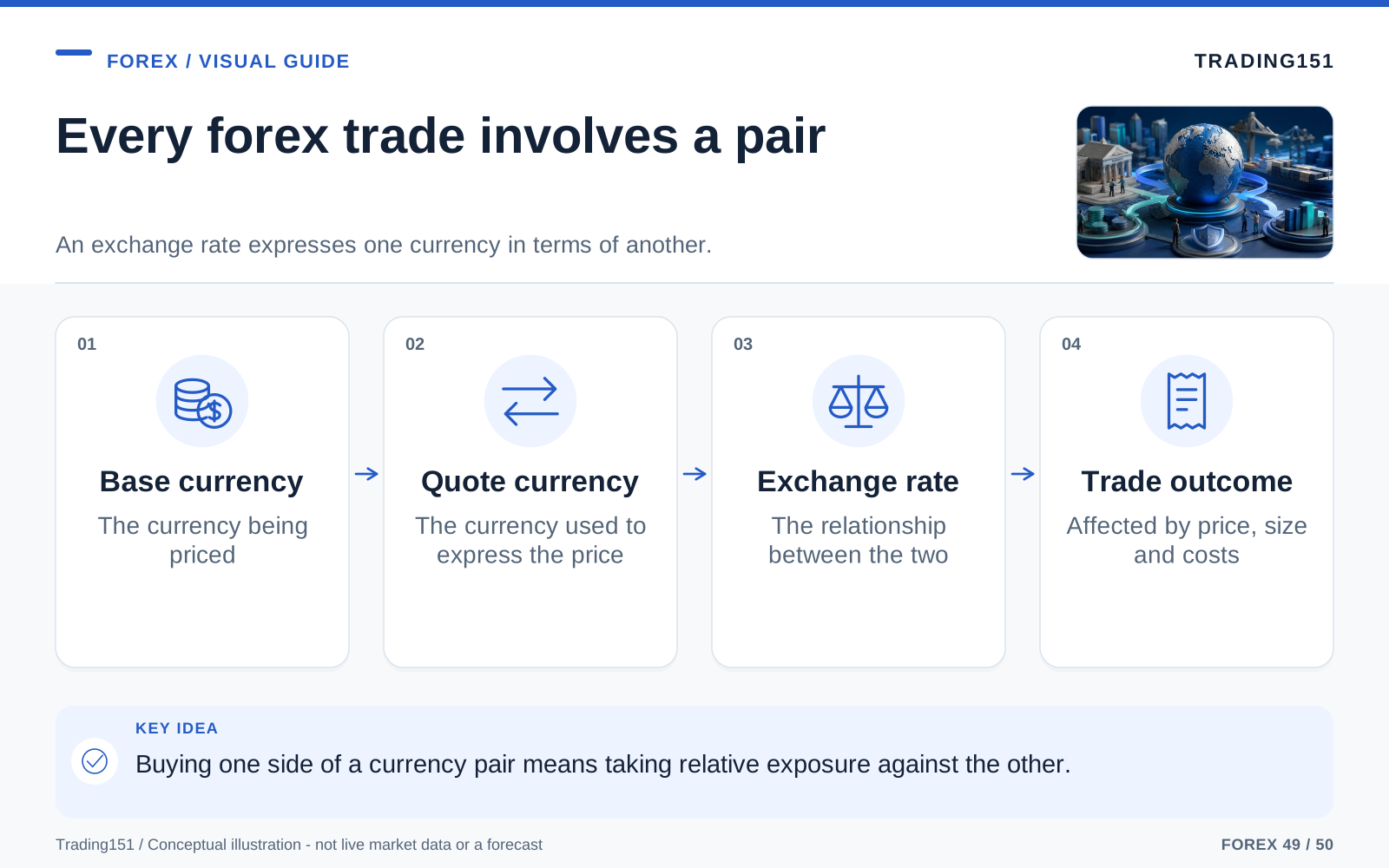
Read this diagram as text
- Base currency
- The currency being priced
- Quote currency
- The currency used to express the price
- Exchange rate
- The relationship between the two
- Trade outcome
- Affected by price, size and costs
Why the Forex Market Never Really Feels Still
Unlike the stock market, Forex doesn't have a physical headquarters or a central trading floor. It’s an over-the-counter (OTC) market, which basically means it’s a large, decentralized digital network of banks, brokers, and traders scattered across the globe. As trading passes from one time zone to the next, the entire mood of the market shifts. A currency pair might barely budge during the quiet Asian hours, suddenly spring to life when the London desks open, and get completely chaotic once New York traders start reacting to morning data.
Because these participants are spread across different continents, the market stays open 24 hours a day, five days a week. As one part of the world goes to sleep, another is waking up and logging on.
The big four trading sessions are:
- Sydney
- Tokyo
- London
- New York
This rolling schedule is great, but don't fall into the trap of thinking every hour is worth trading. There are definitely quiet periods and highly volatile ones, especially when major global sessions overlap and everyone is trading at once.
When you're starting out, timing matters a lot. Just because you can place a trade at 3:00 a.m. doesn’t mean you should. Liquidity, price swings, and trading costs all fluctuate depending on the time of day.
Who Participates in Forex?
If you search for Forex online, you’d think the market is entirely made up of 20-somethings trading on their laptops. Retail traders are definitely part of the ecosystem, but they are far from the center of it.
The real currents are controlled by heavy hitters:
- Central Banks: The big bosses. Institutions like the US Federal Reserve or the European Central Bank can single-handedly tank or skyrocket a currency. Their decisions on interest rates or inflation targets are the true market movers.
- Commercial and Investment Banks: The heavy lifters. Mega-banks handle the vast majority of currency trading, moving billions for their clients and themselves.
- Multinational Corporations: The everyday users. Huge companies are constantly swapping currencies to pay overseas staff, buy materials, or protect themselves against future price swings.
- Hedge Funds and Institutions: The big speculators. These firms trade large positions to profit off long-term global economic trends.
- Retail Traders: That’s us. Individual people using trading apps. We’re the loudest group on the internet, but financially, we make up a very small slice of the pie.
Keeping this hierarchy in mind keeps you grounded. You aren't playing a casual game against other amateurs; you're stepping into an arena dominated by institutions with bottomless pockets and lightning-fast information. That doesn’t mean you can’t make money, but it does mean you need a healthy dose of humility from day one.
How Forex Trading Works in Practice
The most fundamental rule of Forex is that currencies are always traded in pairs.
You can’t just buy "euros" in a vacuum. You have to buy euros with something else—usually US dollars, Japanese yen, or British pounds.
A pair looks like this: EUR/USD.
- EUR is the base currency.
- USD is the quote currency.
If EUR/USD is trading at 1.1000, it just means 1 euro costs 1.10 U.S. dollars.
Every trade is essentially a bet on a tug-of-war between two economies.
- If you think the euro will overpower the dollar, you buy EUR/USD.
- If you think the euro will weaken against the dollar, you sell EUR/USD.
This relative pricing is what trips up a lot of beginners. A currency can shoot up on a chart not because its home country is doing great, but simply because the other country in the pair is doing terribly.
That constant push-and-pull is the heartbeat of the market.
Major, Minor, and Exotic Pairs
Not all currencies get the same amount of screen time.
- Major pairs always include the U.S. dollar and are the most heavily traded. Think EUR/USD, GBP/USD, and USD/JPY.
- Minor pairs skip the U.S. dollar but still feature big global currencies, like EUR/GBP or EUR/JPY.
- Exotic pairs mash up a major currency with one from a smaller or developing economy. These can be volatile and expensive to trade.
If you're just starting out, do yourself a favor and stick to the majors. They're much more predictable, easier to analyze, and significantly cheaper to trade than exotics.
Bid, Ask, and the Spread
When you open up your broker’s app, you’ll see two prices next to every pair.
- The bid is the price you can sell at.
- The ask is the price you can buy at.
The gap between those two numbers is called the spread. Think of it as your broker’s invisible commission built right into the trade.
If EUR/USD is listed as:
- Bid: 1.1000
- Ask: 1.1002
Your spread is 2 pips.
Why does this matter? Because it means every trade you open starts out slightly in the red. The market has to move in your direction just to cover the broker’s cut before you even see a penny of profit.
Newbies often ignore the spread because the numbers look tiny. But those tiny costs eat away at your account fast, especially if you’re trading constantly in a choppy market.
What’s a Pip?
A pip is the standard measuring tape of the Forex world.
For almost all currency pairs, a pip is the fourth decimal place. So, if EUR/USD ticks up from 1.1050 to 1.1051, congratulations, it just moved one pip.
Some modern brokers add an extra decimal place (sometimes called a pipette), but the core concept is the same. Instead of saying the price went up by a tiny fraction of a cent, traders just use pips. It’s a universal language that makes it way easier to talk about risk, profits, and stop-loss placements without getting lost in endless decimals.
Lot Sizes: How Much Are You Trading?
In the stock market, you buy shares. In Forex, positions are measured in lots.
- Standard lot: 100,000 units of currency
- Mini lot: 10,000 units
- Micro lot: 1,000 units
Trading 100,000 euros sounds unusually out of reach for a regular person, right? Most of us don't have that kind of cash sitting around to casually throw at a screen. That’s exactly where leverage bridges the gap.
Leverage: The Feature That Attracts People and Wrecks Them
Leverage is what allows you to control a large chunk of money using just a tiny deposit of your own cash. But keep in mind, the leverage your broker advertises is a ceiling, not a suggestion. What really matters is your effective leverage—how big your open trades are compared to your actual account balance. Opening three small trades might not feel risky, but if they all rely on the US dollar dropping, you've essentially just placed one large, highly leveraged bet.
Let's say your broker gives you 1:100 leverage. You could potentially control a $10,000 trade while only putting up $100 of your own money. On paper, that sounds amazing. It takes tiny, boring price movements and turns them into thrilling, meaningful profits.
That rush is exactly why leverage is so seductive.
Without it, Forex is pretty slow. Currencies don't usually swing substantially from day to day. But leverage magnifies everything.
And that multiplier works both ways.
A move in your favor makes you feel like a genius. But a slight move against you? It becomes painful, fast.
This is where beginners get completely wiped out. They might be totally right about the overall market direction, but because their position is massively over-leveraged, a tiny temporary dip in price turns into a catastrophic loss for their account.
Experienced traders respect leverage; they don't abuse it. Used smartly, it’s a helpful tool. Used recklessly, it's the fastest way to hit zero.
Margin and Margin Calls
The cash you have to lock up to open one of these leveraged trades is called margin.
If your trade is losing badly and your account balance drops below the broker's safety threshold, they will step in and automatically close your positions to stop the bleeding. That’s a margin call.
It’s not dramatic like in the movies. It’s entirely mechanical, cold, and final. You'll just look at your screen and realize your trades were liquidated whether you were ready to close them or not.
Why Currencies Move
Okay, so we know how to trade, but why do currencies go up and down? They don't just bounce around randomly, even if a 5-minute chart looks like pure chaos.
The market is constantly weighing a country's economic health, its political stability, and global risk.
Here are some of the heavy hitters that drive price:
1. Interest Rates
This is the big one. Money naturally flows to wherever it’s treated best. If a country raises its interest rates, foreign investors flood in to take advantage of the higher returns, which drives up demand for that currency. But remember, the market prices in expectations. If everyone knows a rate hike is coming, the actual announcement might barely move the needle. It's the surprises that cause chaos.
2. Inflation
Inflation eats away at purchasing power. If inflation gets too hot, traders expect the central bank to step in and hike interest rates to cool things down. If it drops, they expect rate cuts. Currencies often surge or plummet based purely on these shifting expectations long before the bank does anything.
3. Economic Growth
Growth, inflation, employment, and spending figures can change expectations for interest rates and investment flows. Currency prices respond to the surprise relative to expectations and to conditions in both economies. Strong growth does not mechanically produce a stronger currency.
4. Employment Data
Job reports—especially out of the US—are notorious for causing large spikes in the market. More people working means a resilient economy. Weak employment numbers usually spark panic about a looming slowdown.
5. Political Stability and Geopolitical Risk
Money hates uncertainty. Elections, trade wars, actual wars, or sudden changes in government leadership will send investors scrambling. They pull their money out of risky currencies and park it in perceived "safe havens."
6. Market Sentiment
Sometimes it’s just a global vibe check. Is the market feeling optimistic and willing to take risks? Or is everyone terrified and playing it safe? Broad global mood swings can push currencies around regardless of what a specific country’s domestic data looks like.
Two Main Ways Traders Analyze Forex
If you want to make sense of all this, traders generally fall into two camps, though the best usually blend both.
Fundamental Analysis
Fundamental traders are big-picture thinkers. They obsess over news feeds, economic calendars, central bank speeches, and global politics. They want to know the absolute core reasons why a currency should rise or fall.
This style requires a lot of patience, as big economic themes can take weeks or months to fully play out.
Technical Analysis
Technical traders are the chart junkies. They don’t care as much about the news; they care about price action, trends, support and resistance levels, and mathematical indicators. Their philosophy is that all human emotion and economic data are already baked into the price on the screen.
This style appeals to people who love structure, patterns, and strict rules.
Let’s be clear: neither method is a crystal ball. Analysis isn't about predicting the future with absolute certainty. It's simply about building a logical case, setting your risk limits, and acting with discipline.
A Simple Example of a Forex Trade
Let’s walk through a basic trade so you can see how this all connects.
Imagine you’re watching EUR/USD, and the current price is 1.0500. Let's say Europe just dropped some surprisingly great economic data, and the U.S. dollar is looking weak across the board. You decide the euro is going to climb.
With that in mind, you hit the "buy" button.
Here is what a professional trade setup looks like:
- Pair: EUR/USD
- Entry: 1.0500
- Stop-loss: 1.0470
- Target: 1.0560
A stop-loss order defines an intended exit trigger, not a guaranteed execution price. A stop-market order can fill beyond that trigger during a fast move or gap; a stop-limit order may not fill at all. Profit targets also depend on the order type and available liquidity.
This is crucial because a trade isn’t just a hunch. It’s a complete plan. If you jump into the market without knowing exactly where you plan to get out on both the winning and losing side, you aren't trading. You're just winging it.
Best case scenario: the price climbs to 1.0560, hits your target, and you walk away with a win.
Worst case scenario: a US central banker says something unexpected, the dollar surges, the price drops to 1.0470, and your stop-loss kicks you out.
Taking a loss like that isn't a failure, so long as it happened within your plan. It’s just part of the business. Accepting that you will lose trades—and keeping those losses contained—is one of the absolute hardest psychological hurdles for new traders to overcome.
Risk Management: The Part Beginners Want to Skip
Ask new traders what they want, and they'll all ask for the "perfect" entry strategy or a secret indicator. What they need first is a reality check on risk. Think of your account as a risk budget. If you take three different trades that all rely on the US dollar getting weaker, you haven't diversified your risk at all—you've just taken one large bet in three different fonts. A disciplined trader spots that and either shrinks their position sizes or just picks the best single setup.
Because let's face it: the best strategy in the world is completely useless if a few reckless, oversized trades wipe out your entire account.
Choose a planned loss that the account and household can afford, then size the position around the exit distance and instrument value. Rules such as 1% or 2% per trade are examples, not evidence that a trade is safe or that most professionals use the same limit. Allow for costs, correlated positions, and execution beyond the intended stop.
I know, that sounds boring. But boring keeps you in the game.
Survival has to come first. Small losses are annoying but easily recovered. Large losses destroy your confidence, scramble your judgment, and make you abandon your rules completely.
Here are the classic rookie mistakes you need to avoid:
- Betting way too much money because a trade looks like a "sure thing."
- Nudging your stop-loss further away because you can't stomach taking a loss.
- Adding more money to a losing position, hoping it will bounce back.
- "Revenge trading"—jumping into terrible setups just to win back money you just lost.
- Opening a dozen trades at once because you’re bored.
When you're in the heat of the moment, these mistakes feel totally justified. That’s exactly what makes them so deadly.
The Psychological Side of Forex
This is where Forex stops being a math equation and starts feeling like a mirror.
Trading will expose your deepest personality flaws faster than almost anything else.
If you're an impatient person, you'll jump into trades too early. If your ego hates being wrong, you'll refuse to cut your losses. If you're greedy, you'll watch a great profit turn back into a loss because you wanted just a little bit more. If you're anxious, you'll panic and close winning trades prematurely the second they start working.
The charts matter, sure. But your own behavior matters just as much.
Two traders using similar entry rules can get different results because of position sizing, costs, execution, exits, discipline, and luck. Psychology matters, but it is not the entire explanation. A strategy also needs evidence that it has a useful edge.
Most trading failures boil down to these four emotional traps:
- Fear: Freezing up on a great setup, or bailing out of a good trade too early.
- Greed: Overleveraging, overtrading, or ignoring your take-profit targets.
- Revenge: Getting angry at the market and gambling to win your money back instantly.
- Overconfidence: Hitting a lucky winning streak, feeling invincible, and completely abandoning your risk rules.
This is why successful traders keep journals. It’s not to be pretentious. It’s because human memory is biased. When money and pride are involved, we lie to ourselves about why we did things. Writing it down forces you to stay honest.
What Beginners Usually Get Wrong About Forex
Let's bust a few toxic myths that social media loves to push about the currency markets.
“Forex is an easy way to make quick money.”
It can definitely make you money quickly. But it will take your money just as fast. The Instagram gurus driving sports cars usually conveniently leave that second part out.
“You only need the right strategy.”
No strategy on earth can save a trader who risks too much, moves their stop-loss, and trades purely on emotion.
“More trades means more opportunities.”
Usually, it just means more broker fees, more exhaustion, and more forced, low-quality mistakes.
“A demo account is enough once you understand the basics.”
Demo trading is essential, but fake money doesn't trigger human emotion. The psychological gap between clicking a button with monopoly money and risking your actual paycheck is large.
“If I lose, I just need to be more aggressive next time.”
That is, without exaggeration, the fastest possible route to blowing up your account.
How to Start the Right Way
If you’re still curious about Forex, that's great. But take it slow. Here’s a sane, realistic roadmap for getting started:
1. Learn the Basics First
Don't just start clicking buttons. Make sure you understand pips, lots, margin, and how to place an order. You don’t need an economics degree, but you shouldn't be guessing how the platform works while your money is on the line.
2. Use a Demo Account
Trade with virtual money first. Get a feel for how fast the market moves when news breaks. Prove to yourself that you can stick to a plan before you risk a single real dollar.
3. Choose a Regulated Broker
This is non-negotiable. Don't send your money to a shady offshore app with a nice interface. Use a broker regulated by major financial authorities. It ensures your money is safe and you aren't getting scammed on the backend.
4. Start Small
When you finally go live, fund your account with a very modest amount. Your goal in the first few months isn't to get rich. It’s purely to survive and learn how you react under real pressure.
5. Focus on One or Two Pairs
You don’t need to watch 30 different charts. Pick one or two major pairs and get to know their quirks and rhythms. Less noise means better focus.
6. Build a Routine
Check an economic calendar every morning so a random news drop doesn't blindside you. Log your trades. Review your wins and losses objectively to see what you did right and where you messed up.
7. Treat It Like a Skill, Not a Lottery Ticket
The people who survive in this industry treat it like a craft. They study, they adapt, and they check their egos at the door. It’s rarely glamorous, but it works.
Exchanging holiday money and trading a leveraged contract are different activities
A business expecting a payment in euros may use the foreign-exchange market to manage the amount it will receive in dollars. A traveler may exchange a small cash balance. A leveraged retail trader may instead hold a contract that changes in value with the exchange rate without taking ordinary delivery of the full currency amount. These activities share prices but not identical risks.
The market's size does not make an individual position safe. The BIS final tables report average daily OTC foreign-exchange turnover of about $9.51 trillion in April 2025. That survey includes multiple instruments and participants; it is not the amount of retail spot speculation or the value of assets sitting in a single exchange. High aggregate turnover does not guarantee a particular broker's fill or liquidity at every moment.
Read the quote and the account specifications together. Buying EUR/USD expresses a relative position in euros versus dollars, but the cash result also depends on size, costs, and the account currency. Margin allows exposure larger than the deposit, which can magnify losses as well as gains.
Before opening an account, establish who the legal counterparty is, how prices and charges are set, and which protections apply in the relevant jurisdiction. A demonstration platform can help explain order handling, but it does not prove that a strategy will earn money. The first useful goal is understanding the transaction well enough to recognize when the proposed exposure is unsuitable.
Retail forex is a specific product relationship
The broad FX market includes banks, companies, investors, and many kinds of transactions. A retail trading account usually provides access through a particular broker and contract. That arrangement may involve leveraged exposure rather than physical delivery of the two currencies. Read the agreement, financing terms, and execution policy. Understanding the global market is useful, but the account's actual risks come from the product and provider through which the trade is made. 1, 2, 3
So, Is Forex Worth Learning?
Honestly? Yes, for the right kind of person.
It’s the most accessible financial market in the world. You can trade it almost any time of day, you don't need a fortune to get started, and there are incredible opportunities if you are disciplined.
But the market is absolutely ruthless. It doesn't care if you're a beginner. It won't reward you just because you really need a win. And it definitely won't give you a refund if you make a silly mistake.
That’s why you have to approach trading with a healthy mix of curiosity and intense caution.
Spend time understanding what drives currencies up and down. Respect the incredible power of leverage. Keep your risk ridiculously small at first, and police your own emotions relentlessly.
Forex is simply the world haggling over the price of money. Economies rise and fall, global moods shift, and the charts reflect that ongoing tug-of-war. Once you internalize that, the flashing numbers stop looking like a casino and start looking like a puzzle.
It’s never going to be "easy," but with the right mindset, the mechanics start to make total sense.
And having that clarity is a much better place to start than blindly chasing hype.
Take your time. Before you jump from studying to live trading, practice your entire routine with stakes so small that you're trading out of curiosity, not fear. Write down why you entered, where you planned to exit, and how you handled the pressure. Learning what a pip is takes five minutes; the real work is proving to yourself that you can follow your own rules when real money is on the line.
Sources and further reading
- BIS: April 2025 FX turnover, September 2025 preliminary release
- FCA: Firm Checker
- BIS: Final April 2025 FX Turnover Tables, June 2026
- SEC Investor Bulletin: Stop, Stop-Limit and Trailing Stop Orders
- CFTC: Eight things to know before trading forex
Editorial revision: 7 October 2026. Numerical scenarios are hypothetical unless identified as historical. References support the added explanations and selected corrections; rules and product terms should be checked again before acting.