
Leverage lets a relatively small deposit support a much larger currency position. That changes how quickly gains and losses affect the account; it does not improve the underlying trade. The number worth understanding first is the cash exposure behind the position. Only then do the broker's margin requirement, closeout rules, and advertised leverage ratio become useful.
Part 1: Why Forex Needs Leverage in the First Place
Forex is inherently a market of tiny movements. Unlike wild crypto tokens or small-cap stocks, major pairs like EUR/USD or USD/JPY don’t usually jump 10% in a single day. Yes, they can spike during major news events, but on a normal Tuesday, currency prices just inch along by fractions of a percent.
That creates a real problem for the average retail trader. If a currency pair only moves 0.5% and you’re trading with a hundred bucks, your profit for being totally right is going to be pocket change. You might have nailed the market direction perfectly, but the financial payoff just isn't worth the screen time.
Enter leverage. It doesn’t exist just to tempt people into taking crazy bets (even if that’s how a lot of rookies use it). The core purpose is pretty practical: leverage lets traders with smaller bankrolls participate in a market where making real money requires controlling large amounts of currency.
Without it, retail Forex wouldn't really exist. With it, you can control a position that’s significantly larger than the actual cash sitting in your account. That’s the magic of it, but it’s also the trap.
What Leverage Means
Think of leverage as borrowed market muscle. Your broker lets you open a larger position than your own cash could normally afford, as long as you put up a smaller deposit to back it up. The ratio just tells you how much market exposure you get for every dollar of your own money. But keep in mind, there's a big difference between the maximum leverage your broker offers and what you use. Just because your broker lets you control a large position doesn't mean you should. As your trades get bigger or your account balance drops, your "effective leverage" shoots up, making your account way more fragile. Keeping an eye on that reality is a lot more helpful than staring at the flashy leverage limit advertised on your broker's homepage.
Here’s how standard leverage ratios break down in plain English:
- 1:10 Means every $1 of your money controls $10 in the market.
- 1:50 Means every $1 controls $50.
- 1:100 Means every $1 controls $100.
- 1:500 Means every $1 controls $500.
If that sounds powerful, it is. If it sounds concerning, well, it’s that too.
The best everyday comparison is buying a house. You don’t usually hand over $500,000 in cash. You put down a 10% or 20% deposit, and the bank covers the rest. If the house's value goes up, the return on your personal deposit is fantastic. But if the housing market tanks, the losses eat into your down payment fast.
Forex leverage is the same concept. You aren’t fronting the full cost of the trade. You put up a tiny fraction of it, and that buys you a seat at a much bigger table.
Why Beginners Misread Leverage
When new traders see high leverage, they just see dollar signs. The platform says they can control $100,000, and they suddenly feel like a Wall Street hotshot. What they completely gloss over is that leverage doesn’t just supersize your potential profits—it dramatically speeds up how fast you can lose your money.
Brokers conveniently leave that part out of their marketing. A heavily leveraged trade doesn’t need to move very far in the wrong direction to do serious damage. The market can make a totally routine dip—the kind a veteran trader wouldn't even blink at—and a beginner who is maxed out on leverage will find their account instantly blown to pieces.
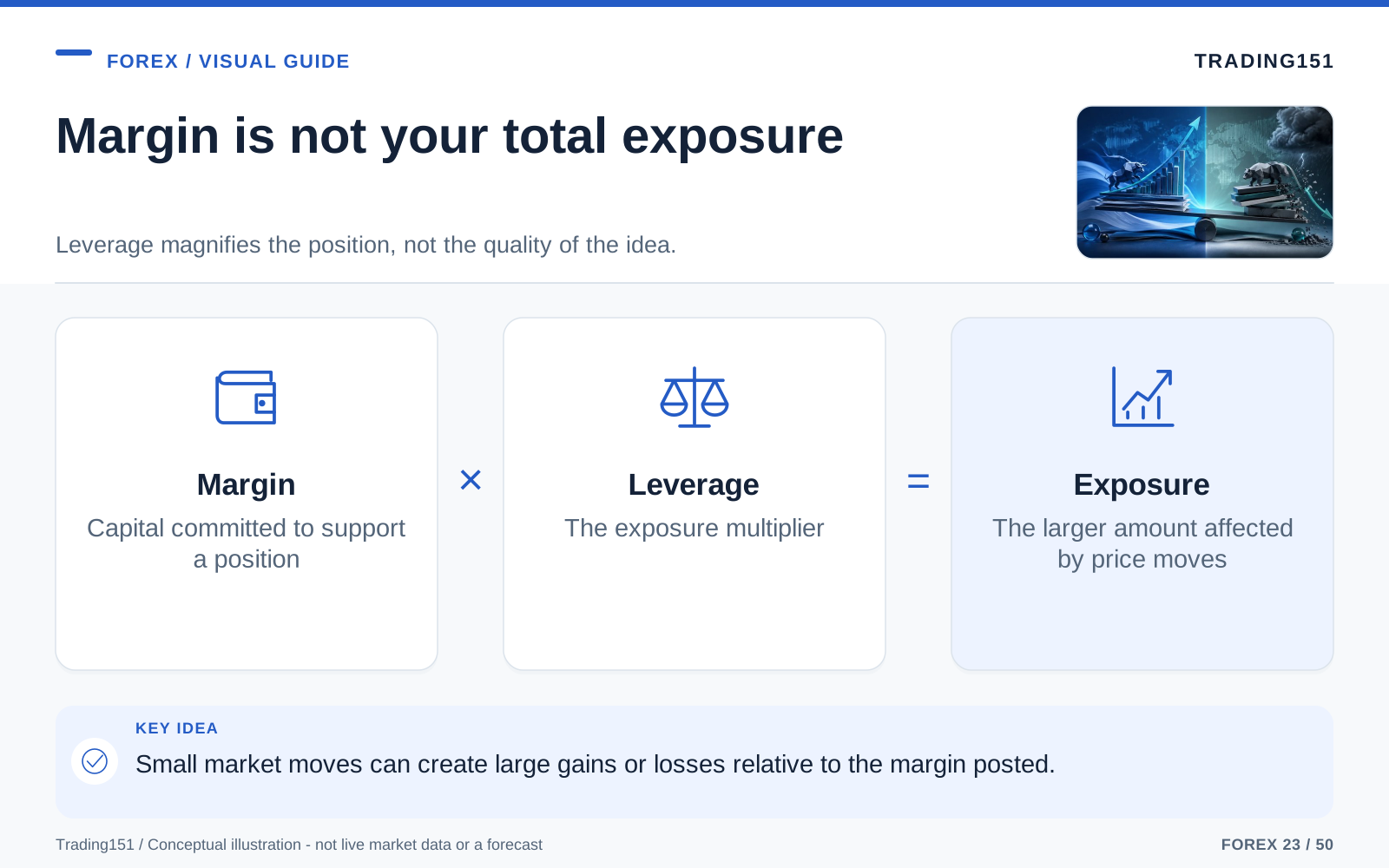
Read this diagram as text
- Margin
- Capital committed to support a position
- Leverage
- The exposure multiplier
- Exposure
- The larger amount affected by price moves
Part 2: Margin Isn’t a Fee. It’s the Deposit That Keeps the Trade Alive
If leverage is your borrowed buying power, margin is the cash you have to lock up to get it.
This is where so many people get confused. A lot of traders hear the word "margin" and assume it’s a hidden broker fee, a commission, or money that just vanishes when they open a trade. That’s completely wrong.
Margin is just collateral. It’s a chunk of your own money that the broker temporarily sets aside to keep your leveraged trade open. It’s a good-faith deposit, plain and simple.
While your trade is active, you can't use that specific chunk of money for anything else. It's still yours, it's still in your account, but it's frozen in place to back up your position.
The Relationship Between Leverage and Margin
Leverage and margin are essentially a seesaw. The higher your leverage, the less margin you need to open a trade. The lower your leverage, the more of your own cash you have to cough up upfront.
It boils down to this:
- Lower leverage = you need more margin.
- Higher leverage = you need less margin.
Let's say you want to control a $100,000 position:
- At 1:1 leverage, you'd need to put up the full $100,000.
- At 1:50 leverage, you’d only need $2,000.
- At 1:100 leverage, you’d need $1,000.
- At 1:500 leverage, you’d only need $200.
That $200 number is what gets people in trouble. Controlling a hundred grand for the price of a nice dinner feels like a cheat code. But there’s no magic here. You’ve just drastically lowered the deposit required. If the market turns against you, it moves against the full $100,000 position size—not your little $200 deposit.
Understanding that one fact will completely change how you look at risk.
Part 3: What’s Really Happening Inside Your Trading Account
To survive in this game, you have to know how to read your platform's dashboard. Those numbers at the bottom of your screen aren't just for show. They are constantly telling you whether your account is healthy or if it's on life support. Your margin figures all talk to each other. Used margin is tied up in active trades, free margin is your safety net for market swings, and your margin level acts as a master health bar. Every broker calculates stop-outs a little differently, so do yourself a favor and read the fine print. Finding out how your broker handles liquidations while you're in the middle of a crashing market is a terrible experience.
Platforms might look slightly different, but these core numbers are universal:
- Balance: This is your actual cash after closed trades. If you deposit $1,000 and haven't closed any trades yet, your balance is a flat $1,000.
- Equity: This is the real-time value of your account, factoring in the open profits or losses floating right now.
Formula: Balance + Floating P/L - Used Margin: The cash currently locked up to support your active trades.
- Free Margin: The cash you have left over to absorb losses or open new trades.
Formula: Equity - Used Margin - Margin Level: Your overall account health. It tells you how much equity you have compared to the margin you're using.
Formula: (Equity / Used Margin) x 100
Once you get it, it all makes sense. Your balance doesn't move until you hit close. Your equity dances up and down with the live market. Your used margin is frozen. And your free margin expands when you're winning and shrinks when you're losing.
That last part is critical. When a trade starts bleeding, your official balance doesn't take the hit first—your equity and free margin do. In plain English, your account loses its flexibility and its safety net long before the loss is officially permanently logged.
A Simple Example
Let's say you have $2,000 in your account, and you open a trade that requires a $200 margin deposit.
- Balance: $2,000
- Equity: $2,000
- Used Margin: $200
- Free Margin: $1,800
- Margin Level: 1,000%
Now, let's say the market drops and you're suddenly down $300.
- Balance: $2,000
- Equity: $1,700
- Used Margin: $200
- Free Margin: $1,500
- Margin Level: 850%
You haven't closed the trade, so your balance still says $2,000, but your account is getting weaker. If it keeps dropping, your breathing room vanishes. This invisible slide is exactly how people suddenly find themselves in deep trouble without realizing how bad it got.
Part 4: Margin Call and Stop Out Aren’t Myths. They’re Built-In Survival Mechanisms
If your floating losses get too big compared to the cash in your account, your broker is going to step in. They aren't doing it to teach you a lesson about discipline; they’re doing it because they refuse to let your leveraged losses put their own money at risk.
This is where margin calls and stop outs enter the chat.
What a Margin Call Really Means
A margin call is a demand to meet the account's margin requirements; its form depends on the broker and product. Some platforms issue warnings, while others can liquidate positions without giving a separate notice or time to deposit funds. Read the agreement before relying on an alert.
Brokers have different thresholds for this, but when your margin level drops to a specific percentage, the platform will likely lock you out of opening any new trades. It’s a giant red flag telling you your account is under severe stress.
You aren't dead in the water yet, but it’s a clear sign that you took on way too much size for the money you have.
What Stop Out Means
If things keep getting worse, the broker pulls the plug. This is a stop out. Once your equity drops too close to your used margin, the system will automatically start closing your trades to stop the bleeding.
The order in which positions are closed depends on the broker's policy. Liquidation is not guaranteed to happen at the displayed price, especially during gaps or thin trading. A stop-out process protects the broker's exposure and should not be mistaken for a guaranteed limit on the client's loss.
For most traders, this is the painful, expensive reality check of what over-leveraging looks like.
A Typical Blow-Up Scenario
Picture a guy with a $1,000 account who opens trades tying up $500 in margin. To him, it seems fine. He’s still got half his money free, right? Wrong. He has left himself almost zero cushion for normal market chop.
A $500 floating loss would reduce equity to $500 and free margin to zero, assuming the required margin remains $500 and ignoring charges. That produces a margin level of 100%. Whether liquidation begins there or at a lower level depends on the account rules; zero free margin is not a universal stop-out threshold.
This is why you’ll hear traders swear up and down that "the market barely moved" before they got wiped out. Looking at a chart, they’re right—it barely moved. But because they were carrying reckless size, their account couldn't survive a standard ripple in the water.
Part 5: Why Leverage Feels So Good Right Before It Feels Terrible
Leverage is dangerous because of the math, sure, but it’s mostly dangerous because of what it does to your brain. It distorts reality. It makes a tiny account feel large, tricking you into thinking you're playing in the big leagues when you're really just taking professional-sized risks with a beginner's budget.
The Excitement Phase
When a highly leveraged trade goes your way, the high is incredible. A tiny shift in the market suddenly generates profits that look huge compared to your initial deposit. It’s exhilarating. You feel like a genius.
And that’s exactly when the dangerous thoughts creep in: “If I made this much today, why not double the size tomorrow?”
A couple of lucky wins will convince a new trader they've cracked the code. The account spikes, their ego swells, they crank up the lot size, and all common sense goes straight out the window.
The Panic Phase
Eventually, the music stops. The same leverage that made you feel invincible starts working against you. A tiny market dip that should be harmless suddenly looks like a fatal blow. You panic. You start moving your stop losses further away, hoping the market will bounce back. You average down on losing trades. You sit there sweating, staring at the screen, praying for a reversal.
At this point, leverage isn't just killing your account balance; it’s destroying your ability to think clearly. Once panic takes over, the account usually flatlines shortly after.
This is the real trap. Leverage applies psychological pressure that most beginners simply don't have the emotional armor to handle.
Part 6: The Difference Between Available Leverage and Real Leverage
This is one of the most vital concepts in Forex, and almost no one talks about it. Adding to the confusion is how market correlation can mask your true exposure. If you buy EUR/USD, buy GBP/USD, and short USD/CHF, it feels like three totally different trades. In reality, you've just placed one large bet that the US Dollar is going to weaken. You aren't diversified; you're stacking risk. That's why smart sizing looks at the whole portfolio, assuming that if the underlying theme fails, all those trades will likely fail together.
Available leverage is simply the maximum limit your broker offers you—like 1:100, 1:500, or whatever your local laws allow.
Real leverage is what you are using in the moment, calculated by comparing the total size of your open trades to your actual cash balance.
Because of this, two people can have the same broker, the same settings, and substantially different risk profiles.
Let’s look at an example:
- Trader A has $10,000 in cash and opens trades worth $20,000. His real leverage is just 2:1.
- Trader B has $10,000 in cash and opens trades worth $200,000. His real leverage is 20:1.
Both guys technically have accounts that allow 1:500 leverage, but only one of them is trading with a cool head.
Bottom line: the limit your broker sets doesn’t mean much. The only question that matters is, How much total risk are you carrying compared to the cash in your pocket?
Part 7: How Professionals Think About Leverage and Margin
Pros don’t obsess over how big of a trade the broker will let them open. They obsess over exactly how much cash they’ll lose if the trade tanks. It’s a simple mindset shift, but it changes the whole game.
A pro figures out their risk first, their trade size second, and thinks about leverage last. An amateur does it backward. They dream up how much money they want to make, pick a huge lot size, and just hope the platform accepts the order.
1. They Decide the Risk Before Entering
Before a pro clicks buy, they already know they are risking exactly 1%, 0.5%, or 2% of their account. The number is set in stone before the trade even exists.
This completely removes emotion from the equation. If you don't cap your risk upfront, you end up sizing trades based on greed, boredom, or revenge. And those are terrible trading strategies.
2. They Use Stop Losses to Define the Math
A stop loss isn't just a safety net; it’s a mathematical tool. It marks the exact spot on the chart where your idea is officially wrong. Once you know that distance, you can calculate your position size perfectly. Entering a trade and figuring out your stop loss later is completely backward.
Sure, a stop loss doesn't promise zero slippage in a crazy news event, but it is hands down the best tool you have for making sure your leverage doesn't turn lethal.
3. They Treat Free Margin Like Oxygen
One of the biggest illusions in trading is looking at high leverage, seeing large free margin, and feeling totally safe—even when you're massively overexposed. That leftover margin gives you a false sense of security.
Veteran traders don't view free margin as spare cash to buy more trades. They view it as their shock absorbers. When the market gets bumpy, that breathing room is what keeps them in the game.
4. When in Doubt, They Size Down
Rookies hate uncertainty, so they try to force big wins by throwing huge size at messy markets. Pros do the exact opposite. If the charts are choppy, a big news event is looming, or they just aren't feeling confident, they cut their position size in half. You don't beat a confusing market by acting aggressive.
Part 8: Position Sizing Is Where Good Risk Management Becomes Real
Ask a struggling trader how they picked their lot size, and they’ll mumble something like, “It looked about right,” or, “I had enough margin left.” That’s not managing risk; that’s just winging it. The right way to do it is to start with the actual dollar amount you are willing to lose, measure the distance to your stop loss, and let the math dictate the lot size. When you do it backward—picking a fat lot size and then cramming your stop loss in uncomfortably tight just to make the math work—you are letting your greed dictate your risk. A good setup can always be traded with a smaller size; you can't make a trade "safer" just by pretending your stop loss is closer than it realistically should be.
Proper position sizing always starts with three simple inputs:
- Your total account balance
- The exact percentage of that money you are okay with losing
- The pip distance from your entry to your stop loss
Once you plug those in, the right lot size calculates itself. This naturally keeps your leverage in check. You stop trading what the broker allows, and start trading what your risk plan demands.
For example, if you have a $2,000 account and want to risk 2%, your absolute maximum loss is $40. If your stop loss is 50 pips away, you simply adjust your lot size so that a 50-pip drop equals exactly $40. Not $400. Not $4.
It sounds ridiculously simple, but this is the hard line between trading and gambling. Gamblers ask, “How big can I go?” Traders ask, “How much can I lose and still be okay to trade tomorrow?”
Part 9: A Tale of Two Traders
Let’s look at a quick real-world example to see this in action.
Two traders each fund an account with $2,000. They use the same broker, they both have 1:500 leverage available, and they both spot the same exact breakout on EUR/USD.
Trader One: Chasing the Jackpot
- Mindset: “This is the one. I need to make some real money today.”
- Position: 2 standard lots.
- Exposure: Absolutely large compared to his account balance.
- Reasoning: The platform accepted the order, so it must be fine.
The market dips 50 pips against him. In Forex, 50 pips is nothing. It’s just daily background noise. But because his size is so huge, the financial hit is devastating. He’s staring at a large red number, his heart rate is sharply higher, and he’s probably about to make a terribly emotional decision.
The leverage didn't fail him. He failed himself by using that leverage to carry a trade his account had no business holding.
Trader Two: Defending the Capital
- Mindset: “If this trade fails, it’s just another minor business expense.”
- Risk limit: 2% of the account ($40).
- Stop loss: 50 pips.
- Position size: Calculated perfectly so that a 50-pip loss equals a $40 hit.
The market takes the same 50-pip dip. Trader Two gets stopped out, loses his forty bucks, and moves on with his day. His account is 98% intact. It’s a minor annoyance, not a tragedy.
Both guys had the same 1:500 leverage. One used it to execute a disciplined plan. The other used it to blow himself up.
Part 10: The Hidden Trap of “I Still Have Free Margin”
This is the classic beginner pitfall. You open a leveraged trade, look down at your used margin, and realize it's barely a blip. You’ve still got plenty of free margin sitting there. The account looks super healthy. It almost feels like a waste not to use it.
And that’s when the whisper starts: “I could probably throw on one more trade.”
One extra trade turns into two. Two turns into three. You keep building exposure, completely ignoring the fact that your risk is snowballing.
Sure, on paper, you have free margin. But in reality, your account is turning into glass. What happens if major news drops and hits all three pairs at once? Volatility spikes, things get heavily correlated, and what felt like three smart, separate ideas suddenly act like one gigantic, doomed bet.
This is how traders accidentally build a house of cards. Each trade felt affordable by itself, but combined, they leave the account totally defenseless against a bad market swing.
Here’s how you should look at free margin: It is not spare cash begging to be spent. It’s your safety net. It’s the buffer that stops a rough Tuesday from turning into a margin call.
Part 11: Practical Rules for Using Leverage Without Getting Burned
You can never completely remove risk from the markets. But you absolutely can manage your leverage so that a normal bad trade doesn't become the end of your career.
1. Stop Letting the Broker Dictate Your Size
Your broker’s maximum leverage limit is not a suggested target. It’s just the mechanical limit of the software. Treat it as such.
2. Lock in Your Risk Before You Enter
Decide the exact percentage of your account you are willing to lose on a single idea. Build the entire trade around that specific dollar amount.
3. Stop Losses Aren't Optional Decor
Put your stop loss where the chart proves your idea was wrong. Don't just pick a random, tight distance just so you can justify trading a bigger lot size.
4. Look at the Big Picture
Having five small, highly correlated trades is basically just having one dangerously big trade. Always monitor your total portfolio risk.
5. Protect Your Free Margin
Most blown accounts don't happen because the trader lacked a good strategy. They happen because they left zero room for the market to breathe.
6. Chill Out During the News
High leverage and wild news spikes are a toxic mix. If you plan on holding through a major central bank announcement, you better slash your position size.
7. Play to Survive
Your primary job isn’t to hit home runs. Your primary job is to protect your money long enough to figure out what you're doing.
Margin is a deposit, not a loss limit
Consider a hypothetical $20,000 position supported by $1,000 of margin. A 1% move against the position represents about $200 before financing and trading costs: one fifth of that deposit. The market has not made an unusually large move, but the account has experienced one. This is why judging a trade by its required margin can be misleading.
Required margin and intended risk answer different questions. Margin determines whether the broker will permit the exposure. A risk estimate considers position size and a planned exit, while allowing for the possibility that the exit will execute at a worse price. Using every dollar of available margin leaves little room for an ordinary fluctuation, let alone a gap.
Read how the account treats several positions together. Hedged positions may still incur costs or require margin, and positions that appear unrelated can lose money at the same time. A broker can also change margin requirements under its terms. Free margin that looked comfortable when a trade opened may not stay comfortable.
Protections depend on the jurisdiction, product, and client classification. The UK's retail CFD rules, for example, include leverage limits and negative balance protection; they should not be assumed to apply to an offshore or professional account. Before funding an account, know the closeout trigger, which positions may be closed first, and whether losses can exceed the money deposited. Those details matter more than the largest leverage ratio on the sales page.
Measure leverage across the account
Several modest-looking positions can create substantial combined exposure. Calculate the notional amounts, the currencies involved, and the effect of a common adverse move. The margin displayed beside each trade does not reveal the whole account's vulnerability. Keep enough attention on aggregate exposure that a series of individually acceptable orders does not quietly exceed the intended risk budget. 1, 2, 3
The Takeaway
When you strip away all the fancy terminology, leverage and margin are pretty straightforward. Leverage is the tool that lets you swing a bigger bat than your cash balance would normally allow. Margin is just the deposit the broker locks up to make that happen. Without them, retail Forex just wouldn't work. Keep in mind, though, that the market isn't perfect. Prices can gap, and stop losses can occasionally slip if volatility goes sharply higher. Keeping your leverage modest is what ensures that a nasty slippage event doesn't nuke your whole account. The best way to use leverage is honestly the most boring way: use just enough of it to make your proper risk management work, and completely ignore the rest.
Just because you can push the limits doesn't mean it's safe.
The core issue is never the leverage itself. It’s how you choose to use it. It's about how much total exposure you load up on, how much breathing room you leave yourself, and whether your lot size is based on cold math or emotional greed. A trader who understands how margin works but refuses to act with discipline will eventually go broke. But a trader with average chart skills and iron-clad risk management will survive in this game far longer than anyone expects.
The smartest question you can ask isn't, “How much can I make on this?” It’s, “What happens to my account if I’m totally wrong?”
If you can honestly answer that second question before you click enter, and you're at peace with the math, leverage stops being a trap and becomes a highly effective tool. That’s the moment you stop gambling and start trading like a pro.
Key Takeaways:
- Leverage boosts your buying power, letting you control bigger positions with less cash.
- Margin is just the collateral required to keep that trade open—it is not a fee.
- High leverage means you need less margin to enter a trade, but it doesn't reduce your actual financial risk by a single penny.
- Equity, free margin, and margin level are the true indicators of whether your account is healthy or dying.
- Margin calls and stop outs kick in automatically when your losses eat up too much of your equity.
- The only real ways to protect yourself from leverage risk are proper position sizing, hard stop losses, and plain old self-control.
- The goal isn't to max out your leverage. The goal is to only use what your account can safely handle.
Sources and further reading
- BIS: April 2025 FX turnover, September 2025 preliminary release
- FCA: Firm Checker
- SEC Investor Bulletin: Stop, Stop-Limit and Trailing Stop Orders
- CFTC: Eight things to know before trading forex
Editorial revision: 7 October 2026. Numerical scenarios are hypothetical unless identified as historical. References support the added explanations and selected corrections; rules and product terms should be checked again before acting.