
Central banks influence currencies through policy rates, communication, balance-sheet measures, and sometimes direct intervention. Markets respond to what those actions change about expectations, not just to whether a rate went up or down. A hike can accompany a falling currency when investors expected something stronger or hear a weaker outlook for future policy.
Who the Central Banks Are and Why Traders Watch Them So Closely
Every major economy relies on a central bank. On paper, their job description sounds a bit dry: keep inflation in check, prevent financial meltdowns, and try to keep people employed. In reality, it’s an delicate balancing act. Every move they make ripples outward, directly impacting mortgage rates, stock markets, and—most importantly for us—currency valuations.
Of course, not all central banks have the same clout. In the currency world, a select few completely dominate the radar.
- The Federal Reserve (Fed): The US central bank is the undisputed heavyweight. Because the US dollar is the backbone of global trade and the world's primary reserve currency, whatever the Fed does sends shockwaves globally. When the Fed moves, every market on the planet feels it.
- The European Central Bank (ECB): The ECB calls the shots for the entire eurozone. Imagine trying to set one monetary policy for over a dozen different countries, all with substantially different economies and political headaches. It's a large juggling act, making the ECB one of the most complex banks to follow.
- The Bank of Japan (BoJ): Historically famous for keeping interest rates near zero (or below) and utilizing experimental policies. Because Japan is an export powerhouse and the yen is a favorite for funding trades, the BoJ plays an outsized role in how money flows globally.
- The Bank of England (BoE): The UK economy might not rival the US or the Eurozone in size, but London is still a large global financial hub. Because of that, the BoE punches well above its weight class.
You’ll also hear plenty about the Swiss National Bank, the Reserve Bank of Australia, the Bank of Canada, and the People’s Bank of China. They can definitely cause violent market swings when they catch traders off guard. But if you want to grasp the core rhythm of the Forex market, the "Big Four" are where the real action is.
Why do we care so much? Because these groups don't just move money around. They dictate what money costs.
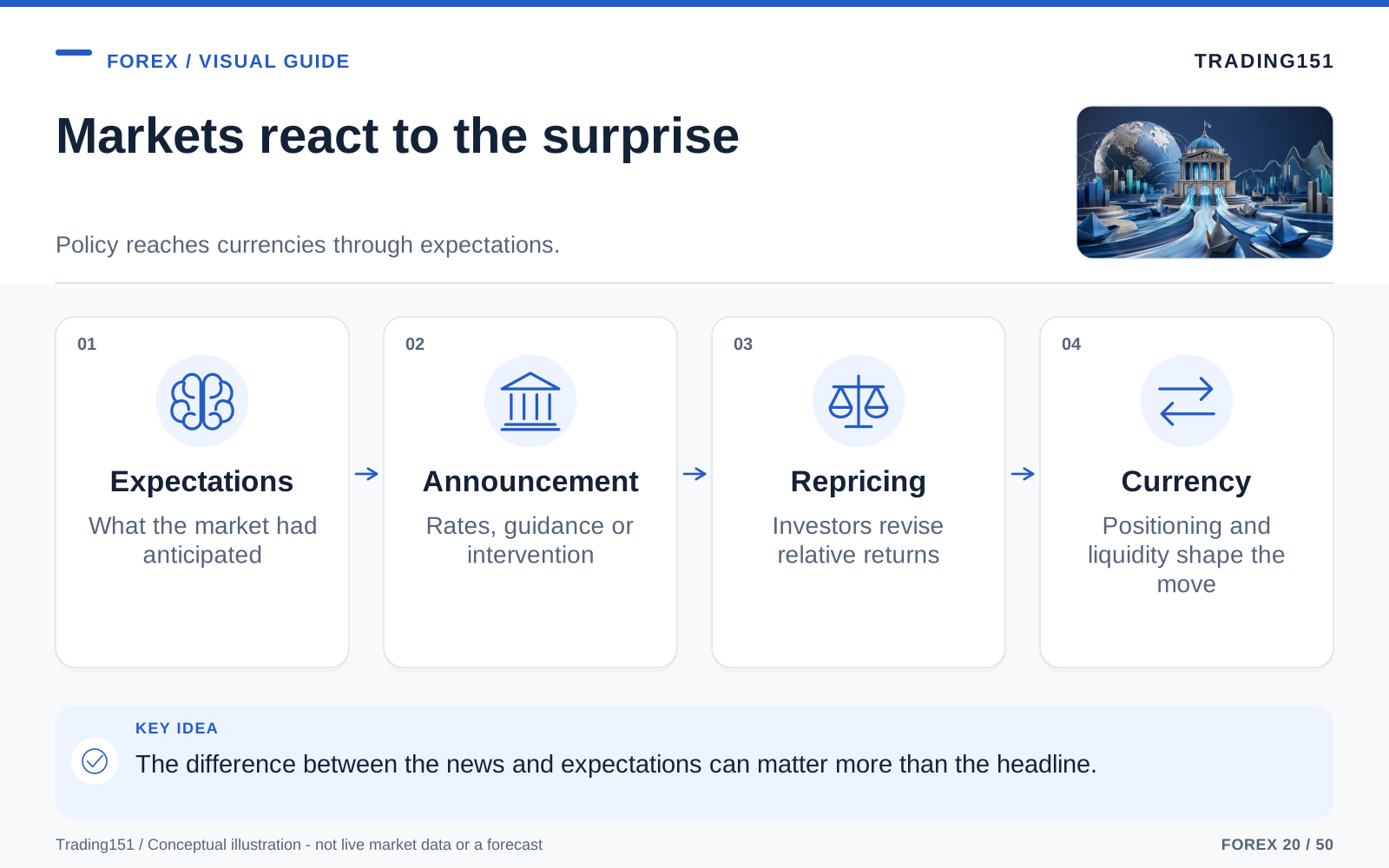
Read this diagram as text
- Expectations
- What the market had anticipated
- Announcement
- Rates, guidance or intervention
- Repricing
- Investors revise relative returns
- Currency
- Positioning and liquidity shape the move
Why Currencies React So Strongly to Central Bank Decisions
Think of a currency as a stock in a specific country. Just like a stock, people only want to hold it if they think they’re getting a good return. That return could be high interest, a safe haven during a crisis, or just the belief that the currency's value will climb over time. But markets don't just react to a headline in a vacuum. Traders are constantly comparing what the bank did versus what they expected them to do. A bank might raise rates, but if the market was bracing for a bigger hike—or if the bank hints they're done raising rates for the year—the currency will tank. The real shock value lives in the gap between the actual announcement and what the market had already priced in.
And central banks have their hands on all those levers.
When a central bank hikes interest rates, that country’s currency suddenly looks a lot more tempting. Investors realize they can get a better yield on government bonds and savings, so capital floods in. When rates are slashed, the exact opposite happens. The money leaves in search of better returns elsewhere, dragging the currency down with it.
It sounds perfectly logical, but Forex is rarely that simple. Traders aren't just reacting to today's news. They are obsessed with predicting what the central bank is going to do next month, next quarter, and next year. You aren't trading the present; you're trading the future.
That’s why a seemingly boring sentence buried in a press release can cause absolute chaos on the charts. Everyone is hunting for breadcrumbs about what comes next.
The Central Bank Toolbox
Central banks have a specific set of tools to steer their economies, and each one leaves a distinct footprint on the currency charts. Some are direct policy changes; others rely entirely on psychology and market manipulation. To survive as a trader, you need to figure out a bank's "reaction function"—basically, the exact pain points that will force them to act. Are they laser-focused on inflation right now? Are they panicking about job losses? Figuring out what data they care about most helps you filter out the daily noise and anticipate their next move.
1. Interest Rates: Still the Main Lever
Interest rates are the undisputed king of the central bank toolbox. They dictate borrowing costs, reward savers, and essentially decide how attractive a currency is on the world stage.
Think about how you handle your own savings. If one bank offers you a 0.5% yield and the one down the street offers 5%, you’re moving your cash. Institutional money managers do the same thing, just with billions of dollars—which is enough to swing entire exchange rates.
If the Fed is keeping US rates high while the Bank of Japan refuses to budge from rock-bottom rates, big money prefers the US dollar over the Japanese yen. That large flow of capital pushes the dollar up and forces the yen down.
- Higher rates generally boost a currency because investors get paid more to hold it.
- Lower rates usually drag a currency down as capital chases better yields elsewhere.
Of course, there are always exceptions. If a central bank is panic-hiking rates because their economy is in a death spiral or inflation is completely out of control, the currency might not catch a bid at all. Context is everything. A confident, calculated rate hike strengthens a currency. A desperate one just scares investors away.
2. Quantitative Easing and Quantitative Tightening
Sometimes, dropping interest rates to zero just doesn’t fix the problem. That’s when central banks bust out the heavy artillery: quantitative easing (QE).
During QE, a central bank basically creates money to buy up assets like government bonds. The idea is to flood the financial system with cash, drive down long-term borrowing costs, and keep the economy from dying. It’s a great crisis tool, but it radically alters how the market treats that currency.
By flooding the market with new money, the currency’s value naturally gets diluted. It’s not always a violent drop, but large, long-term QE programs almost always put a heavy ceiling on a currency's potential.
Quantitative tightening (QT) is the hangover cure. The bank stops printing, lets those bonds mature, and sucks that excess cash back out of the system. This tightens the economy and usually gives the currency a nice tailwind since the money supply is shrinking.
3. Forward Guidance: Moving Markets With Words
This is where things get really interesting. Central banks don't always need to change a policy to move a market. Sometimes, all they have to do is open their mouths.
In finance, this is called forward guidance. It’s the art of dropping hints. They might do this in an official statement, a post-meeting press conference, or even a seemingly casual comment during a TV interview.
Traders obsess over these breadcrumbs because words always precede actions. If a central bank chief casually mentions that inflation is "stickier than expected," traders immediately start pricing in future rate hikes. If they sound slightly nervous about a slowing job market, the market starts betting on rate cuts—long before a cut is on the table.
This is why central bank speeches feel so ridiculously robotic and over-rehearsed. Every syllable is weighed. Changing a phrase from "some progress" to "substantial progress" might sound trivial to a normal person, but to algorithmic trading bots and hedge funds, it's the trigger to buy or sell billions.
4. Balance Sheet Policy and Liquidity Measures
When the global system hits the fan, central banks can unleash emergency lending programs and swap lines to keep credit flowing. While these aren't directly aimed at exchange rates, currency traders watch them like hawks. Why? Because anything that impacts market liquidity or systemic fear changes how cash flows across borders.
During a large panic, a currency (like the US dollar or Swiss franc) might skyrocket simply because people are terrified and want a safe place to hide their wealth. When the central bank steps in and calms the panic with emergency liquidity, that "safe haven" premium evaporates and the currency drops. It’s all driven by market psychology.
Hawks, Doves, and Why Tone Matters So Much
If you watch financial news for more than ten minutes, you’ll hear policymakers called hawkish or dovish. But keep in mind, these aren’t permanent personality traits. A central banker might be an aggressive hawk when inflation is raging, and pivot to a cautious dove a few months later if the economy stalls. Traders aren't just listening to what they say; they are comparing today's tone to what the official said last time. Swapping the word "further tightening" for "restrictive for some time" is a subtle shift, but it’s enough to send markets into a frenzy.
Basically, a "hawk" is someone terrified of inflation. They want higher interest rates and tighter monetary policy to keep prices down, even if it hurts economic growth.
A "dove" cares more about keeping people employed and the economy growing. They prefer lower rates and cheap money, and they’re willing to tolerate a little inflation to get it.
While the labels are handy, you have to read the room. You have to ask yourself what they sound like today, given the current data.
A lot of major Forex moves boil down to a simple question: did they sound tougher or softer than we thought they would? If the market was betting on a fiercely hawkish speech and the central banker only sounds mildly hawkish, the currency is going to dump. It's all about expectations.
Direct Intervention: When Words Aren’t Enough
Central banks usually like to play the long game. They tweak rates, guide expectations, and let the open market sort out the exchange rate. But every so often, things get so out of hand that they have to physically step in.
This is known as direct intervention. It’s exactly what it sounds like: the central bank steps into the open market and starts aggressively buying or selling their own currency to force the price exactly where they want it.
It doesn't happen often, but when it does, it’s violently volatile.
If a currency gets too strong, a country’s exports become way too expensive for foreigners to buy. If it gets too weak, importing basic necessities like food and oil causes severe domestic inflation. When the market pushes a currency too far, too fast, policymakers will intervene to stop the bleeding.
For retail traders, intervention is a nightmare scenario. A chart that’s been quietly trending for weeks can instantly look like it was hit by a freight train, wiping out stop-losses in the blink of an eye.
Japan and the Weak Yen
Japan is the textbook example of this in recent years. As the yen severely weakened, it helped their exporters but made importing energy massively expensive for regular citizens. When the pain got too high, Japanese authorities drew a line in the sand, dumped billions of dollars, and bought up the yen to forcefully prop it up.
It’s the ultimate flex. They are showing the market they are willing to burn through their actual foreign reserves to defend a price level. Traders might try to test them, but fighting a central bank during an active intervention is a great way to blow up your account.
The Swiss Franc Shock
Then there are the Black Swan events. January 2015 is permanently burned into the brains of older traders. For years, the Swiss National Bank had artificially capped the value of the Swiss franc against the euro. Everyone assumed that boundary was bulletproof. Until, suddenly, they scrapped it without warning.
It was absolute carnage. The franc exploded in value in minutes. Retail accounts went deep into the negative. Major brokerages went bankrupt. It fundamentally changed how people viewed risk in the Forex market.
The takeaway? Central banks make the rules, which means they can break them whenever they want. And you will not get a warning.
Why the Market Tries to Read Central Banks Before They Act
The Forex market has zero patience. No one wants to wait for the actual interest rate decision. Traders spend weeks trying to front-run it by obsessing over inflation data, job reports, and retail sales—because every new data point changes the odds of what the bank will do next. You don't need a PhD in economics to trade, but you do need to know if a rate hike is a coin toss or a 100% certainty. The market's existing bias dictates how hard it will react to a surprise.
This is why a random inflation report on a Tuesday can cause a large currency spike. If inflation comes in hot, traders instantly assume the central bank will have to hike rates to cool it down. Every piece of data is just a proxy for central bank action.
When the data changes the narrative, the currency follows.
It's also why trading the actual rate decision is tricky. Sometimes a bank hikes rates exactly as expected, and the currency flatlines. Then, during the press conference thirty minutes later, the chairman says something mildly pessimistic and the currency plummets. The real volatility isn't in the decision itself; it's in the clues they drop about the future.
The Relationship Between Central Banks and Traders
It’s easy to picture central banks and retail traders locked in a battle against each other, but it's a lot more symbiotic than that. They are constantly feeding off each other.
Central banks need the financial markets to do their dirty work. If they raise rates to slow down the economy, they need bond yields to rise and lending to tighten. Traders basically act as the delivery mechanism for the bank's policy.
At the same time, policymakers are glued to the charts. A calm market means investors buy into the narrative. A substantially volatile market means investors think the central bank has lost control of the wheel.
It's a continuous feedback loop. The bank makes a move, the market reacts, and the bank uses that reaction to plan their next step.
The Carry Trade
Nothing highlights this dynamic better than the carry trade. It's a classic strategy: you borrow money in a currency with ridiculously low interest rates, and you invest it in a currency with high interest rates. You just sit back and pocket the difference.
In a calm market, it's virtually free money. But the entire trade relies on central bank policies staying diverged. If the bank with low rates starts hiking, or the bank with high rates starts cutting, the easy money disappears.
When that gap closes, it gets ugly fast. Everyone rushes for the exits at the same time, causing violent, face-ripping reversals in the currency markets.
A Real-World Example: The Post-Pandemic Inflation Shock
You don't even have to look far back in history to see this play out. The post-pandemic era was basically a masterclass in how central bank divergence drives the Forex market.
When COVID hit, every central bank panicked. They slashed rates to zero and printed trillions to keep the global economy afloat. But then came the hangover: vicious, sticky inflation.
What happened next dictated currency trends for years. Central banks were forced to hike rates to kill inflation, but they didn't all do it at the same pace.
The US Federal Reserve went aggressive, jacking up rates fast. Other countries dragged their feet, either because they were scared of causing a recession or their economies just couldn't handle higher borrowing costs. Because the US offered significantly better yields, the US dollar went on an absolute tear against almost every other major currency.
This wasn't just theory. Traders were simply looking at the board and asking, "Who is going to keep rates the highest, for the longest?" For a long time, the answer was the Fed, and the dollar charts reflected that.
That is central bank divergence in a nutshell. It’s not just financial jargon; it is the absolute best engine for finding large, sustained trends in Forex.
Why Retail Traders Often Underestimate Central Banks
When you first get into Forex, it’s easy to get obsessed with candlestick patterns, RSI indicators, and perfectly drawn support lines. And hey, technical analysis is great. But too many retail traders treat macroeconomics like boring background noise, completely ignoring the fact that it’s the engine driving the very patterns they are trying to trade.
A "perfect" head-and-shoulders pattern will get absolutely obliterated if a central bank suddenly pivots. A strong support zone will shatter if a governor unexpectedly hints at a rate cut.
This is why professionals live and die by the economic calendar. They know exactly when the rate decisions are happening. They know when the inflation data drops. They understand that they aren't just trading lines on a screen—they are trading institutional policy and market expectations.
The Deeper Truth: Central Banks Trade in Confidence
Ultimately, central banks are in the business of selling confidence. People need to believe that prices won't spiral out of control, that the banks won't collapse, and that their fiat currency will still have value tomorrow.
That illusion of control is fragile. If the market starts to think a central bank has lost its grip on inflation, the currency will tank. But if a central bank has unshakeable credibility, they can calm a volatile market with a single well-timed speech.
A central bank that communicates poorly, flips-flops on policy, or caves to political pressure loses that credibility fast. In Forex, "belief" isn't some abstract concept—it’s the glue holding the entire fiat system together.
Compare the decision with what was already expected
Consider two hypothetical decisions. In the first, a central bank raises rates by a quarter point when that move was widely expected. In the second, it leaves rates unchanged when another increase had been strongly anticipated. The first action is a hike and the second is no change, but the larger information surprise may be the decision to pause.
The surrounding documents can matter more than the headline. Read the statement, projections where available, and the explanation at the press conference. Distinguish a commitment from conditional guidance. A central bank saying it will respond if inflation persists is not promising a fixed sequence of future moves regardless of the data.
Also separate the roles of public authorities. Responsibility for setting monetary policy and authorizing currency intervention can differ by country. A finance ministry may make an intervention decision that the central bank implements as agent. Describing every official currency purchase as an independent central bank policy choice can be inaccurate.
For a trading record, write down the expected outcome before the announcement and the actual change afterward. That reduces the temptation to invent an explanation from the price move alone. Even a well-understood policy surprise does not guarantee a tradable entry: spreads, rapid repricing, and subsequent interpretation can make execution much less orderly than the retrospective story.
Compare the decision with the expected path
A rate decision is one point in a larger policy outlook. Markets may respond to the accompanying guidance, vote distribution, forecasts, or explanation of inflation risks as much as to the announced rate itself. A widely anticipated increase can therefore produce a different reaction from an unexpected one of the same size.
Before interpreting the move, write down what was expected and which part of the release changed that view. This keeps the analysis from becoming circular: a rising currency is not, by itself, proof that the statement was hawkish. The evidence should come from the decision and its context, not just the price that followed. 1, 2
Conclusion: The Market Moves, but Central Banks Set the Conditions
You've probably heard the old saying: don’t fight the Fed. In the Forex market, that rule applies to all the major central banks. You don't want to bet against the people who print the money and decide what it costs.
Sure, they don't micromanage every 5-minute candle on your chart. They make mistakes, and sometimes severe economic shocks force their hand. But when you look at the long-term, macroeconomic trends, they are the undeniable heavyweights of the market.
Understanding this dynamic changes everything. It explains why a currency is falling despite a strong economy, or why a single speech can trigger a large rally. The true value of a currency isn't just about what's happening right now—it's about where the big money thinks the central bank is steering the ship.
So, the next time you see a large green or red candle wipe out a chart, don't just look for a technical reason. Look under the hood. Which bank just changed its tone? What did the market expect, and what did the policymakers deliver? Smart traders let the dust settle, read between the lines of the press conference, and trade the new reality. Central banks build the playing field; your job is just to figure out the rules of the game.
Sources and further reading
- Bank of England: Money Creation in the Modern Economy
- BIS: April 2025 FX turnover, September 2025 preliminary release
Editorial revision: 7 October 2026. Numerical scenarios are hypothetical unless identified as historical. References support the added explanations and selected corrections; rules and product terms should be checked again before acting.