Interest rates affect stocks through borrowing costs, investment alternatives, and the value investors place on future cash flows. Those channels do not always pull in the same direction. A rate cut prompted by a deteriorating economy can coincide with falling stocks, while higher rates can accompany strong business conditions. The reason for the change matters as much as the change itself.
Interest Rates Are the Price of Money
When you hear on the news that "interest rates went up," they’re usually talking about a big benchmark rate set by a central bank—like the Federal Reserve in the US. Other countries have their own versions, but the gig is the same. The central bank tweaks a short-term rate that eventually dictates the cost of borrowing for everyone. But keep in mind, not all rates hold hands and jump together. Central banks handle the short-term stuff, while long-term bond yields are busy reacting to inflation fears, economic growth, and future predictions. Things like mortgage rates and corporate loans usually care a lot more about those market yields than whatever overnight rate the Fed just announced.
Obviously, you and I aren't calling up the Federal Reserve to finance a new car. But these benchmark rates trickle down through the entire financial infrastructure. Banks use them as a baseline. Bond markets shift based on them. Lenders use them to price risk. Soon enough, that one central bank decision shows up in your credit card APR, mortgage quotes, savings account yields, and the cost of business loans.
Put simply, an interest rate is the price of renting someone else’s money. When rates are low, money is cheap. Taking on debt feels painless, business expansions look like no-brainers, and people would rather spend their cash now than sit on it. But when rates spike, money gets expensive. Debt suddenly hurts, hoarding cash in a savings account pays off, and both families and CEOs think twice before swiping the card.
That shift in how we all behave is exactly what the stock market cares about. A stock isn't just a blinking ticker symbol; it’s a tiny slice of a company’s future profits. Anything that messes with those future profits—or changes how much people are willing to pay for them today—is going to move the share price.
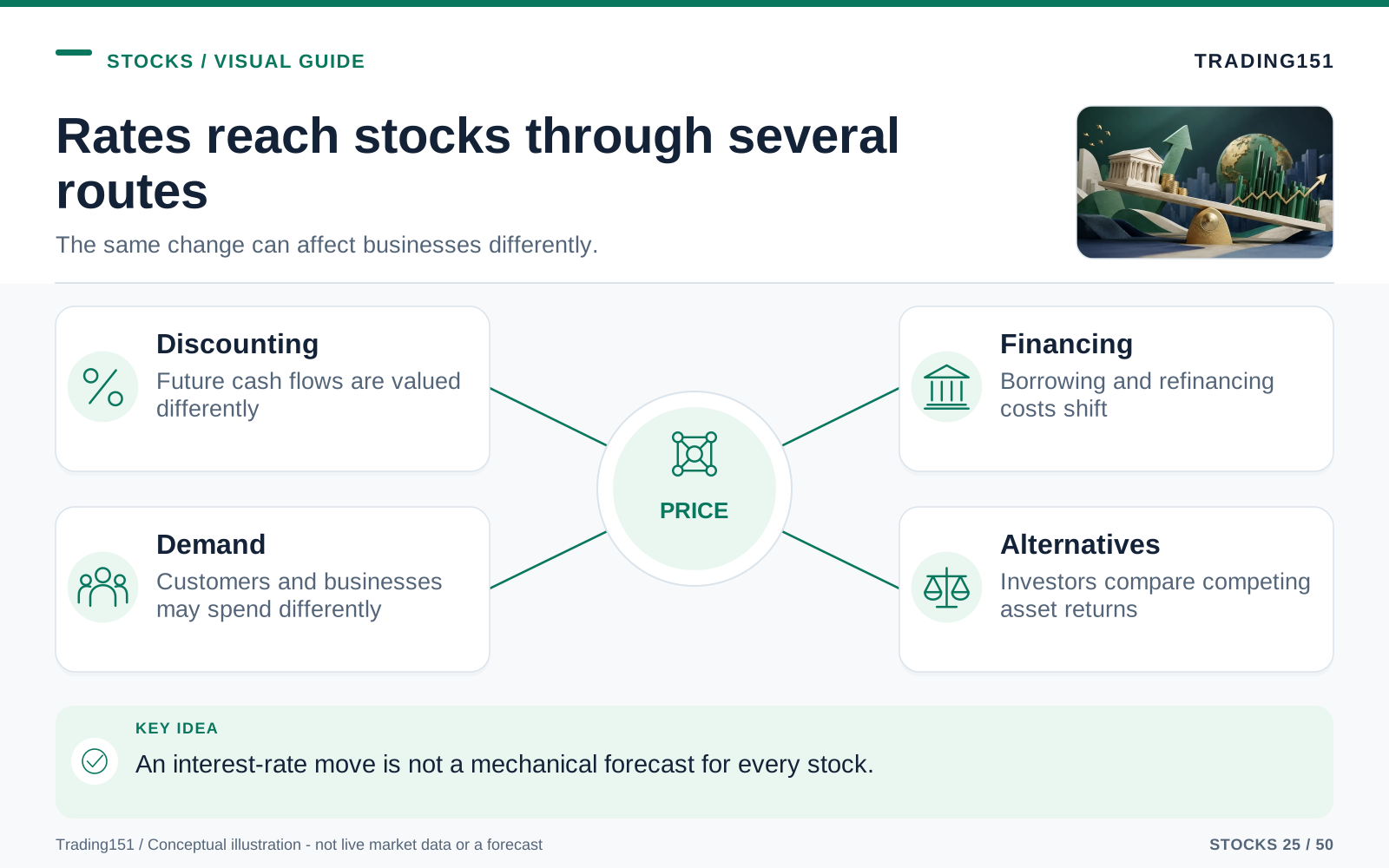
Read this diagram as text
- Discounting
- Future cash flows are valued differently
- Financing
- Borrowing and refinancing costs shift
- Demand
- Customers and businesses may spend differently
- Alternatives
- Investors compare competing asset returns
Higher Rates Put Pressure on Companies
Picture a company that wants to build a new warehouse, upgrade its software, and hire a few hundred people. If borrowing money is practically free, the math is pretty forgiving. They can take out a loan or issue some bonds without sacrificing much of their future cash flow. The expansion doesn't even need to be substantially successful to make sense; it just needs to earn a tiny bit more than the rock-bottom cost of the loan.
Now flip the script. Rates are up. The company still wants that warehouse, but the loan isn't cheap anymore. The interest payments are going to eat into their cash, meaning the new project has to be a guaranteed home run to justify the cost. Management might decide to put the warehouse on hold, freeze hiring, or scrap the plan altogether. And if the company is already swimming in old debt? It gets much worse. Eventually, they have to refinance those old loans, and the new debt is going to come with a much steeper monthly bill.
This is a big deal because a business is about more than just bringing in sales. You can sell a million products, but if your costs are rising faster than your revenue, investors are going to be disappointed. Interest payments are a large cost. When a big chunk of a company's cash is suddenly being handed over to lenders, there's less left over for dividends, stock buybacks, research, or anything else that drives growth.
Wall Street judges public companies harshly on their bottom line. If higher interest payments start eating into profit margins, analysts are going to slash their forecasts. Then, investors ask themselves a pretty logical question: "If this company is going to make less money than I thought, why am I paying top dollar for its stock?" People start selling, demand dries up, and the price drops.
But this doesn't happen evenly across the board. A large, established company with a mountain of cash and barely any debt might just shrug off a rate hike. On the flip side, a trendy, fast-growing startup that survives on borrowed cash and the patience of its investors is going to feel the squeeze immediately. That’s why speculative stocks usually get absolutely hammered when rates rise, while boring, cash-rich businesses tend to hold their ground.
Consumers Feel It Too
Businesses don't exist in a vacuum—they need us to buy their stuff. And just like companies, regular people change their spending habits when money gets tight.
Think about a family looking to buy a house. With a 3% mortgage, the monthly payment might fit right into their budget. But bump that rate up to 7%, and suddenly that exact same house is totally unaffordable, even if the asking price hasn't budged. They might decide to keep renting, buy a smaller place, or just put the whole thing on hold. And that one decision ripples out. It means they aren't buying new furniture, hiring movers, shopping for paint, or upgrading appliances.
The same logic applies to cars, vacations, laptops, and kitchen renovations. When credit card rates sting, carrying a balance becomes painful. When auto loans are expensive, you keep your old car running for another year. Throw in constant news headlines about inflation and looming recessions, and even people who aren't in debt start clutching their wallets a little tighter.
When everyday folks stop spending, businesses feel it fast. Retailers sell fewer luxury items. Airlines notice empty seats. Restaurants see their Friday night crowds thin out because people are cooking at home. Tech companies realize nobody is upgrading their phones this year. Eventually, all those skipped purchases show up in a company's quarterly earnings.
Wall Street doesn't wait around for the official earnings report, though. Investors try to read the tea leaves. If they think higher rates will choke consumer spending six months down the road, they’ll start dumping retail and travel stocks today. That’s why the market often freaks out before the average person even notices a change in the economy. Stocks are always trying to price in the future before it happens.
The Valuation Effect: Why Future Profits Become Less Exciting
There’s another, slightly nerdier reason interest rates matter, and it has more to do with tomorrow's promises than today's reality. In the investing world, a company is basically valued on the cash it’s expected to rake in down the line. A dollar you earn next year is worth something today. A dollar you earn ten years from now is also worth something today, but a lot less. The longer you have to wait for the payoff, the less it's worth right now. This is a lot like bond duration: if a company's value relies entirely on profits projected way out in the future, its stock price is going to be sensitive to rate changes.
Finance geeks call this "discounted cash flow." The jargon is clunky, but the concept is just common sense. If I offer you $1,000 right now or $1,000 in ten years, you’re taking the cash today. You could invest it, spend it, or just avoid the risk that I go broke and never pay you. Waiting has a price tag.
Interest rates essentially set that price tag. When rates are near zero, the future looks valuable. Investors are totally fine paying top dollar for companies that are bleeding cash today, as long as they promise large profits a decade from now. That’s why growth stocks tend to go on an absolute tear when money is cheap. Their whole appeal relies on profits that are years away.
But when rates rise, that math gets severe. Those distant future profits are suddenly discounted much more heavily, meaning they're worth a lot less today. The company might still be great, and its future might still be bright, but investors just aren't willing to pay a premium for it anymore. A startup promising a windfall in 2035 suddenly has to compete with safe, boring investments that are handing out decent cash right now.
This is why flashy tech stocks and early-stage companies get crushed when rates go up. It’s not that their software got buggy or their CEO forgot how to run the business. The market is just doing the math and saying, "Those future profits are cool and all, but in a world where I can get a decent return on a risk-free bond, I'm not waiting ten years for a payday."
Bonds Become Real Competition
Stocks are constantly fighting for your money. You can buy shares, sure, but you can also buy bonds, stash cash in a high-yield savings account, buy real estate, or invest in commodities. The appeal of each option changes the second interest rates move. It's not a robotic equation, though—investors are weighing expected returns against volatility, liquidity, and taxes. A strong bond paying 5% might lure money away from dividend stocks, but a growing company can still hold its own if its potential upside is worth the extra risk. It's all about relative value.
For a long time after the 2008 crash, and again during the pandemic, playing it safe paid you practically nothing. Savings accounts offered literal pennies. Government bonds yielded so little that if you wanted to grow your wealth, you had to buy stocks. Wall Street even had a catchy acronym for it: TINA (There Is No Alternative).
When safe assets pay zero, the stock market looks tempting, even with all its wild swings. People gladly take on the risk because the alternative is watching inflation slowly eat their cash. That desperate search for returns pumps up stock prices, especially for companies with a great growth story to tell.
But when interest rates climb, the vibe shifts entirely. Suddenly, a boring Treasury bill, a CD, or a money market fund starts offering a return you can be proud of. For a cautious investor, that is a large game-changer. Why stomach the rollercoaster of the stock market if you can get a guaranteed return just for sitting on your hands?
Large institutional investors—think pension funds, insurance companies, and university endowments—obsess over this. When bond yields get high enough, they naturally start sliding billions of dollars out of stocks and into fixed income. It’s not a mass panic where everyone sells everything, but when giant pools of money quietly head for the exits, stock prices inevitably feel the pressure.
The exact opposite happens when rates fall. If safe yields drop back to zero, money floods back into the stock market looking for action. That flood of cash can push share prices up, sometimes long before the actual economy starts looking any better.
Lower Rates Can Lift Stocks, But Not Always for Happy Reasons
It’s super tempting to look at all this and boil it down to a bumper sticker: higher rates are bad, lower rates are good. There’s truth to that, but reality is a lot messier.
Yes, lower rates generally help stocks. Borrowing is cheaper, people spend more freely, businesses can refinance their debt easily, and those future earnings we talked about become more valuable. Plus, when bonds pay nothing, investors flock to equities. If the economy is just hitting a mild speed bump, a rate cut can be the perfect reassurance that the central bank has the market's back.
But a rate cut isn't always a reason to pop champagne. Sometimes, central banks slash rates because the economy is on the brink of disaster. If investors realize that rates are dropping because unemployment is spiking, banks are failing, and corporate profits are falling, the stock market is going to crash anyway. The medicine might be on the way, but the patient is still sick.
That’s why Wall Street often cares more about the reason than the rate cut itself. A rate cut because inflation has gracefully returned to normal is fantastic news. A rate cut because a severe recession just kicked the door down is concerning. The same central bank move can spark a large rally or a severe sell-off, depending entirely on the context.
Different Sectors React in Different Ways
Interest rates don’t blanket the stock market evenly. Some industries are hyper-sensitive to borrowing costs, while others care way more about consumer demand, government regulations, or commodity prices.
Companies That Often Struggle When Rates Rise
- High-growth technology companies: We touched on this earlier. When a stock's value is built on the promise of large profits a decade from now, higher discount rates make those future dollars worth less today. If the company is also burning cash and needs to borrow to keep growing, the pain is doubled.
- Real estate and REITs: Real estate runs on debt. Higher rates mean more expensive mortgages, falling property values, and suddenly, the dividend yields that real estate trusts pay out don't look nearly as attractive compared to a risk-free bond.
- Utilities: Power and water companies carry a lot of debt because building power plants and laying pipe is substantially expensive. People usually buy utility stocks for their slow, steady dividends, but when bond yields shoot up, those dividends lose their shine.
- Consumer discretionary businesses: These are the companies selling stuff we want, not stuff we need. When money gets tight, families stop buying new cars, designer clothes, and plane tickets long before they stop buying groceries.
Companies That May Hold Up Better
- Financial firms: Banks can thrive when rates go up because they can charge more for loans. But it's a delicate balance. If rates go too high, people stop taking out loans entirely, or worse, they start defaulting on the ones they already have.
- Value stocks: These are the mature, sometimes boring companies that are raking in steady cash right now. When investors lose their patience for risky startups, they tend to hide out in these modestly priced, reliable businesses.
- Consumer staples and healthcare: No matter how bad the economy gets, people still need toilet paper, toothpaste, heart medication, and food. These companies aren't completely bulletproof, but their sales don't fall off a cliff just because rates went up.
- Cash-rich companies: If a business is sitting on a mountain of cash and carries zero debt, rate hikes don't scare them. In fact, they might make money off the higher interest on their cash reserves, while their debt-laden competitors fight for survival.
Keep in mind, nothing is guaranteed. A bank might get crushed by bad loans despite high rates. A grocery chain could tank if its stock was ridiculously overpriced to begin with. And a tech giant can keep soaring if its earnings are growing fast enough to offset the rate hike. Interest rates just set the stage; the company itself still has to perform.
The Market Cares About Expectations More Than Announcements
One of the most maddening things for new investors is watching the market react on the day rates change. The Fed might raise rates, and stocks inexplicably shoot up. Or they cut rates, and the market takes a nosedive. It feels completely rigged or irrational. Usually, it's neither. Markets rally on a rate hike if it was a smaller hike than everyone panicked over. They tank on a rate cut if the central bank pairs it with a doom-and-gloom economic forecast. You have to look at what was already priced in before the announcement to make any sense of it.
The stock market is basically a large anticipation machine. By the time a rate decision hits the news, investors have been obsessing over it for months. If everyone and their mother knew a quarter-point hike was coming, the actual announcement is old news. The real drama is in the tone: does the central bank sound aggressive, nervous, relaxed, or worried?
That's why the language in a press conference is often a bigger deal than the actual number. Traders parse through policy statements like they're reading ancient prophecies, looking for tiny changes in phrasing. If officials hike rates but hint that it's the last one for a while, stocks will probably surge. If they hold rates steady but threaten to raise them next month, stocks will drop.
This is why day-trading the news is usually a fantastic way to lose money. The question you should be asking isn't "Did rates go up?" It's "Did they go up more or less than Wall Street already bet they would?" If you ignore expectations, the market's reaction will always look backwards.
Inflation Is the Shadow Behind the Whole Story
Central banks don't just move interest rates around for fun. They usually crank them up to fight inflation and cool down a boiling economy, and they cut them to jumpstart growth or stop a recession. So, whenever investors are stressing about rates, they're really stressing about inflation.
Inflation is a stock market killer in a few different ways. It drives up costs for businesses, bleeds consumers dry, and makes forecasting future profits a total nightmare. If a company can raise its prices fast enough to cover its rising costs, it'll survive. If it can't, its profits get obliterated. Plus, high inflation forces central banks to keep rates high, which triggers all the nasty borrowing and valuation problems we've already talked about.
But, to be fair, a tiny bit of inflation isn't the end of the world. In a booming economy, a little price bump alongside rising wages is totally normal. The nightmare scenario is when inflation gets too high, gets stuck there, and becomes substantially unpredictable. That's when investors panic, knowing the central bank is going to have to hit the economic brakes hard.
Because of this, a Tuesday morning inflation report can rattle the stock market just as violently as a big central bank meeting. A cool inflation report makes traders think rate cuts are on the horizon. A hot report sparks panic that borrowing costs are staying high. Stocks aren't just reacting to how much groceries cost today; they're reacting to what those grocery prices mean for interest rates tomorrow.
What This Means for Regular Investors
For the everyday investor, the hardest part of all this is keeping your emotions in check. The headlines are loud. The market swings are violent. TV pundits shout with absolute certainty, even when they're proven completely wrong three days later. It’s easy to feel like you need to take action after every Fed meeting—buy, sell, pivot, go to cash, jump back in.
You're much better off just understanding how the machine works rather than trying to outsmart it. Yes, higher rates can squeeze stocks, especially debt-heavy companies or trendy startups with no current profits. And yes, lower rates can be a nice tailwind if the economy is stable. But no interest rate environment lasts forever, and rates are just one piece of a much larger puzzle.
Instead of asking, "What is the market going to do tomorrow because of this rate hike?", ask yourself, "Do the companies I own make sense in this economy?" A strong business will survive regardless of what the Fed is doing. It might not love paying more for a loan, but it has a plan. It has loyal customers, great cash flow, the power to raise prices, and a balance sheet that doesn't collapse the second money stops being free.
This is also why diversification isn't just a boring buzzword. If your entire portfolio is made up of speculative tech stocks, you'll feel like a genius when rates are near zero, and you'll get wiped out when they rise. Spreading your bets across different types of assets, industries, and investing styles won't make you immune to risk, but it definitely stops one economic curveball from ruining your entire financial life.
Separate the discount-rate effect from the earnings effect
Start with the valuation mechanism. In a simplified example, $100 received one year from now is worth about $95.24 when discounted at 5%, or $90.91 at 10%. That illustrates why a higher required return lowers the present value of an unchanged future payment. It does not provide a complete stock valuation, because a business has many uncertain future cash flows rather than one fixed payment.
Next examine earnings. A company refinancing substantial debt may face rising interest expense, while a business with cash reserves may earn more interest income. Banks and insurers have their own combinations of asset yields, funding costs, credit risk, and duration. A sector label alone does not settle the net effect.
Market expectations complicate the picture further. Share prices may already reflect an anticipated policy decision, so the reaction can depend on guidance or on a smaller detail that changes the expected path of rates. "Rates rose and stocks rose" is not necessarily a contradiction; the announcement may have been less restrictive than investors expected.
For an individual holding, inspect debt maturities, fixed versus floating borrowing, and the sensitivity of customers to financing costs. Then test the valuation under more than one rate assumption. This connects monetary policy to the actual business instead of relying on a rule that stocks and rates must always move in opposite directions.
Separate debt maturity from the headline rate
A rate change does not affect every company immediately. Fixed-rate debt, floating-rate debt, cash balances, and upcoming refinancing create different exposures. Read the maturity schedule and interest-rate disclosures before assuming that all highly indebted businesses face the same near-term effect. The timing of the cash obligation can matter as much as the direction of policy. 1, 2
Follow the Rate Through the Business
Ultimately, interest rates move the stock market because they alter the fundamental trade-offs we make with money. They change the math on corporate loans, dictate whether consumers feel rich or broke, shift how we value future profits, and constantly change the tug-of-war between stocks and bonds. They shape the market’s mood because they shape the reality of everyone participating in it.
When rates climb, the stock market naturally faces an uphill battle. Debt hurts, future earnings don't look as shiny, and safe bonds suddenly look tempting. When rates drop, a lot of that pressure lifts. Money flows easily, valuations stretch, and investors are happy to roll the dice on riskier bets again.
Rates matter because they impact both the nuts and bolts of a business and the premium investors are willing to pay for it. You might see a company double its sales, but its stock still tanks because Wall Street is discounting its future earnings. Another company might conceptually benefit from a rate hike, but completely fall apart if its customers go bankrupt.
The biggest takeaway? Don't build your entire financial future around a guess on where rates are going. The experts are frequently wrong, central banks pivot, and Wall Street prices in the news months before it happens. Just focus on owning great companies—ones with manageable debt, the ability to control their own prices, and cash flows that don’t rely on a zero-percent interest rate to survive.
Get into the habit of asking where a company sits in the economy. Do they have a mountain of debt coming due? Are their customers easily spooked by mortgage rates? Are all their promised profits a decade away? Answering those questions takes a concerning, vague headline about macroeconomic policy and turns it into something you can use.
Sources and further reading
Editorial revision: 7 October 2026. Numerical scenarios are hypothetical unless identified as historical. References support the added explanations and selected corrections; rules and product terms should be checked again before acting.